ScholarWorks @ Georgia State University
ScholarWorks @ Georgia State University
Business Administration Dissertations Programs in Business Administration
Spring 4-15-2014
Improving Recurrent Software Development: A Contextualist
Improving Recurrent Software Development: A Contextualist
Inquiry Into Release Cycle Management
Inquiry Into Release Cycle Management
Syed M. Kamran
Georgia State University
Follow this and additional works at: https://scholarworks.gsu.edu/bus_admin_diss
Recommended Citation Recommended Citation
Kamran, Syed M., "Improving Recurrent Software Development: A Contextualist Inquiry Into Release Cycle Management." Dissertation, Georgia State University, 2014.
https://scholarworks.gsu.edu/bus_admin_diss/33
PERMISSION TO BORROW
In presenting this dissertation as a partial fulfillment of the requirements for an advanced degree from Georgia State University, I agree that the Library of the University shall make it available for inspection and circulation in accordance with its regulations governing materials of this type. I agree that permission to quote from, to copy from, or publish this dissertation may be granted by the author or, in his/her absence, the professor under whose direction it was written or, in his absence, by the Dean of the Robinson College of Business. Such quoting, copying, or publishing must be solely for the scholarly purposes and does not involve potential financial gain. It is understood that any copying from or publication of this dissertation which involves potential gain will not be allowed without written permission of the author.
NOTICE TO BORROWERS
All dissertations deposited in the Georgia State University Library must be used only in accordance with the stipulations prescribed by the author in the preceding statement.
The author of this dissertation is:
Kamran M. Syed
Georgia State University Robinson College of Business 35 Broad Street NW
Atlanta, GA 30303
The director of this dissertation is:
Dr. Lars Mathiassen
Improving Recurrent Software Development: A Contextualist Inquiry Into Release Cycle Management
BY
KAMRAN M. SYED
A Dissertation Submitted in Partial Fulfillment of the Requirements for the Degree
Of
Executive Doctorate in Business
In the Robinson College of Business
Of
Georgia State University
GEORGIA STATE UNIVERSITY ROBINSON COLLEGE OF BUSINESS
Copyright by Kamran M. Syed
ACCEPTANCE
This dissertation was prepared under the direction of the Kamran M. Syed Dissertation Committee. It has been approved and accepted by all members of that committee, and it has been accepted in partial fulfillment of the requirements for the degree of Doctoral of Philosophy in Business Administration in the J. Mack Robinson College of Business of Georgia State University.
H. Fenwick Huss, Dean
DISSERTATION COMMITTEE
Dr. Lars Mathiassen (Chair)
Dr. Wesley Johnston
TABLE OF CONTENTS
CHAPTER I: INTRODUCTION ...1
CHAPTER II: LITERATURE REVIEW ...5
II.I SOFTWARE RELEASE LITERATURE ...5
II.II SOFTWARE PROCESS IMPROVEMENT LITERATURE ...6
CHAPTER III: ANALYTICAL FRAMEWORK ...9
CHAPTER IV: RESEARCH METHODOLOGY ...14
IV.I PROBLEM-SOLVING CYCLE ...16
IV.II RESEARCH CYCLE ...38
IV.III DATA COLLECTION ...38
IV.IV DATA ANALYSIS ...39
CHAPTER V: RESULTS ...45
V.I DIAGNOSTIC PHASE ...45
V.II ESTABLISHMENT PHASE ...52
V.III ACTING PHASE ...57
V.IV LEARNING PHASE ...67
CHAPTER VI: DISCUSSION ...72
VI.I IMPROVING RELEASE CYCLE MANAGEMENT AT SOFTWARE INC. ...72
VI.II RELEASE CYCLE MANAGEMENT IN RECURRENT SOFTWARE DEVELOPMENT ...76
VI.III A GROUNDED MODEL OF RELEASE CYCLE MANAGEMENT ...81
CHAPTER VII: CONCLUSION ...90
APPENDIX A: SHARED PLATFORM DOCUMENT ...95
APPENDIX B: SECURE-ON-REQUEST RELEASE MANAGEMENT IMPROVEMENT PROJECTS – STATUS REPORT ...146
APPENDIX C: CUSTOMER ADVISORY BOARD - MEETING ITEMS ...148
APPENDIX D: OCTOBER 2013 RELEASE SECURE-ON-REQUEST RELEASE CHECKLIST...150
APPENDIX E: DATA ANALYSIS SCHEMA (AS SEEN IN NVIVO) ...151
APPENDIX F: SECURE-ON-REQUEST NEW RELEASE CYCLE MODEL ...152
APPENDIX G: SECURE-ON-REQUEST RELEASE MANAGEMENT
ASSESSMENT AND IMPROVEMENT OPTIONS ...153
REFERENCES ...160
LIST OF TABLES
Table 1: Research Design Summary (Mathiassen et al., 2012) ...4
Table 2: Key Analytical Constructs ...11
Table 3: Analytical Framework ...13
Table 4: Problem Solving Timeline ...17
Table 5: Release Management Practice-Based Assessment (Pre-intervention) ...20
Table 6: Improvement Projects Schedule ...22
Table 7: Improvement of Secure-on-Request Customer Relationship Project ...23
Table 8: Conceptual Definitions of the Six SaaS-Qual Factors (Benlian, et al., 2011; Barqawi, 2014) ...26
Table 9: Improvement of Secure-on-Request Requirements And Quality ...27
Table 10: Improvement of Secure-on-Request Release Cycle Project ...30
Table 11: Reoccurring Meetings for the New Secure-on-Request Release Model ...37
Table 12: Release Management Practice-Based Assessment (Post-intervention) ...37
Table 13: Data Sources ...39
Table 14: A Grounded Model of Release Cycle Management (RCM) in Recurrent Software Development...87
LIST OF FIGURES
Number Page
Figure 1: Contextualist Inquiry Diagram (Pettigrew, 1987) ...10
Figure 2: IDEAL Model (McFeeley, 1996) ...16
Figure 3: Secure-on-Request Service Blueprint at Software Inc. ...21
Figure 4: The New Secure-on-Request Release Model ...36
Figure 5: Data Analysis Activities ...43
Figure 6: Secure-on-Request new and fixed defects trends ...68
Figure 7: Conceptual Representation of Release Cycle Management (RCM) in Recurrent Software Development ...81
Figure 8: A Grounded Model of Release Cycle Management (RCM) in Recurrent Software Development...88
ABBREVIATIONS AND DEFINITIONS
CAB - Customer Advisory Board
CAR - Canonical Action Research
CPR - Collaborative Practice Research
GSU – Georgia State University
QA - Quality Assurance
RCM - Release Cycle Management
SPI - Software Process Improvement
TAM - Technical Account Manager
ABSTRACT
IMPROVING RECURRENT SOFTWARE DEVELOPMENT: A CONTEXTUALIST INQUIRY INTO RELEASE CYCLE MANAGEMENT
BY
KAMRAN M. SYED
May 8th, 2014
Committee Chair: Dr. Lars Mathiassen
Major Academic Unit: J. Mack Robinson College of Business
Software development is increasingly conducted in a recurrent fashion, where the same product or service is continuously being developed for the marketplace. Still, we lack detailed studies about this particular context of software development. Against this backdrop, this dissertation presents an action research study into Software Inc., a large multi-national software provider. The research addressed the challenges the company faced in managing releases and organizing software process improvement (SPI) to help recurrently develop and deliver a specific product,
Secure-on-Request, to its customers and the wider marketplace. The initial problem situation was characterized by recent acquisition of additional software, complexity of service delivery, new engineering and product management teams, and low software development process maturity. Asking how release management can be organized and improved in the context of recurrent development of software, we draw on Pettigrew’s contextualist inquiry to focus on the ongoing interaction between the contents, context and process to organize and improve release cycle practices and outcomes. As a result, the dissertation offers two contributions. Practically, it contributes to the resolution of the problem situation at Software Inc. Theoretically, it introduces a new software engineering discipline, release cycle management (RCM), focused on recurrent delivery of software, including SPI as an integral part, and grounded in the specific experiences at Software Inc.
INTRODUCTION
The costs and time to create customized business systems software are often prohibitive
(Carmel & Becker, 1995; Ncube, Oberndorf, Kark, 2008; Sawyer, 2000; Xu & Brinkkemper,
2007). As a result, the need for packaged business software has grown in recent years
(Colomo-Palacios, Soto-Acosta, García-Peñalvo & García-Crespo, 2012). The common business model of
the producers of software packages is to make one and then sell many copies (Xu &
Brinkkemper, 2007). However, academic literature often lacks clarity in differentiating between
software types, such as commercial off-the-shelf software (COTS), shrink-wrapped software or
commercial software (Xu & Brinkkemper, 2007). By not fully exploring the deeper implications
that emerge from considering that not all software development is the same, there remain gaps in
the research. For example, an important area of packaged software that is not emphasized in
literature is the recurrent nature of its development. Through using the term ‘recurrent’ we mean
that the software is incrementally updated with improvements or new features, so new versions
of the software can be released into the marketplace, ideally to fulfill or exceed the evolving
consumer requirements.
Hence, studies into the recurrent development of software have the potential to explore
new ground by exhibiting the unique aspects of these development processes and examining
ways to improve them. That is the approach taken in the dissertation. Specifically, the
dissertation examines how the recurrent development of software is managed and how the
processes can be improved. The study draws on Xu and Brinkkemper’s (2007) definition of
packaged software as a ready-to-use product that is available to buy off-the-shelf from vendors,
and requires little in the way of modification. The definition is often used in talking about
upscale enterprise software suites, such as customer relationship management (CRM) systems or
enterprise resource planning (ERP).
Release management has been increasingly studied, within the software literature, mostly
narrowly focusing on release management as separate activities, but also at times focusing
holistically at the entire set of activities involved. Still, there are no studies that focus specifically
on release management in the context of recurrent development of software. Similarly, software
process improvement (SPI) has been studied extensively to drive improvements in software
practices. There are a variety of SPI approaches available, mostly focused on process
improvements as separate activities that support software development through interventions
over time. There are a few studies of SPI as an emergent, integrated activity, but we found no
studies focused on SPI in the specific context of recurrent software development.
Against this backdrop, we conducted a collaborative action research study with Software
Inc., a large multi-national software provider. The study adopts two complementary
perspectives, one grounded in SPI and engineering practices, and the other grounded in service
delivery and customer interactions. This overall research design is described in detail in the
Shared Dissertation Platform Document, Appendix A. Drawing on these complementary
perspectives, through action research, we addressed the challenges the company faced in
managing releases and in organizing SPI to improve the recurrent development and delivery of a
specific product, Secure-on-Request. To factor in considerations to the specific environment at
Software Inc. and to emphasize the particular characteristics of recurrent software development,
theoretical framework has previously been used to support action research into software practices
(Frederiksen & Mathiassen, 2008; Napier et al., 2011), and it helped us organize a systematic
inquiry into the context, content, and process involved in transforming the release management
and process improvement at Software Inc.
On the basis of the above, the research focuses on the following research question: How
can release management be organized and improved in the context of the recurrent development
of software? This dissertation offers two contributions. Practically, it contributes to the resolution
of the problem situation at Software Inc. Theoretically, it introduces a new release paradigm,
release cycle management (RCM), focused on the recurrent delivery of software, including SPI
as an integral part, and, grounded in the specific experiences at Software Inc. This action
research, therefore, adds to the body of knowledge the concept of RCM which will be elaborated
upon and precisely defined during the study. The empirical insights gained from our problem
diagnosis, interventions and learning from Software Inc., are helpful to both practitioners and
academic researchers. Overall, this dissertation relies on the style composition for action research
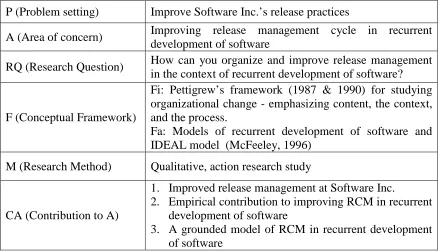
(Mathiassen et al., 2012) summarized in Table 1. The different elements of this design will be
Table 1: Research Design Summary (Mathiassen et al., 2012)
P (Problem setting) Improve Software Inc.’s release practices
A (Area of concern) Improving release management cycle in recurrent
development of software
RQ (Research Question) How can you organize and improve release management in the context of recurrent development of software?
F (Conceptual Framework)
Fi: Pettigrew’s framework (1987 & 1990) for studying organizational change - emphasizing content, the context, and the process.
Fa: Models of recurrent development of software and IDEAL model (McFeeley, 1996)
M (Research Method) Qualitative, action research study
CA (Contribution to A)
1. Improved release management at Software Inc.
2. Empirical contribution to improving RCM in recurrent development of software
LITERATURE REVIEW
This chapter provides a review of two major streams of scholarly literature. First, the field
of software release is reviewed, after which, the vast body of knowledge on SPI is examined. In
the conclusion of this chapter, the research opportunity is presented.
II.I Software Release Literature
The software release literature introduces a number of related practices. The literature
recognizes specific release related activities, like software release management, which covers
identifying, collecting, packaging, and distributing the components of a software item, such as
executable programs, documentation, release notes, and configuration information (Ballintijn,
2005; Scott & Nisse, 2001). Van Der Hoek, Hall, Heimbigner, & Wolf (1997) defines software
release management as: “The process through which software is made available to and obtained
by the user.” Similarly, the literature covers release planning as the activity of deciding how to
assign releasable product characteristics, such as features and requirements, to a planned
sequence of releases of an evolving software product (Carlshamre, 2002; Regnell & Kuchcinski,
2011; Ruhe & Saliu, 2005; Svahnberg et al., 2010). The literature also highlights a number of
approaches to release time estimation (Gaur & Oberoi, 2012). Related to release estimation, a
number of researchers have attempted to conceptualize software prediction mathematical models
to forecast the software release time (Qian, Yao & Khoshgoftaar, 2010). There are also studies
focused on the technical aspects of release build and configuration management (Mazlan, Sefat,
Selan & Lukose, 2013).
The specific release activities, like release management, release planning, release
estimation, release build and configuration management have been well studied. Furthermore,
there is an emerging literature that takes a broader, holistic view on software releases. For
example, Taborda establishes an end-to-end release framework which ensures initiatives are
planned and prioritized to streamline IT project portfolio execution and delivery in an enterprise
management context (Taborda, 2012). Similarly, Humble and Farley lay out a detailed, holistic
concept of release pipelines, in their study on improving release management (Humble & Farley,
2010). However, their study is only focused on the technical aspects of software release. While
both these studies are focused on software releases from a holistic perspective, their context is
different from recurrent development of software for the market. Therefore, the traditional
software release literature lacks a unified concept of release that presents how all the moving
parts fit together, including requirements management, development, testing, documentation,
user acceptance and delivery in recurrent software development.
One of the goals of this dissertation is to address this gap in the literature by developing a
holistic perspective of these different viewpoints about release, and assembling a multifaceted
understanding of a recurrent software release, from the point it is first identified and defined as
part of strategic planning, to its ultimate realization as a solution delivering additional benefits.
II.II Software Process Improvement Literature
The SPI literature covers a wide variety of approaches and practices aimed at improving
quality and reliability, employee and customer satisfaction, and return on investment in software
enhance their capability to deliver quality software (Grady, 1997; Humphrey, 1989; Mathiassen
et al., 2002). Although very successful cases have been reported (Diaz & Sligo, 1997; Haley,
1996; Humphrey et al., 1991; Larsen & Kautz, 1996), there is a critical debate about the
approach (Bach, 1995; Bollinger & McGowan, 1991; Fayad & Laitinen, 1997; Humphrey &
Curtis, 1991) and the feasibility and practicability of SPI initiatives (Bach 1995; Bollinger &
McGowan 1991; Brodman & Johnson 1995; Curtis 1994; Fayad & Laitinen 1997; Herbsleb et al.
1997; Humphrey et al. 1991; Ngwenyama & Nielsen 2003).
SPI projects usually rely on well-known models of software process maturity, such as the
Software Engineering Institute's Capability Maturity Model (CMM) (Paulk et al., 1993) and
Bootstrap (Kuvaja et al., 1994). Critics claim that the models offer an overly rigid and limited
view of software production and overlook the variety and complexities of software producing
organizations (Bollinger & McGowan, 1991; Kohoutek, 1996; Mathiassen & Sorensen, 1996;
Pries-Heje & Baskerville, 1999; Velden et al., 1996; Allison & Merali, 2007). Therefore, there is
a need to investigate alternative or complementary approaches in the SPI field.
An increasing volume of research proposes advice to achieve SPI success. McFeeley
(1996) discusses how to effectively organize learning cycles through the IDEAL model (i.e.
Initiate, Diagnose, Establish, Act, Learn) for SPI. Mashiko and Basili (1997) and Ravichandran
(2000) examine how SPI can benefit from software quality management ideas. Fichman and
Kemerer (1997) discuss organizational barriers towards adoption of software process
innovations. Abrahamsson (2000, 2001) discusses tactics to ensure and manage commitment
from different stakeholders. Nielsen and Nøerbjerg (2001) emphasize social and organizational
Borjesson and Mathiassen (2004) argue that it is important to balance practice pull and process
push, and to spend more resources on deployment.
While these contributions suggest how to achieve SPI success, there are few studies that
focus on the particular challenges and opportunities related to SPI in the context of the recurrent
development of packaged software (Allison & Merali, 2007; Carmel & Becker, 1995;Sawyer,
2000; Xu & Brinkkemper, 2007). As a consequence, there is little known about how to improve
release practices and how to leverage such processes in the wider context of SPI for the recurrent
development of packaged software. Furthermore, there is a need to investigate the emergent
nature of SPI, rather than consider it a deterministic activity. The emergent aspect of SPI would
consider the design and action of the change process as being intertwined and shaped by their
context in the recurrent development of software (Mathiassen, 1998; Truex, Baskerville & Klein,
1999).
In conclusion, the SPI literature has much to offer in terms of improving software quality,
meeting stakeholder expectations and boosting efficiency, but it has not been applied to release
processes in the context of recurrent software. Hence, there is a research opportunity to rethink
release management and its relation to SPI in that context. Against this backdrop, this
dissertation seeks to contribute to the literature of SPI and software release management for the
recurrent development of software. Moreover, our aim is to make the empirical insights gained
from our problem diagnosis, interventions, and learning from Software Inc., helpful to both
ANALYTICAL FRAMEWORK
We adopted Pettigrew’s (1987 & 1990) contextualist inquiry framework to investigate the
changes for improvement in the release cycle processes at Software Inc. Contextualist inquiry is
concerned with understanding how transformation efforts unfold in particular organizational
settings, focusing on the interactions between content, context, and process (see Figure 1).
Content refers to the areas being transformed; in this case we focused on how releases were
managed and on how process improvement could be supportive at Software Inc. Context refers
to the environment in which the organization operates, as well as the systems, processes, and
beliefs within the organization through which ideas for change have to proceed. Focusing here
on release cycle processes, we were particularly interested in how the actors and social support
elements of the context shape, and were shaped by, the process of improving release
management. Finally, process refers to the actions and interactions between various interested
parties as they attempt to transform practices. In our case, we focused on the actions and
interactions related to the improvement in processes through the IDEAL model (McFeeley,
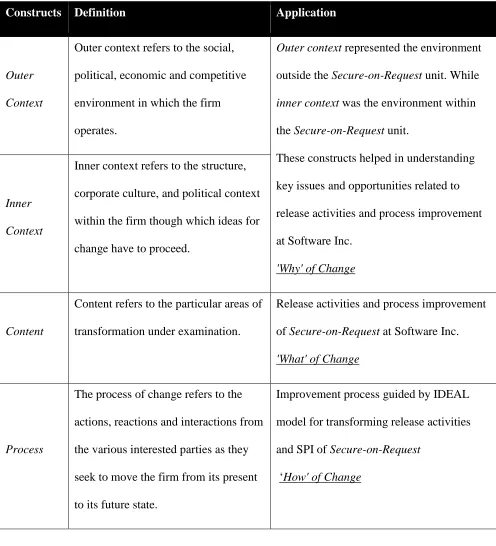
1996) within Software Inc. This dissertation used contextualist inquiry’s core constructs (Table
2) to analyze the problems at Software Inc.
Figure 1: Contextualist Inquiry Diagram (Pettigrew, 1987)
Next, we will provide a brief account of the contextualist research approach in terms of its
basic concepts, and the ensuing framework for guiding this research. This is necessary, not only
for the sake of completeness of this dissertation, but also because, in a methodologically oriented
work like this, it would be difficult to appreciate the value and validity of our results without
having a basic understanding of the analytical approach used to arrive at them. In essence, the
contextualist approach arises out of a conviction that, to be understood and studied effectively,
organizations must be seen as “embedded” in and interacting with their social, cultural, political
and historical context. The immediate effect of such a dynamic view of organizations is a
profound shift of the researcher’s attention and analysis away from mere “change” to a whole
Table 2: Key Analytical Constructs
Constructs Definition Application
Outer
Context
Outer context refers to the social,
political, economic and competitive
environment in which the firm
operates.
Outer context represented the environment
outside the Secure-on-Request unit. While
inner context was the environment within
the Secure-on-Request unit.
These constructs helped in understanding
key issues and opportunities related to
release activities and process improvement
atSoftware Inc.
'Why' of Change Inner
Context
Inner context refers to the structure,
corporate culture, and political context
within the firm though which ideas for
change have to proceed.
Content
Content refers to the particular areas of
transformation under examination.
Release activities and process improvement
of Secure-on-Request atSoftware Inc.
'What' of Change
Process
The process of change refers to the
actions, reactions and interactions from
the various interested parties as they
seek to move the firm from its present
to its future state.
Improvement process guided by IDEAL
model for transforming release activities
and SPI of Secure-on-Request
In addition, Pettigrew (1987 & 1990) explicitly draws our attention to the relations or
“interconnections” among the context, content and process concepts. Pettigrew’s following
comments are insightful: “The analytical challenge is to connect up the content, contexts and the
processes of change over time to explain the differential achievement of change objectives.
Perhaps the most critical connection is the way actors in the change process mobilize the
contexts around them and in so doing provide legitimacy for change. Changes in the outer
context can also be mobilized to fashion change …The contexts…are not inert or objective
entities. Just as managers and other actors perceive and construct their own versions of those
contexts, so do they subjectively select their own versions of the environment around them and
seek to reorder the … change agenda to meet perceived challenges and constraints.” (Pettigrew,
McKee & Ferlie, 1988). These comments are enlightening because they clearly emphasize the
need to study the drivers of change (context and process) and their interactions. They also remind
us that the interactions involved need to be studied over a period of time and should examine the
systems’ space-across the organization’s hierarchic levels- looking at subjective as well as
objective aspects.
In terms of concretely applying the contextualist approach, we identified and examined
multiple levels of the context involved, recognized the role of history, the present actors and the
processes in the Secure-on-Request unit. In developing the contextualist analytical framework for
our analysis, we also incorporated the various attributes of the recurrent development of
Secure-on-Request as the ‘content for change,’ and the phases of the IDEAL cycle (McFeeley, 1996) as
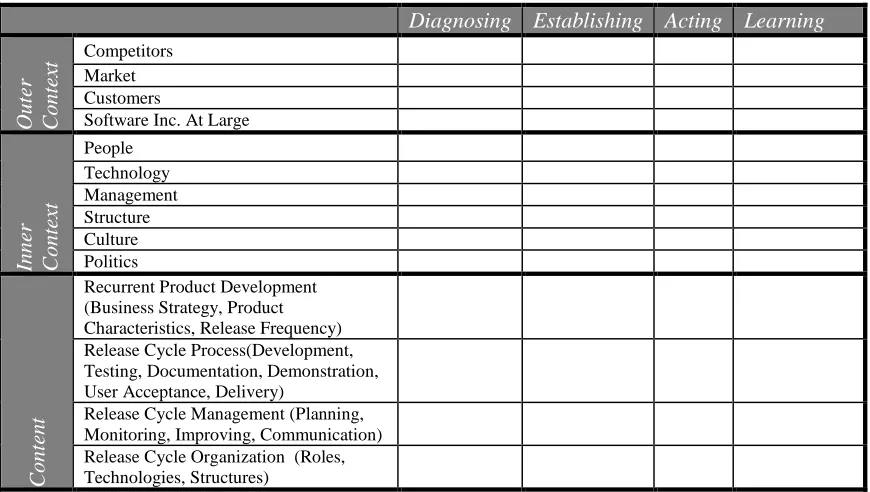
the ‘process of change.’ The resulting analytical framework (Table 3) helped us organize a
management and process improvement at Software Inc. As such, the analytical framework was
an ideal lens to study the transformation of release activities and the organizing of SPI to help
Software Inc., recurrently develop and deliver Secure-on-Request to its customers and the
market.
Consequently, the analytical framework, shown below, helped us form the concept of
RCM during our interventions at Software Inc. RCM will be elaborated upon and precisely
[image:25.612.90.525.343.589.2]defined later in the study.
Table 3: Analytical Framework
Diagnosing Establishing Acting Learning
O u ter C ont ex
t Competitors
Market Customers
Software Inc. At Large
Inne r C ont ex t People Technology Management Structure Culture Politics C ont en t
Recurrent Product Development (Business Strategy, Product Characteristics, Release Frequency) Release Cycle Process(Development, Testing, Documentation, Demonstration, User Acceptance, Delivery)
RESEARCH METHODOLOGY
Action research is a form of collaborative social research (Miles & Huberman, 1994). Our
research at Software Inc., was conducted as an action research study to improve recurrent release
management practices and software development processes for Secure-on-Request software. Our
general research approach was collaborative practice research (CPR), a type of action research in
which methodological pluralism and collaboration between researchers and practitioners is
emphasized (Mathiassen, 2002). Through CPR methodology, we worked towards understanding
the release management and software engineering practices at Software Inc., through
interpretation, and improving the release management area by making interventions (Mathiassen,
2002).
Baskerville and Wood-Harper (1998) note that action research characteristics are
orientated toward the research process rather than merely the outcome of the research. Action
research methods are highly pragmatic in nature (Baskerville & Wood-Harper, 1996). Kurt
Lewin (1952), who is often cited as the originator of action research, believed that knowledge is
originated from problem solving in real-life situations. We believe the real-life problem at
Software Inc., presented in this dissertation is exactly what Baskerville, Wood-Harper and Kurt
Lewin have referred to. Our action research introduced changes to Secure-on-Request’s complex
release management and SPI processes, and observed the effects of these changes at Software
Inc. The social interaction that took place throughout this action research process was important
as it helped to bring about organizational learning and change at Software Inc., to improve
release management and SPI practices. By improving the release management and related
software processes at Software Inc., a real-life problem-solving situation, we generated
knowledge in the form of empirical insights gained from our problem diagnosis, interventions,
and learning which will help both practitioners and academic researchers. Hence, the outcome is
an increased understanding of the social situation, practical problem solving and an expansion of
scientific knowledge. The essence of this action research, laid in its objectives of advancing both
the software release management and SPI theories in research, as well as facilitating the resulting
organizational change at Software Inc. (Lee, 2003; Mumford, 2001).
Clark observes that: “for convenience it is useful to think of the practitioner as part of a set
of actors who are oriented to solution of practical problems, who are essentially organizational
scientists rather than academic scientists” (Clark, 1972, p. 65 in (Baskerville & Wood-Harper,
1996). As action researchers, we agreed to a set of rules to ensure a collaborative framework for
action with those already working at Software Inc. Shared Dissertation Platform Document
IV.I Problem-Solving Cycle
In our problem solving cycle, we collaborated with Software Inc., to support release
management innovation and proceed in a stepwise, iterative fashion, based on the approach
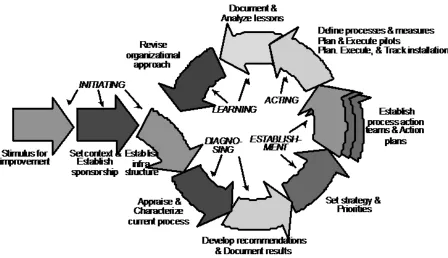
described in the IDEAL model (Figure 2). This model, developed in 1996 by the Carnegie
Mellon University Software Engineering Institute, presents a five-phase (Initiating, Diagnosing,
Establishing, Acting, and Learning) cyclic approach to SPI (McFeeley, 1996). The IDEAL
model can be seen as a specialized version of Susman and Evered’s (1978) classical action
[image:28.612.82.530.380.638.2]research.
Table 4: Problem Solving Timeline
Cycle Phase Phase Timeline Phase Overview
Initiation January 5, 2013 –
April 9, 2013
Obtained commitment, set goals and established an
improvement infrastructure
Diagnostic April 9, 2013 –
June 28, 2013
Assessed current practices; developed and
prioritized recommendations for improvements
Establishment June 28, 2013 – July 2, 2013
Created specific, focused improvement initiatives.
Teams were established to deal with each of the
recommended improvement areas from the
diagnostic phases
Acting July 2, 2013 –
October 26, 2013
Developed and implemented solutions for each
improvement area.
Learning October 26, 2013 -
February 28, 2014
Evaluated results of the initiatives. Improvements
data were collected
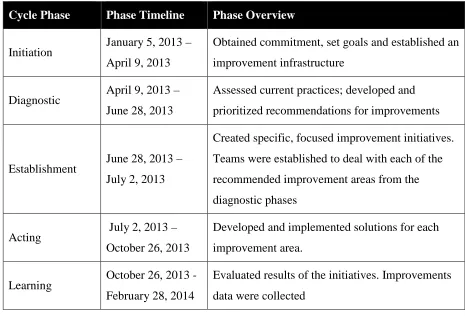
As the research project was organized according to the IDEAL model (McFeeley, 1996),
this structure is also used in presenting the problem solving cycle (see Table 4). After initiating
the project, we diagnosed existing strengths, weaknesses, and opportunities with respect to
release practices. These insights fed an intervention cycle, focused on establishing improvement
teams to recommend suggested changes, and then acting upon those suggested changes. The
collaboration closed with a learning phase which asked identified stakeholders to reflect upon the
initiative’s impact and the effectiveness of the improvement organization. The Shared
IDEAL model and the problem-solving cycle of this research. Next, we will focus on each phase
in the IDEAL cycle:
1) The initiation phase is the initial step in the IDEAL model (McFeeley, 1996). In this phase,
the Software Inc., senior management understood the need for the SPI, and along with
Georgia State University (GSU) committed to the SPI program. From the release cycle
perspective, we defined the context for SPI during this phase. Getting the Software Inc.,
management commitment and support was vital to bring about release management
innovation in a way that would improve software engineering and management processes for
the Secure-on-Request team. With Software Inc.’s solid management commitment, the study
started on a strong footing. More details on the initiation phase are included in Shared
Dissertation Platform Document (Appendix A).
2) The purpose of the diagnostic phase was to perform the baselining activity to get a picture of
the current strengths and weaknesses in the release management area of Secure-on-Request
within Software Inc. We believe release practices, viewed in a broader perspective, are the
culmination of all the software engineering and management processes that are involved in a
cycle of developing a new version of software. Release management intrinsically depends on
and relates to these processes. Therefore, for our study at Software Inc., it made release
management an obvious choice of area to start driving software engineering and management
process improvement for the recurrent development of Secure-on-Request. During this phase,
we investigated release management from a dual perspective. We focused on the release
management activity itself, and used release practices as a lens to make sense of the
We reviewed Secure-on-Request's organization structure and responsibilities, and
evaluated baseline information needed against Software Inc.’s business drivers for SPI. We
evaluated baseline information from the viewpoint of key stakeholders. We gathered
information through perception-based as well as practice-based methods (Napier,
Mathiassen, & Johnson, 2009). In the perception-based part of the assessment, we identified
individuals from Software Inc., who are involved in the release process of
Secure-on-Request, as well as internal and external customers. Participants’ viewpoints were analyzed
with a focus on strengths and weaknesses of the release management practices of
Secure-on-Request. For our practice-based assessment, we selected release management principles
identified in the release-management literature (Elephant, 2006; Team, 2006). We then
benchmarked these principles and current release management practices at Software Inc.
Based on the data collected (see Table 13) and observations, the research team assigned
scores to Software Inc.’s release management practices, based on how they compared to the
identified principles. The release management practice assessment and assigned scores are
Table 5: Release Management Practice-Based Assessment (Pre-intervention)
Principle Score
1 Define regular, targeted release dates High
2 All deployments performed by a team independent of development team
High
3 Always have a tested back-out plan Medium
4 Use a mature Software Configuration Management (SCM) process and tool to support the development of multiple releases in parallel
Medium
5 Test the deployment process at least once before deploying to live Medium 6 Link all release documentation and scripts to your deployment unit Low 7 Construct deployment units as early as possible Low 8 Use an independent team to build all releases Low
9 Automate as much as possible – use integrated tools for configuration, change management and deployment management
Weak
10 Have a documented Release Policy Weak
We presented the diagnosis and a portfolio of proposed improvements to the steering
committee in June 2013 (Appendix G). As an outcome of the diagnostic phase, eight areas
were identified for improvement, and these were: specifying and stabilizing requirements,
prioritizing requirements across channels, managing technical debt, testing releases,
managing release cycles, maintaining complete service information, communicating releases
across customers and giving customers a voice. All these areas were interrelated and affect
the release management of Secure-on-Request.
This dissertation also utilized the Service Blueprinting technique (Bitner et al., 2008;
Barqawi, 2013). Service blueprinting revealed the complex context of Secure-on-Request in
an easy way. Using service blueprinting for Secure-on-Request, we displayed possible areas
for improvement and assigned the recommended project deliverables (during the
Figure 3: Secure-on-Request Service Blueprint at Software Inc. (Bitner et al., 2008; Barqawi, 2014)
The information gathered in this phase was then used to initiate development of the
strategic action plan that provided guidance and direction to the SPI program. More details
for the diagnostic phase are included in Shared Dissertation Platform Document(Appendix
A).
3) During the establishment phase, the steering committee developed a set of SPI strategic
action plans that provided guidance and direction to the SPI program. These SPI strategic
action plans were critical to provide clear guidance for the various process improvement
actions that would be taken (McFeeley, 1996). The gaps identified during the diagnostic
phase were prioritized, and strategies were developed for improvements, as explained in
greater detail in Shared Dissertation Platform Document (Appendix A).
The SPI strategic action plans were approved by the steering committee in form of
three projects: improvement of customer relations, improvement of requirements and quality,
projects were integrated into the baseline findings and the recommendations during the
diagnosis phase. The project objectives and goals were well-defined. These projects provided
clear engineering and business reasons for conducting the SPI program and were clearly and
measurably linked to the organization’s vision and business plan (McFeeley, 1996). Project
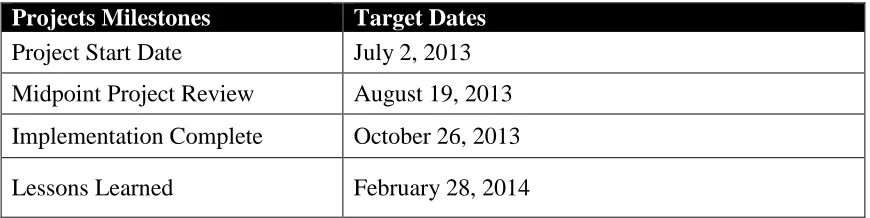
[image:34.612.94.529.264.373.2]schedules and milestones were determined, as shown in Table 6.
Table 6: Improvement Projects Schedule
Projects Milestones Target Dates
Project Start Date July 2, 2013
Midpoint Project Review August 19, 2013
Implementation Complete October 26, 2013
Lessons Learned February 28, 2014
We know from SPI literature that organizations face problems with the implementation
and deployment of SPI best practices. The majority of these problems belong to “people,
group, team and community culture and behavior” (Dorrenbos & Combelles, 2004). The
three project teams were made of individuals from cross-functional teams with diverse skills,
both in technology and business. We used the broader perspective of the release
management, presented in this action research, to address the problems Dorrenbos and
Combelles have referred. The lens of release management provided the project teams with a
shared understanding of evaluating and driving improvement of the broader engineering and
management processes involved in the recurrent development of Secure-on-Request
collaboration aspects, and, therefore, the results from the projects were communicated easily
at all the levels of the organization (Stelzer & Melis, 1999).
Support from the leadership team and operational preparedness were part of the three
projects’ deliverables committed by Software Inc. (Dyba, 2005; Niazi et al., 2006).
Improvement of Customer Relationship Project
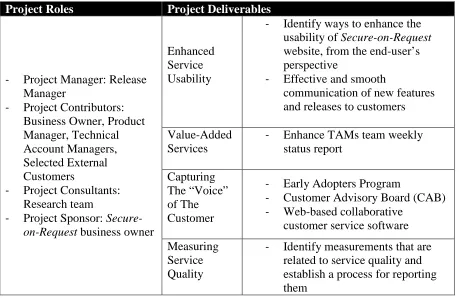
The deliverables and assigned roles of the Improvement of Customer Relationship
[image:35.612.91.550.339.637.2]project are shown in Table 7.
Table 7: Improvement of Secure-on-Request Customer Relationship Project
The steering committee understood that Secure-on-Request could be prevented from
advancing until a common understanding of its functionality was established between the
Project Roles Project Deliverables
- Project Manager: Release Manager
- Project Contributors: Business Owner, Product Manager, Technical Account Managers, Selected External Customers
- Project Consultants: Research team
- Project Sponsor: Secure-on-Request business owner
Enhanced Service Usability
- Identify ways to enhance the usability of Secure-on-Request
website, from the end-user’s perspective
- Effective and smooth
communication of new features and releases to customers
Value-Added Services
- Enhance TAMs team weekly
status report
Capturing The “Voice” of The Customer
- Early Adopters Program
- Customer Advisory Board (CAB)
- Web-based collaborative customer service software
Measuring Service Quality
engineering team and the customers. Therefore, the deliverables of this project were clearly
identified for the engineering team to benefit from it. Secure-on-Request’s engineers must
have a positive, collaborative relationship with their customers to improve the software
engineering processes (Börjesson, Mathiassen, 2004; Mathiassen, Nielsen, & Pries-Heje,
2002). This view supports the broader perspective of release cycle processes presented in this
research. The Secure-on-Request’s engineering team had to develop an understanding from
their customers of how the application they were building was expected to function, when
released. This need for engineers to better understand their customer expectations would
improve engineering practices. This could be accomplished when release processes were
considered as a driver of SPI.
As part of the project of improving the customer relationship, the research team
working with Software Inc.’s key stakeholders recommended enhancing the service usability
for Secure-on-Request customers. The team suggested that focusing on the usability features
of the Secure-on-Request portal would enhance the service quality from the end-user
perspective. Also, improving the release documentation process would result in the smooth
communication of new features and releases to customers, and would consequently improve
release management.
The research team recommended improving the TAMs team’s weekly status report,
which highlighted key information, such as customer concerns and Software Inc.’s
responsiveness to the value-added services. The report was a tool used by management to
deal with customers’ issues, and it could also provide the engineering team with very
Capturing the “voice” of the customer was crucial to ensure the Secure-on-Request
product team understood its customers’ expectations. It was also a key for improving the
customer relationship with the Secure-on-Request engineering team. Capturing the “voice” of
the customer enabled the Secure-on-Request engineering team to better understand the
customers’ perspective. The Early Adopters Program was an initiative in which Software
Inc., received feedback from customers about new product features prior to the formal
release. In addition, the web-based customer service collaborative tool was a valuable source
for Secure-on-Request’s engineering team to understand the needs of their customers.
For measuring service quality, the research team proposed that Software Inc., measure
the Secure-on-Request service delivery processes against SaaS-Qual service quality factors
(Benlian, et al., 2011; Barqawi, 2013). The conceptual definitions of the Six SaaS-Qual
factors are shown in Table 8. These measurements will benefit the engineering team by
providing more information about the Secure-on-Request business, which in turn will help to
Table 8: Conceptual Definitions of the Six SaaS-Qual Factors (Benlian, et al., 2011;
Barqawi, 2014)
Factor Conceptual Definition
Rapport
Includes all aspects of an SaaS provider’s ability to provide knowledgeable,
caring, and courteous support (e.g., joint problem solving or aligned working
styles) as well as individualized attention (e.g., support tailored to individual
needs)
Responsiveness
Consists of all aspects of an SaaS provider’s ability to ensure that the availability
and performance of the SaaS-delivered application (e.g., through professional
disaster-recovery planning or load balancing) as well as the responsiveness of
support staff (e.g., 24-7 hotline support availability) is guaranteed
Reliability
Comprises all features of an SaaS vendor’s ability to perform the promised
services in a timely, dependable, and accurate fashion (e.g., providing services at
the promised time, provision of error-free services)
Flexibility
Covers the degrees of freedom customers have to change contractual (e.g.,
cancellation period, payment model) or functional/technical (e.g., scalability,
interoperability, or modularity of the application) aspects in the relationship with
an SaaS vendor
Features
Refers to the degree the key functionalities (e.g., data extraction, reporting, or
configuration features) and design features (e.g., user interface) of an SaaS
application meet the business requirements of a customer
Security
Includes all aspects to ensure that regular (preventive) measures (e.g., regular
security audits, usage of encryption, or antivirus technology) are taken to avoid
Improve Requirements and Quality Project
The deliverables and assigned roles of the Improve Requirements and Quality project
[image:39.612.104.513.226.548.2]are shown in Table 9.
Table 9: Improvement of Secure-on-Request Requirements And Quality
Complex software like Secure-on-Request is more prone to defects (Kemerer,
1995). The complexity of Secure-on-Request influenced development defects (Banker,
Slaughter, 2000), and also production defects after the release (Banker, Datar,
Kemerer, Zweig, 1993; Banker, Davis, Slaughter, 1998). Development defects are
Project Roles Project Deliverables
- Project Manager: Release Manager - Project Contributors: Development Manager, Product Managers, Quality Assurance (QA) Managers - Project Consultants: Research team
- Project Sponsor: Secure-on-Request business owner
Requirement Management Process
- Visualization of requirements (wireframes) using software tools.
- Validation of requirements through meetings and sessions and unifying statements of all stakeholders.
Quality Improvement Process
- QA to put together a regression test plan
- Process to analyze escaped defects each release
- Scheduled weekly meetings with Dev to demonstrate new completed features to QA
- Single point of QA contact for the development
- Automation – Utilize
performance testing to address performance business goals
those discovered prior to release, while production defects are bugs found after the
release (Harter, Kemerer, Slaughter, 2012).
On one hand, scholars like Juran (1959 & 1992), Deming (1992), and Crosby
(1979) have long advocated process improvement as a means to improve quality in
product development. Numerous studies have established a positive relationship
between SPI and software quality (Herbsleb, Zubrow, Goldenson, Hayes, Paulk, 1997;
Krishnan, Kellner, 1999; Li, Rajagopalan, 1998; Ramasubbu, Mithas, Krishnan,
Kemerer, 2008). On the other hand, according to Lahtela & Jantti (2011) a well-defined
release-management process can be pivotal to improving the quality of release
planning, building, testing, and deployment activities. This will likely reduce the
number of problems occurring after delivering the release to customers.
We find support to the argument presented in this research from the above
literature. Quality is strongly tied to SPI and software release practices. Hence, in this
project, using the broader lens of release management as a driver of SPI, we
understood, evaluated and helped to drive improvement of the quality processes
involved in the recurrent development of Secure-on-Request at Software Inc.
To improve the quality of Secure-on-Request, the research team recommended
putting processes in place for:
• Regression testing to ensure that a change for the new release did not introduce
new defects.
• Identifying and addressing common causes of both development and production defects.
• Establishing a clear line of communication between development and QA
leaderships.
• Taking advantage of QA automation tools.
• Running end-to-end scenario-based testing, that depicted actual procedures used by most Secure-on-Request customers.
An accurate understanding of the customers’ requirements was crucial for an
effective release. Poorly understood requirements create uncertainty (Mathiassen et al.
2008). For better requirements management, the team recommended using specialized
software tools for developing visual templates of requirements to help the
Secure-on-Request development team to implement customer requirements. The team proposed
that meetings be held to validate and align requirements coming from different
stakeholders.
Improve Release Cycle Project
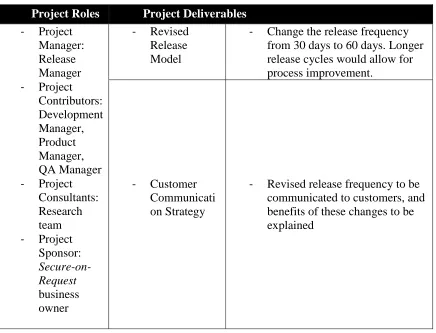
The deliverables and assigned roles of the Improve Release Cycle project are
Table 10: Improvement of Secure-on-Request Release Cycle Project
Given that Secure-on-Request changes could occur on a continuing basis, one concern
for release management at Software Inc., was determining when to issue a new release. The
severity of the problems addressed by the release, and measurements of the fault densities of
prior releases, affected this decision (Sommerville, 1995). Optimizing the release cycle of
Secure-on-Request would improve the release management practices. The team
recommended changing the release cycle from a 30-day to 60-day release model. This
adjustment to the release model would allow changes to other areas in the release-cycle and
contribute to maturing the software processes. For example, sufficient time would be allotted
Project Roles Project Deliverables - Project Manager: Release Manager - Project Contributors: Development Manager, Product Manager, QA Manager - Project Consultants: Research team - Project Sponsor: Secure-on-Request business owner - Revised Release Model
- Change the release frequency from 30 days to 60 days. Longer release cycles would allow for process improvement.
- Customer
Communicati on Strategy
for implementing the requirement and quality process improvements suggested in the
previous project. The extra duration of the new release cycle would also contribute to the
recommended documentation process changes (as stated earlier) that would subsequently
improve customer communication and eventually make the release more successful. To
improve customer communication during a release cycle, the research team also proposed a
plan for communication to customers, involving product management and Technical Account
Manager (TAM) teams.
The required stakeholders of the three projects agreed on the recommended
improvement approach and execution plan (Appendix A, Table 4.3-2).
As stated above, improving the release model would positively impact all of the
software engineering and management processes in the context of the recurrent development
of Secure-on-Request. This project illustrated the core of the argument presented in this
action research, that from a broad perspective, software release practices can be seen as the
culmination of all the software engineering and management processes involved in one cycle
of developing a new version of Secure-on-Request. In this sense, the release was a unique
and important area that depended on, and was intrinsically related to, the other engineering
and management processes, and as such it would drive their improvement.
4) During the acting phase, the three project teams started developing improvements and
solutions to the process issues approved by Software Inc. The key problems discovered
during the diagnosing phase were prioritized and selected during the establishing phase.
acting phase activities at Software Inc. The acting phase ended on October 26, 2013. The
following is an overview of our activities during the acting phase for each project:
Improvement of Customer Relationship
o Enhanced Service Usability:
To identify ways to enhance the usability of the Secure-on-Request portal,
from the end user’s perspective, the research team worked with the TAM
team to provide a list of requirements that could enhance portal usability.
The list was prioritized and communicated to the product management and
engineering teams. As a result, most of the items on the list were placed on
the product management roadmap.
Product managers took ownership of coordinating the documentation
process to achieve effective and smooth release communication to
customers. The documentation team and product managers started
working early in the release cycle to review and identify documentation
impact activities.
o Value-Added Services:
In order to enhance the effectiveness of the TAM team weekly status
report, the research team discussed the summary report with management
and TAMs. A summary section was added to the report, which included
main items for quick review.
Regarding the early adopters program, introductory meetings between
PMs and customers that were identified as early adopters were completed.
Customers reported positive feedback, and more meetings for discussing
requirements and evaluating features were scheduled.
The TAM management and the research team worked on the CAB
initiative. Information and sample agendas were discussed, and a list of
customers was identified. A CAB meeting was held in September 2013 at
Software Inc., conference for customers.
Several demonstrations of the web-based collaborative customer service
tool were carried out by potential vendors. The solutions included live
chat, ticketing, and knowledge-based management systems. A solution
was chosen, and the development team implemented the integration of the
tool within Secure-on-Request website.
o Measuring Service Quality:
To identify measurements that were related to service quality and to
establish a process for reporting them, the research team discussed service
quality measures with TAM and product management teams. A list of
measurements was recommended for measuring service quality, renewal
rates, expansion (new customers) and open and closed tickets.
Improvement of Requirements and Quality
To use visualization aids (screenshots, mockups, etc.) for requirements, a
software tool was used by product managers to develop visualizations of
requirements for the development, quality assurance and documentation
teams.
Requirements validation meetings started with all stakeholders, including
product managers, TAMs, quality assurance, and development teams
during the requirement gathering process. User acceptance criteria for
requirements implementation was also put in place.
o Quality Improvement Process
Various initiatives were put in place to improve QA related processes. The
QA team put together a regression test plan to ensure that a change for the
new release did not introduce new faults. A process was put together to
analyze escaped defects during a release. Weekly development
demonstration sessions of the completed features were initiated for QA. A
clear line of communication was established between development and
QA leaderships. The QA team started putting together a plan of action to
utilize automation tools. The QA team then started running end-to-end
scenario-based testing, which depicted the actual procedures used by most
Secure-on-Request customers.
Improvement of Release Cycle
The release frequency was changed from 30 days to 60 days. See Figure 4
for the new release model. Longer release cycles allowed for processes
improvement, and consequently this helped to improve the
Secure-on-Request quality. A release model was developed by the release manager
and was agreed upon by all stakeholders. The first Secure-on-Request
release following this model was made on October 19, 2013. Table 11
shows the set of meetings for the new release model.
o Customer Communication Strategy
The new release frequency was communicated with customers, and the
benefits of these changes were explained by product managers and TAMs.
5) In the learning phase, we reviewed the implemented solutions and evaluated the outcome of
the three improvement projects. Shared Dissertation Platform Document(Appendix A) has
details and key dates of the learning phase activities at Software Inc. Our learning phase
assessments included perception-based as well as practice-based methods (Napier et al.,
2009) with a focus on evaluating the impact on the service-delivery process of
Secure-on-Request. Our goal was to identify changes in each of the three project improvement areas, the
effect on the processes, as well as the challenges that occurred during implementing the
changes, and to make suggestions for improvement. For the practice-based part of the
assessment, we used the norms and practices from release management literature that were
identified in the diagnostic phase (Elephant, 2006; Team, 2006) and compared them to
software release management practices at Software Inc., after the implementation of the
observations, and the assessment results were compared against those from the diagnosing
phase. The resulting assessments are summarized in Table 12. An overall assessment of the
improvement projects will be discussed in Chapter VI.
Table 11: Reoccurring Meetings for the New Secure-on-Request Release Model
Meeting Purpose Schedule
Stakeholders Meeting Gather and discuss input from key stakeholders for the requirements of the next release
Thursday of week #7 of previous release
Sprint Planning Sprint team to negotiate the scope for the release
with the product manager Monday of the Week #1
Product Manager and Docs Review
A requirements walkthrough by the product manager, for the documentation lead, engaging the documentation lead much earlier in the release cycle
Tuesday of week #1
Weekly Development Team Demonstration
Weekly demonstration by the development team to product managers, quality assurance and the
documentation teams for the completed new features during previous week. Week #2 thru Week #5.
Wednesdays of week #2 thru week #5
Sprint Demonstration
Development team to show the stakeholders the work they have accomplished for the entire release cycle
Monday of week #6
TAMs Demonstration Product manager to show TAMs the new set of
features included in the upcoming release Tuesday of week #6
Sprint Retrospective
A session for stakeholders to learn what worked and what did not work during the previous release cycle and subsequently make the necessary adjustments for the next release cycle based on the learnings
[image:49.612.67.549.126.378.2]First Thursday after the release
Table 12: Release Management Practice-Based Assessment (Post-intervention)
Principle Score
1 Define regular, targeted release dates High
2 All deployments performed by a team independent of development team High
3 Always have a tested back-out plan High
4 Use a mature Software Configuration Management (SCM) process and tool to support the development of multiple releases in parallel
Medium
5 Test the deployment process at least once before deploying to live High 6 Link all release documentation and scripts to your deployment unit High
7 Construct deployment units as early as possible High
8 Use an independent team to build all releases High
9 Automate as much as possible – use integrated tools for configuration, change management and deployment management
Weak
IV.II Research Cycle
In parallel with the problem-solving cycle, the research unit at Software Inc., concentrated
on adding new knowledge to recurrent development of software, SPI and software release
streams of literature. This cycle was guided by the style composition for action research
developed by Mathiassen, et al. (2012) (Table 1). We reviewed recurrent development of
software, SPI and software release streams of literature, and this dissertation drew upon
Pettigrew’s contextualist inquiry theory(1987 & 1990). The research process was a collaborative
and iterative process, focused on problem diagnosis, change, and reflection (Avison et al., 2001).
Details on how our study satisfied the three methodological characteristics (Baskerville &
Wood-Harper, 1996) and how it deals with the three dilemmas (Rapoport, 1970) are covered in the
Action Research Design section in Shared Dissertation Platform Document(Appendix A). This
document also covers in detail how Canonical Action Research (CAR) principles of action
research were followed during our action study at Software Inc., to ensure rigor in our study.
(Davison et al., 2004).
IV.III Data Collection
We collected rich data from multiple primary and secondary sources (Myers, 2008), all
through our collaborative study. Using the guidelines from Yin, (2008) and Miles and Huberman
(1994), the principle data sources included semi-structured interviews, and problem solving
cycle documentation. We identified key individuals from Software Inc., to be interviewed for our
study. We conducted approximately one-hour face-to-face interviews, as well as phone
interviews were recorded. During the course of our data collection, we used triangulation (Miles
& Huberman, 1994) to counterbalance any insider bias (Coghian, 2001). Table 13 shows the
[image:51.612.67.546.208.532.2]primary and secondary data sources we used in our research.
Table 13: Data Sources
Primary Data Sources Secondary Data Sources
Meetings:
- Release Management Meetings (Weekly)
- Bi-Weekly Scrums
- Release Planning and Demos
- Daily Customer Escalation Calls
Release management documentation tools:
- Rally Dev - Requirements tool
- Bugzilla - Defect Management tool
- Zoho – Customer Relationship Management tool
Semi-structured interviews:
- Professional Services
- Sales
- Quality Assurance
- Product Management
- Operational Services
- Development
- Business Unit Owner
- Technical Account Management
- Project Management Office
- External Customer
IV.IV Data Analysis
To pursue the contextualist approach, we needed to apply its characteristically content and
process-oriented mode of analysis to the collected data, to see what major issues and problems
emerged vis-à-vis the release cycle processes. Here, we felt a clear need to further operationalize
data to identify specific issues or challenges of possible empirical interest and significance. We
developed a comprehensive coding scheme for this purpose (Appendix E). The overall rationale,
and the general mechanics, of this analysis technique are explained below.
First, Pettigrew’s notion of ‘content,’ as “the what” of change (Table 2 & 3), sensitized us
to look for specific entities that are subject to possible change, as well as the particular nature of
that change. As the principal arena of observable changes of interest, we focused our attention
particularly on the release cycle processes (development; testing; documentation; demonstration;
user acceptance and delivery), release cycle organization (roles, technology and structure) and
release cycle management (planning, monitoring, improving and communicating) activities
within the inner context of the Secure-on-Request unit. Given our interest in more of a planned
future of the Secure-on-Request unit, we looked for both the “reactive change” in response to
environmental (outer context)pressures, and the planned “design change” that may be
intrinsically desirable from Software Inc., and its customers perspective on the
Secure-on-Request unit.
Second, the notion of “process,” as “the How” of change (Table 2 & 3), prompted us to
examine significant “actions, reactions and interactions” of any “actors” in terms of how they
caused or affected any changes in the Secure-on-Request unit. In either case, starting either from
the content end or from the process end, what we were looking for was a “significantly coupled
chain” of actors, their actions, and the changes that they caused or influenced.
We then scanned through the data to see if interesting themes emerged. We focused on
the changes in the Secure-on-Request unit that were expected to be either important or