Georgia State University Georgia State University
ScholarWorks @ Georgia State University
ScholarWorks @ Georgia State University
History Dissertations Department of History
Summer 6-20-2011
The African-American Emigration Movement in Georgia during
The African-American Emigration Movement in Georgia during
Reconstruction
Reconstruction
Falechiondro Karcheik Sims-Alvarado
Georgia State University
Follow this and additional works at: https://scholarworks.gsu.edu/history_diss
Part of the History Commons
Recommended Citation Recommended Citation
Sims-Alvarado, Falechiondro Karcheik, "The African-American Emigration Movement in Georgia during Reconstruction." Dissertation, Georgia State University, 2011.
https://scholarworks.gsu.edu/history_diss/29
THE AFRICAN-AMERICAN EMIGRATION MOVEMENT IN GEORGIA DURING
RECONSTRUCTION
by
FALECHIONDRO KARCHEIK SIMS-ALVARADO
Under the Direction of Hugh Hudson
ABSTRACT
This dissertation is a narrative history about nearly 800 newly freed black Georgians who sought
v
1866 and 1868. This work fulfills three overarching goals. First, I demonstrate that during the
wake of Reconstruction, newly freed persons’ interest in returning to Africa did not die with the
Civil War. Second, I identify and analyze the motivations of blacks seeking autonomy in Africa.
Third, I tell the stories and challenges of those black Georgians who chose emigration as the
means to civil and political freedom in the face of white opposition. In understanding the motives
of black Georgians who emigrated to Liberia, I analyze correspondence from black and white
Georgians and the white leaders of the American Colonization Society and letters from Liberia
settlers to black friends and families in the Unites States. These letters can be found within the
American Colonization Society Papers correspondence files and some letters reprinted in the
ACS’s monthly periodical, the African Repository.
To date, no single work has been published on the historical significance of black
Georgians who emigrated to Liberia during Reconstruction. What my research uncovers is that
that 31 percent of the 3,184 passengers transported to West Africa by the American Colonization
Society from 1865 to 1877 were Georgians, thereby making Georgia, the leading states to
produce the highest numbers of blacks to resettle in Liberia and the logical focal point for the
African-American emigration movement during Reconstruction.
INDEX WORDS: American Colonization Society, African Colonization Movement,
African-American Emigration Movement, Back-to-Africa Movement, Black migration, Columbus,
vi
THE AFRICAN-AMERICAN EMIGRATION MOVEMENT IN GEORGIA DURING
RECONSTRUCTION
by
FALECHIONDRO KARCHEIK SIMS-ALVARADO
A Dissertation Submitted in Partial Fulfillment of the Requirement for the Degree of
Doctor of Philosophy
in the College of the Arts and Sciences
Georgia State University
vii Copyright by
Falechiondro Karcheik Sims-Alvarado
viii
THE AFRICAN-AMERICAN EMIGRATION MOVEMENT IN GEORGIA DURING
RECONSTRUCTION
by
FALECHIONDRO KARCHEIK SIMS-ALVARADO
Committee Chair: Hugh Hudson
Committee: Mohammed H. Ali
Mary Rolinson
Electronic Version Approved:
Office of Graduate Studies:
College of Arts and Sciences:
Georgia State University
ix DEDICATION
x
ACKNOWLEDGEMENTS
This dissertation would not have been possible without the dedication of my committee members: Drs. Hugh Hudson, Mohammed H. Ali, and Mary Rolinson. Together, they worked diligently to ensure that I produced a quality dissertation and gave voice to the freed men and women of Georgia who courageously sailed to Liberia in search of freedom. As well, I owe my deepest gratitude to three additional scholars who read and edited drafts of my dissertation, offered suggestions, and mentored me throughout the writing process: Drs. Ian Fletcher, Akinyele Umoja, and Jacqueline Rouse. It would have been next to impossible to write this dissertation without your guidance. Ms. Paula Sorrell, I cannot thank you enough for all you have done for me. You are absolutely the best.
I am thankful to Dr. Wesley Chenault, archivist at Auburn Avenue Research Library in Atlanta, Georgia, whose assistance helped facilitate the telling of this story. It is always a pleasure working with you.
Dissertation funding was made possible through Georgia State University and the Southern Regional Education Board. Dr. Andy Abraham, I am forever grateful to you. I
appreciate your commitment to each SREB recipient. Drs. Henry L. Gates, Waldo E. Martin and Patricia Sullivan, my experience as a seminarian of the W.E.B. Du Bois NEH Summer Institute at Harvard University was incomparable.
I am heartily thankful to those individuals who inspired me and played a role in shaping my academic development: Drs. Janice Sumler-Edmond, Vicki Crawford, Lita Hooper, Carole Merritt, Josephine Bradley, Jabari Simama, and Claude A. Clegg III.
I am especially grateful to my friends who assisted in piecing together my dissertation after my computer and photocopies of over 300 letters written mostly by former Georgia slaves were stolen in December 2009. Thank you to Christi Jackson and Sonya M. Gomez for working alongside me in logging the names of emigrants and transcribing letters.
xi
furniture to play, creating science projects, and painting and drawing dinosaurs and dragons every day.
To all my friends and family, I love you all. I thank you for all the encouragement you have shown throughout the past two decades. It has been a long and difficult journey. To my mother, Mildred Lee English-Sims, I live and work every day to be the best representation of a daughter for you. Finally, I thank my grandparents, Myrtice Richburg-English and William L. English, who died prior to my completing the doctoral program. You were my examples of torchbearers. Grandmother Myrtice, thank you for teaching me the importance of
xii
TABLE OF CONTENTS
ACKNOWLEMENTS v
LIST OF TABLES viii
LIST OF TERMS ix
CHAPTER ONE: INTRODUCTION 1
CHAPTER TWO: A BRIEF HISTORY OF THE AFRICAN-AMERICAN
EMIGRATION MOVEMENT, 1773-1865 24
CHAPTER THREE: THE AFRICAN-AMERICAN EMIGRATION MOVEMENT
IN MACON AND SPARTA, GEORGIA, 1865-1866 65
CHAPTER FOUR: THE AFRICAN-AMERICAN EMIGRATION MOVEMENT
IN MACON AND COLUMBUS, GEORGIA, 1866-1867 108
CHAPTER FIVE: AT THE CROSSROADS OF AFRICAN-AMERICAN
EMIGRATION IN GEORGIA, 1867-1868 132
EPILOGUE 163
APPENDIX 170
xiii LIST OF TABLES
TABLE 1.1: PERCENTAGE OF ACS-SPONSORED GEORGIA
EMIGRANTS TO OVERALL NUMBER OF EMIGRANTS
WHO RESETTLED IN LIBERIA, 1865-1877 21
TABLE 1.2: NUMBER OF ACS-SPONSORED EMIGRANTS TO
LIBERIA, 1817-1885 22
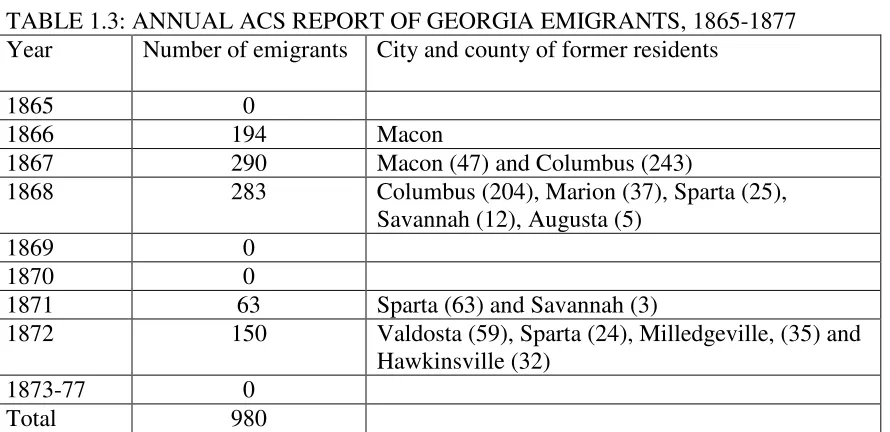
TABLE 1.3: ANNUAL ACS REPORT OF GEORGIA EMIGRANTS, 1865-1877 23
TABLE 2.1: FREE AND ENSLAVED BLACK POPULATION IN
THE UNITED STATES, 1790 63
TABLE 2.2: NUMBER OF GEORGIA EMIGRANTS WHO SAILED
TO LIBERIA DURING THE YEARS, 1827-1860 64
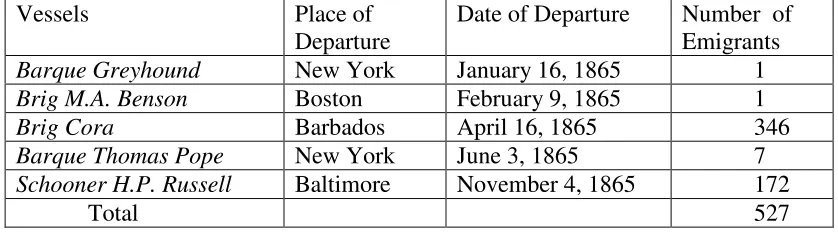
TABLE 3.1: VESSELS TO LIBERIA, 1865 105
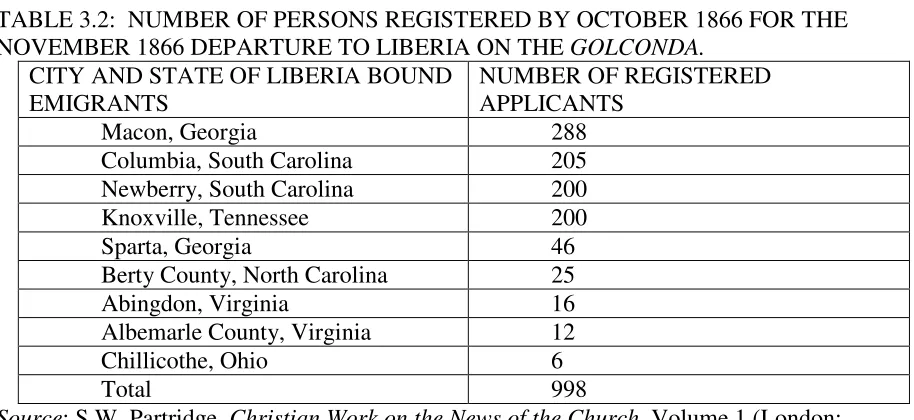
TABLE 3.2: NUMBER OF PERSONS REGISTERED BY OCTOBER 1866 THE NOVEMBER 1866 DEPARTURE TO LIBERIA ON
THE GOLCONDA 106
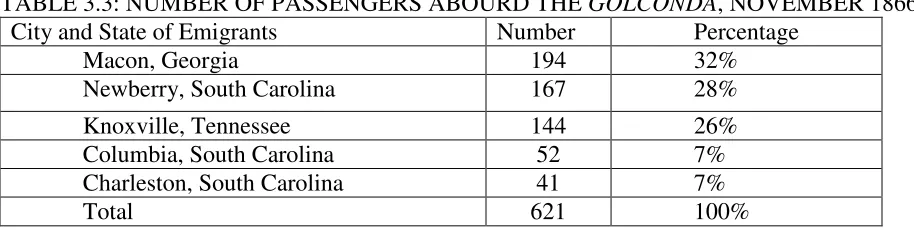
TABLE 3.3: NUMBER OF PASSENGERS ABOURD THE GOLCONDA,
NOVEMBER 1866 107
TABLE 5.1: NUMBER OF EMIGRANTS ABOARD THE GOLCONDA,
xiv LIST OF TERMS
Emigrant: An individual(s) who leaves from one country to reside in another.
Emigration: To leave from one country or region to settle in another.
Emigrationist: An advocate of the organization efforts of a group of people to leave from
one country to resettle in another.
Migration: The physical movement or relocation to a new location within the country
in which he/ she resides.
Resettle: The relocation or transportation of a group of people to a new settlement.
Resettlement: The act of settling or taking up residency in a new place.
1
CHAPTER ONE: INTRODUCTION
God of high heaven will put a curse should we continue to live with our former masters and ex-slaveholders, who are not enjoying the same right as he has ordained that we shall enjoy in our own native soil; for God says in His Holy Work that he has a place and land for all his people, and our race had better to it.
Henry Adams
In 1866, interest in returning to Africa was ignited in Macon shortly after the ratification
of the Thirteenth Amendment and Civil Rights Act. Responding to a difficult transition from
slavery to freedom and feeling unwelcome in a nation slow to accept freedmen as equals
Maconites emigrated to Liberia in November 1866.
In 1867, Georgia’s largest cities, particularly where large black population exists, were
influxed with influential Radical Republicans. Blacks in Macon formed alliances with white
Radicals to work toward seizing full citizenship within the United States. Consequently,
emigration advocates in Macon temporarily postponed their mobilization efforts to capitalize on
the historic political elections of 1867 and 1868. Blacks voted for the first time in their lives,
worked to change the Georgia Constitution, elected black men into office, and struggled to ratify
the Fourteenth Amendment. By contrast, blacks of Columbus lacked faith in the promises
offered by Congress and Radical Republicans. Witnessing blacks throughout Georgia
2
laborers, and political and racial intimidation, several hundred Columbusites packed their bags
and sailed to Liberia in 1867 and 1868. Blacks in other parts of Georgia shared the same
sentiments as those in Columbus and emigrated as well. By May 1868, nearly 800 Georgians had
resettled in Liberia.
The post-bellum African-American emigration movement in Georgia has received little
attention from historians. Based on the primary documents within the voluminous collection of
the African Colonization Society Papers, I recognized that conducting a study on those who
chose to leave the United States for Liberia during the nineteenth-century is very ambitious.
Narrowing the scope of what is the beginning of future studies of post-bellum black emigration,
my primary goal in this dissertation is to examine the motives for freedmen’s leaving during four
departures: November 1866, May 1867, November 1867, and May 1868.
Each departure occurred, not by coincidence, around heated election dates in Georgia and
the passage of historic Congressional legislation in Washington, D.C. The departure of
November 1866 coincided with Georgia’s first state election after the Civil War and the General
Assembly’s immediate rejection of the Fourteenth Amendment. The May 1867 departure
occurred shortly after Congress passed the First and Second Reconstruction Acts, which
established military presence in states not yet admitted into the Union and granted suffrage to
black men. In November1867, blacks emigrated after Georgians elected delegates for the
Georgia Constitutional Convention. The May 1868 departure followed the late April 1868
election, which allowed Georgians to elected state officers and vote in favor of a new Georgia
Constitution.
The motives of blacks emigrating from the United States were not stimulated exclusively
3
economy in which newly freed persons entered into following the Civil War. As blacks pushed
to assert themselves as citizens within the United States, they experienced great opposition from
resentful whites, who wanted to assert and maintain their social, economic, and political control.
The enticements of living in a self-governing nation where education and land were not denied to
blacks were major factors that pulled freed families to Liberia. In the minds of many post-bellum
African Americans, Liberia was their “Promised Land.” It was free of whites, land was granted
to settlers, nation-building was possibly, and for some African-born emigrants, they were
returning “home.”
Based on the correspondence between Georgia emigrants and ACS leaders from the
African Colonization Society Papers and letters from Liberian settlers published in the ACS’s
monthly publication, African Repository, I identify the motives that powered the
nineteenth-century “Back-to-Africa” movement in Georgia and give voice to those emigrants who sought
freedom in Africa during the early years of Congressional Reconstruction. As well, I will address
the following research questions: Where was emigration sentiment strongest in Georgia? How
did grassroots leaders mobilize blacks to emigrate? What were the sentiments of blacks toward
emigration? What challenges did black emigrants experience as they prepared to leave the
United States? Why were the promises of full citizenship and land not enough to convince some
newly freed persons to remain in America?
Contrary to Wilson Jeremiah Moses, who asserts in Classical Black Nationalism that
“there was not much interest in emigration from the end of the Civil War to World War I,”
African emigration interest did not almost fade into oblivion after 1865.1 Instead, blacks
continued to express a high interest in foreign resettlement throughout the late-nineteenth
1
William Jeremiah Moses, Classical Black Nationalism: From the American Revolution to Marcus Garvey
4
century, especially during the years of Reconstruction (see Table 1.2)2 Although, post-bellum
emigrants did not surpass the number of passengers who sailed to Liberia during the heyday of
the ACS in the 1850s, their numbers immediately following emancipation remained high and
were only 7% less than that of their predecessors who emigrated a decade or so earlier. While the
ACS provided passage to 3,184 African Americans between 1865 and 1877, the number of
individuals who applied for passage to Liberia during Reconstruction ran into the thousands and
exceeded the number of applicants who had expressed an interest in foreign migration during the
antebellum period. If additional ships and money had been available to transport and sustain
applicants who desired to go to Africa, more blacks would almost certainly have left the United
States during the late nineteenth-century. The consequence of such actions might have reduced
the South’s already struggling economy or may have increased the Chinese and European
indentured labor trade to the South if its largest and most reliable labor source sought autonomy
beyond American shores.
In examining the mobilization efforts to transport blacks to Liberia, it is important to note
that high interest in African colonization following the Civil War was not solely the result of the
indefatigable efforts of the ACS leaders, Rev. William McLain, Financial Secretary, and William
Coppinger, Corresponding Secretary. This enthusiasm reflected a broader and already existing
desire among newly freed people, who for multiple reasons doubted that America was their
promised land. The individuals who favored foreign migration were pained by America’s
treatment of African Americans. They lost faith in their lives ever improving as long as they
remained in the presence of whites. They desired land ownership, political representation, and
2
5
residency in a homogeneous black nation. These key factors contributed greatly toward high
black turnout at eastern docks from New York to Georgia on scheduled dates of departure.
Emancipation, black male suffrage, full citizenship, and the promises of “40 acres and a mule”
through land redistribution were not enough to keep this group in the U.S.
It is also striking that the largest group of African Americans to resettle in Liberia came
from Georgia (their numbers comprised 31 percent of the total number of passengers transported
to West Africa by the American Colonization Society during fragment Reconstruction).3
Although the number of annual departures of Georgia emigrants oscillated throughout the
post-emancipation years, numbers of emigrants remained consistently high when compared to other
states where emigration recruitment was present. Consequently, Georgia became the epicenter of
the African-American emigration movement throughout Reconstruction (see Table 1.1).
Methodology
In examining the motives of black Georgians leaving the United States during
Reconstruction, I rely primarily upon the American Colonization Society Papers. Of the many
types of records within the Society’s collections, I use two types of sources: periodicals and
correspondence.
In an effort to put black Georgia emigrants center stage and learn of their organizational
efforts and motives for leaving the United States between 1866 and 1868, I relied heavily upon
the ACS’s monthly periodical, the African Repository and specifically, letters written between
3
6
black Georgians and ACS officers, William Coppinger (Corresponding Secretary) and Rev.
William McLain (Financial Secretary).
The African Repository contains monthly financial reports and the names of financial
contributors, officers, and agents. In addition, the periodical served as a successful tool of
recruitment and media propaganda. Freed men and women, who ascended to positions of
leadership (sometimes by default because they were literate or were a business owner or
minister), galvanized support and recruited blacks to sail to Liberia by distributing the Repository
to members of their immediate community. The African Repository informed potential recruits
on how best to prepare for the voyage and how best to acclimate to the new country. It also
offered maps of Liberia, which assisted blacks in determining where they would most like to
resettle.
The most important sections of the African Repository for blacks were: (1) The “List of
Emigrants,” which contained the numbers, names, dates of departures, and former place of
residence of passengers; and (2) “Letters from Liberia,” which included published letters written
from emigrants to friends and family in America or to ACS agents. These letters offered
inspiring accounts of their arrival and successful resettlement, as well as encouragement to come
“home” to the “Fatherland” These letters contained tenets of Black Nationalism and described a
world that in the minds of some African Americans was a “utopia,” “Promised Land,” “Star in
the East,” or “Black Israel.” At best, the letters and lists of emigrants served as motivating tools
that helped ignite and stimulate “Liberian fever,” a term used often in the correspondence of
blacks to describe the interest of emigration. At the least, they helped blacks contemplating
7
Thousands of letters were written between African Americans and ACS officers and
agents. These letters spanned from 1817 to 1935. The collection of letters is massive and may
be one of the largest repository of letters written by freeborn and emancipated blacks of the
antebellum era and freedmen of the Reconstruction period. Possibly the size of the collection or
the mistaken belief that interest in emigration declined following the Civil War, scholars have
failed to examine these letters. Scholars may have assumed that blacks simply did not write in
large numbers to the ACS because literacy was not high amongst former slaves.
By using the letters in my research, I am able to show that blacks expressed a high
interest in returning to Liberia during Reconstruction. Despite their level of literacy, they were
able to articulate their desire to leave the U.S. Contained within the letters is evidence of
inquiries about going to Liberia; dates of departure; and information on how grassroots
emigration companies organized, mobilized, and galvanized support from blacks within their
immediate community. Most importantly, these letters tell us, through the voices of black
emigrants, their reasons for leaving the United States.
Bishop Henry McNeal Turner and other leading blacks, such as Congressman Jefferson
F. Long and James Simms have long been recognized as leading advocates of black emigration
during Reconstruction and post-Reconstruction. With the exception of Turner, most of the
“Back-to Africa spokesmen” of these eras did not sail to Africa. In fact, it was not until
November 1891 that Turner actually boarded a ship to West Africa.4 When he arrived in Africa,
he did not stay nor did he resettle there.5 Lesser known individuals, who were former slaves,
4
Edwin S. Redkey, Respect Black: The Writings and Speeches of Henry McNeal Turner (New York: Arno Press and the New York Times, 1971), 85.
5
8
local preachers, and farmers, took on grassroots leadership positions and were more successful in
galvanizing and mobilizing support for emigration than Turner and others. These individuals’
organizational efforts have gone unrecognized and challenge the notion that a wide interest in
African emigration died after the Civil War.
In examining the organizational efforts of black emigration advocates in Georgia, the
ACS correspondence offers us an intimate look at the lives of blacks during Reconstruction and a
fresh perspective on black emigration sixty years preceding Marcus Garvey’s twentieth-century
emigration movement. As well, these letters allow us to look closely at what blacks in Georgia
were experiencing as they transitioned from slavery to freedom: displacement, poverty, a
smallpox epidemic, intimidation, denial of land, unfair wages, and lack of protection from the
military law enforcement. As black Georgians prepared for departure in 1866, 1867, and 1868,
they described their disappointment with Republicans, the death of the Georgia delegate George
Ashburn and the failures to convict his murderers, and Congress’s refusal to appropriate funds to
assist blacks in emigrating to Africa. All were factors that pushed blacks to emigrate from the
United States.
While these letters offer us new ways in looking at freedmen during Reconstruction, they
also allows us to reexamine the motives of the white leaders of the ACS, who have historically
been accused of wanting to make the United States more racially homogeneous. Correspondence
between officers within the ACS organization and emigrants tells us about the organization’s
commitment to improving the lives of blacks, their frustration with Congress for failing to
appropriate funds to resettle blacks in Africa, and their discontent with white Republicans,
Freedmen’s Bureau officers, and employers who hoped to see blacks remain in the United States
9
from leaving by the efforts of opponents of emigration. While the ACS served as an ally of
blacks, its members also endangered their own lives and personal reputations in the pursuit of
helping blacks acquire autonomy.
Historiography
The historiography of the nineteenth-century African colonization movement is not
extensive but it is varied. Several books survey the history of Liberia.6 Others focus on the
country’s early history, the leadership and mission of the American Colonization Society, and
the emigrants who helped to make Liberia a sovereign nation in 1847.7 Most of what has been
published on the black repatriation movement reflects the years 1817 to 1865.8 What little
6
Elwood Dunn and Svend E. Hails, Historical Dictionary of Liberia:African Historical Dictionaries Series (Metuchen, NJ: Scarecrow Press, 1985); Harold D. Nelson, ed., Liberia: A Country Study (Washington D.C.: U.S. Government Printing Office, 1985); and Abayomi C. Cassll, Liberia: The History of the First Republic (New York: Fountainhead Publishers, 1970).
7
G.E. Saigbe Boley, Liberia: The Rise and Fall of the First Republic (New York: MacMillan Publishers, 1983); Elwood D. J. Gus Liebenow, Liberia: The Evolution of Privilege (Ithaca, NY: Cornell University Press, 1969); J. Gus Liebenow, Liberia: The Quest for Democracy (Bloomington: Indiana University Press, 1987); and Richard West, Back to Africa: A History of Sierra Leone and Liberia (New York: Holt, Rinehart and Winston, 1970).
8
Claude A. Clegg III, The Price of Liberty: African Americans and the Making of Liberia (Chapel Hill: University of North Carolina Press, 2004); Floyd J. Miller, The Search for a Black Nationality: Black Colonization and Emigration, 1787-1863 (Urbana-Champagne: University of Illinois Press, 1975); Early Lee Fox, American Colonization Society, 1817-1840 (Baltimore, MD: The Johns Hopkins University Press, 1919); Marie Tyler-McGraw, An African Republic: Black and White Virginians in the Making of Liberia (Chapel Hill:University of North Carolina Press, 2007); Nina Mjagkij, ed. Organizing Black America: An Encyclopedia of African American Associations (New York: Garland Publishing, 2001); Clarence Mohr, On the Threshold of Freedom: Masters and Slaves in the Civil War of Georgia (Athens: University of Georgia Press, 1986); Wilson Jeremiah Moses, Classical Black Nationalism: from the American Revolution to Marcus Garvey (New York: New York University
10
scholarship that covers the later nineteenth century deals primarily with the post-Reconstruction
years 1878 to 1899. This period, which saw black-led domestic and foreign schemes, was the
third wave of the nineteenth-century African repatriation movement.9 Despite the steady growth
of scholarship on the history of Liberia, the American Colonization Society, and regional studies
of Back-to-Africa movements, little research has been conducted on the efforts of freed people
who either emigrated to or entertained the idea of resettling in Liberia during Reconstruction.
What has been written thus far on this period consists primarily of a small collection of theses
and dissertations that have gone unpublished. These works focus largely on missionary efforts in
Liberia.10 In the general scholarly literature on Reconstruction, black repatriation to Africa
receives cursory treatment when it is mentioned at all. My goal in writing this dissertation is not
only to fill this gap, but to contribute to making the subject of black emigration, whether to
Africa, Canada, Brazil, the Caribbean, or Mexico, one of the central themes of Georgia’s
Reconstruction history.
In the historiography of African colonization, one of the earliest scholarly works is Early
Lee Fox’s The American Colonization Society, 1817-1840, published in 1919.11 His work
9
Kenneth C.Barnes, The Back to Africa Movement in Arkansas in the Late 1800s (Chapel Hill: University of North Carolina Press, 2004); Edwin S. Redkey, Black Exodus: Black Nationalism and Back to Africa, 1819-1910
(New Haven, CT: Yale University Press, 1969); and Nell Irvin Painter, Exodusters: Black Migration to Kansas following Reconstruction (Philadelphia, PA: W.W. Norton, 1992).
10
Amos Jones Beyon, “The American Colonization Society and the Formation of the Political , Economic, and Religious Institutions in Liberia, 1822-1900” (Ph.D. dissertation: West Virginia University, 1985); Luckson Ewhiekpamare Ejofooi, “The Missionary Career of Alexander Crummell in Liberia: 1853-1873” (Ph.D. dissertation: Boston University Graduate School, 1974); Naomi Hodgson, “The Presbyterian Mission to Liberia, 1832-1900” (Ph.D. dissertation: Columbia University, 1980); Sandy Dwayne Martin, “The Growth of Christian Missionary Interest in West Africa Among Southeastern Black Baptists, 1880-1915” (Ph.D. dissertation: Columbia University, 1981); and Werner Theodor Wickstrom, “The American Colonization Society and Liberia, An Historic Study of Religious Motivation and Achievement, 1817-1867” (Ph.D. dissertation: Hartford Seminary, 1958).
11
11
presents general facts concerning the early decades of the African colonization movement: the
mission and leadership of the ACS and the challenges of functioning as an agency and
colonizing Liberia. Fox glorifies the leadership of the ACS, and he defends the intentions of the
organization, whose initial mission was praised by blacks and sympathetic whites as an attempt
to improve the lives of the free black population. He also asserts that, despite the ACS’s failure
to remove the entire black race from the country, the organization successfully colonized and
Christianized Liberia. Through his own admission, Fox’s empirical research contains flaws and
inconsistencies and, consequently, his work has never been widely accepted by scholars of
African colonization.
In 1961, P. J. Staudenraus’s The African Colonization Movement, 1816-1865 surpassed
the scholarship of Fox.12 Derived from his dissertation, Staudenraus relied heavily upon the
American Colonization Society Papers to revise or rather correct the initial research conducted
by Fox and to better chronicle the genesis of the colonization movement and the first fifty years
of the ACS’s operation.13 What makes Staudenraus’s work important to the study of black
repatriation movements and the colonization of Liberia is his use of primary sources to
reconstruct the organizational history of the ACS, the opinions of key opponents and advocates
of African colonization, and the financial and logistical challenges of the colonization mission.
Today, Staudenraus’s work is the foundation of all scholarship conducted on the
nineteenth-century African colonization movement. But like Fox, he too failed to write about the opinions
of antebellum blacks on the subject of African repatriation.
12
P.J. Staudenraus, The African Colonization Movement, 1816-1865 (New York: Columbia University Press, 1961).
13
12
Following the modern civil rights movement in the U.S., scholars began to direct their
attention away from the white leadership of the colonization movement and focused instead on
the black émigrés who colonized Liberia.14 In 1969, Edwin S. Redkey published Black Exodus:
Black Nationalism and Back-to-Africa Movements, 1890-1910. Unlike his predecessors, Redkey
examined the origins of black-led, grassroots, foreign and domestic migration schemes that
served as a prelude to Marcus Garvey’s twentieth-century movement. Recognizing the
importance of writing a history reflective of African-Americans’ participation in the colonization
of Liberia, Tom Shick published Emigrants to Liberia, 1820-1843: An Alphabetical Listing,a log
containing the names of African-American emigrants who resettled in Liberia under the auspices
of the American Colonization Society.15 This list of emigrants served as the nucleus of his own
empirical research. In Behold the Promised Land, Shick recorded first generation
Americo-Liberians’ uneasy migration across the Atlantic Ocean to the shores of West Africa, their arrival
to Liberia, and their struggle to cohabitate peacefully amongst the indigenous population.16
Along with his study of the social environment of the early settlers, Shick also examined early
maps of Liberia; population reports; photos of emigrants; and illustrations of Masonic temples,
churches, and homes built by settlers.
The primary documents from the American Colonization Society Papers served as a
reliable source for Shick and for future scholars who later published additional transcribed logs
14
See Charles Morrow Wilson, Liberia: Black Africa in Microcosm (New York: Harper & Row, 1971); Edwin S. Redkey, Black Exodus: Black Nationalism and Back to Africa Movements, 1819-1910 (New Haven, CT: Yale University Press, 1969); and Richard West, Back to Africa: A History of Sierra Leone and Liberia (New York: Holt, Rinehart and Winston, 1970).
15
Tom W. Shick, Emigrants to Liberia, 1820-1843: An Alphabetical Listing (Newark, DE: Liberian Studies Association in America, Inc., 1971).
16
13
of nineteenth-century black emigrants, such as Immigrants to Liberia,1865 to 1904: An
Alphabetical Listing and Immigrants to Liberia,1844-1865: An Alphabetical Listing.17
Following Staudenraus’s and Shick’s treatment of the American Colonization Society
Papers and Redkey’s social history of black participation in the colonization of Liberia came the
publication of two works based largely on black emigrants’ letters to former masters and families
(fictive and blood related) in America. In Dear Master: Letters of a Slave Family, Randall M.
Miller edited the antebellum correspondence of the Skipworths, a family of former slaves from
Virginia and Alabama, to their former white owner, John Hartwell Cocke.18 Inspired by Miller,
Bell I. Wiley published his findings in Slaves No More: Letters from Liberia, 1833-1869. The
letters from emigrants to former masters Wiley selected for his book were unpublished and
unedited by the press or the American Colonization Society. These letters revealed much about
the relationships between former slaves and the masters who granted them manumission but in
Liberia. Both Wiley and Miller identified common themes in the correspondence: hardship,
Christian conversion, self-determination, and emigrants’ reliance upon former owners to assist in
acclimating to a life of freedom in a foreign land.19
In Sojourners in Search of Freedom: The Settlement of Liberia by Black Americans,John
Wesley Smith examined the ways in which first and second generation settlers grappled with
17
Peter J. Murdza, Jr., Immigrants to Liberia: 1865 to 1904, An Alphabetical Listing (Newark, DE: Liberian Studies Association in America, Inc., 1976) and Robert T. Brown, Immigrants to Liberia, 1844-1865: An Alphabetical Listing (Philadelphia, PA: Institute of Liberian Studies, 1980).
18
Randall M. Miller, Dear Master: Letters of a Slave Family (Ithaca, NY: Cornell University Press, 1978).
19
14
their new lives in Liberia.20 Relying heavily upon the letters of emigrants as well, Smith
discussed the settlers’ sentiments of regret mixed with the support for colonization; their
changing economic and social conditions in the U.S. and Liberia; and their enterprise in
establishing townships, building schools, generating businesses and overcoming adversity in the
West African country. Underscoring the desire to resettle in Liberia, Antonio Daniel’s Swing
Low, Sweet Chariot: The Mortality Cost of Colonizing Liberia in the Nineteenth Century offers a
statistical analysis of the fatalities amongst early Liberian settlers. 21 He argued that, in their
pursuit of freedom, Liberia settlers may have paid the highest “reliably recorded” mortality cost
in the history of human migration.22 While the statement is an exaggeration, the point it well
made that resettlement was difficult and fatalities were high among first generation Liberian
settlers.
Recent scholarship includes several regional studies of black emigration and the émigrés
who emigrated from America over the span of the nineteenth century. Richard Hall’s On Africa’s
Shore: A History of Maryland in Liberia, 1834-1857 provides a narrative history of the eleven
hundred free-born and emancipated blacks who chose to emigrate to Liberia during the
antebellum years under the auspices of the Maryland Colonization Society. Claude A. Clegg III’s
The Price of Liberty: African-Americans and the Making of Liberia examines the multifarious
tragedies black North Carolinians experienced in their pursuit of self-government, autonomy,
Christian conversion, and prosperity in Liberia. The price included physical hardship, premature
death, and opposition from the indigenous population. Alan Huffman’s Mississippi in Africa:
20
James Wesley Smith, Sojourners in Search of Freedom: The Settlement of Liberia by Black Americans
(New York: University Press of America, 1987).
21
Antonio Daniel, Swing Low, Sweet Chariot: The Mortality Cost of Colonizing Liberia in the Nineteenth Century (Chicago, IL: The University of Chicago Press, 1995).
22
15
The Saga of the Slaves of Prospect Hill Plantation and their Legacy in Liberia Today describes
the legal challenges endured by a group of enslaved Mississippiansfollowing the death of their
master who had promised them foreign manumission and the cultural conflict they became
embroiled in after their arrival in Africa. In An African Republic: Black and White Virginians in
the Making of Liberia,Marie Tyler-McGraw explores the concerted efforts of blacks and whites
to support the African colonization movement in Virginia and the factors that led more blacks to
emigrate from there than any other state prior to the Civil War. Kenneth Barnes’s Journey of
Hope: the Back-to-Africa Movement in Arkansas in the Late 1800s examines the
post-Reconstruction surge in emigration from Arkansas and why previously failed attempts and
fraudulent schemes made by black or white-led emigration societies did not deter these
emigrants.23
Like Clegg and Huffman, Tyler-McGraw takes a transnational approach to exploring the
lives of nineteenth-century emigrants to Liberia. She introduces a trans-Atlantic debate over
cultural identity, national identity, and citizenship, while offering a narrative about the persons
who came to be known as “Americo-Liberians.” She shows that Liberian colonization was not
the utopia blacks hoped it would be.24 While hoping to civilize and proselytize native Liberians,
23
Richard Hall, On Africa’s Shore: A History of Maryland in Liberia, 1834-1857 (Baltimore: Maryland Historical Society, 2004);Alan Huffman, Mississippi in Africa: The Saga of the Slaves of Prospect Hill Plantation and their Legacy in Liberia Today (New York: Penguin, 2004); Claude A. Clegg III, The Price of Liberty: African Americans and the Making of Liberia (Chapel Hill: University of North Carolina Press, 2004); Kenneth Barnes,
Journey of Hope: the Back to Africa Movement in Arkansas in the Late 1800s (Chapel Hill: University of North Carolina Press, 2004); and Marie Tyler-McGraw, An African Republic: Black and White Virginians in the Making of Liberia (Chapel Hill: University of North Carolina Press, 2007).
24
To learn of nineteenth-century blacks’ concept of a “black utopia,” see Paul Gilroy, The Black Atlantic: Modernity and Double Consciousness (New York: Verso, 1999); Francis Abiola Irele, “ ‘What is Africa to Me?': Africa in the Black Diaspora Imagination,” Souls 7, no 3-4 (2005): 26-46; William H. Pease and Jane H. Pease,
16
black American setters brought with them their own racist view of Africans and a social
paradigm they learned from whites in America. Sadly, they exploited the country’s natural
resources and the original inhabitants. The eventual result was a ruinous civil war that continued
up to 2003, when President Charles Taylor, the descendant of an American emigrant, gave up
power and went into exile in Nigeria.
In addition to the work of Clegg and Barnes, Steven Hahn’s A Nation Under Our Feet:
Black Political Struggles in the Rural South, from Slavery to the Great Migration, and Nell I.
Painter’s Exodusters: Black Migration to Kansas following Reconstruction deal with the
Back-to-Africa movements after the Civil War. They take the position that blacks’ interest in foreign
resettlement did not die with their recognition as citizens through post-bellum constitutional
amendments. Clegg asserts that Liberian fever remained consistent amongst blacks throughout
most of the nineteenth century. Despite financial challenges met by the American Colonization
Society, blacks’ interest in Liberian resettlement amongst North Carolinians did not temper
during Reconstruction and, in fact, their numbers made up the second largest group of emigrants
after Georgians to sail to Liberia during this period. In his analysis of black interest in African
resettlement, Hahn takes the position that the post-Reconstruction Back-to-Africa movement was
a grassroots phenomenon supported primarily by landless farmers and rural workers. Painter has
a similar view. Her case study of post-Reconstruction black migration to Kansas in 1879 show
that “Exodustors” consisted of black separatists not only in domestic but also in foreign
resettlement. She asserts that Kansas, for many blacks, was only a place for temporary
settlement. Those who desired African emigration were either waiting for the opportune moment
or simply lacked the financial resources to sail to Liberia. And despite negative reports, Liberia
17
Reconstruction decades. While the Exodus to Kansas caught the attention of many farmers,
migration to Arkansas was equally appealing. And like Painter, Barnes highlights the desire of
blacks who migrated to Arkansas to resettle in Liberia under the auspices of the International
Migration Society led by Bishop Henry McNeal Turner in 1895.25
Scholars of black emigration recognize that Georgians have consistently taken part in the
multiple African colonization and Back-to-Africa movements of the nineteenth century. Yet no
single work has been published on its relevance to Liberian colonization, particularly during
Reconstruction when the largest group of the black emigrants to sail to Liberia came from
Georgia.26 Reconstruction scholars, such as W.E.B. Du Bois, Paul A. Cimbala, Donald L. Grant,
and particularly Mark V. Wetherington, mention black Georgians’ participation in emigration
schemes of the post-emancipation era, but this movement has never received the attention it
deserves.27 John Hope Franklin, Edmund L. Drago, Kenneth Stampp, and Eric Foner do not
25
Clegg, Price of Freedom; Barnes, Journey of Hope; Steven Hahn, A Nation Under Our Feet: Black Political Struggles in the Rural South, from Slavery to the Great Migration (Cambridge, MA: Harvard University Press, 2003); and Nell Irvin Painter, Exodusters: Black Migration to Kansas following Reconstruction (Philadelphia, PA: W.W. Norton, 1992).
26
What has been written thus far on Georgia’s involvement in the nineteenth-century African Colonization Movement consist of a few theses and dissertation. See Edward F. Sweat, “Free Negroes in Antebellum Georgia” (Ph.D. dissertation: Indiana University, 1957); James M. Gifford, “The American Colonization Movement in Georgia, 1817-1860” (Ph. D. dissertation, University of Georgia, 1877); F. Karcheik Sims-Alvarado, “The African Colonization Movement in Georgia: 1817-1860” (M.A. thesis: Clark Atlanta University 2001), and
Matthew F. McDaniel, “Emigration to Liberia from the Chattahoochee Valley of Georgia and Alabama, 1853-1903” (M.A. thesis: Louisiana State University, 2007). For published works on Georgia’s involvement in the American Colonization Movement of the antebellum years, see Clarence Mohr, On the Threshold of Freedom: Masters and Slaves in Civil War Georgia (Baton Rouge, LA: Louisiana State University Press, 2001) and Michael Thurmond,
Freedom: Georgia's Antislavery Heritage, 1733-1865 (Atlanta, GA: Longstreet Press, 2003).
27
Authors who briefly discuss black emigration to Liberia from Georgia during the Reconstruction years are Paul A. Cimbala, Under the Guardianship of the Nation: The Freedmen's Bureau and the Reconstruction of Georgia, 1865-1870 (Athens: University of Georgia Press, 2003); Alan Conway, The Reconstruction of Georgia
(Minneapolis: University of Minnesota Press, 1967);Avery Craven. Reconstruction: The Ending of the Civil War
(New York: Holt, Rinehart and Winston, 1969); W. E. B. Du Bois, Black Reconstruction in America 1860-1880
(New York: Simon & Schuster, 1999); Donald Lee Grant, The Way it was in the South: The Black Experience in Georgia (Athens: University of Georgia Press, 2001); Clara Mildred Thompson, Reconstruction in Georgia: Economic, Social, Political, 1865-1872 (Manchester, NH: Ayer Publishing, 1971); and Mark V. Wetherington,
18
discuss black emigration in their accounts of Reconstruction.28 This neglect gives the impression
that domestic migration and foreign emigration were not viable options for blacks seeking
autonomy, and that the movement for African repatriation became inactive following the Civil
War and remained dormant until the explosion of Marcus Garvey’s United Negro Improvement
Association in the 1920s.29
Organization of Chapters
My dissertation is arranged into five chapters. “Chapter One: Introduction” contains the
dissertation’s argument, significance, scholarship, and methodology.
“Chapter Two: A Brief History of the African-American Emigration Movement,
1773-1865” offers, first, a historical overview of the organizational efforts and motives of blacks who
proposed resettling in Africa from the American Revolution to the close of the Civil War (from
its proto-emigration phase to the first wave of the emigration movement). Second, I highlight
the historical connection between Georgia and the ACS’s earliest attempt to launch its
organization’s mission, how freeborn and emancipated black Georgians responded to Liberian
fever, as it came to be called, and their motives for seeking resettlement beyond the shores of the
28
See Eric Foner, Reconstruction: America’s Unfinished Revolution, 1863-1877 (New York : Harper & Row, 1988); Ibid, Short History of Reconstruction, 1863-1877 (New York: Harper Collins, 1990); John Hope Franklin, Reconstruction: After the Civil War (Chicago, IL: University of Chicago, 1961); Kenneth M. Stampp, The Era of Reconstruction, 1865-1877 (New York: Vintage Books, 1965); Edmund L. Drago, Black Politicians and Reconstruction in Georgia: A Splendid Failure (Athens: University of Georgia Press, 1992); and Elizabeth Studley Nathans, Losing the Peace: Georgia Republicans and Reconstruction, 1865-1871 (Baton Rouge: Louisiana State University Press, 1969).
29
19
United States prior to the close of the Civil War. The second wave, which covers the years of
Reconstruction (1865-1877), is discussed in the succeeding chapters.
“Chapter Three: The African-American Emigration Movement in Macon, and Sparta,
Georgia, 1865-1866” examines the economic conditions of blacks in Macon following the Civil
War and their motives and organizational efforts to emigrate to Liberia in 1866. I will also
examine black Spartans’ response to Liberian resettlement and their efforts to emigrate. This
chapter will demonstrate how Maconites and Spartans prepared for departure and the challenges
they faced during growing opposition toward blacks’ resistance to field labor and their pursuit to
achieve political and economic autonomy.
“Chapter Four: The African-American Emigration Movement in Macon and Columbus,
Georgia, 1866-1867” is a continued examination of the African-American emigration movement
in Georgia, where mobilization efforts began to wane in Macon but ‘took fire’ in Columbus in
1867. First, I examine how the rise in black support for Republicanism severely curtailed
grassroots efforts to emigrate more Maconites after 1867. Second, I will explain how a lack of
faith in their quality of life improving in the United States pushed blacks from Columbus to
Liberia. Third, I will identify and analyze the motivating factors that stimulated emigration and
caused Columbus to become leaders of black emigration in Georgia.
“Chapter Five: At the Crossroad of African-American Emigration in Georgia, 1867-
1868” examines the recruitment and mobilization efforts of black Georgians from Columbus,
Sparta, Marion, and other surrounding areas during the Georgia Constitutional Convention
(December 1867 and March 1868) and the state election of late April 1868. Mobilization efforts
and interest in emigration were great amongst blacks following the delegate election of
20
Constitution and to elect new state legislators into office in April 1868, political and racial
tension escalated between Republicans and Democrats. The events that preceded the election and
Congress’s decision to stop appropriating money to fund future voyages to transport blacks to
Liberia affected emigration numbers. Blacks were ambivalent about their future in America.
Some teetered on the subject of emigration and others were staunched supporters. Despite
21
TABLE 1.1: PERCENTAGE OF ACS-SPONSORED GEORGIA EMIGRANTS TO OVERALL NUMBER OF EMIGRANTS WHO RESETTLED IN LIBERIA, 1865-1877.
Year Georgia Emigrants Overall Number of Emigrants Percentage
1865 0 527 0%
1866 194 621 39%
1867 290 633 46%
1868 283 453 65%
1869 0 160 0%
1870 0 196 0%
1871 63 247 26%
1872 150 150 100 %
1873 0 73 0%
1874 0 27 0%
1875 0 23 0%
1876 0 21 0%
1877 0 53 0%
Total: 980 3,184 31%
22
TABLE 1.2: NUMBER OF ACS-SPONSORED EMIGRANTS TO LIBERIA, 1817-1885
Year Number of Emigrants
1817-1864 10,764 (+5722 recaptured Africans)
1865-1877 3,184
1878-1885 600
Total: 20,270
23
TABLE 1.3: ANNUAL ACS REPORT OF GEORGIA EMIGRANTS, 1865-1877 Year Number of emigrants City and county of former residents
1865 0
1866 194 Macon
1867 290 Macon (47) and Columbus (243)
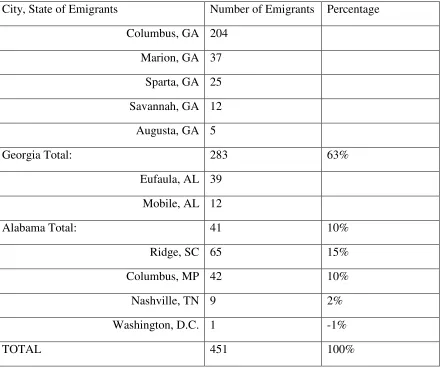
1868 283 Columbus (204), Marion (37), Sparta (25),
Savannah (12), Augusta (5)
1869 0
1870 0
1871 63 Sparta (63) and Savannah (3)
1872 150 Valdosta (59), Sparta (24), Milledgeville, (35) and
Hawkinsville (32)
1873-77 0
Total 980
24
CHAPTER TWO: A BRIEF HISTORY OF THE AFRICAN-AMERICAN EMIGRATION MOVEMENT, 1773-1865
Since 1619, black Americans fought to achieve two types of freedom: personal and civic.
According to author Orlando Patterson, personal freedom is that which "gives a person the sense
that … on the one hand, one is not being coerced or restrained by another person in doing
something desired and, on the other hand, the conviction that one can do as one pleases within
the limits of other person's desire to do the same." Civic freedom is "the capacity… to participate
in its life and governance. A person feels free…to the degree that he or she belongs to the
community of birth, has a recognized place in it and is involved in some way in the way it is
governed."30 Believing the United States Government would never grant them these freedoms,
African Americans opted to seize them or create them elsewhere by emigrating beyond the
shores of the United States. Blacks proposed various locations throughout the Americas, but the
most favored place to resettle for emigrationists was West Africa. The desire of blacks to live in
a racially homogeneous land as citizens with political, economic, and personal autonomy
coupled with the financial resources and organizational efforts of a group of benevolent whites
gave birth to the African-American emigration movement, the American Colonization Society
(ACS), and the nation-state Liberia.
As early as the eighteenth century, African Americans had articulated their desire to
resettle in West Africa. This desire was a response to the denial of civil liberties and land and a
way to claim personal autonomy against individual, familial, and community subjugation and
30
25
control. During the years between the American Revolution and the Civil War, this response
occurred in two phases: proto-emigration and first wave.
The “proto-emigration” phase traces the years 1773 to 1814 when blacks capitalized on
the revolutionary thinking of the time and advocated for emigration abroad and the end of
slavery. African Americans residing in the U.S. and transient Black Loyalists (American blacks
who joined the British Army during the Revolutionary War in exchange for freedom) in London
and Nova Scotia sought to emigrate to Africa. The desire for land and independence, and the
reality of poverty were the motives that pushed emigration for blacks on both sides of the
Atlantic Ocean.
Following the American Revolution, free blacks from Massachusetts and Rhode Island
were inspired by the actions of Black Loyalists who emigrated to Sierra Leone in 1787 and 1792
to pursue a more autonomous life. Faced with similar social, economic, and political challenges
as blacks in Canada and England, free U.S. blacks formed emigration associations and petitioned
legislators to assist in transporting them to West Africa.31 Unfortunately, the necessary financial
resources of blacks, compassionate whites, or the government did not coalesce to meet the
growing demand by blacks to leave the U.S. during this period.
The “first wave” reflects the years, 1815 to 1865, which witnessed organized endeavors
by blacks and whites to resettle African Americans in a location beyond the U.S. Suggested
destinations were Canada, Mexico, Sierra Leone, Liberia, and various places throughout the
Caribbean. The first successful resettlement of blacks from the United States to Africa was led
by Paul Cuffe, a wealthy black sailor, who used his personal funds and ship to transport
thirty-eight free blacks to Sierra Leone in 1815. Plans for a second voyage by Cuffe were cut short due
31
26
to his death in 1817.32 On January 31, 1820, the American Colonization Society (ACS), a white
led benevolent society formed in December 1816, transported nearly ninety free blacks to
Liberia. Funded by white northern abolitionists, religious leaders and slave masters, the ACS
wanted to resolve racial tension in the United States by assisting free blacks in resettling in
Liberia. There, free blacks could exercise personal and civic freedoms and obtain land otherwise
denied to them in the U.S. The sentiments of free blacks and whites toward the mission of the
ACS were mixed and the debate over black resettlement remained a controversy up to the end of
the Civil War. Nearly 10,000 African Americans (50 percent of the emigrants were newly
emancipated slaves) and 5,000 illegally captured Africans emigrated to Liberia through the
auspices of the ACS from 1820 to 1865. Of the American emigrants, the largest percentages
were from Virginia, North Carolina, and Georgia (in that order).
This chapter offers a brief overview of the African-American emigration movement from
1773 to 1865. First, I offer a brief historical overview of the organizational efforts and motives
of blacks who proposed resettling in Africa from the American Revolution to the close of the
Civil War (from the proto-emigration period to the first wave of the emigration movement).
Then, I highlight the historical connection between Georgia and the ACS’s earliest attempt to
launch its organization’s mission, analyzing how freeborn and emancipated black Georgians
responded to Liberian fever, as it came to be called by blacks, and their motives for seeking
resettlement beyond the shores of the United States.
32
27 Proto-Emigration
During the American Revolution, four changes occurred as a result of white colonists’
wanting to break away from the control of Great Britain: (1) the Declaration of Independence
was enacted; (2) the United States became an independent nation; (3) the Constitution of the
United States became the law of the land; (4) and, most radical of all, the liberation of African
slaves in some northern states. As white colonists demanded their independence from King
George III, blacks did not sit idly by while white colonists fought for their own autonomy. The
dream of liberty and the ideology of revolution aroused their spirit and caused them to want the
same civic and personal freedoms cherished by whites advocating for independence. They
challenged legislators and slaveholders to grant emancipation. Slaves escaped from their owners.
They also sued for their freedom, arguing that their enslavement contradicted the Constitution
and their natural rights.33
The founding of the United States, the subsequent drafting of the Declaration of
Independence, and the demand for emancipation by blacks during the American Revolution
opened the debate over slavery. With nearly one in five persons in the U.S. being an enslaved
person of African descent, the Founding Fathers debated over the continued use of bondspersons
as a form of labor (see Table 2.1).34 Men of influence, including Thomas Jefferson, failed to
33
James Oliver Horton, Free People of Color: Inside the American Community (Washington: Smithsonian Institution Press, 1993), 2; James Oliver Horton and Lois E. Horton, Slavery and the Making of America (New York: Oxford University Press, 2004, 64-66; Leon F. Litwack, North of Slavery: The Negro in the Free States 1790-1860 (Chicago: The University of Chicago Press, 1961), 11-12; Ira Berlin, Slaves without Masters: The Free Negro in the Antebellum South (New York: Pantheon, 1974), 10 and 17.
34
United States, Heads of Families at the First Census of the United States Taken in the Year 1790
28
confront slavery head-on and, consequently, acquiesced by settling for a compromise.35 That
comprise resulted in the North, mostly a “society with slaves,” adopting two forms of
emancipation: immediate and gradual.36 The South, a “slave society,” pushed forward to build
an empire by the muscle and sweat of enslaved men, women, and children.37
The first three states to adopt immediate emancipation were Vermont (1777), New
Hampshire (1780), and Massachusetts (1783). The U.S. Census of 1790 shows that blacks never
exceeded more than 2 percent of the total population in Vermont, New Hampshire, and
Massachusetts (see Table 12.1). With the three New England states lacking a large black
population and an economy dependent upon slave labor, they led the way in granting immediate
emancipation.
Northern states favoring gradual emancipation were Pennsylvania (1780), Rhode Island
(1784), Connecticut (1784), New York (1799), and New Jersey (1804).38 The black population
ranged from 2.3 to 8 percent, relatively higher than the states adopting immediate emancipation
(see Table 2.1). Like Vermont, New Hampshire, and Massachusetts, slave production did not
substantially sustain their economy either. Although the North did not possess the number of
slaves as the South, the region took a dawdling approach to granting manumission (see Table
2.1). Not all northern states or territories were quick to embrace immediate or gradual
35
To learn more about the attitudes of slavery during the American Revolution see Roger W. Wilkins,
Jefferson's Pillow: The Founding Fathers and the Dilemma of Black Patriotism (Boston: Beacon Press, 2002).
36
To learn the distinctions between a “society with slaves” and a “slave society,” see Ira Berlin, Many Thousands Gone First Two Centuries of Slavery in North America (Cambridge, Massachusetts: Belknap Press of Harvard University, 2000), 8-10.
37
See Leon Litwack, North of Slavery, 3. For other works on immediate and gradual emancipation in the North, see Arthur Zilversmit, The First Emancipation: The Abolition of Slavery in the North (Chicago: University of Chicago Press, 1967); Joanne Pope Melish, Disowning Slavery: Gradual Emancipation and “Race” in New
England, 1780-1860 (Ithaca: Cornell University Press, 1998); and David Gellman, Emancipating New York: The Politics of Slavery and Freedom, 1777-1827 (Baton Rouge: Louisiana State University, 2006).
38
29
emancipation. In fact, emancipation in the New England and Middle states occurred over a span
of three decades. New York did not grant freedom to all its slaves until July 4, 1827. New Jersey
did not completely abolish slavery till 1846 (a mere seventeen years prior to the signing of the
Emancipation Proclamation).39
While the American Revolution opened the opportunity for abolishing slavery in the
U.S., it inadvertently ignited a transnational migration phenomenon among American blacks.
Beginning with the commencement of the Revolutionary War, blacks sought freedom and
autonomy with their feet. They migrated within and across three continents on both sides of the
Atlantic Ocean: throughout the U.S; to Nova Scotia, the Caribbean, and London; and eventually
to Sierra Leone. Testing the limits of their mobility, post-Revolutionary blacks attempted to
exercise what I refer to as their freedom of movement, the right to migrate and resettle without
any legal restrictions.
Beginning first in 1775, Lord Dunmore, the Royal Governor of Virginia, asked American
blacks belonging to Whig supporters to turn against their masters by running away and joining
the British Army in exchange for freedom.40 Contrary to Dunmore’s proposition, emancipation
was not offered to slaves owned by Loyalists. Instead, British masters took with them 30,000 to
50,000 slaves outside of the U.S. during the war, yet further expanding the forced migration of
blacks across the Diaspora.41 The number of black soldiers who accepted Dunmore’s proposal is
uncertain.42 However, James W. Walker notes nearly 2,000 American blacks were recorded in
39
Paul Finkleman, Slavery and the Law (Lanham, Maryland: Rowman and Littlefield, 2002), 115-116.
40
Michael Lee Lanning, African Americans in the Revolutionary War (New York: Citadel Press, 2005), 52.
41
Ibid, 52 and 16; and Phillip Papas, That Ever Loyal Island Staten Island and the American Revolution
(New York: New York University Press, 2007), 73.
42
30
1783 as enlisted soldiers within the British Army. Of the Black Loyalists, 1,410 were runaways,
409 were free blacks, 83 were enrolled involuntarily, and 49 were recruited as soldiers.43
When the British Army made its presence in the colonies of the Carolinas and Georgia,
nearly 100,000 slaves (20 percent of the black population in the American colonies) belonging to
Whig supporters ran from their masters and escaped to British lines.44 Thomas Jefferson noted
Virginia alone lost 30,000 slaves during the War of Independence. However, not all fugitives
sought refuge amongst the British.45 Many remained in the United States and sought refuge
wherever they could. Some migrated to northern cities where there existed a sizable free black
presence: Boston and New Bedford, Massachusetts; Philadelphia, Pennsylvania; and Providence,
Rhode Island.
According to Michael Lee Lanning, nearly 1,000 blacks from Savannah and Charleston
were granted freedom by the British. Many of them migrated to East Florida when territory was
ceded to the Spanish in September 1783.46 When the British were forced to evacuate the U.S,
several hundred blacks emigrated to the West Indies and Bahamas but faced the dangers of
re-enslavement. However, the largest group of blacks to emigrate from the U.S. during this period
were Black Loyalists and their families (most from Staten Island, Boston, Savannah, Charleston,
43
James W. St. G. Walker, The Black Loyalists: The Search for a Promised Land in Nova Scotia and Sierra Leone, 1783-1870, (Toronto: University of Toronto Press, 1992), 3.
44
Ibid., 3-4. Along with Charleston and Savannah, Staten Island served as one of several asylums for escaped slaves. See Phillip Papas, That Ever Loyal Island Staten Island and the American Revolution (New York: New York University Press, 2007).
45
Walker, Black Loyalists, 3.
46
31
and St. Augustine), who sought resettlement in England and Canada. Enticed by the promises of
land and independence, 200 blacks emigrated to London and 3,000 to Nova Scotia.47
As noted, the migration and emigration of blacks during the Revolutionary and
post-Revolutionary years was vast and wide. It was also unsettling and testing. Upon the arrival of
blacks to Nova Scotia and London, the emigrants soon learned there was no land to be granted.
In both places, they faced racial discrimination, unemployment, and poverty.48 The number of
destitute blacks was so high they became known by whites as the “Black Poor.”49 Frustrated and
exhausted from begging for land, blacks began seeking an alternative location for resettlement:
West Africa.
On April 9, 1787, 350 blacks sailed from Portsmouth to Sierra Leone. They were joined
by nearly a dozen white officials and artisans and sixty white women, who were described as
“chiefly women of the lowest sorts” simply because they married black men. Half or more of the
male passengers were identified as seamen who served in the Royal Navy and “Rangers with the
Army in the American Woods.”50
Championing black emigration was the white British abolitionist, Granville Sharp, who
petitioned the Treasury to provide transportation and provisions to Poor Blacks of London
47
See Barrington Walker, The History of Immigration and Racism in Canada: Essential Readings
(Toronto: Canadian Scholars' Press, 2008), 58-59; and Paul R. Magocsi, Encyclopedia of Canada's Peoples
(Toronto: Published for the Multicultural History Society of Ontario by the University of Toronto Press, 2006).
48
Michael Lee Lanning, African Americans in the Revolutionary War, 161-162. To learn more about the land discrimination toward eighteenth-century blacks in Nova Scotia, see James St. G Walker, “Land and Settlement in Nova Scotia” in The History of Immigration and Racism in Canada: Essential Readings, edited by Barrington Walker (Toronto: Canadian Scholars' Press, 2008), 49-67.
49
Michael Lee Lanning, African Americans in the Revolutionary War, 161; and Walker, “Land and Settlement in Nova Scotia,” 54-59.
50
32
wanting to return to Africa.51 Five years later, Sharp joined forces with Thomas Peters (a former
American slave residing in Nova Scotia) to advocate on behalf of black Canadians favoring
emigration to West Africa.52 Recognizing their social, political and economic challenges, Sharp
introduced Peters to other white abolitionists, bankers, and politicians of London, who hoped to
assist transient blacks in receiving land and improving their quality of life. Through the
concerted efforts of blacks and whites, the Sierra Leone Company was formed. In 1792, nearly
2,000 blacks from Nova Scotia embarked upon fifteen vessels bound for Freetown, Sierra
Leone.53
The mobilization efforts made by black emigrationists of Canada and London were not
the first of its kind. On April 20, 1773, fourteen years prior to the emigration of Black Loyalists
from London, four Boston slaves, Peter Bestes, Sambo Freeman, Felix Holbrook, and Chester
Joie, addressed the following letter to legislators asking to be allowed to work to pay their own
transportation fees to return to Africa:
We are willing to submit to such regulations and laws as may be made relative to us, until we leave the providence, which we determine to do as soon as we can from our joynt labours procure money to transport ourselves to some part of the coast of Africa, where we propose a settlement.54
Although their request was not granted, the four men’s initiative, did set a precedent for blacks,
who would contemplate emigrating to Africa following the American Revolution.
51
Robin W. Winks, The Blacks in Canada A History (Montreal, Quebec: McGill-Queen's University Press, 1997), 61.
52
Ibid., 62.
53
Walker, Black Loyalists, 96.
54
“Petition of Peter Bestes, Sambo Freeman, Felix Holbrook, and Chester Joe,” Early Negro Writing, 1760 – 1837, ed. Dorothy Porter (Maryland: Black Classic Press, 1995), 254-255. To see additional petitions drafted by Felix Holbrooks and other black Bostonians, see the “Africans in America” website at