ScholarWorks @ Georgia State University
ScholarWorks @ Georgia State University
Political Science Theses Department of Political Science
Spring 5-10-2014
Privatizing Education with the Public's Purse: An Analysis of the
Privatizing Education with the Public's Purse: An Analysis of the
2012 Georgia Constitutional Amendment on Charter Schools
2012 Georgia Constitutional Amendment on Charter Schools
Kristina La Plant
Follow this and additional works at: https://scholarworks.gsu.edu/political_science_theses
Recommended Citation Recommended Citation
La Plant, Kristina, "Privatizing Education with the Public's Purse: An Analysis of the 2012 Georgia Constitutional Amendment on Charter Schools." Thesis, Georgia State University, 2014.
https://scholarworks.gsu.edu/political_science_theses/60
This Thesis is brought to you for free and open access by the Department of Political Science at ScholarWorks @ Georgia State University. It has been accepted for inclusion in Political Science Theses by an authorized
PRIVATIZING EDUCATION WITH THE PUBLIC’S PURSE: AN ANALYSIS OF THE 2012
GEORGIA CONSTITUTIONAL AMENDMENT ON CHARTER SCHOOLS
ABSTRACT
Charter schools have recently become a hot topic of debate in the United States. For
par-ents who cannot afford private schooling or moving to another school district, charter schools
seem to be an attractive option. These schools, which are often argued to outperform traditional
schools, offer an alternative path to public education which allows teachers more flexibility to
employ innovative strategies in the classroom. In order to expedite the creation of such schools,
Republicans in the Georgia General Assembly called for the amending of the Georgia
Constitu-tion which would allow the state to approve charters by circumventing the publicly elected local
school board. This study analyzes the more recent political history of the Commission, the debate
surrounding the amendment, and ultimately the vote itself for Amendment 1.
TABLE OF CONTENTS
ACKNOWLEDGEMENTS ... Error! Bookmark not defined.v
LIST OF TABLES ... iv
LIST OF FIGURES ... v
1 INTRODUCTION ... 1
1.1 Purpose of the Study ... 1
1.1.1 Georgia Charter Schools Commission ... 2
1.1.2 Campaign for a Charter School Amendment ... 5
1.1.3 Voting Behavior ... 7
1.2 Expected Results ... 9
2 METHODOLOGY ... 11
2.1 Data and Variables ... 12
2.1.1 Demographics... 12
2.1.2 Educational “Need” ... 12
2.1.3 Political Predictors ... 13
3 RESULTS ... 14
3.1 Preliminary Results ... 14
3.1.1 The County-Level Dynamic ... 17
3.1.2 Interaction Effects ... 22
4 CONCLUSIONS ... 25
REFERENCES ... 29
LIST OF TABLES
Table 3.1 OLS Regression of “Yes” Votes on Amendment 1...15
Table 3.2 OLS Regression of “Yes” Votes on Amendment 1 in Metropolitan Counties...18
Table 3.3 OLS Regression of “Yes” Votes on Amendment 1 in Rural Counties...20
LIST OF FIGURES
1 INTRODUCTION
Over the past two decades, charter schools have recently become a popular alternative to
traditional public schooling. Charter schools generally receive federal and state funding but are
not subject to the same regulations and standards as their traditional counterparts. With more
au-tonomy for creativity and teaching innovations, families in failing school systems began flocking
toward the idea of charter schools. In 2009, President Obama’s initiative “Race to the Top”
sweetened the deal even more, granting federal money to states that created robust and
innova-tive strategies that addressed major challenges facing their educational systems (White House
2013). The study presented here analyzes Georgia’s race towards charter schools.
1.1 Purpose of the Study
The purpose of this study is to analyze the vote for Amendment 1, a ballot proposition
from the 2012 Georgia General Election that would enable the state to create charter schools. Not
only is this study relevant to understanding the growing support for charter schools; we can also
draw many inferences about the relationship between charter school advocacy and voting
behav-ior by analyzing the vote. On November 6, 2012 Georgia made history as the first state to amend
its constitution in favor of state-sponsored charter schools (O’Sullivan 2012). Therefore,
analyz-ing the vote for Amendment 1 in Georgia not only leads us to a better understandanalyz-ing of the
dy-namic support networks for charter schools but also serves as a model for prospective states
looking to enact similar educational policies. The study begins by offering a detailed account of
the recent charter schools debate in Georgia followed by an analysis of the campaign for and
against the Amendment. Secondly, several camps of literature on voting behavior are introduced
demographic, educational “need” and political variables, we make several general claims about
the public’s attitude towards charter schools in the state of Georgia.
1.1.1 Georgia Charter Schools Commission
Should parents have the right to choose an alternative public school for their children if
they feel that the existing system is underperforming? On the surface, the charter schools debate
in Georgia focused primarily on the issue of school choice. For those who could not relocate to
another school district or could not afford private schooling, charter schools seemed to offer a
solution to parents desperately looking for change in their child’s education. But with local
school boards not granting charter applications as fast as the Georgia legislature would have
liked, politicians decided to step in. The idea was to create a state commission that would speed
up the charter granting process and finally give parents and students an option for school choice.
But once the commission actually began signing charters, the solution was not as promising as
some may have hoped.
In 2008 the Georgia House Education Committee endorsed House Bill 881 which
essen-tially created a “back door for the state to divert local dollars to fund charter schools that the
lo-cal school boards did not want” (Downey 2011a). When then-governor Sonny Perdue signed HB
881 into law on May 13, 2008 he authorized the creation of the Georgia Charter Schools
Com-mission, the bill’s prized progeny. This law allowed charter-seeking applicants to directly present
their case to the GCSC for approval, an autonomous state-level entity, even if the request had
been previously dismissed by the school board (Georgia General Assembly 2007-2008).
As one may predict, any time a governing body grants itself power (especially when that
particular power was solely overseen by some other entity) problems naturally arise. The case of
con-cerns money. If we want to build new schools how shall they be funded? Before the GCSC,
state-chartered schools were only authorized to receive federal and state funding (unlike
tradi-tional schools which receive federal, state and local monies); however, under the GCSC,
com-mission-chartered schools would receive funding at all three levels, even if the local board
op-posed the charter mandate in the first place (Downey 2011a).
In June 2009 state-charted schools strapped for cash and on the verge of closing their
doors became eligible to receive local funding contingent upon GCSC reauthorization (Dodd
2009). Though this was great news for existing state-chartered schools like the Ivy Preparatory
Academy in Norcross and the Scholars Academy State Elementary in Riverdale who were in dire
need of economic stimulus, local districts soon realized they had lost the power over their own
purse (Dodd 2009).
The GCSC’s authority to approve charters and divvy up local dollars irrespective of the
localities themselves represented legal loopholes at their finest. For many, the legislature was
sending a message to local districts to “pay more, say less” (Downey 2011a). The issue of
fund-ing schools is especially concernfund-ing for many considerfund-ing the frequency with which pundits and
politicians often refer to the destitution of the educational system in America. On average, local
districts provide about “45 percent of what it now costs to educate a child”; charter schools are
hard-pressed to survive without it, and local districts cannot afford to save them (Downey
2011a).
Local boards losing their voice as a result of the 2008 Act leads us to another problem,
perhaps the most disputed, regarding the variety of constitutional and egalitarian oversights by
the legislature. When Gwinnett Schools lost nearly $850,000 as a consequence of the Ivy
the GCSC, the rumors of lawsuits quickly became a reality (Dodd 2009b).
In 2010, seven school systems filed a case with the Fulton County Superior Court arguing
that the state did not have the constitutional authority to grant local dollars to
commission-chartered schools.1 The arguments aligning on each side of the debate were fairly simple in
theo-ry. The GCSC either was or was not operating within the confines of the Georgia Constitution.
Thomas Cox, who represented DeKalb and Atlanta public schools during the case argued that the
“Constitution specifies that public education is under the management and control of county
boards of education," not by state-created commissions (Dodd 2010). Conversely, Bruce Brown,
an attorney representing the charter schools claimed that “nothing in the Georgia Constitution
gives the local district a monopoly on public education” (Dodd 2010). In the end, Judge Wendy
Shoob sided with the charter schools upholding the mechanism of local funding and maintaining
the constitutionality of the GCSC.
Dissatisfied with the ruling, the public school systems appealed their case to the Georgia
Supreme Court. The state high court focused primarily on the constitutionality and legitimacy of
the GCSC (Downey 2011b). Chiefly, does the state have constitutional authority to create and
fund charter schools “over the objection of local school boards?” (Downey 2011b). Lawyers
rep-resenting the state and the GCSC argued that the authority to create such schools was covered
under the “special schools” provision in the state Constitution; however, state-run “special
schools” have historically referred to institutions for the blind and deaf (Downey 2011b)2 or
more recently, as vocational trade schools, schools for exceptional children, or schools for adult
education (Gwinnett County School District 7). Fundamentally, the majority of the Georgia
1
The seven school systems include Gwinnett, Atlanta, DeKalb, Bulloch, Candler, Henry, and Griffin public schools.
2
preme Court rejected the argument that merely labeling a commission-chartered school as
“spe-cial” was enough to distinguish it as such. With the charter school defense unable to prove that
such schools qualified as “special schools” the Georgia Supreme Court, in a 4-to-3 decision,
re-versed the Fulton County Superior Court decision and struck down the GCSC as
unconstitution-al. The ruling basically left 16 commission-chartered schools with illegal charters and some
15,000 students without a school to attend (Dodd 2011).
1.1.2 Campaign for a Charter School Amendment
In the face of the Georgia Supreme Court’s ruling and the now defunct GCSC, the
Geor-gia General Assembly began working to propose a constitutional amendment to voters that (if
approved) would essentially give itself the power the state high court said it did not have. In the
beginning of 2012, Senate Republicans asserted that amending the Constitution to “require local
school boards to pass on local money to state-sponsored charter schools” was among its top
pri-ority (Torres 2012). In January, 2012 the amendment, House Resolution 1162, was introduced
and contention quickly grew. Most of the controversy surrounding the charter school amendment
centered on efforts to uncover the true purpose of the amendment.
Proponents of the GCSC and the amendment frequently claimed that a state commission
was necessary to implement charter schools as the process was often stymied by local boards,
despite the fact that Georgia charter schools grew from 35 to 119 in just a seven year period;
fur-thermore, the GCSC only chartered 8 operational schools during its less than 3 year existence
(Downey 2012a). Others, like Tim Callahan of the Professional Association of Georgia
Educa-tors, claimed that the real purpose of the amendment was about “tapping into local funds without
the local board having approved the charter school” (Downey 2012a). Opponents feared that the
though voiceless local systems under the guise that charter schools equal success, for which little
empirical evidence exists (Downey 2012a). As a whole, the opposition to the charter school
amendment is most easily classified as a coalition of interest groups. Professional educational
and civil rights groups came out in overwhelming numbers to voice their disapproval for
Amendment 1 including the Georgia Association of Educational Leaders (GAEL), the Georgia
School Boards Association (GSBA), The League of Women Voters of Georgia, and the NAACP
(Robinson 2012; Blau 2012).
From a partisan perspective, the charter school debate highlights an even more fervent
dynamic between state Republicans and Democrats. Firstly, the charter school amendment was
one of the top legislative priorities among a Republican-dominated legislature which drew little
support from Democrats (Wingfield 2012). Secondly, the burgeoning movement toward charter
schools since 2008 enjoyed great support from both Republican Georgia governors; in May,
pre-sent governor Nathan Deal even went as far to promise state funding to a few schools who lost
their charter (as a result of the state Supreme Court’s ruling) contingent upon the passage of the
amendment in the 2012 General Election in November (Thornton 2012). On the other hand, the
State Democratic Party outright opposed the amendment, financial provisions from out-of-state
wealthy Republicans were heavily scrutinized, and “civil-rights icon” Rev. Joseph Lowery
“slammed [the proposed amendment] in a radio ad…as a precursor to resegregation” (Wingfield
2012).
However, partisan affiliation does not predict support or opposition for either side. For
example, Georgia State Schools Superintendent Dr. John Barge, a Republican, outlined the
rea-sons he opposed the amendment in a statement three months prior to the election: “I cannot
and unnecessarily duplicates the good work already being done by local districts” (Downey
2012b). All things together, this suggests that the rallying forces for and against charter schools
consisted of broad, diverse coalitions rather than restrictive partisan groupings.
Attempting to draw a line for amendment support down party lines is even messier when
we take the disjointed Tea Party into consideration. Throughout the debate, the Georgia Tea
Par-ty struggled to find a unified voice in the face of the charter school amendment. For example, the
Savannah Tea Party strongly endorsed the amendment claiming that there was nothing but
posi-tive benefits to be gained, while Atlanta Tea Party activists agreed with the opposition movement
that such an amendment was an unnecessary expansion of government power (Barrow 2012a).
Interestingly, “both tea party camps say their position is rooted in tea party principles, like small
government, local control and market competition” (Barrow 2012a). But despite all of the
law-suits and rulings, the contention between politicians and the school board, and the ardent
activ-ism between Democratic and Republican leaders, the only thing that mattered now was how
Georgia citizens would vote in the November election.
1.1.3 Voting Behavior
The heart of this study analyzes the percent “yes” vote for Amendment 1 across all 159
counties of Georgia. The purpose of this analysis is to estimate which demographic, political,
and/or educational “need” variables most likely led to the 58 to 42 percent victory of the charter
school amendment. Georgia’s Amendment 1 is a superior case for charter school analysis, not
only because it provides insight into a nationwide political and educational trend, but also
be-cause Georgia was the first state to amend its constitution in support of charter schools
(O’Sullivan 2013). Secondly, analyzing the voters who are and are not receptive to charter
part of their educational environment. Lastly, a general analysis of this rather unique piece of
legislation provides invaluable information on the democratic process, checks and balances in
state government, and sheds new light on voter behavior on charter school state ballot
proposi-tions.
Because there is no specific literature which solely focuses on voting behavior on state
charter school ballot propositions, the theoretical model for this study consists of an
amalgama-tion of voting behavior, state ballot proposiamalgama-tion, and tax initiative literature. Most studies on
vot-ing behavior in ballot measures identify several key demographic and political variables that
drive support and participation including race, persons aged over 65, college education, income,
homeownership, and party identification (Sears and Citrin 1982; Button 1993; Jung 2002;
Branton 2003; Dyck 2010). Therefore, we should expect these variables to have some type of
influence in the model for this analysis. According to James Button’s (1993, 38) study on racial
cleavages in local voting, he found that African Americans more consistently supported
educa-tional ballot measures than Whites. Building off Button, this study recognizes that strong racial
cleavages have the capacity to divide regions along the traditional sense of a “color line” which
can significantly impact voter preferences. Therefore, we should expect to see substantial
vari-ance in support for the charter school amendment between rural and metropolitan areas
especial-ly considering that nearespecial-ly 70 percent of the entire African American population in Georgia reside
in the state’s three largest metropolitan areas: Atlanta, Augusta, and Columbus.3
Several studies analyzing voting behavior on SPLOST (Special Purpose Local Option
Sales Tax) initiatives in Georgia are also relevant to this analysis because one of the chief
con-cerns by amendment opponents is that a state charter school commission, which aims to
3
tion local dollars, could put an unnecessary burden on taxpayers. This anti-tax sentiment is often
operationalized in SPLSOT studies by examining the percentage of persons aged over 65 while
more general economic self-interest variables analyze percentage of homeowners and household
income per county (Jung 2002; Sanders and Lee 2009; LaPlant and LaPlant 2012). In accordance
with these previous works, this study also expects to find a significant relationship between these
economic self-interest variables and support for Amendment 1.
Lastly, this study incorporates a handful of sociological and educational studies to
devel-op “educational need” variables for the purposes of this analysis; the “need” for charter schools
is most frequently operationalized by graduation rates, drop out rates and standardized test scores
(Archbald 2004; Lauen 2009; Davies and Aurini 2011). This study exclusively analyzes
gradua-tion rates in order to avoid problems with collinearity instead of assessing graduagradua-tion and
drop-out rates together. Together, the political history leading to the charter school aendment and the
literature on voting behavior guides a set of expected results.
1.2 Expected Results
According to the most relevant political science literature associated with this analysis
and the history of the charter schools debate in Georgia we can expect certain variable
direction-alities in our dataset. First in terms of our demographic variables, if the statements were true that
the Georgia electorate was fearful that the passage of Amendment 1 would increase property
tax-es and create an unnectax-essary tax burden then we would expect countitax-es with a higher percentage
of persons aged 65 and over to have a negative impact on the “yes” vote for the amendment,
which would be in accordance with all of the aforementioned SPLOST studies in Georgia.
Con-versely, counties with a higher percentage of persons aged 18 and younger may represent a
ex-pect support to increase for Amendment 1. Race is another key issue in this analysis. Recalling
Button’s work, we would expect counties with a higher African American population to vote yes
for the amendment as well. Household income is another variable we expect to vary in
interac-tion with other variables. To one extent we expect more affluent areas to support charter schools
because they have the capacity to spot local funding; while on the other hand, less affluent areas
may also support charter schools as a means to improve the educational system. We should
ex-pect support to change among race and partisanship as the levels of household income vary as
this is one of the best self-interested economic variables in the dataset.
Second, if the premier argument for charter school advocacy rests upon the “need” for
educational reform, then there are several variables that should elucidate this claim. One of such
variables includes graduation rates. The lower the graduation rate by county, the more support
we should expect for Amendment 1. Per pupil spending (PPS) is another measure that should
validate the claim that charter schools will assuage failing systems. School systems with low PPS
may contribute to underperformance, leading parents to seek charter schools as an alternative
educational path for their children. We should also approach the issue of PPS with a caveat.
More money does not always equal more success. As a matter of fact, comparing PPS to the
most recent Adequate Yearly Progress (AYP) report from the Department of Education indicates
that some of the worst school systems in Georgia receive the most funding. Therefore, counties
with higher PPS may also be more inclined to support Amendment 1. Lastly, we examine the
average score on the Scholastic Aptitude Test (SAT) by county to assess performance. Again,
counties with lower aggregate SAT scores may be inclined to support Amendment 1.
Lastly, we will examine several political predictors of the Amendment 1 “yes” vote. The
Since the amendment was almost singularly a Republican initiative in the Georgia legislature, we
would expect Republican constituents to vote in favor of the amendment. Keeping in mind that
Georgia republicans were also divided on the amendment, especially differing Tea Party
coali-tions, we have also incorporated a variable which measure factionalism by county. The
precurso-ry idea is that support for the amendment will be greater in counties where the Republican party
is more unified. Turnout is another measure that we expect to capture voting sentiment on the
amendment. According to Jung’s (2002, 26) SPLOST referenda study, he uncovered an inverse
relationship between the “yes” vote and turnout. If the “yes” vote decreases while turnout
in-creases, it should speak to the magnitude of support for the amendment. Finally, we examine a
geopolitical measure which examines the “yes” vote among rural and metropolitan areas in
Georgia. Because charter schools are often associated with affluence, we expect the “yes” vote to
increase in metropolitan areas.
2 METHODOLOGY
The dependent variable of this study is the percent “yes” vote by county across all 159
Georgia counties. The dependent variable is coded as a percentage rather than a dichotomous
variable so we can obtain the most precise results possible. Considering the characteristics of the
data we employ the use of an Ordinary Least-Squares Regression Model. In order to account for
heteroskedasticity among the 11 key independent variables of analysis, the model also uses
ro-bust standard errors. The remainder of this section explains in depth how the independent
varia-bles of analysis were obtained, measured, coded and also displays the general characteristics of
2.1 Data and Variables
This study examines the “yes” vote for Amendment 1 in the November 2012 General
Election in Georgia as the dependent variable across all 159 counties. Each county was coded
with its respective percentage “yes” vote for Amendment 1. The independent variables of this
study consist of demographic, educational “need” and political variables which are theoretically
expected to predict the outcome of the election. Since the dependent variable unit of analysis is a
county-level measure, all independent variables are coded as aggregate county measures. The
following sections explain the operationalization of variables in detail.
2.1.1 Demographics
As suggested from a broad literature on voting behavior, tax initiative referenda, and
bal-lot propositions, this study analyzes five major demographic predictors. Percentage of persons
aged 65 and older, percentage of persons 18 and under, percentage with a Bachelor’s degree,
percentage African American, and average household income were all obtained from the Census
Bureau State and County QuickFacts for the year 2012. All independent variables in this section
are measured as aggregate percentages while the household income variable is reported as an
av-erage measure for each county.
2.1.2 Educational “Need”
To test whether educational “need” was a significant factor in the “yes” vote for
Amendment 1 we analyze three variables: graduation rates, per pupil spending, and composite
SAT scores. Four-year graduation rate data for the 2012 school year was obtained to assess
“need” for alternative school choice options.4 This measure captures the percentage of students
in each county who are expected to graduate “on time” or within 4 years. Per pupil expenditures
4
were obtained from the financial reports of the Georgia Department of Education for 2012.5
Lastly, composite SAT scores were collected for each county in 2012. This measure includes the
average composite score among students for the entire county. 6
2.1.3 Political Predictors
The last group of variables examine four political predictors of the “yes” vote. First, the
average GOP vote in presidential elections from 2000-2012 was calculated as a proxy for
Repub-licanism in each county.7 For all four elections, the total number of votes cast for the GOP
presi-dential candidate was calculated as a percentage of the entire vote from each county. Percentages
for each year were then averaged to yield a comprehensive measure of Republicanism for each
county.
Capturing party dynamics at the county level can be difficult to measure. In association
with the GOP measure, another variable has been created which aims to account for divisions (or
factionalism) within the Republican Party. Since votes cast in a presidential election might not
have the capacity to illuminate the nuances of local politics, a gubernatorial measure aims to
cap-ture the degree of factionalism in the GOP by county. Analyzing the 2010 Republican
Guberna-torial Primary races by county may paint a more accurate picture of party dynamics in Georgia.
For each county, the Republican gubernatorial candidate who received the second-most votes
was subtracted from the candidate who received the most votes in that county.8 Therefore,
small-er values on this measure indicate thsmall-ere was a greatsmall-er deal of competition, or that the GOP may
have been factionalized. Larger values of this measure are interpreted to indicate cohesion
5
Values refer to the Full-Time Equivalent (FTE) student expenditures. Data obtained from the Georgia Department of Education online financial report database.
http://app3.doe.k12.ga.us/ows-bin/owa/fin_pack_revenue.display_proc
6
Data obtained from AJC online database: http://www.myajc.com/news/ga-sat-scores-2013/
7
Election results available for all years available at the Georgia Secretary of State website.
8
(unifactionalism) in the party. This measure is intended to illuminate not only divisions within
the GOP itself, but also the lack of unity between the two Tea Party camps positioned on each
side of the charter school debate.
Turnout percentages were obtained from the election returns of the 2012 General Election
from the Georgia Secretary of State.9 Lastly, the model also accounts for whether each county is
part of a metropolitan statistical area (MSA). Rural counties are coded 0 and metropolitan
coun-ties are coded as 1.10 Variable characteristics including minimum, maximum, and mean values
can be found in the appendix.
3 RESULTS
The following sections present the preliminary results of the OLS model and offer several
explanations for the findings. In particular, this section examines how county-level dynamics,
interactions between key independent variables, and the ballot language of the amendment
influ-enced the “yes” vote.
3.1 Preliminary Results
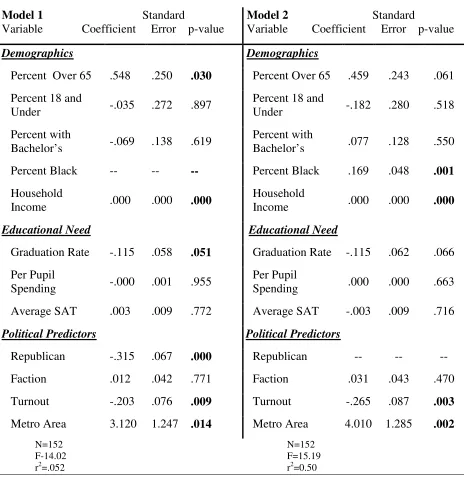
The table below represents the preliminary results of our model. Notice that Table 3.1
consists of two separate models. Two of our independent variables, “Republican” and “Percent
Black”, are highly correlated; for this reason two models have been created to adequately show
the significance of each variable in the model.11 Model 1, which includes the GOP measure,
re-turned with six statistically significant variables.
9
Data obtained from: www.sos.ga.gov
10
Data from the Census Bureau on Metropolitan Statistical Areas http://www.census.gov/population/metro/data/defhist.html
11
Table 3.1 OLS Regression of “Yes” Votes on Amendment 1
N=152 N=152
F-14.02 F=15.19
r2=.052 r2=0.50
Percent over 65, household income and metropolitan areas all had positive coefficients. We can
interpret these results as following: counties with higher percentages of persons aged over 65,
with higher household incomes, in metropolitan areas were most likely to vote “yes” for the
amendment. On the other hand, graduation rates, how Republican a county is, and magnitude of
turnout were all negative predictors of the “yes” vote. Some of these results counter our original
Model 1 Standard
Variable Coefficient Error p-value
Model 2 Standard
Variable Coefficient Error p-value
Demographics Demographics
Percent Over 65 .548 .250 .030 Percent Over 65 .459 .243 .061
Percent 18 and
Under -.035 .272 .897
Percent 18 and
Under -.182 .280 .518
Percent with
Bachelor’s -.069 .138 .619
Percent with
Bachelor’s .077 .128 .550
Percent Black -- -- -- Percent Black .169 .048 .001
Household
Income .000 .000 .000
Household
Income .000 .000 .000
Educational Need Educational Need
Graduation Rate -.115 .058 .051 Graduation Rate -.115 .062 .066
Per Pupil
Spending -.000 .001 .955
Per Pupil
Spending .000 .000 .663
Average SAT .003 .009 .772 Average SAT -.003 .009 .716
Political Predictors Political Predictors
Republican -.315 .067 .000 Republican -- -- --
Faction .012 .042 .771 Faction .031 .043 .470
Turnout -.203 .076 .009 Turnout -.265 .087 .003
expectations. The remainder of this section aims to explain these results and offer supplemental
models.
First, we will talk about the directionalities we correctly predicted for Model 1.
Household income was correctly predicted to have a significant impact on the percent “yes” vote
for Amendment 1. Again, this most likely captures the reality that charter schools thrive in more
affluent areas because of the need for financial donations.
The relationship between graduation rates and support for Amendment 1 were also
cor-rectly predicted. According to the model, as graduation rates increase, which aim to serve as a
proxy for successful educational systems, support for the amendment decreases. Therefore,
Georgians in school districts with higher graduation rates may have not seen a “need” for
educa-tional improvement and voted against the amendment.
Turnout was also a significant predictor in the model and reaffirmed the Jung’s findings
on SPLOST referenda. In regards to Amendment 1, counties with higher turnout rates were
sig-nificantly less likely to vote “yes” for the amendment. As Jung suggests, it may be the case that
charter school legislation is more likely to pass in special elections which typically have lower
turnout than general elections (Jung 2002, 27).
Lastly, metropolitan areas were a strong predictor of support for the amendment as
ex-pected. Support in these areas is likely attributable to higher affluence and the black vote. This
relationship is highlighted in Model 2, which incorporates the African American variable, where
the p-value for metropolitan areas increases from .014 to .002. This result also confirms Button’s
work that African Americans are much more likely to support educational ballot propositions.
Shifting to our variables which yielded counter-intuitive results, percent over 65, was a
knowledgeable about the amendment, or that this group is more likely to have
chil-dren/grandchildren and are more invested in the issue. Following tables will examine interactions
effects to determine if any such relationships exist.
However, what is perhaps most interesting about the results is that the GOP average
measure has a negative coefficient. What this means is that as a county becomes more
Republi-can, the likelihood it will support Amendment 1 decreases. This is a striking result because the
amendment itself was largely a Republican effort in the Georgia legislature, and according to the
literature, Republicans tend to support charter schools more than Democrats. Interpreting these
results in the same manner as above, for every 1 percent increase in the Republican measure the
“yes” vote for Amendment 1 decreases by .31 percent. The following section aims to clarify
the-se counter-intuitive results.
3.1.1 The County-Level Dynamic
Since our model does not show support for Amendment 1 among the Republican
elec-torate this leads us to first think that perhaps the GOP measure we have created does not
ade-quately capture the nuances of local politics. Therefore, the following tables try to account for
these shortcomings. Theoretically speaking, we should see differences between rural and
metro-politan Republicans in Georgia (Gimpel and Karnes 2006).12 Therefore, each county’s
metropoli-tan status has been designated by our metropolimetropoli-tan variable (1=metro 0=rural). Juxtaposing
met-ro and rural areas, we can see a clearer image of county-level dynamics. Table 3.2 shows the
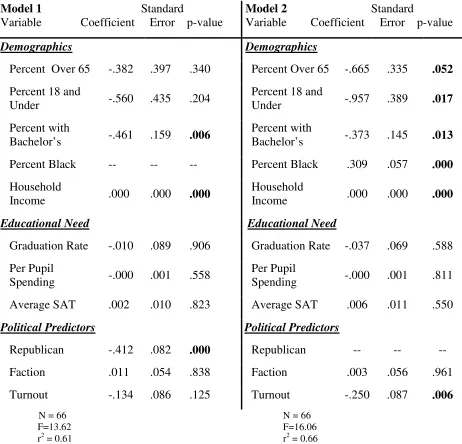
re-sults for Models 1 and 2 in metropolitan counties only.
Notice when we control for metropolitan counties the percent of the population with a
Bachelor’s degree becomes statistically significant with a negative coefficient. In other words,
12
for every 1 percent increase in persons with a Bachelor’s degree support for Amendment 1
[image:24.612.77.539.154.598.2]de-creases by .46 percent.
Table 3.2 OLS Regression of “Yes” Votes on Amendment 1 in Metropolitan Counties
Model 1 Standard
Variable Coefficient Error p-value
Model 2 Standard
Variable Coefficient Error p-value
Demographics Demographics
Percent Over 65 -.382 .397 .340 Percent Over 65 -.665 .335 .052
Percent 18 and
Under -.560 .435 .204
Percent 18 and
Under -.957 .389 .017
Percent with
Bachelor’s -.461 .159 .006
Percent with
Bachelor’s -.373 .145 .013
Percent Black -- -- -- Percent Black .309 .057 .000
Household
Income .000 .000 .000
Household
Income .000 .000 .000
Educational Need Educational Need
Graduation Rate -.010 .089 .906 Graduation Rate -.037 .069 .588
Per Pupil
Spending -.000 .001 .558
Per Pupil
Spending -.000 .001 .811
Average SAT .002 .010 .823 Average SAT .006 .011 .550
Political Predictors Political Predictors
Republican -.412 .082 .000 Republican -- -- --
Faction .011 .054 .838 Faction .003 .056 .961
Turnout -.134 .086 .125 Turnout -.250 .087 .006
N = 66 N = 66
F=13.62 F=16.06
r2 = 0.61 r2 = 0.66
The negative relationship between education and support for Amendment 1 is also elucidated in a
public opinion poll by the Atlanta Journal-Constitution from October 2012. According to the
poll, persons with no college education supported the amendment by 45 percent, while those
of those with a college education favor strengthening public schools while those with no college
education only support strengthening schools by 49 percent (Charter School Amendment Poll
2012). When it comes to supporting more options for school choice, college educated and
non-college educated support is 37 and 41 percent respectively (Charter School Amendment Poll
2012). Educated persons likely oppose the amendment because they believe that the best way to
strengthen schools is by improving the preexisting educational infrastructure. More educated
persons may also be aware of how the amendment would negatively affect local school funding.
Household income and the Republican measure remain significant predictors in Model 1.
Table 3.2 shows that Republicans in metropolitan areas are still less likely to support the
amendment, but what is most fascinating are the results from Model 2. When we control for
met-ropolitan areas in Model 2 every single demographic variable is significant. Again, this speaks to
the importance of the black vote for the amendment. Demographics may have a greater
explana-tory power than partisanship when it comes to analyzing who is most likely to support the charter
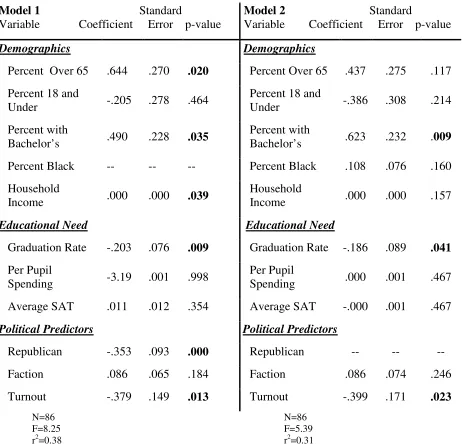
schools amendment in metropolitan areas. Below, Table 3.3 breaks down the models by rural
counties. Interestingly, Model 1 (GOP Model) does a much better job at predicting the “yes” vote
in rural counties than it does in metropolitan counties. These tables reaffirm Gimpel and Karnes’
(2006) findings that there in fact appears to be a wide gap between rural and urban voting
behav-ior. Most directionalities of independent variables are consistent through each model, except for
the education variable. Notice, when we reduce the model to rural counties only, percent with a
Bachelor’s degree becomes a positive predictor of the “yes” vote for both the GOP Model and
the Black Model. Persons from rural counties clearly have a different attitude about charter
Table 3.3 OLS Regression of “Yes” Votes on Amendment 1 in Rural Counties
N=86 N=86
F=8.25 F=5.39
r2=0.38 r2=0.31
We can draw several distinctions about the charter school amendment from these models.
First, race is more important in metropolitan areas than rural areas. The Black Metro Model from
Table 3.2 yielded six statistically significant variables as opposed to the three significant
varia-bles yielded from the GOP Metro Model. Second, every single demographic predictor was
sig-nificant in the Black Model. Third, no educational or political predictors were sigsig-nificant in the
Black Metropolitan Model, expect for turnout. Therefore, we can be confident that demographics
Model 1 Standard
Variable Coefficient Error p-value
Model 2 Standard
Variable Coefficient Error p-value
Demographics Demographics
Percent Over 65 .644 .270 .020 Percent Over 65 .437 .275 .117
Percent 18 and
Under -.205 .278 .464
Percent 18 and
Under -.386 .308 .214
Percent with
Bachelor’s .490 .228 .035
Percent with
Bachelor’s .623 .232 .009
Percent Black -- -- -- Percent Black .108 .076 .160
Household
Income .000 .000 .039
Household
Income .000 .000 .157
Educational Need Educational Need
Graduation Rate -.203 .076 .009 Graduation Rate -.186 .089 .041
Per Pupil
Spending -3.19 .001 .998
Per Pupil
Spending .000 .001 .467
Average SAT .011 .012 .354 Average SAT -.000 .001 .467
Political Predictors Political Predictors
Republican -.353 .093 .000 Republican -- -- --
Faction .086 .065 .184 Faction .086 .074 .246
played a major role influencing the “yes” vote in metropolitan counties. On the other hand, the
Rural Model tells a different story. With completely inverse results, the GOP Rural Model y
ed six statistically significant variables while the Black Rural Model only yielded three. The
GOP Rural Model shows significant predictors in all three categories (demographic, educational
“need”, and political). Fascinatingly, percent African America
cant in the Black Rural Model. This may lead one to conclude that support for Amendment 1 was
based more on race and demographics in metropolitan areas while support in rural areas was
more political or “need” based.
Below, Figure 3.1 highlights the percent “yes” vote by county type. Of the 159 counties
in Georgia, 83 voted in favor of Amendment 1 (52 percent). Majority of “yes” votes came from
metropolitan areas while nearly 75 percent of the “no” vote came from rural
quarter of metropolitan counties voted against the amendment.
Figure 3.1 Percent “Yes” Vote by County Type
Metro No Vote Rural No Vote Metro Yes Vote Rural Yes Vote
played a major role influencing the “yes” vote in metropolitan counties. On the other hand, the
Rural Model tells a different story. With completely inverse results, the GOP Rural Model y
ed six statistically significant variables while the Black Rural Model only yielded three. The
GOP Rural Model shows significant predictors in all three categories (demographic, educational
“need”, and political). Fascinatingly, percent African American was not even statistically signif
cant in the Black Rural Model. This may lead one to conclude that support for Amendment 1 was
based more on race and demographics in metropolitan areas while support in rural areas was
Below, Figure 3.1 highlights the percent “yes” vote by county type. Of the 159 counties
in Georgia, 83 voted in favor of Amendment 1 (52 percent). Majority of “yes” votes came from
metropolitan areas while nearly 75 percent of the “no” vote came from rural counties. Only a
quarter of metropolitan counties voted against the amendment.
Figure 3.1 Percent “Yes” Vote by County Type
Metro Yes Vote 31%
Rural Yes Vote 21% Metro No Vote
12% Rural No Vote
36%
Rural Yes Vote Metro No Vote Rural No Vote
played a major role influencing the “yes” vote in metropolitan counties. On the other hand, the
Rural Model tells a different story. With completely inverse results, the GOP Rural Model
yield-ed six statistically significant variables while the Black Rural Model only yieldyield-ed three. The
GOP Rural Model shows significant predictors in all three categories (demographic, educational
n was not even statistically
signifi-cant in the Black Rural Model. This may lead one to conclude that support for Amendment 1 was
based more on race and demographics in metropolitan areas while support in rural areas was
Below, Figure 3.1 highlights the percent “yes” vote by county type. Of the 159 counties
in Georgia, 83 voted in favor of Amendment 1 (52 percent). Majority of “yes” votes came from
3.1.2 Interaction Effects
The previous sections have argued that county-level dynamics, such as whether a county
is rural or metropolitan may have influenced voters’ support for Amendment 1. This section
ar-gues there are key ways in which the main independent variables of interest interact with one
an-other that may also influence the “yes” vote.
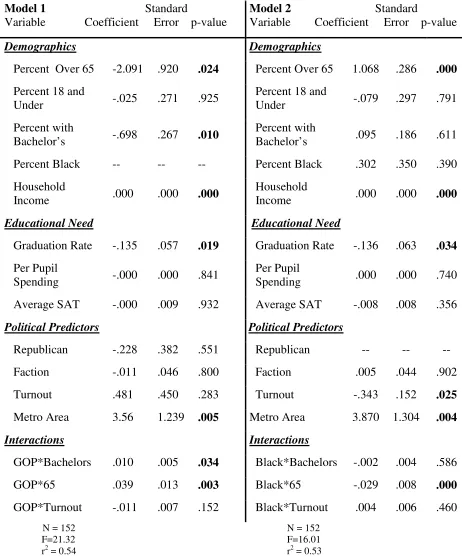
Below, Table 3.4 examines three different types of interaction effects between the
aver-age GOP measure and percent African American. Here we are interested in determining how
both models react when interacted with other significant variables. In the GOP Interaction Model
we have interacted the average Republican vote variable with percent with a Bachelor’s degree,
percent 65 and over and turnout. Percent 65 and over was chosen as an interaction term because
we originally expected this variable to yield a negative coefficient. Interacting this variable with
the average Republican vote may shed light on why both variables produced counter-intuitive
findings. Percent with a Bachelor’s degree was chosen because the directionality of coefficients
shifted when controlling for metropolitan and rural areas. Lastly, the turnout measure is used an
interaction term to test for consistency in its significance and directionality. The Black
Interac-tion Model tests the same three interacInterac-tions with the percent African American variable.
The GOP Interaction Model from Table 3.4 yields seven statistically significant results.
When controlling for the GOP interaction terms, the percent over 65 coefficient becomes
nega-tive, as we originally expected. Furthermore, the interaction terms between the average
Republi-can vote and percent with a Bachelor’s degree and percent over 65 are signifiRepubli-cant with positive
coefficients. These interactions tell us a lot about the effect of how “Republican” a county is and
its effect on the “yes” vote for Amendment 1. Without taking interaction terms into account, the
Table 3.4 OLS Regression of “Yes” Votes on Amendment 1 with Interaction Variables
Model 1 Standard
Variable Coefficient Error p-value
Model 2 Standard
Variable Coefficient Error p-value
Demographics Demographics
Percent Over 65 -2.091 .920 .024 Percent Over 65 1.068 .286 .000
Percent 18 and
Under -.025 .271 .925
Percent 18 and
Under -.079 .297 .791
Percent with
Bachelor’s -.698 .267 .010
Percent with
Bachelor’s .095 .186 .611
Percent Black -- -- -- Percent Black .302 .350 .390
Household
Income .000 .000 .000
Household
Income .000 .000 .000
Educational Need Educational Need
Graduation Rate -.135 .057 .019 Graduation Rate -.136 .063 .034
Per Pupil
Spending -.000 .000 .841
Per Pupil
Spending .000 .000 .740
Average SAT -.000 .009 .932 Average SAT -.008 .008 .356
Political Predictors Political Predictors
Republican -.228 .382 .551 Republican -- -- --
Faction -.011 .046 .800 Faction .005 .044 .902
Turnout .481 .450 .283 Turnout -.343 .152 .025
Metro Area 3.56 1.239 .005 Metro Area 3.870 1.304 .004
Interactions Interactions
GOP*Bachelors .010 .005 .034 Black*Bachelors -.002 .004 .586
GOP*65 .039 .013 .003 Black*65 -.029 .008 .000
GOP*Turnout -.011 .007 .152 Black*Turnout .004 .006 .460
N = 152 N = 152
F=21.32 F=16.01
r2 = 0.54 r2 = 0.53
However, when we examine how “Republican” a county is respective to the percentage of
The same is true for the relationship between the average Republican measure and the
percent of the population aged 65 and over. The more “Republican” a county becomes is a
signif-icant predictor of support for Amendment 1 when interacted with the percent of the population
aged over 65. In the Black Interaction Model we see that the percent over 65 variable coefficient
is positive and significant, as it has been in most models; however, when percent over 65 is
inter-acted with percent African American, the term yields a negative coefficient. The results from this
table may indicate that age plays a significant role in the charter school debate. If we treat the
average Republican vote and percent African American measures as proxies for conservatism
and liberalism respectively, then we might conclude that older conservative s were more likely to
support the amendment while older liberals were less likely to support the amendment.
Further-more, considering that the Georgia Democratic Party outright opposed Amendment 1 may have
signaled hardcore democrats, especially blacks aged 65 and over who grew up during the Civil
Rights movement, may have simply followed that State Party’s lead, even though African
Amer-icans are more likely to support educational ballot propositions. Overall, the Interaction Models
contribute to our understanding of which types of coalitions were most likely to support or
op-pose the amendment.
3.1.3 Ballot Language
The last area to examine regarding Amendment 1 is the ballot language itself. It would
not be much of a stretch to say that for many Georgians, the first time they had heard or even
read about the propositions for Amendment 1 may have been when they deciding whether or not
to vote “yes” at their polling place. For those who may have been unfamiliar with the
amend-ment, the ballot language itself seemed rather innocent. The official ballot language for
ap-proval of public charter schools upon the request of local communities? Notice that nowhere is
any mention made to the extraneous State Commission that would be created (or reinstated) to
override decisions made by local school boards. Nor is there any mention made on the fact that
the approving the amendment would allow the state to take public money away from local school
systems and give that money to the same charter schools that had previously been denied
appli-cation by the local system.
Opponents of the amendment argued that the ballot language was “intentionally
mislead-ing” and was likely the chief reason why the amendment passed by such a large margin of
58.5-42.5 (Bailey-Covin 2012). Even State Senator Vincent Ford (D-Atlanta) accused proponents of
“using vague ballot language…to confuse voters about the real intent of the proposal” (Barrow
2012b). It is certainly a fact that out of the nearly 3.8 million votes cast for Amendment 1 there
were at least a few voters who had never even heard of the charter school amendment until they
were already casting their votes. Bearing this in mind, it is certainly true that a large number of
Georgia voters were likely hoodwinked into voting “yes” for a constitutional amendment they
knew little about. As a matter of fact, after the election there were a flurry of reports from
Geor-gia voters who claimed they were unsure of what the amendment would actually do. This may
also explain why the amendment passed with 58.5 percent electoral support, 11 percentage
points higher than a local poll just weeks before the election (Huddleston 2012). The ballot
lan-guage for the amendment should not be overlooked as a major component that lead to the 17
point margin of victory.
4 CONCLUSIONS
In sum, this research has presented a handful of models which aimed to predict support
among voters and their perception towards charter schools in rural and metropolitan areas. The
Metropolitan Model showed that demographics including age, race, income and education were
the best predictors of support for the amendment while the rural vote was more influenced by
political and educational “need” variables. The research also shows that rural counties
over-whelming voted against the amendment, but the tremendous support from metropolitan counties
ultimately led to the amendment’s passage on Election Day. It makes sense that the amendment
gained major support from metropolitan counties considering that the bottom five performing
high schools, middle schools, and elementary schools for the entire state are found exclusively in
the Atlanta, Fulton, and Cobb County school systems (Best, worst schools 2013).
The Interaction Models also demonstrated that age and partisanship were major
predic-tors of support. If we treat the interaction of the average Republican vote and percentage of
per-sons over 65 as a coalition of conservatism and the interaction of percent black with percent over
65 as a coalition of liberalism, there are clear divisions of support and opposition respectively.
Lastly, examining the ballot language itself explains why the amendment passed by such a large
margin of victory. Together, this research paints an intricate picture of charter school support by
examining county-level dynamics, key interaction effects, and the actual substance of the
amendment itself.
Even though most of the models incorrectly predicted support for Amendment 1 among
Republicans and seniors, we may have simply misclassified their positions. It may be the case
that Republicans in the electorate captured anti-tax sentiment, not Georgia seniors, which would
have made the model more accurate. As mentioned earlier, counties with more persons aged over
65 may represent more individuals with children and grandchildren, causing this demographic
research was able to show a positive significant relationship between percent over 65 and percent
under 18 at the same time.
This study raises several important questions regarding the future of charter
schools in the United States. Are charter schools really the answer to failing traditional school
systems? There exists an impressive literature relating successful movements towards charter
schools linked with the revitalization of traditional community structure (Warren 2005). The
au-thor argues that the most successful initiatives towards educational reform are complimented by
strong community structures. Simply implanting a charter school into a dysfunctional community
provides no guarantee for success just like transplanting failing democracies in a war-torn
coun-ties. Then there is the debate over whether or not charter schools are more successful than
tradi-tional public schools. Despite the persistent rhetoric that charter schools are the solution to
fail-ing public schools, a recent study out of Stanford University shows that only 17 percent of
char-ter schools actually outperform their traditional counchar-terparts (Cox 2011).
Lastly, this analysis makes clear that the charter school debate in Georgia was far more
complicated than a Republican legislature pushing through conservative legislation in a red state.
On the contrary, this study demonstrates that the charter school debate was contested most in
partisan counties.13 The charter school debate should be understood not as a battle between
ideo-logues, but rather as a broad coalition of the college educated, seniors, African Americans, the
affluent, rural and metropolitan citizens alike fighting to improve the future of the educational
system for Georgia students. Georgia received national attention as a result of the Amendment 1
13
Though the “Faction” variable was not a significant predictor of support in any of the models there are some in-teresting facts that should be observed. The mean faction score for Georgia counties was 9.08, or that the average Gubernatorial candidate won by 9 points. When we examine faction scores below the mean, which range all the way to .14, we end up with 78 “factionalized” to “highly factionalized” counties. From these 52.6 percent voted against Amendment 1. Even when we examine factionalism scores above the mean which range all the way to
victory, becoming the first state to amend its constitution to support charter schools (Klein,
REFERENCES
Archbald, Douglas A. 2004. “Magnet Schools, and the Liberation Model: An Empirical Study.” Sociology of Education 77(4): 283-310.
Bailey-Covin, Nicole. “GA voters pass the Charter School Amendment against public school boards’ hopes.” The Examiner, November 7, 2012. http://www.examiner.com/article/ga- voters-pass-the-charter-school-amendment-against-public-school-boards-hopes
(Accessed April 16, 2014).
Barrow, Bill. 2012a. “Tea party activists divided on Georgia charter school amendment.”
Associated Press, November 3. http://chronicle.augusta.com/news/government/elections/
georgia-elections/2012-11-03/tea-party-activists-divided-georgia-charter (Accessed January 4, 2014).
Barrow, Bill. 2012b. “Georgia Voters OK Charter Schools Amendment.” Associated Press, November 14. http://www.times-herald.com/local/GA-voters-OK-charter-schools- amendment (Accessed January 4, 2014).
“Best, worst metro CCRPI school scores, 2012.” Atlanta Journal-Constitution, May 7, 2013. http://www.ajc.com/news/news/best-worst-metro-ccrpi-scores-2012/nXjHT/ (Accessed January 4, 2014).
Blau, Max. 2012. “Georgia charter schools amendment opposition ramps up.” Creative Loafing, September 25. http://clatl.com/freshloaf/archives/2012/09/25/georgia-charter-schools- amendment-opposition-ramps-up (Accessed January 4, 2014).
Branton, Regina P. 2003. “Examining Individual-Level Voting Behavior on State Ballot Propositions.” Political Research Quarterly 56(3): 367–77.
Button, James. 1993. “Racial Cleavage in Local Voting: The Case of School and Tax Issue Referendums.” Journal of Black Studies 24(1): 29–41.
“Charter schools amendment poll.” Atlanta Journal-Constitution, October 13, 2013.
http://www.ajc.com/news/education/charter-amendment-poll/ (Accessed April 16, 2014).
Cox, Thomas A. 2011. “Court decision not fatal to charters.” Atlanta Journal-Constitution, July 18. http://www.ajc.com/news/news/opinion/court-decision-not-fatal-to-charters/nQJgH/ (Accessed January 4, 2014).
Davies, Scott and Janice Aurini. 2011. “Exploring School Choice in Canda: Who Chooses What and Why?” Canadian Public Policy 37(4): 459-477.
Dodd, Aileen. 2009a. “3 charter schools could qualify for more local funding.” Atlanta Journal-
Constitution, June 11. http://www.ajc.com/news/news/local/3-charter-schools-could-
Dodd, Aileen. 2009b. “Gwinnett Schools suing over charter school’s funding: $850,000 went to Ivy Preparatory Academy of Norcross.” Atlanta Journal-Constitution, September 11. http://www.ajc.com/news/news/local/gwinnett-schools-suing-over-charter-schools- fundin/nQRbR/ (Accessed January 4, 2014).
Dodd, Aileen. 2010. “Case against Charter Schools Commission heads to state Supreme Court.”
Atlanta Journal-Constitution, October 10. http://www.ajc.com/news/news/local/case-
against-charter-schools-commission-heads-to-s/nQkxW/ (Accessed January 4, 2014).
Dodd, Aileen. 2011. “State Supreme Court disbands charter commission, rules schools
unconstitutional.” Atlanta Journal-Constitution, May 16. http://www.ajc.com/news/news/ local/state-supreme-court-disbands-charter-commission-ru/nQtYs/ (Accessed January 4, 2014).
Downey, Maureen. 2011a. “Lawmakers to the rescue of charters? Didn’t they cause this problem in the first place?” Atlanta Journal-Constitution, May 16. http://blogs.ajc.com/get-
schooled-blog/2011/05/16/the-legislature-to-the-rescue-of-charters-didnt-they-cause-this- problem-in-the-first-place/ (Accessed January 1, 2014).
Downey, Maureen. 2011b. “Breaking news: Georgia Supreme Court strikes down Charter Schools Commission in 4-3 vote.” Atlanta Journal-Constitution, May 16.
http://blogs.ajc.com/get-schooled-blog/2011/05/16/breaking-news-supreme-court-strikes- down-charter-schools-commission-in-4-3-vote/ (Accessed January 2, 2014).
Downey. Maureen. 2012a. “Choice or cash?” Atlanta Journal-Constitution, February 5. http://www.ajc.com/news/news/opinion/choice-or-cash/nQQ4J/ (Accessed January 2, 2014).
Downey, Maureen. 2012b. “Barge: Can’t support diverting $430 million from schools to create duplicate bureaucracy for charter school approval.” Atlanta Journal-Constitution, August 14. http://blogs.ajc.com/get-schooled-blog/2012/08/14/barge-cant-support-diverting-430- million-from-schools-to-create-duplicate-bureaucracy-for-charter-school-approval/ (Accessed January 4, 2014).
Dyck, Joshua J. 2010. “Political Distrust and Conservative Voting in Ballot Measure Elections.” Political Research Quarterly 63(3): 612–26.
Georgia General Assembly: Regular Session Legislation. 2007-2008. “Georgia Charter Schools Commission; establish.” http://www.legis.ga.gov/legislation/en- US/display/20072008/ HB/881 (Accessed January 4, 2014).
Huddleston, Dave. 2012. “Poll: 47% of Georgia voters support charter school amendment.”
WSBTV, October 26. http://www.wsbtv.com/news/news/local/poll-47-ga-voters-support-
charter-school-amendment/nSpf3/ (Accessed January 4, 2012).
Izlar, Mary Camille. 2013. “Stanford Study Says Charter School Children Outperform.”
Bloomberg Businessweek, June 25. http://www.businessweek.com/news/2013-06-
25/charter-school-children-outperform-peers-in-regular-classrooms (Accessed January 1, 2014).
Jung, Changhoon. 2002. The Impact of the Special Purpose Local Option Sales Tax (SPLOST) on Local Government Finance in Georgia. Athens: University of Georgia, Carl Vinson Institute of Government.
Klein, Mike. 2012. “No Generation Holds a Copyright on Learning Innovation.” Georgia Public Policy Foundation, October 2. http://mikekleinonline.com/tag/georgia-charter-schools-association/ (Accessed February 14, 2014).
LaPlant, James and Kristina LaPlant. 2012. “‘David is Going to Beat Goliath’: An Analysis of the 2012 T-SPLOST Referendum in Georgia.” Proceedings of the Georgia Political Science Association 2012 in Savannah, Georgia. http://www.gpsausa.org/images/stories/ proceedings/2012/LaPlant_Formatted_10-26-2013.pdf (Accessed on January 4, 2014).
Lauen, Lee. 2009. “To Choose or Not to Choose: Hhigh School Choice and Graduation in Chicago.” Educational Evaluation and Policy Analysis 31(3): 179-199.
O’Sullivan, Michael. 2013. “Revisiting the Georgia Charter School Amendment.” Students First, April 9. http://www.studentsfirst.org/state/georgia/blog/entry/revisiting-the-georgia- charter-school-amendment (Accessed January 4, 2014).
Sanders, Robert M., and Sooho Lee. 2009. “Determinants of Public Support for Education Sales Tax Initiatives in Georgia.” Journal of Education Finance 34(3): 267–88.
Sears, David O., and Jack Citrin. 1982. Tax Revolt: Something for Nothing in California. Cambridge, MA: Harvard University Press.
Thornton, Megan. 2012. “Governor inks a deal: Gov. Nathan Deal signs HB 797 at Cherokee Charter Academy.” Cherokee Tribune, May 4. http://www.cherokeetribune.com/view/ full_story/18452648/article-Governor-inks-a-deal--Gov--Nathan-Deal-signs-HB-797-at- Cherokee-Charter-Academy?instance=home_news_left (Accessed January 4, 2014).
Torres, Kristina. 2012. “Senate Republicans outline their 2012 agenda.” Atlanta Journal- Constitution, January 19. http://www.ajc.com/news/news/local-govt-politics/senate- republicans-outline-their-2012-agenda/nQQTG/ (Accessed January 2, 2014).
Warren, Mark R. 2005. “Communities and Schools: A New View or Urban Education Reform.”
Wingfield, Kyle. 2012. “Charter schools amendment points the way for Georgia GOP.” Atlanta Journal-Constitution, November 9. http://blogs.ajc.com/kylewingfield/2012/11/09/ charter-schools-amendment-points-the-way-for-georgia-gop/ (Accessed January 4, 2012).
APPENDIX
Variables, Characteristics and Sources
Variables Minimum Maximum Mean Standard
Deviation
Source
“Yes” Vote for Amendment One
(Nov 6, 2012)
25.75 71.44 50.53 8.80 GA Secretary of State Elections
Division Percent of
popula-tion over 65 (2011)
3.7 30.9 13.95 3.70 Census Bureau State and Coun-ty QuickFacts Percent of the
popu-lation 18 and under (2012)
14.6 29.7 12.89 2.95 Census Bureau State and Coun-ty QuickFacts Percent with a
Bachelor’s Degree (2006-2010)
4.7 47.6 15.81 8.48 Census Bureau State and Coun-ty QuickFacts Percent Black
(2011)
.7 73 28.35 17.23 Census Bureau State and Coun-ty QuickFacts Average GOP vote
in Presidential Elec-tions (2000-2012)
20.44 81.05 60.88 12.47 GA Secretary of State Elections
Division Factionalism (July
2010)
.14 57.03 13.09 11.60 GA Secretary of State Elections
Division Metropolitan Area
(2003)
0 1 .433 .497 Census Bureau Metropolitan Statistical Areas
Population by Coun-ty (2010)
246 949599 61654.65 129950.5 Census Bureau State and Coun-ty QuickFacts Median Household
Income (2006-2010)
22188 87605 40222.14 11348.45 Census Bureau State and Coun-ty QuickFacts High School
Gradu-ation Rate Percent-age (2012)
45.3 93.3 73.10 9.08 Atlanta Journal Constitution Online Database Per Pupil Spending
(2012)
4307.76 10535.48 5758.80 695.4158 Georgia De-partment of
Ed-ucation
Average SAT Scores 1027 1580 1347.9 96.67
Atlanta Journal Constitution Online Database Turnout 36.25 85.82 72.78 5.93 Georgia