ScholarWorks @ Georgia State University
ScholarWorks @ Georgia State University
Psychology Theses Department of Psychology
12-18-2013
Responses to Caregiver Violations of Communication in Typically
Responses to Caregiver Violations of Communication in Typically
Developing Children, Children with Autism Spectrum Disorder, and
Developing Children, Children with Autism Spectrum Disorder, and
Children with Down Syndrome
Children with Down Syndrome
Ann Grossniklaus
Follow this and additional works at: https://scholarworks.gsu.edu/psych_theses
Recommended Citation Recommended Citation
Grossniklaus, Ann, "Responses to Caregiver Violations of Communication in Typically Developing Children, Children with Autism Spectrum Disorder, and Children with Down Syndrome." Thesis, Georgia State University, 2013.
https://scholarworks.gsu.edu/psych_theses/112
DEVELOPING CHILDREN, CHILDREN WITH AUTISM SPECTRUM DISORDER, AND
CHILDREN WITH DOWN SYNDROME
by
ANN MARIE GROSSNIKLAUS
Under the Direction of Lauren B. Adamson
ABSTRACT
Examining responses to violations of communication may provide insight into children’s
communicative competencies not apparent during reciprocal interactions. In this study, the
caregivers of 18-month-old typically developing children, 30-month-old children with autism
spectrum disorder (ASD), and 30-month-old children with Down syndrome followed our
suggestion to playfully violate communication with their children in two contexts: requesting and
social interacting. Caregivers of children with ASD made fewer bids and violations, which their
children accepted less often than typically developing children; they also used instrumental
behaviors more often when responding. Children with Down syndrome responded to their
caregivers similarly to typically developing children, and used more high-level communicative
behaviors in the requesting, versus social interacting, context. This study highlights the
bidirectional nature of parent-child interactions, and suggests that violations of communication
may serve as a “press” to elicit child behaviors not present during reciprocal communication.
RESPONSES TO CAREGIVER VIOLATIONS OF COMMUNICATION IN TYPICALLY
DEVELOPING CHILDREN, CHILDREN WITH AUTISM SPECTRUM DISORDER, AND
CHILDREN WITH DOWN SYNDROME
by
ANN MARIE GROSSNIKLAUS
A Thesis Submitted in Partial Fulfillment of the Requirements for the Degree of
Master of Arts
in the College of Arts and Sciences
Georgia State University
Copyright by Ann Marie Grossniklaus
DEVELOPING CHILDREN, CHILDREN WITH AUTISM SPECTRUM DISORDER, AND
CHILDREN WITH DOWN SYNDROME
by
ANN MARIE GROSSNIKLAUS
Committee Chair: Lauren B. Adamson
Committee: Roger Bakeman
Şeyda Özçalışkan
Electronic Version Approved:
Office of Graduate Studies
College of Arts and Sciences
Georgia State University
DEDICATION
This work is dedicated to my family, who never lost faith in me, no matter what the
circumstances. This work is also dedicated to my uncle Kenny, my grandparents, and everyone
in my family whose life has been touched by intellectual disability. Finally, I would like to
ACKNOWLEDGEMENTS
I am forever indebted to the research assistants and laboratory volunteers Anita Hasni,
Jessica Sauls, and Bonnie Held; without whom this work would not have been possible. I would
also like to gratefully acknowledge the research coordinators who aided in this work, Pamela K.
Rutherford, Benjamin Brandon, and Katharine Suma. I would like to thank my thesis committee,
Dr. Lauren Adamson, Dr. Roger Bakeman, and Dr. Şeyda Özçalışkan for their continual
guidance. Finally, I would like to thank Dr. Christopher Henrich and Dr. Nevena Dimitrova for
TABLE OF CONTENTS
ACKNOWLEDGEMENTS ... iv
LIST OF TABLES ... ix
LIST OF FIGURES ... x
1. Introduction ... 1
1.1 Children’s Ability to Repair Violations of Communication ... 3
1.2 Requesting... 7
1.3 Social Interacting ... 9
1.4 Affective Communication ... 11
1.5 The Current Study ... 13
1.6 Study Hypotheses... 14
1.6.1 Caregiver communicative acts. ... 14
1.6.2 Overall child responsiveness. ... 14
1.6.3 Children’s low- and high-level responses. ... 15
1.6.4 Specific communicative behaviors. ... 16
1.6.5 Affective responses. ... 16
2. Method ... 18
2.1 Participants ... 18
2.3 Communication Play Protocol ... 20
2.4 Transcripts... 21
2.5 Coding Schemes... 21
2.6 Caregiver Codes ... 23
2.6.1 Type of caregiver communicative act. ... 23
2.6.2 Form of caregiver communicative act. ... 23
2.7 Child Codes ... 24
2.7.1 Type of child responsiveness to caregiver communicative acts. ... 24
2.7.2 Specific communicative behaviors... 25
2.7.3 Type of child affect. ... 26
2.8 Data Coding Procedure ... 26
2.8.1 Types of caregiver communicative acts. ... 27
2.8.2 Children’s responsiveness, specific communicative behaviors, and affective responses. ... 27
2.9 Inter-Observer Agreement ... 28
2.10 Sample Reduction ... 29
3. Results ... 31
3.1 Frequency of Caregiver Communicative Acts ... 31
3.2 Form of Caregiver Communicative Acts ... 34
3.4 Children’s Use of Low- and High-Level Behaviors ... 42
3.5 Children’s Use of Specific Communicative Behaviors ... 44
3.6 Children’s Affective Responses ... 48
4. Discussion ... 52
4.1 Typically Developing Children... 54
4.2 Children with ASD ... 57
4.3 Children with Down syndrome ... 61
4.4 Study Limitations ... 65
4.5 Conclusion ... 66
References ... 68
LIST OF TABLES
Table 1. Structure of Coding Scheme ... 22
Table 2. Sample sizes for Requesting, Social Interacting, and Comparison Conditions, After Dropping Participants. ... 30
Table 3. Frequency and Form of Caregiver Communicative Acts. ... 33
Table 4. Children's Responsiveness to Caregiver Communicative Acts ... 41
Table 5. Children's Low-and High-Level Responses to Caregiver Communicative Acts ... 43
Table 6. Context Differences of Children's High-Level Responses to Caregiver Communicative Acts ... 44
Table 7. Percentage of Children Displaying Specific Communicative Behaviors to Caregiver Bids and Violations in the Requesting Context ... 46
Table 8. Percentage of Children Displaying Specific Communicative Behaviors to Caregiver Bids and Violations in the Social Interacting Context ... 47
LIST OF FIGURES
Figure 1. Frequency of caregiver bids and violations. ... 32
Figure 2. Percentage of the form of caregiver bids and violations that contained a literal element
in the requesting context. ... 36
Figure 3. Children's percentage of the response of accept. ... 37
Figure 4. Children's percentage of the response of aware, but not responding. ... 38
1. Introduction
Early interactions with a primary caregiver are essential to the child’s
development of reciprocal communicative interactions. In the course of typical development,
caregiver-child interactions during infancy serve as a regulatory system for the infant to adjust
his or her behavioral states to those of the caregiver (Tronick, 1982). However, these states often
go through periods of mismatch, in which reparations of communication are crucial in order for
the infant to garner meaning from the interaction (Tronick & Beeghly, 2011). Previous research
has shown that studying these periods of mismatch or interruptions of reciprocal communicative
interactions adds to our understanding of the child’s communicative development.
In a seminal study, researchers investigated very young infants’ reactions to a mother’s
disruption of a face-to-face interaction (Tronick, Als, Adamson, Wise, & Brazelton, 1978). After
an initial play period, the mother continued to face her infant but became unresponsive, assuming
what has been termed a “still-face.” Infants were found to be affectively wary of their mothers
during the interruption period, to show a decrease in positive affect, and to display a pattern of
attempting to re-engage their mothers and then looking away, which has been subsequently
called the “still-face effect” (Tronick et al., 1978; see Adamson & Frick, 2003, for a summary of
research using the still face paradigm). This study demonstrated the importance of maternal
responsiveness in early infant-mother interactions, as well as the infant’s emerging ability to
self-regulate in the event of a nonresponsive partner. A recent meta-analysis (Mesman, van
Ijzendoorn, & Bakermans-Kranenburg, 2009) revealed that in over 80 empirical studies using the
the child’s gender, risk status (for example, siblings of children with autism spectrum disorder )
and variations in the still-face procedure.
It is possible that the still-face effect is strong because the still-face procedure effectively
challenges infants’ understanding of typical interactions with their caregivers, regardless of
individual child characteristics and changes in the procedure. However, there is a gap in the
current literature on how both typically and atypically developing children respond to more
subtle violations of expectations in communicative interactions with their primary caregiver.
Aside from the still-face studies, previous studies examining children’s affective expressions to
their caregivers have focused on their affect during reciprocal communication, rather than during
violations of communication. Therefore, the present study examines children’s affective
expressions during a situation that has not often been investigated, caregiver violations of
communication. The main purpose of the current study was to examine how typically developing
children, as well as children with autism spectrum disorder (ASD) and with Down syndrome,
responded to violations of their expectations during a communicative interaction with their
caregivers. We were specifically interested in two different types of caregiver communicative
acts: (1) caregiver bids for communication, in which the caregiver attempts to draw the child into
a communicative interaction, and (2) caregiver violations of communication, in which the
caregiver actively disrupts the child’s expectations of a communicative interaction. An example
of a caregiver violation of communication is when a caregiver does not comply with the child’s
request for an object. We examined overall responsiveness, specific communicative behaviors,
and affective responses of both typically developing children aged 18 months and atypically
Examining a child’s responsiveness, specific communicative behaviors, and affective
responses to a violation of communication may provide insight into the child’s understanding of
the communicative interaction that is not readily apparent during a reciprocal interaction. A
violation of communication could serve as a communicative “press” in which children are
pressured to showcase their communicative abilities in order to repair the interaction with their
parent. Children with ASD and children with Down syndrome may have problems with certain
communicative skills and affective regulation that are significantly different from those of
typically developing children’s communicative development. Studying atypically developing
children’s responses to violations of communication may aid researchers in understanding these
children’s communicative competencies and their communication profile in different contexts.
Key to this study is our examination of children’s responses to, and reparations of,
violations in communication with their primary caregiver as opposed to an experimenter. A brief
literature review follows, describing previous research that has addressed the issue of children’s
ability to repair violations of their communicative expectations with an experimenter, followed
by a review of studies exploring aspects of the ability of children with ASD and children with
Down syndrome to repair communicative interactions.
1.1 Children’s Ability to Repair Violations of Communication
In an important early study, Ross and Lollis (1987) probed typically developing infants’
reactions to violations of communication by examining their responses to interruptions of a
turn-taking game. Infants were observed four times longitudinally between the ages of 9 and 18
months. After a game consisting of at least four infant turns was established, the experimenter
paused for a 15-second interval, looking at the infant with a neutral facial expression but not
turns at appropriate times and frequently; these basic turn-taking abilities did not show any
developmental gains with age. However, the infants’ responses to the interruption periods
provided strong evidence for their awareness of the turn-taking structure as well as their role in
the game. Infants emitted more communicative signals for their partner to resume his or her turn
during the interruption period than during the reciprocal game period. As the infants grew older,
their communicative signals to the adult increased in clarity, and the signals they used were more
effective at repairing the communication violation. Over the nine months of the study, the infants
showed an increasing recognition of roles in the turn-taking game; the infants’ frequency of
taking the adult’s turn instead of their own turn during the interruption period increased fourfold
(Ross & Lollis, 1987). This study demonstrated that information about a child’s communicative
development, such as their ability and effort to repair a violation of communication, might be
gleaned from observing the child’s responses during a violation of communication.
More recent studies from Tomasello and colleagues have used the Ross and Lollis (1987)
experimental paradigm of examining children’s responses to a communicative interruption when
interacting with an adult. These researchers have expanded upon the original paradigm to
examine children’s understanding of joint intentionality, shared commitments, and cooperation.
Warneken, Chen, and Tomasello (2006) studied 18-month-old and 24-month-old typically
developing children’s responses to an experimenter’s interruption of four types of interactions.
These interactions included four conditions: one problem-solving task and one social game in
which the experimenter held a parallel role to the child, as well as one problem-solving task and
one social game in which the experimenter’s role was complementary to the child’s role. The
researchers found that in all four conditions, when the experimenter interrupted his role for a
re-engage the experimenter using communicative behaviors, although the 24-month-olds were
generally more skilled than the 18-month-olds. When this experiment was replicated with three
chimpanzees using similar tasks, none of the chimpanzees ever made an attempt to communicate
to the experimenter about the interruption of communication. These results led the authors to
conclude that shared intentionality is an aspect of communication unique to humans. A second
study expanded upon the original Warneken et al. (2006) study by examining children with ASD
with a mean chronological age of 40.3 months, and children with developmental delay with a
mean chronological age of 43.0 months. This study found that during interruption periods,
children with ASD attempted to reengage the partner less often than children with developmental
delays; in cases where the children with ASD did attempt to reengage the partner, they had
poorer coordination of eye gaze with other communicative behaviors than children with
developmental delay (Liebal, Colombi, Rogers, Warneken, & Tomasello, 2008). The authors
concluded that cooperative behavior and joint intentionality may represent areas of
communicative difficulty in children with ASD.
A third study enlarged upon the Warneken et al. (2006) study but used two different
experimental manipulations. In this study, all of the games the researchers used could be either
played alone or with a partner. Additionally, the study introduced two different conditions: one
in which the experimenter invited the child to play a game together with her, the joint
commitment condition, and another in which the experimenter joined the child as the child was
already playing the game, the no joint commitment condition. In the joint commitment condition,
two- and three-year-old children reacted to the adult experimenter’s interruption with
communicative actions attempting to reengage the experimenter, although they could have easily
reengage the adult significantly less often than in the joint commitment condition (Grӓfenhain,
Behne, Carpenter, & Tomasello, 2009).
Another recent study from Warneken and colleagues (Warneken, Grӓfenhain, &
Tomasello, 2012) used the Ross & Lollis (1987) paradigm to examine joint intentions and
cooperation in 21- and 27-month-olds. Here they hypothesized that children might attempt to
re-engage a nonresponsive partner in order to accomplish a task. Therefore, they studied children’s
responses to an experimenter’s interruption of a task in four different conditions. In two of the
conditions, the experimenter was needed to complete the task; in one condition she appeared
“unable” to help the child achieve the goal, in the second, she was “unwilling” to help the child.
In the third and fourth conditions, the experimenter was not needed to achieve the task, and was
again either “unable” or “unwilling” to help complete the task. The researchers found that
whether or not the experimenter was actually needed to accomplish the task, children at both
ages attempted to re-engage the experimenter at comparable levels; however, they attempted to
re-engage the “unable” partner more frequently than the “unwilling” partner (Warneken et al.,
2012). This study provided support for the claim that typically developing children are not
merely attempting to re-engage a partner to use him or her as a tool to accomplish a goal, but
rather view a partner as someone with whom they must cooperate in order to achieve a goal.
The present study focused on children’s responses to a caregiver violation of
communication that built upon an already existing communication system. This contrasted with
previous studies, which examined children’s reactions to an interruption of communication with
an unfamiliar adult experimenter. We sought to increase generalizability by examining
breakdowns of communication outside of the laboratory, and how children attempt to re-engage
a partner with whom they have extensive communicative experience.
In the current study, we focused on how children responded when their caregivers
violated their expectations in two contexts, one where the caregiver did not comply with the
child’s request (i.e., the requesting context) and the other a turn-taking game where the caregiver
failed to follow an established pattern of turn taking (i.e., the social interacting context). Games
and requesting episodes are two contexts which can showcase the infant’s developing skills in
interactions. We focused on the reactions to communication violations of three different groups
of children, comprised of typically developing children, children with ASD, and children with
Down syndrome. The comparison of these three groups provides us with information regarding
the three groups of children’s differing communicative development. As noted previously, the
context of a violation of communication serves as a “press” to elicit communication in children
with developmental disabilities that they would not exhibit during a reciprocal communicative
interaction.
In the remaining part of this literature review we will focus on scientific evidence
concerning both the competence and impairments of children with ASD and children with Down
syndrome in three domains crucial to the ability to repair communicative interactions ––
requesting, social interacting, and affective communication.
1.2 Requesting
In typically developing children, requesting is a skill that emerges around 8 months of
age. This skill requires the requester to have some knowledge about the action-related abilities of
the requestee (Bruner, Roy, & Ratner, 1982). In terms of atypically developing children, many
deficits in joint attention (Chiang, Soong, Lin, & Rogers, 2008; Loveland & Landry, 1986;
Mundy, 1995; Mundy, Sigman, Ungerer, & Sherman, 1986; Mundy & Stella, 2000; Stone,
Ousley, Yoder, Hogan, & Hepburn, 1997; Wetherby, 1986). Children with ASD are more likely
to use interactive actions, such as requesting, that lead to environmental consequences, than they
are to use interactive actions that lead to social consequences such as sharing attention and
interests (Wetherby, 1986). Other researchers have described this distinction as children with
ASD being relatively competent in using communicative gestures to request for objects, but
displaying a deficit in using the same types of gestures to initiate joint attention about an object.
(Mundy, 1995; Mundy et al., 1986; Chiang et al., 2008). Children with ASD are also more likely
to use contextually-restricted forms of communication to request, such as touching an object or
using an adult’s hand as a tool to obtain an object, than they are to use contextually-flexible
forms of communication, such as pointing and showing (Loveland & Landry, 1986; Stone et. al.,
1997; Wetherby, 1986). Some researchers have pointed to a possible difference in the
neurological systems involved in requesting and sharing attention, which may account for the
asynchrony between the two systems in children with ASD (Mundy, 1995).
In contrast to children with ASD, children with Down syndrome appear to have difficulty
making nonverbal requests. Additionally, these children’s deficits in expressive language may
render them particularly impaired in a requesting context. In an influential study, Smith and von
Tetzchner (1986) found that compared to mentally age-matched typically developing children,
children with Down syndrome exhibited deficits in nonverbal requesting behaviors. The authors
also found that this deficit was related to expressive language delays at follow-up visits.
Subsequent investigations of children with Down syndrome’s nonverbal requesting abilities have
intellectual disabilities and typically developing children. The children with intellectual
disabilities were not significantly different from the typically developing children in terms of the
frequency of their requesting behaviors; however, children with Down syndrome used
significantly fewer nonverbal requesting behaviors than the two comparison groups (Mundy,
Sigman, Kasari, & Yirmiya, 1988). Mundy, Kasari, Sigman, & Ruskin (1995) replicated the
1988 finding that children with Down syndrome displayed fewer nonverbal requests than
mentally age-matched typically developing children. Evidence from previous research suggests
that a deficit in nonverbal requesting behavior is unique to Down syndrome. However, these
deficits may be restricted to requesting for objects; nonverbal requests for social interacting may
not be impaired (Fidler, Philofsky, Hepburn, & Rogers, 2005). Additionally, in a communicative
interaction with their primary caregiver, children with Down syndrome have been found to be
unengaged more often in requesting, versus social interacting, contexts (Adamson, Bakeman,
Deckner, & Romski, 2009).
1.3 Social Interacting
Social interacting, specifically turn-taking games, provides insight into the infant’s
development of joint attention abilities (Bruner, 1977). Joint attention refers to the child’s ability
to integrate communicative interactions between himself, his caregiver, and an object or event;
children’s coordination of these triadic interactions emerges by 13 months of age in typically
developing children (Adamson, 1995; Bakeman & Adamson, 1984). In terms of atypical
development, social impairment is one of the well-known core deficits in children with ASD, and
is a diagnostic criterion of the disorder. A deficit in joint attention is well-documented in children
with ASD (Adamson et al. 2009; Adamson, McArthur, Markov, Dunbar, & Bakeman, 2001;
1996; Mundy, 1995; Mundy et al., 1986; Mundy & Stella, 2000; Mundy, Sigman, & Kasari,
1990; Stone et al., 1997; Wetherby, 1986). When children with ASD interact socially with an
adult, extensive difficulties permeate the interaction; the child rarely attends to the adult partner,
and episodes of coordinated joint attention are infrequent (Adamson, Bakeman, Deckner, &
Nelson, 2012; McArthur & Adamson, 1996). This can lead to a disruption of communication
between the adult and the child. The adult might attempt to repair this disruption by using literal
communication to direct the child’s attention, such as tapping on an object or waving it in front
of the child’s face. Previous studies have found that adults interacting with children with ASD
use literal bids paired with conventional bids for joint attention far more frequently than they do
with typically developing children and children with other developmental disorders (Adamson et
al., 2001; McArthur & Adamson, 1996). Some researchers have suggested that the disturbances
in joint attention skills that children with ASD present can be traced back to an earlier
disturbance in dyadic interactions with an adult. Specifically, children with ASD may have
particular difficulties engaging in triadic interactions that are most similar to their earlier
experiences in dyadic interactions, such as reciprocal turn-taking (Chiang et al., 2008).
The social impairments of children with ASD are not limited to a disturbance in joint
attention interactions. Compared to mentally age-matched developmentally delayed children and
typically developing children, children with ASD oriented less often to social stimuli in their
environment, and were less responsive to communicative partners’ expressions of distress
(Dawson et al., 2004). In contrast to typically developing children and children with Down
syndrome, children with ASD have been found to be less interested in social interacting than
In contrast to children with ASD, the responses to caregiver violations of a turn-taking
game by children with Down syndrome may serve to highlight these children’s aptitude for
social interacting. Children with Down syndrome display higher frequencies of social interacting
behaviors, such as the request for a repetition of a game, compared to mentally age-matched
typically developing children (Mundy et al., 1988). During playtime and mealtime at school,
children with Down syndrome have been found to interact significantly more with their
classmates than both children with ASD and younger typically developing children (Attwood,
Frith, & Hermelin, 1988). The interest of children with Down syndrome in interacting with an
adult experimenter increased over the course of a year-long study compared to typically
developing children, whose interest in interacting with the experimenter declined (Adamson et
al., 2010). This interest in social interacting makes children with Down syndrome competent
partners in conversation, and they are more skilled than typically developing language-matched
children in maintaining a topic over several conversational turns. They are also more proficient
than their language-matched peers at repairing conversational breakdowns (Tager-Flusberg,
1999; Tager-Flusberg & Anderson, 1991). Overall, researchers have found that when interacting
with their primary caregivers, the diagnosis of Down syndrome has a less pervasive effect on
communication than the diagnosis of ASD (Adamson et al., 2012).
1.4 Affective Communication
Affective expression is another aspect of communication that differs in children with
ASD and children with Down syndrome. Overall, positive affective expression appears to
constitute a particular area of difficulty for children with ASD and a particular area of strength
for children with Down syndrome. In terms of affective communication in social interacting,
towards adults than their typically developing peers and peers with ASD. Their consistently high
level of positive affect may serve to enhance their social communication, leading to a relative
strength in social interacting. In a study comparing the affective expression of children with
intellectual disabilities, ASD, and typically developing children during a joint attention context
and a requesting context, the children with intellectual disabilities showed uniformly higher
levels of positive affect across both contexts compared to the two other groups (Kasari, Sigman,
Mundy, & Yirmiya, 1990). The group of children with intellectual disabilities was comprised of
nine children with Down syndrome and nine children with intellectual disabilities of unknown
origin. Therefore, a uniformly higher level of positive affective expression may not be unique to
children with Down syndrome and may extend to other children with intellectual disabilities.
Comparing the affective expressions of children with ASD to children with Down
syndrome has shown that children with ASD display significantly lower levels of positive affect
towards both parents and experimenters (Joseph & Tager-Flusberg, 1997). Another study
examining affective exchanges between children with ASD and their mothers found that
compared to typically developing children, children with ASD displayed qualitative differences
in their expression of affect (Dawson, Hill, Spencer, Galpert, & Watson, 1990). Children with
ASD were much less likely to combine smiles with eye contact when interacting with their
mothers in a face-to-face setting; therefore, their smiles lacked communicative intent compared
to their typically developing peers. Children with ASD also were much less likely to smile in
response to their mother’s smiles, and the mothers of children with ASD were less likely to smile
in response to their children’s smiles (Dawson et al., 1990). Recently, researchers found that
compared to 18-month-old typically developing children and 30-month-old children with Down
as having lower levels of positive affect (Adamson et al., 2012). These results suggest a
disruption in the affective regulation of children with ASD and their caregivers.
1.5 The Current Study
In the current study, we focused on how children responded when their caregivers
violated their expectations in two contexts, one a requesting situation where the caregiver did not
comply with the child’s request and the other a social interacting situation where the caregiver
failed to follow an established pattern of turn taking. Requesting and social interacting formats
entail different communicative skills. During a violation of communication in a requesting
situation, children may be pressed to use various skills associated with joint attention, such as
eye contact, gestures, vocalizations, verbalizations, as well as potentially simulating affective
distress, in order to gain help obtaining or acting on an object. In contrast, in the social
interacting context of a turn-taking game, children may be pressed to show understanding of
their own, as well as the adult’s, role in a turn-taking game in order to repair the breakdown of
communication. The study compared three groups of children: typically developing children,
children with ASD, and children with Down syndrome, interacting with their caregivers across
two different communicative contexts: requesting and social interacting. Typically developing
children were observed at 18 months, and the atypically developing groups were observed at 30
months. These groups were comparable on language level. The ages were chosen because
18-month-old typically developing children may be at a developmental point when they undergo
accelerated language production and comprehension, which has been called a vocabulary “spurt”
(see Goldfield and Reznick, 1990; Reznick & Goldfield, 1992). Thus, typically developing
children at age 18 months, as well as their language-matched atypically developing peers, may
1.6 Study Hypotheses
The present study had two overarching aims: (1) to describe children’s responsiveness to
caregiver bids and violations and (2) to describe children’s specific communicative behaviors
and affective responses to caregiver bids and violations. We expected that children’s responses to
caregiver bids would provide insight into how children respond to a typical communicative
interaction with their caregiver, contrasting with how children respond to a caregiver violation of
communication, which is less common.
1.6.1 Caregiver communicative acts.
To meet our first goal, we characterized caregiver communicative acts (bids and
violations) before describing children’s responsiveness to these acts. Our first step was to
compare the frequency of caregiver communicative acts as well as the form (literal,
conventional, or both) of caregiver communicative acts. Literal caregiver communicative acts
contained an element that made these acts more perceptually salient to the child, for example,
tapping on an object while inviting the child to play with the object. We hypothesized that there
would not be a significant difference in the frequency of caregiver communicative acts between
the three groups, replicating previous research (Adamson et al., 2001; McArthur & Adamson,
1996). However, we anticipated that caregivers of children with ASD and caregivers of children
with Down syndrome would use more literal communicative acts than the caregivers of typically
developing children.
1.6.2 Overall child responsiveness.
We expected that typically developing children’s overall responsiveness would not differ
between the requesting and social interacting contexts. We hypothesized thatchildren with ASD
often) than typically developing children and children with Down syndrome. Accepting a
caregiver communicative act meant that the child responded in a manner consistent with the
caregivers’ communication, for example, agreeing to the caregiver’s invitation to play.
Furthermore, we anticipated that children with ASD would show the more rejecting (such as
cutting off the communicative interaction completely) and unaware (such as oblivious) responses
to caregiver communicative acts for communication than both of the other groups. We expected
that the responses of children with Down syndrome would be moderated by context, such that
they would be more accepting in the social interacting context and less accepting (i.e., showing
more unaware and rejecting responses) in the requesting context. We expected that children with
Down syndrome would show differing responsiveness given their relative strength in social
interacting contexts, but difficulties in requesting contexts.
1.6.3 Children’s low- and high-level responses.
We formed a communicative score by categorizing children’s responses as containing at
least one low-level response, or at least one high-level response. The breakdown of many low-
and high-level communicative responses was derived from the coding scheme for the Early
Social Communication Scales (Mundy et al., 2003). Additional behaviors of interest added to the
current study were broken into low- and high-level responses based on the clarity and complexity
of the response. A low-level communicative response was less complex and clear than a
level communicative response. We postulated that typically developing children would use
high-level communicative behaviors more frequently than both comparison groups. We expected that
children with ASD would use low-level communicative behaviors more frequently than typically
developing children. However, we anticipated that the communicative score of children with
communicative score when responding to caregiver communicative acts in the requesting context
than in the social interacting context. We anticipated that children with Down syndrome would
use low-level communicative behaviors more frequently than typically developing children. We
expected that the communicative score of children with Down syndrome would also be
moderated by context; however, we anticipated that these children would have a higher
communicative score of responses in the social interacting context than in the requesting context.
1.6.4 Specific communicative behaviors.
We expected typically developing children to use verbalizations and take the adult’s turn
significantly more frequently than children with ASD and Down syndrome. We anticipated that
children with ASD would show a higher frequency than both comparison groups of touching the
object, grabbing the object, and using the partner as a tool. We expected that children with ASD
would use eye contact and alternate gaze less often than both typically developing children and
children with Down syndrome. We expected that children with Down syndrome would use
gestures as a means to communicate more frequently than both comparison groups; in particular,
the reaching gesture.
1.6.5 Affective responses.
We hypothesized that the affective responses of typically developing children to
caregiver communicative acts would be moderated by context, such that these children would
display more positive affect during caregiver communicative acts in the social interacting context
than in the requesting context. Children with ASD were expected to show uniformly lower levels
of positive affect to caregiver communicative acts across the two communicative contexts. We
affect during periods of caregiver communicative acts across the two communicative contexts,
2. Method
2.1 Participants
This study used an existing archive of video records that was compiled for a project
investigating parent-child interactions in typically developing children (TD), children with
autism spectrum disorder (ASD), and children with Down syndrome (DS) (Adamson, Bakeman,
& Deckner, 2004; Adamson et al., 2009, see also Adamson et al., 2012). The sample consisted of
56 typically developing children (28 boys), 23 children with ASD (20 boys), and 29 children
with Down syndrome (19 boys). These children were observed 5 times over the course of a year;
for the purposes of this study, we focused on the first visit at 18 months of age for the typically
developing children, and the visit closest to age 30 months for the children with ASD and Down
syndrome. We selected these ages so that the children in the three groups would be comparable
on language as assessed using the MacArthur Communication Development Inventory (CDI;
Fenson et al., 1993). Raw CDI scores for the 18-month old TD children averaged 69.9 (SD =
71); mean scores for the 30-month-old ASD and DS groups were 113.5 (SD = 159.4) and 50.5
(SD = 65.2), respectively. These scores did not differ significantly per a One-Way Analysis of
Variance (ANOVA).
The typically developing toddlers were recruited from a larger pool of parents who
volunteered to participate in a university research study in the department of psychology. The
mean age at the first observations of the typically developing toddlers was 18.1 months (SD =
0.3). The children with ASD were recruited by three clinicians in the metropolitan Atlanta area.
Upon agreeing to participate in the study, diagnosis was confirmed in the ASD group by the
administration of the Autism Diagnostic Interview-Revised by an on-site trained research
sample was 30.8 months (SD = 4.6). All of the children in the ASD sample were receiving
clinical services, including 96% participating in speech therapy and occupational therapy, and
83% attending a special needs preschool. Children in the Down syndrome sample were recruited
using a network of referral services for children with communication delays. The mean age of
the children with Down syndrome was 30.3 months (SD = 4.9) at the initial visit. All but one
child in the DS sample were receiving clinical services, including 97% receiving speech-therapy,
83% receiving occupational therapy, and 62% of the children attending a special needs
preschool.
The TD, ASD, and DS samples were diverse, with 79% of TD, 83% of ASD, and 79% of
DS children classified as European American. Additionally, 16% of TD, 0% of ASD, and 21%
of DS children were African American, and 4% of TD, 13% of ASD, and 0% of DS children
were Hispanic. The majority of the children’s parents were well-educated, with 75% of the TD,
65% of the ASD, and 79% of the DS parents having earned at least a bachelor’s degree.
We used the term “caregiver” in this study to indicate the interactions between our
participants and their primary caregivers. The vast majority of our 108 participants were
mother-child dyads (n = 106), however, two dyads were father-child, both in the Down syndrome group.
2.2 Procedure for Data Collection
Children and their caregivers were observed interacting in a 4.6 m × 3.1 m playroom in
the Developmental Laboratory at Georgia State University. Each observational session lasted
two hours on average. The sessions were recorded by two video cameras situated behind
one-way mirrors. These one-one-way mirrors were on opposing walls of the playroom, permitting the
order for observers to simultaneously view both recordings of the interactions, the video
recordings were synchronized with a common vertical interval time code (VITC).
2.3 Communication Play Protocol
The current study examined caregiver-child interactions during the Communication Play
Protocol (CPP) portion of the observation sessions (Adamson et al., 2004; 2009; 2012). The CPP
encouraged parent-child communication over the course of six 5-minute long “scenes” in which
the child was the star of the play and the parent was the supporting actor. These scenes were
structured to facilitate interaction over three specific communicative contexts: requesting,
commenting, and social interacting. Both video records and transcripts of the observational
sessions were available in the project archive.
For the purposes of this study, we examined one scene in the communicative context of
requesting (the “I Want” scene), and one scene in the communicative context of social
interacting (the “Take Turns” scene). The length of the “I Want” scene was 310.28 s (SD =
11.96) on average and did not differ by group. The mean length of the “Take Turns” scene was
312.83 s (SD = 13.78) and also did not differ by group. In the “I Want” scene, three highly
desirable toys were placed on a shelf above the child’s reach but within the parent’s easy reach.
The toys included two toys provided by the laboratory and one of the child’s favorite toys from
home. The parent was instructed by means of a “cue card” to momentarily pretend not to
understand the child’s request before giving the child the toy. The cue card suggestion stated,
“Readily agree to help [your child]. But initially act puzzled about which toy. Then make a
mistake offering [your child] another toy. Finally, go ahead and give [your child] the toy”
(Adamson & Bakeman, 1998). In the “Take Turns” scene, the director brought in toys designed
“encourage [your child] to communicate, tease her a bit by pausing before you take some of your
turns” (Adamson & Bakeman, 1998).
2.4 Transcripts
For the purposes of the current study, we used each utterance from previously transcribed
transcripts as our primary unit of analysis for caregiver communicative acts. These transcripts
originated from a study by Adamson and Bakeman (2006). For the earlier study (2006), a pair of
transcribers transcribed each scene of the CPP. The first transcriber viewed the scene from one
camera angle and transcribed the scene, and the second reviewed the transcript while viewing the
scene from the second camera angle. A third, senior transcriber reviewed the transcript if one of
the original two transcribers was new to transcription. Occasionally, transcribers made
corrections to the transcripts if an utterance was misheard or missed altogether.
2.5 Coding Schemes
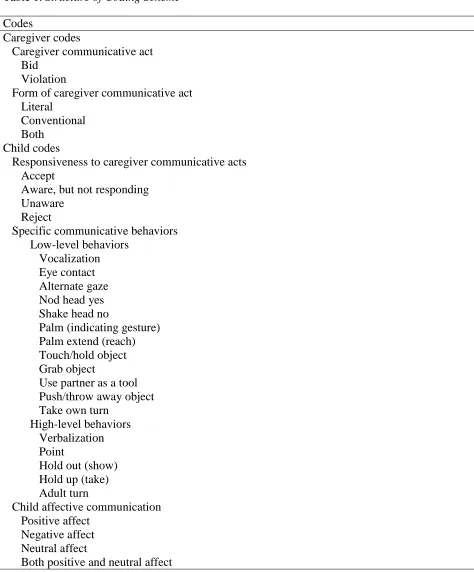
Table 1 summarizes the codes used to determine the (1) type and the form of caregiver’s
communicative acts and (2) the codes used to determine the type of responsiveness by the child
to the caregiver’s communicative acts, the types of child’s specific communicative behaviors
including low- and high-level behaviors, and the types of child’s affective communication. This
coding scheme was used to code both the requesting and social interacting contexts. Please see
Table 1. Structure of Coding Scheme
Codes
Caregiver codes
Caregiver communicative act Bid
Violation
Form of caregiver communicative act Literal
Conventional Both
Child codes
Responsiveness to caregiver communicative acts Accept
Aware, but not responding Unaware
Reject
Specific communicative behaviors Low-level behaviors
Vocalization Eye contact Alternate gaze Nod head yes Shake head no
Palm (indicating gesture) Palm extend (reach) Touch/hold object Grab object
Use partner as a tool Push/throw away object Take own turn
High-level behaviors Verbalization Point
Hold out (show) Hold up (take) Adult turn
Child affective communication Positive affect
Negative affect Neutral affect
2.6 Caregiver Codes
2.6.1 Type of caregiver communicative act.
The code of caregiver bid for communication originated from a previous study by
Adamson et al. (2001). A caregiver bid occurred when the parent invited the child to take part of
an activity, or sustain the activity by attempting to re-engage the child. For example, a caregiver
bid occurred when the caregiver took a reciprocal turn in the social interacting context, since he
or she was actively sustaining the communicative interaction. A caregiver violation occurred
when he or she disrupted the interaction by either pretending not to understand a child’s request
in the requesting context, or forgetting his or her role during a turn-taking game in the social
interacting context. A non-applicable communicative act was coded when the caregiver
communicated with the child other than by using a bid or violation, for example, commenting to
the child.
2.6.2 Form of caregiver communicative act.
The codes of literal versus conventional caregiver communication were derived from
earlier coding schemes developed by Adamson and Bakeman (1982; 1983). A caregiver bid or
violation was either purely literal, purely conventional, or contained both literal and
conventional elements. A purely literal communicative act contained no conventional elements
of communication such as language or conventional gestures, and it was used to make the object
of focus more perceptually salient. An example of a purely literal communicative act would be
shaking a toy in front of the child’s face in order to get his or her attention. A purely
conventional bid contained no literal aspects of communication; therefore, using only language
and conventional gestures were considered to be purely conventional bids. An example of a
ball.” If a communicative act contained a literal and conventional element simultaneously, it was
coded as both literal and conventional.
2.7 Child Codes
2.7.1 Type of child responsiveness to caregiver communicative acts.
Coders characterized the type of children’s responsiveness to caregiver communicative
acts as one of four mutually exclusive codes: accept, aware, but not responding, unaware, and
reject. These codes were adapted from the Adamson et al. (2001) coding scheme.
Accept. When the child accepted the caregiver communicative act, he or she responded to
the caregiver in an active, communicative manner that did not cut off the communicative
interaction. Generally, the child responded in a manner compliant with what the caregiver was
asking of him or her. For example, the caregiver might have asked, “What do you want?” and the
child gestured emphatically toward the shelf.
Aware, but not responding. When the child was aware, but not responding to the
caregiver communicative act, he or she noticed the act, but did not respond to it. A common
example of aware, but not responding occurred when the child watched passively as the
caregiver either made a bid or a violation of communication.
Unaware. Whenthe child was unaware of the caregiver communicative act, he or she
typically continued with the activity as if no caregiver bid or violation occurred.
Reject. When the child rejected the caregiver communicative act, he or she actively
responded to the caregiver communicative act in a way that cut off the communicative
interaction. For example, if the caregiver asked, “Where’s your ball?” and the child shook his or
her head to indicate “no” or used a vocalization combined with negative affect, this would be
2.7.2 Specific communicative behaviors.
If the child responded by accepting or rejecting the initial caregiver communicative act,
specific child behaviors associated with this response were also coded. The child could respond
to a caregiver communicative act with one or more communicative behaviors that have been
previously identified as low- and high- level communicative behaviors. The codes of eye contact,
alternating gaze, and pointing were derived from the Early Social Communication Scales coding
scheme (Mundy et al., 2003). The codes of own turn and adult turn were adapted from the Ross
and Lollis (1987) coding scheme, which characterized children’s reactions to adult’s violations
of a turn-taking game. The palm, palm extend, hold up, and hold out codes originated from
Özçalışkan and Goldin-Meadow’s (2005) gesture coding scheme.
2.7.2.1 Low-level behaviors.
There were twelve low-level communicative behaviors coded in the present study. These
behaviors included vocalizations, eye contact with the parent, alternating gaze between the
parent and the object, the child nodding his head to indicate “yes”, shaking his head to indicate
“no”, the child’s gesture of extending his palm towards an object to indicate the object, coded as
palm, the child extended his arm while reaching toward an object to request the object, coded as
palm-extend, the child taking his own turn, the child touching the object, grabbing the object,
using the partner as a tool, and/or pushing away the object.
2.7.2.2 High-level behaviors.
There were five high-level communicative behaviors coded in this study. These behaviors
included verbalizations and pointing toward an object, the child holding out the toy to the
caregiver, indicating his/her desire to give the parent the toy, the child holding up the toy to show
Mundy et al.’s (2003) Early Social Communication Scales, high-level behaviors were more clear
and complex than low-level behaviors. Verbalizing indicates a clarity/refinement of a
vocalization; pointing also indicates the refinement of a reaching gesture. Holding up the toy and
holding out the toy were considered high-level behaviors because these behaviors are associated
with more complex joint attention behaviors; the communicative purpose of these behaviors is
very clear, unlike alternating gaze from the parent to the object that could indicate both a request
or a joint attention behavior. Finally, taking the adult’s turn indicated that the child had a
rudimentary understanding of the adult’s, versus the child’s, role in the turn-taking interaction.
2.7.3 Type of child affect.
Following each caregiver bid or violation, the presence of children’s positive or negative
affect was noted. If positive or negative affect was not present, it was assumed that the child’s
affective expression remained neutral. If the child displayed both negative and positive
emotional reactions, this indicated a “mixed” affective response, and was coded as both.
2.8 Data Coding Procedure
The first author of the study and two research assistants coded both the “I Want” scene
and the “Take Turns” scene of the Communication Play Protocol; these scenes correspond to the
requesting context and the social interacting context, respectively. Coding was done using
Mangold International’s INTERACT software. This allowed the coders to review behaviors of
interest in slow motion, and embed the onset and offset times of specific codes into the software.
It also allowed for the coders to embed a hierarchical coding scheme into the software; that is,
once a behavior of interest was noted, the coders selected subsequent codes that followed the
2.8.1 Types of caregiver communicative acts.
Caregiver utterances and caregiver nonverbal communicative acts were coded by two
independent observers as three options: caregiver bids, caregiver violations, or as non-applicable
communicative acts. To accurately characterize each caregiver utterance and nonverbal
communicative act, coders viewed the 5-minute video clip of a scene while simultaneously
examining a previously recorded transcription of all caregiver and child utterances in the scene.
Coders noted next to each utterance on the transcript whether the utterance was a caregiver bid, a
caregiver violation, or a non-applicable caregiver utterance, which had no notation and was
simply left in the original form on the transcript. After one pass of reviewing the video record
and the transcript simultaneously, the coder viewed the video record again and pressed a
computer key whenever a caregiver bid or violation occurred; thus, recording the onset and
offset time of the communicative act in the INTERACT software. Additionally, we computed the
total number of caregiver communicative acts per scene by adding together the caregiver bids,
caregiver violations, and non-applicable caregiver communicative acts in each scene.
2.8.2 Children’s responsiveness, specific communicative behaviors, and affective
responses.
To characterize children’s responsiveness, specific communicative behaviors, and
affective responses to caregiver bids and violations, we employed a hierarchical coding scheme
using Mangold International’s INTERACT software. A second pair of independent coders
viewed caregiver bids and violations that were entered into the INTERACT software prior to this
stage of data collection. Coders viewed each caregiver communicative act and corresponding
child response as many times as necessary, to ensure that no specific child behaviors were
certain that the child response corresponded to the correct caregiver communicative act. This
strategy was especially useful when several caregiver communicative acts occurred in succession
over a short period of time (i.e., a 10- or 20- second interval).
2.9 Inter-Observer Agreement
Inter-observer agreement was assessed on 20% of the corpus coded by two sets of
independent coders. Forty-four 5-minute scenes were randomly selected to calculate
inter-observer agreement on identifying caregiver bids and violations, and 35 5-minute scenes were
randomly chosen to compute inter-observer agreement on the form of the caregiver
communicative act, overall child responsiveness, specific child behaviors, and child affect. The
coders were blind to which video segments were used to calculate inter-observer agreement.
Cohen’s kappa, a statistic that assesses the reliability of a categorical scale while correcting for
chance agreements, was computed to assess inter-observer agreement (Cohen, 1960).
For caregiver bids and violations, Cohen’s kappa (κ) values were .79 and .68,
corresponding to 87% and 86 % inter-observer agreement in the requesting and social interacting
contexts, respectively. These Cohen’s kappa statistics indicated acceptable inter-observer
agreement, given the small number of codes (three; caregiver bid, caregiver violation, or
non-applicable communicative act) and the moderate variability of the codes (i.e., caregiver
communicative acts were most likely to be non-applicable, followed by caregiver bids, and
finally caregiver violations) (Bakeman & Quera, 2011).
For the form of the caregiver communicative act, overall child responsiveness, specific
child behaviors, and child affect, two types of Cohen’s kappa statistics were used to calculate
inter-observer agreement. The first was the Cohen’s kappa statistic for event alignment
events, and then coded the string of events that followed the initial event (in this case, a caregiver
bid or violation). The tolerance for the event-alignment kappa value was 5, with an 80% overlap.
Values for the event alignment kappa statistic ranged from .74 – .91. Given the small number of
mutually exclusive and exhaustive codes, as well as the moderate to high variability of the use of
the codes, all event alignment kappa statistics indicated acceptable inter-observer agreement. The
second Cohen’s kappa statistics was the statistic for time-unit agreement, which referred to the
second-by-second agreement of the occurrence of specific behaviors (Bakeman & Quera, 2011).
The tolerance for the time-unit agreement kappa value was ± 2 1/10 seconds Values for the
Cohen’s kappa statistic for time-unit agreement ranged from .81 – .94. Again, given the small
number of possible codes for many of the variables, as well as the variability of the codes, all of
our kappa statistics indicated acceptable inter-observer agreement.
2.10 Sample Reduction
The primary goal of the present study was to describe children’s responses to caregiver
violationsof communication. We were especially concerned with the number of participants who
did not experience a caregiver violation of communication in either the requesting or social
interacting context. In the requesting context, the number of participants who did not experience
a violation of communication was 0, 3, and 4 for the TD, ASD, and DS groups, respectively. In
the social interacting context, the number of participants who did not experience a violation of
communication was 22, 9, and 4 for the TD, ASD, and DS groups, respectively. Therefore, we
made the decision to drop participants from the context where they did not experience a violation
of communication, but to retain them as participants in the context in which they did experience
a violation of communication. Only one participant did not experience a violation of
dropping participants only from the context where they did not experience a caregiver violation,
we could retain as many participants as possible for the study as a whole, in order to retain
enough power to detect statistically significant effects. Additionally, conceptually, if a child
experienced a caregiver violation at least one context, the child’s response to the violations he or
she did experience was valuable in answering the overarching question of how children
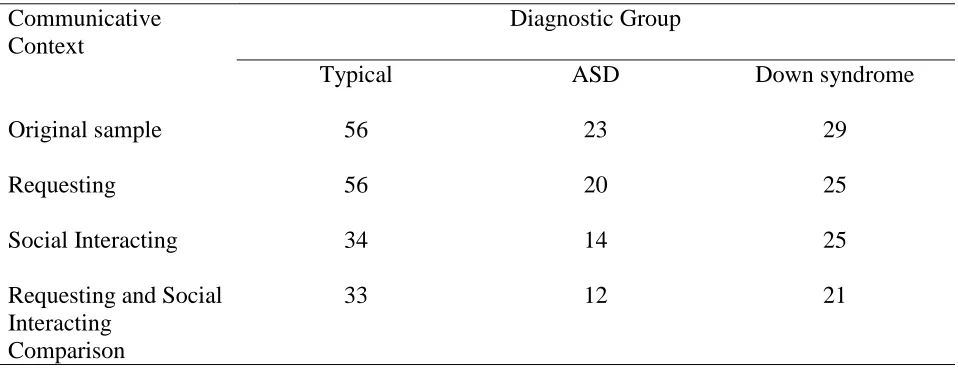
responded to caregiver interruptions of communication. Table 2 describes the sample sizes for
[image:42.612.68.547.329.514.2]the requesting and social interacting contexts after dropping participants.
Table 2. Sample sizes for Requesting, Social Interacting, and Comparison Conditions, After Dropping Participants
Communicative Context
Diagnostic Group
Typical ASD Down syndrome
Original sample 56 23 29
Requesting 56 20 25
Social Interacting 34 14 25
Requesting and Social Interacting
Comparison
3. Results
3.1 Frequency of Caregiver Communicative Acts
In the requesting context, across the three groups of children, caregivers made an average
of 19.5 bids per 5-minute observational period (SD = 14.4), 20.2 violations (SD = 12.1), and 95
total communicative acts (SD = 29). In the social interacting context, caregivers made an average
of 19.4 bids per observational period (SD = 9.9), 8.0 violations (SD = 7.7), and 107 total
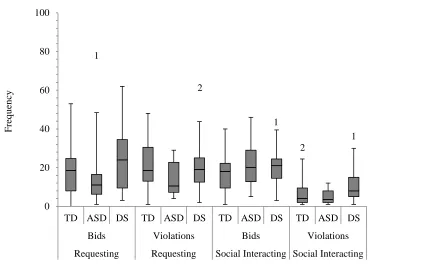
communicative acts (SD = 28.2). Figure 1 illustrates the distribution of the frequency of
caregiver communicative acts for each group in both communicative contexts. The frequency of
caregiver communicative acts was analyzed using One-Way Analyses of Variance (ANOVA).
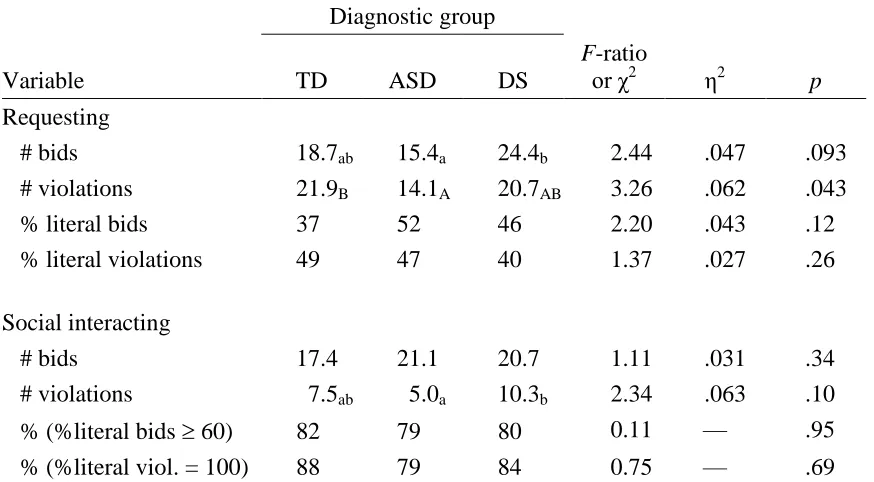
Table 3 summarizes the findings of diagnostic group differences for the frequency of caregiver
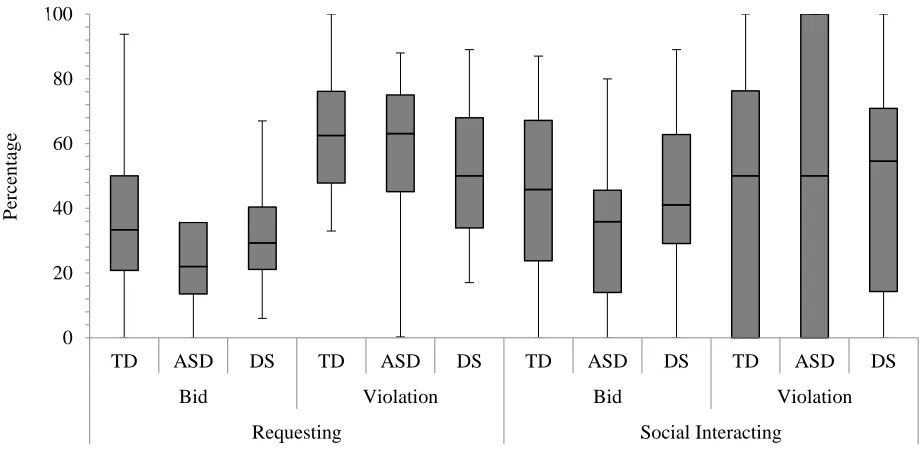
Figure 1. Frequency of caregiver bids and violations. In the requesting context, N = 56, 20, and 25 for the TD, ASD, and DS groups, respectively. In the social interacting context, N = 34, 14, and 25 for the TD, ASD, and DS groups, respectively. From the x-axis upwards, the dark lines of the boxes represent the 1st quartile, the median, and the 3rd quartile of the distribution. The whiskers represent the range of the distribution, and numerals above the whiskers represent the number and the approximate location of outliers.
0 20 40 60 80 100
TD ASD DS TD ASD DS TD ASD DS TD ASD DS Bids Violations Bids Violations Requesting Requesting Social Interacting Social Interacting
1
2
1 1
2
Fre
q
u
en
Table 3. Frequency and Form of Caregiver Communicative Acts
Diagnostic group
Variable TD ASD DS
F-ratio
or χ2 η2
p
Requesting
# bids 18.7ab 15.4a 24.4b 2.44 .047 .093
# violations 21.9B 14.1A 20.7AB 3.26 .062 .043
% literal bids 37 52 46 2.20 .043 .12
% literal violations 49 47 40 1.37 .027 .26
Social interacting
# bids 17.4 21.1 20.7 1.11 .031 .34
# violations 7.5ab 5.0a 10.3b 2.34 .063 .10
% (%literal bids 60) 82 79 80 0.11 — .95
% (%literal viol. = 100) 88 79 84 0.75 — .69
Note. In the requesting context N = 56, 20, and 25, and in the social interacting context N = 34, 14, and 25 for the TD, ASD, and DS groups, respectively. For the requesting context, % literal is the percentage of bids and violations containing a literal element. For the social interacting context, the percentage scores are, for bids, the percentage of caregivers for whom at least 60% of their bids contained a literal element and, for violations, the percentage of caregivers for whom 100% of their bids contained a literal element. Means that do not differ significantly per a Tukey post hoc test, p < .05, share a common uppercase subscript and means that do not differ significantly per a Tukey post hoc test, p < .10, share a common lowercase subscript.
For the purposes of this study, we considered any effect at the p ≤.05 level to be
significant, and any effect that was significant at the p ≤ .10 value as marginally significant. We
hypothesized there would be no group differences in terms of the frequency of caregiver bids and
violations. Contrary to our hypotheses, there were group differences in the frequency of
caregiver bids and violations. In terms of violations, in the requesting context, children with
ASD experienced significantlyfewer violations of communication than typically developing
children; children with Down syndrome did not differ significantly from either group. There was
interacting context. Children with ASD experienced fewerviolations than children with Down
syndrome, and typically developing children did not differ significantly from either group. In
terms of caregiver bids, there was a marginally significant group difference of the frequency of
caregiver bids in the requesting context. Children with ASD experienced fewer caregiver bids in
the requesting context than children with Down syndrome; typically developing children did not
differ from either group.
3.2 Form of Caregiver Communicative Acts
To characterize the number of caregiver communicative acts that contained a literal
element, we combined the number of acts coded as purely literal and as both literal and
conventional to account for all instances when the caregiver exhibited a literal element during a
communicative act. This score was then transformed into a percentage of the total number of
caregiver communicative acts. Due to the participants’ extremely frequent use of a literal
element when communicating in the social interacting context, we employed a binary recode to
analyze the percentage of caregiver bids and violations that contained a literal element for the
social interacting context. Such recording was not necessary in the requesting context where the
frequency of the caregivers’ use of a bid or violation that contained a literal element was not
extremely skewed and was normally distributed.
In the social interacting context 99.3% of caregiver produced at least one communicative
act that contained a literal element. Therefore, in the social interacting context, we chose to
recode the percentages of caregiver communicative acts that contained a literal element as a
binary variable, but to use different cut-off percentages based on how negatively skewed the
percentages were for bids and violations. For caregiver bids, 80% of the participants used a bid
bid that did not contain a literal element less than 60% of the time. We chose 60% as the cut-off
percentage for recoding caregiver bids, to parallel as closely as possible the 85%/15% split for
caregiver violations, described below. For caregiver bids, a score of 0 indicated that the caregiver
used a violation that contained a literal element less than 60% of the time, whereas a score of 1
indicated that the caregiver used a bid that contained a literal element 60% or more of the time.
In terms of caregiver violations in the social interacting context, 85% of the participants’ used a
literal element every time they violated the interaction. Therefore, we used 100% as the cut-off
percentage for recoding caregiver violations. A score of 0 indicated that the caregiver used a
violation that contained a literal element less than 100% of the time, whereas a score of 1
indicated that the caregiver used a violation that contained a literal element 100% of the time.
Thus, 85% of the participants received a score of 1, and 15% received a score of 0. We then used
a chi-square test to examine group differences for the percentage of bids and violations that
contained a literal element in the social interacting context.
Figure 2 illustrates the distribution of the form of caregiver communicative acts. Given
the extreme skew of bids and violations that contained a literal element in the social interacting