2019 International Conference on Computation and Information Sciences (ICCIS 2019) ISBN: 978-1-60595-644-2
Design of Stadium Security System
Based on Android and Zigbee
Wei Song
ABSTRACT
With the rapid development of IoT application technology, to develop efficient and fast design a scenario of Internet of things application has been becoming the current hot topic. This paper was designed using an Android and ZigBee this two common Internet of things technology development sports venues monitoring system, the method of system adopts hierarchical design, simple and efficient development process, has a certain popularization significance.
1. INTRODUCTION
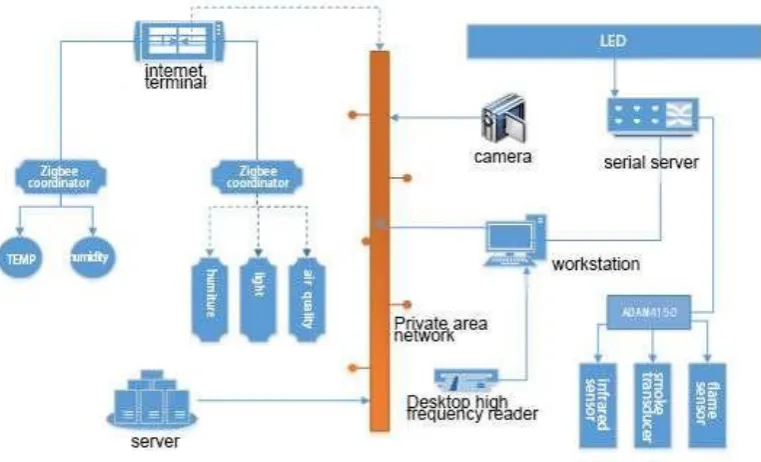
Figure 1. Overall architecture diagram of the system.
2. OVERALL SYSTEM DESIGN
In the stadium security system, Android mobile terminal needs to realize the real- time display of the temperature and humidity value of the ZigBee channel of the main venue, and use the IoT sensing device such as infrared sensor and smoke sensor characteristic gas sensor to realize the security monitoring system of the stadium.
When there is an abnormal situation, the alarm light in the control field flashes,and the system notifies the security movement through the Socket communication mode. After receiving the notification, the security mobile system can check the scene and turn off the alarm light.
The system consists of a sensing layer, a network layer and an application layer, and is implemented layer by layer from bottom to top.The hardware equipment and network topology relationship mainly involved in this project. Figure 1 below is the physical architecture diagram.
3. PERCEPTION LAYER DESIGN
The sensing layer intelligent environment module is composed of various types of wireless sensors. The number of specific sensors depends on the size of the stadium and the requirements of the system. The field data collected by the sensor module of the sensing layer is transmitted to the system gateway through the wireless sensor network, and the gateway converts the data into a TCP/IP data format and sends it to the application layer for use. The communication between the sensor and the sensor, the sensor and the coordinator is to transmit and receive data through the wireless 2.4 GHz frequency band, without using a transmission medium such as a cable as a channel for data transmission. This requires a built-in wireless local area network protocol for encoding in the wireless sensor to achieve wireless data transmission. The system uses the Zigbee protocol as the wireless LAN protocol to perform wireless data transmission and reception between sensors.
[image:3.612.98.515.371.436.2]The configuration of the WLAN wireless local area network is mainly for configuring the coordinator, relay, and sensor in the sensor network, and configuring the relevant parameters of the above various devices by using the ZigBee networking parameter configuration tool. In IAR (C), the format of the transmitted data packet is confirmed as shown in Table I, and is downloaded to each of the above device modules by using the SmartRF Flash Programmer download tool.
Table I. Sensor Send Packet Format.
Head Type Len Data Count Chk
0xFF 0xFD 0x00 0x04 0xX
X 0xX X 0xX X 0xX X
Count[L] Count[H
] 0xX X
4. NETWORK LAYER DESIGN
A wireless local area network is a network that is established within a certain local area by using wireless communication technology. The standard protocols adopted by WLAN are mainly IEEE 802.11 series protocols. In addition, other wireless LAN standard protocols include Bluetooth, UWB, ZigBee, WiMax, IrDA, HomeRF and other technologies. The sensor network in this system uses the ZigBee wireless network.
network. To ensure that each device in the network can perform normal networking communication, you need to configure the corresponding networking parameters so that the network PAN ID, channel, and baud rate of each device are consistent, and each device is on the same channel. In order to communicate with each other.
[image:4.612.220.384.455.632.2]The configuration of the WLAN wireless local area network is mainly to configure the ZigBee coordinator, ZigBee relay, and ZigBee sensor in the sensor network. First, the driver is downloaded to the ZigBee coordinator (master) and the sensor module through the downloader. In the relay module, the parameter configuration of the coordinator (master), sensor module, and relay module is completed according to the parameter configuration given in Table II.
Table II. Sensor parameters.
Network number (Pan_id) Arbitrary setting (do not repeat)
Channel numberChannel) 13
Baud rate 38400
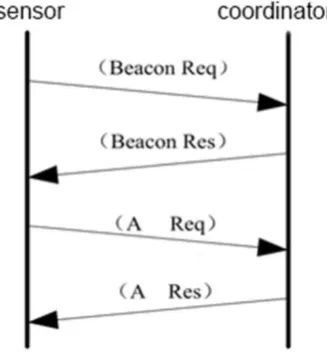
The sensor access process is divided into four steps. First, the sensor sends a beacon request to the coordinator (Beacon Req); when the coordinator receives the beacon request sent by the sensor, it sends a beacon response (Beacon Res) to the sensor. After the sensor receives the beacon response replied to by the coordinator, it sends a connection request (A Req) to the coordinator; when the coordinator receives the connection request, it immediately replies with a connection response (A Res) to the sensor. And assign an address to the network access sensor, and the network access process ends. The schematic diagram of the sensor access process is shown in Figure 2.
The coordinator sends data to the sensor through broadcast, and the sensor communicates with the coordinator by specifying the destination address of the transmitted data as a coordinator.
5. ANDROID APPLICATION DESIGN
According to the versatility of software development and use, the application layer development environment uses Android (Java) development, development tools Eclipse 4.2.1, development environment Jdk1.7, operating environment Android2.3 and above, application layer software is divided into security network management application software and Mobile application software, using socket technology for communication between the two.
5.1 Security Network Management Application Design
The security gateway receives the data sent by the sensor through the serial port. The main steps are as follows:
1.open the specified serial port and set the baud rate.
2.send the opcode through the message processor.
3.modify the UI, display the corresponding data, send to the socket 4, close the serial port.
The main implementation process of the program to open the serial port is as follows:
com = ZigBeeAnalogServiceAPI.openPort(1, 0, 5); if (com < 0) {
Toast.makeText(MainActivity.this, "Serial port open failed", Toast.LENGTH_SHORT)
.show();}
ZigBeeService service = new ZigBeeService(); Service.start();// Start serial thread
After receiving the data, the serial port sends an operation code to the socket through the message processor, waiting for the mobile terminal to receive
private void getValue() {
ZigBeeAnalogServiceAPI.getValue("byte", new OnByteValueResponse() { public void onValue(byte[] value) {
// TODO Auto-generated method stub
Message msg = Message.obtain(); msg.what = 1; msg.obj = value;
mHandler.sendMessage(msg);// Send a message
}});
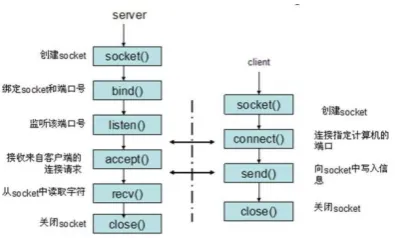
Figure 3. Socket communication process.
In the system, security monitoring can be performed by multiple clients. Therefore, when designing the gateway, a one-to-many communication mode is adopted. The gateway program serves as the server end of the socket, and the server requests a separate thread for each client requesting access. Process to ensure efficient and stable system operation.
5.2 Mobile Application Design
The mobile terminal is mainly responsible for receiving the data sent by the gateway through the socket and displaying it on the application interface. When the data is abnormal, the system issues a vibration or an audible alarm. Socket data reception adopts the mode of asynchronous acquisition to prevent the application interface from dying.
After the power-on operation of the measured system, the Android mobile control program can read the underlying sensor data transmitted by the gateway in any scene within 0.1 seconds, and the system response speed is fast and real-time.
REFERENCES
1. Wu Yi and Zhang Wei. 2017."Research on indoor WiFi location algorithm based on improved Android platform, "Electronic Technology Application 2017, 43(03), 77-79 DOI:10.16157. 2. Zifei Hu, Guojun Wen, Jingyu Liang, and Xia Yu. 2018. "Design of factory personnel
security positioning system based on TDOA technology," Electronic Technology Application 2018, 44(05).
3. Erik Aguirre1, Peio Lopez-Iturri1, and Leyre Azpilicueta2. 2016. "Implementation and Analysis of a Wireless Sensor Network-Based Pet Location Monitoring System for Domestic Scenarios," Sensors (Basel) 2016, No.9 Vol.16.
4. Maria Ganzhaac, Marcin Paprzyckiad, and Wiesław Pawłowskib. 2016. "Semantic interoperability in the Internet of Things: An overview from the INTER-IoT perspective ,"
Journal of Network and Computer Applications 2016, No.9.
5. Weimin Wang. 2016. "Research on Information Security Perception and Interaction Technology Based on Internet of Things," Information Security and Technology , 2016 No.1
6. Renheng Li, Shen Yi, Zhenghua Zhang, LV Dong-fang and XU Yang. 2016. "Design of Gas Security and Wireless Control System Based on Android," Computer and Network
2016, No.17.
7. Wang Hao, Han Min, and Dong Jie. 2016.06. "Research on Vehicle Video Intelligent Monitoring System Based on Android Platform," Electronic Technology Application
8. Du Junchao and ZigBee. February 2015. "Technical principle and actual combat,"
Mechanical Industry Press February 2015.
9. Guan Lei, Received date: 2019-05-20. "Android Application Development Study Manual,"
Tsinghua University Press.