New Dean Scott DeRue talks about a vision
for Ross and a lifetime relationship with alumni
MAP CELEBRATES
25 YEARS
You are our most powerful and passionate
resource. We are proud to introduce Alumni
Advantage, a new program for you to make
the most of your alumni status.
We value you. Alumni Advantage is our
commitment to be your lifetime partner
in success.
View the comprehensive list of offers at
michiganross.umich.edu/alumniadvantage.
Your Ross degree has value for a lifetime.
HERE.
Come to Ross for Executive Education,
recruitment, student and faculty
engagement, or to audit a class.
THERE.
Network at alumni club or #RossTalks
events, and serve as an admissions
ambassador.
EVERYWHERE.
Benefit from alumni career services,
online learning, subscription
FEATURED STORIES
28
COVER STORY:
BIG IDEAS, POWERFUL EXPERIENCES,
AND THE ROSS ADVANTAGE
Scott DeRue, the ninth dean of Michigan Ross, shares some thoughts on business, education, and a new era of alumni relations.
20 MAP AT 25:
HOW ROSS STUDENTS HAVE
BEEN CHANGING THE WORLD
The school changed business education worldwide with its signature Multidisciplinary Action Projects (MAP) program, which remains the gold standard for action-based learning.
16
A VISION REALIZED
Construction project completes the concept of a unified Michigan Ross campus.
36
20 QUESTIONS
Getting to know Lisa Mazzoni, MBA ’04, who cofounded a California winery on the rise.
38
FROM THE LOCKER ROOM
TO THE BOARDROOM
New University of Michigan Athletic Director
Warde Manuel, MBA ’05, combines the locker room and the boardroom.
40 APPRECIATING POSSIBILITIES
The work of Gilead CFO Robin Washington, BBA ’84, adds hope for suffering patients and promising students.
50 FIRST PERSON
Venga CEO and cofounder Brian Shimmerlik, BBA ’05, gets his feet wet in the “Shark Tank.”
DEPARTMENTS
2
TAPPAN & HILL
News and notes from Ross.
ROSS THOUGHT IN ACTION
—FACULTY FOCUS
8
QUOTE / UNQUOTE
Ross faculty members talk on the record about breaking news and business trends.
10 POLICY PITCHES FOR
THE NEW PRESIDENT
Michigan Ross faculty weigh in on the critical issues facing the next U.S. president.
12
WHAT ARE YOU THINKING ABOUT?
Professors Seth Carnahan and Anna Costello discuss hot topics in business.
14
THE DELICATE DANCE OF
TECHNOLOGY AND LABOR
Professor Mohamed Mostagir examines the increasing friction between technology advances and job loss.
42
ALUMNI ACTIVITIES
Photos and events from Ross alumni around the world.
46
CLASS NOTES
The latest news from classmates.
49 OBITUARIES
TABLE OF CONTENTS
DEAN
Scott DeRue
DIRECTOR OF BRAND MANAGEMENT
James Cleaver
EDITORIAL DIRECTOR
David Kiley
EDITORIAL MANAGER
Bob Needham
WRITERS
Terry Kosdrosky, Bob Needham,
Lisa Kiser, Brittany Smith, Christopher Ankney
CREATIVE DIRECTOR
Liene Karels
DESIGNER
Gretchen Hehlo
PRODUCTION MANAGER
Fay Sommer
PRINTER
University Lithoprinters
Vol. 47, No. 2, 2016. Stephen M. Ross School of Business at the University of Michigan. This publication is produced twice a year by the Office of Marketing and Communications and made possible through the generosity of private donations. ISSN 0046-0400 For more information, contact Dividend, Stephen M. Ross School of Business, University of Michigan, 700 E. University, Kresge Hall, 4th Floor West, Suite K4510, Ann Arbor, MI 48109-1234. 734-763-7022.
THE REGENTS OF THE UNIVERSITY OF MICHIGAN
Michael J. Behm, Mark J. Bernstein, Laurence B. Deitch, Shauna Ryder Diggs, Denise Ilitch, Andrea Fischer Newman, Andrew C. Richner, Katherine E. White, Mark S. Schlissel (ex officio)
UNIVERSITY OF MICHIGAN
NONDISCRIMINATION POLICY NOTICE The University of Michigan, as an equal opportunity/ affirmative action employer, complies with all applicable federal and state laws regarding nondiscrimination and affirmative action. The University of Michigan is committed to a policy of equal opportunity for all persons and does not discriminate on the basis of race, color, national origin, age, marital status, sex, sexual orientation, gender identity, gender expression, disability, religion, height, weight, or veteran status in employment, educational programs and activities, and admissions. Inquiries or complaints may be addressed to the Senior Director for Institutional Equity, and Title IX/ Section 504/ADA Coordinator, Office for Institutional Equity, 2072 Administrative Services Building, Ann Arbor, Michigan 48109-1432, 763-0235, TTY 734-647-1388, [email protected]. For other University of Michigan information call 734-764-1817. © 2016 The Stephen M. Ross School of Business at the University of Michigan.
STEPHEN M. ROSS SCHOOL OF BUSINESS
Dividend is the alumni magazine of the University of Michigan’s Ross School of Business. michiganross.umich.edu
HAS YOUR CONTACT INFO CHANGED?
Tell us at [email protected] or 734-763-7022.
i
Six Ross MAcc Grads Win
Prestigious Sells Award
Every year, a select number of the highest scorers on the CPA exam receive the Elijah Watt Sells Award, recognizing their exceptional work and aptitude. Of the more than 93,000 CPA test takers in 2015, only 75 people scored high enough to qualify for the award. Ross grads from the Master of Accounting Program made up eight percent of those high scorers—the highest number of award winners to come from one school. The 2015 Elijah Watt Sells Award winners from the Ross MAcc Program are Chia-Jen Chang, Charles Coop, Alex Engebretson, Lisa Marchlewski,Michael Rozman Proppe, and Emily L. Slaga. In order to qualify for the award, test takers must score above 95.50 across four sections of the CPA exam on their first attempt.
RICE BUSINESS PLAN COMPETITION
Two University of Michigan student-run startups were awarded substantial prizes at this year’s Rice Business Plan Contest , the world’s largest and richest graduate-level business plan competition. Neurable and PreDxion Bio, the two winning teams, both started their successful business plan contest seasons at the Zell Lurie Institute’s Michigan Business Challenge, and together took home $430,000 in cash prizes and investment dollars at RBPC. Beating out more than 400 original business plan submissions and 40 competing teams, Neurable took second place in the competition, earning the $50,000 Second Place Prize, as well as the OWL Investment Prize of up to $280,000. Co-founded by Michael Thompson, MBA ’18, and Ramses Alcaide, PhD Neuroscience ’16, Neurable has created the first non-invasive brain-computer interface that allows for real-time control of software and physical objects. PreDxion Bio took home the $100,000 TiE Boston Angel Investment Prize. Co-founded by Caroline Landau, MBA ’16, and Walker McHugh, MSE Biomedical/Medical Engineering ’17, PreDxion Bio is a precision medicine diagnostics company with a beachhead product that measures proteins in the blood of critically ill patients.
THOUGHT FOR FOOD GLOBAL SUMMIT
More than 2,400 students from 105 countries and 578 universities participated in the 2016 Thought For Food Global Summit in Zurich, Switzerland. Thought For Food is a movement that brings together university students from around the world to tackle hunger and provide innovative solutions to global food security problems. Michigan Ross student Eric Katz, BBA ’17, and his team of entrepreneurs won the summit’s business proposal competition for seed funding and a grand prize of $10,000. Teams were evaluated based on their proposal’s innovation, feasibility of implementation, uniqueness, team spirit, and the potential for their business to help feed nine billion people by 2050. The team’s venture, Kulisha, produces low-cost, high-quality, sustainable fish feed made from insects.
PATAGONIA CASE COMPETITION
Outdoor outfitter Patagonia sponsored its first-ever case competition to help rid its products of PFC chemicals, which are used for waterproof clothing but contaminate natural areas. A Ross-led team won the competition and will now work with Patagonia to implement its plan. Team members were Allyson Stewart, MBA ’18; Denise Miller, MBA/MS ’17; David Ruebenson, MBA ’18; Aysha Malik, MBA ’18; and Kevin Golovin and Sarah Snyder, both engineering PhD students. The Ross team beat out more than 100 teams from 30-plus universities.
ACCENTURE INNOVATION CHALLENGE
A team of Ross MBAs beat out more than 200 others to take home the top prize at the annual Accenture
Innovation Challenge, by developing a winning plan to help a nonprofit organization expand its reach. Jerry Won, Emily Knoll, and Stephen Hardin, MBAs ’18, took top honors in the competition. This year’s event provided pro-bono management consulting support to help the growth plans for Back on My Feet, a nonprofit that uses the power of running to fight homelessness.
KPMG U.S. NATIONAL CASE COMPETITION
Three Ross BBA students and a friend won this year’s KPMG U.S. National Case Competition, the second year in a row that a U-M team took top national honors.
Chelsea Racelis, BBA ’18; Keishiro Iwasaki, BBA ’18;
Jay Parekh, BBA ’18; and Sonia Thosar of the College of Engineering were the winning team. After the national win, they went on to the KPMG International Case Competition to compete against teams from 22 countries.
Positive Research
Incubator Renamed for
Terence E. Adderley
The Positive Research Incubator at the Michigan Ross Center for Positive Organizations has a new name: Adderley Positive Research Incubator.
New Ross MM Grad Earns
Olympic Silver Medal
Connor Jaeger, BSE ’14/MM ’16, won a silver medal at the Summer Olympics in Rio de Janeiro, Brazil, in August. On the heels of completing his Ross Master of Management degree in the spring, Jaeger competed in his second Olympics as a member of the U.S. swimming team. He won the silver medal in the 1,500-meter freestyle race, and his time of 14:39.48 was a record for a member of the U.S. team. Jaeger also won three NCAA championships
during his time swimming at U-M.
Leaders share ideas for driving
change at Positive Business
Conference
The third annual Positive Business Conference returned to Michigan Ross this spring. Hundreds of academics and business leaders— including executives from Google, Kellogg Co., and Patagonia—shared experiences, research, and best practices on how business can be a positive force in the world. This means ensuring that business creates economic value, creates great places to work, and is a good neighbor in the community and society. While positive business practices are a growing part of corporate culture, there are some skeptics who see only cost and few benefits. Several at the conference
shared concrete evidence of the ways that positive business practices can improve bottom-line results.
WATCH KEYNOTE ADDRESSES FROM THE POSITIVE BUSINESS BUSINESS CONFERENCE ROSSDIVIDEND.COM
Mitsui Symposium Celebrates
25 Years, Honors Professor
E. Han Kim
The Mitsui Life Financial Research Center at Ross held its 25th Finance Symposium in May, bringing together the world’s top thinkers and
researchers in finance. In addition to tackling issues such as warehouse banking, mergers, and the effects of financial advisor misconduct, Ross Professor E. Han Kim was honored for his contributions to the field of finance.
Kim, a prolific researcher and teacher, helped establish the Mitsui Center as a way to bridge the U.S. and Asian financial markets. As the global economy evolved, the focus of the center shifted to studying financial economics in general. “We try to focus on the latest issues and gather the top experts on those issues together to share knowledge,” says Kim, Everett E. Berg Professor of Business Administration and director of the Mitsui Life Financial Research Center and East Asia Management Development Center. “The goal is to get a better understanding of the causes and effects of financial events and to provide a cure.” Reflecting on the symposium’s 25 years, Kim says he enjoys seeing colleagues come together pursuing big ideas and solving real problems.
“It’s very gratifying to see former students, colleagues, and co-authors presenting their papers and sparking discussion and constructive debate,” he says. “This is how we arrive at solutions to issues like financial crises and corporate governance problems.”
Executive Education Adds
‘Ascending to the C-Suite’
Program for Women
“Ascending to the C-Suite: From Theory to Practice” immerses participants in specialized subjects the mastery of which is critical for C-Suite executives— yet that may be missing from professional development for women leaders. Each topic is taught with a
360-degree view by pairing renowned Michigan Ross faculty with global business leaders.
The first offering of the program begins in November. More information is available online at michiganross. umich.edu/programs/executive-education.
DEAN SCOTT DERUE AND INFORUM CEO TERRY BARCLAY DISCUSS THE PROGRAM ON THE “MICHIGAN MATTERS” TV SHOW ROSSDIVIDEND.COM
Handleman Lecture Series
Brings Malcolm Gladwell
to Campus
Acclaimed author Malcolm Gladwell spoke to a Michigan Ross audience at Hill Auditorium in September as part of the Joesph and Sally Handleman Lecture Series. Gladwell spoke on some personal characteristics shared by most successful entrepreneurs—including a sense of urgency, a spirit that does not require the approval of others, and an understanding of the volatility in the world. Gladwell also took questions from the audience.
Faculty Awards, Honors,
and Appointments
A number of Michigan Ross faculty members have been recognized and honored for their excellence in teaching, research, and service, both by the school and the university’s Board of Regents. Ross also gained another distinguished university professor.
Damian Beil, Jeffrey Sanchez-Burks, David Wooten, and Carolyn Yoon were promoted to the rank of professor.
Felipe Csaszar, Scott Rick, and Chris Williams were promoted to associate professor, with tenure.
Wally Hopp was appointed the C.K. Prahalad Distinguished University Professor of Business and Engineering. This honor is for U-M’s elite faculty, and Hopp joins Jane Dutton as one of two distinguished university professors currently at Ross.
Michigan Ross faculty also honored their own with the annual faculty awards and the Neary Teaching Excellence Awards. Winners of the 2016 Ross Faculty Awards are:
Junior Awards
Martin Schmalz . . . NBD Bancorp Assistant Professorship of Business Administration
Kyle Handley . . . Sanford Robertson Professorship
Stefanus Jasin . . . Arnold and Linda T. Jacob Faculty Award
Senior Awards
Wally Hopp...CORE award
Gretchen Spreitzer... RSB Researcher of the Year Award
Jerry Davis ... RSB Senior Faculty Research Award
Greg Miller ... Victor L. Bernard Faculty Award for Leadership in Teaching
Valerie Suslow...Andy Andrews Award
SUBSCRIBE
Ross Thought in Action
Neary Teaching
Excellence Awards
Ryan Ball... Full-Time MBA Teaching Excellence Award
Izak Duenyas... Executive MBA Teaching Excellence Award
Aneel Karnani... Weekend MBA Teaching Excellence Award
Brad Killaly... BBA Teaching Excellence Award
Jim DeSimpelare... MAcc Teaching Excellence Award
Bill Lanen... Global MBA Teaching Excellence Award
Martin Schmalz... Evening MBA Teaching Excellence Award
Ari Shwayder... MM Teaching Excellence Award
Carolyn Yoon ... PhD Teaching Excellence Award
Executive Education
Kim Cameron... Executive Education Teaching Impact— Custom Programs Award
Gretchen Spreitzer... Executive Education Teaching Impact— Open Enrollment Programs Award
Other Honors and Awards
Achyuta Adhvaryu was named a faculty research fellow at the National Bureau of Economic Research, one of the most influential institutions for economic policy research in the U.S. He was also selected as a Faculty Affiliate of the International Growth Centre.
Gautam Ahuja has been selected as the Strategic Management Society’s 2016 Foundations Scholar for the foundational impact of his research. This highly selective
recognition is awarded by SMS’s Knowledge and Innovation/Technology group, which focuses on how managers can best leverage their organization’s knowledge base for competitive advantage. Ahuja also received the 2016 BPS Irwin Outstanding Educator Award from the Academy of Management’s Business Policy and Strategy division. This award goes to exemplary educators with at least 15 years of service since their doctorate program.
Wayne Baker’s research paper “Paying it Forward vs. Rewarding Reputation: Mechanisms of Generalized Reciprocity” won the Outstanding Published Article Award from the American Sociological Association’s Section of Altruism, Morality, and Social Solidarity.
Ryan Ball received the Golden Apple award from students honoring outstanding university teaching. The only student-selected teaching award on U-M’s campus, Golden Apple honors undergraduate and graduate faculty members who continuously seek to engage students in the classroom.
Marcus Collins was named an Advertising Age “40 under 40.” The list recognizes people who are reshaping marketing and making an impact in the field. Collins is senior vice president and director of social engagement at advertising agency Doner.
Andrew Hoffman has received an Aspen Institute Faculty Pioneer Award, which recognizes faculty at the vanguard of teaching about the interface of business and society. It’s awarded to educators who demonstrate leadership and risk taking, and who help build a curriculum that examines the relationship between capital markets, corporations, and the public good.
Shirli Kopelman’s book Negotiating
Genuinely: Being Yourself in Business received
Ted London also received an Aspen Institute Faculty Pioneer Award with a Field Building distinction for his longstanding contributions to base-of-the-pyramid strategies. The award recognizes his impact on the collective understanding of a field of inquiry and how that field of inquiry is taught in MBA classrooms.
David Mayer received the 2016 Cummings Scholarly Achievement Award for his prolific and high-quality research. The prestigious award is given by the Organizational Behavior Division of the Academy of Management and honors early- to mid-career scholars.
Sarah Miller also has been named a faculty research fellow at the influential National Bureau of Economic Research. Miller also was awarded a $150,000 grant from the Russell Sage Foundation. She will study the impacts of the Affordable Care Act on bankruptcy and other financial outcomes.
Eric Schwartz was named a “Twenty in their 20s” by Crain’s Detroit Business. The list recognizes 20-somethings on the rise in southeast Michigan.
Jagadeesh Sivadasan was selected to join the International Growth Centre as a research affiliate. The IGC promotes economic growth in developing countries through ideas generated from frontier research.
Chris Williams is a recipient of the 2016 Deloitte Wildman Medal Award, presented by the American Accounting Association for his research, “Are IFRS-based and US GAAP-based Accounting Amounts Comparable?” which was published in the Journal of
Accounting Economics.
Appointments
Lynn Wooten was appointed senior associate dean of student and academic excellence. In this role, Wooten will be charged with ensuring the success of students across their entire life cycle at Ross. This new structure will encourage greater sharing of lessons and innovations across programs. Among those reporting to Wooten will be two new faculty
academic directors. Jagadeesh Sivadasan was named faculty director for the Full-Time MBA Program. Dana Muir steps into the new position of faculty director of undergraduate programs. Associate Dean Wally Hopp, and faculty directors John Branch (Part-Time MBA), Izak Duenyas (Executive MBA), Cathy Shakespeare (MAcc), and Norm Bishara
(MM) will also report to Wooten, as will Career Services, Academic Services, and Graduate Admissions.
M. S. Krishnan was appointed associate dean for Executive Education and Global Initiatives. Under Krishnan’s leadership, Ross has increased graduate student access to global experiences by 18 percent, and undergraduate student access to global experiences by 28 percent.
Francine Lafontaine was appointed senior associate dean for faculty and research, and will look after all concerns related to faculty affairs, including the school’s centers and institutes, research enterprise, and strategy for diversity and inclusion.
Wally Hopp, associate dean for learning design, will take on responsibility for the Office of Action-Based Learning, in addition to the school’s commitment to designing and delivering innovative learning experiences for its students.
Ross Welcomes New Faculty
Five new professors and lecturers join the Michigan Ross faculty this academic year, bringing with them expertise and research interests ranging from communication to financial regulation.“ The corporate tax rate
in the United States is
still one of the highest in
the world, so unless that
changes, the incentive
for tax-inversion deals
is still there.”
E. Han Kim, Everett E. Berg Professor of Business Administration and professor of finance and international business, on why tax-inversion mergers will likely continue.
U.S. News & World Report
March 9, 2016
40
Average monthly number
of top-tier media outlets
featuring Michigan Ross
(Jan.-June)
“ Prejudice can take subtle
forms. Micro-aggressions
are extremely ambiguous
forms of prejudice, like
not making eye contact
or calling someone by an
Americanized version
of their Chinese name:
It might mean nothing,
or it might signal
something else.”
David Mayer, Michael R. and Mary Kay Hallman Fellow and associate professor of management and organizations, on the difficulties companies face rooting out hidden biases in hiring.
Bloomberg
March 17, 2016
Q
uote
U
n
Q
uote
Jeremy Kress joins the business law faculty as a lecturer. Kress is a senior research fellow at the Center on Finance, Law, and Policy at U-M Law School and is a former attorney at the Federal Reserve. While at the Fed, Kress conducted an investigation into corporate governance failures that led to the $6 billion trading loss by JPMorgan’s Chief Investment Office and recommended changes to the Fed’s supervisory practices to prevent similar losses. He also clerked for U.S. District Judge Matthew Leitman in Detroit.
Samantha Meyer joins the technology and operations faculty as assistant professor. Meyer earned her PhD from Northwestern University’s McCormick School of
Engineering, where her dissertation was on resource and communication networks in urban primary school systems. She also spent the past year at Ross as a research fellow. Meyer’s research interests are around social networks and resource sharing at the interpersonal and interorganizational levels, including knowledge sharing networks, the interaction between social and physical networks, and social media use in organizations.
Bob Totte joins the accounting faculty as intermittent lecturer. Totte has nearly 40 years of experience in the tax accounting field and is a returning lecturer to Ross, having taught here from 1982 to 1983 and again from 1987 to 1993. He recently retired from Jarden Corp., where he was senior vice president. His teaching interests include tax policy developments and technical topics that prepare students to handle real-life tax issues when they enter the workforce.
7th
Ross ranking for amount
of coverage among peer
schools in top outlets
(Jan.-June)
“ People will say ‘I want
to grow revenues by 25
percent’ but they rarely
announce that they
want to improve their
listening skills.”
Scott DeRue, Edward J. Frey Dean of Business and Stephen M. Ross Professor of Business, on the importance of mindfulness and continuous learning.
Fast Company
March 17, 2016
“ It’s difficult to even
understand the
relationships between
hospitals and doctors’
practices. We don’t have
a lot of clear research.”
Francine Lafontaine, senior associate dean for faculty and research and William Davidson Professor of Business Economics and Public Policy, on smaller healthcare mergers that escape regulatory notice.
The New York Times
April 8, 2016
“ If you go public, or are
publicly listed, you will
never be rewarded for
creating jobs. Workers
are a big expense.”
Jerry Davis, Wilbur K. Pierpont Collegiate Professor of Management and professor of management and organizations, on why startups aren’t the job creators they once were.
Inc.
April 19, 2016
“ Two of the remaining
candidates, Trump
and Sanders, promise
significant shifts in those
policies (from the Obama
years). Yet both of them
have not issued detailed
statements on many
facets of their
economic policies.”
Paolo Pasquariello, associate professor of finance, on how Wall Street is looking at the election.
U.S. News & World Report
May 2, 2016
“ CEO succession planning
isn’t rocket science. Yet
80 percent of the biggest
U.S. companies get it
wrong because they fail to
focus on the political and
cultural fundamentals.”
Noel Tichy, professor of management and organizations, on corporate succession planning.
Wall Street Journal
June 8, 2016
778
Total number of media
articles featuring Ross
during month of July
“ Most states have a sense
of moderate enforcement,
and then some are more
aggressive, like Florida.
It’s a percolating issue.”
Norm Bishara, associate professor of business law and ethics, on the enforcement of non-compete agreements for low-wage workers.
CBS Moneywatch
Jan. 10, 2016
“ You don’t actually have to
change trade policies to
have some real effect on
economic activity right
now. If Trump is actually
elected and these things
seem even more likely,
they could slow down
economic activity and
investment quite a lot—
whether or not they
come to pass.”
Kyle Handley, assistant professor of business economics, on how uncertainty with trade policy affects the economy.
Bloomberg
June 30, 2016
“ This isn’t a natural
disaster, where
everyone is aligned
right away. This is
difficult stuff to process.
But a compassionate
organization cultivates
a sense of empathy for
those who are suffering.
And the first thing is for
leaders to be present,
talking, listening, and
acknowledging that
something specific has
happened, and that
some people may have
concerns.”
Alison Davis-Blake, Leon Festinger Collegiate Professor of Management and professor of management and organizations, on why companies should address the issue of police shootings.
Fortune
Policy Pitches for
the New President
Michigan Ross faculty weigh in on the critical issues
facing the next president—whomever that may be.
T
o call this presidential election season unusual is an understatement. But once the race is over, there will be a new resident in the White House with a laundry list of serious policy issues to address. No matter who wins, he or she will need to focus considerable time on national security in the face of terrorist attacks, but also healthcare, trade, taxes, income inequality, and energy policy, just to name a few. We asked Michigan Ross faculty with expertise in these areas of business and the economy what they would tell an incoming president. One thing is clear from these policy prescriptions: The solutions won’t be an easy political pill to swallow.TAXES
Promises Will Be
Hard To Keep
Few campaigns go by without promises of tax relief to one income group or another, depending on the candidate. But living up to those promises invites problems, says Professor Joel Slemrod.
“I’d advise caution about tax cuts inevitably promised during the campaign,” he says. “While the short-term fiscal situation has stabilized, over the long term there is a gaping fiscal imbalance because the cost of the promises in the Social Security and Medicare programs greatly exceeds the taxes in place now to fund them. Because the real income of everyone except those at the top has stagnated, the tax system should be used to lean against—but cannot be expected to eliminate—this secular trend toward greater inequality. Higher income tax rates aimed at top earners can achieve this without endangering growth.” Slemrod, the Paul W. McCracken Collegiate Professor of Business Economics and Public Policy, says the corporate tax system should be overhauled to discourage tax-inversion mergers that seek incorporation in countries with lower corporate tax rates.
“The president should reform, with renewed vigilance, the way we tax corporations and adjust it to the changing global environment to address erosion of revenue via tax havens.”
TRADE
Keep It Free But
Include Assistance
Both major party candidates say they oppose the Trans-Pacific Partnership. But Professor Linda Lim
thinks once in office the new president should press ahead with both the Trans-Pacific Partnership (TPP) with Asia and the Trans-Atlantic Trade and Investment Partnership (TTIP) with the European Union.
“The TPP and TTIP will lower foreign barriers to U.S. exports and ensure greater competitiveness and fairer competition for U.S. businesses at home and abroad,” says Lim, professor of strategy. “I see these agreements strengthening intellectual property rights while raising household consumption and living standards by maintaining low inflation.” But while she urges full steam ahead on those free-trade pacts, she also would advise the new president to expand trade and technology adjustment assistance for the businesses and workers negatively affected by the agreements. “He or she should expand trade adjustment assistance and other policies to help workers and
INCOME INEQUALITY
The Central Issue
The solutions might be politically difficult, but income inequality cannot be ignored for much longer or volatile social unrest will follow, says Professor Wally Hopp. The percentage of total income received by the top 1 percent of Americans has risen from 8 percent in the 1970s to 20 percent today. That’s not sustainable, nor is it at all healthy for the economy as a whole. “Technology and globalization are profoundly transforming work in America,” says Hopp. “Blue and white collar jobs alike are being automated, offshored or both. But our political process has failed to address the needs of the middle class and has instead given us tax regulations, labor laws, and trade agreements that tilt outcomes in favor of the economic elite. As a result, we have reached levels of income inequality not seen since the Gilded Age.”
Hopp, associate dean for learning design, C.K. Prahalad Distinguished University Professor of Business and Engineering, Herrick Professor of Business, and professor of technology and operations, says consolidating income at the top slows the velocity of money though the economy because those people spend it more slowly than working people. “If things continue as they are, it won’t be long before anger leads to full-blown social revolution,” he says. Indeed, look how far two “disruption” candidates—Donald Trump and Bernie Sanders—have come this year. “To avoid this, we need the new president to rebalance government policy in favor of the middle class by increasing the minimum wage to ensure that no one working full time lives in poverty, increasing support to education to help people train and retrain for jobs in the knowledge economy, and significantly investing in infrastructure to create jobs and the basis for a robust economy in the future.”
AFFORDABLE HEALTHCARE
Expand It
The Affordable Care Act (ACA) was a centerpiece of Obama’s policy agenda. Though it’s unpopular with many Republicans, Professor Thomas Buchmueller says the new president should push it onward with
improvements.
“I would urge the new president, as well as the Congress, governors and state legislators, to build on the Affordable Care Act to further advance the goals of expanding insurance coverage and controlling healthcare costs,” he says. “Although more than 20 million Americans have gained insurance since the law was signed in 2010, there are still about 30 million who remain uninsured. Further coverage gains can come from more states adopting the ACA’s Medicaid expansion and by improving take-up in states that have already done so. Expanding take-up could be done by more aggressive outreach and education. The experience of Michigan illustrates how expanding coverage can benefit a state’s population and its economy.” Buchmueller, Waldo O. Hildebrand Professor of Risk Management and Insurance and professor of business economics and public policy, says the new administration and Congress should rigorously pursue a cost-control strategy. “Controlling costs requires a multipronged strategy that includes vigorous enforcement of antitrust laws to prevent providers from accumulating and exploiting market power,” he says. “A rare area of agreement among Democrats and Republicans in Congress is that many would like to repeal the ACA’s high-cost health plans. But this ‘Cadillac tax’ is a key element of the law’s strategy for controlling costs. It should be left in place and given time to work.”
ENERGY POLICY
Put a Price on Carbon
The next president needs to take serious, fast steps to address climate change, and the best way to do that is to set a price on carbon, says Professor Tom Lyon. “We know price signals work. Just look at how quickly cheap natural gas has displaced coal in the electricity market, or how car buyers switch to efficient cars when gas prices soar and back to gas guzzlers when prices plummet,” he says. “Do what economists have been advising for decades—put a price on carbon that is high enough to motivate change, say $50 a ton. That would be enough to make nuclear power—still the only scalable baseload carbon-free option— economically viable against natural gas, even for existing nuclear units. And we should ramp up R&D into next-generation nuclear plants, which will be safer and generate less waste.” Lyon, Dow Professor of Sustainable Science, Technology and Commerce and professor of business economics, also says that should be part of a wider overhaul of energy policy. “Cancel the corn ethanol subsidy, even if Iowa farmers complain,” he says. “Increase R&D on technology that goes beyond carbon-free and actually removes carbon from the atmosphere. Work with developing countries to make sure they have cleaner alternatives than coal.”
Income disparity between men
and women and the comparatively
small number of female business
executives are two inter-related
issues that have been under
scrutiny for years, yet both
problems persist. Many companies
have launched initiatives to rectify
this, and members of Congress
have even proposed legislation
to spur change. Research by Seth
Carnahan, professor of strategy at
Michigan Ross, however, suggests
managers should look inward if
they want to find a root cause of
gender disparity in the workplace.
WHAT ARE YOU THINKING ABOUT?
I’ve recently been thinking about gender inequality at companies and how it relates to a manager’s ideology. I’ve been looking at partners in law firms, their political ideologies, and the promotion and hiring of women at those firms. We tracked political leanings through campaign donations over the last decade. In offices where partner attorneys are more conservative, we found that male junior attorneys were much more likely than female junior attorneys to be hired and promoted to partner. Conversely, law offices where partners are more liberal have smaller gender gaps in hiring and promotion. For example, the gender gap in promotion to partner is about 80 percent larger in law offices where partners are more conservative, as compared to those where partners are more liberal. The data that we are using allow us to measure a number of other factors like the type of law being practiced, the geographic location of the office, and the law school ranking and law school honors of the junior attorneys. But ultimately, this is a correlation, and we need more research to know exactly why it’s happening. For example, in surveys, it’s clear that conservatives and liberals think about gender roles differently. Do these views directly influence the way that managers make personnel decisions? Or might the effect result from workplace culture, such that female junior attorneys do not match well with conservative offices? I’m really interested in resolving these questions.
WHY IS THIS INTERESTING TO YOU?
Understanding why some organizations have a harder time than others attracting, hiring, and promoting talented women is a very important puzzle. And I’ve always been curious about the way that political ideology affects our personalities and worldviews. Yet, I was skeptical when we started the project that gender inequality would be tied to managers’ political ideology. The correlation is larger than I expected, which motivates me to find out more.
WHAT ARE THE IMPLICATIONS FOR INDUSTRY?
Political ideology can be a hot-button issue, especially at work and especially during an election year. But I think that our research serves as a nudge, reminding us to step back and consider the predispositions and beliefs that we bring to our personnel decisions. It might also be helpful to think about how our beliefs feed into the culture of the organization, which may go a long way in determining whether a firm is an attractive place for talented women.
—I N T E RV I E W E D BY T E R RY KOS D ROS K Y
Q:
What are You
Thinking About?
A:
Gender Equality
and Political
Ideology at Work
SE
TH
C
AR
N
WHAT ARE YOU THINKING ABOUT?
I’m thinking about how firms become exposed to credit risk when they transact with supply-chain partners. In particular, when a company enters into a transaction to buy goods and services from suppliers or sell goods and services to customers, they often do so on credit. This is called trade credit and it’s more than three times as large as bank financing as a source of short-term borrowing for companies in the United States. Furthermore, a large portion of this credit risk remains largely unhedged. That means firms in the United States may face large financial risks if their customer base defaults on trade credit loans. My research focuses on understanding the magnitude of these risks for individual firms as well as for the economy as a whole. I also study how managers can use information—either public financial statements or soft, relationship-specific data—to assess and minimize credit risk when they enter into a trade transaction.
WHY IS THIS INTERESTING TO YOU?
We live in a global economy, and most companies are highly exposed to a variety of industries and countries through their supply chain links. While this diversity creates many benefits, it also carries costs in terms of exposure to negative events. We saw many of these spillover effects during the recent financial crisis. It’s also difficult for managers to understand the scope of their financial exposure due to the complexity of the supply chain and the opaque nature of many suppliers and customers. What’s fascinating is how large trade credit exposures are, yet how little is understood about how to mitigate risk.
WHAT ARE THE IMPLICATIONS FOR INDUSTRY?
My research helps to inform both managers and the trade credit industry on how to assess the risk that a customer might default on a trade credit loan. One of my papers was recently used to aid a credit bureau in building their credit scoring model for trade creditors. My hope is that if we improve our understanding of the sources and consequences of trade credit risk, managers will become more efficient in making trade credit decisions. My research can also aid industries that serve to hedge trade credit risk. In this way, businesses may be better prepared to cope with cross-industry and cross-country credit spillovers during times of economic distress. To illustrate, consider the damage that businesses incur during a hurricane. Severe weather often causes damage to local businesses, shutting them down for weeks or even indefinitely. Businesses most affected by Hurricane Sandy during the fall of 2012 delayed or even defaulted on payments to their own suppliers, causing an economic spillover effect that stretched far beyond the northeast region. Similarly, banking crises can wreak tremendous havoc on the corporate economy. My research provides strong evidence that firms that had strong ties to the financial sector during the 2007-2008 U.S. financial crisis passed their liquidity problems onto their supply chain partners through trade credit claims; this exacerbated employment losses on Main Street.
—I N T E RV I E W E D BY T E R RY KOS D ROS K Y
Bank credit gets a lot of time and
attention from policymakers and the
business press, but there’s another
type of financial risk that dwarfs
short-term bank financing and is
less understood. Anna Costello,
Arthur Andersen Faculty Fellow and
assistant professor of accounting,
is trying to help businesses,
accountants, and policymakers get
a better handle on the credit risk
that comes from everyday supplier
relationships. Doing so will help
them find better ways to hedge the
risk, understand its sources, and
quantify the potential exposure.
Q:
What are You
Thinking About?
A:
Trade Credit
Exposure
A
NN
A C
O
ST
EL
The Delicate Dance
of Technology
and Labor
Professor Mohamed Mostagir examines the increasing
friction between technology advances and job loss.
C
antechnology cause structural unemployment? Economic theory and data from the past couple of centuries suggest that the answer is no. The productivity gains and lower prices spurred by technology free money to be spent elsewhere, increasing demand for other products and creating enough new jobs to offset the losses.So the theory goes. But Professor Mohamed Mostagir, in a talk at the 2016 SXSW Interactive conference, notes that technology may be advancing so rapidly that a sizable chunk of the workforce can’t be retrained with new skills fast enough.
INFORMED SOLUTIONS
Measuring the skills gap is the first step toward informing the right policies and changes, Mostagir says. It will still take changes in education and social policy, though, to adjust to the new realities. “If you look at education, we’ve been teaching people the same things and mostly in the same way for the past 20 years or so, as if the skills demand never changes,” he says. “At Ross, I know we are asking companies more pointed questions about the skills they need so we can best match our curriculum to current and future needs.” That problem isn’t necessarily new. What has changed, though, is that new skills become outdated faster than ever. “People say ‘we have to retrain workers,’ but you can’t just wave a wand and endow someone with skill,” says Mostagir. “It takes time and resources, and by the time training is done the demand may have changed.” For example, the future of work will likely involve close human-to-machine interaction, even in the creative fields of art, design, photography, graphics, and writing. Mostagir says a system that can continually measure the new skills needed and predict them accurately will be a useful guide for educators. “It’s becoming clear the combination of machine and human is highly efficient and effective,” he says. “Supercomputers have been able to beat people at chess for a long time, but there are instances where a mediocre chess player and a mediocre machine will beat
the individual supercomputer. It appears the speed of the machine and the decision-making and pattern recognition abilities of humans make a great combination.” Likewise, social policy will have to address worker displacement and training. The idea of providing people with a universal basic income—once proposed by economist Friedrich Hayek—has received renewed attention, including from a few libertarian-leaning conservatives. Providing a subsistence cash amount does away with a lot of the welfare-state infrastructure, yet keeps a social safety net. “The job displacement rate is going to go up, and the first people hit are usually those with few other options,” he says. “That’s why it is important to study the effectiveness of these programs now.”
Though this line of research might seem more in the realm of economic policy, Mostagir, who is trained in both operations and economics, thinks looking at these problems from an operations perspective might be the best way of attacking them. “Operations is really the science of making things better,” he says. “It’s not only about streamlining supply chains or making airlines more profitable. We need economists to describe what’s happening and propose high-level solutions. But the nuts and bolts is where operations comes in. Labor markets could benefit a lot from optimization, and I believe our field is in a position to make a meaningful and lasting impact on how these markets are run.”
—T E R RY KOS D ROS K Y
MIND THE GAP
For the past decade, recruiting and consulting firm Manpower has surveyed employers about the skills gap. The firm found in 2015 that 38 percent of employers worldwide had difficulty filling jobs, a 2-point increase from the previous year. There is also a major debate that has arisen in the U.S. over the impact of raising the minimum wage. The argument against raising precipitously to, say, $15 per hour, states that restaurants and other retail businesses will quickly move to automation where they can. Some analysts, experts and
Construction Project Completes the Concept of a Unified Michigan Ross Campus
T
he most noteworthy aspects of the recent construction project at Michigan Ross don’t have anything to do with number of floors, square footage, or materials. They have to do with functionality and flexibility. And they have to do with creating spaces that encourage collaboration, innovation, and learning outside the classroom. Taken together, they transform the business school complex into a true 21st century learning environment to meet the needs of students, faculty, and staff today and into the future.“The new space better aligns our facilities with the important mission of the school,” says Ross Chief Financial Officer Sean O’Neil. “We are able to build great spaces that foster bold innovation and collaboration. Thanks to the commitment of our alumni, we are able to do this without putting additional pressure on tuition.” In broad outlines, the project includes: one new, five-story building, Jeff T. Blau Hall, replacing the old Computer & Executive Education/Electronic Education/“E” Building; a complete renovation of the former Kresge Library building into the new, multi-purpose Kresge Hall; and renovations to the Executive Residence, Sam Wyly Hall, and the exterior of the Hill Street parking garage to create a unified campus look.
PROJECT TEAM
Project Manager: University of Michigan Architecture, Engineering & Construction
AMONG THE FEATURES OF THE PROJECT:
• A completely re-thought Kresge Library Services, transitioning from a collection of physical reference materials to a full suite of information resources and research services, guided by expert staff. • Best-in-class Career Services facilities
for recruiters and students.
• Nine classrooms, including one mid-sized, 175-seat room that falls between a basic classroom and an auditorium. • A flexible classroom space designed to
facilitate team-based action learning, where class time is used to work on projects addressing real business challenges. • Specifically designated quiet study spaces. • Two workshop/ “maker” spaces to encourage
brainstorming and collaboration. • Two large atriums that admit natural
light and improve building aesthetics.
• Professional, welcoming facilities for graduate and undergraduate admissions offices.
• A “Center for Centers,” where most of the school’s centers and institutes—focused on specific subjects like leadership, sustainability, social impact, and so on—can share and work together. • A professionally equipped video
production studio.
• High-definition, digital audio/video infrastructure to facilitate live streaming and other innovative technology.
BLAU HALL/KRESGE HALL MAJOR DONORS:
Stephen M. Ross, BBA ’62 Jeff T. Blau, BBA ’90 Sanford R. Robertson, BBA ’53/MBA ’54
Elizabeth D. Black, MBA ’87 Michael, MBA ’68, and Sophia Brenner
Michael R., BBA ’66/MBA ’67, and Mary Kay Hallman J. Ira, BBA ’59, and Nicki Harris Robert Hutchens, BBA ’84, and Randi Brosterman Hutchens Mike, BBA ’72, and Sue Jandernoa
Stephen Malkin, BBA ’83
William C., MBA ’65, and Sally A., AM ’67, Martin Tim, MBA ’80, and Beth O’Day
Jane, BBA ’86/MAcc ’86, and Daniel Och Keshava C. and Bharathi C. Reddy Timothy J., AB ’82/ MBA ’84, and Elise M., BFA ’82, Sloan Harvey J. Spevak, BBA ’87/MAcc ’87 Lawrence and Wendy Tenebaum
Ronald N., BBA ’66, and Eileen, MMus. ’75, Weiser Noah Yosha, BBA ’99 Hengde Zhang, BBA ’10 “We’ve been able to create more spaces
for people to find a quiet place to study, and other spaces to work collaboratively in teams,” says Ross Director of Operations
Charles Amyx.
The project was fast-tracked—a three-year project substantially completed in 27 months, including demolition and construction. Some final work on Wyly Hall is continuing into the fall. Speed was important, both to minimize disruption to the school and take advantage of lower costs offered by construction contractors, Amyx says. He has high praise for everyone who worked on the project, which went smoothly. “It was a high-functioning team. There was a lot of cooperation and communication,” Amyx says, adding that the project could serve as a model for fast tracking other University of Michigan construction. Donors funded the entire building project. A major gift from Stephen M. Ross, BBA ’62, was critical, as were important donations from Jeff Blau, BBA ’90, and Sanford R. Robertson, BBA ’53/ MBA ’54, along with many others (see sidebar). From the beginning, the project emphasized functional, forward-thinking design. “Our programs, centers, and institutes were housed in buildings that were designed for another purpose. With Kresge Library, for example, we began to ask the question, what does a library look like in the 21st century? It’s not stacks of books. It’s something very different,” Amyx says. “What we have now is buildings that are far more functional and modular. The one constant is change. Some programs expand, some contract, and we have to be able to react to that in an efficient way. So, the open office environment and using furniture systems instead of hard walls allows us to be able to react to those changes quickly.” Compared to the opening of the main Ross building in 2009, primarily housing instructional space and faculty offices, the new project is more focused on programmatic and student support functions. “The space configuration really does matter,” O’Neil says. “Having space for staff to meet with their core groups, having innovation happen in space that’s well-thought-out and well-designed, is important.” That space is now completing the vision of an integrated business campus, ready to meet the needs of the Michigan Ross community both today and tomorrow.
—B O B N E E D H A M
—P H OTOS BY M A R K B I A L E K MORE PHOTOS OF THE FINISHED PROJECT,
AND A TIME-LAPSE VIDEO OF THE CONSTRUCTION ROSSDIVIDEND.COM
$135,000,000
TOTAL COST, FUNDED BY DONATIONS
104,000 FT
2
NEW CONSTRUCTION
75,000 FT
2
KRESGE RENOVATION
179,000 FT
2
FULL RENOVATION
18 Months
CONSTRUCTION TIMEFRAME FROM START TO SUBSTANTIAL COMPLETION
Michigan Ross changed the landscape of business
education 25 years ago with its signature Multidisciplinary
Action Projects (MAP) program. Today, innovation
continues to create transformative experiences for
the next generation of business leaders.
B. Joseph White became dean of Michigan Ross in 1990—only a few years removed from his time as an officer at Cummins Inc., a diesel engine manufacturer—and brought back with him a lingering concern about business school graduates. He saw plenty of smart, talented people, but with limited real-world effectiveness.
At the same time, accounting professor
Paul Danos was leading a committee at Ross to rethink the MBA curriculum. Though he didn’t have White’s recent industry experience, he had similar concerns.
What they and others at Ross pioneered as a solution —Multidisciplinary Action Projects—brought experience-based learning to the forefront of business education and sparked further curriculum innovation both at Ross and other schools.
“I resolved that if I became a dean, whether at Michigan or another school, I would do what I could to help students become more effective in the world into which they were heading,” says White, who served as dean from 1990-2001 and later became president of the University of Illinois. “MAP became one of the most gratifying experiences
of my professional life—to work with Paul Danos and all of the sponsoring companies and really see an idea come alive and its intended effect.”
MAP has not only given Ross national recognition as an innovator, but it also has made a deep impact on the lives of thousands of alumni, who often point to the MAP experience as one of their most memorable times at Michigan Ross.
How much impact? Alumni who experienced MAP are now business leaders sponsoring projects of their own.
“MAP was not only ahead of business teaching when it launched, it was ahead of industry,” says Seth Kaufman, MBA ’01, chief marketing officer for PepsiCo North America Beverages. “In the future, I see it continuing to push the boundaries of what’s possible in bringing people and ideas together.”
“We were dealing with the first-mover problem,” White recalls. There were plenty of obstacles and skeptics. But by addressing them one at a time while focusing on the main goal, the overall value became apparent, says Danos, who is now dean emeritus of the Tuck School of Business at Dartmouth College.
“I just decided to roll the dice and
go with a very radical change, and
Joe White supported it,” he says.
“There was some political sensitivity. But when we presented it I think most people were ready for a big change. It just hadn’t been proposed to them yet. It proved to me if you think things through carefully, have good people on your team, and you’re careful in how you implement, change isn’t as scary as it seems.” A MAP pilot ran in 1992 with part of the Full-Time MBA class participating—140 students across 21 projects at 20 companies. It didn’t take long for even some of the skeptical students to see the value.
NO ROADMAP REQUIRED
Dean White named Danos associate dean (later senior associate dean) overseeing the MBA Program with a mission to fashion a new core curriculum with a major action-learning piece. Danos decided it was time to stop tweaking around the edges and forge ahead with full-scale change. Semesters were broken up into two seven-week terms, with a full term in the spring semester for first-year MBAs dedicated to a real-world action project—MAP. The idea was to give students a real-world issue to solve at a company, let them deal with the uncertainty they would encounter in the business world, work as a team under deadline, and present solutions. There was no syllabus, and no case study with guidance questions. That kind of overhaul asked a lot from faculty, students, and corporate sponsors. Faculty had to move or shorten long-established core courses and step out of their area of expertise and become MAP project advisors for a term instead of classroom research teachers. Students were asked to go along with something no other business school was doing. Sponsors had to come up with projects that would be meaningful to students.
Ford is the longest-running sponsor of MAP projects, having first engaged in the program in 1994. The iconic automaker has since collaborated with Ross students and faculty on more than 50 additional projects around the globe. Ford employees can reach out directly to apply for a MAP project. Ford Strategic Alliance Manager Amy Skehan explains, “We encourage people to sign up for MAP because we realize how beneficial these projects are. They’re a fast, valuable way to identify a problem and get a solution.” The level of trust that’s been developed over the years between Michigan Ross and Ford has elevated the scope of projects and enabled the company to better identify future opportunities.
And it’s not unusual for the organization to sponsor multiple projects in a given year. In 2015, a Ford Credit MAP team designed risk management tools and a financing model for transportation businesses, while another Ford team worked on developing the strategy and value proposition for a new mobile app. That same year, another Ford team created a strategic framework for translating the company’s corporate sustainability tenets into actual business deliverables. Skehan says, “MAP is very important to Ford because of the interdisciplinary nature. It’s also really great to have the teams on site. We work with other programs that aren’t on site, and you don’t get the same results.”
A Long, Productive Partnership
“One of the ways we knew that was because students who weren’t in the pilot were concerned they were at a competitive disadvantage,” says White. “The recruiters really liked this thing.” The next year MAP became part of the required core MBA curriculum, with all 420 MBA first-years working across 60 projects at 46 companies. To date 10,438 Full-Time MBA students have worked on 2,010 projects in 92 countries with 1,352 sponsor companies.
Other business schools took notice of MAP’s success, and some adopted action-learning programs into their curricula.
“Once MAP was instituted at full scale it became part of the Michigan brand, part of the character,” says White. “Then into the next decade, as other schools began to do versions of MAP, we were seen as a pioneer in a major new teaching method.” In the 2010 book Rethinking the MBA: Business
Education at a Crossroads, Harvard Business School
professors Srikant Datar, David Garvin, and researcher Patrick Cullen highlighted Michigan Ross’ MAP. “The reason we looked at MAP was because in our conversations with executives and other faculty members, many pointed to it as the gold standard for experiential learning in MBA programs,” says Cullen, now vice president of strategy and innovation at AACSB International. “It was distinctive because it was in the first year and no other classes were offered during that period. There was a lot of praise given to the global nature of these projects as well.”
GROWTH: GLOBAL AND ACROSS PROGRAMS
The types of projects students handled grew in variety over the years—such as nonprofits and entrepreneurial ventures—and MAP expanded to the Executive MBA and Global MBA Programs in 2002, Evening MBA Program in 2008, and Weekend MBA Program in 2011. This winter, BBA, Minor in Business, and Master of Management students can enroll in a Capstone MAP course. Expanding globally has been key to MAP’s vitality. The first international MAP pilot launched in 1995 with one project for Whirlpool in Europe. The following year it was standard offering with six sponsoring companies in Warsaw, London, Kiev, Israel, and Holland.
Soon, corporate global expansion and student demand for global experiences pushed the demand higher, says Andy Lawlor, lecturer of entrepreneurship and strategy and director of global MBA projects. In 2002, 300 students applied for 160 international MAP spots. “I was only going to be able to satisfy half of them,” he says. “It was a very exciting time, although I sure
COMPOUNDING IMPACT
Talk to a Ross MBA alumnus
from the past 25 years and
chances are one of the first things
they’ll talk about is MAP.
It’s such a profound experience for students, it’s no surprise that many sponsors are Ross alums. Having been in the trenches, this new generation of business leaders knows better than anyone the impact MAP has on students, so they’re returning the favor and paying forward their experience.
“MAP was instrumental for me. Being an international student, I had never worked in the U.S. before,” says Rodrigo Fernandes, MBA ’11, reflecting on his MAP project at J.P. Morgan in Chicago. “It gave me a chance to test the waters in corporate America and get accustomed to the culture and work environment.”
Fernandes’ MAP experience actually shifted the course of his career and sparked his decision to pursue financial services in the U.S., something he hadn’t considered prior. He now serves as vice president, commercial strategy and corporate development, at Capital One, where he convinced senior management to sponsor a MAP project. His pitch consisted of three main points:
recruitment value, the infusion of new insights, and the opportunity to give back. Management agreed, and students exceeded expectations. The first team investigated additional products and services at a specialty segment in Capital One’s business portfolio. The company wanted a fresh perspective to determine whether there was a business opportunity or not. After considering the MAP team’s analysis, they decided to go for it.
“This project caught the attention of senior leadership, and three to four months later we made a large acquisition in the same industry,” says Fernandes. “I can’t correlate all of that to MAP, but there is something to be said for that work. MAP helped bring that industry to the forefront at Capital One.” Recruitment has been another huge
benefit for sponsors, he says.
“The MAP project made really good impressions, which speaks to the caliber of Michigan Ross students,” he adds. “We have been able to extend offers to Ross grads who weren’t even involved in our MAPs because of the positive impression our first team left.”
PepsiCo’s Kaufman agrees. He pitched MAP to his company as a recruiting vehicle, but the value has been much larger. PepsiCo MAP projects have encompassed both traditional projects, such as the rebranding of the SoBe drink line, as well as more unconventional assignments, including the creation of new revenue streams outside of food and beverage. “We have seen real impact in terms of ideas actually being implemented,” says Kaufman, whose MAP project as a student was with an Israeli startup. “We’ve adopted marketing platforms, innovations, and pursued business opportunities that originated from MAP projects. Having students come in and push our thinking is great. When you’re on the inside, it’s difficult to have a critical perspective. But we encourage students to really tell it like it is and challenge the status quo.” Fernandes echoes this sentiment. “There’s value in the outside perspective. Those who are less familiar with a company can often find the blind spots in terms of market, industry, and competitors.”
But it’s not just an outside perspective that MAP brings. The student factor plays a role as well, Fernandes says.
“People want to help students,”
he says. “The MAP team uncovered
so much in their interviews. Even
an outside consulting company
can’t get that level of information.”
STAYING ON TOP
MAP led to an infusion of action-based learning throughout Ross. Leadership crisis challenges, undergraduate
experiences, and on-site consulting projects all were sparked by that pilot project in 1992, says Jeffrey Sanchez-Burks, professor of management and organizations and faculty director of the Office of Action-Based Learning.
“We started humbly with MAP in our Full-Time MBA Program and now there are wonderful variations on the theme customized for particular programs,” he says. “We’ve taken a model in one program to a whole community of learning partners. What started out as a key feature of our Full-Time MBA Program is now something that everyone at Michigan Ross can participate in.”
presentations, research support helps with qualitative analysis and surveys when needed, second-year MBAs serve as coaches, and research librarians help with data. The new frontier today is to help students think more about what they’ve learned from MAP and use mindful engagement to understand how they’ve changed and how they will apply their learning experience going forward. “We continue to blur the line between learning and action,” says Sanchez-Burks. “We want students to articulate their learning goals, both in the analytic and leadership dimensions, and view their experiences through that lens and think about those goals throughout MAP. We prompt them to talk about their experiences and push them to seek feedback. When they get back from their summer internships, we have a reorientation to go over their original goals and how their experiences changed them.” Ross also will make wider use of online learning for MAP teams, who often find they need a crash course on a particular subject.
“We’re looking at a series of online modules that teams can use on demand anywhere in the world,” he says. “Sometimes a team finds they need to get some fast knowledge on surveys or interview techniques, but they’re in Lima, Peru. These online modules can give them a quick course wherever and whenever.”
Sanchez-Burks says the
goal is to continue to make
Michigan Ross the innovation
hub of transformational,
experience-based learning.
“We have never rested on our laurels because we came up with MAP,” he says. “We’ve constantly tested innovations, and we’re going to introduce some game-changers going forward. Leading means you have to stay out front, and that’s what we intend to do.”
—T E R RY KOS D ROS K Y & L I S A K I S E R
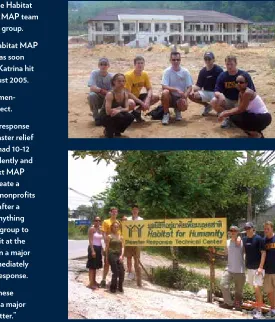
MAP projects are often transforma-tive experiences, but one in particular stands out for Professor Len Mid-dleton, a longtime MAP advisor. After the deadly December 2004 tsunami in Asia, Habitat for Humanity wondered if it should get involved in disaster response. It wasn’t an area the home-building charity had been involved in, so it asked for a MAP team in 2005 to study the question. The six-student team saw firsthand the devastation in Phuket, Thailand, and heard heartbreaking stories in addition to working on their business analysis. “This was life-changing,” says Mid-dleton. “Seeing the aftermath of that tsunami changed everyone. It gave the students a social ethos you really like to see. They took their business knowl-edge and skills and applied them in a way that could really help people.” The team presented their recommenda-tions to Habitat, finding there was great need for an organization to take the lead on temporary and permanent housing after natural disasters. One month after
[image:29.612.324.599.118.440.2]Scott DeRue
often talks about
how business
school changed
his life. It was
the first time
he realized that
business could
be the most
powerful force
for change in
the world.
A
s an undergraduate business major at The University of North Carolina, he discovered a world of new possibilities. He started out by pursuing those possibilities in the business world, working at the Monitor Group in consulting and private equity. Through this experience, he came to realize that his real interests lay in teaching business and helping others discover their own potential and world of possibilities. He earned a PhD at Michigan State and joined the Michigan Ross faculty in 2007. Leadership roles followed: He became director of the Sanger Leadership Center, faculty director of the Emerging Leaders Program, and associate dean for Executive Education. An authority on leadership and management, DeRue is considered one of the world’s most influential business professors and is often featured in media the world over.This summer, DeRue, 39, became the ninth dean of Michigan Ross. DeRue has already made clear some priorities for his term, including:
• Cultivating big ideas that shape the future of business. • Strengthening Ross’ position as the leader in
experience-driven business education. • Setting the standard for lifelong learning
and alumni engagement.
The Michigan Ross mission statement reads,
“We develop leaders who make a positive
difference in the world.” What does that mean
to you personally, and do you see it evolvin