“It’s Definitely an Uphill Battle”:
The Process of Innovation Implementation in the
Context of School-Based Child Obesity Programs
An Honors Thesis Submitted By
Jenna Brubaker
to the
Organizational Studies Program
University of Michigan
with the guidance & support of
Richard H. Price, PhD
ACKNOWLEDGEMENTS i
ABSTRACT ii
INTRODUCTION 1
Existing Research on Innovation Implementation 2
Mobilization Stage 4
Enactment Stage 5
Translation Stage 7
Mobilization-Translation-Enactment Model 9
Research Question One 10
Research Question Two 11
Research Question Three 13
METHODS 16
Identifying Candidate Programs 17
Identifying Interviewees 19
Interview Protocol 19
RESULTS 20
Research Question One 20
Research Question Two 26
Research Question Three 30
DISCUSSION 33
Implications for Innovation Research 35
Implications for Implementing Innovations 35
Implications for Implementing Health-Based Programs in Schools 38
Limitations of This Study 40
Conclusion 40
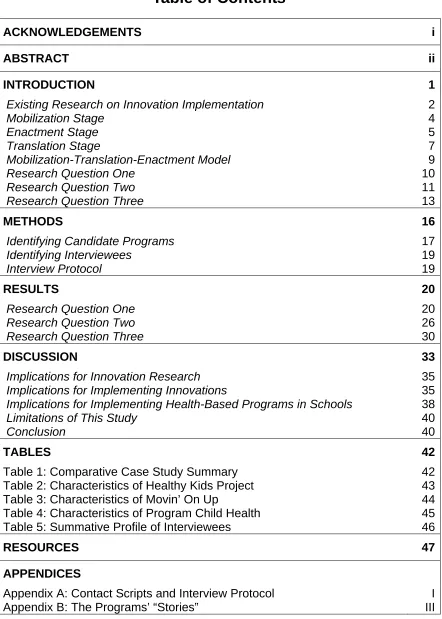
[image:2.612.87.529.96.715.2]TABLES 42
Table 1: Comparative Case Study Summary 42 Table 2: Characteristics of Healthy Kids Project 43 Table 3: Characteristics of Movin’ On Up 44 Table 4: Characteristics of Program Child Health 45 Table 5: Summative Profile of Interviewees 46 RESOURCES 47
APPENDICES
Acknowledgements
Conceptualizing, designing, and conducting this study was a process in itself, marked by
its own obstacles, roles, successes, and difficulties. I’d like to extend a tremendous thank-you to
those seventeen individuals willing to take time from their full schedules to answer my interview
questions with patience and passion. Thanks also to students and staff of the Organizational
Studies Department at the University of Michigan, whose intellectually stimulating discussions
have inspired this study. Grateful appreciation goes to: my intuitive one, who knew when to
motivate and when to distract; my forever best friend, who forever believes in me; my brothers
and their beautiful families, who never fail to make me smile; my Dad, who is with me every
day; and my Mom, whose love, patience, and encouragement are enduring. Finally, I’d like to
express my warm and sincere gratitude to Dr. Richard Price, my own ‘internal champion,’ a
ABSTRACT
Childhood obesity has recently reached a magnitude of epidemic proportion in the United States. In response, school-based prevention programs designed to ensure proper nutrition and physical activity have been on the rise. This study is an investigation into the implementation of such child obesity prevention programs in schools. The purpose of the study was to understand the implementation of innovations as a process, involving particular roles and a sequence of stages, as represented by my Mobilization-Translation-Enactment model. In-depth interviews were conducted with seventeen key players in three child obesity prevention programs. In each program I identified an external champion, program entrepreneur(s), and an internal champion. The study’s findings suggest that the process of program implementation involves three stages layering onto each other as the program evolves, with external champions, program
INTRODUCTION
Childhood obesity has proven to be an increasingly urgent issue over the past several
decades. The proportion of students classified as overweight has almost tripled over the past
thirty years (Institute of Medicine [IOM], 2004a). Children spend an average of four hours a day
in front of a television or computer screen; eat bigger and bigger meal portions, consuming great
quantities of fatty foods; and suffer frightening rates of heart disease, hypertension, diabetes, and
other acute illness (IOM, 2004b). This trend is more than a cause for concern. It is an epidemic; a
cause for fright; a call to immediate, effective action.
Children and their families aren’t the only ones with a stake in this emerging crisis. It is
in the interest of community organizations, government agencies and programs, public health
professionals, recreation and sports enterprises, health-care insurers, and countless other
institutions and organizations to confront the problem and promote successful solutions (IOM,
2004c). Myriad attempts to reduce childhood obesity have been made through grassroots
movements and government programs alike. Some such attempts aim to “increase physical
activity, decrease sedentary behavior and/or reduce dietary energy intake” by intervening in
children’s “social, regulatory, or physical environments” (Robinson & Sirard, 2005, p. 194).
These environmental approaches are particularly attractive because children “spend a large part
of their days in a relatively small number of settings,” and thus parents, guardians, and other
adult mentors can effectively control these settings and guide children to healthy choices
(Robinson & Sirard, 2005, p. 194).
Elementary and middle schools, then, are a natural venue in which to address this
problem (Wechsler, Devereaux, Davis, & Collins, 2000). Countless schools across the country
have adopted programs aimed at preventing childhood obesity. In addition to educating students
environment factors in child health by implementing physical activity requirements, prohibiting
junk foods advertisements within school buildings, and offering healthy choices in cafeteria
menus and meal programs (IOM, 2004d). Some of these school programs have been highly
successful in encouraging children to adopt healthy lifestyles.
Existing Research on Innovation Implementation
Yet it can be extraordinarily difficult to actually develop, implement, and institutionalize
such a program. To understand these difficulties, we look to an entire sector of research and
scholarship devoted to the creation, implementation, and dissemination of innovations. Rogers
(2003) describes an innovation as “an idea, practice, or object that is perceived as new by an
individual” or organization (p. 12). Mumford and Moertl (2003) ask how ideas are generated,
and how they are developed and refined into innovations. Other scholars look to understand how
key attributes of the innovation itself – such as compatibility, complexity, and trialability –
influence the process by which the innovation is adopted (Grilli & Lomas, 1994; Rogers, 2003).
Still others look to characteristics of individual actors in the implementation process, like
champions (Markham, 1998; Schon, 1963; Shane, 1995); opinion leaders (Burt, 1999; Fitzgerald,
Ferlie, Wood, & Hawkins, 2002; Locock, Dopson, Chambers, & Gabbay, 2001); change agents
(Lomas, 2000; Rogers, 2003); and boundary spanners (Kimberly & Evanisko 1981; Barnsley,
Lemieux-Charles, and McKinney, 1998). Damanpour (1991) conducts a meta-analysis of
innovation research to evaluate particular structural determinants of organizational
innovativeness such as specialization, centralization, and managerial attitude toward change.
Other authors discuss other characteristics of the adopting organization, such as a receptive
context for change (Dopson, Fitzgerald, Ferlie, Gabbay, & Locock, 2002). Still others explore
innovations, such as interorganizational networks (Burns & Wholey 1993) or policy incentives
(Fitzgerald et al. 2002).
In one particularly relevant study, Greenhalgh, Robert, MacFarlane, Bate, and
Kyriakidou (2004) undertook a substantial literature review – of mostly health care research – to
determine how we can “spread and sustain innovations in health service delivery and
organization” (p. 581). The authors looked into findings of hundreds of research studies
regarding the innovation itself, the process of adopting the innovation, channels of
communication and influence, characteristics of the adopting organization, characteristics of the
adopting organization’s environment, and the implementation process. The studies represented a
range of different research traditions (e.g. medical sociology, marketing, development studies,
and evidence-based medicine), each of which uses its own language, metaphors, criteria for
‘quality’ and ‘success’, and so on. From this systematic literature review, the authors developed
a “Conceptual Model for Considering the Determinants of Diffusion, Dissemination, and
Implementation of Innovations in Health Service Delivery and Organization” (p. 595). It is
indeed a remarkable synthesis of innovation literature. But the model is so complex, and includes
so many different components of and concepts for the implementation of health innovations, that
it is difficult to isolate and distinguish any given determinant for its practical implications. In
fact, Greenhalgh and her co-authors suggest that “the next generation of research on diffusion of
health service innovations” be “process rather than ‘package’ oriented”: “research questions
should be framed so as to illuminate a process” (p. 615).
In this exploratory investigation, then, I propose to take a step back and look at the
process of innovation implementation. This study is an emphasis on behavior that is central to
the dynamic task of organizing rather than behavior that occurs in a static organizational context
empirical research on innovations outlined above is not without significant relevance. In fact, the
process of innovation implementation will likely engage a collection of the roles, actions,
sequences, and activities already discussed in innovation literature. My review of the literature
suggests that the process of innovation implementation involves three distinct stages –
Mobilization, Translation, and Enactment – with a particular role corresponding to each. The
following paragraphs explore these stages and roles in the context of school-based child obesity
prevention programs and as they relate to existing theoretical literature.
Mobilization Stage
Developing an innovation such as a childhood obesity prevention program is no easy
task. It requires time, dedication, considerable financial resources, and the involvement of people
with appropriate expertise (Mumford & Moertl, 2003). Moreover, the preventive nature of
childhood obesity prevention programs makes them particularly difficult to mobilize: preventive
innovations have a delayed reward, and one that may not be visible because it’s the absence of
something (e.g. obesity, diabetes, heart problems) (Rogers, 2003).
External champions are individuals who recognize these difficulties but have the passion
to overcome obstacles and resolve the issue at hand. Light (2006) cautions against focusing on
inherent personality traits of these individuals (such as motivation and tolerance for ambiguity)
and urges that we focus instead on teachable skills “such as the ability to activate the public,
raise capital, negotiate results, and manage the difficult transitions involved in taking an
organization from its initial start-up phase to maturity” (p. 48). External champions tend to have
longstanding involvement in a leadership role in a school, hospital, or public health department
(Mumford & Moertl, 2003). They have the ability to shake up considerable financial and human
resources: they “use scarce resources effectively,” “leverage their limited resources by drawing
philanthropy to the commercial methods of the business sector” (Dees, 2001). I hypothesize that
external champions engage in the following actions during the Mobilization stage, explained in
the context of school-based child obesity prevention programs:
• Partnering: getting people on board; creating basic partnerships; recognizing in particular the importance of a relationship between the school and the hospital
• Initiating: obtaining funds; securing the support of local individuals and organizations; creating an organized plan for the program
• Motivating: providing a driving force behind the implementation and expansion of the program
• Legitimizing: acting as a leading member of the health care community to promote the program
I suggest that Mobilization is defined by the external champion’s engagement in these
actions. When the external champion begins to perform these actions, it is the beginning of
Mobilization; conversely, the end of the external champion’s involvement signals the end of this
first stage.
Enactment Stage
Once an innovation is developed, further challenges await upon its introduction to an
organization. The Enactment stage involves earning the buy-in of key potential adopters – in the
case of childhood obesity programs, administrators, teachers, parents, and children alike – so that
the innovation’s implementation is successful and sustained. This is a particularly difficult task
for four reasons. First, potential adopters are disinterested in disturbing the status quo: they tend
to want to stick to old routines (Shane, 1995). Second, some potential adopters don’t perceive the
problem in the first place. It’s difficult to introduce a childhood obesity prevention program to
individuals who don’t believe that childhood obesity is an important and pressing issue. Third,
the possibility of adopting a new innovation “creates uncertainty about its consequences in the
mind of potential adopters,” which makes potential adopters uncomfortable and thus less likely
resources or social standing if a new innovation is adopted into their organization, and would
thus be particularly opposed to the innovation’s implementation.
Because these challenges arise when an innovation is introduced into an organization,
“organizations often require a catalyst to promote innovation” (Shane, 1995, p. 49). Elias,
O’Brien, and Weissberg (2006) find that to accomplish major change in a school – particularly if
it means reframing the school’s environment – requires “transformative leaders” willing to make
a personal commitment to advocate for the innovation’s vision. Such a leader is often called an
internal champion, “a charismatic individual who throws his or her weight behind an innovation,
thus overcoming indifference or resistance that the new idea may provoke in an organization”
(Rogers, 2003, p. 414). Indeed, some authors even believe that “the new idea either finds a
champion or dies” (Schön, 1963, p. 84). Howell and Shea (2001) define “champion behavior” as
“[demonstrating] conviction in the innovation, [building] involvement and support, and
[persisting] under adversity” (p. 21). Internal champions utilize internal and external
organizational connections to further the cause of an innovation, using interpersonal negotiation
skills and persuasion and influence tactics to do so (Markham, 1998; Shane, 1995; Rogers,
2003). I hypothesize that internal champions engage in the following actions during Enactment,
explained in the context of school-based child obesity prevention programs:
• Communicating: introducing the program to teachers, parents, and students
• Endorsing: working for parent and teacher buy-in; acting as cheerleader and champion for the innovation; campaigning for a cultural shift within the school
• Balancing: juggling the interests of the program with interests of the school; maintaining a positive relationship with staff and parents; maintaining financial stability
• Facilitating: helping to determine the best time and method by which to introduce the program
I suggest that the Enactment stage begins when the internal champion comes into the
picture and begins communicating, endorsing, balancing, and facilitating, and ends when these
the case of child obesity prevention programs, marks the program’s successful implementation
into a school.
Translation Stage
It can be challenging, however, to create and maintain effective collaboration between the
world of the external champion and the world of the internal champion. Occurring between
Mobilization and Enactment, the Translation stage involves framing the external champion’s
innovation in such a way that is appropriate for the setting of the internal champions and other
key potential adopters. Price (2002a) discusses the difficulty of developing networks and social
capital across different sectors – like health care and education – when norms are so incoherent
between sectors. Lomas (2000) speaks to this difficulty in his article about a Canadian initiative
to encourage partnerships between researchers and policy makers. It is difficult, he says, for
researchers to find a point of entry into the policy-makers’ sphere and to understand the political
pressures on policy-makers; similarly, it is difficult for policy decision-makers to interpret
researchers’ findings and to truly understand everything that research involves. Finally, it is
difficult for any of them to find time to meet, collaborate, and discuss (Lomas 2000). One can
imagine that similar difficulties arise between, on the one side, the healthcare-based researchers
and innovators of childhood obesity programs, and on the other side, the school-based
administrators and teachers who actually adopt the programs. Innovators create ideal prototype
programs within the context of their ideal platonic sphere, but adopters need to implement a real
material program within their own ecological niche.
To bridge such a chasm between innovators and implementers, there is a need for some
sort of a boundary-spanning role. The meta-analysis of health innovation literature by
Greenhalgh et. al (2004) revealed that “organizations that promote and support the development
innovations quickly” (p. 603). Baldridge and Burnham (1975) found that individuals in particular
organizational positions were “extremely important as boundary role people” by “[serving] as a
link between demands and ideas from the outside and the innovations being adopted within the
schools” (p. 169). These boundary-spanners, or what I will call program entrepreneurs, have
“one foot in each of two worlds” (Rogers, 2003, p. 368). In systems with a pronounced chasm
between innovators and adopters, program entrepreneurs “build the interpersonal bridges” to
connect the two (Burt, 1999, p. 49). They “customize the design and delivery” of the innovation
to appeal to potential adopters, and in turn provide feedback from the potential adopters back to
the innovator (Rogers, 2003, p. 368). Program entrepreneurs are culturally sensitive – they
understand how to frame the problem for a particular cultural and political setting; recognize
what dilemmas need to be overcome before the program can be implemented; and intuitively
know how to best maneuver the program within that cultural and political setting (Price, 2002b).
In the case of childhood obesity prevention programs, program entrepreneurs understand the
‘health and research sphere’ of innovators and external champions, but also understand how the
implementation process must work within the ‘school sphere’ of staff and internal champions. I
hypothesize that program entrepreneurs engage in the following actions during the Translation
stage, explained in the context of school-based child obesity prevention programs:
• Connecting: making connections with individuals inside the school; recognizing the importance of identifying an internal champion, and making an effort to do so; building a network with individuals and organizations outside the school
• Adjusting: recognizing key differences between the health sphere and the school sphere; adjusting program design and outcome expectations accordingly
• Adapting: recognizing the dynamics involved in disseminating the program to different schools; tweaking the program design to fit accordingly
• Persevering: overcoming numerous obstacles, particularly in getting buy-in from parents and teachers
I anticipate that the program entrepreneur begins Translation when the external champion
stages become a model for the implementation of school-based child obesity prevention
programs.
Mobilization-Translation-Enactment Model
Based on the existing literature outlined above, I propose that the implementation of an
innovative school program designed to prevent childhood obesity is a three-stage organizing
process. Each of the three stages is associated with a social and organizational role, and all three
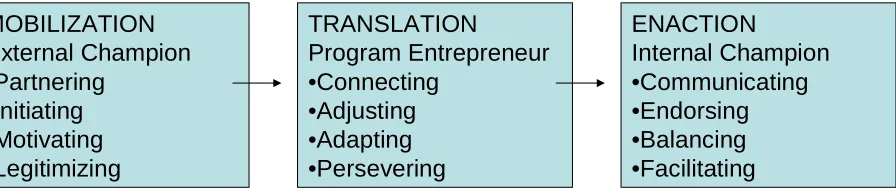
are interlinked. My proposed model (Figure 1) illustrates three distinct roles in three distinct
stages of the innovation implementation process: an external champion in the Mobilization stage,
a program entrepreneur in the Translation stage, and an internal champion in the Enactment
stage.
MOBILIZATION External Champion •Partnering
•Initiating •Motivating •Legitimizing
TRANSLATION
Program Entrepreneur •Connecting
•Adjusting •Adapting •Persevering
ENACTION
[image:13.612.97.545.419.516.2]Internal Champion •Communicating •Endorsing •Balancing •Facilitating Fig. 1: Mobilization-Translation-Enactment Model
of the Innovative Program Implementation Process in Organizations
The study described here is an investigation into the plausibility of the above model, thus
both contributing to innovation literature and attempting to yield ideas for practitioners engaged
in implementing innovations. In the context of a comparative case study involving three
school-based child obesity prevention programs, I search for answers to the following three research
Research Question One: Are the three stages distinct, ordered, and not overlapping, as hypothesized in the model?
Weinstein, Rothman, and Sutton (1998) outline the defining properties of a stage theory.
They refer in particular to stage theories of health behavior, but their comments can help us
examine the characteristics of the proposed model as a stage theory. A stage theory entails “a
classification system to define the stages”: there are a limited number of categories, and
individuals or programs at one stage will share attributes with other individuals or programs at
that stage (p. 51). Second, a stage theory entails a particular “ordering of the stages,” though this
sequence of stages doesn’t mean that the process is necessarily inevitable or irreversible (p. 51).
While other paths of action are possible, the “substantial majority follow the specified
sequence,” so the theory is “accurate and useful even if other paths to action are possible” (p.
52). A third property of stage theory is that all individuals or programs at the same stage “have to
address similar issues before they can progress to then next stage” (p. 52). If this is indeed the
case, the Mobilization-Translation-Enactment model is particularly useful, because we can
identify what needs to happen for a program to progress to the next stage of implementation.
Finally, “some barriers must be more important at certain stages than others” (p. 52). So a
program in the Mobilization stage faces different barriers than a program in the Translation stage
or the Enactment stage. Interestingly, the authors also explain that while it may be relatively easy
to identify the different stages of a stage model, it is significantly more difficult to figure out
exactly how individuals or programs move from one stage to the next.
If the process of program implementation is indeed a sequence of stages that are distinct,
ordered, and not overlapping, then the corresponding linear model can be a “useful analytical
framework” that “simplifies” and allows practitioners a “sense of orientation” during the
implementation process (Godin, 2006, p. 660). On the other hand, Greehalgh et al (2004) found
considering an innovation to successfully routinizing it is generally a nonlinear process
characterized by multiple shocks, setbacks, and unanticipated events” (p. 610). Thus the multiple
case studies outlined in this paper seek to determine whether the model’s distinct, ordered, and
non-overlapping stages are indeed a true reflection of the process of program implementation.
Research Question Two: Are there three different roles held by three different individuals, as hypothesized in the model?
This research question involves two sub-questions. First, are there indeed three different
roles, or are the responsibilities of each stage such that one individual may fill the functions of
more than one role? Second, are individuals uniquely assigned to each role? That is, can only
one person fill each role, or might there be two or three external champions, program
entrepreneurs, and/or internal champions for a given program?
For the first sub-question, two different approaches to role theory predict contradicting
results. The first is an energy-expansion approach, and it proposes that there are certain rewards
of role accumulation – role privileges, status enhancement and security, and ego gratification
among them – such that an individual may reap personal benefit from taking on more than one
role (Sieber, 1974). This approach predicts that an individual is both capable of and inclined to
fulfill the responsibilities of multiple roles, which means that one person might be external
champion, program entrepreneur, and internal champion for a given program. On the other hand,
the scarcity approach to role theory proposes that an individual who undertakes more than one
role is “likely to face a wide, distracting, and sometimes conflicting array of obligations,” and
that “we begin to experience strain, worry, anxiety, or the pressures of others if we devote more
time and attention to one role obligation than we feel we should, or than others feel we should”
champion, program entrepreneur, and internal champion would perhaps be too much for one
person to handle.
A compromise of both approaches to role theory, however, has interesting implications
for the proposed model: if each role is confined to one stage, and if the stages are indeed distinct,
ordered, and non-overlapping, then one individual might fulfill more than one role for a given
program and experience the rewards of role accumulation without experiencing considerable role
strain or role overload. If, however, the roles and/or the stages are overlapping in nature, it is less
feasible for one individual to undertake the responsibilities of more than one role at once without
spreading himself too thin. This study’s findings might provide evidence for either version of
role theory.
This brings us to the second sub-question, which asks whether more than one individual
might fill any given role. Some theorists argue that human beings possess only limited time and
energy with which to complete their numerous responsibilities, and that “various groups having a
claim on individual’s energies and time compete with one another in the effort to draw out as
much as they can, within normative limits, from the available pool of resources” (Coser, 1974, p.
1 cited in Marks, 1977, p. 923). Perhaps role-sharing individuals effectively merge their time and
energy into a greater “pool of resources,” thus easing the role’s burden on each individual. On
the other hand, Feldman (1984) argues that roles, even when not formally assigned, ensure that
important jobs get done by “[reducing] individual members’ ambiguities about what is expected
specifically of them” (p. 49). This line of reasoning implies that perhaps role-sharing fails to
reduce these ambiguities because individuals have to negotiate the role’s expectations and
responsibilities with one or more other people. This study’s results may support one or the other
If the process of program implementation indeed involves three distinct roles – each of
which is responsible for a different aspect or stage of the process – then the model can serve to
increase the likelihood of successful implementation by clearly specifying what is required of
each role at each stage. Thus the multiple case studies outlined in this paper look to identify key
individuals involved in the implementation process, and to explore the roles and responsibilities
that they play.
Research Question Three: What is the influence of different resource
environments –financial capital and social capital contexts in particular – on how the implementation process unfolds?
Damanpour’s (1991) meta-analysis of innovation research indicates that the
innovativeness of an organization is positively associated with its financial and social resources.
Indeed, my own review of innovation research supported this same finding as relates to both
financial capital and social capital. Such findings suggest that the innovation implementation
process may unfold differently in different resource environments.
Rosner (1968) maintains that an organization with adequate financialcapital can bear
costs of the innovation itself, costs of the innovation’s implementation, and potential costs of the
innovation’s failure (see also Corwin, 1975). Greenhalgh et. al (2004) determined in their
meta-analysis that “if there is dedicated and ongoing funding for its implementation, the innovation is
more likely to be implemented and routinized” (p. 611). The researchers also found some
evidence that higher socio-economic status of patients or clients (or, in the case of schools,
students’ families) can have a positive effect on the implementation process. Thus we expect
that, for those programs implemented in financially rich contexts, the implementation process
involves fewer obstacles and less resistance than for those programs implemented in financially
The social capital of a program’s environment also has significant influence on the
program’s implementation process. One aspect of social capital in this case relates to the
adopting organization’s connections within the community. In a statistical analysis of the
correlates of school innovativeness, Corwin (1975) measured school-community cooperation
based on school-centered activities (e.g. field trips), members of community participating in the
school (e.g. parent aides), and community-based joint activities (e.g. voter registration or clinics).
His study found that those schools that engaged in school-community cooperation were more
likely to have successfully adopted innovations than were those that did not engage in
school-community coooperation. Provan and Milward (2001) advise that school-community-wide networks be
evaluated “as service-delivery vehicles that provide value to local communities in ways that
could not have been achieved through the uncoordinated provision of services by fragmented and
autonomous agencies” (para. 13). Their essay suggests the value of using organizational
connections to solve problems in the public domain, perhaps through program implementation.
Another aspect of social capital in innovation implementation is the social capital of key
individuals involved in the process. Corwin (1975) says that “there is evidence from a study of
social welfare agencies that rates of program changes were positively correlated with the number
of outside professional activities of the personnel” (p. 3). In his own statistical analysis of
school-based innovations, Corwin discovered that schools whose faculty were involved in
professional organizations were more likely to be innovative because, he says, “being active in
teacher organizations provides an additional measure of status security, and also a national
organization can be a source of influence and new ideas” (p. 27). These two aspects of social
capital – that of the adopting organization and that of key individuals involved in the
implementation process – may prove to be significant determinants of how the program
If financial capital and social capital significantly influence how the program
implementation process unfolds, then the proposed model should be understood as the
representation of a process that occurs within a particular resource environment. Thus the
multiple case studies in this paper offer an opportunity to further investigate this relationship,
and to provide insight into how the process of innovation implementation might be successfully
managed in varying levels of resource wealth.
In light of the three research questions listed above, it is prudent to ask another question
here: what is the point of this study? My aim is twofold. Primarily, the study seeks to understand
the implementation of innovations as a process involving particular roles and a sequence of
stages. This aspect of the study looks at these three particular case studies because they are a
window through which to look at the larger process of program implementation. Secondarily,
however, the study is an effort to understand child obesity prevention programs and how certain
factors contribute to successful implementation of these programs in schools. This aspect of the
study is an effort to address the larger social issue of child obesity. While these two aims may
seem quite different, they are by no means contradictory. Robinson and Sirard (2005) argue that
“a research project [aimed at improving individual and population health] should only be
performed if… the result may change how you would intervene to address a clinical policy, or
public health problem” (p. 199). Thus if this study is indeed to help improve the larger social
issue of child obesity, we must determine if and how its results change how practitioners might
intervene to address the problem of child obesity. The answers to the three research questions
outlined above may be interpreted as efforts to understand the process of innovation
METHODS
Information for this study was obtained by conducting qualitative case studies exploring
the implementation of three school-based childhood obesity prevention programs within sixty
miles of each other. Table 1 provides a comparative case study summary for the three programs:
Healthy Kids Project, primarily in Prospect; Movin’ On Up, in Wilson; and Program Child
Health, primarily in Mobile City.1
Case studies were my method of choice in this study for several reasons. The study poses
questions about the “how” and “why” of innovation implementation within a real-life context,
which lends itself well to case study research (Yin, 2003). This type of research cannot be
reduced to a laboratory setting; rather, it can be observed in real life, and case studies help to
“emphasize the rich, real-world context” in which these school programs are implemented
(Eisenhardt & Graebner, 2007, p. 25; see also Yin, 2003). Developing a theory from the case
study information, then, helps to create a link between “rich qualitative evidence” and
“mainstream deductive research” (Eisenhardt & Graebner, 2007).
Furthermore, the use of multiple cases rather than a single case offers a multitude of
advantages. The multiple-case approach allows the researcher to make comparisons between
cases. This can help to determine whether a particular feature or pattern is unique to one case or
seems to be shared across cases (Eisenhardt & Graebner, 2007). Features that may be mediators,
moderators, or completely unrelated are more easily recognizable as such. Finally, with multiple
cases a researcher can provide a satisfying amount of empirical data that supports the theory,
indicating the theory’s generalizability across a series of contexts and situations (Eisenhardt &
Graebner, 2007).
1
Identifying Candidate Programs
To identify candidate programs, I spoke with a hospital administrator who has familiarity
with local programs aimed at preventing childhood obesity. This informant notified me about the
three programs mentioned above, all of which have been funded in part or in full by the Regional
Community Foundation.
The first is the “Healthy Kids Project” [see Table 2], run by State University’s U-FIT
Program, Cardiovascular Center, and School of Public Health along with Prospect Public
Schools and several other participating sponsors. It is funded in part by the Regional Community
Foundation and also receives considerable financial support from local organizations and private
donors. This twelve-week program targets sixth graders in all five Prospect public middle
schools. The program’s goals for these students are increased consumption of fruits and
vegetables; better beverage choices; decreased consumption of fast and fatty foods; increased
physical activity; and decreased TV and computer time. Healthy Kids Project components
include activities during advisory period, an online healthy behaviors blog, healthier selections in
the cafeteria, and increased opportunities for physical activity during and after school.
Post-program, in-school surveys indicate positive behavioral changes and wellness screening data
suggest significant drops in cholesterol and other heart health risk factors. The program is led by
a director from the State University Health System, a program manager, two wellness
coordinators, and a program steering committee.
“Movin’ On Up” [see Table 3] is a program provided by Wilson Community Hospital
and the Wilson School District to third and fourth grade students; a number of program elements
have also been implemented in the city’s K-2 and 5-6 schools. The program is funded by a
$100,000 grant from the Wilson Community Foundation, a branch of the Regional Community
and vegetables; and the reporting of students’ Body Mass Index percentile to parents. Movin’ On
Up components include healthy meal options in the school lunch program; healthy classroom
snacks and once-a-month birthday treats policies; new Project Fit America equipment at the
school; and skits and lessons “designed to enhance the existing fitness and nutrition curriculum.”
The program is led by a program manager and a fifteen-member advisory board with members
from the hospital, school district, and community.
The third program, Program Child Health [see Table 4], is provided by the Carnegie
Health System and City Year Mobile City to kindergarten through eighth grade students in five
public schools in some of the Mobile City area’s poorest neighborhoods. The program is funded
by a $100,000 grant from the Regional Community Foundation – half of which was awarded to
City Year, and the other half to the Carnegie Health System. The purpose of the program is to
promote good nutrition and physical activity among Mobile City schoolchildren, particularly by
“[improving] the school health environment.” Program Child Health components include after
school programs designed to encourage healthy food choices with a focus, for example, on
healthy food shopping and cooking; and after school physical activity programs such as
recreation and sports, cheerleading, exercise, and step teams. These programs are delivered by
City Year corps members: young adults from diverse backgrounds who have devoted themselves
to at least one years’ worth of service to schools in the city. These corps members work full-time
in teams of eight to nine corps members at each school. Program Child Health involves the
formation of a Coordinated School Health Team (CSHT) at each school, comprised of school
administrators, teachers, parents, corps members, and staff representatives from both City Year
Mobile City and the Carnegie Health System. At this point, the program itself is guided largely
The aforementioned programs are a fruitful multi-case sampling. While they have similar
goals and target the same general audience (students in primary school), they involve children
from different backgrounds in terms of ethnicity, socioeconomic status, and the like. The
programs represent a variety of methods and levels of involvement, as well as differing lengths
of intervention and different ways of measuring results.
Identifying Interviewees
Table 4 includes a list of interviewees’ names and occupations, as well as their roles in
each program. Rather than hypothesis-testing, my research was hypothesis-generating: the study
was an effort to develop a model illustrating the dynamic processes involved in program
implementation. As such, my strategy was to conduct interviews with a number of individuals
involved in each program. The investigation was conducted using a “snowball” sampling
strategy: interviewing began with initial contacts, who then suggested additional individuals to
be interviewed. A total of sixteen interview sessions were conducted with seventeen individuals
(one session was a joint interview with two individuals). Interviews took place between October
2007 and January 2008, with one outlier in June 2007 and another in March 2008. Most were
conducted in the interviewees’ office or place of employment, although one took place in a diner
in Wilson and another was conducted over the phone.
Interview Protocol
The study sought to identify external champions, program entrepreneurs, and internal
champions for each program, and to explore the actions in which these individuals engaged
during each stage. To do this, I conducted the interviews using a semi-structured qualitative
interview protocol consisting of two parts. The first part asked the interviewee to “tell the story”
of the program’s conception and implementation in his or her own words, including the
individuals with whom I might make contact for additional information.The cycle continued so
that all external champions, program entrepreneurs, and internal champions were identified.
Whenever possible, these individuals were then interviewed regarding their background, their
motivation, and their strategies in moving the program toward implementation. Appendix A
provides the general script for initial contact and interview, as well as a list of questions asked of
most interviewees.
RESULTS
In the interviews, I asked each individual associated with a program to tell his or her
version of the “story” by which that particular program was implemented. Results from these
qualitative interviews were compiled and fit together to create a coherent “story” to determine if
and how each case study’s implementation process fits with the proposed model. Stories are
important because, as Weick, Sutcliffe, and Obstfeld (2005) note, “the order in organizational
life comes just as much from the subtle, the small, the relational, the oral, the particular, and the
momentary as it does from the conspicuous, the large, the substantive, the written, the general,
and the sustained” (p. 410). Appendix B recaps the “stories” that emerged from interviews and
program documents, and illustrates how external champions, program entrepreneurs, and internal
champions carried out the processes associated with each stage of the model. Detailed interview
records are available on request.
Analysis of the study’s results focuses on three distinct, but related research questions.
Research Question One: Are the three stages distinct, ordered, and not overlapping, as hypothesized in the model?
The model suggests three stages in the process of program implementation, one replacing
the other in a linear fashion as time progresses. The benefit of such a model is in its very
“sense of orientation” if they know what factors help move a program from one stage to the next
(Godin, 2006, p. 659). If an implementation process indeed follows the proposed stage model,
the external champion will know exactly what she needs to do during the Mobilization stage in
order for the implementation to succeed, and how that differs from what the internal champion
needs to do during the Enactment stage. Furthermore, “stage models offer the possibility of
creating programs… that will be more effective and efficient” than programs that try to get
everything done at once (Weinstein et al, 1998, p. 61).
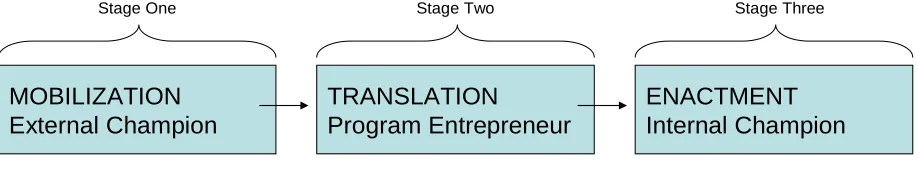
In my proposed model, the external champion engages in distinct actions from the
beginning of Mobilization until the end of Mobilization, at which point the external champion’s
involvement ends, the program entrepreneur’s involvement begins, and Translation begins.
Similarly, at the end of Translation, the program entrepreneur’s involvement ends, the internal
champion’s involvement begins, and Enactment begins. This linear sequence can be
demonstrated as follows:
MOBILIZATION External Champion
TRANSLATION
Program Entrepreneur
ENACTMENT Internal Champion
Time
[image:25.612.85.544.479.576.2]Stage One Stage Two Stage Three
Fig. 2: Proposed Stage Sequence of Program Implementation Process
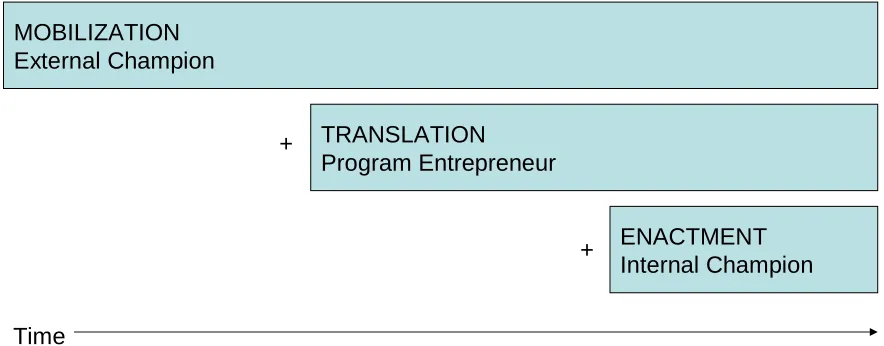
Results from the three case studies indicate, however, that while the stages do indeed
occur in a linear fashion, each stage layers onto, rather than replaces, the former. Mobilization
Translation processes and the program entrepreneur’s role do indeed begin some time after
Mobilization begins, but they also last through the end of Enactment. The implementation
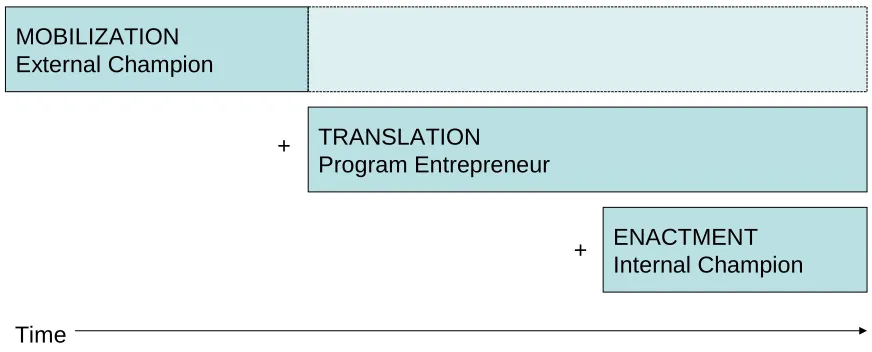
process for the Healthy Kids Project is a good example of this adjusted model:
MOBILIZATION External Champion
TRANSLATION
Program Entrepreneur
ENACTMENT Internal Champion
Time
+
+
Fig. 3: (Actual) Phase Sequence of Program Implementation Process for Healthy Kids Project
For example, while the proposed model predicted that Dr. Hart, Healthy Kids Project’s
external champion, would have dropped out of the picture as soon as the Translation stage began,
he has in fact “as much input now as he did two years ago.” He continues to be responsible for
creating and nurturing basic partnerships, such as that with the Prospect school board. (Michelle
Reed, the board’s president, says that Dr. Hart and his team “chose to stay close to the school
board,” effectively gaining a thumbs-up from the board and thus establishing a formal
partnership with the Prospect School District). Moreover, Dr. Hart is clearly a motivating force
for the program’s success and dissemination. Members of his team clearly admire him for his
fervor and dedication. Lucy Brigard, one of the Healthy Kids Project’s program entrepreneurs,
says that Dr. Hart is “passionate” about preventing childhood obesity. Another program
entrepreneur, Carol Hyatt, agrees: “He levels and excites us, and helps us to see we can do things
[image:26.612.82.524.191.364.2]because we’re the doers. When people ask us ‘How do you branch out so much?’ it all goes back
to Dr. Hart.” Finally, Dr. Hart continues to engage in legitimizing. He is regularly asked to speak
about his thoughts on childhood obesity and the success of Healthy Kids Project at local and
national events, meetings, and conferences, for such institutions as the National Center for
Institutional Diversity. No doubt his position as a highly respected leader at one of the nation’s
top health systems lends itself well to promoting Healthy Kids Project and disseminating its
ideas – as he has done throughout the entire implementation process.
In another divergence from the proposed model, Healthy Kids Project’s program
entrepreneurs – Lucy Brigard, Carol Hyatt, and Elaine Brown – have continued to play a
significant role in the program even after its implementation process moved from Translation to
Enactment. For example, they recognized the importance of connecting and building meaningful
relationships during Translation, and then they continued to create and nurture these
relationships after the Enactment stage began. All three of Healthy Kids Project’s program
entrepreneurs are regularly asked to speak at PTSO meetings, present during school assemblies,
and generally share information about the program with other schools and districts. Furthermore,
the three women didn’t simply stop adapting the program to each school as soon as Enactment
began. Instead, the need for “tweaking and flexibility” – as one of them called it – continued
even after the program had been implemented at each target school, and that needs continues as
they look to expand the program outside the Prospect district’s boundaries. Finally, the program
entrepreneurs are certainly persevering into the Enactment stage, working tirelessly with schools
and teachers, ensuring that the program is implemented in a way that works best for all involved.
It is clear that Healthy Kids Project’s program entrepreneurs have continued their Translation
more accurately represents Healthy Kids Project’s implementation process than did the original
model (Fig. 2).
The other two programs in this study also adhered to the revised model more so than the
original model, but not without some variations. In Movin’ On Up, the external champion’s role
and responsibilities decreased to some extent once Translation began:
MOBILIZATION External Champion
TRANSLATION
Program Entrepreneur
ENACTMENT Internal Champion +
+
Time
Fig. 4: (Actual) Phase Sequence of Program Implementation Process for Movin’ On Up
In a sense, Movin’ On Up’s external champion turned over some of her Mobilization
responsibilities to Jane Lutz, the program entrepreneur. For example, Lutz has been largely
responsible for partnering: major partnerships have been established through connections with
her rather than connections with the external champion. So while Movin’ On Up’s
implementation process remains true to the revised model, it includes a slight variation in the
extent to which and by whom Mobilization actions continue throughout the process.
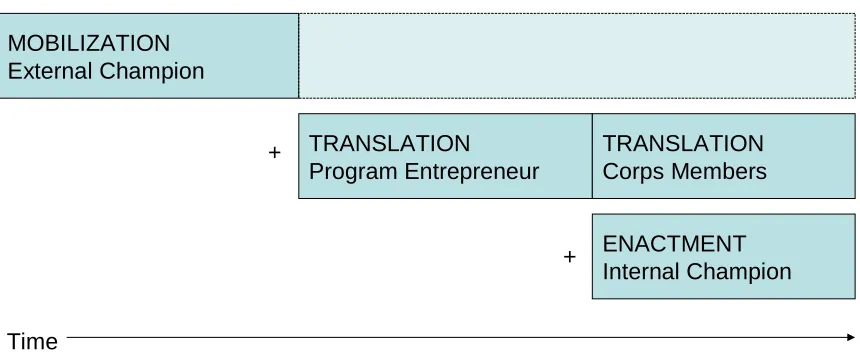
Program Child Health’s implementation process involves an additional twist on the
model: the City Year corps members, who take the baton from the program entrepreneur once
[image:28.612.82.518.244.420.2]MOBILIZATION External Champion
TRANSLATION
Program Entrepreneur
ENACTMENT Internal Champion
Time
Fig. 5: (Actual) Phase Sequence of Program Implementation Process for Program Child Health
TRANSLATION Corps Members +
+
Once the program is introduced to a target school and Enactment begins, it is the corps members
who are largely responsible for the Translation processes of connecting, adapting, and
persevering. For example, corps members are the primary connection between the external
champion and the internal champion. Furthermore, each City Year team adapts the program to
their respective target school as they see fit. And perseverance? City Year’s director has no end
of praise for the resolve of these young people: “They’re like a mini army – but these are
positive, idealistic, uplifting young adults who are willing to work for a penance. They’re quite
exceptional.” For Program Child Health, there is no doubt that the Translation processes –
apparently so integral to program implementation, even after Enactment has begun – remain in
good hands after they have passed from program entrepreneur to corps members.
Let us return to the first research question. Does the process of program implementation
indeed follow a linear model with three distinct stages? The answer, it seems, is that it does only
to an extent. The child obesity prevention programs examined in this study did undergo three
different phases – Mobilization, Translation, and Enactment, each with its own role and set of
processes – as represented in a revised model with slight variations (Figs. 3, 4, & 5). The revised
[image:29.612.87.517.100.281.2]stage is similar to other programs at that stage; programs at a particular stage need to address
similar issues before moving on to the next stage; and a program in one stage faces different
challenges than a program in other stages. However, the revised model differs from a typical
stage model in that roles and actions from one stage continue even after the next stage has begun.
Regardless of variations, all three case studies have demonstrated multi-phase implementation
processes whose roles and actions are introduced to the process in a particular order.
Research Question Two: Are there three different roles held by three different individuals, as hypothesized in the model?
The model suggests that three roles exist in the process of program implementation: the
external champion, responsible for Mobilization; the program entrepreneur, responsible for
Translation; and the internal champion, responsible for Enactment (refer to Fig. 1). These roles
and their functions are an important part of the model. While the actions that take place during
each stage are certainly integral to program implementation, what makes the implementation
succeed isn’t the actions themselves but the people who engage in those actions. If the program
implementation process indeed involves three distinct roles – each of which is responsible for a
different stage of the process – then the model can serve to increase the likelihood of successful
implementation by clearly specifying what is required of each role at each stage. Research
Question Two asks two sub-questions that attempt to clarify these issues.
The first sub-question asks: are there indeed three different roles, or are the
responsibilities of each stage such that one individual may fill the functions of more than one
role? The model assumes that for each program we can identify three distinct individuals who
were largely responsible for the actions that took place during each of the three distinct stages.
Because each role – external champion, program entrepreneur, and internal champion – requires
individual could fill more than one role. This is particularly true if the stages layer onto rather
than replace each other, as discussed in Research Question One; if one individual was
responsible for more than one role, he would be exhausted by the time and energy required to fill
two or three roles at once. From this theoretical background of role theory, the proposed model
indicates that we expect to see that an individual may hold no more than one role. It is no
surprise then that, in the case studies, the three distinct roles of external champion, program
entrepreneur, and internal champion are held by no fewer than three distinct individuals.
The second sub-question refers to an alternative: might the three roles be held by more
than three individuals? That is, might any given program have, say, two or three program
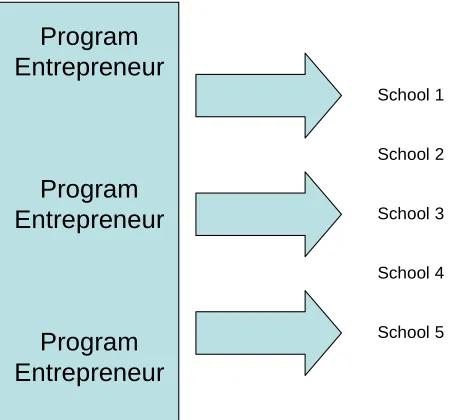
entrepreneurs? The answer, it appears, is yes. In Healthy Kids Project, three individuals were
connecting, adjusting, adapting, and persevering during the Translation phase of the program’s
implementation. It appears that this sharing of a role in fact lent itself to the program’s successful
implementation and dissemination, as Healthy Kids Project moved from one to three and then
[image:31.612.194.419.507.717.2]five different schools:
Fig. 6: Healthy Kids Project’s
Program-Entrepreneur-to-School Connections
Program Entrepreneur
Program Entrepreneur
Program Entrepreneur
School 1
School 2
School 3
School 4
Project Healthy School’s three program entrepreneurs could pool their resources and effectively
divide their time and energy among all of the processes necessary to engage in Translation
actions in multiple schools.
On the other hand, Jane Lutz, the program entrepreneur for Movin’ On Up, is spread too
[image:32.612.194.440.279.401.2]thin trying to negotiate the program’s implementation in three different schools:
Fig. 7: Movin’ On Up’s
Program-Entrepreneur-to-School Connections
Program
Entrepreneur
School 1
School 2
School 3
The program is expanding to Wilson’s K-2 and 5-6 schools, but Lutz is “disappointed with the
way the expansion is going at this point.” While the K-2 principal is behind the project, he’s
getting resistance – and he’s a fairly new principal, he’s picking his battles. Movin’ On Up does
not seem to be at the top of his list: Lutz has been trying to contact him for a meeting with the
teachers, but is having difficulty getting a hold of him. Meanwhile, the 5-6 principal is very
supportive, but there’s not a lot of time in the older kids’ schedules to work in components of the
Movin’ On Up program. Lutz has spent countless hours attempting to dovetail other programs
into a coherent lesson plan for the 5-6 school, but explains that this too has been a disaster: there
are “too many people who are too busy.” While one program entrepreneur can successfully
implementation into any more schools may quickly become unmanageable for a single individual
in that role.
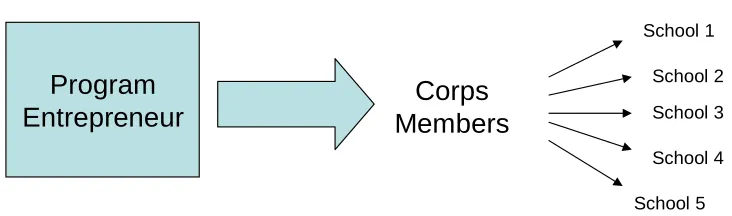
Program Child Health, meanwhile, is a bit different. Although only one program
entrepreneur is available for the program’s implementation into five different schools, the team
of corps members assigned to each school (and responsible for Translation processes there)
[image:33.612.130.496.299.407.2]makes it possible for one program entrepreneur to oversee such widespread dissemination:
Fig. 8: Program Child Health’s
Program-Entrepreneur-to-School Connections
Program
Entrepreneur
Corps
Members
School 1 School 2 School 3 School 4 School 5
Indeed, explaining why City Year decided to continue the program even after a first year of
challenges and somewhat limited success, the program entrepreneur emphasized that the corps
members had built some capacity to keep the program going in each school. It is doubtful that a
single program entrepreneur would have the ability to establish such sustained connections in so
many different schools without the help of an intermediary role like that of the corps members.
The case studies suggest, then, it is unlikely for one individual to play more than one role
in a program’s implementation process. At the same time, it is possible for more than one
individual to act as program entrepreneur for a given program. While none of the case studies in
the present investigation seemed to have more than one apparent external champion, or more
than one apparent internal champion in each target school, whether the number of actors at each
Research Question Three: What is the influence of different resource
environments – financial capital and social capital contexts in particular – on how the implementation process unfolds?
Program implementation doesn’t simply occur in strict adherence to the proposed model,
independent of any factors relating to the program’s organizational environment. Instead, it
should be understood that the model represents an implementation process as it occurs within the
context of the program’s organizational environment. Thus it is crucial to examine these case
studies with special attention to how program implementation may occur differently in different
organizational environments – namely, in different financial capital and social capital contexts.
Damanpour’s (1991) meta-analysis of the determinants and moderators of organizational
innovativeness found positive associations between financial capital and innovation, and social
capital and innovation. Thus, we expect to see that programs in organizational environments with
more slack resources (financial capital) are more likely to be implemented, or are more easily
implemented, because the organizations in that environment (schools, hospitals, etc) can afford
the costs of implementation and absorb any potential program failure. Similarly, we expect that
programs in organizational environments with more external communication and social
connections (social capital) are more likely to be implemented, or are more easily implemented.
This is because organizations in such environments utilize lines of communication to generate
new and creative ideas, and bring new ideas into the organization; furthermore, such
organizations are more likely to be open to new ideas altogether.
Financial capital:
Findings from the three case studies suggest that organizational environments that are
financially resource-rich are more fertile ground for program implementation than those that are
financially resource-poor. The relative wealth of the school and school district in which a
process. Both the external champion and the program entrepreneur for Program Child Health talk
about the difficulty of operating within a school district with limited financial resources. Says
Kenneth Camden, the external champion, “it’s all related to how many resources they have, and
having to make hard choices about what programs they will promote and are willing to invest
in.” Similarly, overburdened schools with limited resources are unlikely willing (or able) to
make this kind of program a priority. Camden still remembers what one principal said when he
went to visit her school with the intent of adding a school-based clinic: “She said, ‘That sounds
very nice, but we don’t even have a computer lab or a science lab.’” One of the biggest obstacles
for the external champion during Mobilization and the program entrepreneur during Translation
may be getting obesity to the top of the list when schools and school districts are facing so many
other problems.
Even if a school does decide to implement a child obesity prevention program, the
financial capital of its students and their families may determine the success or failure of that
program. Healthy Kids Project program entrepreneurs witnessed this firsthand in their efforts to
disseminate the program from Prospect to nearby Edmonton, a bigger city with fewer financial
resources. Obtaining parent buy-in was far easier in Prospect than it was in Edmonton, says one
of the program entrepreneurs, in part because Prospect parents tend to “have the time and
resources to spend on these issues [of child health] because their immediate needs are being
met.” On the other hand, parent buy-in has been significantly more difficult in Edmonton
because these parents “have other things to worry about.” Camden of Program Child Health
agrees: “If you don’t know where your next paycheck will come from, or whether your food
stamps will last, or whether your lighting and heating will stay on or be turned off, it’s difficult
capital thus has tremendous bearing on the obstacles faced by program entrepreneurs during
Translation and internal champions during Enactment.
Social capital:
The case studies indicate that those individuals and organizations with more social capital
facilitate the process of program implementation to a greater degree than do those with less
social capital. The hospital and school involved in the pilot Movin’ On Up program, for example,
had already collaborated on counseling and physical training programs, and thus had already
established relationships and paths of communication. Less energy had to be dedicated to paving
the way for this collaboration, and more could be directed to actual program implementation.
Furthermore, a representative of the Regional Community Foundation, which granted funding to
all three programs, indicated that because “the hospital is a key part of the community,” its
commitment to the initiative increased Movin’ On Up’s social capital and bolstered the
proposal’s feasibility and legitimacy.
For Program Child Health, on the other hand, the involvement of any one hospital didn’t
necessarily draw the community’s support, because many hospitals reside in Mobile City and
there are numerous healthcare options for residents. However, Camden, the program’s external
champion, is a hospital administrator who also has strong connections to the community,
schools, and partner organizations, and thus a great degree of social capital – which significantly
attributed to the program’s successful connections with state government officials and national
experts on childhood obesity. In fact, a Regional Community Foundation representative
remarked that Camden’s association with City Year, the hospital, and the school district made
Program Child Health’s proposal particularly attractive.
Similarly, it is clear that the social capital of Dr. Gil Hart, Healthy Kid Project’s external
professor at the University’s Medical School and director of its Cardiovascular Center, Dr. Hart
had the personal connections necessary to bring key individuals on board with the program.
It can be concluded from the case studies, then, that the proposed model of program
implementation will indeed manifest differently in resource-rich and resource-poor
organizational environments.
DISCUSSION
This study explored the dynamic implementation process of child obesity prevention
programs in schools. It was designed to address two issues in previous work on organizational
innovation: prior scholarly work tends to focus on the characteristics of implementation, rather
than its organizing processes, and lacks consistent terms and functions to describe various roles
in the process.
My proposed model suggested three stages, each involving a particular set of actions:
Mobilization, associated with an external champion; Translation, associated with a program
entrepreneur; and Enactment, associated with an internal champion. The study’s three case
studies were designed to (a) explore research questions relating to different aspects of the model
(the stage process, the distinct roles, and the organizational context), and (b) determine whether
the model is indeed a good representation of the innovation implementation process in the
context of school-based child obesity prevention programs.
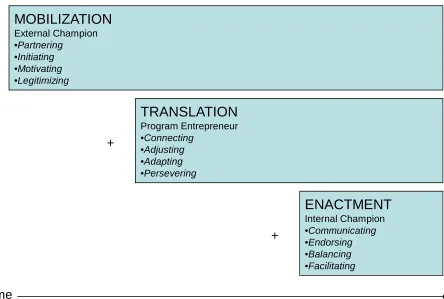
Several conclusions can be drawn on the basis of the analyses presented here. First, a
multi-phase model, in which roles and actions are layered onto the process in a particular order,
appears to be a more suitable than a multi-stage model, in which each stage replaces the former.
Second, the three roles of external champion, program entrepreneur, and internal champion are
role may be performed by more than one individual. Third, a program’s implementation process
occurs in the context of the program’s organizational environment. Specifically, organizational
environments that are financially resource-rich are more fertile ground for program
implementation than those that are financially resource-poor. Also, those individuals and
organizations with more social capital facilitate the process of program implementation to a
greater degree than do those with less social capital. A fourth conclusion is that a revised
version of the proposed model appears to be the most accurate representation of the process of
program implementation for the three case studies illustrated here. That revised model is as
follows:
MOBILIZATION
External Champion •Partnering•Initiating
•Motivating
•Legitimizing
TRANSLATION
Program Entrepreneur •Connecting•Adjusting
•Adapting
•Persevering
ENACTMENT
Internal Champion •Communicating•Endorsing
•Balancing
•Facilitating
Fig. 9: (Revised) Mobilization-Translation-Enactment Model of the Innovative Program Implementation Process in Organizations
Time
+
[image:38.612.96.540.359.658.2]