R E S E A R C H
Open Access
Strong convergence of composite general
iterative methods for one-parameter
nonexpansive semigroup and equilibrium
problems
Xin Xiao
1, Suhong Li
1,2*, Lihua Li
1, Heping Song
3and Lingmin Zhang
1* Correspondence: [email protected] 1College of Mathematics and Information Technology, Hebei Normal University of Science and Technology, Qinhuangdao 066004, China
Full list of author information is available at the end of the article
Abstract
In this paper, we introduce both explicit and implicit schemes for finding a common element in the common fixed point set of a one-parameter nonexpansive semigroup {T(s)|0≤s<∞} and in the solution set of an equilibrium problems which is a solution of a certain optimization problem related to a strongly positive bounded linear operator. Strong convergence theorems are established in the framework of Hilbert spaces. As an application, we consider the optimization problem of ak-strict pseudocontraction mapping. The results presented improve and extend the corresponding results of many others.
2000 AMS Subject Classification:47H09; 47J05; 47J20; 47J25.
Keywords:Nonexpansive semigroup, equilibrium problem, variational inequality pro-blem, strongly positive bounded linear operator.
1. Introduction
LetHbe a real Hilbert space with inner product〈·,·〉and norm || · ||. Recall, a map-pingTwith domainD(T) and rangeR(T) inHis called nonexpansive iff for allx, yÎ
D(T),
||Tx−Ty|| ≤ ||x−y||.
LetCbe a closed convex subset of a Hilbert spaceH, a familyℑ= {T(s)| 0 ≤s<∞} of mappings ofCinto itself is called a one-parameter nonexpansive semigroup onCiff it satisfies the following conditions:
(a)T(s+t) =T(s)T(t) for alls, t≥0 andT(0) =I; (b) ||T(s)x - T(s)y||≤||x - y|| for allx, yÎCands≥0. (c) the mappingT(·)xis continuous, for eachxÎC.
We denote byF(ℑ) the set of common fixed points of {T(t):t≥0}. That is,F(ℑ) =∩0
≤s<∞F(T(s)). It is clear thatT(s)T(t) =T(s+t) =T(t)T(s) fors, t≥0. Recall thatfis called to be weakly contractive [1] iff for all x, yÎD(T),
||f(x)−f(y)|| ≤ ||x−y|| −ϕ(||x−y||),
for some : [0, +∞)® [0, +∞) is a continuous and strictly increasing function such that is positive on (0, +∞) and(0) = 0. If(t) = (1 - k)t, thenfis called to be con-tractive with the concon-tractive coefficientk. If(t)≡0, thenfis said to be nonexpansive.
LetCbe a nonempty closed convex subset of HandF:C × C®Rbe a bifunction,
where Ris the set of real numbers. The equilibrium problem (for short,EP) is to find
xÎ Csuch that for ally ÎC,
F(x, y)≥0, (1:1)
The set of solutions of (1.1) is denoted byEP(F). Given a mappingT:C®H, letF(x,
y) =〈Tx, y- x〉for allx, yÎ C. Then,xÎ EP(F) if and only ifx ÎCis a solution of the variational inequality 〈Tx, y - x〉≥ 0 for all yÎ C. In addition, there are several other problems, for example, the complementarity problem, fixed point problem and optimization problem, which can also be written in the form of an EP. In other words, the EP is an unifying model for several problems arising in physics, engineering, science, optimization, economics, etc. In the last two decades, many papers have appeared in the literature on the existence of solutions of EP; see, for example [2-5] and references therein. Some solution methods have been proposed to solve the EP; see, for example, [6-12] and references therein.
To study the equilibrium problems, we assume that the bifunction F: C × C ® R
satisfies the following conditions: (A1)F(x, x) = 0 for allxÎC;
(A2)Fis monotone, i.e.,F(x, y) +F(y, x)≤ 0 for allx, yÎ C; (A3) for eachx, y, zÎC,
lim sup t→0
F(tz+ (1−t)x, y)≤F(x, y);
(A4) for eachxÎC, ya F(x, y) is convex and lower semi-continuous.
Recently, Takahashi and Takahashi [10] introduced the following iterative method
F(yn, u) +r1nu−yn, yn−xn ≥0, ∀u∈C, xn+1=αnf(xn) + (1−αn)Tyn n≥1
for approximating a common element in the fixed point set of a single nonexpansive mapping and in the solution set of the equilibrium problem. To be more precise, they proved the following Theorem.
Theorem TTLet Cbe a nonempty closed convex subset ofH. LetFbe a bifunction from C × CtoRsatisfying (A1)-(A4) and let Tbe a nonexpansive mapping of Cinto
Hsuch that F(T)∩EP(F)≠∅. Letfbe a contraction ofHinto itself and let {xn} and
{yn} be sequences generated byx1ÎHand
F(yn, u) +r1nu−yn, yn−xn ≥0, ∀u∈C, xn+1=αnf(xn) + (1−αn)Tyn n≥1
where {an}Î0[1] and {rn}⊂(0,∞) satisfy
lim n→∞αn= 0,
∞
n=1
αn=∞, ∞
n=1
lim infn®∞ rn > 0, and ∞n=1|rn+1−rn| <∞. Then {xn} and {yn} converge strongly
to zÎF(T)∩EP (F), wherez=P(T)∩EP(F)f(z).
Subsequently, many authors studied the problem of finding a common element in the fixed point set of nonexpansive mappings, in the solution set of variational inequal-ities and in the solution set of equilibrium problems, for instance see [10-20].
Iterative methods for nonexpansive mappings have recently been applied to solve convex minimization problems; see, e.g., [21-26] and the references therein. Let Abe a strongly positive linear bounded operator (i.e., there is a constant γ >¯ 0 such that Ax,x ≥ ¯γ||x||2, ∀x ÎH), andTbe a nonexpansive mapping onH. A typical problem
is to minimize a quadratic function over the set of the fixed points of a nonexpansive mapping on a real Hilbert spaceH:
min x∈F(T)
1
2Ax,x − x,b (1:2)
whereF(T) is the fixed point set of the mappingTonHandbis a given point inH. Starting with an arbitrary initialx0Î H, define a sequence {xn} recursively by
xn+1= (I−αnA)Txn+αnb n≥0 (1:3)
It is proved [23] (see also [24]) that the sequence {xn} generated by (1.3) converges strongly to the unique solution of the minimization problem (1.2) provided the sequence {an} satisfies certain conditions.
In 2007, related to a certain optimization problem, Marino and Xu [27] introduced
the following viscosity approximation method for nonexpansive mappings. Let fbe a
contraction on H. Starting with an arbitrary initialx0 Î H, define a sequence {xn}
recursively by
xn+1= (I−αnA)Txn+αnγf(xn), n≥0 (1:4)
and proved that if the sequence {an} satisfies appropriate conditions, the sequence
{xn} generated by (1.4) converges strongly to the unique solution of the variational inequality
(A−γf)x∗, x−x∗ ≥0, x∈C,
which is the optimality condition for the minimization problem
min x∈C
1
2Ax, x −h(x),
wherehis a potential function forgf(that is,h’(x) = gf(x)for xÎH).
In 2009, Cho et al. [28] extended the result of Marino and Xu [27] to the class ofk -strictly pseudo-contractive mappings and proved the convergent theorem.
Motivated by the ongoing research and the above mentioned results, we introduce both explicit and implicit schemes for finding a common element in the common fixed point set of a one-parameter nonexpansive semigroup {T(s)|0 ≤ s <∞}, in the solution set of an equilibrium problems, in the solution set of variational inequalities in the framework of Hilbert spaces. The results presented in this paper improve and extend the corresponding results in [9,10,14,15,27-30].
The following lemma can be found in [7].
Lemma 1.1Let Cbe a nonempty closed convex subset ofH and letF:C × C® R be a bifunction satisfying (A1)-(A4). Then, for anyr >0 andxÎ H, there existszÎ C such that
F(z, y) + 1
ry−z, z−x ≥0, ∀y∈C.
Further, define
Trx={z∈C : F(z, y) + 1
ry−z, z−x ≥0, ∀y∈C},
for all zÎH. Then the following hold: (1)Tris single-valued;
(2)Tris firmly nonexpansive, i.e., for any x, yÎH,
||Trx−Try||2≤ Trx−Try, x−y;
(3)F(Tr) =EP(F);
(4)EP(F) is closed and convex.
Remark 1.1The mappingTris also nonexpansive for allr >0.
Lemma 1.2[27] AssumeAis a strongly positive linear bounded operator on a Hilbert spaceHwith coefficient γ >¯ 0 and 0 <r≤||A||-1. Then ||I−ρA|| ≤1−ργ¯.
Lemma 1.3[31] Let Cbe a nonempty bounded closed convex subset ofHand letℑ= {T(s): 0≤s<∞} be a nonexpansive semigroup onC, then for anyh≥0,
lim t→∞supx∈C||
1 t
t
0
T(s)xds−T(h)(1 t
t
0
T(s)xds)||= 0.
Lemma 1.4LetCbe a nonempty bounded closed convex subset of a Hilbert spaceH andℑ = {T(t): 0≤ t<∞}be a nonexpansive semigroup onC. If {xn} is a sequence in C satisfying the properties:
(i)xn⇀z;
(ii) lim supt®∞lim supn®∞||T(t)xn- xn|| = 0,
wherexn⇀zdenote that {xn} converges weakly toz, thenzÎF(ℑ).
Proof. This Lemma is the continuous version of Lemma 2.3 of Tan and Xu[32]. This proof given in [32] is easily extended to the continuous case.
Lemma 1.5[33] LetCbe a nonempty closed convex subset of a real Hilbert spaceH,
T be nonexpansive mapping fromCinto self. Then the mappingI-Tis demiclosed at
zero, i.e.,
xnx, ||xn−Txn|| →0implies x=Tx.
Lemma 1.6[22] Assume {an} is a sequence of nonnegative real numbers such that
an+1= (1−γn)an+δn, n≥0.
where {gn} is a sequence in (0,1) and {δn} is a sequence inRsuch that
(i) ∞n=1γn=∞.
Lemma 1.7[34] Let {ln} and {bn} be two nonnegative real number sequences and
{an} a positive real number sequence satisfying the conditions ∞n=0αn=∞ and
limn→∞βαnn = 0 or
∞
n=0βn<∞. Let the recursive inequality
λn+1≤λn−αnψ(λn) +βn, n= 0, 1, 2· · ·,
be given, whereψ(l) is a continuous and strict increasing function for alll≥0 with
ψ(0) = 0. Then {ln} converges to zero, asn®∞.
2. Implicit viscosity iterative algorithm
Theorem 2.1LetCbe a nonempty closed convex subset of a Hilbert spaceH. Let Fbe a bifunction from C × CintoRsatisfying (A1)-(A4). Letfbe a weakly contractive map-ping with a functiononH, Aa strongly positive linear bounded operator with coeffi-cient γ >¯ 0 on H,ℑ = {T(s): s≥ 0} be a nonexpansive semigroup onC, respectively. Assume that Ω:=F(ℑ)∩EP(F)≠∅, {an}, {bn}⊂(0,1), {tn}⊂(0,∞) be real sequences
satisfy-ing the conditions
lim
n→∞αn= limn→∞βn= 0, limn→∞tn=∞.
then for any 0< γ ≤ ¯γ and anyr >0, there exists a unique sequence {xn}⊂H
satis-fying the following condition ⎧
⎨ ⎩
F(un, y) + 1ry−un, un−xn ≥0, ∀y∈C, zn= (1−βn)t1n 0tnT(s)unds+βnun, xn= (I−αnA)zn+αnγf(xn), ∀n≥1.
(2:1)
Furthermore, the sequence {xn} converges strongly to z*Î Ωwhich uniquely solves the following variational inequality
(γf−A)z∗,z−z∗ ≤0, for any z∈. (2:2)
Proof. We divide the proof into six steps.
Step 1.
Since an®0 asn®∞, we may assume, with no loss of generality, thatan< ||A||-1
for all n≥1. Then, αn< 1γ for all n≥1.
First, we show that the sequence {xn} generated from (2.1) is well defined. For each n
≥1, define a mapping Sfn inHas follows
Sfn := (I−αnA)[(1−βn) 1 tn
tn
0
T(s)Trds+βnTr] +αnγf.
Observe from Lemma 1.1 thatTrbe a nonexpansive for eachr >0, thus we have that for any x, yÎC,
||Sf
nx−Sfny||
≤ ||I−αnA||[(1−βn) 1 tn
tn
0
||T(s)Trx−T(s)Try||ds+βn||Trx−Try||]
+αnγ||f(x)−f(y)||
≤(1−αnγ¯)[(1−βn)||x−y||+βn||x−y||] +αnγ||f(x)−f(y)|| ≤[1−αn(γ¯−γ)]||x−y|| −αnγ ϕ(||x−y||)
whereψ(x- y) =ang(||x-y||). This shows that Sfn is a weakly contractive mapping
with a function ψ on Hfor each n ≥1. Therefore, by Theorem 5 of [11], Sf
n has a
unique fixed point (say) xnÎ H. This means that Eq.(2.1) has a unique solution for
eachn≥1, namely,
xn= (I−αnA)[(1−βn) 1 tn
tn
0
T(s)Trxnds+βnTrxn] +αnγf(xn)
= (I−αnA)[(1−βn) 1 tn
tn
0
T(s)unds+βnun] +αnγf(xn),
where note from Lemma 1.1 that uncan be re-written asun=Trxn.
Next, we show that {xn} is bounded. Indeed, for anyzÎΩ, note thatz=Trz. It fol-lows from Lemma 1.1 that
||un−z|| = ||Trxn−z|| = ||Trxn−Trz|| ≤ ||xn−z||. (2:3)
Notice that
||zn−z|| ≤(1−βn)||un−z||+βn||un−z|| =||un−z|| ≤ ||xn−z||.
(2:4)
It follows that
||xn−z||2=xn−z, xn−z
=(I−αnA)(zn−z),xn−z+αnγf(xn)−f(z),xn−z +αnγf(z)−Az, xn−z
≤(1−αnγ¯)||xn−z||2+αnγ||xn−z||2−αnγ ϕ(||xn−z||)||xn−z|| +αnγf(z)−Az, xn−z
= [1−αn(γ¯−γ)]||xn−z||2+αnγf(z)−Az,xn−z −αnγ ϕ(||xn−z||)||xn−z||
≤ ||xn−z||2+αnγf(z)−Az,xn−z −αnγ ϕ(||xn−z||)||xn−z||.
(2:5)
Therefore,
ϕ(||xn−z||)≤ 1
γ||γf(z)−Az||,
which implies that {(||xn- z||)} is bounded. We obtain that {||xn- z||} is bounded
by the property of . So {xn} is bounded and so are {un}, {zn}, {f(un)}, {Azn} from Eq.
(2.3) and Eq.(2.4). We may, without loss of generality, assume that there exists a bounded set K⊂Csuch thatxn, un, znÎ K, for eachn≥1.
Step 2. We claim that there exists a subsequence {nk} of {n} such that xnk z∗ and z*ÎF(ℑ).
Indeed, for anyz Î Ω, denote wn:=t1n 0tnT(s)unds, then ||wn-z||≤ ||un-z||≤||xn
-z||. From Eq.(2.1), the boundedness of {f(xn)}, {Azn}, {un}, {wn} and the conditions
limn®∞an= limn®∞bn= 0, we see that
||zn−wn|| =βn||un−wn|| →0 (n→ ∞) (2:6)
and
In view of Eq.(2.6) and Eq.(2.7), we obtain that
||xn−wn|| →0 (n→ ∞). (2:8)
Let K1={ω∈K:ϕ (||ω−z||)≤ 1γ||γf(z)−Az||}, then K1 is a nonempty bounded
closed convex subset ofHandT(s)-invariant. Since {xn}⊂K1 andK1is bounded, there existsr >0 such thatK1⊂Br, it follows from Lemma 1.3 that
lim sup s→∞
lim sup n→∞ ||wn−
T(s)wn|| = 0. (2:9)
By virtue of Eq.(2.8) and Eq.(2.9), we arrive at
lim sup s→∞
lim sup n→∞ ||xn−
T(s)xn|| = 0. (2:10)
On the other hand, since {xn} is bounded, we know that there exists a subsequence {xnk} of {xn} such that xnk z
∗. By Lemma 1.4 and Eq.(2.10), we arrive atz* ÎF(ℑ).
In Eq.(2.5), interchangez* andzto obtain
ψ(||xnk −z∗||)≤ γf(z∗)−Az∗, xnk−z∗,
where ψ(||xnk−z∗||) =ϕ(||xnk−z∗||)||xnk−z∗||. From xnk z
∗, we get that
lim sup k→∞
ψ(||xnk−z∗||)≤ lim n→∞γf(z
∗)−Az∗,x
nk−z∗= 0.
namely,
ψ(||xnk −z
∗||)→0as k→ ∞,
which implies that xnk →z∗ as k®∞by the property ofψ, and thus znk →z∗. Step 3. We shall show that limn®∞ ||un - xn|| = 0 and z* Î EP (F), where z* is obtained in Step 2.
Since Tris firmly nonexpansive, from Lemma 1.1(2), we see for anyzÎΩthat
un−z2=Trxn−Trz2 ≤ Trxn−Trz, xn−z =un−z, xn−z
= 1
2(un−z
2+x
n−z2− un−xn2),
from which it follows that
||un−z||2≤ ||xn−z||2− ||un−xn||2. (2:11)
On the other hand, it follows from Eq.(2.1) and Eq.(2.11) that
xn−z2
≤(1−αnγ¯)2zn−z2+ 2αnγf(xn)−Az, xn−z
≤(1−αnγ¯)2un−z2+ 2αnγxn−z2+ 2αn||γf(z)−Az||||xn−z|| ≤(1−αnγ¯)2xn−z2− (1−αnγ¯)2un−xn2+ 2αnγxn−z2
+2αn||γf(z)−Az||||xn−z||.
Moreover, we have from Eq.(2.12) that
(1−αnγ¯)2un−xn2
≤(1−αnγ¯)2xn−z2− xn−z2+ 2αnγxn−z2 +2αn||γf(z)−Az||||xn−z||
≤2αnγxn−z2+ 2αn||γf(z)−Az||||xn−z|| ≤4αnM,
(2:13)
whereMis a constant such thatM ≥max{supn≥1{g||xn- z||2}, supn≥1{||gf(z) -Az||
||xn - z||}}. From the condition an ® 0(n ® ∞), we get from Eq.(2.13) that lim
supn®∞||un- xn|| = 0, which implies that asn® ∞, ||un- xn||® 0. Because ||un
-xn|| = ||Trxn- xn||® 0(n® ∞), we see from Lemma 1.5 and Lemma 1.1 thatz*Î F
(Tr) =EP(F). Therefore,z*ÎΩ.
Step 4. We claim thatz* is the unique solution of the variational inequality (2.2). Firstly, we show the uniqueness of the solution to the variational inequality (2.2) in
Ω. In fact, supposep, qÎ Ωsatisfy Eq.(2.2), we see that
(A−γf)p,p−q ≤0, (2:14)
(A−γf)q,q−p ≤0. (2:15)
Adding these two inequalities (2.14) (2.15) yields
0≥ A(p−q), p−q −γf(p)−f(q), p−q ≥ ¯γp−q2−γp−q2+γ ϕ(||p−q||)||p−q|| = (γ¯−γ)p−q2+γ ϕ(||p−q||)||p−q||,
thus
ϕ(||p−q||)≤ γ − ¯γ
γ ||p−q||.
From γ− ¯γγ ≤0, we get that
ϕ(||p−q||)≤0.
By the property of, we must havep=qand the uniqueness is proved.
Next we show that z* is a solution inΩto the variational inequality (2.2). In fact, since
xn= (I−αnA)(1−βn) 1 tn
tn
0
T(s)unds+ (I−αnA)βnun+αnγf(xn),
we derive that
Axn−γf(xn)
=− 1
αn
(I−αnA)(1−βn)(I− 1 tn
tn
0
T(s)ds)un
+1
αn
For anyzÎΩ, it follows that
A(xn)−γf(xn), un−z
=−(1−βn)
αn
(I−αnA)(I− 1 tn
tn
0
T(s)ds)un, un−z
+1
αn
(I−αnA)(un−xn), un−z
=−1−βn
αn (I− 1
tn tn
0
T(s)ds)un−(I− 1 tn
tn
0
T(s)ds)z, un−z
+(1−βn)A(I− 1 tn
tn
0
T(s)ds)un, un−z
+1
αn
un−xn, un−z+Axn−Aun, un−z.
(2:16)
Now we consider the right side of Eq.(2.16). Observe from Eq.(2.1) that
un−xn, un−z ≤rF(un, z).
Note from z Î Ω ⊂EP(F) thatF (z, un)≥ 0, then F(un, z)≤ -F(z, un) ≤ 0, which implies that
1
αn
un−xn, un−z ≤0.
On the other hand, it is easily seen that I− t1
n tn
0 T(s)ds is monotone, that is
(I− 1 tn
tn
0
T(s)ds)un−(I− 1 tn
tn
0
T(s)ds)z, un−z ≥0.
Thus, we obtain from Eq.(2.16) that
(A(xn)−γf(xn), un−z
≤(1−βn)A(I− 1 tn
tn
0
T(s)ds)un, un−z+Axn−Aun, un−z.
(2:17)
Also, we notice from ||xn-un||®0 (n®∞) and xnk →z∗∈ that
lim sup k→∞ A(I−
1 tnk
tnk
0
T(s)ds)unk,unk−z= 0, (2:18)
and
lim sup k→∞
A(xnk−unk),unk−z= 0. (2:19)
Now replacing nin Eq.(2.17) withnkand takinglimsup, we have from Eq.(2.18) and Eq.(2.19) that
(A−γf)z∗, z∗−z ≤0. (2:20)
for any zÎΩ. This is,z*ÎΩis unique solution of Eq.(2.2).
Step 5. We claim that
lim sup n→∞
1 tn
tn
0
To show Eq.(2.21), we may choose a subsequence {xni}of {xn} such that
lim sup n→∞
1 tn
tn
0
T(s)unds−z∗, γf(z∗)−Az∗
= lim i→∞
1 tni
tni
0
T(s)unids−z
∗, γf(z∗)−Az∗.
(2:22)
Since {xni} is bounded, we can choose a subsequence {xnij} of {xni} converges weakly
to z.
We may, assume without loss of generality, that xni z, then uni z, note from
Step 2 and Step 3 that zÎΩ and thus t1
ni tni
0 T(s)unidsz. It follows from Eq.(2.22)
that
lim sup n→∞
1 tn
tn
0
T(s)unds−z∗, γf(z∗)−Az∗=z−z∗, γf(z∗)−Az∗ ≤0.
So Eq.(2.21) holds, thanks to Eq.(2.20).
Step 6. We claim thatxn® z* asn®∞.
First, from Eq.(2.8) and Eq.(2.21) we conclude that
lim sup n→∞ γf(z
∗)−Az∗,x
n−z∗ ≤0. (2:23)
Now we compute ||xn-z*||2 and have the following estimates:
||xn−z∗||2
= ||(I−αnA)(zn−z∗) +αn(γf(xn)−Az∗)||2
≤(1−αnγ¯)2||zn−z∗||2+ 2αnγf(xn)−Az∗, xn−z∗ ≤(1−αnγ¯)2||zn−z∗||2+ 2αnγ||xn−z∗||2
−2αnγ ϕ(||xn−z∗||) + 2αnγf(z∗)−Az∗, xn−z∗ ≤(1−αnγ¯)2||xn−z∗||2+ 2αnγ||xn−z∗||2
+2αnγf(z∗)−Az∗, xn−z∗ −2αnγ ϕ(||xn−z∗||)
≤(1 +α2nγ¯2)||xn−z∗||2−2αnγ ϕ(||xn−z∗||) + 2αnγf(z∗)−Az∗, xn−z∗.
It follows that
ϕ(||xn−z∗||)≤ γ¯
2
2γαn||xn−z
∗||2+ 1
γγf(z∗)−Az∗, xn−z∗.
By virtue of the boundedness of {xn}, Eq.(2.23) and the conditionan®0(n®∞), we can conclude that limn®∞(||xn- z*||) = 0. By the property of, we obtain thatxn®
z*ÎΩasn®∞. This completes the proof of Theorem 2.1.
From Theorem 2.1, we can derive the desired conclusion immediately for a single
nonexpansive mappingT.
Corollary 2.1 LetCbe a nonempty closed convex subset of a Hilbert spaceH. LetF
a bifunction fromC × C® Rsatisfying (A1)-(A4),fbe a weakly contractive mapping
with a function onH, Aa strongly positive linear bounded operator with coefficient ¯
limn®∞ an = 0, bn = o(an). Then for any 0< γ ≤ ¯γ and any r >0, there exists a
unique {xn}⊂Hsuch that
⎧ ⎪ ⎨ ⎪ ⎩
F(un, y) + 1
ry−un, un−xn ≥0, ∀y∈C, zn= (1−βn)Tun+βnun
xn= (I−αnA)zn+αnγf(xn), ∀n≥1.
Furthermore, the sequence {xn} converges strongly toz* ÎΩwhich solves the
varia-tional inequality (2.2).
Remark 2.1 Putting bn = 0, (t) = (1 - k)t and un= xn in Theorem 2.1, we can
obtain Theorem 3.1 in [30].
Remark 2.2 The parameter gcan be allowed to take the coefficient γ¯ in Theorem 2.1 and Corollary 2.1. Our results contain the ones in [23] and [27] as special cases.
3. Explicit viscosity iterative algorithm
Theorem 3.1Let Cbe a nonempty closed convex subset of a Hilbert spaceH. LetFa
bifunction from C × C ®R satisfying (A1)-(A4), fbe a weakly contractive mapping
with a function onH, Aa strongly positive linear bounded operator with coefficient ¯
γ >0 onH, and ℑ= {T(s):s ≥ 0} be a nonexpansive semigroup onC, respectively. Assume thatΩ =F(ℑ)∩EP(F)≠∅, {an}, {bn}⊂(0, 1), {tn}⊂(0,∞) are real sequences
satisfying the following restrictions:
(C1) limn®∞an= 0, ∞n=1αn=∞, ∞n=0|αn−αn−1|<∞;
(C2) limn®∞bn= 0, ∞n=0|βn−βn−1| <∞;
(C3) ∞n=0t1n <∞,
∞
n=0|t1n −
1
tn−1| <∞.
For any 0< γ ≤ ¯γ and anyr >0, let a sequence {yn} be iteratively generated fromy1 Î Cby:
⎧ ⎨ ⎩
F(vn, y) +1ry−vn, vn−yn ≥0, ∀y∈C, zn= (1−βn)t1n
tn
0 T(s)vnds+βnvn yn+1= (I−αnA)zn+αnγf(yn), ∀n≥1.
(3:1)
Then {yn} converges strongly to the unique solution in F to the inequality (2.2).
Proof. Firstly, we show that {yn} is bounded.
Since an®0 asn®∞, we may assume, with no loss of generality, thatan< ||A||-1
for all n≥1. Then, αn< 1γ¯ for all n≥1.
For any zÎΩ, note from Lemma 1.1 thatvncan be re-written asvn=Trynfor each
n≥1 andz=Trz. It follows from Lemma 1.1 that
||vn−z||=||Tryn−z|| = ||Tryn−Trz|| ≤ ||yn−z||.
Notice that
From which it follows that
||yn+1−z||
≤ ||I−αnA|| ||zn−z||+αnγ||f
yn
−f(z)|| +αn||γf(z)−Az|| ≤(1−αnγ )¯ ||zn−z||+αnγ||yn−z|| −αnγ ϕ
||yn−z||
+αn||γf(z)−Az|| ≤(1−αnγ )¯ ||yn−z||+αnγ||yn−z||+αn||γf(z)−Az||
=[1−αn(γ¯−γ )]||yn−z||+αn||γf(z)−Az||.
By induction,
||yn+1−z|| ≤ max{||y0−z||,||γ
f(z)−Az|| ¯
γ −γ }, n≥0.
and {yn} is bounded, which leads to the boundedness of {vn}, {zn}, {f(vn)}, {Azn}. We
may, without loss of generality, assume that there exists a bounded setK ⊂Csuch
thatyn, vn, znÎ K, for eachn≥1.
Using a similar method of proof as in the Step 2 of the proof of Theorem 2.1, we can conclude that
||yn+1−wn|| →0as n→ ∞. (3:2)
and
||yn+1−zn|| →0as n→ ∞. (3:3)
Let K1={ω∈K:||ω−z|| ≤ max{||y0−z||,||γfγ(¯z−)−γAz||}}, then K1 is a nonempty
bounded closed convex subset of Hand T(s)-invariant. Since {yn+1}⊂K1 and K1 is
bounded, there exists r >0 such thatK1 ⊂Br, it follows from Lemma 1.3 that lim sup
s→∞
lim sup n→∞ ||ωn−
T(s)wn||= 0. (3:4)
By virtue of Eq.(3.2) and Eq.(3.4), we arrive at
lim sup s→∞
lim sup n→∞ ||yn+1−
T(s)yn+1||= 0. (3:5)
Next we shall prove thatyn+1-yn®0 asn®∞.
Note that
||yn+1−yn|| ≤ ||αnγf
yn
− ||αnγf
yn−1
||+ αnγf
yn−1
−αn−1γf
yn−1
||
+||(I−αnA)zn−(I−αnA)zn−1||+||(I−αnA)zn−1−(I−αn−1A)zn−1||
≤αnγ||yn−yn−1|| −αnγ ϕ
||yn−yn−1||
+|αn−αn−1|γ||f
yn−1
|| +(1−αnγ )||zn−zn−1||+|αn−1−αn| ||Azn−1||.
(3:6)
Also
||zn−zn−1||
≤ ||(1−βn)wn−(1−βn)wn−1||+||(1−βn)wn−1−(1−βn−1)wn−1||
+||βnvn−βnvn−1||+||βnvn−1−βn−1vn−1||
≤(1−βn)||wn−wn−1||+|βn−1−βn|——wn−1||
+βn||vn−vn−1||+|βn−βn−1| ||vn−1||,
and
||vn−vn−1||=||Tryn−Tryn−1|| ≤ ||yn−yn−1||. (3:8)
where wn:= t1n 0tnT(s)vnds. Now we compute ||wn-wn-1||,
||wn−wn−1||
≤ ||1 tn
tn
0
T(s)vnds− 1 tn
tn
0
T(s)vn−1ds||+||
1 tn
tn
0
T(s)vn−1ds
− 1
tn−1
tn
0
T(s)vn−1ds||+||
1 tn−1
tn
0
T(s)vn−1ds−
1 tn−1
tn−1
0
T(s)vn−1ds||
≤ ||vn−vn−1||+|
1 tn−
1 tn−1| ||
tn
0
T(s)vn−1ds||+
1 tn−1||
tn−1
tn
T(s)vn−1ds||.
(3:9)
Substituting Eq.(3.7)-(3.9) into Eq.(3.6), we arrive at
||yn+1−yn||
≤ ||yn−yn−1|| −αnγ ϕ
||yn−yn−1||
+|αn−αn−1|M
+|1 tn −
1 tn−1|M
+ 1
tn−1
M+|βn−1−βn|M,
for some positive constantM. Thanks to the conditions (C1) - (C3) and Lemma 1.7, we conclude that
||yn+1−yn|| →0, as n→ ∞. (3:10)
Now, we show
lim
n→∞||vn−yn|| = limn→∞||Tryn−yn|| = 0. (3:11)
Indeed, using a similar method of proof as in the Step 3 of the proof of Theorem 2.1, we can obtain that
yn+1−z 2
≤(1−αnγ )¯ 2yn−z2−(1−αnγ )¯ 2vn−yn2+ 2αnγ||yn−z|| ||yn+1−z||
+ 2αn||γf(z)−Az|| ||yn+1−z||,
from which it follows that
(1−αnγ )¯ 2vn−yn2
≤(1−αnγ )¯ 2yn−z2−yn+1−z 2
+ 2αnγ||yn−z|| ||yn+1−z||
+ 2αn||γf(z)−Az|| ||yn+1−z||
≤yn−z2−yn+1−z 2
+ 4αnM1
=||yn−z||+||yn+1−z|| ||yn−z|| − ||yn+1−z||
+ 4αnM1
≤M1||yn−yn+1||+ 4αnM1,
whereM1is an appropriate constant such thatM1= max{supn≥ 1{g||yn- z|| ||yn+1 -z||}, supn≥1{||gf(z) -Az|| ||yn+1-z||}, supn≥1{||yn-z|| + ||yn+1-z||}}. From the
con-ditionan ®0(n ® ∞) and Eq.(3.10), we get that lim supn®∞ ||vn- yn|| = 0, which
It follows from Theorem 2.1 that there is a unique solutionz* ÎΩto the variational inequality (2.2).
Next, we show that lim supn®∞〈gf(z*) -Az*,yn+1-z*〉≤0
Indeed, we can take a subsequence {ynk+1} of {ynk} such that
lim sup n→∞ γ
fz∗−Az∗,yn+1−z∗= limn→∞γf
z∗−Az∗,ynk+1−z ∗
We may assume that ynk+1z since {yn+1} is bounded. From Eq.(3.5) and Lemma
1.4, we conclude zÎ F(ℑ). Similarly, from Eq.(3.11) and Lemma 1.1 and Lemma 1.5,
we have zÎEP(F). Therefore,zÎΩ.
In view of the variational inequality (2.2), we conclude
lim sup n→∞ γf
z∗−Az∗,yn+1−z∗= limn→∞γf
z∗−Az∗,ynk+1−z∗
=γfz∗−Az∗,z−z∗ ≤0
From (3.4), we see that
lim sup n→∞ γf
z∗−Az∗,zn−z∗ ≤0. (3:12)
Finally, we show that yn®z*. As a matter of fact, yn+1−z∗
2
=||(I−αnA)(zn−z∗) +αn(γf(yn)−Az∗)||2
=||(I−αnA)(zn−z∗)||2+αn2γf(yn)−Az∗
2
+2αn(I−αnA)(zn−z∗),γf(yn)−Az∗
≤(1−αnγ )¯ 2zn−z∗
2
+α2nγf(yn)−Az∗
2
+ 2αnzn−z∗,γf
yn
−Az∗ −2αn2A(zn−z∗),γf(yn)−Az∗
≤(1−αnγ¯)2yn−z∗
2
+αn2γf
yn
−Az∗2+ 2αnγzn−z∗,f
yn
−f(z∗) +2αnzn−z∗,γf(z∗)−Az∗ −2α2nA(zn−z∗),γf(yn)−Az∗
≤[(1−αnγ¯)2+ 2αnγ]yn−z∗2+αn[2zn−z∗,γf(z∗)−Az∗ +αnγf(yn)−Az∗
2
+ 2αn||A(zn−z∗)|| ||γf(yn)−Az∗||]
= [1−2αn(γ¯−γ)]yn−z∗2+αnAn,
(3:13)
where
An= 2zn−z∗,γf(z∗)−Az∗+αn
γfyn
−Az∗2
+2||A(zn−z∗)|| ||γf
yn
−Az∗||+γ¯2yn−z∗2
.
Since {yn} is bounded, there must exist a constantM2 >0 such that
γfyn
−Az∗2+ 2||A(zn−z∗)|| ||γf
yn
−Az∗||+γ¯2yn−z∗2≤M2.
It then follows from Eq.(3.13) that yn+1−z∗
2
whereBn= 2〈zn- z*,gf(z*) - Az*〉+anM2. From the conditions (C1) - (C2), Eq.(3.12)
and Lemma 1.6, we obtain from Eq.(3.14) that yn® z* in norm. This completes the
proof of Theorem 3.1.
From Theorem 3.1, we can derive the desired conclusion immediately for a nonex-pansive mapping T.
Corollary 3.1 LetHbe a Hilbert space,Cbe a nonempty closed convex subset ofH,
F a bifunction from C × C® R satisfying (A1)-(A4). Letf be a weakly contractive
mapping with a function onH, andAa strongly positive linear bounded operator
with coefficient γ >¯ 0 on H, andT be a nonexpansive mapping from Cinto itself. Assume thatΩ =F(T)∩ EP(F)≠∅, for any 0< γ ≤ ¯γ and any r >0, let y1 ÎC, and {yn} be a sequence generated in
⎧ ⎪ ⎨ ⎪ ⎩
Fvn,y
+1ry−vn,vn−yn ≥0, ∀y∈C, zn= (1−βn)Tvn+βnvn
yn+1= (I−αnA)zn+αnγf
yn
, ∀n≥1.
where {an}, {bn}⊂ (0, 1) are real sequences satisfying the conditions (C1) - (C2) in
Theorem 3.1. Then the sequence {yn} converges strongly toz* Î Ωwhich uniquely
solves the variational inequality (2.2).
Remark 3.1Putting A=I,bn= 0 and(t) = (1 -k)tin Corollary 3.1, we can easily
conclude Theorem TT [10].
Remark 3.2 Putting bn = 0, (t) = (1 - k)t and un= xn in Theorem 3.1, we can obtain Theorem 3.2 in [30].
4. Application
In this section, we shall consider another class of important nonlinear operator:k-strict pseudocontractions.
Recall that a mapping S: C® Cis said to be ak-strict pseudocontraction if there exists a constantkÎ(0, 1) such that
Sx−Sy2≤x−y2+k(I−S)x−(I−S)y2
for all x, y ÎC. Note that the class of k-strict pseudocontractions strictly includes the class of nonexpansive mappings.
Corollary 4.1 LetCbe a nonempty closed convex subset of a Hilbert space H, Fbe
a bifunction from C × C® Rsatisfying (A1)-(A4). Let fbe a weakly contractive
map-ping with a functiononH, Aa strongly positive linear bounded operator with coeffi-cient γ >¯ 0 onH, T: C ®Hbe a k-strictly pseudo-contractive mapping for some 0≤
k< 1, respectively. Assume that Ω=F(T)∩EP(F)≠∅, for any 0< γ ≤ ¯γ and anyr
>0, let y1Î C, and {yn} be a sequence generated in ⎧
⎪ ⎨ ⎪ ⎩
Fvn,y
+1ry−vn,vn−yn ≥0, ∀y∈C, zn= (1−βn)PCSyn+βnyn
yn+1= (I−αnA)zn+αnγf
yn
, ∀n≥1.
whereS:C ®H is a mapping defined bySx =kx+ (1 -k)Txand PC is the metric
(C1) - (C2) in Theorem 3.1. Then the sequence {yn} converges strongly toz* Î Ω
which uniquely solves the variational inequality (2.2).
Proof. From Lemma 2.3 in [35], we see that S: C® His a nonexpansive mapping andF(T) =F(S). It follows from Lemma 2.2 [32] that, PC S: C® Cis a nonexpansive mapping and F(PCS) =F(S) =F(T). Hence the result follows from Corollary 3.1.
Remark 4.1Puttingvn=ynand(t) = (1 - k)tin Corollary 4.1, we can obtain Theo-rem J in [29], Further, putting bn= 0, we can obtain Theorem CKQ in [28].
5. Numerical examples
Now, we give some real numerical examples in which the conditions satisfy the ones of Theorems 3.1 and 2.1 and some numerical experiment results to explain the main results Theorems 3.1 and 2.1 as follows:
Example 5.1. LetH=RandC= 0[1]. For eachxÎ C, we define f(x) = 14x2,A(x) =
2x, T(x) = 1 2x
2. Let α
n=βn= 1n∈[0, 1],n ÎN. For each (x, y)ÎH × H, we defineF (x, y) =x2+y. Then {yn} is the sequence generated by
yn+1=
1 2(1−
2 n)(1−
1 n)y
2
n+ (1− 2 n)
1 nyn+
1 8ny
2
n (5:1)
and yn®y* = 0 asn® ∞, wherey* = 0Î F(T)∩EP(F).
Proof. It is obvious that the bifunctionF(x, y) satisfies the conditions (A1)-(A4) and f(x) = 1
4x
2 is a weakly contractive mapping with a function ϕ(t) = 1
2t on R,
T(x) = 12x2 is a nonexpansive mapping on Cand F(T) = {0},A(x) = 2xis a strongly
positive linear bounded operator with coefficient γ¯ = 1 onR, and the bifunctionF(x,
y) =x2 +y satisfies conditions (A1)-(A4) andEP(F) = {y: y ≥0}. αn=βn= 1n ∈[0, 1]
satisfy limn®∞ an = 0,
∞
n=0αn=∞,
∞
n=0|αn−αn−1| <∞, limn®∞ bn = 0,
∞
n=0|βn−βn−1| <∞ andF(T)∩EP(F) = {0}.
Hence, the conditions satisfy the ones of Theorem 3.1. Substituting all of the given conditions to the scheme (3.1), we have (5.1). Following the proof of Theorem 3.1, we easily obtain {yn} converges strongly toy* = 0ÎF(T)∩EP(F).
The proof is completed.
Example 5.2. LetC= 0[2],H, f, A, T,an, bn, Fbe as in Example 5.1.,F(T)∩EP(F) = {0, 2}. Then there exists a unique sequence {xn}⊂Hsatisfying the following equation
xn= 1 2(1−
2 n)(1−
1 n)x
2
n+ (1− 2 n)
1 nxn+
1 8nx
2
n (5:2)
Furthermore,xn®x* = 2 asn®∞, wherex* = 2ÎF(T)∩EP(F).
Proof. As in the proof of Example 5.1, the conditions satisfy the ones of Theorem 2.1. Substituting all of the given conditions to the scheme (2.1), we have (5.2), and ifxn
≠0 for eachn, (5.2) is equal to the following equation
xn=
1−(1− 2
n)
1
n
1
2(1−
2
n)(1−
1
n) +
Following the proof of Theorem 2.1, we easily obtain {xn} converges strongly tox* = 2 ÎF(T)∩EP(F). The proof is completed.
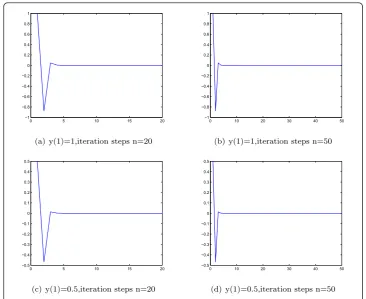
Next, we give the numerical experiment results using software Matlab 7.0 and get Figures 1 and 2, which show that the iteration processes of the sequence {yn} as initial
point y(1) = 1, y(1) = 0.5 and the sequence {xn}, respectively. From the figures, we can
see that {yn} converges to 0 and {xn} converges to 2, and the more the iteration steps
are, the more fast the sequence {yn} and {xn} converges to 0 and 2, respectively.
0 5 10 15 20
í1
í0.8
í0.6
í0.4
í0.2 0 0.2 0.4 0.6 0.8 1
(a) y(1)=1,iteration steps n=20
0 10 20 30 40 50
í1
í0.8
í0.6
í0.4
í0.2 0 0.2 0.4 0.6 0.8 1
(b) y(1)=1,iteration steps n=50
0 5 10 15 20
í0.5
í0.4
í0.3
í0.2
í0.1 0 0.1 0.2 0.3 0.4 0.5
(c) y(1)=0.5,iteration steps n=20
0 10 20 30 40 50
í0.5
í0.4
í0.3
í0.2
í0.1 0 0.1 0.2 0.3 0.4 0.5
[image:17.595.114.481.87.386.2](d) y(1)=0.5,iteration steps n=50
Figure 1The case of iteration sequence (5.1).
0 10 20 30 40 50
2 4 6 8 10 12 14 16
(a) iteration steps n=50
0 20 40 60 80 100
2 4 6 8 10 12 14 16
[image:17.595.116.481.571.714.2](b) iteration steps n=100
Acknowledgements
The authors are very grateful to the referees for their careful reading, comments and suggestions, which improved the presentation of this article. The first author was supported by the Natural Science Foundational Committee of Hebei Province(Z2011113) and Hebei Normal University of Science and Technology (ZDJS 2009 and CXTD2010-05).
Author details
1College of Mathematics and Information Technology, Hebei Normal University of Science and Technology, Qinhuangdao 066004, China2Institute of Mathematics and Systems Science, Hebei Normal University of Science and Technology, Qinhuangdao 066004, China3Library, Hebei Normal University of Science and Technology, Qinhuangdao 066004, China
Authors’contributions
XX and SL carried out the proof of convergence of the theorems. LL, HS and LZ carried out the check of the manuscript. All authors read and approved the final manuscript.
Competing interests
The authors declare that they have no competing interests.
Received: 31 January 2012 Accepted: 9 June 2012 Published: 9 June 2012
References
1. Alber Ya, I, Guerre-Delabriere, S: Principles of weakly contractive maps in Hilbert spaces, New Results in Operator Theory. In: Gohberg I, Lyubich Yu (eds.) Advances and Application, vol. 98, pp. 7–22. Birkhauser, Basel (1997) 2. Blum, E, Oettli, W: From optimization and variational inequalities to equilibrium problems. Math Stud.63, 123–145
(1994)
3. Flores-Bazan, F: Existence theory for finite-dimensional pseudomonotone equilibrium problems. Acta Appl Math.77, 249–297 (2003). doi:10.1023/A:1024971128483
4. Hadjisavvas, N, Komlósi, S, Schaible, S: Handbook of Generalized Convexity and Generalized Monotonicity. Springer, Berlin (2005)
5. Hadjisavvas, N, Schaible, S: From scalar to vector equilibrium problems in the quasimonotone case. J Optim Theory Appl.96, 297–309 (1998). doi:10.1023/A:1022666014055
6. Ceng, LC, Yao, JC: A hybrid iterative scheme for mixed equilibrium problems and fixed point problems. J Comput Appl Math.214, 186–201 (2008). doi:10.1016/j.cam.2007.02.022
7. Combettes, PL, Hirstoaga, SA: Equilibrium programming in Hilbert spaces. J Nonlinear Convex Anal.6, 117–136 (2005) 8. Flam, SD, Antipin, AS: Equilibrium programming using proximal-like algorithms. Math Program.78, 29–41 (1997) 9. Tada, A, Takahashi, W: Strong convergence theorem for an equilibrium problem and a nonexpansive mapping. In:
Takahashi W, Tanaka T (eds.) Nonlinear Analysis and Convex Analysis. pp. 609–617. Yokohama, Yokohama (2006) 10. Takahashi, S, Takahashi, W: Viscosity approximation methods for equilibrium problems and fixed point problems in
Hilbert spaces. J Math Anal Appl.331, 506–515 (2007). doi:10.1016/j.jmaa.2006.08.036
11. Ye, J, Huang, J: Strong convergence theorems for fixed point problems and generalized equilibrium problems of three relatively quasi-nonexpansive mappings in Banach spaces. J Math Comput Sci.1, 1–18 (2011)
12. Ciric, L, Olatinwo, MO, Gopal, D, Akinbo, G: Coupled fixed point theorems for mappings satisfying a contractive condition of rational type on a partially ordered metric space. Adv Fixed Point Theory. (2012)
13. Ceng, LC, Yao, JC: Hybrid viscosity approximation schemes for equilibrium problems and fixed point problems of infinitely many nonexpansive mappings. Appl Math Comput.198, 729–741 (2008). doi:10.1016/j.amc.2007.09.011 14. Ceng, LC, Al-Homidan, S, Ansari, QH, Yao, JC: An iterative scheme for equilibrium problems and fixed point problems of
strict pseudo-contraction mappings. J Comput Appl Math.223, 967–974 (2009). doi:10.1016/j.cam.2008.03.032 15. Colao, V, Marino, G, Xu, HK: An iterative method for finding common solutions of equilibrium and fixed point problems.
J Math Anal Appl.344, 340–352 (2008). doi:10.1016/j.jmaa.2008.02.041
16. Chang, SS, Joseph Lee, HW, Chan, CK: A new method for solving equilibrium problem fixed point problem and variational inequality problem with application to optimization. Nonlinear Anal.70, 3307–3319 (2009). doi:10.1016/j. na.2008.04.035
17. Plubtieng, S, Punpaeng, R: A new iterative method for equilibrium problems and fixed point problems of nonexpansive mappings and monotone mappings. Appl Math Comput.197, 548–558 (2008). doi:10.1016/j.amc.2007.07.075 18. Qin, X, Shang, M, Su, Y: Strong convergence of a general iterative algorithm for equilibrium problems and variational
inequality problems. Math Comput Model.48, 1033–1046 (2008). doi:10.1016/j.mcm.2007.12.008
19. Qin, X, Shang, M, Su, Y: A general iterative method for equilibrium problems and fixed point problems in Hilbert spaces. Nonlinear Anal.69, 3897–3909 (2008). doi:10.1016/j.na.2007.10.025
20. Qin, X, Cho, YJ, Kang, SM: Convergence theorems of common elements for equilibrium problems and fixed point problems in Banach spaces. J Comput Appl Math.225, 20–30 (2009). doi:10.1016/j.cam.2008.06.011
21. Deutsch, F, Yamada, I: Minimizing certain convex functions over the intersection of the fixed point sets of nonexpansive mappings. Numer Funct Anal Optim.19, 33–56 (1998)
22. Xu, HK: Iterative algorithms for nonlinear operators. J London Math Soc.66, 240–256 (2002). doi:10.1112/ S0024610702003332
23. Xu, HK: An iterative approach to quadratic optimization. J Optim Theory Appl.116, 659–678 (2003). doi:10.1023/ A:1023073621589
24. Yamada, I: The hybrid steepest descent method for the variational inequality problem of the intersection of fixed point sets for nonexpansive mappings. In: Butnariu K, Censor Y, Reich S (eds.) Inherently Parallel Algorithm for Feasibility and Optimization. pp. 473–504. Elsevier, New York (2001)
26. Geobel, K, Kirk, WA: Topics in Metric Fixed Point Theory. In Cambridge Studies in Advanced Mathematics, vol. 28, Cambridge University Press, Cambridge (1990)
27. Marino, G, Xu, HX: A general iterative method for nonexpansive mappings in Hilbert spaces. J Math Anal Appl.318, 43–52 (2006). doi:10.1016/j.jmaa.2005.05.028
28. Cho, YJ, Kang, SM, Qin, X: Some results on k-strictly pseudo-contractive mappings in Hilbert spaces. Nonlinear Anal.70, 1956–1964 (2009). doi:10.1016/j.na.2008.02.094
29. Jung, JS: Strong convergence of iterative methods for k-strictly pseudo-contractive mappings in Hilbert spaces. Appl Math Comput.215, 3746–3753 (2010). doi:10.1016/j.amc.2009.11.015
30. Li, S, Li, L, Su, Y: General iterative methods for a one-parameter nonexpansive semigroup in Hilbert space. Nonlinear Anal.70, 3065–3071 (2009). doi:10.1016/j.na.2008.04.007
31. Shimizu, T, Takahashi, W: Strong convergence to common fixed points of families of nonexpansive mappings. J Math Anal Appl.211, 71–83 (1997). doi:10.1006/jmaa.1997.5398
32. Tan, KK, Xu, HK: The nonlinear ergodic theorem for asymptotically nonexapansive mappings in Banach spaces. Proc Am Math Soc.114, 399–404 (1992). doi:10.1090/S0002-9939-1992-1068133-2
33. Browder, FE: Nonlinear operators and nonlinear equations of evolution in Banach spaces. Proc Sympos Pure Math.18, 78–81 (1976)
34. Ceng, LC, Tanaka, T, Yao, JC: Iterative construction of fixed points of nonself-mappings in Banach spaces. J Comput Appl Math.206, 814–825 (2007). doi:10.1016/j.cam.2006.08.028
35. Zhou, H: Convergence theorems of fixed points for k-strict pseudo-contractions in Hilbert spaces. Nonlinear Anal.69, 456–462 (2008). doi:10.1016/j.na.2007.05.032
doi:10.1186/1029-242X-2012-131
Cite this article as:Xiaoet al.:Strong convergence of composite general iterative methods for one-parameter
nonexpansive semigroup and equilibrium problems.Journal of Inequalities and Applications20122012:131.
Submit your manuscript to a
journal and benefi t from:
7 Convenient online submission
7 Rigorous peer review
7 Immediate publication on acceptance
7 Open access: articles freely available online 7 High visibility within the fi eld
7 Retaining the copyright to your article