R E S E A R C H
Open Access
A modified three-term PRP conjugate
gradient algorithm for optimization models
Yanlin Wu
**Correspondence: [email protected] Department of Basic Teaching, Yango College, Fuzhou, Fujian 350015, P.R. China
Abstract
The nonlinear conjugate gradient (CG) algorithm is a very effective method for
optimization, especially for large-scale problems, because of its low memory
requirement and simplicity. Zhang
et al.
(IMA J. Numer. Anal. 26:629-649, 2006) firstly
propose a three-term CG algorithm based on the well known Polak-Ribière-Polyak
(PRP) formula for unconstrained optimization, where their method has the sufficient
descent property without any line search technique. They proved the global
convergence of the Armijo line search but this fails for the Wolfe line search
technique. Inspired by their method, we will make a further study and give a modified
three-term PRP CG algorithm. The presented method possesses the following
features: (1) The sufficient descent property also holds without any line search
technique; (2) the trust region property of the search direction is automatically
satisfied; (3) the steplengh is bounded from below; (4) the global convergence will be
established under the Wolfe line search. Numerical results show that the new
algorithm is more effective than that of the normal method.
MSC:
90C26
Keywords:
conjugate gradient; sufficient descent; trust region
1 Introduction
We consider the optimization models defined by
min
x∈n
f
(
x
),
(.)
where the function
f
:
n→
is continuously differentiable. There exist many similar
professional fields of science that can revert to the above optimization models (see,
e.g.
,
[–]). The CG method has the following iterative formula for (.):
x
k+=
x
k+
α
kd
k,
k
= , , . . . ,
(.)
where
x
kis the
k
th iterate point, the steplength is
α
k> , and the search direction
d
kis
designed by
d
k+=
⎧
⎨
⎩
–
g
k++
β
kd
k,
if
k
≥
,
–
g
k+,
if
k
= ,
(.)
where
g
k=
∇
f
(
x
k) is the gradient and
β
k∈
is a scalar. At present, there are many
well-known CG formulas (see [–]) and their applications (see,
e.g.
, [–]), where one of
the most efficient formulas is the PRP [, ] defined by
β
kPRP=
g
T k+δ
kg
k,
(.)
where
g
k+=
∇
f
(
x
k+) is the gradient,
δ
k=
g
k+–
g
k, and
.
is the Euclidian norm. The
PRP method is very efficient as regards numerical performance, but it fails as regards the
global convergence for the general functions under Wolfe line search technique and this
is a still open problem; many scholars want to solve it. It is worth noting that a recent
work of Yuan
et al.
[] proved the global convergence of PRP method under a modified
Wolfe line search technique for general functions. Al-Baali [], Gilbert and Nocedal [],
Toouati-Ahmed and Storey [], and Hu and Storey [] hinted that the sufficient descent
property may be crucial for the global convergence of the conjugate gradient methods
including the PRP method. Considering the above suggestions, Zhang, Zhou, and Li []
firstly gave a three-term PRP formula
d
k+=
⎧
⎨
⎩
–
g
k++
β
kPRPd
k–
ϑ
kδ
k,
if
k
≥
,
–
g
k+,
if
k
= ,
(.)
where
ϑ
k=
gkT+dkgk
. It is not difficult to deduce that
d
Tk+
g
k+= –
g
k+holds for all
k
, which
implies that the sufficient descent property is satisfied. Zhang
et al.
proved that the
three-term PRP method has global convergence under Armijo line search technique for general
functions but this fails for the Wolfe line search. The reason may be the trust region feature
of the search direction that cannot be satisfied for this method. In order to overcome this
drawback, we will propose a modified three-term PRP formula that will have not only the
sufficient descent property but also the trust region feature.
In the next section, a modified three-term PRP formula is given and the new algorithm is
stated. The sufficient descent property, the trust region feature, and the global convergence
of the new method are established in Section . Numerical results are reported in the last
section.
2 The modified PRP formula and algorithm
Motivated by the above observation, the modified three-term PRP formula is
d
k+=
⎧
⎨
⎩
–
g
k++
gkT+δkdk–dTkgk+δk
γgk+γdkδk+γdkgk
,
if
k
≥
,
–
g
k+,
if
k
= ,
(.)
where
γ
> ,
γ
> , and
γ
> are constants. It is easy to see that the difference between
Algorithm
(New three-term PRP CG algorithm (NTT-PRP-CG-A))
Step : Initial given parameters:
x
∈
n,
γ
>
,
γ
>
,
γ
>
,
<
δ
<
σ
<
,
ε
∈
(, )
. Let
d
= –
g
= –
∇
f
(
x
)
and
k
:=
.
Step :
g
k ≤ε
, stop.
Step : Get stepsize
α
kby the following Wolfe line search rules:
f
(
x
k+
α
kd
k)
≤
f
(
x
k) +
δα
kg
kTd
k,
(.)
and
g
(
x
k+
α
kd
k)
Td
k≥
σ
g
kTd
k.
(.)
Step : Let
x
k+=
x
k+
α
kd
k. If the condition
g
k+≤
ε
holds, stop the program.
Step : Calculate the search direction
d
k+by (.).
Step : Set
k
:=
k
+
and go to Step .
3 The sufficient descent property, the trust region feature, and the global
convergence
It has been proved that, even for the function
f
(
x
) =
λ
x
(
λ
> is a constant) and
the strong Wolfe conditions, the PRP conjugate gradient method may not yield a
de-scent direction for an unsuitable choice (see [] for details). An interesting feature of
the new three-term CG method is that the given search direction is sufficiently
de-scent.
Lemma .
The search direction d
kis defined by
(.)
and it satisfies
d
kT+g
k+= –
g
k+(.)
and
d
k+≤
γ
g
k+(.)
for all k
≥
,
where
γ
>
is a constant
.
Proof
For
k
= , it is easy to get
g
Td
= –
g
Tg
= –
g
and
d
=
–
g
=
g
, so (.)
is true and (.) holds with
γ
= .
If
k
≥
, by (.), we have
g
kT+d
k+= –
g
k++
g
kT+g
Tk+
δ
kd
k–
d
Tkg
k+δ
kγ
g
k+
γ
d
kδ
k+
γ
d
kg
k= –
g
k++
g
Tk+
δ
kg
kT+d
k–
d
kTg
k+g
Tk+δ
kγ
g
k+
γ
d
kδ
k+
γ
d
kg
kThen (.) is satisfied. By (.) again, we obtain
d
k+=
g
k++
g
Tk+
δ
kd
k–
d
Tkg
k+δ
kγ
g
k+
γ
d
kδ
k+
γ
d
kg
k≤
g
k++
g
Tk+
δ
kd
k–
d
Tkg
k+δ
kγ
g
k+
γ
d
kδ
k+
γ
d
kg
k≤
g
k++
δ
kg
k+d
k+
d
kg
k+δ
kγ
g
k+
γ
d
kδ
k+
γ
d
kg
k≤
g
k++
δ
kg
k+d
kγ
d
kδ
k= ( + /
γ
)
g
k+,
(.)
where the last inequality follows from
γgk+γdkδk+γdkgk
≤
γdkδk
. Thus (.) holds
for all
k
≥
with
γ
=
max
{
, + /
γ
}
. The proof is complete.
Remark
() Equation (.) is the sufficient descent property and the inequality (.) is the
trust region feature. And these two relations are verifiable without any other conditions.
() Equations (.) and (.) imply that the sequence
{
f
(
x
k)
}
generated by Algorithm is
descent, namely
f
(
x
k+
α
kd
k)
≤
f
(
x
k) holds for all
k
.
To establish the global convergence of Algorithm , the normal conditions are needed.
Assumption A
(i) The defined level set
=
{
x
∈
n|
f
(
x
)
≤
f
(
x
)
}
is bounded with given point
x
.
(ii) The function
f
has a lower bound and it is differentiable. The gradient
g
is Lipschitz
continuous
g
(
x
) –
g
(
y
)
≤
L
x
–
y
,
∀
x
,
y
∈
n,
(.)
where
L
>
a constant.
Lemma .
Suppose that Assumption
A
holds and NTT-PRP-CG-A generates the
se-quence
{
x
k,
d
k,
α
k,
g
k}.
Then there exists a constant
β
>
such that
α
k≥
β
,
∀
k
≥
.
(.)
Proof
Using (.) and (.) generate
α
kL
≥
(
g
k+–
g
k)
Td
k≥
–( –
σ
)
g
kTd
k= ( –
σ
)
g
k,
where the last equality follows from (.). By (.), we get
α
k≥
–
σ
L
g
kd
k≥
–
σ
L
γ
.
Remark
The above lemma shows that the steplengh
α
khas a lower bound, which is
help-ful for the global convergence of Algorithm .
Theorem .
Let the conditions of Lemma
.
hold and
{
x
k,
d
k,
α
k,
g
k}be generated by
NTT-PRP-CG-A
.
Thus we get
lim
k→∞
g
k= .
Proof
By (.), (.), and (.), we have
δβ
g
k≤
δα
kg
k≤
f
(
x
k) –
f
(
x
k+
α
kd
k).
Summing the above inequality from
k
= to
∞
, we have
∞
k=
δβ
g
k≤
f
(
x
) –
f
∞≤ ∞
,
which means that
g
k →,
k
→ ∞
.
The proof is complete.
4 Numerical results and discussion
This section will report the numerical experiment of the NTT-PRP-CG-A and the
algo-rithm of Zhang
et al.
[] (called Norm-PRP-A), where the Norm-PRP-A is the Step of
Al-gorithm that is replaced by: Calculate the search direction
d
k+by (.). Since the method
is based on the search direction (.), we only compare the numerical results between the
new algorithm and the Norm-PRP-A. The codes of these two algorithms are written by
Matlab and the problems are chosen from [, ] with given initial points. The tested
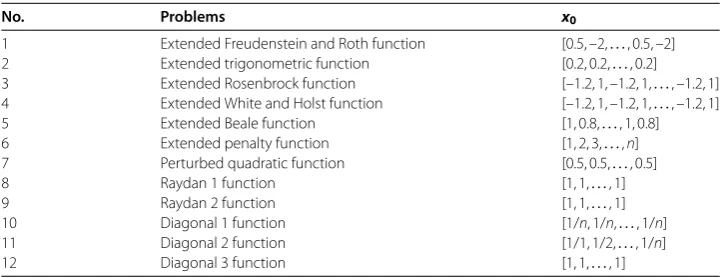
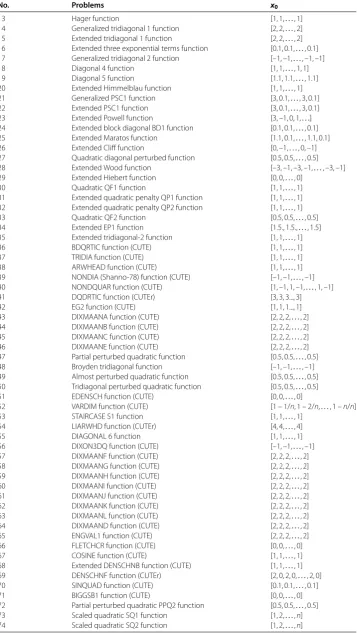
problems are listed in Table . The parameters are
γ
= ,
γ
= ,
γ
= ,
δ
= .,
σ
= ..
The program uses the
Himmelblau
rule: Set
St
=
|f(xk|)–f(xf(xk+)| [image:5.595.117.481.593.732.2]k)|
if
|
f
(
x
k)
|
>
τ
, otherwise set
St
=
|
f
(
x
k) –
f
(
x
k+)
|
. The program stops if
g
(
x
)
<
or
St
<
τ
hold, where we choose
Table 1 Test problems
No. Problems x0
1 Extended Freudenstein and Roth function [0.5, –2,. . ., 0.5, –2] 2 Extended trigonometric function [0.2, 0.2,. . ., 0.2] 3 Extended Rosenbrock function [–1.2, 1, –1.2, 1,. . ., –1.2, 1] 4 Extended White and Holst function [–1.2, 1, –1.2, 1,. . ., –1.2, 1]
5 Extended Beale function [1, 0.8,. . ., 1, 0.8]
6 Extended penalty function [1, 2, 3,. . .,n]
7 Perturbed quadratic function [0.5, 0.5,. . ., 0.5]
8 Raydan 1 function [1, 1,. . ., 1]
9 Raydan 2 function [1, 1,. . ., 1]
10 Diagonal 1 function [1/n, 1/n,. . ., 1/n]
11 Diagonal 2 function [1/1, 1/2,. . ., 1/n]
Table 1 (
Continued
)
No. Problems x0
13 Hager function [1, 1,. . ., 1]
14 Generalized tridiagonal 1 function [2, 2,. . ., 2] 15 Extended tridiagonal 1 function [2, 2,. . ., 2] 16 Extended three exponential terms function [0.1, 0.1,. . ., 0.1] 17 Generalized tridiagonal 2 function [–1, –1,. . ., –1, –1]
18 Diagonal 4 function [1, 1,. . ., 1, 1]
19 Diagonal 5 function [1.1, 1.1,. . ., 1.1]
20 Extended Himmelblau function [1, 1,. . ., 1]
21 Generalized PSC1 function [3, 0.1,. . ., 3, 0.1]
22 Extended PSC1 function [3, 0.1,. . ., 3, 0.1]
23 Extended Powell function [3, –1, 0, 1,. . .]
24 Extended block diagonal BD1 function [0.1, 0.1,. . ., 0.1] 25 Extended Maratos function [1.1, 0.1,. . ., 1.1, 0.1]
26 Extended Cliff function [0, –1,. . ., 0, –1]
27 Quadratic diagonal perturbed function [0.5, 0.5,. . ., 0.5] 28 Extended Wood function [–3, –1, –3, –1,. . ., –3, –1]
29 Extended Hiebert function [0, 0,. . ., 0]
30 Quadratic QF1 function [1, 1,. . ., 1]
31 Extended quadratic penalty QP1 function [1, 1,. . ., 1] 32 Extended quadratic penalty QP2 function [1, 1,. . ., 1]
33 Quadratic QF2 function [0.5, 0.5,. . ., 0.5]
34 Extended EP1 function [1.5., 1.5.,. . ., 1.5]
35 Extended tridiagonal-2 function [1, 1,. . ., 1]
36 BDQRTIC function (CUTE) [1, 1,. . ., 1]
37 TRIDIA function (CUTE) [1, 1,. . ., 1]
38 ARWHEAD function (CUTE) [1, 1,. . ., 1]
39 NONDIA (Shanno-78) function (CUTE) [–1, –1,. . ., –1] 40 NONDQUAR function (CUTE) [1, –1, 1, –1,. . ., 1, –1]
41 DQDRTIC function (CUTEr) [3, 3, 3..., 3]
42 EG2 function (CUTE) [1, 1, 1..., 1]
43 DIXMAANA function (CUTE) [2, 2, 2,. . ., 2]
44 DIXMAANB function (CUTE) [2, 2, 2,. . ., 2]
45 DIXMAANC function (CUTE) [2, 2, 2,. . ., 2]
46 DIXMAANE function (CUTE) [2, 2, 2,. . ., 2]
47 Partial perturbed quadratic function [0.5, 0.5,. . ., 0.5] 48 Broyden tridiagonal function [–1, –1,. . ., –1] 49 Almost perturbed quadratic function [0.5, 0.5,. . ., 0.5] 50 Tridiagonal perturbed quadratic function [0.5, 0.5,. . ., 0.5]
51 EDENSCH function (CUTE) [0, 0,. . ., 0]
52 VARDIM function (CUTE) [1 – 1/n, 1 – 2/n,. . ., 1 –n/n]
53 STAIRCASE S1 function [1, 1,. . ., 1]
54 LIARWHD function (CUTEr) [4, 4,. . ., 4]
55 DIAGONAL 6 function [1, 1,. . ., 1]
56 DIXON3DQ function (CUTE) [–1, –1,. . ., –1]
57 DIXMAANF function (CUTE) [2, 2, 2,. . ., 2]
58 DIXMAANG function (CUTE) [2, 2, 2,. . ., 2]
59 DIXMAANH function (CUTE) [2, 2, 2,. . ., 2]
60 DIXMAANI function (CUTE) [2, 2, 2,. . ., 2]
61 DIXMAANJ function (CUTE) [2, 2, 2,. . ., 2]
62 DIXMAANK function (CUTE) [2, 2, 2,. . ., 2]
63 DIXMAANL function (CUTE) [2, 2, 2,. . ., 2]
64 DIXMAAND function (CUTE) [2, 2, 2,. . ., 2]
65 ENGVAL1 function (CUTE) [2, 2, 2,. . ., 2]
66 FLETCHCR function (CUTE) [0, 0,. . ., 0]
67 COSINE function (CUTE) [1, 1,. . ., 1]
68 Extended DENSCHNB function (CUTE) [1, 1,. . ., 1] 69 DENSCHNF function (CUTEr) [2, 0, 2, 0,. . ., 2, 0]
70 SINQUAD function (CUTE) [0.1, 0.1,. . ., 0.1]
71 BIGGSB1 function (CUTE) [0, 0,. . ., 0]
[image:6.595.120.478.98.732.2]=
–and
τ
=
τ
=
–. For the choice of the stepsize
α
kin (.) and (.), the largest
cycle number is and the current stepsize is accepted. The dimensions of the test
prob-lems accord to large-scale variables with ,, ,, and ,. The runtime
environ-ment is MATLAB Rb and run on a PC with CPU Intel Pentium(R) Dual-Core CPU
at . GHz, . GB of RAM, and the Windows operating system.
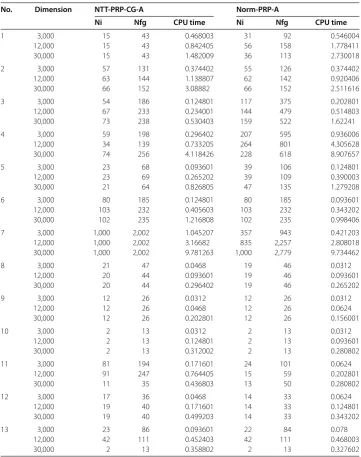
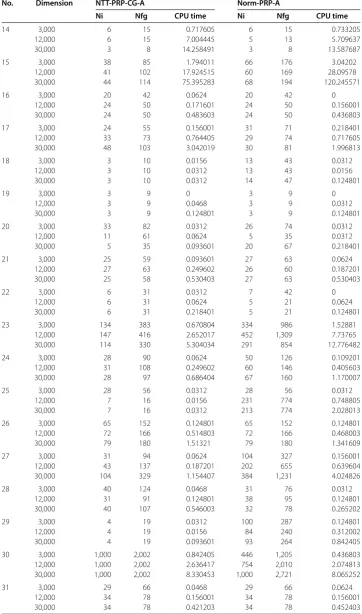
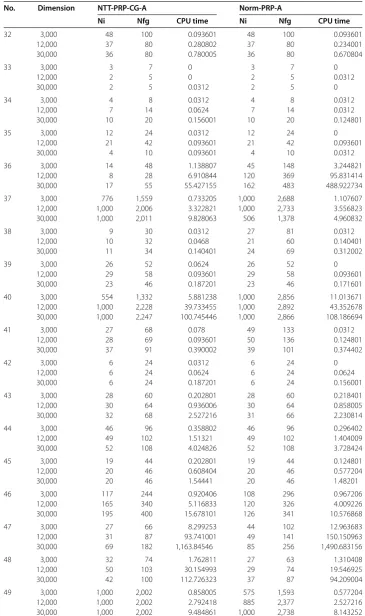
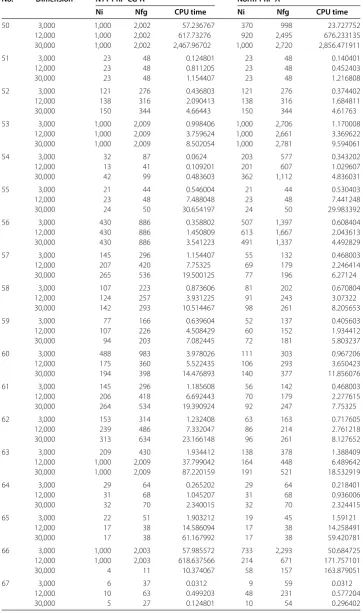
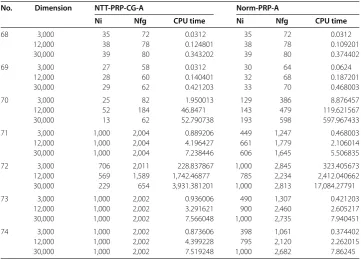
Table report the test numerical results of the NTT-PRP-CG-A and the Norm-PRP-A,
and we notate:
No. the test problems number. Dimension: the variables number.
[image:7.595.117.479.274.732.2]Ni: the iteration number. Nfg: the function and the gradient value number. CPU time:
the CPU time of operating system in seconds.
Table 2 Numerical results
No. Dimension NTT-PRP-CG-A Norm-PRP-A
Ni Nfg CPU time Ni Nfg CPU time
1 3,000 15 43 0.468003 31 92 0.546004
12,000 15 43 0.842405 56 158 1.778411
30,000 15 43 1.482009 36 113 2.730018
2 3,000 57 131 0.374402 55 126 0.374402
12,000 63 144 1.138807 62 142 0.920406
30,000 66 152 3.08882 66 152 2.511616
3 3,000 54 186 0.124801 117 375 0.202801
12,000 67 233 0.234001 144 479 0.514803
30,000 73 238 0.530403 159 522 1.62241
4 3,000 59 198 0.296402 207 595 0.936006
12,000 34 139 0.733205 264 801 4.305628
30,000 74 256 4.118426 228 618 8.907657
5 3,000 23 68 0.093601 39 106 0.124801
12,000 23 69 0.265202 39 109 0.390003
30,000 21 64 0.826805 47 135 1.279208
6 3,000 80 185 0.124801 80 185 0.093601
12,000 103 232 0.405603 103 232 0.343202
30,000 102 235 1.216808 102 235 0.998406
7 3,000 1,000 2,002 1.045207 357 943 0.421203
12,000 1,000 2,002 3.16682 835 2,257 2.808018
30,000 1,000 2,002 9.781263 1,000 2,779 9.734462
8 3,000 21 47 0.0468 19 46 0.0312
12,000 20 44 0.093601 19 46 0.093601
30,000 20 44 0.296402 19 46 0.265202
9 3,000 12 26 0.0312 12 26 0.0312
12,000 12 26 0.0468 12 26 0.0624
30,000 12 26 0.202801 12 26 0.156001
10 3,000 2 13 0.0312 2 13 0.0312
12,000 2 13 0.124801 2 13 0.093601
30,000 2 13 0.312002 2 13 0.280802
11 3,000 81 194 0.171601 24 101 0.0624
12,000 91 247 0.764405 15 59 0.202801
30,000 11 35 0.436803 13 50 0.280802
12 3,000 17 36 0.0468 14 33 0.0624
12,000 19 40 0.171601 14 33 0.124801
30,000 19 40 0.499203 14 33 0.343202
13 3,000 23 86 0.093601 22 84 0.078
12,000 42 111 0.452403 42 111 0.468003
Table 2 (
Continued
)
No. Dimension NTT-PRP-CG-A Norm-PRP-A
Ni Nfg CPU time Ni Nfg CPU time
14 3,000 6 15 0.717605 6 15 0.733205
12,000 6 15 7.004445 5 13 5.709637
30,000 3 8 14.258491 3 8 13.587687
15 3,000 38 85 1.794011 66 176 3.04202
12,000 41 102 17.924515 60 169 28.09578
30,000 44 114 75.395283 68 194 120.245571
16 3,000 20 42 0.0624 20 42 0
12,000 24 50 0.171601 24 50 0.156001
30,000 24 50 0.483603 24 50 0.436803
17 3,000 24 55 0.156001 31 71 0.218401
12,000 33 73 0.764405 29 74 0.717605
30,000 48 103 3.042019 30 81 1.996813
18 3,000 3 10 0.0156 13 43 0.0312
12,000 3 10 0.0312 13 43 0.0156
30,000 3 10 0.0312 14 47 0.124801
19 3,000 3 9 0 3 9 0
12,000 3 9 0.0468 3 9 0.0312
30,000 3 9 0.124801 3 9 0.124801
20 3,000 33 82 0.0312 26 74 0.0312
12,000 11 61 0.0624 5 35 0.0312
30,000 5 35 0.093601 20 67 0.218401
21 3,000 25 59 0.093601 27 63 0.0624
12,000 27 63 0.249602 26 60 0.187201
30,000 25 58 0.530403 27 63 0.530403
22 3,000 6 31 0.0312 7 42 0
12,000 6 31 0.0624 5 21 0.0624
30,000 6 31 0.218401 5 21 0.124801
23 3,000 134 383 0.670804 334 986 1.52881
12,000 147 416 2.652017 452 1,309 7.73765
30,000 114 330 5.304034 291 854 12.776482
24 3,000 28 90 0.0624 50 126 0.109201
12,000 31 108 0.249602 60 146 0.405603
30,000 28 97 0.686404 67 160 1.170007
25 3,000 28 56 0.0312 28 56 0.0312
12,000 7 16 0.0156 231 774 0.748805
30,000 7 16 0.0312 213 774 2.028013
26 3,000 65 152 0.124801 65 152 0.124801
12,000 72 166 0.514803 72 166 0.468003
30,000 79 180 1.51321 79 180 1.341609
27 3,000 31 94 0.0624 104 327 0.156001
12,000 43 137 0.187201 202 655 0.639604
30,000 104 329 1.154407 384 1,231 4.024826
28 3,000 40 124 0.0468 31 76 0.0312
12,000 31 91 0.124801 38 95 0.124801
30,000 40 107 0.546003 32 78 0.265202
29 3,000 4 19 0.0312 100 287 0.124801
12,000 4 19 0.0156 84 240 0.312002
30,000 4 19 0.093601 93 264 0.842405
30 3,000 1,000 2,002 0.842405 446 1,205 0.436803
12,000 1,000 2,002 2.636417 754 2,010 2.074813
30,000 1,000 2,002 8.330453 1,000 2,721 8.065252
31 3,000 29 66 0.0468 29 66 0.0624
12,000 34 78 0.156001 34 78 0.156001
[image:8.595.116.479.108.723.2]Table 2 (
Continued
)
No. Dimension NTT-PRP-CG-A Norm-PRP-A
Ni Nfg CPU time Ni Nfg CPU time
32 3,000 48 100 0.093601 48 100 0.093601
12,000 37 80 0.280802 37 80 0.234001
30,000 36 80 0.780005 36 80 0.670804
33 3,000 3 7 0 3 7 0
12,000 2 5 0 2 5 0.0312
30,000 2 5 0.0312 2 5 0
34 3,000 4 8 0.0312 4 8 0.0312
12,000 7 14 0.0624 7 14 0.0312
30,000 10 20 0.156001 10 20 0.124801
35 3,000 12 24 0.0312 12 24 0
12,000 21 42 0.093601 21 42 0.093601
30,000 4 10 0.093601 4 10 0.0312
36 3,000 14 48 1.138807 45 148 3.244821
12,000 8 28 6.910844 120 369 95.831414
30,000 17 55 55.427155 162 483 488.922734
37 3,000 776 1,559 0.733205 1,000 2,688 1.107607
12,000 1,000 2,006 3.322821 1,000 2,733 3.556823
30,000 1,000 2,011 9.828063 506 1,378 4.960832
38 3,000 9 30 0.0312 27 81 0.0312
12,000 10 32 0.0468 21 60 0.140401
30,000 11 34 0.140401 24 69 0.312002
39 3,000 26 52 0.0624 26 52 0
12,000 29 58 0.093601 29 58 0.093601
30,000 23 46 0.187201 23 46 0.171601
40 3,000 554 1,332 5.881238 1,000 2,856 11.013671
12,000 1,000 2,228 39.733455 1,000 2,892 43.352678
30,000 1,000 2,247 100.745446 1,000 2,866 108.186694
41 3,000 27 68 0.078 49 133 0.0312
12,000 28 69 0.093601 50 136 0.124801
30,000 37 91 0.390002 39 101 0.374402
42 3,000 6 24 0.0312 6 24 0
12,000 6 24 0.0624 6 24 0.0624
30,000 6 24 0.187201 6 24 0.156001
43 3,000 28 60 0.202801 28 60 0.218401
12,000 30 64 0.936006 30 64 0.858005
30,000 32 68 2.527216 31 66 2.230814
44 3,000 46 96 0.358802 46 96 0.296402
12,000 49 102 1.51321 49 102 1.404009
30,000 52 108 4.024826 52 108 3.728424
45 3,000 19 44 0.202801 19 44 0.124801
12,000 20 46 0.608404 20 46 0.577204
30,000 20 46 1.54441 20 46 1.48201
46 3,000 117 244 0.920406 108 296 0.967206
12,000 165 340 5.116833 120 326 4.009226
30,000 195 400 15.678101 126 341 10.576868
47 3,000 27 66 8.299253 44 102 12.963683
12,000 31 87 93.741001 49 141 150.150963
30,000 69 182 1,163.84546 85 256 1,490.683156
48 3,000 32 74 1.762811 27 63 1.310408
12,000 50 103 30.154993 29 74 19.546925
30,000 42 100 112.726323 37 87 94.209004
49 3,000 1,000 2,002 0.858005 575 1,593 0.577204
12,000 1,000 2,002 2.792418 885 2,377 2.527216
[image:9.595.114.480.103.720.2]Table 2 (
Continued
)
No. Dimension NTT-PRP-CG-A Norm-PRP-A
Ni Nfg CPU time Ni Nfg CPU time
50 3,000 1,000 2,002 57.236767 370 998 23.727752
12,000 1,000 2,002 617.73276 920 2,495 676.233135
30,000 1,000 2,002 2,467.96702 1,000 2,720 2,856.471911
51 3,000 23 48 0.124801 23 48 0.140401
12,000 23 48 0.811205 23 48 0.452403
30,000 23 48 1.154407 23 48 1.216808
52 3,000 121 276 0.436803 121 276 0.374402
12,000 138 316 2.090413 138 316 1.684811
30,000 150 344 4.66443 150 344 4.61763
53 3,000 1,000 2,009 0.998406 1,000 2,706 1.170008
12,000 1,000 2,009 3.759624 1,000 2,661 3.369622
30,000 1,000 2,009 8.502054 1,000 2,781 9.594061
54 3,000 32 87 0.0624 203 577 0.343202
12,000 13 41 0.109201 201 607 1.029607
30,000 42 99 0.483603 362 1,112 4.836031
55 3,000 21 44 0.546004 21 44 0.530403
12,000 23 48 7.488048 23 48 7.441248
30,000 24 50 30.654197 24 50 29.983392
56 3,000 430 886 0.358802 507 1,397 0.608404
12,000 430 886 1.450809 613 1,667 2.043613
30,000 430 886 3.541223 491 1,337 4.492829
57 3,000 145 296 1.154407 55 132 0.468003
12,000 207 420 7.75325 69 179 2.246414
30,000 265 536 19.500125 77 196 6.27124
58 3,000 107 223 0.873606 81 202 0.670804
12,000 124 257 3.931225 91 243 3.07322
30,000 142 293 10.514467 98 261 8.205653
59 3,000 77 166 0.639604 52 137 0.405603
12,000 107 226 4.508429 60 152 1.934412
30,000 94 203 7.082445 72 181 5.803237
60 3,000 488 983 3.978026 111 303 0.967206
12,000 175 360 5.522435 106 293 3.650423
30,000 194 398 14.476893 140 377 11.856076
61 3,000 145 296 1.185608 56 142 0.468003
12,000 206 418 6.692443 70 179 2.277615
30,000 264 534 19.390924 92 247 7.75325
62 3,000 153 314 1.232408 63 163 0.717605
12,000 239 486 7.332047 86 214 2.761218
30,000 313 634 23.166148 96 261 8.127652
63 3,000 209 430 1.934412 138 378 1.388409
12,000 1,000 2,009 37.799042 164 448 6.489642
30,000 1,000 2,009 87.220159 191 521 18.532919
64 3,000 29 64 0.265202 29 64 0.218401
12,000 31 68 1.045207 31 68 0.936006
30,000 32 70 2.340015 32 70 2.324415
65 3,000 22 51 1.903212 19 45 1.59121
12,000 17 38 14.586094 17 38 14.258491
30,000 17 38 61.167992 17 38 59.420781
66 3,000 1,000 2,003 57.985572 733 2,293 50.684725
12,000 1,000 2,003 618.637566 214 671 171.757101
30,000 4 11 10.374067 58 157 163.879051
67 3,000 6 37 0.0312 9 59 0.0312
12,000 10 63 0.499203 48 231 0.577204
[image:10.595.116.480.112.726.2]Table 2 (
Continued
)
No. Dimension NTT-PRP-CG-A Norm-PRP-A
Ni Nfg CPU time Ni Nfg CPU time
68 3,000 35 72 0.0312 35 72 0.0312
12,000 38 78 0.124801 38 78 0.109201
30,000 39 80 0.343202 39 80 0.374402
69 3,000 27 58 0.0312 30 64 0.0624
12,000 28 60 0.140401 32 68 0.187201
30,000 29 62 0.421203 33 70 0.468003
70 3,000 25 82 1.950013 129 386 8.876457
12,000 52 184 46.8471 143 479 119.621567
30,000 13 62 52.790738 193 598 597.967433
71 3,000 1,000 2,004 0.889206 449 1,247 0.468003
12,000 1,000 2,004 4.196427 661 1,779 2.106014
30,000 1,000 2,004 7.238446 606 1,645 5.506835
72 3,000 706 2,011 228.837867 1,000 2,845 323.405673
12,000 569 1,589 1,742.46877 785 2,234 2,412.040662
30,000 229 654 3,931.381201 1,000 2,813 17,084.27791
73 3,000 1,000 2,002 0.936006 490 1,307 0.421203
12,000 1,000 2,002 3.291621 900 2,460 2.605217
30,000 1,000 2,002 7.566048 1,000 2,735 7.940451
74 3,000 1,000 2,002 0.873606 398 1,061 0.374402
12,000 1,000 2,002 4.399228 795 2,120 2.262015
[image:11.595.117.479.95.355.2]30,000 1,000 2,002 7.519248 1,000 2,682 7.86245
Figure 1 Performance profiles of the algorithms for the test problems (Ni).
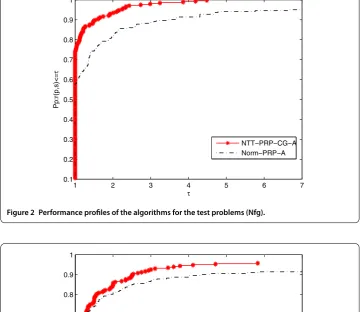
[image:11.595.117.483.125.588.2]Figure 2 Performance profiles of the algorithms for the test problems (Nfg).
Figure 3 Performance profiles of the algorithms for the test problems (CPU time).
5 Conclusions
In this paper, based on the PRP formula for unconstrained optimization, a modified
three-term PRP CG algorithm was presented. The proposed method possesses sufficient descent
property also holds without any line search technique, and we have automatically the trust
region property of the search direction. Under the Wolfe line search, the global
conver-gence was proven. Numerical results showed that the new algorithm is more effective
compared with the normal method.
Competing interests
Author’s contributions
Only the author contributed in writing this paper.
Publisher’s Note
Springer Nature remains neutral with regard to jurisdictional claims in published maps and institutional affiliations.
Received: 25 March 2017 Accepted: 20 April 2017
References
1. Zhang, L, Zhou, W, Li, D: A descent modified Polak-Ribière-Polyak conjugate method and its global convergence. IMA J. Numer. Anal.26, 629-649 (2006)
2. Fu, Z, Wu, X, Guan, C, Sun, X, Ren, K: Towards efficient multi-keyword fuzzy search over encrypted outsourced data with accuracy improvement. IEEE Trans. Inf. Forensics Secur. (2016). doi:10.1109/TIFS.2016.2596138
3. Gu, B, Sheng, VS, Tay, KY, Romano, W, Li, S: Incremental support vector learning for ordinal regression. IEEE Trans. Neural Netw. Learn. Syst.26, 1403-1416 (2015)
4. Gu, B, Sun, X, Sheng, VS: Structural minimax probability machine, IEEE Trans. Neural Netw. Learn. Syst. (2016). doi:10.1109/TNNLS.2016.2544779
5. Li, J, Li, X, Yang, B, Sun, X: Segmentation-based image copy-move forgery detection scheme. IEEE Trans. Inf. Forensics Secur.10, 507-518 (2015)
6. Pan, Z, Lei, J, Zhang, Y, Sun, X, Kwong, S: Fast motion estimation based on content property for low-complexity H.265/HEVC encoder. IEEE Trans. Broadcast. (2016). doi:10.1109/TBC.2016.2580920
7. Pan, Z, Zhang, Y, Kwong, S: Efficient motion and disparity estimation optimization for low complexity multiview video coding. IEEE Trans. Broadcast.61, 166-176 (2015)
8. Xia, Z, Wang, X, Sun, X, Wang, Q: A secure and dynamic multi-keyword ranked search scheme over encrypted cloud data. IEEE Trans. Parallel Distrib. Syst.27, 340-352 (2015)
9. Xia, Z, Wang, X, Sun, X, Liu, Q, Xiong, N: Steg analysis of LSB matching using differences between nonadjacent pixels. Multimed. Tools Appl.75, 1947-1962 (2016)
10. Xia, Z, Wang, X, Zhang, L, Qin, Z, Sun, X, Ren, K: A privacy-preserving and copy-deterrence content-based image retrieval scheme in cloud computing. IEEE Trans. Inf. Forensics Secur. (2016). doi:10.1109/TIFS.2016.2590944 11. Yuan, GL: A new method with descent property for symmetric nonlinear equations. Numer. Funct. Anal. Optim.31,
974-987 (2010)
12. Yuan, GL, Lu, S, Wei, ZX: A new trust-region method with line search for solving symmetric nonlinear equations. Int. J. Comput. Math.88, 2109-2123 (2011)
13. Yuan, C, Sun, X, Lv, R: Fingerprint liveness detection based on multi-scale LPQ and PCA. China Commun.13, 60-65 (2016)
14. Yuan, GL, Lu, XW, Wei, ZX: BFGS trust-region method for symmetric nonlinear equations. J. Comput. Appl. Math.230, 44-58 (2009)
15. Yuan, G, Wei, Z: A trust region algorithm with conjugate gradient technique for optimization problems. Numer. Funct. Anal. Optim.32, 212-232 (2011)
16. Yuan, GL, Wei, ZX, Lu, S: Limited memory BFGS method with backtracking for symmetric nonlinear equations. Math. Comput. Model.54, 367-377 (2011)
17. Yuan, GL, Wei, ZX, Lu, XW: A BFGS trust-region method for nonlinear equations. Computing92, 317-333 (2011) 18. Yuan, GL, Wei, ZX, Wang, ZX: Gradient trust region algorithm with limited memory BFGS update for nonsmooth
convex minimization. Comput. Optim. Appl.54, 45-64 (2013)
19. Yuan, GL, Wei, ZX, Wu, YL: Modified limited memory BFGS method with nonmonotone line search for unconstrained optimization. J. Korean Math. Soc.47, 767-788 (2010)
20. Yuan, GL, Yao, SW: A BFGS algorithm for solving symmetric nonlinear equations. Optimization62, 45-64 (2013) 21. Zhou, Z, Wang, Y, Wu, QMJ, Yang, C-N, Sun, X: Effective and efficient global context verification for image copy
detection. IEEE Trans. Inf. Forensics Secur. (2016). doi:10.1109/TIFS.2016.2601065
22. Andrei, N: A hybrid conjugate gradient algorithm for unconstrained optimization as a convex combination of Hestenes-Stiefel and Dai-Yuan. Stud. Inform. Control17, 55-70 (2008)
23. Dai, Y: A nonmonotone conjugate gradient algorithm for unconstrained optimization. J. Syst. Sci. Complex.15, 139-145 (2002)
24. Dai, Y, Yuan, Y: A nonlinear conjugate gradient with a strong global convergence properties. SIAM J. Optim.10, 177-182 (2000)
25. Dai, Y, Yuan, Y: Nonlinear Conjugate Gradient Methods. Shanghai Sci. Technol., Shanghai (1998)
26. Dai, Y, Yuan, Y: An efficient hybrid conjugate gradient method for unconstrained optimization. Ann. Oper. Res.103, 33-47 (2001)
27. Fletcher, R: Practical Method of Optimization, Vol I: Unconstrained Optimization, 2nd edn. Wiley, New York (1997) 28. Fletcher, R, Reeves, C: Function minimization by conjugate gradients. Comput. J.7, 149-154 (1964)
29. Grippo, L, Lucidi, S: A globally convergent version of the Polak-Ribière gradient method. Math. Program.78, 375-391 (1997)
30. Hager, WW, Zhang, H: A new conjugate gradient method with guaranteed descent and an efficient line search. SIAM J. Optim.16, 170-192 (2005)
31. Hager, WW, Zhang, H: Algorithm 851: CG-DESCENT, a conjugate gradient method with guaranteed descent. ACM Trans. Math. Softw.32, 113-137 (2006)
32. Hager, WW, Zhang, H: A survey of nonlinear conjugate gradient methods. Pac. J. Optim.2, 35-58 (2006)
33. Hestenes, MR, Stiefel, E: Method of conjugate gradient for solving linear equations. J. Res. Natl. Bur. Stand.49, 409-436 (1952)
35. Powell, MJD: Nonconvex minimization calculations and the conjugate gradient method. In: Numerical Analysis, Lecture Notes in Mathematics, vol. 1066, pp. 122-141. Spinger, Berlin (1984)
36. Powell, MJD: Convergence properties of algorithm for nonlinear optimization. SIAM Rev.28, 487-500 (1986) 37. Wei, Z, Li, G, Qi, L: New nonlinear conjugate gradient formulas for large-scale unconstrained optimization problems.
Appl. Math. Comput.179, 407-430 (2006)
38. Wei, Z, Li, G, Qi, L: Global convergence of the PRP conjugate gradient methods with inexact line search for nonconvex unconstrained optimization problems. Math. Comput.77, 2173-2193 (2008)
39. Wei, Z, Yao, S, Liu, L: The convergence properties of some new conjugate gradient methods. Appl. Math. Comput.
183, 1341-1350 (2006)
40. Yuan, GL: Modified nonlinear conjugate gradient methods with sufficient descent property for large-scale optimization problems. Optim. Lett.3, 11-21 (2009)
41. Yuan, GL, Duan, XB, Liu, WJ, Wang, XL, Cui, ZR, Sheng, Z: Two new PRP conjugate gradient algorithms for minimization optimization models. PLoS ONE10(10), e0140071 (2015)
42. Yuan, GL, Lu, XW: A modified PRP conjugate gradient method. Ann. Oper. Res.166, 73-90 (2009)
43. Yuan, GL, Lu, XW, Wei, ZX: A conjugate gradient method with descent direction for unconstrained optimization. J. Comput. Appl. Math.233, 519-530 (2009)
44. Yuan, GL, Wei, ZX: New line search methods for unconstrained optimization. J. Korean Stat. Soc.38, 29-39 (2009) 45. Yuan, GL, Wei, ZX, Zhao, QM: A modified Polak-Ribière-Polyak conjugate gradient algorithm for large-scale
optimization problems. IIE Trans.46, 397-413 (2014)
46. Yuan, GL, Zhang, MJ: A modified Hestenes-Stiefel conjugate gradient algorithm for large-scale optimization. Numer. Funct. Anal. Optim.34, 914-937 (2013)
47. Yuan, GL, Meng, ZH, Li, Y: A modified Hestenes and Stiefel conjugate gradient algorithm for large-scale nonsmooth minimizations and nonlinear equations. J. Optim. Theory Appl.168, 129-152 (2016)
48. Yuan, GL, Wei, ZX: The Barzilai and Borwein gradient method with nonmonotone line search for nonsmooth convex optimization problems. Math. Model. Anal.17, 203-216 (2012)
49. Yuan, GL, Wei, ZX, Li, GY: A modified Polak-Ribière-Polyak conjugate gradient algorithm for nonsmooth convex programs. J. Comput. Appl. Math.255, 86-96 (2014)
50. Yuan, GL, Zhang, MJ: A three-terms Polak-Ribière-Polyak conjugate gradient algorithm for large-scale nonlinear equations. J. Comput. Appl. Math.286, 186-195 (2015)
51. Polak, E: The conjugate gradient method in extreme problems. Comput. Math. Math. Phys.9, 94-112 (1969) 52. Yuan, GL, Wei, ZX, Lu, XW: Global convergence of BFGS and PRP methods under a modified weak Wolfe-Powell line
search. Appl. Math. Model. (2017). doi:10.1016/j.apm.2017.02.008
53. Al-Baali, A: Descent property and global convergence of the Flecher-Reeves method with inexact line search. IMA J. Numer. Anal.5, 121-124 (1985)
54. Gilbert, JC, Nocedal, J: Global convergence properties of conjugate gradient methods for optimization. SIAM J. Optim.2, 21-42 (1992)
55. Ahmed, T, Storey, D: Efficient hybrid conjugate gradient techniques. J. Optim. Theory Appl.64, 379-394 (1990) 56. Hu, YF, Storey, C: Global convergence result for conjugate method. J. Optim. Theory Appl.71, 399-405 (1991) 57. Bongartz, I, Conn, AR, Gould, NI, Toint, PL: CUTE: constrained and unconstrained testing environment. ACM Trans.
Math. Softw.21, 123-160 (1995)
58. Gould, NI, Orban, D, Toint, PL: CUTEr and SifDec: a constrained and unconstrained testing environment, revised. ACM Trans. Math. Softw.29, 373-394 (2003)