R E S E A R C H A R T I C L E
Open Access
Self-recordings of upper arm elevation
during cleaning
–
comparison between
analyses using a simplified reference
posture and a standard reference posture
Camilla Dahlqvist
1*, Catarina Nordander
1, Mikael Forsman
2and Henrik Enquist
1Abstract
Background:To reduce ergonomic risk factors in terms of awkward and constrained postures and high velocities, it is important to perform adequate risk assessments. Technical methods provide objective measures of physical workload. These methods have so far mainly been used by researchers. However, if written instructions how to apply the sensors and how to adopt the reference posture are provided, together with triaxial accelerometers, it may be possible for employees to record their own physical workload. The exposure in terms of e.g. upper arm elevations could then easily be assessed for all workers in a workplace. The main aims of this study were: 1) to compare analyses for self-recording of upper arm elevation during work using a simplified reference posture versus using a standard reference posture, and 2) to compare the two reference postures.
Methods:Twenty-eight cleaners attached an accelerometer to their dominant upper arm and adopted a simplified reference according to a written instruction. They were thereafter instructed by a researcher to adopt a standard reference. Upper arm elevations were recorded for 2 or 3 days. Each recording was analysed twice; relative to the simplified reference posture and relative to the standard reference posture. The group means of the differences in recorded upper arm elevations between simplified and standard reference analyses were assessed using Wilcoxon signed ranks test. Furthermore, we calculated the group mean of the differences between the simplified reference posture and the standard reference posture.
Results:For arm elevation during work (50thpercentile), the group mean of the differences between the two analyses was 0.2° (range -7–10°). The group mean of the differences between the two references was 9° (range 1–21°). The subjects were able to follow the instructions in the protocol and performed self-recording of upper arm elevation and velocity.
Conclusions:The small difference between the two analyses indicates that recordings performed by employees themselves are comparable, on a group level, with those performed by researchers. Self-recordings in combination with action levels would provide employers with a method for risk assessment as a solid basis for prevention of work-related musculoskeletal disorders.
Keywords:Inclinometry, Zero position, Self-measurement, Physical workload, Angular velocity, Arm elevation, Hotel housekeeping
* Correspondence:[email protected]
1Division of Occupational and Environmental Medicine, Department of
Laboratory Medicine, Lund University, SE-221 85 Lund, Sweden Full list of author information is available at the end of the article
Background
Many jobs involve repetitive work, prolonged muscular load and work performed in awkward and constrained pos-tures. Such work are known to be risk factors for develop-ing work-related musculoskeletal disorders (WMSDs) in the neck/shoulder region, arms, and hands [1–4]. To re-duce these risks, it is important to perform risk assess-ments, and to implement organisational and technical measures when necessary [5]. The reliability of risk assess-ments is important as this affects the decisions made and the priorities afforded different interventions [6].
Several kinds of risk assessment methods are available, such as self-reporting, observational methods and tech-nical methods, all of which have advantages and disad-vantages [7]. For example, in self-reporting, which has the advantage of being practical in large groups, over-estimation of the workload is common among individ-uals with pain [8]. Observational methods are often easy to use and interpret, and give a rough estimate of pos-tures during work, but results vary between observers
[9]. As observational methods have no common
refer-ences, they tend to give different results when assessing
the risk of developing WMSDs [10, 11]. Technical
methods, on the other hand, provide exact numerical values for both postures and movements during work, i.e. upper arm elevation and velocity [12].
There is a commonly held belief that technical methods require expensive equipment, technical
under-standing and are time-consuming [13]. However,
low-cost sensors for recording of elevations and veloci-ties during work are now commercially available [14,
15]. These sensors have also made it feasible to measure the workload over several days [16]. Many studies have been performed previously in which the workload on a few individuals has been recorded during 1 day [17,18]. With the advent of low-cost sensors, it is now possible to monitor the entire workforce over several days.
Measurements over extended periods of time are im-portant in planning job rotation as a measure for the
prevention of WMSDs [19]. Furthermore, measurements
made over several days will give a better idea of the loads experienced on an average working day [20]. Such an average measurement is likely to be more strongly correlated with the prevalence of WMSDs than those from one-day recordings. So far, the number of technical recordings has been limited, mainly due to the need for researchers.
If self-recording of physical workload was possible, all the employees’workload at almost any workplace could be ex-plored for several days. Such recordings would be invalu-able when performing risk assessments. However, it would be necessary to develop easily understandable instructions so that the employees can attach the equipment and cali-brate it, i.e. adopt a reference posture. The reference
posture should have a high reproducibility, and this can be studied if recordings are performed over several days. The reference posture should also be easy to adopt, and without the need of extra material. Such a reference would rule out our standard reference posture, which we have used in many studies, as the latter requires a chair and a dumbbell [17, 21–23]. A self-recording method also requires a reli-able method of identifying the reference, as this defines 0 degrees of inclination. Furthermore, the starting and stopping times of work and breaks should be noted, to distinguish between working time and leisure time.
One occupation with a high physical workload and a high risk of WMSDs is cleaning [24]. As an example, the prevalence of complaints and diagnoses in neck/shoul-ders has been reported to be 48% among female hospital cleaners working in a traditional work organisation [25]. Around the world there are many employees working as cleaners and it is important to perform risk assessments of their work in a cost-effective manner. Therefore, we would like to test the self-recording method in the cleaning industry.
The main aims of this study were: 1) to compare analyses for self-recording of upper arm elevation during work using a simplified reference posture ver-sus using a standard reference posture, and 2) to compare the two reference postures. Other aims were to study the between-day repeatability in the simpli-fied reference posture, and to assess the suitability of a protocol for self-recording. Furthermore, we aimed to compare the physical workload, the between-day repeatability of the workload, and to assess the risk of musculoskeletal disorders among different types of cleaning.
Subjects and methods Study design
This was a field study including two parts. In part one (self-recordings), workers received a protocol with in-structions on how to attach a triaxial accelerometer (GC inclinometer) to the upper arm, and how to adopt a ref-erence posture. It was adopted by the cleaners them-selves, without the need of extra material, and referred to as the simplified reference posture. A researcher then instructed each of them to adopt the standard reference posture. The workers wore the GC inclinometer con-tinuously, both day and night, for 2 or 3 days. They re-peated the simplified reference posture each morning and noted starting and stopping times of work and lunch breaks for each day in a provided form.
each worker during the one-day recording and noted exact starting and stopping times for work and breaks.
Subjects Self-recordings
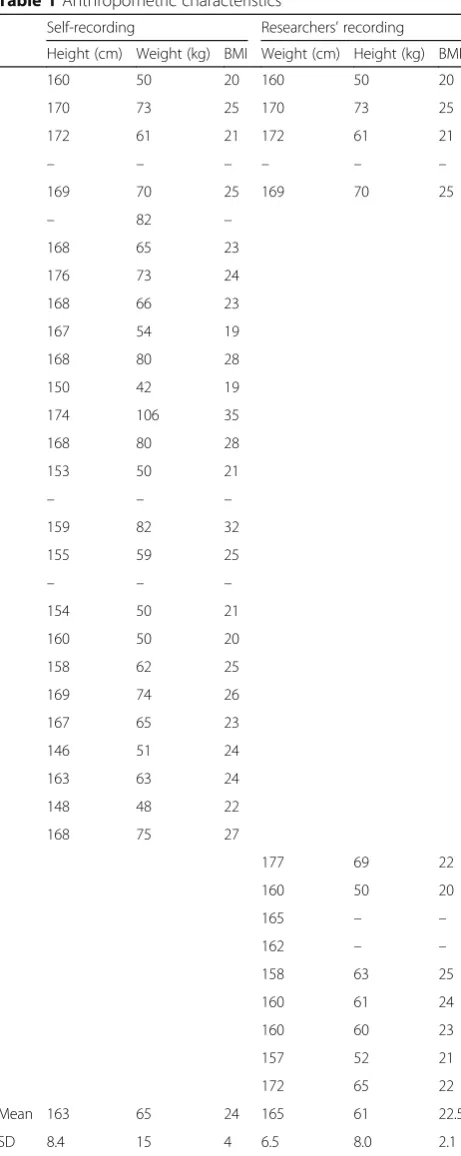
Twenty-eight subjects, 24 women and 4 men, partici-pated in the study (Table1). Their mean age was 43 years (range 22–58). Twenty-four of the subjects (20 women and 4 men) worked as hotel cleaners and 4 (all women) as office cleaners. Three of the 28 subjects were native Swedish speakers, while the other 25 spoke English and Swedish of varying quality. All the hotel cleaners cleaned hotel rooms (denoted hotel housekeeping). Some of them (eleven subjects) also had other tasks such as cleaning corridors, conference rooms, pool areas and/or dining rooms (denoted hotel housekeeping+). The office cleaners cleaned mainly offices, but also toilets, changing rooms, corridors and dining rooms.
Researchers’recordings
Fourteen right-handed female hotel cleaners participated in standard one-day recordings performed by profes-sionals (Table 1). Their mean age was 42 years (range 22–57). They all cleaned hotel rooms. Five of these also performed self-recording, on separate occasions.
Materials
Triaxial accelerometers with an integrated data logger (USB Accelerometer Model X16-mini, Gulf Coast Data Con-cepts, LLC, Waveland, MS, USA,“GC inclinometer”) with a sampling frequency of 25 Hz were used. This frequency is sufficient as it has been shown that 99.5% of the signal power for wrist (and it is not expected to be higher for the upper arms) was contained in the 0–5 Hz band in occupa-tional repetitive work [26]. The size was 5 × 2.4 × 1.3 cm and they contained a 2 GB memory for data logging, a fe-male micro USB-connector and a rechargeable battery [14]. The accelerometer was attached to the upper arm, just
below the insertion of the deltoid muscle, with
double-sided adhesive tape and fixed with plastic film (Tegaderm™, 3 M Health Care, St Paul, MN, USA) to se-cure them from falling off.
Procedures
Standard reference posture
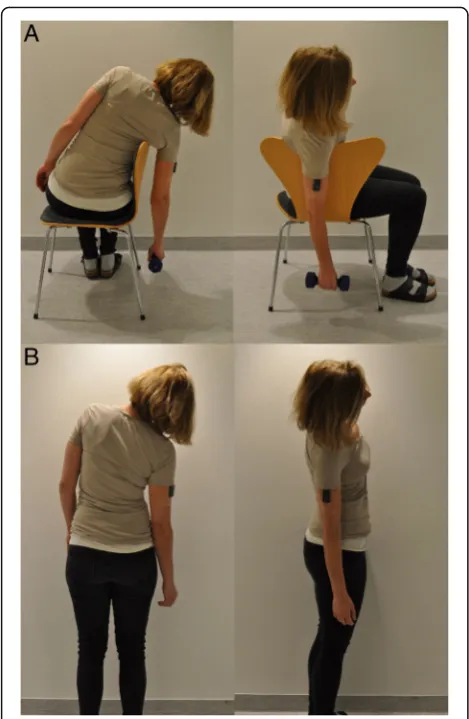
The researcher instructed the subject to sit on a chair and lean towards the backrest with the arm hanging ver-tically over the backrest, holding a dumbbell in the hand (Fig.1a) [21].
Simplified reference posture
[image:3.595.306.537.92.671.2]The subject followed the instructions in the protocol and leaned to the right with the arm alongside the body and with an extended elbow for about 20 s (Fig.1b) [14].
Table 1Anthropometric characteristics
Self-recording Researchers’recording
Height (cm) Weight (kg) BMI Weight (cm) Height (kg) BMI
160 50 20 160 50 20
170 73 25 170 73 25
172 61 21 172 61 21
– – – – – –
169 70 25 169 70 25
– 82 –
168 65 23
176 73 24
168 66 23
167 54 19
168 80 28
150 42 19
174 106 35
168 80 28
153 50 21
– – –
159 82 32
155 59 25
– – –
154 50 21
160 50 20
158 62 25
169 74 26
167 65 23
146 51 24
163 63 24
148 48 22
168 75 27
177 69 22
160 50 20
165 – –
162 – –
158 63 25
160 61 24
160 60 23
157 52 21
172 65 22
Mean 163 65 24 165 61 22.5
SD 8.4 15 4 6.5 8.0 2.1
Height, weight and BMI for the 37 subjects participating in the study. Twenty-eight subjects participated in the self-recording and fourteen subjects participated in the researchers’recording. Five subjects participated in both types of recordings
The protocol
The self-recording method was tested in the cleaning in-dustry. We made one Swedish and one English version of the protocol, as it is known to be a high proportion of immigrants among the employees [27]. Twenty-five jects chose to use the Swedish version, while three sub-jects chose the English version. The protocol with instructions for using the GC inclinometer consisted mainly of pictures with short explanations how to attach the GC inclinometer and how to perform the simplified reference posture (see Additional file 1). The researcher noted that the first subjects seemed to have some diffi-culties in understanding the Swedish and English in-structions properly, due to language barriers. Therefore, we improved the protocol in steps during the study. The first change (version 2) was to add instructions on how to start the GC inclinometer (which for the first subjects had been performed by the researcher), to obtain a complete instruction for self-recording of upper arm ele-vation and velocity. We also simplified the part on how
to attach the inclinometer. The second change (version 3) was to add a second series of toe jumps after the sim-plified reference posture to improve our ability to deter-mine which part of the recording corresponded to it. To make it easier for the subjects to perform the self-recording, minor changes were made throughout the study, such as highlighting the most important steps (starting the device and performing the simplified refer-ence posture), numbering the various steps in the proto-col and simplifying the language in the text boxes. Three versions of the protocol were used. Version 1 was used by four subjects, version 2 was used by five, and version 3 was used by 19 subjects. A few subjects needed help to start the GC inclinometer and some of them had to be reminded to adopt the simplified reference posture. However, the need for help decreased with improved versions of the protocol.
Self-recordings
Each subject was given a GC inclinometer and a proto-col with instructions. Nineteen subjects (at twelve differ-ent times) individually followed the protocol and attached the GC inclinometer, performed five toe jumps and adopted the simplified reference posture by them-selves. The toe jumps were later used to find this part of the recording. At one occasion, nine subjects were helped by their supervisor, due to lack of time. The supervisor started and attached the GC inclinometer, and instructed each subject how to perform the simpli-fied reference posture. The supervisor had not used the protocol previously.
For each subject, the researcher did a brief visual in-spection of that the GC inclinometer was attached prop-erly. The researcher then instructed each of the subjects to perform the standard reference posture.
The subjects were instructed to perform the simplified reference posture every morning and to note the time for this and the starting and stopping times of work and lunch breaks in the provided form. They were instructed to apply more plastic film if needed and they were also told to remove the GC inclinometer if they experienced itching or irritation of the skin. Nineteen of the subjects wore the GC inclinometer for 3 days and nine subjects wore it for 2 days. At the end of the second or third working day, the researcher instructed the subject to perform the standard reference posture again, and then removed the GC inclinometer. In four cases the super-visor removed the GC inclinometer, and one subject re-moved it herself. The stop time was noted.
Researchers’recordings
Researchers experienced in technical methods attached the GC inclinometer to the subject’s right upper arm, one subject at a time, on different days from the Fig. 1aThe standard reference posture, and (b) the simplified
[image:4.595.56.291.85.445.2]self-recordings. Each subject was instructed to adopt the standard reference posture for the right upper arm. The researchers followed each subject during their working day, noting the exact starting and stopping times for work, breaks, and different work tasks.
Questionnaire
To further assess the suitability of the protocol and the self-recording method, all subjects were asked, after the recording, to answer six questions about their percep-tions of the self-recording.
Data processing and analyses
The data were processed with the EMINGO software suite, developed by the Division of Occupational and En-vironmental Medicine in Lund, Sweden using MATLAB (version 2016b, Math Works INC., Natick, MA, USA). The data were resampled at 20 Hz, anti-aliased, low-pass filtered (5 Hz), and visually inspected.
Self-recording
Upper arm elevations and velocities were recorded con-tinuously but only the data on work were analysed. Lunch breaks were excluded according to the times noted in the provided form. The data were analysed twice; once using the simplified reference posture as ref-erence (henceforth referred to as the simplified refref-erence analysis) and once using the standard reference as refer-ence (hrefer-enceforth referred to as the standard referrefer-ence analysis). The 1st, 10th, 50th, 90thand 99thpercentiles of the angular distribution (°) and the percentage of time the arm was elevated above 30°, 60° and 90° were calcu-lated. Furthermore, the median generalised angular vel-ocity (°/s) was derived for each subject. 1 °/s = 0.017 rad s−1and 1 rad s−1= 57.3 °/s. Group means of upper arm elevations and velocities were calculated for comparisons between the simplified reference analysis and the standard reference analysis. Further, for each subject we calculated the differences between the results derived from the two different analyses, as well as the absolute differences (i.e. the non-negative difference, re-gardless of sign). Then the group means of the differ-ences and the group means of the absolute differdiffer-ences were calculated.
Furthermore, for each subject, we calculated the differ-ence between the simplified referdiffer-ence posture and the standard reference posture (°). In most cases we used the references from day 1. In one case, the GC inclinom-eter fell off during day 1. The subject attached it again, and the researcher (who was still there) instructed her, during her lunch break, to perform the standard refer-ence posture again. Another subject appeared to have re-placed the GC inclinometer upside down after it had fallen off during the morning day 1 (detected during
data analysis), and therefore this part of the recording was discarded. For this subject, the standard reference posture from day 3 was used. The simplified reference posture from day 2 was used for both these subjects.
The first and second simplified reference posture were used to investigate the reliability of the reference. Nine of the subjects performed the simplified reference pos-ture on one occasion only and were therefore excluded when analysing the within-subject variation of the reference.
The within-subject variation in workload between the first and second working days was also calculated among the hotel cleaners. Then, two recordings were excluded because the subjects removed their GC inclinometer while showering after day 1. They had replaced the de-vice after showering, but did not repeat the simplified reference posture, and therefore, the data for the remaining days had to be rejected. The remaining 22 re-cordings were divided into hotel housekeeping and hotel housekeeping+, with eleven subjects in each group.
When comparing upper arm elevations and velocities between the specific types of cleaning (hotel housekeep-ing, hotel housekeeping+, and office cleaning), as well as
when comparing with the researchers’ one-day
record-ings of hotel housekeeping, the standard reference ana-lysis was used. The four men were excluded from these calculations, to be able to compare them with previous and future recordings, where the results for women and men are separated [28].
Researchers’recordings
Upper arm elevations and velocities during the working day were analysed, lunch breaks excluded. The same measures as for the self-recordings were calculated; the percentiles of the angular distribution (°) and the per-centage of time the arm was elevated above 30°, 60° and 90° were calculated for each subject. The median gener-alised angular velocity (°/s) was also derived, and group means of both elevations and velocities were calculated.
Statistical analyses
working days, the repeatability coefficient (°) and the intraclass correlation coefficient (ICC) were calculated [29,30]. We used ICC (1,1) i.e. one-way random effects model, absolute agreement, single measures. ICC esti-mates less than 0.5, between 0.5 and 0.75, between 0.75 and 0.9, and greater than 0.90 indicate poor, moderate, good, and excellent reliability, respectively [31]. The dif-ference between the simplified redif-ference posture and the standard reference posture of two following occasions, respectively, as well as upper arm elevations (50th and 90thpercentiles) and the median angular velocity of two working days were the input variables in the model. Comparisons between group means of different types of cleaning were performed using Kruskal-Wallis one-way analysis of variance. Post hoc analyses for
p-values < 0.05 was performed using Mann-Whitney
U-test. The non-parametric tests were used since the data were not normally distributed.
Results
Simplified reference analysis versus standard reference analysis
Recordings of workload
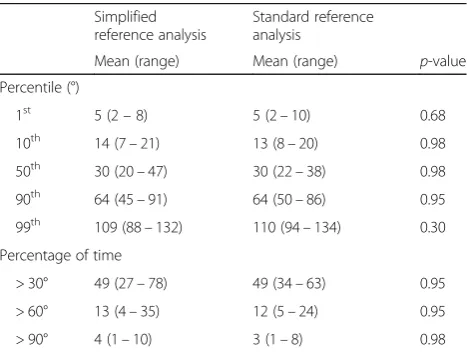
The group means of upper arm elevation and the per-centage of time above 30°, 60° and 90° during work were very similar between the simplified reference analysis and the standard reference analysis (Table2). The upper arm velocity was identical (data not shown), as this is not dependent on the reference.
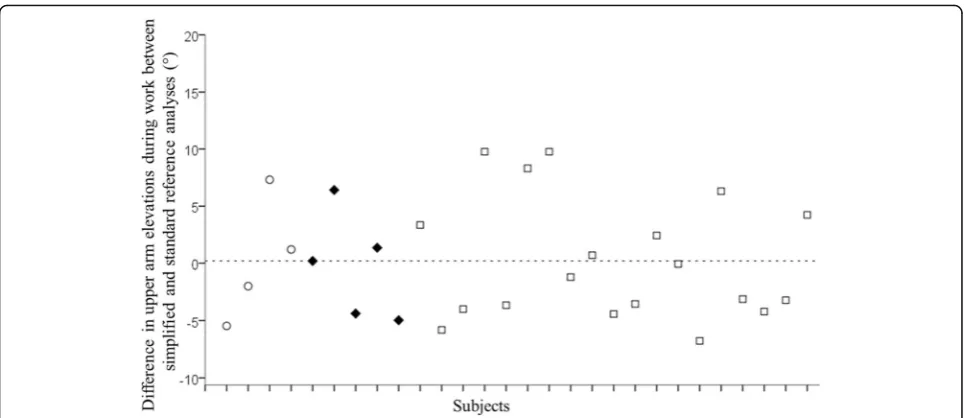
The individual differences between the simplified refer-ence analysis and the standard referrefer-ence analysis at the 50th percentile of arm elevation during work are shown in Fig.2. The group mean difference was 0.2° (range -7–10°).
The group mean of the absolute differences in the 50th percentile of arm elevation was 4° (range 0–10°; Table3), and for the percentage of time above 30° it was 9% (range 0–21%), for 60° 2% (0–11%), and for 90° 1% (0–3%).
Simplified reference posture versus standard reference posture
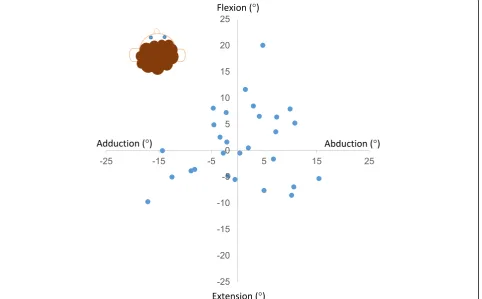
The differences (°) between the simplified reference pos-ture and the standard reference pospos-ture on days 1, 2, and 3 for each subject are shown in Fig. 3. The group mean of the differences for day 1 (day 2 for two subjects) was 9° (range 1 – 21°). The individual arm position in the simplified reference posture relative to the arm pos-ition during the standard reference posture from day 1 (day 2 for two subjects) are shown in Fig.4. They devi-ated in all directions (flexion, extension, adduction and/ or abduction) without any obvious pattern.
Within-subject variation of simplified reference posture
The within-subject variation in the simplified reference posture was poor, with an ICC of 0.2 (Table 4). The re-peatability coefficient was 16°.
The protocol
No subjects were excluded due to an incorrect place-ment of the GC inclinometer. Nevertheless, we im-proved the protocol during the study. These changes appeared to make it easier for the subjects to follow, as the help needed decreased with improved versions of the protocol. An additional change (version 4) was made after the analyses, with instructions not to replace the GC inclinometer if it falls off.
The protocol includes three parts (see Additional file1):
1) Starting the GC inclinometer.
2) Attaching the GC inclinometer to the upper arm. 3) Performing the simplified reference posture.
Comparing different types of cleaning
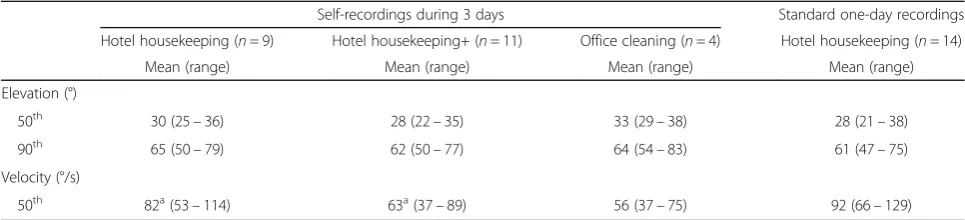
Concerning self-recordings, the median upper arm vel-ocity was higher in hotel housekeeping than in hotel
housekeeping+ (82 vs 63 °/s; Table 5). There were no
differences between self-recordings and researchers’ re-cordings of hotel housekeeping (Table5).
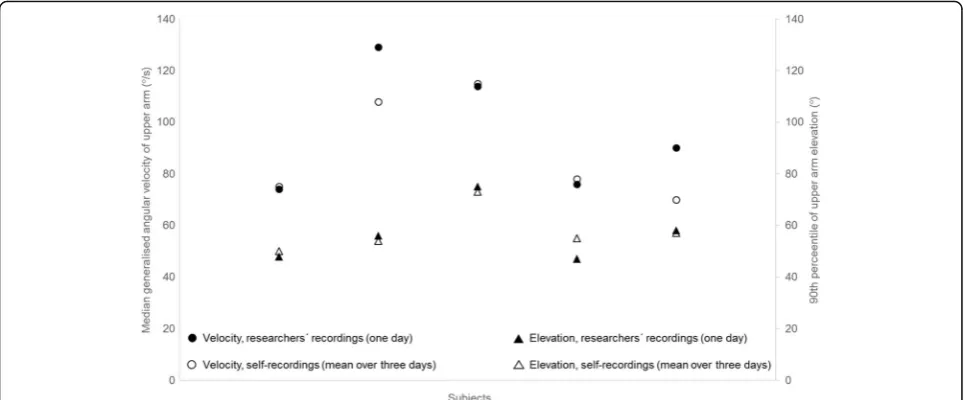
[image:6.595.57.291.512.688.2]Five individuals participated in both the researchers’ re-cordings and the self-rere-cordings. The 90th percentile of upper arm elevation and the median generalised angular vel-ocity for these individuals are shown in Figure5. For them, the group mean difference for the 90th percentile of upper arm elevation between the researchers’recording on 1 day and the self-recording on several days, using the standard reference, was 1° (range -2–8°). The group mean difference for the upper arm velocity was -7 °/s (range -21 °/s–2 °/s).
Table 2Group means of upper arm elevations during work for the simplified and the standard reference analyses
Simplified reference analysis
Standard reference analysis
Mean (range) Mean (range) p-value
Percentile (°)
1st 5 (2–8) 5 (2–10) 0.68
10th 14 (7–21) 13 (8–20) 0.98
50th 30 (20–47) 30 (22–38) 0.98
90th 64 (45–91) 64 (50–86) 0.95
99th 109 (88–132) 110 (94–134) 0.30
Percentage of time
> 30° 49 (27–78) 49 (34–63) 0.95
> 60° 13 (4–35) 12 (5–24) 0.95
> 90° 4 (1–10) 3 (1–8) 0.98
Group means (°) for the simplified reference analysis and the standard reference analysis at the 1st
, 10th
, 50th
, 90th
and 99th
Within-subject variation in workload between days
The repeatability coefficient for hotel housekeeping was 1.6° with an ICC of 0.98 for the 50th percentile
of upper arm elevation (Table 6). Corresponding
values for hotel housekeeping+ were 4.8° and 0.86, respectively. The individual variations in upper arm velocities during the different working days are shown in Fig. 6.
The subjects’perception of self-recording
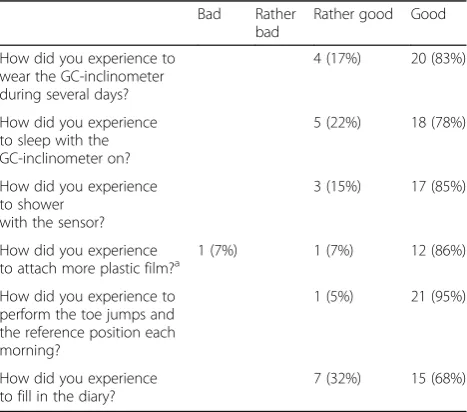
The subjects’ perceptions are reported in Table 7. One
subject answered “Bad” to one of the questions. All
other answers were positive. Additionally, 87% of the subjects stated that the GC inclinometer had not inter-fered during work or leisure time during the three-day recording, and 96% were willing to wear the GC inclin-ometer again.
Discussion
On group level, the recordings of upper arm elevation during work using the simplified reference posture were almost identical to the same recordings using the stand-ard reference posture. The subjects were able to follow
the instructions in the protocol and performed
self-recording of upper arm elevations and velocities for several days.
Simplified reference posture and standard reference posture
For recordings of arm elevations, it has been suggested that it is sufficient to attach an inclinometer with one of its axes aligned with the upper arm (humerus) without adopting a reference posture [15,32]. However, since the humerus may not be parallel to the line of gravity, for example in subjects with voluminous upper arms (strong or obese), we believe that it is important to perform a reference posture to define 0° inclination. When using the standard reference posture the arm hangs out from
the body (see Fig. 1a). Thus, this should be a minor
problem. In the simplified reference posture the arm is closer to the body (see Fig.1b). We therefore plotted the difference between the two reference postures from day
1 (Fig. 4) versus BMI. We saw no correlation, and do
not suspect a major influence of BMI.
[image:7.595.57.540.86.295.2]Fig. 2Individual difference (°) between the simplified reference analysis and the standard reference analysis from day 1 at the 50thpercentile of upper arm elevation during work for the 28 subjects. The dashed line indicates the group mean difference (0.2°). Version 1 of the self-recording protocol was used by four subjects (○), version 2 was used by five (◆) and version 3 was used by 19 subjects (□)
Table 3Group means of the absolute differences of upper arm elevations during work between the simplified and the standard reference analyses
Mean absolute difference (range)
Percentile (°)
1st 1.8 (0.0–4.4)
10th 3.8 (0.2–9.1)
50th 4.2 (0.1–9.8)
90th 4.2 (0.0–12)
99th 4.7 (0.3–18)
Percentage of time
> 30° 9.3 (0.2–21)
> 60° 2.3 (0.0–11)
> 90° 0.6 (0.1–2.9)
The group mean of the absolute differences (°; Mean absolute difference) at the 1st
, 10th
, 50th
, 90th
and 99th
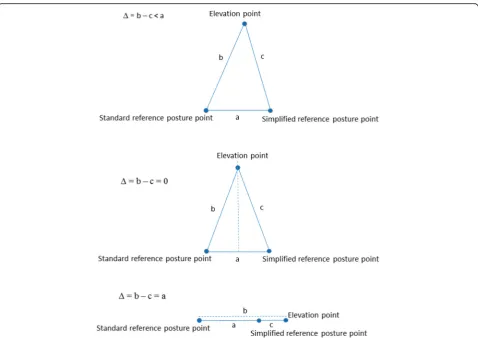
[image:7.595.57.290.537.689.2]For each individual, the difference in upper arm eleva-tion during work between the two analyses was lower than the difference between the two references, and may be explained by the triangle inequality (see Fig. 7). The distance between the two reference points can be seen as the length of one side of a triangle (a). The distance between one of the reference points and a specific
elevation point during work can then be seen as the length of a second side of the triangle (b), while the dis-tance between the other reference point and the same specific elevation point can be seen as the length of the third side of the triangle (c). Thus, as the length of one side in a triangle is less than the difference (Δ) of the lengths of the two other sides, the difference between Fig. 3Individual differences (°) between the simplified reference posture and the standard reference posture on day 1 ( ), day 2 ( ) and day 3 ( ) for all 28 subjects
[image:8.595.58.539.88.239.2] [image:8.595.59.542.402.701.2]the two reference analyses will be less than the differ-ence between the two referdiffer-ences (Δ= b – c < a). For an elevation point that is equally far from the two reference points, the triangle becomes isosceles and the difference between the two reference analyses will be zero (Δ= b– c = 0). If the elevation point is in line with the two ref-erences, the triangle becomes a line and the differ-ence between the two referdiffer-ence analyses will be the same as the difference between the two references (Δ= b – c = a). In this study, the difference during work was never more than 10°, while the difference between the two references was up to 21°. In addition, the group mean difference during work was as low as 0.2° (range -7 – 10°). We therefore consider, on group level, the simplified reference posture sufficient for recording of elevations of the upper arm, given that it is the same work tasks and a low degree of freedom in work performance for all individuals [33]. In the current group of cleaners, the simplified reference posture deviated from the stand-ard reference in a uniform pattern (i.e. in all directions, see Fig. 4). Consequently, deviations during work were balanced on group level. However, this may not be the case in other populations. A non-uniform deviation pat-tern will introduce a systematic error. Concerning upper arm velocity, the self-recording method can be used on in-dividual level, as this measure is not dependent on the reference.
Within-subject variation of simplified reference posture
In a previous study of natural head posture recorded with inclinometer, the individual overall variability (standard deviation) was 1.6° [34]. In our study, the standard deviation of the within-subject variation was 5.6° for the simplified reference posture, i.e. somewhat higher. We speculate that this difference may be because it is more difficult to repeat an arm posture (without support) than a head posture, as in the latter the sight angle serves as a reference. The repeatability coefficient for the simplified reference posture was 16°. Thus, in 95% of measurements, the absolute difference between two simplified reference measurements on one subject is not expected to exceed 16°. Therefore, a recording of upper arm elevations analysed with the simplified refer-ence posture at only one occasion should be interpreted with some caution.
The protocol and the subjects’perceptions of self-recording
The protocol was continuously improved during the study. Thereby, the problems that occurred during the study were resolved. Most importantly, if the GC inclin-ometer falls off it should not be replaced. Further, toe jumps are performed before andafter the simplified ref-erence posture. We believe that version 4 is easy to use. Still, for subjects that do not speak Swedish or English, one might consider to translate it into the language in question.
[image:9.595.56.291.110.165.2]According to the questionnaire which the subjects answered after the study, all but one of the subjects were positive to self-recordings of upper arm eleva-tions and velocities. Only one person answered “Bad” to the question“How did you experience to put on more plastic film?”Since eight subjects reported that it had not been necessary, we think this negative answer was due to language barriers, and this subject also meant that it had not been necessary.
Table 4The within-subject variation of the simplified reference posture
Simplified reference posture
Within-subject variation Repeatability coefficient ICC
SD (95% CI)
5.6 (3.7–7.5) 16 0.2
The within-subject variation (°; standard deviation (SD) and 95% confidence interval (95% CI)), the repeatability coefficient (°) and the intraclass correlation coefficient (ICC) of the simplified reference posture
Table 5Group means of upper arm elevation and velocity during different types of cleaning
Self-recordings during 3 days Standard one-day recordings
Hotel housekeeping (n= 9) Hotel housekeeping+ (n= 11) Office cleaning (n= 4) Hotel housekeeping (n= 14)
Mean (range) Mean (range) Mean (range) Mean (range)
Elevation (°)
50th 30 (25–36) 28 (22–35) 33 (29–38) 28 (21–38)
90th 65 (50–79) 62 (50–77) 64 (54–83) 61 (47–75)
Velocity (°/s)
50th 82a(53–114) 63a(37–89) 56 (37–75) 92 (66–129)
Group means at the 50thand 90thpercentiles of upper arm elevation (°) and the median generalised upper arm angular velocity (°/s) during different types of cleaning when using the standard reference posture as reference. (Data from the four men are excluded). The generalised angular velocity is not dependent on the reference posture. Hotel housekeeping = cleaning hotel rooms, hotel housekeeping+ = cleaning hotel rooms and other tasks such as cleaning corridors. The standard recordings were performed by researchers. Differences calculated by Kruskal-Wallis analysis of variance. Post hoc analysis with Mann-Whitney U-test
[image:9.595.56.539.579.689.2]Risk of musculoskeletal disorders among cleaning staff Our research group has performed technical measure-ments of upper arm elevations and velocities for about thirty years in about sixty different occupations. Most of these occupational groups have also been clinically examined using the standardised Health Sur-veillance in Adverse Ergonomics Conditions (HECO)
method [35, 36] which quantifies the prevalence of
WMSDs and diagnoses of the neck and upper ex-tremities. Exposure-response relationships were ob-tained by compiling the data from the technical measurements and the clinical examinations, and we found strong associations between upper arm velocity
and several diagnoses [2]. Based on this knowledge,
we have recently proposed action levels for the pre-vention of WMSDs. The proposed action level for the
median generalised angular velocity is 60 °/s [37].
This is well in line with the findings in a recent study
by Dalbøge et al., where it was indicated that a me-dian generalised angular velocity of the upper arm below 45 °/s was safe [38]. Based on previous studies [2,
39–42], we have proposed an action level of 60° for the
90th percentile of upper arm elevation. The action
level for elevation was exceeded in office cleaning, while the action levels for both elevation and angular velocity were exceeded in hotel housekeeping (both self-recordings and researchers’ recordings) and hotel housekeeping+, indicating the need for preventive ac-tions. Hence, it was highly relevant to test the self-recording method among cleaners.
Within-subject variation of workload between working days
[image:10.595.57.541.88.288.2]The within-subject variation in upper arm elevation and velocity between working days in hotel housekeeping was low. This indicates that the work is monotonous and repetitive. The between days variation differed Fig. 5Upper arm elevation and the median generalised angularvelocity of the upper arm for the five subjects who participated in both the self-recordings and the researchers’recordings.△= upper arm elevation obtained with self-recording (using the standard reference posture).○= the median generalized upper arm velocity obtained with self-recording.▲= upper arm elevation obtained by the researchers’recordings.●= the median generalised upper arm velocity obtained by the researchers’recordings
Table 6The group means and the within-subject variations of upper arm elevation and velocity between working days
Hotel housekeeping (n= 11) Hotel housekeeping+ (n= 11)
Percentile Group mean (° or °/s)
Within-subject variation SD (95% CI)
Repeatability coefficient (° or °/s)
ICC Group mean (° or °/s)
Within-subject variation SD (95% CI)
Repeatability coefficient (° or °/s)
ICC
50th(°) 29 0.6 (0.3
–0.9) 1.6 0.98 28 1.7 (0.9–2.5) 4.8 0.86
90th(°) 64 1.5 (0.8
–2.2) 4.1 0.97 62 4.4 (2.3–6.4) 12 0.80
Vel. (°/s) 81 4.7 (2.5–6.9) 13 0.93 63 12 (6.4–18) 33 0.66
[image:10.595.57.538.621.696.2]between hotel housekeeping + and hotel housekeeping, and one explanation could be that there were additional and more varied work tasks in hotel housekeeping+, such as for example cleaning corridors, conference rooms and pool areas.
Methodological considerations
To the best of our knowledge, this is the first time self-recordings have been made of upper arm elevation and velocity. This required a protocol explaining how to perform the self-recording. A strength of the study was that the protocol was tested and improved in an occupa-tion with a high proporoccupa-tion of immigrants. Even if the
subjects spoke poor Swedish and English, they were able to perform self-recordings. This indicates that the proto-col is easy to follow and may be used by most em-ployees. A weakness is that we did not improve the protocol systematically and did not evaluate the different steps of improvements in a systematic manner. Instead, we made changes in the protocol based on how comfort-able and secure the subjects appeared to be when they attached the GC inclinometer and performed the simpli-fied reference posture. On a visual inspection of Fig. 2
we did not see any improvement concerning the individ-ual differences between the two analyses. Thus, we do not think that different versions of the protocol im-pacted on our data.
Considering recordings of upper arm elevation, we judge a difference of 5° to be clinically relevant. Prior to the study we did not know the distribution of the differ-ences between the analyses with the two different refer-ence postures. As this was about 5° for both the 50th and the 90th percentiles we would have needed 11 sub-jects to be able to detect a 5° difference between the two analyses with an 80% power. As 28 cleaners were in-cluded, we could detect a difference of 3°.
Conclusions
[image:11.595.59.540.87.244.2]The small difference between the simplified reference analysis and the standard reference analysis indicates that recordings performed by employees themselves are comparable, on group level, with those performed by researchers. The subjects in this study were able to perform self-recording of upper arm elevations and velocities using the protocol provided. The simplified reference posture is sufficient on group level, with the assumption that it is the same work tasks and a high similarity in work performance for all individuals. The self-recording method can be used at an individual level Fig. 6The median generalised angular velocity of the upper arm during work for the 28 subjects for day 1 ( ), day 2 ( ) and day 3 ( ). The dashed line is the suggested action level for ergonomic workload
Table 7Questionnaire responses after the self-recording Bad Rather
bad
Rather good Good
How did you experience to wear the GC-inclinometer during several days?
4 (17%) 20 (83%)
How did you experience to sleep with the GC-inclinometer on?
5 (22%) 18 (78%)
How did you experience to shower
with the sensor?
3 (15%) 17 (85%)
How did you experience
to attach more plastic film?a 1 (7%) 1 (7%) 12 (86%)
How did you experience to perform the toe jumps and the reference position each morning?
1 (5%) 21 (95%)
How did you experience to fill in the diary?
7 (32%) 15 (68%)
Distribution of questionnaire responses from 24 subjects after self-recording of upper arm elevation and velocity during 3 days. The response rate (proportion within brackets) are given for the different options
a
[image:11.595.57.291.492.698.2]for recording of upper arm velocity. Self-recording could increase the use of technical methods when performing risk assessments and, in combination with action levels for the prevention of WMSDs, increase the accuracy of risk assessments. In addition, self-recording in combin-ation with action levels would provide employers with a method of assessing the risk of developing WMSDs among employees, which would be an important im-provement of prevention. Hotel cleaning implies a high risk of musculoskeletal disorders due to a high upper arm velocity.
Additional files
Additional file 1:The protocol (version 4)“Instructions for self-recording of upper arm elevation and velocity”. (DOCX 1071 kb)
Additional file 2:Datasets of upper arm elevation using simplified and standard reference postures. (XLSX 26 kb)
Abbreviations
GC inclinometer:Gulf Coast triaxial accelerometer X16-mini; WMSDs: Work-related musculoskeletal disorders
Acknowledgements
The authors wish to thank all the subjects, the hotels, and cleaning companies participating in the study.
Funding
The current study was supported by AFA Insurance (No. 150181). AFA Insurance had no role in the design of the study, collection, analysis, interpretation of data, and in writing the manuscript.
Availability of data and materials
The datasets used to calculate the group means of upper arm elevation and within-subject variations are included as a supplementary information file, see Additional file2.
Authors’contributions
[image:12.595.59.538.85.423.2]responsible for the interpretation of the results. CD, CN, MF and HE have contributed to, read, and approved the final manuscript.
Ethics approval and consent to participate
The study was approved by the Regional Ethics Committee in Lund (No. 2015/416). All subjects gave their written informed consent.
Consent for publication
The subject in Fig.1gave her written informed consent for publication.
Competing interests
The authors declare that they have no competing interests.
Publisher’s Note
Springer Nature remains neutral with regard to jurisdictional claims in published maps and institutional affiliations.
Author details 1
Division of Occupational and Environmental Medicine, Department of Laboratory Medicine, Lund University, SE-221 85 Lund, Sweden.2Division of Ergonomics, KTH Royal Institute of Technology, SE-141 57 Huddinge, Sweden.
Received: 7 May 2018 Accepted: 29 October 2018
References
1. da Costa BR, Vieira ER. Risk factors for work-related musculoskeletal disorders: a systematic review of recent longitudinal studies. Am J Ind Med. 2010;53:285–323.
2. Nordander C, Hansson G-Å, Ohlsson K, Arvidsson I, Balogh I, Strömberg U, Rittner R, Skerfving S. Exposure–response relationships for work-related neck and shoulder musculoskeletal disorders–analyses of pooled uniform data sets. Appl Ergon. 2016;55:70–84.
3. Nordander C, Ohlsson K, Åkesson I, Arvidsson I, Balogh I, Hansson G-Å, Strömberg U, Rittner R, Skerfving S. Exposure–response relationships in work-related musculoskeletal disorders in elbows and hands–a synthesis of group-level data on exposure and response obtained using uniform methods of data collection. Appl Ergon. 2013;44:241–53.
4. van Rijn RM, Huisstede BM, Koes BW, Burdorf A. Associations between work-related factors and the carpal tunnel syndrome--a systematic review. Scand J Work Environ Health. 2009;35:19–36.
5. Phillips K, Bills J, Gare J. Developing modified equipment and work practices to reduce the risk of work-related musculoskeletal disorders from conservation treatment. AICCM Bulletin. 2016;37:42–8.
6. Spielholz P, Silverstein B, Morgan M, Checkoway H, Kaufman J. Comparison of self-report, video observation and direct measurement methods for upper extremity musculoskeletal disorder physical risk factors. Ergonomics. 2001;44:588–613.
7. Li G, Buckle P. Current techniques for assessing physical exposure to work-related musculoskeletal risks, with emphasis on posture-based methods. Ergonomics. 1999;42:674–95.
8. Hansson GA, Balogh I, Bystrom JU, Ohlsson K, Nordander C, Asterland P, Sjolander S, Rylander L, Winkel J, Skerfving S. Questionnaire versus direct technical measurements in assessing postures and movements of the head, upper back, arms and hands. Scand J Work Environ Health. 2001;27:30–40. 9. Eliasson K, Palm P, Nyman T, Forsman M. Inter- and intra- observer reliability
of risk assessment of repetitive work without an explicit method. Appl Ergon. 2017;62:1–8.
10. Chiasson M-È, Imbeau D, Aubry K, Delisle A. Comparing the results of eight methods used to evaluate risk factors associated with musculoskeletal disorders. Int J Ind Ergon. 2012;42:478–88.
11. Takala EP, Pehkonen I, Forsman M, Hansson GA, Mathiassen SE, Neumann WP, Sjogaard G, Veiersted KB, Westgaard RH, Winkel J. Systematic evaluation of observational methods assessing biomechanical exposures at work. Scand J Work Environ Health. 2010;36:3–24.
12. Hansson G-Å, Balogh I, Ohlsson K, Granqvist L, Nordander C, Arvidsson I, Åkesson I, Unge J, Rittner R, Strömberg U, Skerfving S. Physical workload in various types of work: part II. Neck, shoulder and upper arm. Int J Ind Ergon. 2010;40:267–81.
13. David GC. Ergonomic methods for assessing exposure to risk factors for work-related musculoskeletal disorders. Occup Med. 2005;55:190–9. 14. Dahlqvist C, Hansson G-Å, Forsman M. Validity of a small low-cost triaxial
accelerometer with integrated logger for uncomplicated measurements of postures and movements of head, upper back and upper arms. Appl Ergon. 2016;55:108–16.
15. Korshøj M, Skotte JH, Christiansen CS, Mortensen P, Kristiansen J, Hanisch C, Ingebrigtsen J, Holtermann A. Validity of the Acti4 software using ActiGraph GT3X+accelerometer for recording of arm and upper body inclination in simulated work tasks. Ergonomics. 2014;57:247–53.
16. Villumsen M, Madeleine P, Jørgensen MB, Holtermann A, Samani A. The variability of the trunk forward bending in standing activities during work vs. leisure time. Appl Ergon. 2017;58:273–80.
17. Åkesson I, Balogh I, Hansson GÅ. Physical workload in neck, shoulders and wrists/hands in dental hygienists during a work-day. Appl Ergon. 2012;43: 803–11.
18. Arvidsson I, Balogh I, Hansson G-Å, Ohlsson K, Åkesson I, Nordander C. Rationalization in meat cutting–consequences on physical workload. Appl Ergon. 2012;43:1026–32.
19. Balogh I, Ohlsson K, Nordander C, Bjork J, Hansson GA. The importance of work organization on workload and musculoskeletal health--grocery store work as a model. Appl Ergon. 2016;53(Pt A):143–51.
20. Jørgensen MB, Korshøj M, Lagersted-Olsen J, Villumsen M, Mortensen OS, Skotte J, Søgaard K, Madeleine P, Thomsen BL, Holtermann A. Physical activities at work and risk of musculoskeletal pain and its consequences: protocol for a study with objective field measures among blue-collar workers. BMC Musculoskelet Disord. 2013;14:213.
21. Hansson GA, Arvidsson I, Ohlsson K, Nordander C, Mathiassen SE, Skerfving S, Balogh I. Precision of measurements of physical workload during standardised manual handling. Part II: Inclinometry of head, upper back, neck and upper arms. J Electromyogr Kinesiol. 2006;16:125–36. 22. Simonsen JG, Dahlqvist C, Enquist H, Nordander C, Axmon A, Arvidsson I.
Assessments of physical workload in sonography tasks using Inclinometry, goniometry, and Electromyography. Saf Health Work. 2018;9:326–33. 23. Heilskov-Hansen T, Wulff Svendsen S, Frølund Thomsen J, Mikkelsen S,
Hansson G-Å. Sex differences in task distribution and task exposures among Danish house painters: an observational study combining questionnaire data with biomechanical measurements. PLoS One. 2014;9:1–10. 24. Buchanan S, Vossenas P, Krause N, Moriarty J, Frumin E, Shimek JAM, Mirer
F, Orris P, Punnett L. Occupational injury disparities in the US hotel industry. Am J Ind Med. 2010;53:116–25.
25. Unge J, Ohlsson K, Nordander C, Hansson GA, Skerfving S, Balogh I. Differences in physical workload, psychosocial factors and musculoskeletal disorders between two groups of female hospital cleaners with two diverse organizational models. Int Arch Occup Environ Health. 2007;81:209–20. 26. Hansson GÅ, Balogh I, Ohlsson K, Rylander L, Skerfving S. Goniometer
measurement and computer analysis of wrist angles and movements applied to occupational repetitive work. J Electromyogr Kinesiol. 1996;6: 23–35.
27. Thörnquist A. East-West Labour Migration and the Swedish Cleaning Industry : A matter of immigrant competition? In: ThemES - Themes on Migration and Ethnic Studies. Linköping: Linköping University Electronic Press; 2015. p. 43.
28. Messing K, Punnett L, Bond M, Alexanderson K, Pyle J, Zahm S, Wegman D, Stock SR, de Grosbois S. Be the fairest of them all: challenges and recommendations for the treatment of gender in occupational health research. Am J Ind Med. 2003;43:618–29.
29. McGraw KO, Wong SP. Forming inferences about some intraclass correlation coefficients. Psychol Methods. 1996;1:30–46.
30. Martin Bland J, Altman D. Statistical methods for assessing agreement between two methods of clinical measurement. Lancet. 1986;327:307–10. 31. Koo TK, Li MY. A guideline of selecting and reporting Intraclass correlation
coefficients for reliability research. J Chiropr Med. 2016;15:155–63. 32. Hallman DM, Jørgensen MB, Holtermann A. Objectively measured physical
activity and 12-month trajectories of neck–shoulder pain in workers: a prospective study in DPHACTO. Scand J Public Health. 2017;45:288–98. 33. Balogh I, Hansson G-Å, Ohlsson K, Strömberg U, Skerfving S. Interindividual
variation of physical load in a work task. Scand J Work Environ Health. 1999; 25:57–66.
35. Jonker D, Gustafsson E, Rolander B, Arvidsson I, Nordander C. Health surveillance under adverse ergonomics conditions–validity of a screening method adapted for the occupational health service. Ergonomics. 2015;58:1519–28.
36. Nordander C, Ohlsson K, Akesson I, Arvidsson I, Balogh I, Hansson GA, Stromberg U, Rittner R, Skerfving S. Risk of musculoskeletal disorders among females and males in repetitive/constrained work. Ergonomics. 2009;52: 1226–39.
37. Arvidsson I, Dahlqvist C, Enquist H, Nordander C. Action levels for prevention of work related musculoskeletal disorders. Lund: Occupational and Environmental Medicine; 2017.http://sodrasjukvardsregionen.se/ download/rapport-182017-atgardsnivaer-mot-belastningsskada 38. Dalbøge A, Frost P, Andersen JH, Svendsen SW. Surgery for subacromial
impingement syndrome in relation to intensities of occupational mechanical exposures across 10-year exposure time windows. Occup Environ Med. 2017.
39. Svendsen SW, Bonde JP, Mathiassen SE, Stengaard-Pedersen K, Frich LH. Work related shoulder disorders: quantitative exposure-response relations with reference to arm posture. Occup Environ Med. 2004;61:844–53. 40. Bodin J, Ha C, Petit Le Manac’h A, Sérazin C, Descatha A, Leclerc A,
Goldberg M, Roquelaure Y. Risk factors for incidence of rotator cuff syndrome in a large working population. Scand J Work Environ Health. 2012;38:436–46.
41. Dalbøge A, Frost P, Andersen JH, Svendsen SW. Cumulative occupational shoulder exposures and surgery for subacromial impingement syndrome: a nationwide Danish cohort study. Occup Environ Med. 2014;71:750–6. 42. Mayer J, Kraus T, Ochsmann E. Longitudinal evidence for the association