R E S E A R C H
Open Access
On strong KKT type sufficient optimality
conditions for multiobjective semi-infinite
programming problems with vanishing
constraints
Sy-Ming Guu
1,2*, Yadvendra Singh
3and Shashi Kant Mishra
3*Correspondence:
1Graduate Institute of Business and
Management, College of Management, Chang Gung University, Kwei-Shan District, Taoyuan City, Taiwan, ROC
2Department of Neurology, LinKou
Chang Gung Memorial Hospital, Kwei-Shan District, Taoyuan City, Taiwan, ROC
Full list of author information is available at the end of the article
Abstract
In this paper, we consider a nonsmooth multiobjective semi-infinite programming problem with vanishing constraints (MOSIPVC). We introduce stationary conditions for the MOSIPVCs and establish the strong Karush-Kuhn-Tucker type sufficient optimality conditions for the MOSIPVC under generalized convexity assumptions.
MSC: 90C34; 49J52
Keywords: semi-infinite programming; mathematical programs with vanishing constraints; optimality conditions; generalized convexity
1 Introduction
Multiobjective semi-infinite programming problems (MOSIPs) arise when more than one objective function is to be optimized over the feasible region described by an infinite num-ber of constraints. If there is only one objective function in a MOSIP, then it is known as semi-infinite programming problem (SIP). SIPs have played an important role in several areas of modern research, such as transportation theory [], engineering design [], robot trajectory planning [] and control of air pollution []. We refer to the books [, ] for more details as regards SIPs and their applications and to some recent papers [–] for details as regards MOSIPs.
Achtziger and Kanzow [] introduced the mathematical programs with vanishing con-straints (MPVCs) and showed that many problems from structural topology optimization can be reformulated as MPVCs. Hoheisel and Kanzow [] defined stationary concepts for MPVCs and derived first order sufficient and second order necessary and sufficient opti-mality conditions for MPVCs. Hoheisel and Kanzow [] established optiopti-mality conditions for weak constraint qualification. Mishraet al.[] obtained various constraint qualifica-tions and established Karush-Kuhn-Tucker (KKT) type necessary optimality condiqualifica-tions for multiobjective MPVCs. We refer to [–] and references therein for more details as regards MPVCs.
Recently, the idea of a strong KKT has been used to avoid the case where some of the Lagrange multipliers associated with the components of multiobjective functions vanish.
Golestani and Nobakhtian [] derived the strong KKT optimality conditions for non-smooth multiobjective optimization. Kanzi [] established strong KKT optimality con-ditions for MOSIPs. Pandey and Mishra [] established the strong KKT type sufficient conditions for nonsmooth MOSIPs with equilibrium constraints.
Motivated by Achtziger and Kanzow [], Golestani and Nobakhtian [] and Pandey and Mishra [], we extend the concept of the strong KKT optimality conditions for the MOSIPs with vanishing constraints (MOSIPVCs) that do not involve any constraint qual-ification. The paper is organized as follows. In Section , we present some known defini-tions and results which will be used in the sequel. In Section , we define stationary points and establish strong KKT type optimality for MOSIPVC. In Section , we conclude the results of the paper.
2 Definitions and preliminaries
In this paper, we consider the following MOSIPVC:
MOSIPVC minf(x) :=f(x),f(x), . . . ,fm(x)
,
subject to gt(x)≤, t∈T,
Hi(x)≥, i= , . . . ,l,
Gi(x)Hi(x)≤, i= , . . . ,l,
wherefi:Rn→R,gt:Rn→R∪ {+∞},Gi:Rn→R,Hi:Rn→Rare given locally Lips-chitz functions and the index setTis arbitrary (possibly infinite). LetM:={x∈Rn:g
t(x)≤ ,t∈T,Hi(x)≥,Gi(x)Hi(x)≤,i= , . . . ,l}, denote the feasible set of the MOSIPVC. A pointx¯∈Mis said to be a weakly efficient solution for the MOSIPVC if there exists no
x∈Msuch that
fi(x) <fi(x¯), ∀i= , , . . . ,m.
Letx¯∈M. The following index sets will be used in the sequel.
T(x¯) :=t∈T:gt(x¯) =
,
I+(x¯) :=
i∈ {, . . . ,l}:Hi(x¯) >
,
I(x¯) :=
i∈ {, . . . ,l}:Hi(x¯) = .
Furthermore, the index setI+(x¯) can be divided as follows:
I+(x¯) :=
i∈ {, . . . ,l}:Hi(x¯) > ,Gi(x) = ,
I+–(x¯) :=
i∈ {, . . . ,l}:Hi(x¯) > ,Gi(x) < .
Similarly, the index setI(x¯) can be partitioned as follows:
I+(x¯) :=
i∈ {, . . . ,l}:Hi(x¯) = ,Gi(x¯) > ,
I(x¯) :=
i∈ {, . . . ,l}:Hi(x¯) = ,Gi(x¯) =
,
I–(x¯) :=
i∈ {, . . . ,l}:Hi(x¯) = ,Gi(x¯) <
The Clarke directional derivative of a locally Lipschitz functionf :Rn→Raroundx¯ in the directionv∈Rnand the Clarke subdifferential off atx¯are, respectively, given by
f(x¯;v) :=lim x→¯xsupt↓
f(x+tv) –f(x)
t ,
∂cf(x¯) :=
ξ∈Rn:f(x¯;v)≥ ξ,v,∀v∈Rn.
We recall the following results from [].
Theorem . Let f and g be locally Lipschitz fromRntoRaroundx¯.Then the following
properties hold:
. f(x¯;v) =max{ξ,v:ξ∈∂
cf(x¯),∀v∈Rn},
. ∂c(λf)(x¯) =λ∂cf(x¯),∀λ∈R,
. ∂c(f +g)(x¯)⊆∂cf(x¯) +∂cg(x¯).
The following definitions and lemma from Kanzi and Nobakhtian [] will be used in the sequel.
Definition . Letf :Rn→Rbe a locally Lipschitz function aroundx¯. Then
. f is said to be generalized convex atx¯if, for eachx∈Rnand anyξ∈∂ cf(x¯),
f(x) –f(x¯)≥ ξ,x–x¯,
. f is said to be strictly generalized convex atx¯if, for eachx∈Rn,x=x¯and any ξ∈∂cf(x¯),
f(x) –f(x¯) >ξ,x–x¯,
. f is said to be generalized quasiconvex atx¯if, for eachx∈Rnand anyξ∈∂cf(x¯),
f(x)≤f(x¯) ⇒ ξ,x–x¯ ≤,
. f is said to be strictly generalized quasiconvex atx¯if, for eachx∈Rnand any
ξ∈∂cf(x¯),
f(x)≤f(x¯) ⇒ ξ,x–x¯< .
Lemma . Let fbe strictly generalized convex and f,f, . . . ,fsbe generalized convex
func-tion at x.Ifλ> andλl≥for l= , . . . ,s,thensl=λlflis strictly generalized convex at x.
3 Strong KKT type sufficient optimality conditions
We extend Definitions . and . of Hoheisel and Kanzow [] to the case of the MOSIPVC.
Definition . (MOSIPVC S-stationary point) A feasible pointx¯ of the MOSIPVC is
i = , . . . ,m, and μt ≥, t∈T(x¯), with μt = for at most finitely many indices and ηHi ,ηiG∈R,i= , . . . ,lsuch that the following conditions hold:
∈ m
i=
λi∂cfi(x¯) +
t∈T(x¯)
μt∂cgt(x¯) – l
i=
ηHi ∂cHi(x¯) + l
i=
ηGi ∂cGi(x¯),
ηHi = , i∈I+(x¯), ηiH≥, i∈I–(x¯)∪I(x¯), ηiH∈R, i∈I+(x¯),
ηiG= , i∈I+–(x¯)∪I(x¯)∪I+(x¯), ηiG≥, i∈I+(x¯).
Definition . (MOSIPVC M-stationary point) A feasible pointx¯ of the MOSIPVC is
called a MOSIPVC Mordukhovich (M-)stationary point if there exist Lagrange multipliers λi> ,i= , . . . ,m, andμt≥,t∈T(x¯), withμt= for at most finitely many indices and
ηHi ,ηGi ∈R,i= , . . . ,l, such that the following conditions hold:
∈ m
i=
λi∂cfi(x¯) +
t∈T(x¯)
μt∂cgt(x¯) – l
i=
ηHi ∂cHi(x¯) + l
i=
ηGi ∂cGi(x¯),
ηiH= , i∈I+(x¯), ηiH≥, i∈I–(x¯), ηHi ∈R, i∈I+(x¯),
ηGi = , i∈I+–(x¯)∪I–(x¯)∪I+(x¯), ηGi ≥, i∈I+(x¯)∪I(x¯),
ηGi ·ηHi = , i∈I(x¯).
Remark . The difference between MOSIPVC M-stationary points and MOSIPVC
S-stationary points occurs only for the index setI. For MOSIPVC M-stationary points, ηGi ≥ andηHi ·ηiG= fori∈I, whereas for MOSIPVC S-stationary points,ηHi ≥ and
ηGi = fori∈I.
In the following theorem, we establish the strong KKT type sufficient optimality result for the MOSIPVC under generalized convexity assumptions.
Theorem . Letx be a MOSIPVC M-stationary point¯ .Suppose that fi, i= , . . . ,m,gt,
t∈T(x¯), –Hi,Gi,i= , . . . ,l,are generalized convex atx on M and at least one of them is¯
strictly generalized convex atx on M¯ .Thenx is a weakly efficient solution for the MOSIPVC¯ .
Proof Sincex¯is a MOSIPVC M-stationary point, there existξ¯if∈∂cfi(x¯),i= , . . . ,m,ξ¯tg∈ ∂cgt(x¯),t∈T(x¯), andξ¯iH∈∂cHi(x¯),ξ¯iG∈∂cGi(x¯),i= , . . . ,l, such that
m
i=
λiξ¯if+ t∈T(x¯)
μtξ¯tg– l
i=
ηHi ξ¯iH+ l
i=
ηGiξ¯iG= . (.)
Suppose on the contrary thatx¯is not a weakly efficient solution for the MOSIPVC, that is, there existsx˜∈M, such that
From the MOSIPVC M-stationary point, we haveλi> fori= , . . . ,m. Thus, we get
m
i=
λifi(x˜) < m
i=
λifi(x¯). (.)
Sincex¯is a MOSIPVC M-stationary point andx˜is a feasible point of the MOSIPVC, we have
gt(x˜) < , μt≥, t∈T(x¯),
–Hi(x˜) < , ηHi ≥, i∈I–(x¯)∪I+(x¯),
–Hi(x˜) = , ηH∈R, i∈I+(x¯),
Gi(x˜) > , ηG= , i∈I+–(x¯)∪I–(x¯)∪I+(x¯),
Gi(x˜)≤, ηG> , i∈I(x¯)∪I+(x¯),
which implies that
t∈T(x¯)
μtgt(x˜) – l
i=
ηiHHi(x˜) + l
i=
ηGiGi(x˜)
≤
t∈T(x¯)
μtgt(x¯) – l
i=
ηHi Hi(x¯) + l
i=
ηiGGi(x¯). (.)
From (.) and (.), we have
m
i=
λifi(x˜) +
t∈T(x¯)
μtgt(x˜) – l
i=
ηiHHi(x˜) + l
i=
ηGiGi(x˜)
< m
i=
λifi(x¯) + t∈T(x¯)
μtgt(x¯) – l
i=
ηHi Hi(x¯) + l
i=
ηiGGi(x¯). (.)
It follows from Lemma . thatmi=λifi(x) +
t∈T(¯x)μtgt(x) –
l
i=ηHi Hi(x) +
l
i=ηiGGi(x) is a strictly generalized convex function atx¯onM. Hence,
= m
i= λiξ¯if +
t∈T(x¯) μtξ¯tg–
l
i= ηiHξ¯iH
+ l
i=
ηGiξ¯iG∈∂c
m
i=
λifi(x¯) +
t∈T(x¯)
μtgt(x¯) – l
i=
ηHi Hi(x¯) + l
i=
ηGi Gi(x¯) . (.)
Therefore, from (.), (.) and (.), we obtain
>
m
i= λiξ¯if+
t∈T(¯x) μtξ¯tg–
l
i=
ηHi ξ¯iH+ l
i=
ηGi ξ¯iG,x˜–x¯
=,x˜–x¯.
The following result is a direct consequence of Theorem ., where the MOSIPVC M-stationary point is replaced by a MOSIPVC S-M-stationary point.
Corollary . Let x be a MOSIPVC S-stationary point¯ .Suppose that fi,i= , . . . ,m, gt,
t∈T(x¯), –Hi,Gi,i= , . . . ,l,are generalized convex atx on M and at least one of them is¯ strictly generalized convex atx on M¯ .Thenx is a weakly efficient solution for the MOSIPVC¯ .
The strong KKT type sufficient condition for the MOSIPVC given in Theorem . can be obtained under further relaxations on generalized convexity requirements.
Theorem . Letx be a MOSIPVC M-stationary point¯ .Suppose that fi,i= , . . . ,m,gt,
t∈T(x¯), –Hi, Gi,i= , . . . ,l,are generalized quasiconvex atx on M and at least one of¯
them is strictly generalized quasiconvex atx on M¯ .Thenx is a weakly efficient solution for¯ the MOSIPVC.
The following example satisfies the assumptions of Theorem ..
Example . Consider the following problem inR:
min f(x) =x
,|x|+|x|
, s. t. gt(x) = –tx≤, t∈N,
H(x) =x≥,
H(x)G(x) =x
|x|+x
≤.
(.)
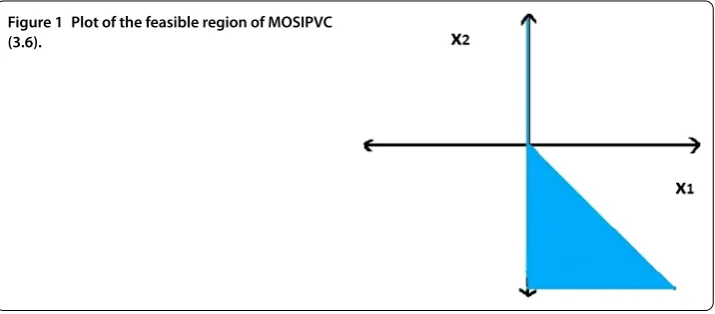
Note thatf(x) =|x|,f(x) =|x|+|x|and the feasible region of the MOSIPVC (.) is given by
M=(x,x)∈R: –tx≤,t∈N,x≥,x
|x|+x
≤,
which is represented by the shaded region in Figure .
[image:6.595.120.478.578.735.2]It is easy to see thatx¯= (, ) is a feasible point of the problem,T(x¯) =NandI(x¯) ={}. The feasible pointx¯is a MOSIPVC M-stationary point withλ> ,λ= ,μ= ,μ=, μ=μ=· · ·= ,ηH= –, ηG= ,ξf= (, )∈∂cf(x¯) ={(, )},ξf = (, )∈∂cf(x¯) = [–, ]×[–, ],ξgt= (–t, )∈∂cgt(x¯) ={(–t, )},ξH= (, )∈∂cH(x¯) ={(, )}andξG= (, )∈∂cG(x¯) = [–, ]× {}.
The strong KKT type sufficient optimality condition for the MOSIPVC can also be ob-tained in the following way.
Theorem . Letx be a MOSIPVC M-stationary point¯ .Suppose that each fi,i= , . . . ,m,
is generalized convex atx on M and¯ t∈T(x¯)μtgt(x) –
l
i=ηHi Hi(x) +
l
i=ηGiGi(x)is
gen-eralized convex atx on M¯ .Thenx is a weakly efficient solution for the MOSIPVC¯ .
ProofSuppose on the contrary thatx¯is not a weakly efficient solution for the MOSIPVC,
that is, there exists a feasible pointx˜such that
fi(x˜) <fi(x¯), ∀i= , . . . ,m.
By strictly generalized convexity offi, we have
ξif,x˜–x¯< , ∀ξif∈∂cfi(x¯),i= , . . . ,m. (.) From the M-stationary condition, we haveλi> ,i= , . . . ,m. Thus, we get
m
i=
λiξif,x˜–x¯
< . (.)
Sincex¯is a MOSIPVC M-stationary point, from (.) and (.), we have
t∈T(x¯) μtξ¯tg–
l
i=
ηHi ξ¯iH+ l
i=
ηGiξ¯iG,x˜–x¯
> . (.)
From (.), we have
t∈T(x¯)
μtgt(x˜) – l
i=
ηiHHi(x˜) + l
i=
ηGiGi(x˜)
≤
t∈T(x¯)
μtgt(x¯) – l
i=
ηHi Hi(x¯) + l
i=
ηiGGi(x¯). (.)
From the generalized convexity oft∈T(x¯)μtgt(x) –
l
i=ηHi Hi(x) +
l
i=ηGiGi(x), atx¯on
M, we get
t∈T(x¯) μtξ¯tg–
l
i=
ηHi ξ¯iH+ l
i=
ηGiξ¯iG,x˜–x¯
≤, (.)
which contradicts (.). Hence,x¯is a weakly efficient solution of the MOSIPVC and the proof is complete.
The following result is a direct consequence of Theorem ., where the MOSIPVC M-stationary point is replaced by a MOSIPVC S-M-stationary point.
Corollary . Letx be a MOSIPVC S-stationary point¯ .Suppose that each fi,i= , . . . ,m is generalized convex andt∈T(¯x)μtgt(x) –
l
i=ηHi Hi(x) +
l
i=ηGi Gi(x)is generalized convex
Figure 2 Plot of the feasible region of MOSIPVC (3.12).
The following example satisfies the assumptions of Theorem ..
Example . Consider the following problem inR:
min f(x) =|x|,|x|
, s.t. gt(x) = –tx≤, t∈N,
H(x) =x+x≥,
G(x)H(x) =|x|
x +x
≤.
(.)
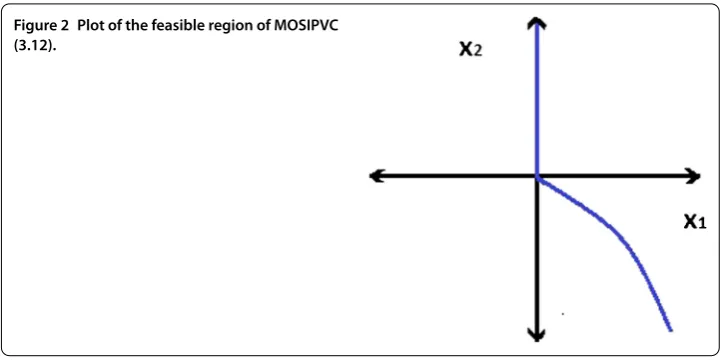
Note thatf(x) =|x|,f(x) =|x|and the feasible region of the MOSIPVC (.) is given by
M=(x,x)∈R: –tx≤,t∈N,x+x≥,|x|
x+x
≤,
which is represented by the shaded region in Figure .
It is easy to see thatx¯= (, ) is a feasible point of the problem,T(x¯) =NandI(x¯) ={}. The feasible pointx¯ is a MOSIPVC M-stationary point withλ> ,λ= ,μ= ,μ= μ=· · ·= ,ηH = –,ηG= ,ξf= (, )∈∂cf(x¯) = [–, ]× {},ξf = (, –)∈∂cf(x¯) =
{} ×[–, ],ξgt= (, )∈∂cgt(x¯) ={(, )},ξH= (, )∈∂cH(x¯) ={(, )}andξG= (, )∈ ∂cG(x¯) = [–, ]× {}. Also,μg(x) +μg(x) +· · ·–ηHH(x) +ηGG(x) = –x+x+x– .
|x|=xis generalized convex atx¯onM.
4 Results and discussion
In this paper, we consider a MOSIPVC. We introduce stationary conditions for the MOSIPVC and establish the strong KKT type sufficient optimality conditions for the MOSIPVC under generalized convexity assumptions. We extend the concept of the strong KKT optimality conditions for the MOSIPVC that do not involve any constraint qualifica-tion. Furthermore, the results of this paper may be extended to strong KKT type necessary optimality conditions for the MOSIPVC involving constraint qualification.
Acknowledgements
Competing interests
The authors declare that they have no competing interests.
Authors’ contributions
YS conceived of the study and drafted the manuscript initially. S-MG participated in its design and coordination and finalized the manuscript. SKM outlined the scope and design of the study. All authors read and approved the final manuscript.
Author details
1Graduate Institute of Business and Management, College of Management, Chang Gung University, Kwei-Shan District,
Taoyuan City, Taiwan, ROC. 2Department of Neurology, LinKou Chang Gung Memorial Hospital, Kwei-Shan District,
Taoyuan City, Taiwan, ROC. 3Department of Mathematics, Institute of Science, Banaras Hindu University, Varanasi, 221005,
India.
Publisher’s Note
Springer Nature remains neutral with regard to jurisdictional claims in published maps and institutional affiliations.
Received: 15 August 2017 Accepted: 26 October 2017 References
1. Kortanek, KO, Yamasaki, M: Semi-infinite transportation problems. J. Math. Anal. Appl.88(2), 555-565 (1982) 2. Polak, E: On the mathematical foundations of nondifferentiable optimization in engineering design. SIAM Rev.29(1),
21-89 (1987)
3. Vaz, AIF, Fernandes, EMGP, Gomes, MPSF: Robot trajectory planning with semi-infinite programming. Eur. J. Oper. Res.
153(3), 607-617 (2004)
4. Vaz, AIF, Ferreira, EC: Air pollution control with semi-infinite programming. Appl. Math. Model.33(4), 1957-1969 (2009) 5. Reemtsen, R, Rückmann, J-J (eds.): Semi-Infinite Programming. Nonconvex Optimization and Its Applications. Kluwer,
Boston (1998)
6. Goberna, MA, López, MA (eds.): Semi-Infinite Programming: Recent Advances. Kluwer, Dordrecht (2001)
7. Chuong, TD, Kim, DS: Nonsmooth semi-infinite multiobjective optimization problems. J. Optim. Theory Appl.160(3), 748-762 (2014)
8. Kanzi, N, Nobakhtian, S: Optimality conditions for nonsmooth semi-infinite multiobjective programming. Optim. Lett.
8(4), 1517-1528 (2014)
9. Kanzi, N: On strong KKT optimality conditions for multiobjective semiinfinite programming problems with Lipschitzian data. Optim. Lett.9, 1121-1129 (2015)
10. Achtziger, W, Kanzow, C: Mathematical programs with vanishing constraints: optimality conditions and constraint qualifications. Math. Program.114(1), 69-99 (2008)
11. Hoheisel, T, Kanzow, C: First and second-order optimality conditions for mathematical programs with vanishing constraints. Appl. Math.52(6), 495-514 (2007)
12. Hoheisel, T, Kanzow, C: Stationary conditions for mathematical programs with vanishing constraints using weak constraint qualifications. J. Math. Anal. Appl.337(1), 292-310 (2008)
13. Mishra, SK, Singh, V, Laha, V, Mohapatra, RN: On constraint qualifications for multiobjective optimization problems with vanishing constraints. In: Xu, H, Wang, S, Wu, SY (eds.) Optimization Methods, Theory and Applications, pp. 95-135. Springer, Heidelberg (2015)
14. Izmailov, AF, Solodov, MV: Mathematical programs with vanishing constraints: optimality conditions, sensitivity, and a relaxation method. J. Optim. Theory Appl.142(3), 501-532 (2009)
15. Dorsch, D, Shikhman, V, Stein, O: Mathematical programs with vanishing constraints: critical point theory. J. Glob. Optim.52(3), 591-605 (2012)
16. Hoheisel, T, Kanzow, C, Schwartz, A: Mathematical programs with vanishing constraints: a new regularization approach with strong convergence properties. Optimization61(6), 619-636 (2012)
17. Golestani, M, Nobakhtian, S: Convexificators and strong Kuhn-Tucker conditions. Comput. Math. Appl.64(4), 550-557 (2012)
18. Pandey, Y, Mishra, SK: On strong KKT type sufficient optimality conditions for nonsmooth multiobjective semi-infinite mathematical programming problems with equilibrium constraints. Oper. Res. Lett.44(1), 148-151 (2016)