
Open Access
Research article
Six-week high-intensity exercise program for middle-aged patients
with knee osteoarthritis: a randomized controlled trial
[ISRCTN20244858]
Carina A Thorstensson*
1,2, Ewa M Roos
1,3, Ingemar F Petersson
1,3and
Charlotte Ekdahl
4Address: 1Spenshult Hospital for Rheumatic Diseases, Halmstad, Sweden, 2Dept of Rheumatology, Lund University, Lund, Sweden, 3Dept of
Orthopedics, Lund University, Lund, Sweden and 4Dept of Physical Therapy, Lund University, Lund, Sweden
Email: Carina A Thorstensson* - [email protected]; Ewa M Roos - [email protected]; Ingemar F Petersson - [email protected]; Charlotte Ekdahl - [email protected] * Corresponding author
Abstract
Background: Studies on exercise in knee osteoarthritis (OA) have focused on elderly subjects. Subjects in this study were middle-aged with symptomatic and definite radiographic knee osteoarthritis. The aim was to test the effects of a short-term, high-intensity exercise program on self-reported pain, function and quality of life.
Methods: Patients aged 36–65, with OA grade III (Kellgren & Lawrence) were recruited. They had been referred for radiographic examination due to knee pain and had no history of major knee injury. They were randomized to a twice weekly supervised one hour exercise intervention for six weeks, or to a non-intervention control group. Exercise was performed at ≥ 60% of maximum heart rate (HR max). The primary outcome measure was the Knee injury and Osteoarthritis Outcome Score (KOOS). Follow-up occurred at 6 weeks and 6 months.
Results: Sixty-one subjects (mean age 56 (SD 6), 51 % women, mean BMI 29.5 (SD 4.8)) were randomly assigned to intervention (n = 30) or control group (n = 31). No significant differences in the KOOS subscales assessing pain, other symptoms, or function in daily life or in sport and recreation were seen at any time point between exercisers and controls. In the exercise group, an improvement was seen at 6 weeks in the KOOS subscale quality of life compared to the control group (mean change 4.0 vs. -0.7, p = 0.05). The difference between groups was still persistent at 6 months (p = 0.02).
Conclusion: A six-week high-intensive exercise program had no effect on pain or function in middle-aged patients with moderate to severe radiographic knee OA. Some effect was seen on quality of life in the exercise group compared to the control group.
Published: 30 May 2005
BMC Musculoskeletal Disorders 2005, 6:27 doi:10.1186/1471-2474-6-27
Received: 05 October 2004 Accepted: 30 May 2005
This article is available from: http://www.biomedcentral.com/1471-2474/6/27
© 2005 Thorstensson et al; licensee BioMed Central Ltd.
Exercise is considered to be one of the most important treatments for patients with mild to moderate knee oste-oarthritis [1,2]. Positive effects on pain and function, as well as cost-effectiveness have been reported [3,4]. The effect size obtained on pain experience is similar to that of pharmacological treatment [3,5]. The side effects have also been reported to be favorable, including reduced risk of inactivity-related disorders, such as cardiovascular dis-ease and diabetes [2,6,7]. Moderate levels of physical activity are not associated with radiographic progression, but activities involving a risk of severe knee injury are closely related to increased risk of developing radio-graphic knee osteoarthritis [8-12]. The dose-response rela-tionship of exercise on symptoms and function is not clear and exercise recommendations in osteoarthritis guidelines are based mostly on studies on elderly people, i.e. mean age ≥ 65 [3,13-15]. It is not clear whether exer-cise has a similar effect on pain and function in middle-aged patients compared with elderly patients. The aim of this study was to examine the effects of a short-term, high-intensity exercise program in middle-aged subjects (age 36–65) with definite radiographic knee osteoarthritis on self-reported pain, function, and quality of life.
Methods
SubjectsA flow chart of the recruitment process is given in Figure 1. Radiologists and orthopedic surgeons at the Halmstad County Hospital, in the south-west of Sweden, and gen-eral practitioners within the catchments area of this hospi-tal, were informed about the study and asked to list patients with radiographic knee osteoarthritis on a "patients eligible for research" list. Between October 1998 and October 2001 121 patients, referred by their general practitioner for radiographic examination because of long standing knee pain, were listed. Ninety-seven fulfilled the inclusion criteria: age 35–65, living in the defined geo-graphic area, and diagnosis of radiogeo-graphic osteoarthritis of Kellgren and Lawrence grade III or more, i.e. definite osteophytes and joint space narrowing. All listed patients received written information about the study. One week after the information was sent, patients were contacted by telephone, and invited to participate in the study. Twenty-eight patients declined participation for various reasons, the most common reason being lack of time and interest. To ensure only patients with symptoms due to knee oste-oarthritis and eligible for exercise intervention were included, the following exclusion criteria were used: inflammatory joint disease, anterior cruciate ligament injury, known symptomatic injury to the menisci, hip symptoms more aggravating than the knee symptoms, about to have knee replacement surgery within 6 months, and co-morbidities not allowing exercise (Figure 1).
they were invited to baseline interview and examination for determination of exclusion criteria. Randomization was performed after the baseline examination. All patients were informed that they could be randomly allocated to either the exercise or the control group. After written informed consent, sixty-five subjects were randomized. Randomization was performed by the patient drawing a sealed envelope containing a piece of folded paper with either the word "exercise" or "control" written on it. Four persons were falsely randomized (one was too old at inclusion, one had severe hip osteoarthritis, one had fibromyalgia, and one had only joint space narrowing and no significant osteophytes), and thus 61 subjects entered the study. Thirty persons were allocated to the exercise group and 31 to the control group. Patients in the control group were offered exercise classes after the six-month fol-low-up period.
Exercise group
The number of participants exercising together varied from two to nine. There were eight intervention groups in all. One-hour exercise sessions, twice a week for six weeks, were supervised by a physical therapist (CT). The program consisted of weight-bearing exercises aimed at increasing postural control and endurance and strength in the lower extremity (see additional file 1 for the complete exercise program). Exercises were performed at five stations at sub-maximal intensity (minimum 60% of maximum heart rate (HRmax)). Intensity was gradually and individually increased during the six weeks by increased lever arms or range of motion. Patients were encouraged to exercise at their most vigorous intensity possible, without losing quality in performance or severely exacerbating pain. Pain during exercise was not considered as an obstacle if the patient perceived it as "acceptable" and no increased symptoms were persistent after 24 hours [16]. If pain exceeded this level, exercise intensity was reduced occa-sionally, until the "acceptable" level was found.
On every occasion, the heart rate of two random partici-pants was estimated at each station using Polar pulsime-ters (Polar® Accurex Plus, Polar, Sweden). The other
Flowchart of recruitment process and included patients
Figure 1
Flowchart of recruitment process and included patients.
Recruited at department of radiography, n=121
Did not fulfil inclusion criteria
n= 24
Received written information, n=97
Declined participation
n=28
Accepted invitation, n= 69
Questionnaires
Tests of physical function Randomization
n=65
Not included:
too old (n=1)
other arthritis disease (n=1) reason not stated (n=2)
Erroneous randomized:
severe hip OA (n=1) too old at inclusion (n=1) fibromyalgia diagnosis (n=1) no significant osteophytes (n=1)
Exercise-group
n=30
Drop-out:
Increased knee symptoms (n=1) Reorganization at work (n=1)
Control-group
n=31
Drop-out:
Lack of time (n=2) Sudden illness (n=1)
Questionnaires Tests of physical function
n=28
Questionnaires Tests of physical function
n=28
Questionnaires Tests of physical function
n=28
Questionnaires Tests of physical function
n=28
Started to exercise, n=14 Occasion 3
exercises at home. In addition, three exercises, which were considered as the most challenging to the individual, were chosen as daily home exercises. Patients were recom-mended to perform some kind of weight bearing submax-imal activity, such as walking or their home exercises, for at least 30 minutes or two times 15 minutes every day.
Control group
The controls were told not to make any lifestyle changes. They met the physical therapist (CT) for one hour at three times; baseline, follow up at 6 weeks and 6 months. After six months they were offered exercise classes or instruc-tions and a home-exercise program.
Outcome measures Primary outcome
The primary outcome measure was the disease-specific Knee injury and Osteoarthritis Outcome Score (KOOS) [18,19]. The KOOS assesses the patients' self-report of pain, other symptoms, activities of daily living, sport and recreation function, and knee-related quality of life, in 42 questions which take about 10 minutes to complete. The KOOS is scored from 0 to 100, separately for each sub-scale, 0 indicating extreme problems and 100 indicating no problems. A change of 10 points or more is considered a clinically significant change [20]. The questionnaire and scoring manual can be found at http://www.koos.nu. The Western Ontario and McMaster Osteoarthritis Index (WOMAC) [21] is included in the KOOS, and WOMAC scores can also be calculated.
Secondary outcome
Secondary outcome measures were the Short Form-36 item (SF-36), ergometer test, and five tests of functional performance. The SF-36 is a generic, widely used measure of general health status, which comprises eight subscales: Physical Functioning (PF), Role-Physical (RP), Bodily Pain (BP), General Health (GH), Vitality (VT), Social Functioning (SF), Role-Emotional (RE) and Mental Health (MH) [22]. The SF-36 is self-explanatory and takes about 10 minutes to complete. The SF-36 is scored from 0 to 100, 0 indicating extreme problems and 100 indicating no problems. The subscales assessing mainly physical components (PF, RP, BP, GH) were summarized to a physical component summary score (PCS), and the men-tal subscales (VT, SF, RE, MH) to a menmen-tal component summary score (MCS) [23]. Values are norm-based scored, using the U.S. general population norms from 1998. Each scale has the mean of 50 and standard devia-tion of 10. Scale score below 50 indicates a health status below average, and a score above 50 indicates a health sta-tus above average. Questionnaires were distributed prior to randomization at baseline, after 6 weeks, and 6 months.
formance were assessed (Figure 2).
1. Åstrand's bicycle-ergometer test [24] (Fig 2A).
2. Rising on one leg, from sitting on lowest possible height [25,26] (Fig 2B).
3. One-leg hop [25,27] (Fig 2C).
4. Lateral step-up [28] (Fig 2D).
5. One-leg semi squatting; maximum number during 30 seconds [26] (Fig 2E).
6. Heel-raising on one leg; maximum number during 20 seconds [26,29] (Fig 2F).
Tests of functional performance were recorded on three occasions: prior to randomization at baseline, after 6 weeks, and at 6 months.
To assess compliance the number of exercise occasions attended was noted.
Statistics
Post-hoc, a power analysis was performed to estimate the number of patients needed to show a clinically significant difference between groups. Estimating the least clinical significant difference to be 11 ± 15 KOOS points, a total of 30 subjects in each group were needed to detect a dif-ference with 80% power, p = 0.05.
Data were analyzed using nonparametric tests. P-values of less than or equal to 0.05 were considered to be signifi-cant, and all tests were two-tailed. To compare groups, Mann-Whitney U-test was used. Friedman's test was used for repeated measures analysis of variance. Six weeks was considered as the time-point of primary interest, and 6 months as follow-up. Wilcoxon signed rank test was per-formed to compare changes from baseline to six weeks and 6 months respectively. Analyses were performed using SPSS 12.0.1 for Windows [30].
The study was approved by the Research Ethics Commit-tee at Lund University, Sweden (LU 99–98), and is in compliance with the Helsinki Declaration.
Results
SubjectsThe mean age of the 61 included subjects was 56 ± 6 years, and the mean BMI was 29.5 ± 4.8 kg/m2. Patient
illness, and increased knee symptoms (Figure 1). There were no clinically significant differences in baseline char-acteristics between the groups. Patient charchar-acteristics are shown in table 1.
Compliance
[image:5.612.65.544.94.570.2]The total number of performed supervised exercise ses-sions by the 28 patients available for follow-up in the intervention group was 302/336 (89.9%). Patients Tests of functional performance
Figure 2
Tests of functional performance. A) Åstrand's cycle-ergometer test [24]. B) Rising on one leg from sitting on lowest pos-sible height [25,26]. C) One-leg hop [25], [27]. D) Lateral step-up [28]. E) One-leg semi squatting; maximum number during 30 sec. [26]. F) Heel-rising on one leg; maximum number during 20 sec. [26], [29].
A
B
C
participated on average in 11 out of 12 possible exercise classes (12 classes (n = 11), 11 (n = 9), 10 (n = 6), 9 (n = 1), 2 (n = 1)). The most common reason for absence was illness not related to knee osteoarthritis, and work-related lack of time.
Between-group differences
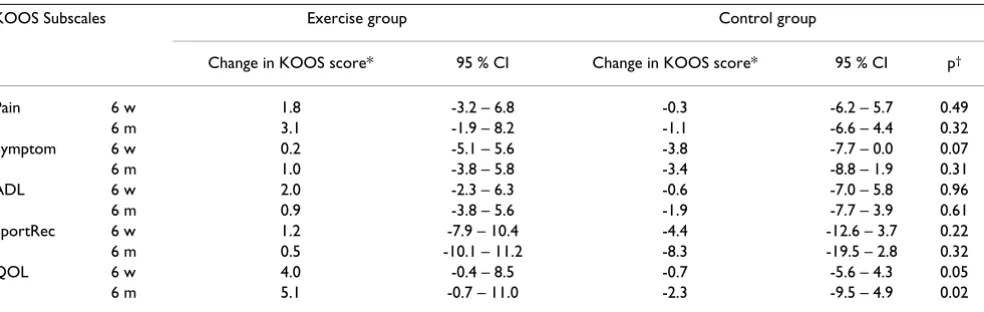
There was no difference between groups in pain or self-estimated function at either 6 week or 6 month follow-up. Quality of life improved significantly in the exercise group compared to the control group at 6 weeks (4.0 vs. -0.7, p = 0.05) and the results persisted at 6 months (5.1 vs. -2.3, p = 0.02, Table 2)
The individual differences ranged from clinically signifi-cant improvement of at least 10 points to clinically
signif-icant deterioration in all KOOS subscales and in both the exercise and control group (Figure 3).
Secondary outcomes
A significant improvement was found in the exercise group compared to the control group at six weeks with regard to the SF-36 Mental Component Summary scale (MCS) (2.1 vs -1.6, p = 0.04). At six months follow-up this difference was no longer persistent (Table 3).
Improvements in functional performance of 0–20 % were seen in both groups at six weeks and six months. There was no difference in improvement between exercisers and controls (p = 0.08–0.9). See additional file 2 for the change in functional performance.
Exercise group n = 30 Control group n = 31 p-value
Age (years) mean ± SD (range) 54.8 ± 7.1 (36–64) 57.3 ± 4.7 (46–65) 0.16
Gender number (%) women 15 (50%) 16 (52%) 0.90
BMI (kg/m)2 mean ± SD 29.6 ± 4.5 29.5 ± 5.1 0.78
Aerobic capacity (ml O2/kgxmin) mean ± SD 25.9 ± 6.4 25.2 ± 4.9 0.66
KOOS* pain 60 ± 18 64 ± 19 0.38
KOOS* symptoms 63 ± 20 66 ± 18 0.67
KOOS* ADL 69 ± 18 71 ± 21 0.76
KOOS* sport & recreation 34 ± 31 37 ± 29 0.54
KOOS* QOL 40 ± 15 46 ± 21 0.31
[image:6.612.54.561.99.225.2]Knee Injury and Osteoarthritis Outcome Score [18,19] Score from 0–100, worst to best.
Table 2: Comparisons of change in Knee injury and Osteoarthritis Outcome Score (KOOS)‡ [18,19] subscales between exercise and control group
KOOS Subscales Exercise group Control group
Change in KOOS score* 95 % CI Change in KOOS score* 95 % CI p†
Pain 6 w 1.8 -3.2 – 6.8 -0.3 -6.2 – 5.7 0.49
6 m 3.1 -1.9 – 8.2 -1.1 -6.6 – 4.4 0.32
Symptom 6 w 0.2 -5.1 – 5.6 -3.8 -7.7 – 0.0 0.07
6 m 1.0 -3.8 – 5.8 -3.4 -8.8 – 1.9 0.31
ADL 6 w 2.0 -2.3 – 6.3 -0.6 -7.0 – 5.8 0.96
6 m 0.9 -3.8 – 5.6 -1.9 -7.7 – 3.9 0.61
SportRec 6 w 1.2 -7.9 – 10.4 -4.4 -12.6 – 3.7 0.22
6 m 0.5 -10.1 – 11.2 -8.3 -19.5 – 2.8 0.32
QOL 6 w 4.0 -0.4 – 8.5 -0.7 -5.6 – 4.3 0.05
6 m 5.1 -0.7 – 11.0 -2.3 -9.5 – 4.9 0.02
* negative = worsening, positive = improvement
[image:6.612.62.554.310.466.2]Discussion
Main messageSix weeks of intensive exercise had no effect on self-reported pain or function in middle-aged patients with symptomatic and moderate-severe radiographic knee osteoarthritis.
Comparisons with other studies
Quite opposite to previously published studies on exer-cise in knee osteoarthritis we found no improvement in
pain or function. Possible reasons for this include our study group having moderate to severe osteoarthritis com-pared with mild to moderate in most previous studies, being younger than previously studied groups and the intervention being of comparably high intensity.
It has been suggested that the responsiveness to exercise is modified by the loss of joint space width [31]. The homogeneity of this study population, with regard to radiographic changes, provided us the possibility to study Change in KOOS pain score at six weeks
Figure 3
Change in KOOS pain score at six weeks. The individual change in KOOS pain at 6 weeks compared to baseline ranged from improvement to worsening, in both exercise and control group. A change of 10 points or more is considered clinically significant [20]. A similar pattern was seen for all KOOS and SF-36 subscales.
Individual cases in temporal consecutive order
-50 -40 -30 -20 -10 0 10 20 30
Cha
nge
in KOOS pain
at 6
wee
ks
the effects of exercise on patients with moderate to severe radiographic knee osteoarthritis. Can significant improvements of pain or self-reported function be expected in patients with radiographic knee osteoarthritis corresponding to Kellgren & Lawrence grade 3 or more? In this study, no improvements were seen on group level in pain or function. However, regular exercise in general is important to prevent diseases caused by inactivity [6], and thus patients with knee osteoarthritis should be encour-aged to exercise. In clinical practice, patients with severe knee osteoarthritis should have treatments based on indi-vidual preferences and different stages of motivation [32].
It can be argued that the exercise intensity was too high for this group with moderate to severe knee osteoarthritis. Even though the intensity of each exercise was individu-ally adapted, all individuals exercised at a minimum of 60% of HR max. It has been suggested that pain during exercise might be a protective mechanism in knee osteoar-thritis, i.e. an increase in pain from too intensive exercises may restrain patients from further joint loading, which otherwise could cause further cartilage damage [33]. Patients in the current study were told to reduce the exer-cise intensity if pain during exerexer-cise was perceived as worse than 'acceptable', or persisted more than 24 hours.
It is suggested that the different degrees of varus-valgus laxity should be taken into account in exercise interven-tions, to enhance the functional outcome [34,35]. Severe knee osteoarthritis is associated with a hip-knee-ankle malalignment and an increase in varus-valgus laxity com-pared to healthy knees [36]. It is possible that varus-valgus laxity mediated the effect of exercise on pain since all patients had radiographic changes corresponding to Kell-gren and Lawrence grade III or more. Malalignment may cause increased joint loads, and greater quadriceps
strength might further increase joint load by the muscles compressing the articular surfaces [37].
Younger patients are usually more physically active than elderly [38], and have higher demands on level of physical function and physical performance at work or leisure time. Thus, moderate to severe knee osteoarthritis might be perceived as more disabling by younger individuals compared to elderly. Our study population was younger (<65 years) and comprised more men (49%) than most other populations with knee osteoarthritis described in randomized controlled trials of exercise [13-15,39,40], which might have reduced the effect on self-reported func-tion in the present study.
This study showed no significant differences on self-reported pain and function either between or within groups. A post-hoc analysis was performed to study the possibility that the benefit from exercise was larger in sub-jects with worse pain at baseline. Fifteen patients in the exercise group were compared to 13 from the control group who had worse than total group median pain score (KOOS Pain 58 on a 0–100, worst to best scale) at base-line. The groups had comparable patient characteristics. The changes seen in these subgroups were however not different from the changes seen in the total groups.
A possible limitation could be lack of power. A post-hoc analysis was performed to estimate the number of patients needed to show a clinically significant difference of 11 ± 15 KOOS-points [20]. The standard deviation of 15 is supported by results from randomized controlled tri-als of glucosamine supplementation [41] and a nutri-tional supplement [42] for knee osteoarthritis, where significant group differences were found in KOOS pain and ADL subscales. The number of subjects in each treat-ment arm in these RCT:s ranged from 15 to 27. The control group.
Short Form-36 item (SF-36) [22] Exercise group Control group
mean 95%CI mean 95%CI p*
Physical Component Summary (PCS) Baseline 42.5 24.4 – 57.5 43.8 24.2 – 57.3 0.49 Change at 6 weeks 3.0 -5.9 – 13.4 0.3 -15.2 – 12.6 0.13 Change at 6 months 3.0 -5.9 – 16.3 -0.7 -14.8 – 9.8 0.09
Mental Component Summary (MCS) Baseline 55.6 40.2 – 66.2 56.3 37.0 – 67.0 0.63 Change at 6 weeks 1.6 -10.6 – 15.0 -2.1 -16.9 – 11.5 0.04 Change at 6 months 0.7 -18.1 – 13.2 -0.7 -16.8 – 12.8 0.40
[image:8.612.56.554.111.237.2]standard deviations in KOOS subscales have not previ-ously been determined in exercise interventions.
Only one of the five KOOS subscales showed a statistical significant improvement, and it can not be excluded that this result could be due to chance. The improvement of the KOOS subscale Quality Of Life in the exercise group was of doubtful clinical significance, however the improvement persisted over time, and is in accordance with previous findings of impact from exercise on mental health aspects in patients with knee osteoarthritis [31,43,44]. Group dynamics, support, or attention received may possibly have influenced the quality of life more than the exercise itself in the present study. Psycho-social factors are important determinants of physical func-tion [45], and our results suggest that supervised exercises and follow-up are important, and that quality of life should be evaluated in osteoarthritis interventions.
Conclusion
A six-week high-intensive exercise program had no effect on pain or function in middle-aged patients with moder-ate to severe radiographic knee OA. Some effect was seen on quality of life in the exercise group compared to the control group.
Competing interests
The author(s) declare that they have no competing interests.
Authors' contributions
CT participated in design, exercise intervention, assess-ments and follow-ups, statistical analyses and writing. ER participated in design, analysis and interpretation of the data, and critically revised the article. IP participated in design and interpretation of the data and critically revised the article. CE initiated and obtained necessary permis-sions for the study, arranged the initial funding, and par-ticipated in the analyses, interpretation and revision of the manuscript. All authors read and approved the final manuscript.
Additional material
Acknowledgements
Grants were received from The Vårdal Foundation, Sweden, The Swedish Rheumatism Association in Stockholm, The Swedish Rheumatism Associa-tion in Gothenburg, The Swedish Research Council, The Department of Research and Development at Spenshult Hospital for Rheumatic Diseases, Halmstad, Sweden
References
1. Altman RD, Hochberg MC, Moskowitz RW, Schnitzer TJ: Recom-mendations for the medical management of osteoarthritis of the hip and knee: 2000 update. American College of Rheu-matology Subcommittee on Osteoarthritis Guidelines. Arthritis Rheum 2000, 43:1905-1915.
2. Jordan KM, Arden NK, Doherty M, Bannwarth B, Bijlsma JW, Dieppe P, Gunther K, Hauselmann H, Herrero-Beaumont G, Kaklamanis P, Lohmander S, Leeb B, Lequesne M, Mazieres B, Martin-Mola E, Pavelka K, Pendleton A, Punzi L, Serni U, Swoboda B, Verbruggen G, Zimmerman-Gorska I, Dougados M: EULAR Recommendations 2003: an evidence based approach to the management of knee osteoarthritis: Report of a Task Force of the Standing Committee for International Clinical Studies Including Therapeutic Trials (ESCISIT). Annals of the Rheumatic Diseases 2003, 62:1145-1155.
3. Fransen M, McConnell S, Bell M: Exercise for osteoarthritis of the hip or knee. Cochrane Database Syst Rev 2003:CD004286. 4. Segal L, Day SE, Chapman AB, Osborne RH: Can we reduce
dis-ease burden from osteoarthritis? Med J Aust 2004, 180:S11-7. 5. Pendleton A, Arden N, Dougados M, Doherty M, Bannwarth B,
Bijlsma JW, Cluzeau F, Cooper C, Dieppe PA, Gunther KP, Hausel-mann HJ, Herrero-Beaumont G, Kaklamanis PM, Leeb B, Lequesne M, Lohmander S, Mazieres B, Mola EM, Pavelka K, Serni U, Swoboda B, Verbruggen AA, Weseloh G, Zimmermann-Gorska I: EULAR rec-ommendations for the management of knee osteoarthritis: report of a task force of the Standing Committee for Inter-national Clinical Studies Including Therapeutic Trials (ESCISIT). Ann Rheum Dis 2000, 59:936-944.
6. Pate RR, Pratt M, Blair SN, Haskell WL, Macera CA, Bouchard C, Buchner D, Ettinger W, Heath GW, King AC, et al.: Physical activ-ity and public health. A recommendation from the Centers for Disease Control and Prevention and the American Col-lege of Sports Medicine. JAMA 1995, 273:402-407.
7. WHO: WHO FAO Diet, nutrition and prevention of chronic diseases. WHO Technical Report Series. Geneva, WHO; 2003. 8. Roos H, Adalberth T, Dahlberg L, Lohmander LS: Osteoarthritis of the knee after injury to the anterior cruciate ligament or meniscus: the influence of time and age. Osteoarthritis Cartilage 1995, 3:261-267.
9. Roos H, Lauren M, Adalberth T, Roos EM, Jonsson K, Lohmander LS: Knee osteoarthritis after meniscectomy: prevalence of radi-ographic changes after twenty-one years, compared with matched controls. Arthritis Rheum 1998, 41:687-693.
10. Von Porat A, Roos EM, Roos H: High prevalence of osteoarthri-tis 14 years after an anterior cruciate ligament tear in male soccer players: a study of radiographic and patient relevant outcomes. Ann Rheum Dis 2004, 63:269-273.
11. Conaghan PG: Update on osteoarthritis part 1: current con-cepts and the relation to exercise. Br J Sports Med 2002, 36:330-333.
12. Sutton AJ, Muir KR, Mockett S, Fentem P: A case-control study to investigate the relation between low and moderate levels of physical activity and osteoarthritis of the knee using data col-lected as part of the Allied Dunbar National Fitness Survey. Ann Rheum Dis 2001, 60:756-764.
13. Ettinger WHJ, Burns R, Messier SP, Applegate W, Rejeski WJ, Morgan T, Shumaker S, Berry MJ, O'Toole M, Monu J, Craven T: A rand-omized trial comparing aerobic exercise and resistance exercise with a health education program in older adults with knee osteoarthritis. The Fitness Arthritis and Seniors Trial (FAST). JAMA 1997, 277:25-31.
14. Hopman-Rock M, Westhoff MH: The effects of a health educa-tional and exercise program for older adults with osteoar-thritis for the hip or knee. J Rheumatol 2000, 27:1947-1954.
Additional File 1
Intensive exercise program Carina
Click here for file
[http://www.biomedcentral.com/content/supplementary/1471-2474-6-27-S1.pdf]
Additional File 2
Tests of functional performance Carina
Click here for file
Publish with BioMed Central and every scientist can read your work free of charge
"BioMed Central will be the most significant development for disseminating the results of biomedical researc h in our lifetime."
Sir Paul Nurse, Cancer Research UK
Your research papers will be:
available free of charge to the entire biomedical community
peer reviewed and published immediately upon acceptance
cited in PubMed and archived on PubMed Central
yours — you keep the copyright
Submit your manuscript here:
http://www.biomedcentral.com/info/publishing_adv.asp
BioMedcentral patients with knee osteoarthritis: a randomized clinical trial.
Journal of Rheumatology 2000, 27:2215-2221.
16. Thomee R: A comprehensive treatment approach for patel-lofemoral pain syndrome in young women. Phys Ther 1997, 77:1690-1703.
17. Borg G: Borg's perceived exertion and pain scales. USA, Human Kinetics; 1998.
18. Roos EM, Roos HP, Lohmander LS, Ekdahl C, Beynnon BD: Knee Injury and Osteoarthritis Outcome Score (KOOS)--develop-ment of a self-administered outcome measure. Journal of Orthopaedic and Sports Physical Therapy 1998, 28:88-96.
19. Roos EM, Roos HP, Ekdahl C, Lohmander LS: Knee injury and Osteoarthritis Outcome Score (KOOS)--validation of a Swedish version. Scandinavian Journal of Medicine and Science in Sports 1998, 8:439-448.
20. Roos EM, Lohmander LS: The Knee injury and Osteoarthritis Outcome Score (KOOS): from joint injury to osteoarthritis. Health Qual Life Outcomes 2003, 1:64.
21. Bellamy N, Buchanan WW, Goldsmith CH, Campbell J, Stitt LW: Val-idation study of WOMAC: a health status instrument for measuring clinically important patient relevant outcomes to antirheumatic drug therapy in patients with osteoarthritis of the hip or knee. J Rheumatol 1988, 15:1833-1840.
22. Ware JE, Sherbourne CD: The MOS-item short-form health survey (SF-36):I. Conceptual framework and item selection. Med Care 1992, 30:473-483.
23. Ware JEJ, Kosinski M: SF-36 Physical and Mental Health Sum-mary Scales: A manual for users of Version 1, Second edition. Lincoln, RI, QualityMetric Incorporated; 2004.
24. Åstrand PO, Saltin B: Oxygen uptake during the first minutes of heavy muscular exercise. Journal of Applied Physiology 1961, 16:971-976.
25. Ostenberg A, Roos E, Ekdahl C, Roos H: Isokinetic knee extensor strength and functional performance in healthy female soc-cer players. Scand J Med Sci Sports 1998, 8:257-264.
26. Roos EM, Ostenberg A, Roos H, Ekdahl C, Lohmander LS: Long-term outcome of meniscectomy: symptoms, function, and performance tests in patients with or without radiographic osteoarthritis compared to matched controls. Osteoarthritis Cartilage 2001, 9:316-324.
27. Tegner Y, Lysholm J, Lysholm M, Gillquist J: A performance test to monitor rehabilitation and evaluate anterior cruciate liga-ment injuries. Am J Sports Med 1986, 14:156-159.
28. Ross M: Test-retest reliability of the lateral step-up test in young adult healthy subjects. J Orthop Sports Phys Ther 1997, 25:128-132.
29. Kaikkonen A, Kannus P, Jarvinen M: A performance test protocol and scoring scale for the evaluation of ankle injuries. Am J Sports Med 1994, 22:462-469.
30. SPSS for Windows. 12.0.1 edition. Chicago, IL, Microsoft Coorporation; 2004.
31. Fransen M, Crosbie J, Edmonds J: Physical therapy is effective for patients with osteoarthritis of the knee: a randomized con-trolled clinical trial. J Rheumatol 2001, 28:156-164.
32. Keefe FJ, Lefebvre JC, Kerns RD, Rosenberg R, Beaupre P, Prochaska J, Prochaska JO, Caldwell DS: Understanding the adoption of arthritis self-management: stages of change profiles among arthritis patients. Pain 2000, 87:303-313.
33. Hurwitz DE, Sharma L, Andriacchi TP: Effect of knee pain on joint loading in patients with osteoarthritis. Curr Opin Rheumatol 1999, 11:422-426.
34. Sharma L, Hayes KW, Felson DT, Buchanan TS, Kirwan-Mellis G, Lou C, Pai YC, Dunlop DD: Does laxity alter the relationship between strength and physical function in knee osteoarthritis? Arthritis Rheum 1999, 42:25-32.
35. Sharma L: Examination of exercise effects on knee osteoar-thritis outcomes: why should the local mechanical environ-ment be considered? Arthritis Rheum 2003, 49:255-260. 36. Sharma L, Lou C, Felson DT, Dunlop DD, Kirwan-Mellis G, Hayes
KW, Weinrach D, Buchanan TS: Laxity in healthy and osteoar-thritic knees. Arthritis Rheum 1999, 42:861-870.
37. Sharma L, Dunlop DD, Cahue S, Song J, Hayes KW: Quadriceps strength and osteoarthritis progression in malaligned and lax knees. Ann Intern Med 2003, 138:613-619.
behavior in older women with rheumatoid arthritis. Arthritis Rheum 2004, 51:246-252.
39. O'Reilly SC, Muir KR, Doherty M: Effectiveness of home exercise on pain and disability from osteoarthritis of the knee: a ran-domised controlled trial. Annals of the Rheumatic Diseases 1999, 58:15-19.
40. Messier SP, Loeser RF, Miller GD, Morgan TM, Rejeski WJ, Sevick MA, Ettinger WHJ, Pahor M, Williamson JD: Exercise and dietary weight loss in overweight and obese older adults with knee osteoarthritis: the Arthritis, Diet, and Activity Promotion Trial. Arthritis Rheum 2004, 50:1501-1510.
41. Braham R, Dawson B, Goodman C: The effect of glucosamine supplementation on people experiencing regular knee pain. Br J Sports Med 2003, 37:45-9; discussion 49.
42. Colker CM, Swain M, Lynch L, Gingerich DA: Effects of a milk-based bioactive micronutrient beverage on pain symptoms and activity of adults with osteoarthritis: a double-blind, pla-cebo-controlled clinical evaluation. Nutrition 2002, 18:388-392. 43. Minor MA, Hewett JE, Webel RR, Anderson SK, Kay DR: Efficacy of physical conditioning exercise in patients with rheumatoid arthritis and osteoarthritis. Arthritis Rheum 1989, 32:1396-1405. 44. Rejeski WJ, Ettinger WHJ, Martin K, Morgan T: Treating disability in knee osteoarthritis with exercise therapy: a central role for self-efficacy and pain. Arthritis Care and Research 1998, 11:94-101.
45. Summers MN, Haley WE, Reveille JD, Alarcon GS: Radiographic assessment and psychologic variables as predictors of pain and functional impairment in osteoarthritis of the knee or hip. Arthritis Rheum 1988, 31:204-209.
Pre-publication history
The pre-publication history for this paper can be accessed here:
![Figure 2Tests of functional performanceTests of functional performance. A) Åstrand's cycle-ergometer test [24]](https://thumb-us.123doks.com/thumbv2/123dok_us/102804.1015432/5.612.65.544.94.570/figure-tests-functional-performancetests-functional-performance-astrand-ergometer.webp)
![Table 3: Comparisons of change in SF-36 Physical and Mental Components Summaries (PCS and MCS) [23] between exercise and control group.](https://thumb-us.123doks.com/thumbv2/123dok_us/102804.1015432/8.612.56.554.111.237/table-comparisons-physical-mental-components-summaries-exercise-control.webp)