GE-International Journal of Management Research
Vol. 3, Issue 12, Dec 2015 IF- 4.316 ISSN: (2321-1709)© Associated Asia Research Foundation (AARF)
Website: www.aarf.asia Email : [email protected] , [email protected]AN EMPIRICAL STUDY ON CONSUMER PERCEIVED VALUE OF
SHAMPOO CONSUMPTION IN BANGLADESH
1. Main Author:
Md. Tamzidul Islam Assistant Professor
BRAC Business School, BRAC University Bangladesh
2. Co-Author:
Mohammad Rezaur Razzak Associate Professor
BRAC Business School, BRAC University Bangladesh
ABSTRACT
In 2016, the global hair care market is estimated to be worth about USD 83.1 billion. (Statista ,2015). Bangladesh, currently with 10 manufacturers, including two local ones, is penetrating in the major category of hair care market; shampoo and that is estimated of about Tk 300 crore (Financial Express, 2013). The total shampoo penetration rate is 88.9% where Unilever’s penetration rate is 55%. This particular study tried to capture the competitive market scenario of the market and analyzed consumer perceived value of different brands operating in Bangladesh. A total of 200 samples were selected based on three variables: Gender, Age, and Income from the capital of Bangladesh-Dhaka city in the middle of 2015. As part of purchase decision making process, the consumers prefer number of variables such as relevance, overall quality, price, availability, packaging etc. It was quite evident that the consumers prefer specific brand; however the selection criteria vary from brand to brand. Among these Sunsilk is preferred most by most of the consumers (46%), followed by Pantene (22%), Head & Shoulders (16%) and others (16%).
Key words: Brand preference, Consumer perceived value, Purchase decision and Shampoo
1. Introduction:
In recent times hair care segment has become very competitive and dynamic driven by the latest
styles and trends. People now aspire for better looking and they are getting more aware of hair
care. They have many different needs and desires, which drive constant change in this category.
They started to feel that hair care needs fairly constant attention. Hair care product like shampoo
has been the fastest growing segment of personal care market in Bangladesh. Here, global brands
are gaining foothold on local shampoo market driven by faster growth in demand.
Dominated by global brands like Sunsilk, Clear and Dove of Unilever, Pantene and Head &
Shoulders of Procter & Gamble (P & G), the shampoo market is registering a steady growth
every year, amid remarkable marketing efforts on hair care. If we take a look on the picture of
shampoo market of our country, it is found that the total size of the market is 7089 tons (3000
TK in value). The Per capita consumption of Shampoo in Bangladesh is 0.93 Grams. Unilever
hair care brands have been catering to the needs of its users with a great degree of success in
Bangladesh. In consumer market it rates itself as one of the prominent brands to be hankered
after. Such as, Sunsilk secures its place in the consumer minds through frequent innovations in
the product and maintaining its quality. The product reaches the end consumer through retailers,
supermarkets and small stores. Its wider availability is one of the factors that determine its high
consumer demand. The per capita spending on beauty and personal care products in Bangladesh
stood at $4.50 last year, just behind neighbouring India's $7.20 (Statista, 2015).
Managing consumer perceived value positively is observed to be one of the major components in
the achievement of any brand and it has been indicated as a critical source of competitive
advantage for the firm (Mizik and Jacobson 2003; Spiteri and Dion 2004; Woodruff, 1997). It
has been imagined as a basic key weapon in pulling in and holding customers (Lee and Overby,
2004; Wang, Lo, Chi, and Yang 2004). In this particular study, a comparison is made to get a
holistic insight about consumer perceived value on regard to the most demanding product in hair
care sector- shampoo, in one of the most promising and emerging economies in the world;
2. Literature review:
2.1 Complexity of consumer value
The degree and heterogeneity of the different studies have made a scattered, sometimes
confounding and still-uncertain base of information about consumer value. To explain polysemy
and terminology of consumer value some scholars suggest that the idea of value is a standout
amongst the most overused and abused ideas in sociologies as a rule and in
marketing/administration writing specifically (Khalifa, 2004). Value and values are two
distinctive assembles. Value must be grasped as the result of an evaluative judgment, while
"values" refer to the guidelines, rules, criteria, standards, objectives, or beliefs that serve as the
premise for those evaluative judgments (Holbrook 1994, 1999). Consumer values are the criteria
considered by Flint, Woodruff and Gardial (1997) as the unwritten convictions that guide
behavior, since they imitate individuals' sought "extreme end-states of existence". The difference
between the consumer value and the customer value can be identified by the work of Lai (1995), who proposes that customer value concentrates on "the buyers‘ evaluation of product purchase at the time of buying ", while customer value "stress people‘s valuation on the consumption or
possession of products " (Lai, 1995).
2.2 Conceptual origin and relationship of consumer value with different key factors
Thaler (1985) develops a model which suggests that general utility for a product can be
conceptualized as an element of acquisition utility (a judgment of overall value for cash) and
transaction utility (a judgment of the value of the "deal"). The dual nature of price has been
studied versus its commitment to the formation of value. Consumer value is a more extensive
and more affluent construct than perceived price (Monroe, 1990; Zeithaml, 1988). Zeithaml
(1988) establishes that consumer value differs from perceived quality in two ways. First, value is
more individualistic and characteristic than quality and is subsequently a larger amount idea than
quality. Second, value (dissimilar to quality) includes a tradeoff of give and gets parts. Moreover,
Monroe and Krishnan (1985) suggest that perceived quality is seen absolutely as an evaluative
measure, whereas perceived value is believed a exchange between perceived quality and
suggest that satisfaction measures show how customers feel about products and services, while
measures of consumer value are lists of how shoppers will act (Goodstein and Butz, 1998).
Eggert and Ulaga (2002) regarded that consumer perceived value measurement should expressly
benchmark the supplier's offerings with those of its significant rivals. According to Holbrook
(1994, 1999), value relies on upon the elements of the object but cannot exist without the
contribution of a subject who values these components otherwise, value as a subject-object or
consumer-product cooperation.
In terms of relativeness, the value of an object must be determined in reference to another
assessed object (Holbrook 1994, 1999; McDougall and Levesque 2000). Value is situational in
the way that it relies on upon the setting in which the evaluative judgment is made (Chen and
Dubinsky 2003; Day and Crask 2000; Patterson and Spreng 1997; Woodruff 1997). After
analyzing consumer value many authors conclude that the research on value is originally not
from marketing or purchasing and supply management, but rather from strategy and strategic
management, psychology and sociology of consumer behavior, accounting, and finance.
2.3 Consumer perceived value of shampoo consumption
As a part of human hair care treatment, shampoo is an indispensable innovation that assists to
remove dandruff, oil, skin specks, contaminants and other impurities that progressively create in
the hair (Ferdous and Batul, 2008). At first consumption, if the product meets the requisitions in
terms of vital qualities the result ought with possesses is observed in the minds of the consumer,
after that it turns into a regular brand for those customers (Ramdhani, Alamanda , and Sudrajat
,2012).
From the study of Anuj Thapa (2012) about customer switching approach with respect to
shampoo brands, it is found that the effect of packing, cost increase in current brand, scheme of
brands, effect of advertisement and so on are the reasons of exchanging behavior of shampoo
buyers. Himani Sharma and Shallu Sharma (2012) suggested that male recurrence in using
shampoo is less contrasted with females in a study about consumer thoughts towards use of
acquiring healthy skin stuffs in Thailand. From that study they identified that beliefs, self
portrait, and appearances of male customers have part in their buying behavior.
2.4 Global and local perspective on shampoo consumption
Researchers suggest the method for understanding the brand awareness involves the assessment of consumers‘ brand involvement (Aaker,1991). Male and female consumers have dissimilar
thoughts in choosing shampoo brands (Sharma and Mehta,2012; Prabha,2007). Sukato and Elsey
(2009) suggested that female customers pay more attention on their own looks which a brand
may be able to persuade. In order to explain the purchasing behavior of fast moving consumer
goods Maxwell, Gallagher, and Falls (2012) said that consumer attitudes have developed a
central position in brand determination include overall professed quality, possible risk, price
awareness. In order to determine the satisfaction level of Clinic Plus shampoo users, Dr. R.
Vijaykumar, N. Raman and prof. P. V. Prabhu (2007) have found that aspects like variations,
different sex , age, usage time, cost, superiority and product features affect the level of
satisfaction of shampoo consumers of the brand.
2.5 Global brands and local cultural aspects
Globalization and interaction of cultural elements may sometime influence and impact the local
culture. Appadurai (1990) argue that globalization involves the use of a variety of instruments of
homogenization (armaments, advertising techniques, language hegemonies, clothing styles and
the like) which are absorbed into local political and cultural economies. The concept of
globalization is illustrated in various ways by the researchers. Some of the researchers come up
with the concept of glocalization which means mingling between global and local cultural
variables (Robertson, 1995).
Exploring the history of Bangladesh suggests that it has a long tradition of culture and
consumption space. However, easy flow of goods, labor and capital are mostly accountable for
cultural exchange and therefore influence the consumption pattern and behavior of Bangladeshi
consumers (Repo, 2000). Ethics and consumerism are often relates with each other, and
protest against the consumption of certain goods and services based on ethical deliberation and
considerations (Doran, 2009). Most of the literature, however attempted to directly relate
between ethics and consumerism. Similarly, Belk et al. (2005) proposed that culture aspects of
consumption channelize the moral belief and norms that eventually shape up the ethical standard
in a particular geography.
2.6 Consumer brand preference
In today‘s highly fragmented market, one of the greatest ways a distinction can be made between
two products is through brand. Most of the products and services on the market have to compete
with similar products and services manufactured by other brands, there are only a few aspects
that typically help to differentiate the two brand‘s products. These include the price and quality
of the product, and any unique characteristics of the product. However, when these
characteristics are too similar to differentiate, it is the brand itself that helps to determine which
product or service will be chosen (Kapferer, 2004)
Customer based definition of brand says about the measurement of financial approach. Financial
approach measure brand value is additional cash flows created by the brand. This additional cash
flows that amount which customers are willing to pay for buy a specific brand product than a
competitors, even the another brand are cheaper (Kapferer, 2004) .
3. Research design:
A descriptive type study was conducted. The data consist of both quantitative and qualitative in
nature. The total sample size is 200. Stratified sampling technique was used as a sample selection
method. Three demographic variables were considered such as gender, age and income to better
represent the sample. In addition to these demographic variables, few other categorical variables
such as usage frequency, size preference, consumer reach were incorporated in the data
collection process. In the usage frequency respondents were asked about their usage frequency
such as occasionally, once in a month, once a week, alternative day, and every day. There are
on regard to the size they prefer. Companies are following different ways to reach top the
consumers such as advertisement, self experiment, promotional campaign, word of mouth.
The sample was selected from the capital of Bangladesh-Dhaka city. As part of data collection
both primary and secondary sources were considered. Relevant articles, websites, newspaper
publications were considered as part of secondary source. In addition, researcher also talked with
the industry exerts to capture the market insights and gather preliminary understanding on the
market. A structured questionnaire consist of nine different questions were incorporated.
Sample Distribution:
VARIABLES NO OF
SAMPLES
% OF SAMPLES
Gender:
Male 100 50%
Female 100 50%
Age:
15-20 100 50%
21-30 60 30%
31 and above 40 20%
Income:
≤5000 30 15%
5001-20000 50 25%
20001-50000 70 35%
50001 and above 50 25%
4. Results:
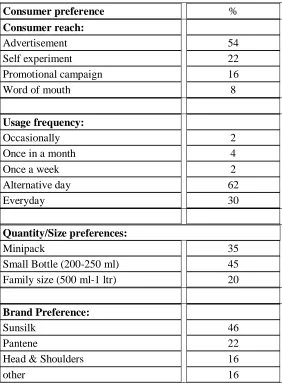
Table-1 shows the descriptive results of the study. It shows that 54% people were informed
through conventional method which is TVC, Press ad and other outdoor promotional methods.
Second part of same table give an idea about usage frequency of the sample and most of them
(62%) suggested that they prefer to use every alternative day. In case of size preference, the
outcome was mixed though 45% prefer small sized bottle for consumption. Brand preference
was consistent with other studies and 46% responded that they prefer Sunsilk (a product of
Table 1: Consumers’ overall perception:
Consumer preference %
Consumer reach:
Advertisement 54
Self experiment 22
Promotional campaign 16
Word of mouth 8
Usage frequency:
Occasionally 2
Once in a month 4
Once a week 2
Alternative day 62
Everyday 30
Quantity/Size preferences:
Minipack 35
Small Bottle (200-250 ml) 45
Family size (500 ml-1 ltr) 20
Brand Preference:
Sunsilk 46
Pantene 22
Head & Shoulders 16
other 16
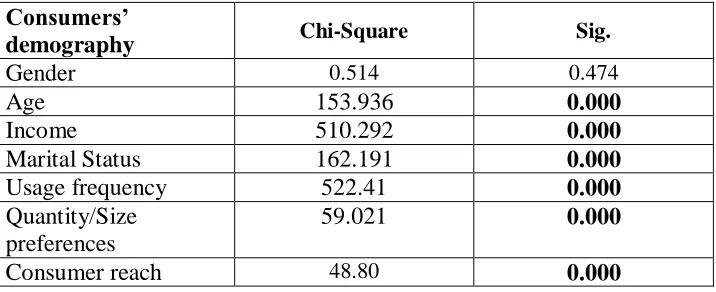
In table-2, different demographic variables such as age, income and marital status and few other
categorical variables such as usage frequency, size preference, consumer reach were tested on
regard to their brand preference. It was evident that, apart from gender each of the other variables
are statistically significant at 0% confidence level. That shows that consumers are relatively
Table 2: Brand preference criteria:
Consumers’
demography Chi-Square Sig.
Gender 0.514 0.474
Age 153.936 0.000
Income 510.292 0.000
Marital Status 162.191 0.000
Usage frequency 522.41 0.000
Quantity/Size preferences
59.021 0.000
Consumer reach 48.80 0.000
Table-3 sheds insight on the factors that affect purchase decision and a 3 point rating scale
(3=satisfactory, 2=moderate, 1=unsatisfactory) was used as measurement on various purchase
related criteria such as relevance, price, packaging both from utilitarian and hedonic
consumption perspectives. Three major brands operating in the market-Sunsilk, Pantene, Head &
Shoulders were taken considering distinctive positioning they have in the market. Afterwards, as
part of analysis, mean value of each of the criteria of three competing brands was taken as part of
comparison. The result shows that in all the areas Sunsilk is perceived as a better brand than its
competitors. Among these, quality and availability were scored significantly high.
Table 3: Factors influencing purchase decision:
Purchase criteria Sunsilk Pantene Head & Shoulders
Relevance 2.04 1.48 1.68
Mother brand preference 1.81 1.56 1.70
Low price 2.49 1.10 1.25
Availability 2.51 1.45 1.62
Attractive Packaging 1.87 1.25 1.39
Family/Celebrity influence 2.43 1.70 1.70
Quality 2.85 2.65 2.36
5. Conclusion:
The study reveals the current shampoo consumption scenario in Bangladesh and it shows that
consumer deliberately choose and stick into brand. This study also opens up the fact that both
has less significance in terms of influencing purchase of individual brands. Selection and using
celebrity properly can also bring more prospects for brands. The fact of usage frequency and size
preference suggest how marketer should design packaging although visual part of packaging has
less significance and appeal as part of purchase influence. Selection of media while
communication also plays a very important role while above the line seems to the most effective
way of reaching the consumer. This study can be further extended to explore the reasons of
choosing different factors as purchase criteria as an exploratory study and would be quite useful
for the branding and marketing strategy development.
REFERENCES
Appadurai, Arjun (1990) Disjuncture and Difference in the Global Cultural Economy. Theory, Culture & Society, Vol: 7: pp: 295 – 310.
Anuj Thapa, ―Consumer switching behavior : A Study shampoo brands ― Abhinav National Monthly referred journal of research in commerce and management, Vol.1, Issue .9, p 98-106. Burnson, P. (2014) Ethical Supply Chains May Become Competitive Advantage, Supply Chain Management Review
Belk, R.W., Devinney, T. and Eckhardt, G. (2005), “Consumer ethics across cultures”, Consumption, Markets & Culture, Vol. 8 No. 3, pp. 275-89.
Chen, Zhan and Alan J. Dubinsky (2003), "A conceptual model of perceived customer value in e-commerce: A preliminary investigation," Psychology & Marketing, 20 (4), 323-347.
Day, Ellen and Melvin R. Crask (2000), "Value assessment: The antecedent of customer satisfaction," Journal of Consumer Satisfaction, Dissatisfaction and Complaining Behavior, 13 52-60.
Dr. R. Vijaykumar, Dr. N. Raman and Dr. P.V. Prabhu, ―Satisfaction derived by the Users of Clinic Plus Shampoo in Coimbatore‖, Indian Journal of Marketing, Vol-37, No-11, November-2007, Page-18-20.
Doran, C. (2009), ―The role of personal values in fair trade consumption‖, Journal of Business Ethics, Vol. 84 No. 4, pp. 549-63.
Eggert, Andreas and Wolfgang Ulaga (2002), "Customer perceived value: A substitute for satisfaction in business markets?," The Journal of Business & Industrial Marketing, 17 (2/3), 107-118.
Fernández,, R., & Bonillo, M. (2006). Consumer Perception of Value: Literature Review and A New Conceptual Framework. 19, 40-58.
Goodstein, Leonard D. and Howard E. Jr. Butz (1998), "The linchpin of organizational change," Organizational Dynamics, 27 (1), 21-33.
Himani Sharma, Shallu Mehta, ―Consumer attitude towards the use of shampoos: A Case study of sirsa city‖, International journal of research in finance and marketing, Vol.2, issue 2 Feb-12 pp 267-277.
Holbrook, M. B. (1994), "The nature of customer value: An axiology of services in the consumption experience," In Service Quality: New Directions in Theory and Practice Eds. R. Rust and R. L. Oliver. California: Sage.
Holbrook, Morris B. (1999), "Introduction to consumer value," In Consumer value. A framework for analysis and research Eds. M. B. Holbrook. London: Routledge.
Kapferer (2004), ―The New Strategic Brand Management‖ (1st
ed), Kogan Page India, New Delhi
Khalifa, Azaddin Salem (2004), "Customer value: a review of recent literature and an integrative configuration," Management Decision, 42 (5/6), 645-666.
Lai, A. W. (1995), "Consumer values, product benefits and customer value: A consumption behavior approach," Advances in Consumer Research, 22 381-388.
Lee, Eun-Ju and Jeffrey W. Overby (2004), "Creating value for online shoppers: Implications for satisfaction and loyalty," Journal of Consumer Satisfaction, Dissatisfaction and Complaining Behavior, 17 54-67.
Maxwell, J, Gilmore A, Gallagher D &Falls D 2012, ‗Long-Term brand Development versus short-term Business targets: The Impact of Price Promotions on Branded food Products‘,Journal of Strategic Marketing, Vol. 20, pp. 609-624.
McDougall, Gordon H. G. and Terrence Levesque (2000), "Customer satisfaction with services: putting perceived value into the equation," The Journal of Services Marketing, 14 (5), 392-410.
Mizik, Natalie and Robert Jacobson (2003), "Trading off between value creation and value appropriation: The financial implications of shifts in strategic emphasis," Journal of Marketing, 67 (1), 63-76.
Monroe, Kent B. (1990), Pricing: Making profitable decisions. New York: McGraw-Hill.
Nuntasaree Sukato, Barry Elsey, ―A model of male consumer behavior in buying skin care products in Thailand‖, ABAC Journal Vol.29, No.1, Jan-Apr-2009 pp 39-52.
Robertson, Roland (1995) Glocalization: Time–Space and Homogeneity–Heterogeneity. In Featherstone, Mike; Lash, Scott; and Robertson, Roland (eds.) Global Modernities. London, Thousand Oaks, and New Delhi: Sage, pp.25-42.
Repo, Petteri (2000) Consumer Interest in Free Trade Revisited: Interpreting Reactions of Four Consumer Organizations. Helsinki: Publication of the Swedish School of
Economics and Business Administration, No. 84.
Patterson, Paul G. and Richard A. Spreng (1997), "Modelling the relationship between perceived value, satisfaction and repurchase intentions in a business-to-business, services context: an empirical examination," International Journal of Service Industry Management, 8 (5), 414-434.
Ramdhani,A, Alamanda,D T &Sudrajat H 2012, ‗Analysis of Consumer Attitude Using Fishbein Multi-Attributes Approach‘, International Journal of Basic and Applied Science, Vol.1, No. 1, pp.33-39.
Reysen S 2005, ‗Construction of a new scale: the Reysen likeability scale‘,Social Behavior andPersonality, Vol.33, pp.201-208.
Sharma,H &Mehta,S 2012, ‗Consumer attitude towards the use of Shampoos: A Case study of Sirsa city‘,International Journal of Research in Finance and Marketing, Vol.2 No.2, pp.267-277.
Spiteri, Joseph M. and Paul A. Dion (2004), "Customer value, overall satisfaction, end-user loyalty, and market performance in detail intensive industries," Industrial Marketing Management, 33 (8), 675-687.
Silverman, D. (2000) Doing Qualitative Research: a Practical Handbook. London: Sage.
Sukato,N & Elsey,B 2009, ‗A model of male consumer behavior in buying skin care products in Thailand‘, ABAC Journal, Vol. 29, No.1, 39-52.
Statista (2015), Size of the global hair care market from 2012 to 2021 (in billion U.S. dollars,
Available from: http://www.statista.com/statistics/254608/global-hair-care-market-size/
(Accessed 28/12/2015)
Thaler, Richard (1985), "Mental accounting and consumer choice," Marketing Science, 4 (3), 199-214.
Pollack, Barry (1999), ―The state of Internet marketing—1999‖, Direct Marketing, Vol.61, No.9, pp.18-21.
Woodruff, Robert B. (1997), "Customer value: The next source for competitive advantage," Journal of the Academy
Yang, Zhilin and Robin T. Peterson (2004), "Customer perceived value, satisfaction, and loyalty: The role of switching costs," Psychology & Marketing, 21 (10), 799-822.