Citation:
Pickford, R and Clothier, H (2007) Retaking the lecture theatre: a model for effective student learning in a traditional environment. ssessment, Teaching & Learning Journal, 1 (1). ISSN 1756-8781
Link to Leeds Beckett Repository record: http://eprints.leedsbeckett.ac.uk/1043/
Document Version: Article
The aim of the Leeds Beckett Repository is to provide open access to our research, as required by funder policies and permitted by publishers and copyright law.
The Leeds Beckett repository holds a wide range of publications, each of which has been checked for copyright and the relevant embargo period has been applied by the Research Services team.
We operate on a standard take-down policy. If you are the author or publisher of an output and you would like it removed from the repository, please contact us and we will investigate on a case-by-case basis.
Retaking the lecture theatre: a model
for effective student learning in a traditional
environment.
Ruth Pickford and Heather Clothier
Introduction and context
This paper is not advocating the large lecture as a solution to the challenges posed by widening participation and large undergraduate cohorts. However, where the lecture theatre is to be retained as a resource the FeFiFoFun (F 4 )
model addresses many of the shortcomings of the traditional lecture. At the heart of the model is the exploitation of the lecture, not primarily as a medium of dissemination, but of inspiration and motivation, supporting a diverse student population in studentcentred learning through dialogue and engagement of both cognitive and affective domains.
Drivers
Inclusivity
.
Given the range of learning styles and cultures represented in many lecture theatres the traditional lecture format may fail to meet the needs of many students. In particular, international students and students with disabilities may struggle. Students whose first language is not English may have problems with oral delivery and research at Leeds Met University suggests that some students with dyslexia may "have difficulty in processing sequential symbolic information" (Powell, Moore, Gray, Finlay and Reaney 2004). In such a diverse student population it is difficult to identify commonality (other than perhaps the culture characterised by the ubiquitous Microsoft Windows!). Given the increasing diversity of the student population and the rising expectations of students adept at processing multiple messages and multiple media simultaneously it can be argued that it is beneficial to design a lecture theatre ‘interface’ that exploits the whole range of channels available.
Student centredness.
Alan Rodgers (2005) suggests that “the more active the studentlearners are, the more effective is the learning process” and that the most effective learning
methods are studentcentred activities “especially those in which the student participant engages with the teacher and/or the material directly”. If we can redesign the lecture to be an active engagement between student, key material and teacher, whereby pace and direction are influenced by the student then we potentially have a useful learning environment.
Designing for good teaching
The F
4Model
The F 4 model for lecture design and delivery is based on a belief that:
· In order to effectively teach students it is important to discover what they know and what they don’t know (Feedback) Fe
· A priority is to identify and elucidate key points (Fixation) Fi.
· Summative assessment can be a valuable resource for engaging students (Formativesummative assessment) Fo.
· Students are more likely to attend a lecture if they want to be there (Fun).
FormativeSummative Assessment and Feedback
The F4 model is independent of the feedback mechanism used but one
particularly powerful approach, the Colourcard feedback system (Pickford and Clothier, 2003) integrates frequent, formative assessment, without the burden of marking, into the lecture. It requires each lecture to be structured around a series of milestone multiplechoice questions. Milestones are identified at the lecture design stage as those critical points at which student understanding needs to be ascertained. The question is displayed at the front of the lecture theatre with colour coded options and each student holds up a card which corresponds to the colour of the selected option. By using carefully designed questions, the lecturer is able to identify problems in student learning and to address these problems immediately before proceeding to the next milestone. Participation in student to lecturer interaction is encouraged by the direct relationship between the content, format and process of the lecture interaction and that of an end of module summative assessment. This summative assessment element is
therefore designed principally to be formative in shaping student behaviour within the lecture.
Fun
According to adult learning theory learning can be most effective if one’s
emotions are engaged in the learning process (Boud and Garrick 1999, Mentowski 2000). It follows then that a lecture may be a more holistic learning experience if students invest on an emotional level. Given that students associating positive emotional experience with a lecture programme are perhaps more likely to attend than those experiencing negative emotions it is sensible to strive to incorporate mainly enjoyable elements into the lecture.
If we are aiming to manage the emotions of learners then music is an excellent tool. It is possible to measure emotional response to music with a heartrate monitor, “we actually physically feel these feelings and that goes beyond words" (Dibben 2006) and there is some evidence of a link between music and cognition: "Music can lift our mood, and certain kinds of music can temporarily boost specific kinds of intelligence" (Lamont 2005).
Another powerful tool is the story. Jan Stewart suggests that when a person is listening to a story both sides of the brain are working. "A good story uses "visual, auditory, kinesthetic and olfactory words to give the story depth and stimulate the right brain to enrich the meaning of the story and store it in the memory for easy recall". Jarvis, Dyson and Burchell (2004) refer to the "quality of the silence" during storytelling and describe how students report a feeling of relaxation "you get a sense of achievement, you absorb it, you understand it and you could retell it".
which they choose those that are best suited to student need at the milestone points.
Fixation and the FeFiFoFun Model
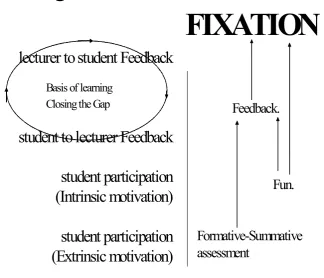
[image:4.595.107.432.344.622.2]Mentokwski (2000) states that “Learning that endures is transformative”. There is little point of a lecture that is forgotten. Our goal in a lecture is to explore a concept through studenttutor dialogue and feedback and to associate this concept with both cognitive and affective triggers that can aid recall for subsequent use. Fixation refers to the internalisation of a concept in both the cognitive and affective domains.
Figure 1: The F
4model
Diagram illustrating the relationship between the 4 FeFiFoFun elements and identifying the contribution each element makes to student learning within the lecture.
lecturer to student Feedback
student to lecturer Feedback
student participation
(Intrinsic motivation)
student participation
(Extrinsic motivation)
Feedback.
Fun.
FormativeSummative
assessment
Basis of learning
Closing the Gap
FIXATION
FIXATION
.
.
F
4
Integration
The principal characteristic of the F 4 lecture is the integration of the four elements
Designing an F
4Lecture.
The process of designing an F 4 Lecture is a 6 step process. The design questions are:
1. What is the key point of this lecture?
2. What are the milestones in students understanding this key point?
3. What type of feedback mechanism is to be used at the milestones to check student understanding?
4. Which aspect of the summative assessment mirrors this feedback mechanism?
5. What are the milestone questions?
6. Which resources will be used to emphasise and explore the key point?
Recommendations.
It is imperative not to lose sight of what you are trying to achieve in the lecture. The F 4 lecture is not primarily a forum for dissemination or delivery but an opportunity for added value via a mass event. Fixation on a small set of critical material (as opposed to syllabus dissemination) frees the lecturer to really focus on inspiring students as well as being able to address a concept fully. The lecture therefore becomes learningdriven (rather than time, syllabus or process driven) and supports permanence and deep learning. Therefore, whilst the planning and design of the lecture and the selection of resources is important, of more
importance is the lecturer's flexibility at milestone points to react immediately to student need and not to stick to a predetermined script. Student engagement with the lecture is the critical success factor and the F 4 approach works best if the rationale is explained to students.
The F 4 model has been used successfully over a number of years in teaching large
cohorts of first and second year students on information systems related courses at Leeds Metropolitan University and Sheffield Hallam University. Although a minority of students indicated through feedback that they had not perceived the benefits of the model the vast majority of feedback was positive and attendance at the F 4 lectures was high.
Whilst it is of course possible to easily incorporate only a subset of the elements of the F 4 approach into the lecture (many of our colleagues, for example,
routinely use music or coloured cards) with benefit, fixation of key concepts is best achieved through adoption of the full model as described in this paper.
References
Boud and Garrick, 1999: quoted in Hartley, P., Woods, A. and Pill, M. eds.(2005), Enhancing Teaching in Higher Education New Approaches to Improving Student
Learning. London: Routhledge Tayor & Francis Group.
Dibben, N ‘What is Music?’,
Universityhttp://www.open2.net/historyandthearts/arts/music251204.html
Jarvis, J, Dyson J and Burchell H (2004) Learning through creating stories: developing student teachers’ understanding of the experiences of pupils within special educational needs in mainstream classrooms. Paper presented at the annual meeting of the British Educational Research Association Conference, September 2004 Manchester UK, http//
www.leeds.ac.uk/educo/documents/00003733.htm
Lamont, A. (2005) Child of our time 2005
Mentokwski Marcia and Associates, Learning that Lasts, Integrating Learning,
Development, and Performance in Colege and Beyond, JoseyBass Publishers,
2000
Murray, H.G. (1997) Effective teaching behaviours in the college classroom in
Knight P.T. (2002), Being a Teacher in Higher Education, Open University Press
Pickford R and Clothier, H (2003) Ask the audience: A simple teaching method to improve the learning experience in large lectures, Teaching, Learning and
Assessment in Databases, 2003,
http://www.ics.ltsn.ac.uk/pub/databases03/PICKFORD.pdf
Powell, N.J., Moore, D., Gray J., Finlay, J. and Reaney, J. (2004) ‘Dyslexia and Learning Computer Programming’, ITALICS (Innovations in Teaching And Learning in Information and Computer Sciences), (online journal) 3,2.
Rodgers, A. (2005) Teaching Adults, Open University Press.
Stewart, J. in Field, J. Evaluation through storytelling, heacademy.ac.uk