Citation:
Southby, K and Rodgers, F and Robinson, J (2018) ’Feel Good’ evaluation report. Project Report. Centre for Health Promotion Research (CHPR) at Leeds Beckett University.
Link to Leeds Beckett Repository record: http://eprints.leedsbeckett.ac.uk/4774/
Document Version: Monograph
Creative Commons: Attribution 4.0
The aim of the Leeds Beckett Repository is to provide open access to our research, as required by funder policies and permitted by publishers and copyright law.
The Leeds Beckett repository holds a wide range of publications, each of which has been checked for copyright and the relevant embargo period has been applied by the Research Services team.
We operate on a standard take-down policy. If you are the author or publisher of an output and you would like it removed from the repository, please contact us and we will investigate on a case-by-case basis.
Feel Good
Evaluation Report
1
Introduction
Feel Good is an eight-week programme delivered by Purple Patch Arts1 (PPA) to increase the mental
health and wellbeing self-care efficacy of individuals with a learning disability and the professionals who support them. It consists of: (1) a mapping of mental health and wellbeing provision within a service; (2) seven weekly sessions to enhance individuals’ knowledge of health and wellbeing strategies, based on exercise, healthy food and relaxation techniques from around the world; (3) mental health and wellbeing action planning co-production, including the dissemination of a resource pack to the service; and (4) a review of service needs to embed action plans. Specific objectives of Feel Good are:
1. Improve the social and emotional wellbeing of individuals with learning disabilities (for example, social isolation, a sense of belonging, amount of exercise)
2. Individuals with learning disabilities are better able to maintain good mental health and wellbeing through self-care
3. Professionals who support individuals with a learning disability improve skills in supporting service users to maintain good mental health and wellbeing through self-care
4. Community-based services for individuals with a learning disability increase provision of accessible mental health and wellbeing interventions
This report presents findings from an evaluation of the Feel Good programme delivered to The Boot Shop in Easingwold from June to September 2017 and Horton Housing Community Café in Selby from September to November 2017, funded by Tees, Esk and Wear Valley NHS Foundation Trust Innovation Fund.
1 Purple Patch Arts is a not-for-profit social enterprise based in Leeds that aims to improve the lives and life chances of people with a learning disability through the provision of education and training for people with a learning disability and the professionals that support them (www.purplepatcharts.org)
ABOUT THE EVALUATION: WHAT DID WE DO?
The evaluation methodology was co-produced between Kris Southby from the Centre for Health Promotion Research (CHPR) at Leeds Beckett University and Fran Rodgers and Jessica Robinson from Purple Patch Arts (PPA).
Service managers from Horton Housing and The Boot Shop were interviewed about their health and wellbeing service provision prior to Feel Good taking place.
During the weekly sessions, a staff member from PPA observed the participants and recorded their engagement on an ‘outcomes tick list’. Participants (n=24) also completed a standardised wellbeing assessment tool (WEMWBS) prior to Feel Good and then again at the end.
Where possible service staff where surveyed before and after Feel Good to assess the impact of the programme on their practice.
2
Results
Participants’ mental health and wellbeing, including their social isolation, belonging, and exercise level
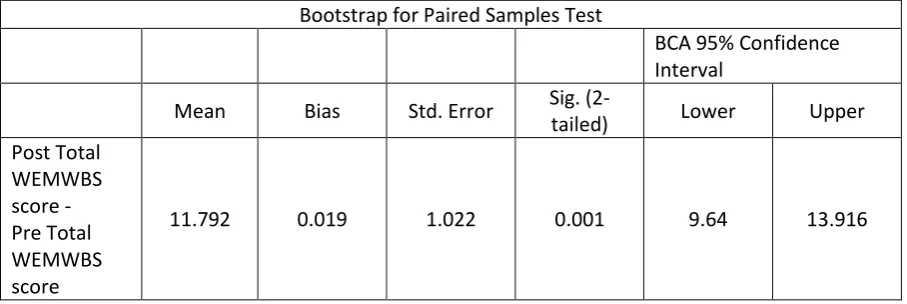
Across both Horton Housing and The Boot Shop, Feel Good resulted in a statistically significant (p=0.01) improvement in participants’ wellbeing, based on the WEMWBS data. The mean wellbeing score improved by 11.8 points (SD=5.1) (Table 1), an unequivocally meaningful improvement in wellbeing 2.
Bootstrap for Paired Samples Test
BCA 95% Confidence Interval
Mean Bias Std. Error Sig.
(2-tailed) Lower Upper Post Total
WEMWBS score - Pre Total WEMWBS score
[image:4.595.72.526.210.362.2]11.792 0.019 1.022 0.001 9.64 13.916
Table 1 Pre- and Post-Feel Good Paired-sample T-Test
Figure 1 shows the improved wellbeing scores of participants at Horton Housing and The Boot Shop. Participants’ wellbeing improved across all items of the wellbeing scale. This suggests that Feel Good improved participants’ wellbeing in a general sense rather than only specific aspects.
2 Taggart, F. & Stewart-Brown, S. (2012). Using and Analysing WEMWBS to measure the impact of
interventions in improving mental wellbeing October 23rd Workshop Workbook. Warwick: Coventry City Council
3
Figure 1 Improvements in WEMWBS scores pre- and post-Feel Good
Prior to Feel Good, service users at The Boot Shop were described as reluctant to go out, try new activities or look at improving their health. Following the Feel Good sessions, participants at The Boot Shop showed improvements in confidence; they were less fearful about going out and trying new things after Feel Good. Staff said that participants were fully engaged in the sensory sessions and felt their health had improved because of the physical exercise. Staff described the positive impact on individual participants:
“[He] can be very bad tempered but is more engaged as a result of the PPA intervention”
“Has extreme OCD but is now touching and engaging with resources, which is a massive breakthrough!”
“Has grown in confidence and often helps others”
Feel Good was thought to have had a similar positive impact on participants at Horton Housing. Prior to Feel Good, most service users rarely engaged in physical exercise and most stayed within
41.5
52.1
Mean WEMWBS score (The Boot Shop)
Before Feel Good After Feel Good
40.9
53.5
Mean WEMWBS score (Horton Housing)
Before Feel Good After Feel Good
Optimistic Useful
Relaxed
Interested
Energy to spare
Dealing with…
Thinking clearly Good about…
Close to other… Confident Make up my…
Loved Interested
Cheerful
Changes to mean WEMWBS score for each item (Horton Housing)
Before Feel Good After Feel Good
Optimistic Useful
Relaxed
Interested
Energy to spare
Dealing with problems Thinking clearly Good about
myself Close to other
people Confident Make up my
own mind Loved Interested
Cheerful
Changes to mean WEMWBS score for each item (The Boot Shop)
4 established social groups. Following the intervention, there has been a noticeable difference in participants’ confidence, as they have become more outgoing and established new friendships. Participants are now more inclined to mix with people they do not know and are also much more open to trying new activities.
“[She] has gained confidence and is much more sociable and able to try new things”
“[He] shows enjoyment during activities but otherwise seems quite low”
Friendships have been established because of the intervention. Overall, the service has become a more open and welcoming place because of service users gaining confidence in speaking to new people and leading activities.
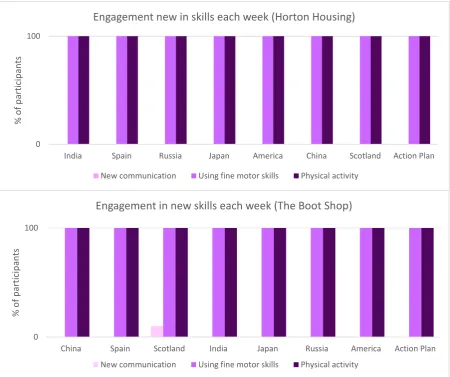
[image:6.595.73.524.245.622.2]Observations showed that Feel Good participants at both Horton Housing and The Boot Shop engaged in new physical activity and fine motor skills each week (Figure 2). One participant at The Boot Shop also exhibited a new communication during the third weekly session.
Figure 2 Feel Good Participants engagement in new physical activity, using fine motor skills, and new communication
0 100
India Spain Russia Japan America China Scotland Action Plan
%
o
f
p
ar
ticip
an
ts
Engagement new in skills each week (Horton Housing)
New communication Using fine motor skills Physical activity
0 100
China Spain Scotland India Japan Russia America Action Plan
%
o
f
p
ar
ticip
an
ts
Engagement in new skills each week (The Boot Shop)
5 Service users’ mental health and wellbeing self-care
The focus of Feel Good is to equip adults with a learning disability and the people that support them with the skills to manage their mental health and wellbeing better. Over the course of the
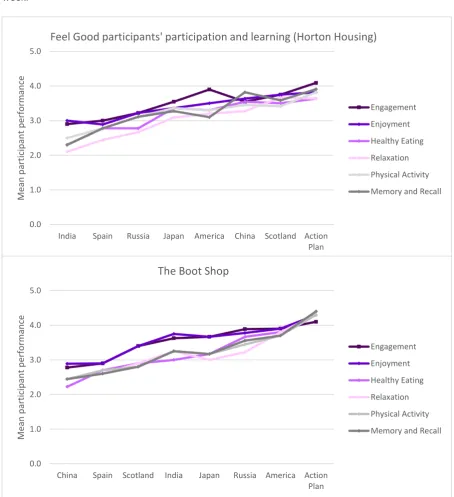
programme, participants at both Horton Housing and The Boot Shop improved their knowledge of healthy eating, relaxation techniques, physical activity, and memory and recall (Figure 3).
[image:7.595.70.525.176.674.2]Moreover, participants’ engagement with, and enjoyment of, the Feel Good activities increased each week.
Figure 3 Participants' perceived performance in Feel Good learning activities
Staff understanding and skill to support service users in maintaining good mental health and wellbeing
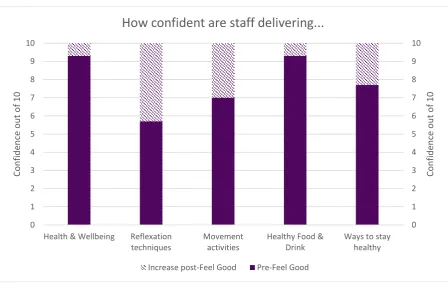
Partial data from staff at The Boot Shop indicates the positive impact of Feel Good on staff understanding and skill to support service users to maintain good health and wellbeing (Figure 4). Whilst staff were very confident delivering activities and information about health and wellbeing and
0.0 1.0 2.0 3.0 4.0 5.0
India Spain Russia Japan America China Scotland Action Plan Me an p ar ticip an t p erf o rm an ce
Feel Good participants' participation and learning (Horton Housing)
Engagement
Enjoyment
Healthy Eating
Relaxation
Physical Activity
Memory and Recall
0.0 1.0 2.0 3.0 4.0 5.0
China Spain Scotland India Japan Russia America Action Plan Me an p ar ticip an t p erf o rm an ce
The Boot Shop
Engagement
Enjoyment
Healthy Eating
Relaxation
Physical Activity
6 healthy eating prior to Feel Good, they were less confident about relaxation techniques and
[image:8.595.74.523.133.416.2]movement activities. At the end of the programme, staff were equally very confident across all domains. The greatest impact of Feel Good on staff confidence and skill was around relaxation techniques.
Figure 4 Staff skill and confidence to support service users to maintain good mental health and wellbeing
Staff at The Boot Shop generally knew the participants and were comfortable dealing with their day-to-day needs and discussing healthy living with them. However, staff sometimes struggled to come up with appropriate activities for the skills and abilities of all participants; ideas around activities that promote healthy living would be beneficial. Now, The Boot Shop staff are much more confident in delivering activities because of Feel Good. The Boot Shop services have been redesigned so that they offer differentiated activities for people with mild, moderate and severe learning disabilities, including all levels of experience and capabilities. Staff are planning their own sessions using the materials provided by PPA. Physical exercise is built into the sessions, which is hugely beneficial to the health and wellbeing of participants, and staff use a variety of games and sensory resources to engage all participants as much as possible. Without Feel Good, The Boot Shop would have continued doing things as they were, offering services that were not suitable for all users.
The Horton Housing service is a community café and so the staff who run the café rarely have time to deliver activities either before or after Feel Good. However, Feel Good has influenced staffing at Horton Housing in relation to service users’ mental health and wellbeing in that two participants have volunteered to continue leading activities and feel confident to do so. The manager is more able to support the volunteers now because of the materials that PPA provided as part of Feel Good, including session plans and resources.
The availability of accessible mental health and wellbeing interventions within community-based services taking part in Feel Good
Feel Good has positively affected the availability of accessible mental health and wellbeing
interventions for people with a learning disability within both The Boot Shop and Horton Housing. 0 1 2 3 4 5 6 7 8 9 10 0 1 2 3 4 5 6 7 8 9 10
Health & Wellbeing Reflexation techniques
Movement activities
Healthy Food & Drink
Ways to stay healthy Con fid en ce o u t o f 10 Con fid en ce o u t o f 10
How confident are staff delivering...
7 Prior to Feel Good, The Boot Shop ran men’s and women’s health groups to discuss general, sexual, mental and emotional wellbeing; evening drama sessions; and arts and crafts sessions where participants made furniture, cushions, gifts, etc. to sell. The activities, collectively, provided opportunities for people to socialise, improve teamwork and confidence, and gave participants a feeling of self-worth. However, it was felt that many participants lacked the skills and/or capabilities to participate and needed a more therapeutic and sensory approach. As a result of Feel Good, The Boot Shop have started a weekly sensory session that is held in a local community centre that participants from The Boot Shop and other residential homes attend. Each week they have a theme and use the PPA session plans provided to plan activities. Moreover, Feel Good has led to The Boot Shop management separating and streamlining their activities to meet the needs of service users better. There is now The Boot Shop (support), The Boot Camp (sensory), The Big Shed (furniture restoration) and The Craft Club (sewing and textiles). This has led to a more rounded approach, particularly around wellbeing – rather than just focusing on healthy eating – which in turn has resulted in improvements in attendee’s health, confidence and anxiety levels. This has also helped management to track progress and meet objectives.
Horton Housing is a free community café to reach and engage isolated individuals. The focus is on socialising and most participants come to have lunch, see people and play bingo. There are some established friendships within the group. Prior to Feel Good, very few activities were thought to focus on ‘health and wellbeing’, and there was no funding to pay for services. They had a computer group for participants to learn the basics of computing, emailing, and internet use. They occasionally had presentations from visitors, such as police, medical professionals and social workers, around health, wellbeing, and safety, although the delivery was not appropriate for those with more complex needs. The lack of funding and staff time resulted in users becoming disengaged from activities. Following Feel Good, whilst Horton Housing have not started any new groups or activities, they now recognise the impact their work is having on the health and wellbeing of participants. In the follow-up interview, the service manager spoke about how everyone enjoys the bingo sessions and fully engages. Moreover, two participants from the Feel Good programme have volunteered to lead weekly activities using the PPA resource pack. Horton Housing staff are able to support this within their time and budget constraints. Overall, Horton Housing has become a more welcoming place because of Feel Good.
Conclusion
Feel Good is intended to increase the mental health and wellbeing self-care efficacy of individuals with a learning disability and the professionals who support them. The programme had a significant positive impact on participants’ wellbeing and many showed increasing knowledge of healthy eating, relaxation techniques, physical activity, and memory and recall.
Feel Good also positively impacted service provision at The Boot Shop and Horton Housing. The Feel Good programme modelled how activities could be differentiated, enabling everyone to be