Citation:
Southby, K and O’Dwyer, L (2015) Barriers to non-’bed-based’ respite - final report. Project Report. Leeds North Clinical Commissioning Group. (Unpublished)
Link to Leeds Beckett Repository record: http://eprints.leedsbeckett.ac.uk/2075/
Document Version: Monograph
The aim of the Leeds Beckett Repository is to provide open access to our research, as required by funder policies and permitted by publishers and copyright law.
The Leeds Beckett repository holds a wide range of publications, each of which has been checked for copyright and the relevant embargo period has been applied by the Research Services team.
We operate on a standard take-down policy. If you are the author or publisher of an output and you would like it removed from the repository, please contact us and we will investigate on a case-by-case basis.
1
LEEDS BECKETT UNIVERSITY
Barriers to non-‘bed-based’
respite - final report
Dr. Kris Southby & Dr. Leonie O’Dwyer
December 2015
2
Contents
Executive summary ... 3
Background and context ... 4
Methodology ... 6
Literature review ... 9
Findings ... 16
Carers and service users in transition & aspirations for future respite provision ... 28
Conclusions and issues for consideration ... 30
References ... 32
Appendix 1: Carers Survey ... 34
Appendix 2: Carers survey respondents ... 36
3
Executive summary
Despite the availability of different options, the vast majority of respite care in Leeds for people with
a learning disability and/or autism with moderate to complex needs takes place in bed-based
settings. The aim of this project has been to understand the actual or perceived barriers to
non-bed-based respite and what can be done to overcome these barriers.
A mixed-methods design was used to capture a ‘360 degree’ view of barriers to non-bed-based
respite. This included a literature review, postal survey with carers, semi-structured interviews with
carers and relevant stakeholders, and consultation with service users via the Leeds Learning Disability People’s Parliament.
Whilst the majority of carers felt they knew something about respite services in Leeds and that they
could choose between bed-based and non-bed-based respite, the default position for most
carers, service users and stakeholders is that respite is a bed-based activity, specifically in a
residential facility.
Carers and service users highly value bed-based respite because of the benefits it brings, including the opportunity for service users and carers to have a ‘break’, for service users to
socialise with peers, and for service users to learn independence. Non-bed-based respite is not
as well regarded and most carers would not want to use non-bed-based respite instead of
bed-based respite. Non-bed-based respite may have some appeal in facilitating service users to
go on holiday.
Not wanting to lose bed-based respite, service users enjoying bed-based respite, fearing
non-bed-based respite would not be enough of a break, and carers not knowing enough
about non-bed-based respite appear to be the most prominent barriers to carers and service
users not availing non-bed-based respite. Concerns about the inappropriateness of staff and
venues was a prominent barrier to non-bed-based respite for carers of people with complex health
problems and autism.
A number of suggestions for local and structural changes have been made about how respite
services should be delivered in the future. Carers, service users and practitioners should be made more aware of the range of respite provisions available in the city. A ‘menu’ of available services
and the opportunity to trial different services may allow carers to dispel any preconceptions about
non-bed-based respite and make more informed choices. Information could be available from a
4
Background and context
Respite care is the provision of short-term support to allow carers some relief from their caring duties and to help them continue caring (Box 1). The vast majority of respite in Leeds – circa 13,591 nights per annum – is currently in ‘bed-based’ placements. Leeds North Clinical
Commissioning Group (CCG) and Leeds Adult Social Care expect the demand for respite to only increase, particularly from young people ‘transitioning’ from Children’s Services and from people
with complex health needs and autism. As such, there is a need for the use of bed-based and
non-bed-based respite to become more equitable.
Leeds North CCG and Leeds Adult Social Care, Leeds City Council, have led a strategic review of
respite services for adults with a learning disability and/or autism. There remains a need though to
capture insight from service users, their carers and stakeholders around the primacy of bed-based
respite.
Box 1: Respite care provision in Leeds
In Leeds, adults with a learning disability and/or autism and their carers are assessed as to
their respite need. Those eligible work with a Care Manager to arrange the most appropriate
respite. Choices include:
- Residential placements in local authority, NHS or third party managed facilities
- Community based respite, including a Shared Lives scheme where service users are
cared for by somebody in the community
- One-off breaks, holidays and leisure activities in mainstream settings.
Respite services can be classified as either ‘bed-based’ or ‘non-bed-based’. Bed-based
respite is when a service user is cared for away from home for one or more nights. Non-bed-based is when a service user is cared for by someone other than their usual carer – care may
be overnight but in the service users own home. (In this instance, holidays are also considered
non-bed-based respite).
The chosen respite activity is then funded by Leeds Adult Social Care and/or the NHS.
Alternatively, carers can chose to manage the cost of care themselves through a ‘Personal Budget’. This means they allocate the funding received by the person they care for
5 The aim of this review is to understand the actual or perceived barriers to non-bed-based
respite for adults with a learning disability and/or autism with moderate to complex needs
and what mitigating factors can be put in place to counter concerns.
Specific objectives are:
1. Scope published literature for prior learning concerning the usage of non-bed-based respite
for adults with a learning disability and/or autism with moderate to complex needs.
2. Identify levels of knowledge and awareness about respite services in Leeds, particularly
alternatives to bed-based respite, among service users and carers,
3. Capture service user, carer and stakeholder perceptions of current respite in Leeds.
4. Understand the perceived or actual barriers towards non-bed-based respite and document
any solutions.
5. Capture specific issues encountered by service users and carers in transition from Children’s Services to Adult Social Care, including their respite aspirations for the future.
Achieving these objectives will inform more effective utilisation of capacity across the respite
system in Leeds to cope with the increasing demand now and in the future.
Organisation of the report
This report is comprised of four sections. Firstly, a brief overview of the methodological approach
to the review follows; this outlines the process by which the data was gathered and analysed.
Existing knowledge in published literature concerning barriers to non-bed-based respite is then
presented before moving on to discuss the findings of data collection. Finally, conclusions and
6
Methodology
This section briefly summarises the methodological approach adopted for this review, including
how data was collected and analysed.
The project sought to gain a ‘360 degree’ view of the barriers to non-bed-based respite for
people with a learning disability and/or autism with moderate to complex needs in Leeds.
Drawing on qualitative and quantitative data in a mixed methods design allowed a rich
understanding of carers and stakeholders lived experience to be triangulated against an
overarching perspective, producing more substantive learning (Cresswell and Plano-Clark, 2011).
Literature review
Leeds Beckett University’s ‘Discover’ database was searched for published literature regarding
barriers to non-bed-based respite for people with a learning disability and/or autism. Eighteen
relevant publications were identified and data extracted.
Carers survey
A postal survey was the main data collection tool for assessing carers’ awareness of respite
services in Leeds and the appeal of, and barriers to, non-bed-based respite (Appendix 1). This approach enabled a large number of carers to add their ‘voice’ to the project and provided an overarching perspective of carers’ understanding and perception of respite in Leeds (Bryman,
2012)1.
127 completed surveys were returned out of 393 sent to carers (Box 2). A 32% response rate
coupled with the distribution of respondents (Appendix 2) suggests the survey results may have
some generalizability to other carers of people with a learning disability and/autism with moderate
to complex needs who access respite in Leeds.
7 The survey also invited carers to be interviewed about their views and experiences of respite in
more detail. 28 respondents indicated a willingness to take part.
Interviews
Semi-structured interviews illuminated the ‘lived experience’ (Savin-Baden and Major, 2013) of the
barriers to non-bed-based respite. Interviewees were asked about their understanding of respite in
Leeds, experiences of barriers to non-bed-based respite, and how respite could be improved
(Appendix 3). All interviews were audio recorded. Participants unable to be interviewed
face-to-face or over the telephone were invited to respond via email.
Carers initially volunteered to be interviewed at the end of the carer’s survey. A random sample
was then approached to take part. Stakeholders were purposively sampled by the project team
based on their relevance to the project aims and objectives.
15 interviews were conducted, including 7 with carers of respite service users (CA) and 8
with stakeholders (ST) from Shared Lives, Learning Disability Care Management teams, Carers
Leeds, Aspire, and other third sector organisations. It was not possible to interview any carers in ‘transition’.
‘Learning Disability Community Support’, ‘Leeds Shared Lives’ and the ‘Joint Care Management Team (Learning Disability)’ provided contact details of carers of current respite users.
Postal survey sent to 393 carers – along with information sheet and return envelope
127 completed surveys returned – 32% response rate
8
Service user consultation on the findings
An interim report, documenting the findings of the carers survey and semi-structured interviews, was presented at the Leeds Learning Disability People’s Parliament on the 24th November 2014.
The meeting was attended by around fifty people, including people with a learning disability (N≈38), advocates from Advonet (N≈7), and other presenters (N≈5). The majority of the people
with a learning disability in attendance were current or ex- respite service users. Attendees were invited to comment on the results and were asked three specific questions: ‘what is respite?’, ‘why don’t people like non-residential respite?’ and ‘what should change in the future?’. Attendees
worked in groups to discuss each questions and record their answers on a large piece of paper.
The outcomes of the consultation are presented in this report as the voice of service users.
Data analysis
Interviews were analysed following a reflexive, iterative process. A common data extraction
framework was devised based on key concepts pertinent to the projects primary objectives and
populated with extracts from each interview. Results were then brought together and written up alongside the carer’s survey results.
Quantitative data derived from the carer’s survey was transferred to the computer programme
SPSS. From there data was subject to appropriate descriptive and inferential statistical techniques.
9
Literature review
Eighteen relevant publications, published between 1983 and 2011, were identified through the
literature search. The publications were based on research carried out in the United Kingdom
(n=9), the Republic of Ireland (n=6) and the United States of America (n=3). There are sufficient
similarities, particularly in conceptualisations of, and policy responses to, learning disability and
autism for research findings to be applied across these borders.
The publications are predominantly based on primary research (n=16), including surveys (n=6),
qualitative methods (n=7), mixed methods (3) and a quasi-experimental design (n=1). Two
publications draw on secondary research (i.e. literature reviews).
The aims of the identified research papers are diffuse. No papers specifically examine the
perceived or actual barriers to non-bed-based respite. Rather, a common theme is the different
experiences and outcomes of availing respite services more generally.
A number of papers (i.e. Power, 2009, Wilkie and Barr, 2008) focus on the experience of carers of
children with a learning disability and/or autism. These papers are included in this review as they
illuminate barriers to availing respite.
Purpose and importance of respite
Caring for someone with a learning disability and/or autism with moderate to complex needs can
be stressful (Redmond and Richardson, 2003). The function of respite is to alleviate such stress and burden by providing a “temporary relief service” from the demands of continual caregiving
(Cotterill et al., 1997, Mac Donald et al., 2007, Upshur, 1983:13, Wilkie and Barr, 2008). In doing so, respite provides carers a sense of renewal and confidence to continue caring; “a lifeline to [carers]…giving them the time and space to recharge their batteries” (Wilkie and Barr, 2008:30). It
is the single most helpful service for families and, where not available, the most needed (McGill et
al., 2006, Petr et al., 1991). Respite care can also benefit service users, encouraging the
development of independence, facilitate a wide range of social opportunities, and offer the chance
to become more involved in the community (Wilkie and Barr, 2008).
Power (2009) identifies the period immediately following the end of a child’s formal education as a
particularly stressful time for carers (and service users) as special or mainstream schooling can no
longer be relied upon for support or indirect respite. Despite its apparent importance, a lack of respite services during this ‘transition’ is a significant gap in provision (Power, 2009).
If delivered at inappropriate times, however, respite has little effect on relieving carers’ stress and
10 historical transition from institutional to community care for people with a learning disability and/or
autism (Mac Donald et al., 2007), respite should not be used to sustain placement at home which
is inappropriate (McGrotherp et al., 1993).
Structure of respite
Different formats and structures of respite are described in the identified publications, including distinctions between ‘in-home’ and ‘out-of-home’ services (Cotterill et al., 1997) and residential
care in specialist facilities and residential care in other, multipurpose facilities (i.e. hospitals,
nursing homes) (Upshur, 1983). In practise, however, ‘respite’ most commonly refers to
service users staying overnight in a residential facility (Wilkie & Barr, 2008; McConkey et al,
2011).
The literature suggests there is some desire for non-bed-based respite among carers and
stakeholders. Wilkie and Barr (2008) highlight a desire for home-based support, including
home-to-home schemes where people are cared for by another family in their home-to-home, and more leisure
opportunities. Similarly, Cotterill et al. (1997) describe carers wanting more flexible short term
provision, including part-day, weekend and evening services delivered in a family setting. The
availability of non-residential respite varies, however. In-home and community-care based
respite are perhaps more likely to be available to children (Cotterill et al., 1997) and service
users with lesser impairments and support needs (Power, 2009).
Person centred planning
A strong theme in the identified publications is that respite services should be tailored to the needs
of service users, not the state, and be delivered with a commitment to the family (Petr et al., 1991,
Truesdale-Kennedy et al., 2006, Wilkie and Barr, 2008, HM Government, 2008, Mansell and
Wilson, 2010). A comprehensive range of respite services designed to meet a variety of
family needs should be available to individual service users, including ordinary holidays,
family based respite, familiarisation services and services for people with challenging behaviour
(Cotterill et al., 1997, Upshur, 1983).
‘Person-centred care planning’ is advocated to meet the individual needs of families. Carers
appreciate a person-centred approach in identifying the particular needs of the person in their care
and giving them a vision for the future (Truesdale-Kennedy et al., 2006). Person-centred
planning and flexible service provision is likely to become more important in the future as
family structures change over time, including more single parents, working mothers and less
11 More emphasis on addressing individual family and service user need through “adopting a needs-led philosophy” is central to delivering a more cost effective service (Cotterill et al., 1997:785,
McConkey et al., 2011). In order to meet the challenges faced by families, public bodies should
look to diversifying their offer, including working collaboratively with lay people and
informal support networks (Wodehouse and McGill, 2009).
‘Consumer directed care’ has arisen as part of the drive to give service users and carers more
choice and flexibility in respite. Consumer directed care involves service users and carers
controlling their own care budget and making choices about the services they access, including
who will deliver the services and when. Consumer directed care allows users to source and
manage services that match the unique needs of the people they care for (Redmond and
Richardson, 2003). In some instances, consumer directed care can improve levels of satisfaction in
families, increase carer employment, minimise out-of-pocket expenses, and reduce institutional
placements (Caldwell, 2007, Redmond and Richardson, 2003). However, many service providers
still exist in their own silos with little regard to the demands of service users (Power, 2009). Most
research exploring the benefits of consumer directed care focuses on the experience of people
with physical impairments (Caldwell, 2007). Equally, none of the identified research reported on the use of ‘direct payments’ or ‘personal budgets’ in the UK.
Barriers to respite services
That parents and carers may face a number of barriers preventing access to potentially beneficial
respite services was a clear theme in the identified literature. Power (2009:97) describes an
‘implementation gap’ between political rhetoric regarding service provision and largely “cosmetic on the ground” services. This has created a scenario where carers felt services were lacking in both
availability and quality (Power, 2009), and that service providers frequently failed to understand carers’ reticence to avail themselves of services that might be of value (Mansell and Wilson, 2010).
Lack of information
The availability of useful information is vital to the sustainability of families as carers (Redmond and
Richardson, 2003). Yet the most significant barrier to availing respite concerned the difficulty
of accessing relevant and comprehensive information about services (Cotterill et al., 1997,
Redmond and Richardson, 2003, Wilkie and Barr, 2008).
The process of gaining information is haphazard, with carers often referred to speak to
different officials and receiving conflicting information (Redmond and Richardson, 2003, Power,
2009). Carers instead rely on informal networks, including friends, family, other contacts and the
12 A centralised service (i.e. a telephone line) may be an effective method for providing carers with
information, advocacy and support to avail essential services, including respite (Redmond and
Richardson, 2003). Dedicated project staff or volunteers to support carers may also make
accessing respite easier (Truesdale-Kennedy et al., 2006). However, the apparent information deficit may be a “smokescreen for the service users” to cover the gap between the aims of
ambitious political programmes and limited resources to fund them properly (Power, 2009:94-95).
Eligibility
Restrictive eligibility criteria prevents access to respite (Cotterill et al., 1997, Redmond and Richardson, 2003). The most prominent example of not ‘fitting’ inclusion criteria related to
challenging behaviour (McGill et al., 2006), with carers of people exhibiting serious challenging
behaviour very often not receiving adequate support. Age may also be a factor (Redmond and
Richardson, 2003), with some services only available to users of a given age.
Exclusion from respite forces carers to either purchase appropriate services themselves or go
without (Redmond and Richardson, 2003).
Time and location
Physical and temporal barriers to respite limit carers availing of services. A lack of “regular, reliable and continuous support” was described (Wilkie and Barr, 2008, Wodehouse and McGill,
2009:651). Respite offered when service users already attend a regularly scheduled event was
inappropriate (McGill et al., 2006, Wilkie and Barr, 2008). This was particularly the case for respite
offered during the day.
With regard to location, respite delivered locally is highly valued by carers (Cotterill et al., 1997,
Redmond and Richardson, 2003, Wilkie and Barr, 2008). Although most carers face difficulties
relating to the availability of appropriate services in their local area, a dearth of local services is
most keenly felt in rural areas (Redmond and Richardson, 2003).
Admin/bureaucracy
Administrative delays and bureaucracy in the organisation of respite adds to the strain of
caring for someone with a learning disability and/or autism, and provides a barrier to
accessing services (Redmond and Richardson, 2003). Supportive and understanding attitudes from providers and flexibility in delivery are crucial in meeting service users’ requirements (Power,
13 It is not only carers and service users who find systems confusing, however. A lack of clarity about
responsibilities can be inherent in the organisational structures of service providers (Redmond and
Richardson, 2003).
Guilt and worry
Feelings of guilt, embarrassment and increased stress can prevent carers from utilising
respite (Cotterill et al., 1997, Hartrey and Wells, 2003, Wilkie and Barr, 2008). Redmond and
Richardson (2003) report mothers feeling a strain or worry when their child was in an environment
with children with different needs. Other carers worry their use of respite indicates an inability to
cope (Mac Donald et al., 2007).
Negative emotions associated with respite often ease after a short period of time (Wilkie and Barr, 2008). Feeling happy and confident in a service allays carers’ feelings of guilt and anxiety, enabling
them to benefit more from the break (Cotterill et al., 1997). Reducing the stress associated with respite also occurs by having regular respite in the carer’s home and establishing a
long-term relationship with a particular respite care provider (Hartrey and Wells, 2003).
Inappropriate venue/staff/service
Carer perception of the appropriateness of respite may play a crucial role in determining
whether or not families avail of services (Mac Donald et al., 2007). Carers experience anxiety
about the perceived quality of provision (Cotterill et al., 1997, Wodehouse and McGill, 2009, Mac
Donald et al., 2007, Caples and Sweeney, 2011), including
- The suitability of the environment and facilities - The reliability of the service
- The knowledge, training and competency of staff
- Lack of rapport between service users and staff
- Service users in an environment alongside people with different support needs
These barriers are most keenly felt by those with complex medical needs or challenging
behaviour.
Human capital and personal characteristics
Availing of respite services may relate to the personal characteristics of carers. Carers who are
tenacious in their pursuit of services and more articulate middle-class families with financial and
14 al., 2006). Family size and the availability of social support networks may not affect the likelihood
of a family using respite (Mac Donald et al., 2007).
Cultural and religious
Carers from ethnic minority backgrounds underuse community care and respite services compared
to other ethnic groups (Dura-Vila and Hodes, 2009, McGrother et al., 2002). It is a myth, however,
that people from minority ethnic communities have lower levels of need for respite services
(McGrother et al., 2002).
Carers from minority ethnic backgrounds are less likely to be aware of respite services and are
more likely to encounter additional barriers preventing them availing of services. Social, cultural and religious values and beliefs about the cause and concept of ‘learning disability’ may
result in the underutilisation of respite (McGrother et al., 2002). Concerns also exist about a lack of
culturally appropriate diet, facilities for washing and purifying, and language needs within respite
(Cotterill et al., 1997, Dura-Vila and Hodes, 2009, McGrother et al., 2002). As such, carers from
minority ethnic communities may be more inclined to express a need for family-based respite
(Cotterill et al., 1997).
Gaps in the literature
There are gaps in the evidence base regarding barriers to non-bed-based respite for adults with a
learning disability and/or autism with moderate to complex needs.
Foremost is the dearth of research specifically exploring the experience of, and barriers to, availing non-bed-based services as oppose to barriers for accessing ‘respite’ more
generally.
It also appears that service planning and provision is made – consciously or unconsciously – in accordance with ‘white’ norms, with a lack of accessible information and knowledge
sharing with minority ethnic communities. It is critical that service providers and future
research examine culturally based assumptions about caring and the needs of minority
ethnic communities.
Limitations of this review
Given the resources, it was not our intention to conduct a full systematic review of the barriers to
non-bed-based respite care for adults with a learning disability and/or autism with moderate to
15 Our search of key academic databases uncovered no papers reporting specifically the barriers to
non-bed-based respite. This could mean that a more comprehensive search of published and grey
literature would have uncovered further work.
Notwithstanding this, this review has captured learning and outcomes concerning barriers to
availing of respite services. These points of learning are transferable and will be discussed later in
16
Findings
This section brings together data gathered across the carers’ survey, interviews with carers and stakeholders, and from the People’s Parliament consultation to address the pre-defined objectives
of the project: 1) knowledge and awareness of respite services in Leeds; 2) perceptions of current
respite provision; 3) perceived or actual barriers to non-bed-based respite; and 4) aspirations for
future respite care.
Where relevant, reference is made to supporting or contradictory findings from the identified
research literature.
Knowledge and awareness about respite services in Leeds
Previous research suggests a lack of knowledge and awareness of respite services among carers
(Cotterill et al., 1997, Redmond and Richardson, 2003, Wilkie and Barr, 2008). The situation in
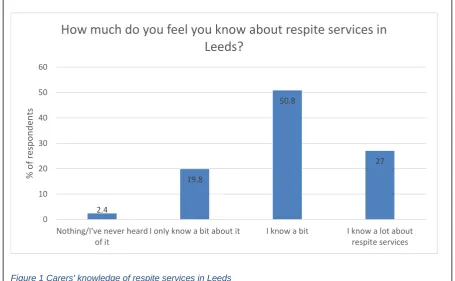
Leeds appears to be mixed (Figure 1).
[image:17.595.54.510.344.625.2]27% respondents to the carers survey feel they know ‘a lot about respite services’ in Leeds, whilst 50.8% feel they know ‘a bit’, 19.8% feel they ‘only know a bit’ and 2.4% feel they know ‘nothing/have never heard of respite’.
Figure 1 Carers' knowledge of respite services in Leeds
2.4
19.8
50.8
27
0 10 20 30 40 50 60
Nothing/I've never heard of it
I only know a bit about it I know a bit I know a lot about respite services
%
o
f
re
sp
o
n
d
en
ts
17 Spearman’s Rho2 tests revealed a small positive correlation between how much information carers
felt they had about respite and their age (r=.202, n= 126, p <.05) and the age of the person they
care for (r=.252, n=126, p<.01). A Mann-Whitney U3 test also revealed a small negative correlation
between how much information carers felt they had about respite and ethnicity (z=-2.156, p=.031,
r=-.196). This suggests that older carers, carers of older service users and carers from
white-British backgrounds feel they have more information about respite services in Leeds. No
other relationships where observed.
Just over half of respondents (54.8%) know they have a choice between residential and
non-residential respite, whilst over a third (35.7%) do not (Figure 2). A Mann-Whitney U test revealed a
small positive correlation between how knowledgeable respite services carers feel and their
awareness of a choice between residential and non-residential respite (z=-2.503, p=.012, r=0.235),
with more knowledgeable carers slightly more aware of a choice.
However, as in the identified publications, the “default position” (ST3) for most carers, stakeholders and service users is to conceptualise ‘respite’ as a bed-based service.
2 Spearman’s Rho is a non-parametric test to describe the strength and direction or the linear relationship between two variables.
[image:18.595.57.512.191.461.2]3 Mann-Whitney’s U is a non-parametric test to assess the difference between two independent groups on a continuous variable.
Figure 2 Carers' awareness of a choice between residential and non-residential respite in Leeds
54.8
35.7
9.5
0.0 10.0 20.0 30.0 40.0 50.0 60.0
Yes No Don't know
%
o
f
re
sp
o
n
d
en
ts
18 Moreover, carers and many stakeholders understand respite to mean bed-based respite
specifically in a residential facility. Service users were also generally not aware of a distinction
between bed-based and non-bed-based respite.
Carers and stakeholders recognised that “a break from caring” (ST4) can be achieved through non-bed-based activities. One stakeholder described the “creative…things people do and call it respite” (ST5). However, non-bed-based activities are not generally considered to be respite; “it would be [the service users] social needs being met…not their respite needs” (ST3).
Perceptions of current respite care provision in Leeds
Carers and stakeholders have some grievances about respite in Leeds. Carers of people with
complex autism particularly felt respite was not able to meet the need of the person they care for. Overall, though, carers generally thought respite in Leeds was “very good”, with most carers “quite happy with how things are going” (CA3). However, such positivity is a reflection of bed-based
rather than non-bed-based respite.
Bed-based respite was described as “essential” (ST1), a “lifeline” (ST1) and “a God send” (CA3)
for carers. A number of factors contribute to the importance of bed-based respite (Box 3).
Non-bed-based respite was not viewed as positively, nor does it have the same appeal, as
[image:19.595.57.515.449.725.2]bed-based respite. 55.3% of respondents thought non-residential respite was not appealing, with 39% stating that non-residential respite was ‘not appealing at all’ (Figure 3).
Figure 3 The appeal of non-residential respite
39
16.3 18.7 18.7
7.3 0 5 10 15 20 25 30 35 40 45
Not appealing at all
Not that appealing A little appealing Very appealing Don't know
% o f re sp o n d en ts
19 A Spearman’s Rho test found a small negative correlation between the appeal of non-residential
respite and both the age of carers (r=-.207, n=108, p<.031) and the age of the person they care for Box 3: Why is bed-based respite so important?
- A break from caring. Bed-based respite provides carers with a “break” (CA1) from the otherwise “24 hour responsibility” (CA2) of caring.
- Family time. Bed-based respite provides an opportunity for carers and their families to do “things that are difficult when you are caring” (ST4)
‘Usually it’s just nice to relax at home’ when son is in respite. Son ‘talks a lot’ – ‘it’s just nice to sit down with everybody else and not have to think. Not to be on guard all the time… We often sleep better… That I don’t have to get up – it’s such a treat.’ (CA5)
- Free time. Bed-based respite provides carers with an opportunity to do what they want, including “very ordinary things” (ST4) such as going to the supermarket.
- Preserving families. Family units “take a hard knock” (CA5) caring for an adult with a learning disability and/or autism. Bed-based respite relieves “a great deal of…stress” (ST1) within families.
- A suitable environment. For most carers, bed-based respite facilities are regarded as “very well equipped”, capable of dealing with service users’ complex needs and “challenging behaviour” (CA5).
- Service users have a break. Bed-based respite also provides service users with an opportunity to have a “holiday away from their carers” (ST1) and experience a different setting.
- Enjoyable for service users. Bed-based respite was thought of as an enjoyable experience for service users.
- A chance to socialise. Bed-based respite was thought of as “quite a social thing as well” (ST5), enabling service users to “mix with other people” (CA6). Carers often try and arrange bed-based respite
at times when the same service users will be attending in order to build up continuity.
- Activities. Bed-based respite includes a chance for service users to do activities they otherwise would not.
“If I’m at home with him on my own, I might think, ‘I just can’t be bothered today. And if you’re happy sitting there watching television or playing with something and doing something himself, I’m quite happy to do that today, because I haven’t got the energy to take you out…” (ST4)
- Learn skills and take risks. Whilst service users can be “overprotected” in their family environment (ST2), bed-based respite allows service users to take risks and try new things.
- Gain independence. Bed-based respite challenges service users to adapt to being around other people in a new social and domestic environment. Crucially, it gives service users a “taste of supported living”
(CA4), which was particularly important to carers concerned about planning for the future when they are
no longer able to continue in their caring role.
“It’s about teaching him independence and about him learning to live a different life away from us as well. Because we’ve always recognised that at some point [son] is going to need full time residential care” (CA5).
20 (r=-.254, n=113, p<.007). This suggests that as carers and the people they care for age
non-bed-based respite becomes slightly less appealing. No other correlations were identified.
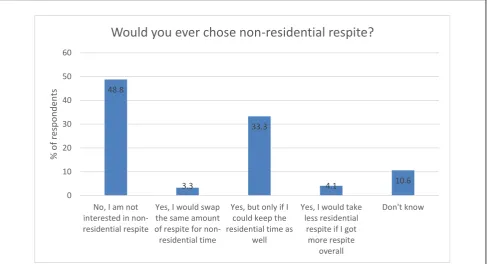
48.8% of survey respondents would not consider non-residential respite (Figure 4). Although
almost 40% of respondents said they would choose non-residential respite, only 3.3% would do so
as a direct alternative to residential respite. Most (33.3%) would only do so in addition to their
current residential provision. A smaller number (4.1%) indicated that they would give up some
residential respite time in exchange for a greater amount of non-residential respite time. This
suggests that non-bed-based respite might be appealing as an adjunct to bed-based
provisions.
No relationships were observed as to who would chose non-residential respite.
Interview respondents suggested carers would consider non-bed-based respite “in an emergency situation” (Q), such as if they were unwell and unable to perform their caring role. Non-bed-based
[image:21.595.57.546.269.533.2]respite may also have some appeal enabling service users to go on holiday (Box 4). Figure 4 Would you ever choose non-residential respite?
48.8 3.3 33.3 4.1 10.6 0 10 20 30 40 50 60
No, I am not interested in non-residential respite
Yes, I would swap the same amount of respite for non-residential time
Yes, but only if I could keep the residential time as
well
Yes, I would take less residential
respite if I got more respite overall Don't know % o f re sp o n d en ts
21
The appeal of Direct Payments
Direct Payments are promoted as a way for families to source and manage services that match
their unique needs, thereby improving their satisfaction with services, minimise costs, and reduce
institutional placements (Caldwell, 2007, Redmond and Richardson, 2003). In Leeds, Direct
Payments were described as an opportunity for carers to be “creative” (ST5) with the services they access, including “more flexibility in how they want their respite to be provided” (ST3).
The perception of Direct Payments among carers, however, was generally negative. One carer said their use of Direct Payments in the past was “one of the worst things that ever happened” to their household (CA2).
Direct Payments were criticised for being too “complicated” (ST2) and creating more work for carers. Utilising Direct Payments was viewed as “doing Leeds City Council’s work for them” (CA2). Whilst carers want a choice regarding respite, they “have got enough on their plate” (ST2) coping
with the caring responsibilities.
Perceived or actual barriers towards non-bed based respite.
A number of perceived or actual barriers to carers availing non-bed-based respite were observed
in the carers survey (Figure 5) and during interviews with carers and stakeholders. Box 4: Non-bed-based respite as a holidays for service users
Many carers want the person they care for to have the opportunity to go on holiday. Whilst some
carers have been able facilitate this themselves, holidays can be troublesome, with the cared-for
person getting bored and wanting to do different activities to their carers.
‘We’re fuddy-duddies for him now. He doesn’t mind doing some things with us, but he likes to do things with other people.’ (CA5).
Using respite time to allow a cared for person to go on holiday was welcomed; “instead of just going to a home they might be able to go on a holiday” (CA4).
A holiday would be especially appealing if the cared for person was able to go with “somebody that [they] know” (CA4).
22 ‘I don’t want to lose bed-based respite’
55.1% of respondents indicated a fear of losing their current residential respite allocation.As
highlighted previously, bed-based respite is highly valued by carers and the thought of not
having it is extremely troubling for carers.
A Mann-Whitney U test revealed a small statistically significant difference between carers highest
academic qualification and not wanting to lose residential respite as a barrier to availing
non-bed-based respite (p=0.015, n=27, r=-.212). This indicates that those with higher academic
qualifications were more likely to see losing bed-based respite as a barrier.
‘The person I care for enjoys bed-based respite’
An equally significant barrier was that service users enjoy bed-based respite; 55.1% of
respondents reported this was the case. One questionnaire respondents said “my daughter loves her stay at residential and treats it as a holiday”.
Service users suggested that attending bed-based (residential) respite was an enjoyable
[image:23.595.57.506.47.371.2]activity; something they looked forward to doing. The enjoyment mostly stemmed from bed-based Figure 5 Perceived or actual barriers to non-residential respite
55.1 55.1 36.2
32.3
12.6 10.2 9.4
6.3 4.7 4.7 0.8
12.6
0 10 20 30 40 50 60
%
o
f
re
sp
o
n
d
en
ts
23 respite being an opportunity to socialise, to take part in activities and for service users to have a
break from their families.
There is a danger, however, that services users’ preferences for particularly services has a
detrimental effect on carers, preventing them availing the most appropriate services to support
them in their caring role.
“Sometimes the barrier is the cared for person not wanting to accept the support that the carer would like - doesn’t like the look of the place, the look of the people, or just thinks ‘I want you to do everything for me’. That can be a barrier” (ST4).
‘It wouldn’t be enough of a break’
Just over a third of survey respondents (36.2%) felt that non-residential respite would not provide them enough of a break from there caring responsibilities. Bed-based respite provides a “proper break” (Q) from caring responsibilities, whereas carers felt non-bed-based respite would not allow them to “get away completely” (CA4), physically and emotionally.
This view was shared by service users who suggested residential respite was an opportunity
for service users to have a break from their parents. Service users felt this may not be
achieved in non-bed-based respite.
‘I don’t know enough about non-bed-based respite’
32.3% of survey respondents felt that a lack of information was a barrier. A Mann-Whitney U test
indicated a small statistically significant difference between carers stated awareness of respite
services and seeing lack of information as a barrier. This indicates that those with more
awareness of respite were less inclined to view a lack of information as a barrier to availing
non-bed-based-respite.
Service users also felt they did not know enough about non-bed-based respite. Some suggested
that, given more information, they would be open to trialling non-bed-based.
Accessing information about respite services in Leeds is “really difficult” (ST4) for carers. Carers felt there is “not enough” (CA1) information available and what little information is available is “dotted around” (CA1) different locations.
24 buildings based” residential respite (ST2). As such, bed-based residential respite dominates the
offer.
Many carers rely on informal networks or word-or-mouth for information regarding respite; “other people in a similar situation…are the best people to find out things from” (ST4). It appears
that the experience of other families can be very powerful in both creating and dispelling
misconceptions about respite services in Leeds.
It appears that carers and care professionals “probably don’t know enough about any non-residential respite” (ST7). The Shared Lives scheme, for example, according to these findings, is
not well known amongst carers or care professionals. Misconceptions about Shared Lives are persistent barriers. It was felt that Shared Lives is not part of individual or strategic “discussions” about respite across the city (ST2). As such, carers “don’t know what to do and how to access [different respite services]” (ST3).
‘I don’t know if I’m eligible’
12.6% of respondents reported not knowing if they were eligible for non-residential respite.
In accordance with the identified research literature, age is a significant factor with regard to
perceived eligibility. Carers felt that their choice of a different respite services “disappear[s] off the radar” (CA2) once service users reach adulthood. One stakeholder suggested non-bed-based respite “feels like something for a younger service users” (ST3).
Perceived eligibility also extends to how well a family is judged to be coping in their caring
role. That is to say, families not in ‘crisis’ – “if you’re classed as a competent family” (CA5) – are
thought to need less support from care professionals and will therefore be less able to access
different services, including non-bed-based respite.
‘Staff and/or venues will be inappropriate’
For just over a tenth of survey respondents (10.2%), concerns that staff or venues for
non-residential respite will be inappropriate for service users is a barrier. This concern was also
expressed by service users.
“As a carer you have to feel that the provision is good in order for you to relax and enjoy that time away from caring.’ If you think the person is not going to be happy then you’re not going to take it up other than in an emergency”. (ST4)
There is a concern that non-bed-based respite will take place in a venue which is not
25 - Staff at non-bed-based respite being less competent, including a “lack of specialist
medical knowledge” (Q), and less reliable than those in bed-based residential settings.
- Service users being cared for in non-bed-based respite alongside inappropriate
service users; some service users need to be with other service users with the same “specific needs” (CA2) – medical and social – whilst others thrive in a more mixed
environment.
- Non-bed-based respite being ‘unsafe’ compared to bed-based respite which are perceived as having “more safeguards in place” and “proper routines [and] regulations”
(CA5).
Concerns about inappropriate staff and venues are exacerbated for carers of adults with more
complex health needs, challenging behaviour and autism.
“When it comes to autistic people, you need someone with a good knowledge of the actual person and a good knowledge of autism… There has to be a good understanding of this complex condition. What might fit one person, won’t fit another.” (CA7)
Comparatively, bed-based respite in a residential setting is viewed “like a really good hotel” that
understands the complexity of service users (ST3).
‘It’s not at appropriate times’
9.4% of respondents reported non-residential respite not being at appropriate times as a barrier.
Carers want the flexibility to avail respite when it suits their needs. For example, some carers want to have respite at weekends, whilst others like to spend that time with the person they care for – “she goes away through the day anyway, why bother having it at weekend as well” (CA3).
However, carers perceived non-bed-based respite as being very inflexible and only during
weekdays.
Non-bed-based respite is also viewed as unreliable; support workers may be unavailable for a
short time or move on to other roles. Many carers are concerned about longer term consistency in the services they receive and bed-based respite care, particularly in a residential setting, “feel[s] more stable” (ST4).
‘There’s too much administration/bureaucracy’
6.3% of respondents suggested that accessing non-residential respite involved too much
26 This does not mean availing non-bed-based respite involves too much administration and/or
bureaucracy per say, rather it involves too much administration and/or bureaucracy for carers already “used to [bed-based] services” (ST7). For carers already stretched by their caring responsibilities, availing non-bed-based respite equates to “somebody else to have to meet with, something else to have to organise” (ST4). It’s simpler to think “my life’s complicated already, I’m not going there” (ST4) and remaining just with bed-based respite.
Additional administration and/bureaucracy can also be a barrier to care professionals, particular for Care Managers who liaise with carers. In the “fast, furious life of a Care Manager, [needing] results quickly and…to move onto the next situation,” (ST2) the time and effort to discuss
and arrange anything other than bed-based respite is a disincentive to promoting non-bed-based respite to carers. A lack of time to facilitate non-bed-based respite was described as a “structural”
barrier (ST2).
‘It’s not in a convenient place’
4.7% of respondents reported non-residential respite not being in a convenient place as a barrier.
One questionnaire respondent stated that non-bed-based respite would be more appealing “if it was somewhere local to where we lived” (Q). Another carer did not want the person they care for
attending non-bed-based respite because they thought it would take place in what they perceived as “very nasty little area[s]” of the city (CA7).
‘I feel guilty/upset ‘
4.7% of respondents reported that feelings of guilt or upset caused a barrier.
Mirroring the identified literature, accessing respite can cause carers to feel guilty and anxious that they have “failed” in their caring role (ST4) or that they “always should be there for the child with disability” (CA5). As such, utilising non-bed-based respite was thought to be “not worth the upset for the short time you receive” (Q). Moreover, some forms of non-bed-based respite, such as community-based care, may exacerbate negative emotions because of a view that “if that family can cope…why can’t I?” (ST2).
‘It might not meet our cultural needs’
Only 0.8% of respondents indicated a concern that non-residential respite would not meet their
cultural or religious needs was a barrier.
A comparison between respondents from white-British and Black, Asian and minority ethnic
27 barrier to carers from BAME backgrounds in Leeds. This contradicts the assertion of the
identified published literature. However, this may be a response bias as a result of the limited
number (n=11) of survey respondents from BAME communities.
‘Other’
12.6% of respondents suggested another barrier prevented them from availing non-residential
respite.
Carers may already have their non-bed-based respite needs fulfilled, either through purchasing additional support from “outside agencies” (Q) or because the person they care for
attends other scheduled activities.
The ‘human’ capital of carers – their knowledge, skills and capacities – was alluded to
as a barrier to availing non-bed-based respite. ST3 suggested how “creative” respite is depends on “the demanding nature of the family” and that “some families are better [at availing personalised services] than others”.
Carers were also concerned that non-bed-based respite would be prohibitively expensive. Non-bed-based respite may breach the privacy of carers and their families; “being able to
trust people in your home” (Q) is a barrier. Service users also expressed concern that non-bed-based respite may feel like “they’re being invaded by strangers”.
“You can have respite in your own home. If you wanted to go on holiday … somebody
[image:28.595.58.537.112.311.2]would come into your home and work there 24 hours a day. The issue with that is not a lot of people take that up because it’s someone coming into your home that you don’t know and you’re not there.” (ST5)
Figure 6 Culture and religion as a barrier to non-residential respite for white-British and BAME peoples
0 9 100 91 0 20 40 60 80 100 White-British BAME % o f re sp o n d en ts
Is culture/religion a barrier to non-residential respite for
white-British and BAME carers?
28
Carers and service users in transition & aspirations for future respite
provision
The identified publications suggests that the transition from children’s to adult service is a
significant time for carers and service users with regard to availing respite services (Power, 2009). For example, on completion of a child’s formal education, carers can no longer rely on school to
provide support or indirect respite. Appropriate respite services during this time of transition is
considered a significant gap in provisions (Power, 2009).
It was not possible to include the voices of carers in transition in this project. However, one
stakeholder described shortcomings of the process in Leeds. They alluded to a stark contrast between children’s and adult services in terms of provisions and environments. For example, one young service user liked to play with children’s toys but “those things disappear completely in adult respite” because of a view that “adults don’t play with toys” (ST4). As such, it became apparent that the service user “didn’t fit easily into what was available in adult services”
(ST4).
The stakeholder also suggested that the transition phase does not start early enough.
How should respite be delivered in the future?
Carers, stakeholders and service users suggested how respite should be delivered in the future
(Box 5). Whilst a number of suggestions relate to modifications of bed-based residential respite,
they may have broader application. Carers and service users also stressed that they would
not like to see bed-based residential respite being stopped.
It would appear that many carers and service users do not fully understand the range of respite
services in Leeds or labour under misconceptions about non-bed-based provisions. More
information about different respite services would be beneficial in helping carers and
service users make more informed decisions. Carers and service users need information that is “really clear…something that spells out what is available” (ST4), including examples of what
different people do and the combination of provisions that are possible.
“To be able to go to and say ‘this organisation does it this way and that little group does it that way, it’s not just the six buildings around the city’” (ST3)
An accessible “menu” (ST2) of provision would enable carers and service users to make informed
non-29 bed-based respite. A “flow chart” (ST2) of different respite options may also help Care
Managers see beyond ‘traditional’ bed-based respite.
The option to ‘trial’ different respite services may also facilitate carers and service users
utilising provisions other than traditional residential respite. Currently there appears to be a lot of
confusion and apprehension about non-bed-based respite.
Box 5: How respite should be delivered in the future
Personal relationships – service providers and practitioners should get to know service users and their families. This includes having “named support” throughout respite and a “passport of how to support the individual” (ST8)
“It’s a person-centred approach that’s needed. Not a fancy building. Not everything laid on. It’s the person liking the other person” (CA7).
Meeting the needs of carers and service users – there is sometimes an assumption that “if the needs of the cared for person are being met…the needs of carers are being met” (ST4). This is not the case.
Social activity – Respite should provide opportunities for service users to engage in social activities, including romantic interactions where appropriate. Practitioners should coordinate with one another in order for service users to do things together.
Flexibility, Creativity, Choice – Respite provisions need to “work to the requirements of the service user” (ST1), including ‘bespoke packages’.
“They might say, ‘if you don’t want the full week, split the week and just have a night here and there. I’d like to see that’” (CA6).
A respite ‘market place’ – the provision of a range of respite services is improving in Leeds. However, a market place “isn’t well developed” (ST2). Service users and carers need to be more aware of their options.
Collaboration – The local authority should work more closely with third sector organisations able to provide appropriate provisions for service users. One Carer, for example, said the Leeds Autism Service was “very good” and “should receive more funding…so that they could do more” (CA7).
Teaching independence – respite can be a tool to help service users “learn to be away from home” (CA5). This is particularly important for older service users and carers concerned about future planning.
Overnight stays – whether in a bed-based residential setting or community care, overnight respite allows carers to have a “break completely” (CA1).
More activities – for many service users, respite provides opportunities to engage in meaningful activity – “no point in them going and just sitting there” (CA3). Providers should plan a programme of activities around the interests of service users and keep carers informed of what they are doing.
30
Conclusions and issues for consideration
This project has aimed to understand the actual or perceived barriers to non-bed-based respite for
adults with a learning disability and/or autism with moderate to complex needs in Leeds.
Results suggest that the majority of carers feel they have at least some knowledge of respite care
in Leeds and are aware of a choice between bed-based and non-bed-based, with carers feeling more knowledgeable with age. However, the ‘default position’ for most carers, service users and, in
some cases, health and care practitioners, in Leeds is that respite is a bed-based activity in a
residential facility.
Bed-based respite is viewed as beneficial for carers and service users. Of particular importance
are the social connections service users make during residential stays and a belief that bed-based
respite enables service users to prepare for when carers are no longer able to continue in their
caring roles and of living away from home. This positive view does not extend to non-bed-based
respite. Most carers would only utilise non-bed based respite as an adjunct to their bed-based
provision. Non-bed-based respite may have some appeal to carers and service users, however, as
an opportunity for service users to go on holiday.
The most frequently cited reasons for carers and service users in Leeds not availing of
non-bed-based respite are:
- Not wanting to lose bed-based respite - Service users enjoying bed-based respite
- Non-bed-based respite not being enough of a break - Not knowing enough about non-bed-based respite
Other reasons include concerns about not being eligible, inappropriate staff and/or venues,
bed-based respite not being at convenient times or in convenient locations, too much
administration/bureaucracy, carers feeling guilty or upset, non-bed-based respite not satisfying cultural or religious needs, the ‘human capital’ of carers to access services, cost, carer already
accessing a proxy non-bed-based respite and non-bed-based respite breaching privacy of carers
and families.
For service users and carers ‘transitioning’ between children’s and adult social care in Leeds,
limited evidence suggest the process may be too abrupt.
A number of suggestions for local and structural changes have been made about how respite
services in Leeds should be delivered in the future. Most significantly carers, service users and
31 services can be personalised, and the opportunity to trial different services may help to dispel
some misconceptions about non-bed-based respite and allow carers to make more informed
choices about the services they access. Information could be available from a central access point
and from Care Managers and be accessible to all carers and service users. Work should be done
collaboratively with third party providers to ensure choice.
Limitations
A mixed methods design has been used to capture a ‘360 degree’ view. This included a literature
review, postal survey of carers, semi-structured interviews with carers and relevant stakeholders,
and consultation with service users. One stakeholder reflected on their experience of working with carers transitioning between children’s and adult social care. However, it has not been possible to include first-hand the voices of carers in ‘transition’. As such, it is not possible to describe carers’ in transitions’ perception of non-bed-based respite or to say what those just entering the social care
system for adults with a learning disability and/or autism in Leeds will want from respite in the
future. Future work should look to address this deficit. Further investigation into the experiences
32
References
BRYMAN, A. 2012. Social research methods, Oxford : Oxford University Press, c2012.
4th ed.
CALDWELL, J. 2007. Experiences of families with relatives with intellectual and developmental disabilities in a consumer-directed support program. Disability & Society, 22, 549-562.
CAPLES, M. & SWEENEY, J. 2011. Quality of life: a survey of parents of children/adults with an intellectual disability who are availing of respite care. British Journal of Learning Disabilities, 39, 64-72.
COTTERILL, L., HAYES, L., FLYNN, M. & SLOPER, P. 1997. Reviewing Respite Services: some lessons from the literature. Disability & Society, 12, 775-788.
CRESSWELL, J. & PLANO-CLARK, V. 2011. Designing and Conducting Mixed Method Research, London, Sage.
DURA-VILA, G. & HODES, M. 2009. Ethnic Variation in Service Utilisation among Children with Intellectual Disability. Journal of Intellectual Disability Research, 53, 939-948.
GOVERNMENT, H. 2008. Carers at the heart of 21st-century families and communities, London, Department of Health.
HARTREY, L. & WELLS, J. S. G. 2003. The meaning of respite care to mothers of children with learning disabilities: two Irish case studies. Journal of Psychiatric & Mental Health Nursing, 10, 335-342.
MAC DONALD, E., FITZSIMONS, E. & WALSH, P. N. 2007. Use of respite care and coping strategies among Irish families of children with intellectual disabilities. British Journal of Learning Disabilities, 35, 62-68.
MANSELL, I. A. N. & WILSON, C. 2010. 'It terrifies me, the thought of the future': listening to the current concerns of informal carers of people with a learning disability. Journal of Intellectual
Disabilities, 14, 21-31.
MCCONKEY, R., KELLY, F. & CRAIG, S. 2011. Access to respite breaks for families who have a relative with intellectual disabilities: a national survey. Journal of Advanced Nursing, 67, 1349-1357.
MCGILL, P., PAPACHRISTOFOROU, E. & COOPER, V. 2006. Support for family carers of children and young people with developmental disabilities and challenging behaviour. Child: Care, Health & Development, 32, 159-165.
MCGROTHER, C. W., BHAUMIK, S., THORP, C. F., WATSON, J. M. & TAUB, N. A. 2002. Prevalence, morbidity and service need among South Asian and white adults with intellectual disability in Leicestershire, UK. Journal of Intellectual Disability Research, 46, 299-309.
MCGROTHERP, C. W., HAUCK, A., BURTON, P. R., RAYMOND, N. T. & THORP, C. F. 1993. More and better services for people with learning disabilities. Journal of Public Health Medicine, 15, 263.
PETR, C. G., BARNEY, D. D., KANSAS UNIV, L. B. C. O. F. & DISABILITY 1991. Keeping Children with Disabilities at Home: Research Results of the Parent Perspective.
33
REDMOND, B. & RICHARDSON, V. 2003. Just Getting on with it: Exploring the Service Needs of Mothers Who Care for Young Children with Severe/Profound and Life-Threatening Intellectual
Disability. Journal of Applied Research in Intellectual Disabilities, 16, 205.
SAVIN-BADEN, M. & MAJOR, C. H. 2013. Qualitative research : the essential guide to theory and practice, London : Routledge, 2013.
TRUESDALE-KENNEDY, M., MCCONKEY, R., FERGUSON, P. & ROBERTS, P. 2006. An Evaluation of a Family-centred Support Service for Children with a Significant Learning Disability. Child Care in Practice, 12, 377-390.
UPSHUR, C. C. 1983. Developing Respite Care: A Support Service for Families with Disabled Members. Family Relations, 32, 13.
WILKIE, B. & BARR, O. 2008. The experiences of parents of children with an intellectual disability who use respite care services. Learning Disability Practice, 11, 30-36.
34
36
Appendix 2: Carers survey respondents
Age of respondents
Age Frequency Percent Cumulative frequency
31-40 1 0.8 0.8
41-50 14 11.2 12
51-60 39 31.2 43.2
61-70 46 36.8 80
71+ 20 16 96
Prefer not to say/DNA 5 4 100
Total 127 100 100
0.8
11
30.7
36.2 15.7
5.5
0 5 10 15 20 25 30 35 40 31-40
41-50 51-60 61-70 71+ Prefer not to say/DNA
% of respondents
Age
37 Do you care for more than one person?
Frequency Percent Cumulative percent
Yes 19 15 15
No 105 82.7 97.6
Prefer not to say/DNA 3 2.4 100
Total 123 100 100
15
82.7 2.4
Do you care for more than one adult who is eligible who
respite? (%)
Yes
No
38 Age of service user
Age Frequency Percent Cumulative percent
18-20 12 9.4 9.4
21-30 31 24.4 33.9
31-40 25 19.7 53.5
41-50 39 30.7 84.3
51-60 15 11.8 96.1
60+ 3 2.4 98.4
Prefer not to say/DNA 2 1.6 100
Total 127 100 100
9.4
24.4 19.7
30.7 11.8
2.4 1.6
0 5 10 15 20 25 30 35 18-20
21-30 31-40 41-50 51-60 60+ Prefer not to say/DNA
% of respondents
Age
o
f se
rv
ice
u
se
r
39 Amount of care needed
Frequency Percent Cumulative percent
Very little care and support 0 0 0
Some of the time 11 8.7 8.7
Most of the time 32 25.2 33.9
Constant care and support 82 64.6 98.5
Prefer not to say/DNA 2 1.6 100
Total 127 100 100
0
8.7
25.2
64.6
1.6
0 10 20 30 40 50 60 70
Very little care and support
Some of the time Most of the time Constant care and support
Prefer not to say/DNA
%
o
f
re
sp
o
n
d
en
ts
Level of support required
How much care & support would you say this person needs? (If
more than one person, how much care and support do you feel you
40 Caring responsibility division
Frequency Percent Cumulative percent
I am the sole/primary carer 63 49.6 49.6
Caring is shared with another person in the same
household 54 42.5 92.1
Caring is shared with another person outside the
household 8 6.3 98.4
Prefer not to say/DNA 2 1.6 100
Total 127 100 100
49.6 42.5
6.3 1.6
How is caring responsibility divided? (%)
I am the sole/primary carer
Caring is shared with another person in the same household
Caring is shared with another person outside the household