
FORECAST SURFACE QUALITY OF ABRASIVE WATER
JET CUTTING BASED ON NEURAL NETWORK
GUILIN YANG
Department of Electromechanical Engineering, Heze University, Heze 274015, Shandong, China
ABSTRACT
In this study, firstly, the YL12 aluminum alloy is used as experimental materials, then in the following experiments it is cut in JJ-I-type water jet machines, and 1,000 group data are gotten by measurement. In each group data, pressure, material thickness, surface roughness, abrasive flow and traversing speed are included. Next, BP artificial neural network is established. In this network, there are four inputs and one output. The inputs are pressure, material thickness, surface roughness and abrasive flow rate; the output is traverse speed. And then the BP artificial neural network is programmed by one toolbox of Matlab. Using the former 1,000 group data, the BP artificial neural network is trained, and its forecast function is obtained. Finally, the BP neural network is tested to verify through using different thickness of aluminum alloy verifies its forecast function. According to given pressure, material thickness, roughness and abrasive flow, traverse speed is predicted. The YL12 aluminum alloy is cut by the predicted traversing speed. The maximum error between the prediction values of surface roughness and the actual values of the surface roughness is 6.5%.
Keywords: Abrasive Water Jet Cutting, BP Neural Network, Surface Quality, Forecast
1. INTRODUCTION
Abrasive water jet (AWJ) is the solid liquid two phases jet beam. Through the jet beam, the material can be grinded, scraped, erode and extruded. Compared with the laser beam, plasma cutting and abrasive water jet, AWJ is new type of cutting tool and has the unique superiority—during the process , without lateral force and recoil , the workpiece will never be out of shape by mechanical force and deformation damage or mechanical vibration. Therefore, AWJ has the reputation of the most durable cutting tool[1,2]. On the other hand, the speed of AWJ cutting is fast, the cutting gap is narrow and the quality is high. Using AWJ cutting, both of labors and material can be saved. It is easy to cooperate the NC system to process the material arbitrarily and realize the automation[3,4].
AWJ is one of soft cutting tool, so the processing performance has its obvious disadvantage, which is called Jet Lag. As the nozzle moves as a certain speed and the workpiece has a thickness, the time of
entering the workpiece and the exit of workpiece is different. The latter is comparatively slower, so this is so-called Jet Lag [5]. This lag causes arc lines on the surface, showed in fig 1. On the other hand, when the high energy water beam leaves the sprayer, the beam will scatter somewhat. The
energy will weaken with the increase of distance, so there will be obvious taper when AWJ cutting workpiece [6]. At the same time, the lag will cause the distinct surface quality differences, that is to say, the surface on the top is smooth and the bottom is rough[7,8]. But through the speed adjusting, in fact, energy compensation, the problem of Jet Lag will be solved.
During the process of AWJ cutting , not only the factor of AWJ itself , but also the elements of the machine tool characteristic, material and technology, the relationship between AWJ parameters and the machining accuracy is highly nonlinear. As a result, it is difficult to control the processing precision and surface quality [9]. The process is often operated by experience. Based on fuzzy neural network, this study establishes the machining model of AWJ. Through the specific water jet machine tool, the sample data are obtained. Using these data, the BP neural network is trained and has prediction function. The model will realize the processing of the higher requirements of precision and intelligent control.
2. BUILDING MODEL OF WATER JET
CUTTING
2.1 Parameter Determination
working[10,11]. To make it simple, selecting specific materials (YL12 duralumin) processing, so the influence of material property will not be taken into consideration.
On the side of AWJ system, considering the specific diameter of water nozzle and nozzle as well as the most commonly used abrasive particle size of abrasive research, the pressure of water jet and the flow rate of abrasive will be studied as the main parameter [12]. On the side of machine tool, due to the specific study of water jet machine tool, therefore the influence caused by machine tool’s property on surface cutting quality will be neglected. In this study, only the transverse speed of nozzle will be used as machine tool parameter, the thickness of material as the processed workpiece parameter. The rate of surface roughness Ra (here, the rate of surface roughness takes the place of the surface cutting quality of workpiece.) will be as studied here, the other two elements the taper and surface morphology will be excluded [13].
2.2Establishment of BP Neural Network
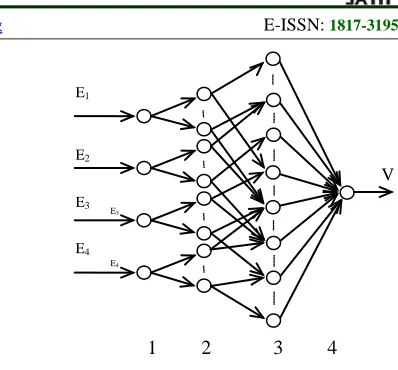
[image:2.612.322.521.69.254.2]AWJ cutting technology of fuzzy artificial neural network structure is shown in figure 2. Fuzzy system has four inputs: E1, E2, E3 and E4. They represent the water jet pressure P, abrasive flow rate of Ma, material thickness of H, and the cutting surface roughness Ra. Fuzzy artificial neural network the system output is the speed of cutting nozzle V. If the single hidden layer neural network only be selected in the study , it is difficult to adjust the weight coefficient in neural network training, what’s more, it is more complicated , and hardly to meet the requirements[14]. As a result, the double hidden layer should be chosen in FNN. But it is lack of the unity and complete theory of how to choose the hidden layer nodes [15]. The number of nodes and input / output unit is directly related to how much they have and also with the other factors [16]. This paper uses Matlab for test selection, gain better nodes.
Figure 2: FNN Neural Network
Considering experimental conditions of the study, E1, E2, E3 and E4 numerical interval of each are identified as [150, 300] MPa, [0, 0.18]kg/min, [10, 30]mm, [2.5, 25] μm.On E1, E3 and E4 parameter, each defines 3 Fuzzy sets, note separately:
{
}
1 1
B = Low pressure
{
}
2 1
B = Intermediate pressure
{
}
1 3
B = The thinner
{
}
2 3
B = Moderate thickness B33=
{
Thickness}
{
}
1 4
B = Fine Processing
{
}
2 4
B = Semi fine processing
{
}
3 4
B = Rough machining E2 is defined by 2 Fuzzy Sets, Note separately :
{
}
1 2
B = Moderate , 2
{
}
2B = Overdose .Chooses Gauss function as membership function, and the cutting surface roughness of the membership
function
2
x 6 A
is µ (x)=e− , 6
) 4 . 6 ( 2 ) ( − − = x
A x e
µ
2
( x 12.5) 6 A
and (x) e − −
µ = , as shown in fig 2.
There are 54 fuzzy rules in fuzzy system. The general form of fuzzy rules: If E1=B and 1l E2=B l2 and l
3
E3=B l 4
E4=B then y=θl (l=1,2,3,…M, M represents the number of rules) and αl is the first
rule activation degree, then the fuzzy system output is :
∑
= = 1 l l l MV θ α
2.3 Sample Data Acquisition
Water jet machine of type JJ-I is used as the experimental device. The maximum pressure of
E1 E3 E4 E2 E3 E4
1 2 3 4
Ultra high pressure generator is up to 380MPa, the maximum displacement is 2.7L / min, water spray nozzle diameter is 0.28mm, sand nozzle diameter is 0.76mm, cutting angle is 90°, abrasive is 40# garnet and target distance is 5.0mm. In the experiment, the thickness of 20mm, 35mm and 50mm YL12 duralumin will be chosen as the test piece. The TR200 roughness is used to measure the specimen surface roughness Ra.
3. NEURAL NETWORK PROGRAMMED
BY MATLAB
3.1 BP Neural Network Establishes Function
The Nnbox toolbox of Matlab software can provide specialized function newff( ) for establishing neural network. The method of the function’s application [17]:
net =newff(A,1,c,Trainfun)
Network properties and parameters can be stored in this net, in which the network parameters respectively stands for each input vector of the maximum or minimum value; L is a row vector and each element represents the number of neurons per layer; C is character vector and elements are each layer of neuronal transmission’s function; Trainfun is a string variable, which is the network training function name.
3.2 BP Neural Network Trains Function
When the neural network is established, the network should be trained. The essence of this training is, through the repetition of comparison between input parameter and output parameter, to adjust the different layer of neurons’ weights and biases, and finally to get the network which can be suited to all samples. Obviously, the prediction of network and the number of training group have direct relationship. In Matlab, network can be trained through Train function, used as following style:
net = train ( net , u , y) u: sample matrix of input y: sample matrix of output
3.3 BP Neural Network Simulates Function
For the trained network, it can be used to deal with the practical problems. Matlab provides a function sim ( ), to realize the neural network’s simulation function. This function is simple and convenient to be used. The using method is the actual network output matrix:
a = sim (net, p)
Type in P: processing parameter matrix.
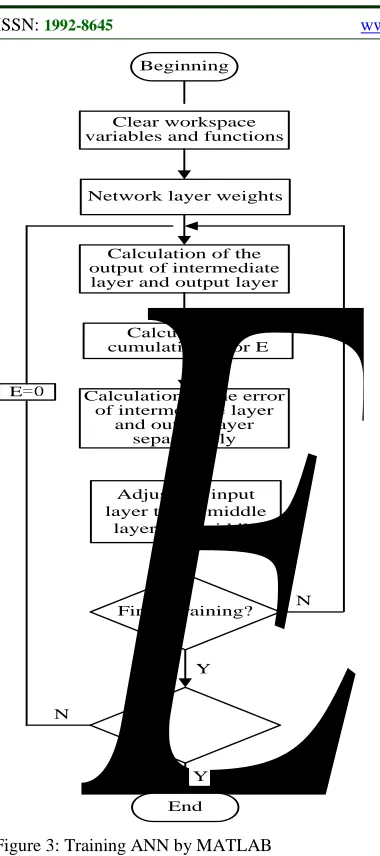
BP neural network training scheme is shown in fig 3.
In this paper, (fig 2) the procedures of the BP neural network model are as follows:
lc clear load matlab; t=output; p=input;
[pn,minp,maxp,tn,mint,maxt] premnmx(p,t); % Initialize neural network
net=newff(minmax(pn),[30 ],{'tansig','purelin'},'t rainlm');
Clear workspace variables and functions
N E=0
Network layer weights
Calculation of the error of intermediate layer
and output layer separatively Calculation of cumulative error E Calculation of the output of intermediate layer and output layer
Adjust the input layer to the middle
layer, the middle Beginning
Finish training?
E
EndY
N
Y
Figure 3: Training ANN by MATLAB
4. EXPERIMENTAL VERIFICATION
Using the trained neural network predicts the speed of different curves and then using the predicted speed programs and cuts the car model which thickness is 5mm and 8mm and material is YL12 duralumin. The recorded data are the shown in the Table1.
A given surface roughness Cutting surface quality error
A given surface roughness
Average value of Surface roughnes A given surface roughness
=
[image:4.612.93.283.69.497.2]—
Table 1: Comparison Of Experimental Data And Prediction Data
NO.
Jet Pres-ure /MPa
Brasive flow
(kg/min
)
Thickness workpiece
(mm)
Demand Rough-ness
(μm)
Prediction speed(m m/min)
Target distance
(mm)
Measured surface roughness
(μm)
1 150 0.1155 5.0 27.5 29.25 5 28.11 2 200 0.1480 5.5 7.8 57.32 5 8.31 3 150 0.1155 6.0 12.6 82.51 6 13.02 4 250 0.1385 6.0 60.03 175.85 7 63.03 5 240 0.1306 8.0 3.26 28.64 8 3.34 6 280 0.1540 9.0 4.15 37.40 6 4.32 7 260 0.1498 9.0 4.15 32.8 5 3.98 8 240 0.1306 8.0 4.5 38.6 6 4.32 9 220 0.1436 6.0 50.32 158 4 48.5 10 220 0.1480 5.5 12.5 70.36 5 11.8 11 180 0.1260 5.0 11.6 42.6 6 11.0
In experimental verification, the biggest cutting quality’s maximum error is 6.5%.
5. CONCLUSION
According to the actual needs of sophisticated processing pieces, this study utilizes the BP neural network to establish YL12 duralumin’s model cut by AWJ. Under the condition of given water beam pressure, the rate flow of abrasive quality, the thickness of AL and required processed the roughness of transverse section, the model can rapidly and reliably predict the desired nozzle’s cutting speed. Using the gained experimental data to train the neural network, when the variance of transverse speed reaches to the fastest convergence , the hidden layer node number is 55 , as a result , in BP neural network, 55 is chosen to be he hidden layer node number ; using the trained neural network the speed of different curve’s part is forecast. This speed is to be programmed and cut, at last, the biggest error of the rate of surface roughness is 6.5%. The quality of transverse section is in the allowed range. The prediction model can be applied to practical production.
ACKNOWLEDGEMENTS
Project of Shandong Province of China under Grant NO. J09LD55.
REFERENCES:
[1] Meyer L, Uberruck T, Koch A,Gastinger I.
“Resection of the spleen using the water jet dissection technique” , JLaparoendosc Adv
Surg Tech A.Vol.5, No.6, 2011, pp.321–324.
[2] Siores, E.Chen, Letal. “Improving surface finish generated by the abrasive water jet process”, International Symposium on
Advances in abrasive Technology,Vol.138,
No.6, 2010, pp.187–192.
[3] Kovacevic, R.Mohan, and Zhang, Y. M,
“Cutting force dynamics as a tool for surface profile monitoring in AWJ”,ASME Journal of
Engineering for Industry, Vol.15, No.3, 2005,
pp.340-346.
[4] Hashish, M, “Characteristics of surface machined with abrasive waterjets”, ASME Journal of Manufacturing Science and
Engineering, Vol.8, No.6, 2000, pp.358-363.
[5] Jiansheng Wang, Jiajun Sun, Mar,
“Accelerating mechanism of abrasive particle in the collimated water jet”, High-pressure
Water Jet,Vol.9, No.5, 1993, pp.23-29.
[6] U. Caydas, A. Hascalik, “A study on surface roughness in abrasive water jet machining process using artificial neural networks and regression analysis method”, Materials
Processing Technology, Vol.202, No.6, 2008,
pp. 574-582.
[7] Savanick G. A, “An abrasive jet device for cutting deep kerfs in hard rock”, 3rd U.S. Water Jet conference, December 15-17, 1999, pp.98-121.
[8] Li Xiaohong, Liu Ailin, Zheng Jinlong, Lu Yiyu. “The study of selfexied oscillation pulsed abrasive jet”, China Safety Science Journal, Vol.5, No.6, 2003, pp.161-165. in Chinese
[9] P. Palanisamy, I. Rajendaran, S. Shanmugasun- daram, “ Optimization of machining paramet- ers using genetic algorithm mand experiment- tal validation for end milling operations”,
Advanced Manufacture Technology, Vol.32,
No.10, 2007, pp.644-655.
[10] Li Xiaohong. “Experimental investigation of hard rock cutting with collimated abrasive water jets”,International Journal of Rock Mechanics & Mining Sciences, Vol.37, No.7, 2000,pp.1143-1148.
[11] Hu Shougen,Ding Sheng. “The principle and status of high pressure pulsed water jet”,
J.East China University of Technology,
Vol.19, No.3, 1997, pp.1-9.in Chinese.
[12] S. Band yopad hyay, S. K. Pal, C. A. Murthy, “Simulated annealing based pattern classification”, Information Science, Vol.109, No.5,1998, pp.165–184.
[13] Tang Chuanlin, Li Xiaohong, Liao Zhenfang. “The study of oscillation jet nozzle with flowcontrol oscillator”,Proc 12th Int Symp on
Jet Cutting Technology, Vol.10, No.2,1996,
pp.62–68. in Chinese .
[14] Savanick G.A, and W. G. Krawaz, “An abrasive jet rock drill.” 4th U.S. Water Jet conference, Univ.of California, Berkeley, Vol. 26,No.2, 1987,pp. 129-132.
[15] Wang J, Kuriyagawa T, and Huang C.Z. “An experimental study to enhance the cutting performance in abrasive waterjet machining”,
MachSci Technol ,Vol.7, No.6, 2003,pp.191–
207.
[16] Hashish M, “Model for abrasive-waterjet (AWJ) machining”, J EngMater Technol
Trans ASME, Vol.111, No.9, 2009, pp.154–
162.
[17] Wang J, Guo D M. “A predictive depth of penetration model for abrasive waterjet cutting of polymer matrix composites”, J
Mater ProcTechnol, Vol.121, No.5, 2002,
![Assessment of Physiological Health Status in Relations to Different Anthropometric and Cardio respiratory Measures of Head Supported Load Carrying Male Porters of Sikkim, India [Article Retracted]](data:image/gif;base64,R0lGODlhAQABAIAAAP///wAAACH5BAEAAAAALAAAAAABAAEAAAICRAEAOw==)