S T U D Y P R O T O C O L
Open Access
An adjunctive human-animal interaction
intervention for veterans with PTSD: study
protocol for a randomized controlled trial
Anouk L. Grubaugh
1*, Ursula S. Myers
1, Stephanie M. Keller
1, Bethany C. Wangelin
1, Brian E. Lozano
1and
Peter W. Tuerk
2Abstract
Background:Posttraumatic stress disorder (PTSD) rarely remits over time, and if left untreated, leads to significant distress, functional impairment, and increased health care costs. Fortunately, effective evidence-based treatments (EBTs) for PTSD, such as Prolonged Exposure (PE), exist. Despite their availability and efficacy, a significant number of individuals with PTSD do not initiate treatment when offered or dropout prematurely. One proposed theory suggests that the emotional-numbing symptoms of PTSD (e.g., blunted affect, apathy) can serve as a barrier to engaging in, and successfully completing, treatment; and the broad human-animal interaction (HAI) literature available suggests that HAI can potentially reduce emotional numbing related to PTSD. Accordingly, this manuscript describes an ongoing, federally funded, randomized controlled trial testing the efficacy of RESCUE, an HAI
intervention, as a viable adjunctive treatment component for PE.
Methods/design:The study will include 70 veterans with PTSD treated at a Southeastern Veterans Affairs Medical Center (VAMC). All participants in the trial receive up to 12 sessions of PE. Participants are randomly assigned 1:1 to (1) volunteer at a local animal shelter or (2) volunteer at a community agency of their choice as part of their in-vivo exposure exercises for PE. Outcomes will be examined via standard clinical interviews, self-report questionnaires, and thematic interviews.
Discussion:It is hypothesized that participants in the HAI condition will report greater decreases in emotional-numbing symptoms and increased treatment compliance and completion rates relative to those in the community volunteer condition. If successful, RESCUE, could be easily incorporated into standard PE and broadly disseminated.
Trial registration:ClinicalTrials.gov. ID:NCT03504722. Retrospectively registered on 2 May 2017.
Keywords:Posttraumatic stress disorder (PTSD), Prolonged exposure (PE), Military, Veterans, Human-animal interaction (HAI), Animal-assisted therapy
Background
Prolonged Exposure (PE) is considered an evidence-based treatment (EBT) for PTSD [1, 2] and has been widely disseminated throughout Department of Defense (DoD) and Veterans Affairs (VA) treatment facilities. Al-though up to 80% of patients demonstrate clinically meaningful improvement after completing an EBT for
PTSD such as PE [1–3], a significant number of individ-uals do not initiate PTSD treatment or drop out of treat-ment prematurely (as high as 78% and 36% overall pooled dropout rates across studies) [4–7]. Given the wide-scale availability of PE and other EBTs for PTSD in VA and DoD treatment settings, and the robust effect sizes for treatment completers, there is a need for novel methods that can improve PTSD treatment engagement and decrease attrition.
One potential avenue for improving EBTs for PTSD is by targeting PTSD symptoms that may adversely impact treatment engagement early in the treatment process.
© The Author(s). 2019Open Access This article is distributed under the terms of the Creative Commons Attribution 4.0 International License (http://creativecommons.org/licenses/by/4.0/), which permits unrestricted use, distribution, and reproduction in any medium, provided you give appropriate credit to the original author(s) and the source, provide a link to the Creative Commons license, and indicate if changes were made. The Creative Commons Public Domain Dedication waiver (http://creativecommons.org/publicdomain/zero/1.0/) applies to the data made available in this article, unless otherwise stated.
* Correspondence:[email protected]
1Ralph H. Johnson Veterans Affairs Medical Center and Department of
Psychiatry and Behavioral Sciences, Medical University of South Carolina, 109 Bee Street, Charleston, SC 29401, USA
Emotional numbing is part of the symptom profile of PTSD and consists of symptoms that reflect difficulties in experiencing positive emotions such as love and hap-piness, loss of interest in activities that were previously important or pleasurable, and feeling distant and cut off from others. In relation to PTSD and other psychiatric disorders, emotional numbing is also associated with ap-athy and low motivation [8, 9]. Together, these symp-toms can limit an individual’s ability and willingness to engage in treatment [10, 11], particularly a treatment that encourages connecting emotionally with trauma-related material. Consistent with this, poor response to PE has been associated with blunted emotional reactivity to trauma cues early in therapy [12].
A promising mechanism for decreasing emotional numbing is through therapeutic human-animal inter-action (HAI [13–15]). HAI refers to the purposeful and semistructured social pairing of a human with a domes-ticated animal for therapeutic purposes. A number of di-verse studies have found that HAI can have positive effects on emotional and physical functioning, stress re-activity, and social functioning [16–18]; and among those with psychiatric symptoms, HAI interventions have been found to improve depression, anxiety, and PTSD [16, 19, 20]. Although promising, the HAI litera-ture is tempered by methodological limitations, such as difficult-to-replicate study procedures, over-reliance on self-report measures, and lack of adequate controls/ randomization (e.g., [18–20]).
Proactive targeting of emotional-numbing symptoms in the early stages of PTSD treatment can potentially im-prove treatment engagement and retention. Consistent with this rationale, we propose to test the efficacy of an HAI adjunct to PE for decreasing emotional-numbing symptoms and improving treatment engagement and outcomes. HAI is a compelling adjunct for PTSD EBTs due to its potential impact on patient-level outcomes as well as its viability for wide-scale implementation and dissemination.
Study overview
The current study is a DoD-sponsored project
(W81XWH-15-1-0087) designed to develop and pilot test the feasibility, acceptability, and efficacy of an adjunctive intervention for increasing treatment compli-ance with EBTs for PTSD by targeting the
emotional-numbing symptoms of PTSD. RESCUE, Recovery
through Engagement with Shelter Canines, Understand-ing, and Exposure, is a HAI intervention that was devel-oped during the initial stages of the project as an adjunct to Prolonged Exposure for PTSD (PE). The in-novative study design focuses on increasing PTSD treat-ment engagetreat-ment through HAI designed to target the emotional-numbing symptoms of PTSD which are
theorized to impede treatment compliance and reten-tion. Although the current trial focuses on veterans treated at a Veterans Affairs Medical Center (VAMC), the study design and findings will have significant rele-vance for the broader population of individuals with PTSD across diverse treatment settings.
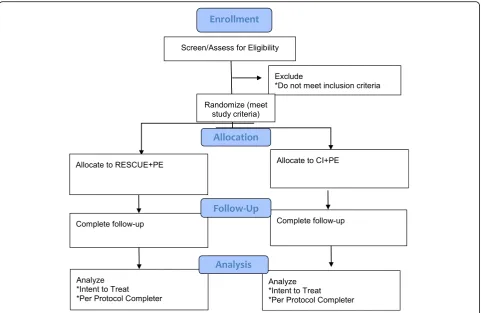
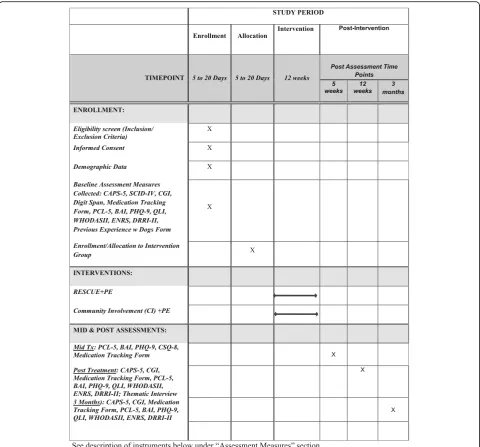
Feasibility, acceptability, and initial efficacy testing of the experimental treatment condition is being conducted using a randomized controlled trial (RCT) of 70 veterans with PTSD assigned to receive either RESCUE paired with PE (RESCUE + PE) or community involvement paired with PE (CI + PE). Consistent with the manual guidelines [21], PE consists of up to 12 weekly sessions. Veterans are encouraged to engage in their assigned vol-unteer activity (either volvol-unteering at the animal shelter or engaging with a community agency, depending on condition) a minimum of once per week. In addition to the baseline assessment, veterans are assessed at mid-treatment (session 5), immediately post mid-treatment (12 weeks), and at the 3-month follow-up (see Fig.1below). Clinical outcomes include levels of PTSD, depression, anxiety, and functional status/quality of life. Addition-ally, after completing treatment, veterans are asked to participate in an individual thematic interview to get their impression of the treatment program overall, their perceptions regarding their current functioning and symptoms relative to the start of treatment, any difficul-ties/barriers they faced with aspects of the program, and their thoughts about specific components of PE (i.e., im-aginal and in vivo) and their volunteer assignment.
Study aims
1) RESCUE + PE will decrease emotional-numbing symptoms of PTSD relative to the PE control arm (CI + PE) primary outcome
2) RESCUE+PE will be feasible and acceptable to veterans
3) Treatment engagement will be higher for the RESCUE + PE group relative to CI + PE group (i.e., higher treatment attendance rates (primary), homework completion rates, and treatment completion rates)
4) Treatment recovery rates (as measured by PTSD diagnostic status yes/no; decreased PTSD symptom severity; and increased quality of life) will be higher for the RESCUE + PE group compared to the CI + PE group at post treatment and at 3-month follow-up
5) Participants randomized to RESCUE + PE will experience a decrease in PTSD numbing from pre to post treatment relative to those randomized to CI + PI
Methods/design
Participant recruitment
Seventy male and female veterans with PTSD are being recruited from a VAMC in the Southeastern United States. Veterans are referred to the study through the PTSD Clinical Team (PCT), general referrals from other VA clinics, posted flyers in approved community loca-tions where veterans are likely to congregate, and word
of mouth from other participants or individual
providers.
All veterans complete an intake assessment by the PCT prior to study entry. Study staff then follow up with the intake evaluator regarding the outcome of the assess-ment and whether or not the veteran expressed an interest in being contacted about future opportunities to participate in research. Veterans who appear to meet the criteria for entry into the study (i.e., positive for PTSD, express willingness to engage in EBT for PTSD) and agree to be contacted are telephoned by a study staff member and given a description of the study. If interested in participating, veterans are scheduled for a telephone baseline assessment that includes informed consent. Veterans who live locally and prefer to be seen in person have the option of completing the informed consent procedures and baseline assessment appointment
in the PCT clinic. Veterans who receive care via telehealth or prefer to receive their care via telehealth are mailed a consent form and baseline packet prior to their baseline assessment date so that they have a physical copy of the consent to refer to while going over the consent form with a study staff member by telephone. Following the tele-phone consenting/baseline appointment, participants are asked to mail the signed consent back to the research team using a self-addressed envelope. Once the signed consent form is received and the baseline measures are completed, the veteran is considered eligible for the study.
Randomization procedures
Once eligibility is established, veterans are assigned 1:1 to one of the two treatment groups by the Project Coordinator using a web-based computer-generated randomization scheme. Once a veteran is randomized and attends the first session, they are entered into the study and included in the intent-to-treat (ITT) analysis.
The post-treatment assessors (12- and 3-month
[image:3.595.58.540.87.400.2]discussion of volunteer assignments is part of the treat-ment protocol. It is not anticipated that the post-treatment assessors will need to be unblinded as this will be their only point of contact with the study participant. If the blind is accidentally broken, the Clinician Admin-istered PTSD Scale (described below) will be reviewed by another team member for fidelity and evaluated against the PTSD Symptom Checklist (described below) which is self-report.
Inclusion criteria for the study are as follows: (1)
Diagnostic and Statistical Manual for Mental Disorders, version 5 (DSM-V) PTSD diagnosis (via the Clinician Administered PTSD Scale; CAPS [22];) stemming from a duty-related Criterion A event [23]; (2) male or female aged 18 to 64 years.
Exclusion criteria for the study are as follows: (1) pres-ence of an active substance-use disorder that requires medical detoxification; (2) diagnosis of Antisocial Per-sonality Disorder or history of animal cruelty; (3) pres-ence of delirium, dementia, amnestic disorders, or other cognitive disorders and psychotic disorders that would likely interfere with the ability to consent or comply with study procedures; (4) presence of active/uncontrolled bi-polar I or II disorder; (5) current use of benzodiazepine medications (if willing, participants are required to taper and cease use under physician supervision, and they must be off the medication(s) for at least 2 weeks prior to enrolling in the study); (6) recent prescription of an SSRI antidepressant medication or a recent change in dosing (participants must be on a consistent dose for at least 2 weeks prior to enrollment and throughout the study); (7) suicidal or homicidal ideation with intent; (8) lack of English language fluency; and (9) presence of a specific phobia related to dogs or any other relevant aversion to dogs (i.e., allergy). Once enrolled, partici-pants will only be discontinued from the study if the study appears to be causing them undue or atypical dis-tress and/or if the patient elects to terminate their study participation.
See description of instruments below under the
“Assessment measures” section and Fig. 2 for the study
assessments and procedures.
Randomization and intervention Prolonged Exposure (PE)
All veterans receive individual sessions of Prolonged Exposure therapy for PTSD (PE). PE consists of up to 12 sessions delivered once weekly for 60 to 90 min. Foa’s PE protocol is used, given consensus statements regard-ing its efficacy for PTSD as well as its wide-scale dissem-ination [21]. Consistent with the manual guidelines, sessions consist of imaginal (in session) exposure exer-cises, in-vivo (out-of-session) exposure exerexer-cises, review of homework, and relevant processing of in- and
out-of-session activities. Study therapists were trained and certified through the VA’s PE certification process and they receive weekly supervision for all cases. Veterans in the RESCUE + PE and CI + PE conditions receive add-itional psycho-educational materials relevant to either canine shelter volunteering or community agency volun-teering, respectively. Discussion regarding experiences with assigned volunteer activities is incorporated into treatment sessions, generally during discussion of home-work assignments and homehome-work review. Thus, the con-trol condition matches the experimental condition in relation to both the addition of out-of-session volunteer activities and in-session discussion and processing of those activities.
Recovery through Engagement with Shelter Canines, Understanding, and Exposure (RESCUE)
Half of all veterans are randomly assigned to receive RESCUE concomitant with PE. RESCUE volunteer sessions occur once weekly at an area Society for the Prevention of Cruelty to Animals (SPCA) chosen by the veteran and last approximately 90 min. Expectations re-garding volunteer assignments are reviewed by study staff prior to the start of treatment and progress or diffi-culties with the assignments are discussed throughout treatment as described above. Prior to starting their vol-unteer assignment, participants receive an orientation by SPCA professionals consistent with what is provided to community volunteers. This training includes an orien-tation to the physical space of the shelter, basic safety and handling education, and discussion of daily tasks involving interaction with the canines that can be ac-complished. Participants are limited to working with
non-aggressivedogs.
Community Involvement volunteer condition
Half of all veterans are randomly assigned to participate in Community Involvement concomitant with PE. Veterans are provided with a brief handout listing local community agencies that are actively recruiting or accepting volunteers (e.g., local Young Men’s Christian Association (YMCA) facilities, soup kitchens, housing and community improvement projects, reading partners) but they are also encouraged to choose any agency not listed on the study handout if they prefer. Veterans are specifically instructed to not volunteer at an animal shel-ter. Veterans are responsible for calling the volunteer agency of their choice and setting up an initial orienta-tion with the facility. They are also asked to engage with the agency at least once per week for the duration of treatment. Study staff are available to help participants coordinate the logistics of initiating and maintaining contact with their chosen community agency as needed. Comparable to the RESCUE condition, study therapists
review progress and/or difficulties with the volunteer as-signments throughout treatment as part of the home-work assignment and review process.
Assessment measures
Participants are screened for eligibility by the Project Coordinator who has a master’s degree in counseling psychology. This screening/baseline assessment includes informed consent and administration of a battery of measures consisting of the Clinician Administered PTSD Scale-5 (CAPS [22];), the Structured Clinical Interview for DSM-IV Axis I Disorders (SCID-IV) Modules for Mood and Generalized Anxiety [24]; Clinical Global
Impressions (CGI [25];); Digit-Span [26]; and a
Medication Tracking Measure. Self-Report measures include the Posttraumatic Stress Disorder Checklist (PCL-5 [27];); Beck Anxiety Inventory (BAI [28];); Patient Health Questionnaire (PHQ-9 [29];); Quality of Life Index (QLI [30];); World Health Organization Disability Assessment Schedule II (WHODAS II [31];; Emotional Reactivity and Numbing Scale (ENRS [32];); a study-specific Previous Experience with Dogs Form; Deployment Risk and Resilience Inventory (DRRI-2 [33];). The baseline assessment typically occurs over one to two sessions and veterans are compensated US$50.00 for their time.
[image:5.595.58.539.87.534.2]), a study-specific Community Involvement Report Form, and a study-specific Violations of Expectancies about Imaginal Exposure Form (VEMIE; sessions 2, 3, and 4). At mid-treatment veterans complete the BAI; PHQ-9; Medication Tracking Measure; and Client Satis-faction Questionnaire–8 (CSQ-8 [34];).
At post treatment and 3 months, veterans complete the same battery of instruments as those administered during the baseline minus the SCID-IV, Treatment Expectancies Form, and Previous Experience with Dogs Form. The 3-month battery does not include a thematic interview. Mid-treatment and post-treatment follow-up assessments typically occur over one session and vet-erans are compensated US$50.00 for each assessment completed (i.e., mid-treatment, post-treatment, and 3-month follow-up). Veterans who drop out of treatment prematurely are encouraged to complete the follow-up assessments and are likewise eligible for compensation. All assessments, including the baseline, are conducted by master’s level or above personnel trained in the inter-view procedures by the PI. Additionally, all assessors participated at the onset of the study in a formal CAPS training provided by a senior clinician in the Charleston PCT clinic. All post assessments are conducted by a study personnel blind to randomization status.
Thematic interview
As part of the post-treatment assessment, veterans complete a 30–45-min individual thematic interview de-signed to get their impression of the treatment program overall, their perceptions regarding their current func-tioning and symptoms relative to the start of treatment, any difficulties/barriers they faced with any aspect of the program, and their thoughts about specific components of PE (i.e., imaginal and in vivo) and their volunteer as-signment. Aside from gathering information to poten-tially improve the program moving forward, it is anticipated that the thematic interview will provide a better understanding of if, and how, HAI and the control volunteer assignment impacted veterans with regard to their symptoms and/or quality of life.
Study/methods monitoring
This study was approved by the Medical University of SC Institutional Review Board (IRB) (Pro#00053520), the Charleston VA Research and Development Office; and the Department of Defense Human Research Protection Office. All participants receive verbal information about the study and a written and signed informed consent document is obtained for study purposes. Quarterly pro-gress reports are submitted to the DoD and annual au-dits of the study are conducted by the MUSC IRB. Any adverse events are required to be reported to the IRB within 24 h and the study PI must respond in writing to
the IRB regarding any needed change in procedures as applicable. MUSC IRB, the Charleston VA Research Office, and the Department of Defense Human Research Protection Office will monitor adverse events related to the study with regard to frequency, severity, and causal-ity and will use these factors to determine whether the study should be terminated given the risk to benefit ra-tio. Any changes to the study protocol must be approved by MUSC IRB and The Department of Defense Human Research Protection Office; and updates to the Clinical-Trials.gov registry are made as applicable. A data moni-toring committee was not established because the clinical trial is relatively small and poses minimal risk beyond usual care for the treatment of PTSD (i.e., usual care for PTSD is Prolonged Exposure). Although min-imal risks with participation are anticipated, the Charles-ton VAMC will cover non-negligent harm associated with study participation and will provide alternative and/ or additional medical services that may arise as conse-quence of study participation as part of the Veterans Health Administration.
Data management
Data is compiled using codes in lieu of personal identi-fiers, and access to study data is limited to research personnel. Development of, and security oversight for, the electronic database for this study is performed by study personnel using a secure, web-based application to support data capture. The application provides: (1) an intuitive interface for data entry (with data validation); (2) audit trails for tracking data manipulation and export procedures; (3) automated export procedures for seam-less data downloads to common statistical packages (SPSS, SAS, Stata); (4) procedures for importing data from external sources; and (5) advanced features, such as branching logic and calculated fields. Only de-identified data is entered into the electronic database. The data-entry management system is accessible from the Charleston VAMC. Although no Protected Health Information (PHI) is entered into the database, data sys-tem security is ensured by implementing multiple-layered firewalls and a network intrusion prevention sys-tem for identifying and blocking malicious network ac-tivity in real time. A hard-copy study log linking patient names with study ID numbers is kept in a locked cabinet in a secure room at the Charleston VAMC, and access to this log is limited to only approved few study personnel. The PI and Project Coordinator will have dir-ect access to the dataset (interim and final) and will pro-vide access to other Co-Investigators (Co-Is) on the study if requested once the dataset is finalized. A pro-cedure for interim analyses was not included as part of the data management plan given the low anticipated risk to participants.
Sample size calculation and power analyses
For the continuous longitudinal clinical, functional, and process outcomes for Primary Aims, with 35 subjects randomized to each intervention group, we will have 85% power to detect at least a 0.3 standardized (sd units) effect size between the two intervention groups assum-ing three time points, and an intra-class correlation no greater than 0.5; level of significance ≤0.05, two-tailed. A standardized effect size of 0.35 sd (Cohen’sd, “small” effect) is equivalent to a raw effect size of 2.8 raw scale units for the PCL (assuming pooled sd for post-treatment PCL scores is 8.1, from preliminary data). All participants randomized to condition and having com-pleted a baseline assessment will be included in ITT analyses.
Analytic strategy
Data screening for violations of proposed statistical methods assumptions (normality of endogenous vari-ables, linear relations among varivari-ables, no outliers, lim-ited missing data/appropriate method for handling missing data) will include histograms, bivariate correla-tions, Q-Q plots, and other diagnostic methods. Pro-cesses associated with subject attrition will be examined to determine whether a missing-at-random assumption is defensible. Data will be analyzed to determine whether missing values are correlated with any baseline values and all relevant psychometric variables will be examined between groups at the baseline point of measurement to ensure adequate randomization. Given limitations of last-observation-carried-forward (LOCF), hierarchical linear models (HLM)/mixed models will be used for ITT analyses of primary and secondary outcome variables. Statistically significant treatment-related changes will be qualified with effect-size estimation and 95% confidence interval estimation.
Feasibility/acceptability
Feasibility and acceptability will be assessed via rates and levels of recruitment, retention, and PE homework com-pliance rates (engagement), feedback from therapists and outside experts, perceived treatment satisfaction, and through the thematic interview data.
Treatment effects
Treatment effects will be examined via changes on con-tinuous measures of PTSD numbing symptoms from the CAPS-5, PCL-5, and ERNS as well as by changes on continuous CAPS-5 and PCL-5 total scores, other asso-ciated mental health outcomes (e.g., BAI, PHQ-9), and functional status/quality of life (e.g., WHODAS-II; QLI). CAPS-5 and PCL-5 emotional-numbing items will be analyzed separately based on factor analytic findings and
the current hypothesis that RESCUE will specifically de-crease emotional-numbing symptoms.
To evaluate pre-post treatment continuous outcome measures, HLM/mixed models will be estimated with randomized group entered as a level-2 fixed effect. Effect sizes and 95% confidence intervals will be employed in a manner consistent with accepted norms [35]. For mul-tiple point measurement related to self-report measures, estimates of slope will also be tested. For dichotomous outcomes, rates will be assessed by chi-square compari-son of between-group percentages. Diagnostic improve-ments will be examined by computing the percentage of treated participants who no longer meet PTSD criteria at each follow-up. Outcomes will also be evaluated using CGI-I scores at all post-treatment follow-ups (i.e., per-centage of veterans receiving a CGI-I rating of 1 or 2).
Dissemination of study findings
The study team will conduct dissemination activities throughout the project period— both locally within the Charleston VA, in informal presentations to other south-eastern VA hospitals, and across the country at profes-sional conferences. We will also use our own core and extended collaborative relationships to distribute infor-mation. Specifically, dissemination activities will include (1) authorship of descriptive materials that outline the study and its objectives in the form of white papers and brochures; (2) publication of the study results in profes-sional and non-profesprofes-sional outlets, such as psychiatric and medical journals; (3) presentations and lectures in the form of graduate courses on treatment outcome re-search, seminars on innovations in treatment, invited grand rounds at our respective and other Universities, meetings describing project results; (4) active, ongoing evaluation of these activities; and (5) distribution of summary data to relevant stakeholders, including VA National Centers for PTSD (i.e., the PTSD Mentoring
Program and the Practice Based Implementation
Network), DoD, and other VAMCs.
purposes. The study protocol will be available upon re-quest within 6 months of the study end date.
Discussion
Despite systemic efforts by the DoD and VA to ensure that EBTs are available to all veterans with PTSD, many veterans are not initiating or completing treatment. This is a significant issue given that PTSD does not typically remit over time and is associated with significant impair-ment across a range of psychosocial indices. Given the increased availability of EBTs, and the well documented and robust effect sizes for patients who complete PE, more attention should be given to testing novel methods for improving treatment engagement and retention ra-ther than furra-ther improving outcomes among those who comply with PE treatment guidelines. As with other psy-chiatric disorders (e.g., depression), the symptoms that pose as a barrier to treatment engagement should be tar-geted directly to improve treatment initiation, engage-ment, and completion [36]. In this effort, the current clinical trial focuses on addressing the emotionally numbing symptoms of PTSD using a HAI model.
In addition to being part of the symptom profile of PTSD, emotional numbing can serve as a barrier to care through its heightened association with apathy, low mo-tivation, and feeling disconnected from others [10, 14]. Unfortunately, current EBTs do not target emotional numbing directly. Thus, although emotional-numbing symptoms can decrease with treatment of a sufficient duration, targeting them proactively and effectively in the early stages of treatment is likely to improve overall treatment retention and subsequent clinical improve-ment. Based on the broader HAI literature, RESCUE (the experimental condition) was designed explicitly as an adjunctive therapy to augment extant EBTs by de-creasing emotional-numbing symptoms, inde-creasing
vet-eran “buy in,” facilitating avenues for effective EBT
psycho-education, and increasing supportive and thera-peutic in-vivo exposure and commensurate behavioral activation, thereby improving PTSD EBT engagement and completion rates.
A strength of the proposed project is that it is de-signed to target the significant number of veterans and active duty personnel with PTSD who are at risk for re-fusing or dropping out of EBTs [4, 5, 7, 37]. Addition-ally, RESCUE incorporates HAI into the chronological treatment progression of PE by taking advantage of an already existing and disseminated infrastructure related to (1) volunteering at an SPCA to socialize shelter dogs for eventual adoption and (2) standard PTSD treatment guidelines (i.e., in-vivo exposures) as mandated by the Uniform Mental Health Services Handbook (VHA HANDBOOK 1160.01). By taking advantage of the avail-ability of SPCA shelters nationally as well as existing
service delivery models for PTSD, RESCUE can easily be scaled up for wide-scale implementation and dissemin-ation. Further, the theory-driven mixed quantitative/ qualitative methods design of this trial will allow for a better understanding of how HAI may be beneficial for individuals with PTSD as well as provide information on how to further improve the treatment program moving forward. Altogether, this study should provide timely in-formation regarding incorporating HAI into EBTs for PTSD.
A significant contribution of the current study is in re-lation to specifying an ecologically valid, active, and well-matched control condition designed to determine animal-specific or HAI-specific effects. Additionally, much of the extant literature to date has focused on the beneficial health effects of HAI through long-term pet ownership rather than the effects of specific interventions. Finally, reviews of HAI specifically related to therapeutic interventions or specific clinical populations suggest an overall lack of methodological rigor [16,18–20] which is a considerable barrier to progress in the field. The current study team noted these trends when designing the trial and decidedly erred on the conservative side in relation to specifying the control group. The control group is well matched in and outside of treatment sessions and partici-pants are randomly assigned to conditions. Additionally, the experimental condition is not related to receiving add-itional services or a service dog, and therapy is provided using an ecologically valid treatment setting and referral stream.
Despite the above study strengths, a few limitations merit note. First, it was not practical or possible to blind the study therapists to condition given the treatment context which necessitated discussion of the volunteer assignment during sessions. However, the current study team’s research focus and experience is related to treat-ing PTSD in VA contexts ustreat-ing exposure-based inter-ventions, and not to HAI. Thus, the potential for implicit bias toward the experimental condition is some-what mitigated. Second, given that veterans in the CI + PE group can self-select their volunteer activity, factors related to preference, comfort, and scheduling ease (i.e., ease of choosing a volunteer assignment close to home) could obscure potential gains related to RESCUE. The use of both quantitative (i.e., tracking of attendance and discussion of volunteer successes and challenges as part of therapy) and qualitative data (i.e., thematic inter-views), however, will allow for a better understanding of the impact of these factors on outcomes. Finally, as is often the case with clinical trials, the current study de-sign is geared to provide more easily interpretable effects given a positive outcome rather than a negative out-come. Although this is important for HAI research at this stage, negative findings will be somewhat more
difficult to interpret and would not rule out the potential for other more intense, or more active HAI augmenta-tions to EBTs.
Implications and conclusions
PTSD is one of the most prevalent mental health disor-ders among post-deployed veterans [38]. Despite the wide-scale availability of EBTs for PTSD within DoD and VA health care settings, however, a significant num-ber of veterans and active duty personnel fail to initiate treatment or drop out of treatment prematurely before experiencing meaningful symptom relief. The current study is designed to address these barriers to care through RESCUE, a novel adjunct to PE based on find-ings regarding emotional numbing and HAI therapeutic models. If proven efficacious, RESCUE has the potential to yield significant and meaningful cost savings at the in-dividual level with regard to suffering and lost work productivity as well as at the systems level with regard to disability and health care utilization patterns.
Supplementary information
Supplementary informationaccompanies this paper athttps://doi.org/10. 1186/s13063-019-3877-3.
Additional file 1.Standard Protocol Items: Recommendations for Interventional Trials (SPIRIT) 2013 Checklist.
Abbreviations
CI:Community Involvement; DoD: Department of Defense; EBT: Evidence-based treatment; HAI: Human-animal interaction; OIF/OEF: Operation Iraqi Freedom; Operation Enduring Freedom; PCT: Posttraumatic Stress Disorder Clinic; PE: Prolonged Exposure; PTSD: Posttraumatic stress disorder; RCT: Randomized controlled trial; SPCA: Society for the Prevention of Cruelty to Animals; VAMC: Veterans Affairs Medical Center; YMCA:Young Men’s
Christian Association
Acknowledgements
Not applicable.
Trial status
ClinicalTrials.gov, ID: NCT03504722; retrospectively registered on 2 May 2017; in ACTIVE STATUS. Recruitment began on 27 September 2016 and will continue through to 1 April 2019 (Funded Extension granted from 31 December 2018 to 30 June 2019). The study completion date is 1 September 2019.
World Health Organization Trial Registration Dataset: see ClinicalTrials.gov Identifier/registration above.
Protocol Version: 3.0, 13 December 2017.
Authors’contributions
The authors are responsible for writing this protocol (i.e., no professional writers were used). AG was responsible for the initial draft of manuscript. PW and AG obtained funding to support the study. UM, SK, BW, and BL made several revisions to the manuscript. All authors read and approved the final manuscript.
Funding
This trial was funded by the DoD (grant# W81XWH-15-1-0087). Contact Infor-mation: Joshua L Disbennett, Grants Management Specialist, U.S. Army Med-ical Research Acquisition Activity Assistance Agreements Branch 2, Phone: 301–619-7349, Email:[email protected]
This funding source had no role in the design of this study and will not have any role during its execution, data analysis, interpretation of the data, or decision to submit results.
Organizational structure and responsibilities:
Principal Investigator: design and conduct of the study; preparation of protocol and revisions; preparation of study brochures, advertisements, and case report forms; managing ClinicalTrials.gov Office, IRB, MUSC IRB, VA R&D and DoD HRPO regulatory agency communications; Publication of study reports.
Project Coordinator: management of data entry and verification and regulatory compliance procedures.
Oversight of interim and annual reports:
Department of Defense Maintenance of data-entry system and data verifica-tion U.S. Army Medical Research and Material Command, Fort Detrick, Mary-land 21702–5012,
Point of Contact: Joshua L Disbennett, Grants Management Specialist, U.S. Army Medical Research Acquisition.
Activity Assistance Agreements Branch 2; and through required progress updates at the annual DoD Military Operational Medicine Research Program In Progress Review (IPR) for PTSD Treatment Conference held in Ft. Detrick, MD 21703.
Availability of data and materials
The data that support the findings of this study are available from the corresponding author upon reasonable request.
Ethics approval and consent to participate
This protocol has been developed in accordance to with the Standard Protocol Items: Recommendations for Interventional Trials (SPIRIT) Checklist (Additional file1). The Consolidated Standards of Reporting Trials (CONSORT) 2010 Statement will be used in the reporting of the final manuscript for the study. This study was approved by the Medical University of SC IRB, the Charleston VA Research and Development Office; and the Department of Defense Human Research Protection Office. All participants receive verbal information about the study and a written and signed informed consent document is obtained. This informed consent document covers the methods described in the protocol. No biological specimens will be collected.
Consent for publication
Not applicable.
Competing interests
The authors declare they have no competing interests.
Author details 1
Ralph H. Johnson Veterans Affairs Medical Center and Department of Psychiatry and Behavioral Sciences, Medical University of South Carolina, 109 Bee Street, Charleston, SC 29401, USA.2Sheila C. Johnson Center for Clinical Services, Department of Human Services, Curry School of Education, University of Virginia, 417 Emmet Street South, 400270, Charlottesville, VA 22904, USA.
Received: 26 February 2019 Accepted: 4 November 2019
References
1. Institute of Medicine. Treatment for Posttraumatic Stress Disorder in Military and Veteran Populations: Initial Assessment. 2012.
2. VA-DOD. VA/DOD Clinical Practice Guideline for the Management of Posttraumatic Stress Disorder and Acute Stress Disorder. 2017. Retrieved fromhttps://www.healthquality.va.gov/guidelines/MH/ptsd/
VADoDPTSDCPGFinal.pdf;. Accessed 9 July 2018.
3. Bradley R, Greene J, Russ E, Dutra L, Westen D. A multidimensional meta-analysis of psychotherapy for PTSD. Am J Psychiatr. 2005;162:214–27. 4. Goetter EM, Bui E, Ojserkis RA, Zakarian RJ, Weintraub BR, Simon NM. A
5. Hoge CW, Grossman SH, Auchterlonie JL, Riviere LA, Milliken CS, et al. PTSD treatment for soldiers after combat deployment: low utilization of mental health care and reasons for dropout. Psychiatr Serv. 2014;65:997–1004. 6. Hundt NE, Helm A, Smith TL, Lamkin J, Cully JA, Stanley MA. Failure to engage: a qualitative study of veterans who decline evidence-based psychotherapies for PTSD. Psychol Serv. 2017; e-pub ahead of print. 7. Steenkamp MM, Litz BT, Hoge MD. Psychotherapy for military-related PTSD:
a review of randomized clinical trials. JAMA. 2015;315:489–500. 8. Frewen PA, Lanius RA. Toward a psychobiology of posttraumatic
self-dysregulation: reexperiencing, hyperarousal, dissociation, and emotional numbing. Ann N Y Acad Sci. 2006;1071:110–24.
9. Ramirez SM, Glover H, Ohlde C, Mercer R, Hamlin C, Goodnick P, et al. Relationship of numbing to alexithymia, apathy, and depression. Psychol Rep. 2001;88:189–200.
10. Litz BT. Emotional numbing in combat-related post-traumatic stress disorder: a critical review and reformulation. Clin Psychol Rev. 1992;12:417–32. 11. Taylor S, Thordarson DS, Maxfield L, Fedoroff IC, Lovell K, Ogrodniczuk J.
Comparative efficacy, speed, and adverse effects of three PTSD treatments: exposure therapy, EMDR, and relaxation training. J Consult Clin Psychol. 2003;71:330. 12. Wangelin BC, Tuerk PW. Taking the pulse of prolonged exposure therapy:
physiological reactivity to trauma imagery as an objective measure of treatment response. Depress Anxiety. 2015;32:927–34.
13. Lefkowitz C, Prout M, Bleiberg J, Paharia I, Debiak D. Animal-assisted prolonged exposure: a treatment for survivors of sexual assault suffering posttraumatic stress disorder. Soc Anim. 2005;3:275–96.
14. Litz BT, Schlenger WE, Weathers FW, Caddell JM, Fairbank JA, LaVange LM. Predictors of emotional numbing in posttraumatic stress disorder. J Trauma Stress. 1997;10:607–18.
15. Sachs-Ericsson N, Hansen NK, Fitzgerald S. Benefits of assistance dogs: a review. Rehabil Psychol. 2002;47:251.
16. Crossman MK. Effects of interactions with animals on human psychological distress. J Clin Psychol. 2017;73:761–84.
17. Ein N, Li L, Vickers K. The effect of pet therapy on the physiological and subjective stress response: a meta-analyis. Stress and Health. 2018; e-pub ahead of print.
18. Friedman E, Gee NR. Critical review of research methods used to consider the impact of human-animal interaction on older adults health. Gerontologist. 2018; epub ahead of priint.
19. O'Haire ME, Geurin NA, Kirkham AC. Animal-assisted intervention for trauma: a systematic literature review. Front Psychol. 2015.https://doi.org/10.3389/ fpsyg.2015.01121.
20. Rumayor CB, Thrasher AM. Reflections on recent research into animal-assisted interventions in the military and beyond. Curr Psychiatry Rep. 2017; 19:110.https://doi.org/10.1007/s11920-017-08861-z.
21. Foa E, Hembree E, Rothbaum BO. Prolonged exposure therapy for PTSD: emotional processing of traumatic experiences therapist guide. New York: Oxford University Press; 2007.
22. Blake DD, Weathers FW, Nagy LM, Kaloupek DG, Gusman FD, Charney DS, et al. The development of a clinician-administered PTSD scale. J Trauma Stress. 1995;8:75–90.
23. American Psychiatric Association. Diagnostic and statistical manual of mental disorders, DSM 5. Arlington: American Psychiatric Publishing; 2013. 24. First M, Williams J, Karg R, Spitzer R. Structured Clinical Interview for DSM-5
Disorders–Research Version (SCID-5-RV). Arlington: American Psychiatric Assocation; 2014.
25. Spearing MK, Post RM, Leverich GS, Brandt D, Nolen W. Modification of the Clinical Global Impressions (CGI) Scale for use in bipolar illness (BP): The CGI-BP. Psychiatry Res. 1997;73:159–71.
26. Wechsler D. Wechsler Adult Intelligence Scale–Fourth Edition (WAIS–IV). San Antonio: The Psychological Corporation; 2008.
27. Weathers FW, Litz BT, Keane TM, Palmieri PA, Marx BP, Schnurr PP. The PTSD Checklist for DSM-5 (pcl-5). Scale available from the National Center for PTSD atwww.ptsd.va.gov; 2013. Accessed 9 July 2018.
28. Steer RA, Beck AT. Beck Anxiety Inventory; 1997.
29. Kroenke K, Spitzer RL. The PHQ-9: a new depression diagnostic and severity measure. Psychiatr Ann. 2002;32:509–15.
30. Ferrans C, Powers MJ. Quality of Life Index: development and psychometric properties. Adv Nurs Sci. 1985;8:15–24.
31. Üstün TB, Kostanjsek N, Chatterji S, Rehm J. Measuring health and disability: manual for WHO disability assessment schedule WHODAS 2.0: World Health Organization; 2010.
32. Orsillo SM, Theodore-Oklota C, Luterek JA, Plumb J. The development and psychometric evaluation of the emotional reactivity and numbing scale. J Nerv Ment Dis. 2007;195:830–6.
33. King LA, King DW, Vogt DS, Knight J, Samper RE. Deployment risk and resilience inventory: a collection of measures for studying deployment-related experiences of military personnel and veterans. Mil Psychol. 2006;18:89–120. 34. Attkisson CC, Zwick R. The Client Satisfaction Questionnaire: psychometric
properties and correlations with service utilization and psychotherapy outcome. Eval Prog Plann. 1982;5:233–7.
35. Snijders T, Bosker R. Modeling variance in two-level models. Sociol Methods Res. 1994;22:342–63.
36. Hembree EA, Cahill SP. Obstacles to successful implementation of exposure therapy. In: Handbook of exposure therapies; 2007. p. 389–408.
37. Schottenbauer MA, Glass CR, Arnkoff DB, Tendick V, Gray SH. Nonresponse and dropout rates in outcome studies on PTSD: review and methodological considerations. Psychiatry. 2008;71:134–68.
38. Litz BT, Schlenger WE. PTSD in service members and new veterans of the Iraq and Afghanistan Wars: a bibliography and critique. PTSD Res Quaterly. 2009;20:1050–835.
Publisher’s Note
Springer Nature remains neutral with regard to jurisdictional claims in published maps and institutional affiliations.