ISSN: 1992-8645 www.jatit.org E-ISSN: 1817-3195
470
MODELING AND SIMULATION OF PHOTOVOLTAIC
SYSTEM EMPLOYING PERTURB AND OBSERVE MPPT
ALGORITHM AND FUZZY LOGIC CONTROL
1ANAS EL FILALI, 2EL MEHDI LAADISSI and 3MALIKA ZAZI
1,2,3
Laboratory LM2PI, ENSET, Mohamed V University Rabat, Morocco
E-mail: [email protected], [email protected], [email protected]
ABSTRACT
Maximum power point tracking (MPPT) is one of the key functions of the solar power management system in solar energy deployment. This work presents a comparison of Perturb and Observe algorithm and fuzzy logic control to increase the efficiency and robustness of photovoltaic (PV) systems, and establishes a dynamic model of PV system using Matlab/Simulink environment which reflect the characteristics of the system perfectly.
Keywords: Photovoltaic, MPPT, Boost, PWM, P and O, Fuzzy logic
1. INTRODUCTION
For a photovoltaic system, the variation of the irradiance or the load induces a degradation of the power supplied by the solar panel, in addition it no longer operates in the optimum conditions. In this context, many researchers have attempted to devise control systems to recover the maximum energy: this is the principle called Maximum Power Point Tracker (MPPT) which is the main object of this work.
Different methods of MPPT algorithm have been discussed, therefore, for this work two MPPT algorithm has been used: P and O algorithm and Fuzzy logic.
The perturb and observe (P&O) method is the most common MPPT approach applied in PV systems [1]. This method determines the system control commands according to the difference in the power output between the current system state and previous system state. Thus, determining the perturbation step used to a system is an essential issue.
Therefore, Fuzzy Logic (FL) based MPPT methods have become a worthy research topic [2,3].
To avoid the numerical inexactitude observed in most FLC-based MPPT techniques that uses the error (e(t)), and the change in error (de(t)/dt) as inputs, and simplify calculation, we use in this paper power variation (ΔPpv) and voltage variation (ΔVpv) as inputs.
The rest of the paper is organized as follows: Section 2 presents a brief description of modeling the PV panel and covers theory of boost dc–dc converter of the PV system. Section 3 discuss on two MPPT algorithms P&O and FL in term of their structures and improvements. Simulation work including the results are discussed in Section 4. Finally, a simple conclusion is given in Section 5.
2. MODELING OF PV SYSTEM USING
SIMULINK
The PV module is a combination of solar cells which is basically a photoactive semiconductor P-N junction diode.
The PV cell absorbs solar energy and converts it into electricity. Different configurations of PV cell can be used to illustrate the - curves such as
single diode model, two diode model, and
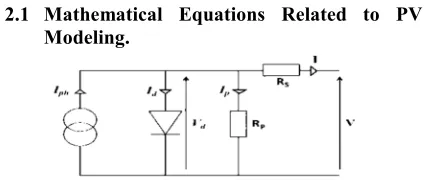
-model. But among them due to degree of accuracy and simplicity single diode model has been used in a number of previous works [4]. For this reason, the single diode configuration of PV module has been selected for this work. Figure1 represents the circuit configuration of a PV cell.
[image:1.612.311.523.630.721.2]2.1 Mathematical Equations Related to PV Modeling.
ISSN: 1992-8645 www.jatit.org E-ISSN: 1817-3195
471 For the PV output current I:
-
I I
I
I
-
I
I exp V R I /V 1
-
I
!∆#$% &'( )*∆+,- /01
2.2 Modeling the PV Panel
PV panel parameters are shown in Table 1. This PV module is made by Green light energy company.
Table 1:PV panel characteristics
Parameters Values
Open Circuit Voltage (Voc) 21.67 Volt Short Circuit Current (Isc) 3.14 Amp
Voltage at Pmax (Vmpp) 17.49 Volt
Current at Pmax (Impp) 2.86 Amp
Maximum Power (Pmpp) 50 Watt
Number of Cell 36
[image:2.612.94.522.263.585.2]A complete Simulink block diagram of PV panel demonstrated bellow:
Figure 2:simulation model of PV panel
Figure.3 shows the variation in the characteristics curves at different temperature when the irradiance is kept constant at 1000w/. Temperature varies from 0°C to 75°C.
(a)
(b)
Figure 3: (a) P-V characteristic of a PV array.
(b) I-V characteristic of a PV array for different temperature.
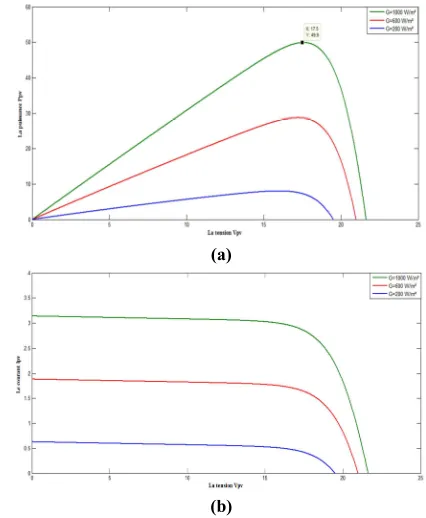
Figure 4 shows the variation in characteristics curve of the selected PV module by changing irradiance values from 400w/ to 1000w/ and T=25°C.
(a)
(b)
Figure 4: (a) P-V characteristic of a PV array.
(b) I-V characteristic of a PV array for different irradiance.
2.3 DC-DC Boost Converter
[image:2.612.307.520.334.593.2] [image:2.612.92.304.374.541.2] [image:2.612.92.297.599.723.2]ISSN: 1992-8645 www.jatit.org E-ISSN: 1817-3195
472 up dc voltage. Fig.5 shows configuration of dc-dc boost converter in the PV system. Maximum power is reached when the MPPT algorithm changes and adjusts the duty cycle of the boost dc-dc converter.
Figure 5: Basic circuit of the boost converter
3. MAXIMUM POWER POINT TRACKING
ALGORITHM
3.1. Perturb and Observe Method
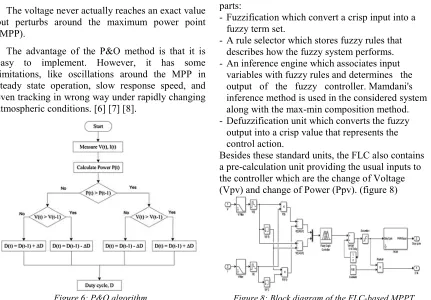
This method is the most common. In this method fewer number of sensors are utilized [6]. When PV power and voltage are increasing, a perturbation will increase a step size ΔD to be added with the duty cycle D, in order to generate next cycle of perturbation and to force the operating point moving towards the MPP. If the PV power decreases and PV voltage increases, the P&O will work vice versa. This iteration is continued until the algorithm finally reaches the MPP. The inputs of the P&O algorithm are current and voltage of the PV. This algorithm is not suitable when the variation in the solar irradiation is high.
The voltage never actually reaches an exact value but perturbs around the maximum power point (MPP).
[image:3.612.316.518.324.394.2]The advantage of the P&O method is that it is easy to implement. However, it has some limitations, like oscillations around the MPP in steady state operation, slow response speed, and even tracking in wrong way under rapidly changing atmospheric conditions. [6] [7] [8].
Figure 6: P&O algorithm
3.2. Fuzzy Logic Based MPPT
Fuzzy logic controllers are described by their capability to imitate human thinking. Fuzzy controllers are able to create variable step size increments of duty ratio command for the power converter even without having an understanding of the mathematical model, contrasting traditional controllers, [2,3]. The duty ratio command of the IGBT for the power converter would usually be the output variable of the fuzzy MPPT algorithm. The most frequently used input variables for the MPPT algorithms are the slope of the (P-V) curve of the PV panel characteristics curves and changes of this slope. In this paper, we have selected variations of power and voltage (∆Ppv and ∆Vpv) as input variables instead.
[image:3.612.94.525.427.727.2]The flow chart of Figure 7 represents the basic concept of the algorithm.
Figure 7: Internal structure of fuzzy logic controller
Fuzzy Logic Controller includes four principal parts:
- Fuzzification which convert a crisp input into a
fuzzy term set.
- A rule selector which stores fuzzy rules that
describes how the fuzzy system performs.
- An inference engine which associates input
variables with fuzzy rules and determines the output of the fuzzy controller. Mamdani's inference method is used in the considered system along with the max-min composition method.
- Defuzzification unit which converts the fuzzy
output into a crisp value that represents the control action.
Besides these standard units, the FLC also contains a pre-calculation unit providing the usual inputs to the controller which are the change of Voltage (Vpv) and change of Power (Ppv). (figure 8)
ISSN: 1992-8645 www.jatit.org E-ISSN: 1817-3195
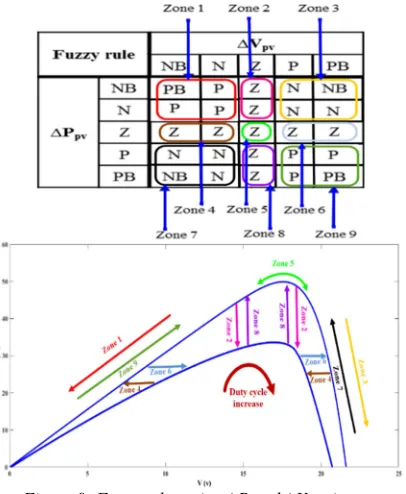
473 A five-term fuzzy set, positive big (PB), positive (P), zero (Z), negative (N), and negative big (NB), is defined to describe each linguistic variable.
[image:4.612.94.297.208.455.2]Figure 9 shows the designed rules database for these fuzzy input variables. The basic concept of this algorithm was derived from the P and O method. The fuzzy rules database was divided into 9 zones according to the characteristics of the P-V curve of the PV panel.
Figure 9: Fuzzy rules using ∆P and ∆V as inputs.
Zone 1. In this case, with the same irradiation, power and voltage decreases at the same time, the operating point would be located on the left side of the MPP. the duty ratio must be increased according to variations of the power and the voltage.
Zone 2. the voltage in this zone is unchanging but power is reducing. in those conditions the system would be unable to determine which side of the MPP the operating point is located. so, we set the output of this zone as “Z”.
Zone 3. In this region the operating point is located on the right side of the MPP, where irradiation remains unchanged, power increases, and voltage drops. the duty ratio must be decreased according to variations of the power and the voltage.
Zone 4. power remains unchanged and voltage decreased, the MPP is assumed to have been reached. In such conditions the output is “Z” to avert contradictions.
Zone 5. the power and voltage are unchanging; it means that the system arrived at the MPP. Duty
ratio would no longer be changed. So that the output in this zone would be set as “Z”.
Zone 6. power remains unchanged and voltage increased, the MPP is assumed to have been reached. In such conditions the output is “Z” to avert contradictions.
Zone 7. In this region the operating point is located on the right side of the MPP, where irradiation remains unchanged, power increases, and voltage decreases. the duty ratio must be decreased according to variations of the power and the voltage.
Zone 8. the voltage in this zone is unchanging but power is increasing. in those conditions the system would be unable to determine which side of the MPP the operating point is located. so, we set the output of this zone as “Z”.
Zone 9. In this case, with the same irradiation, power and voltage decreases at the same time, the operating point would be located on the left side of the MPP. the duty ratio must be increased according to variations of the power and the voltage.
4. SIMULATION RESULTS
Based on the algorithms, the simulation was conducted using dc-dc boost converter system implemented with SimPower Systems toolbox of MATLAB/Simulink. The simulation system contains a photovoltaic module, dc/dc boost converter, resistive load and control module as shown in figure 11.
4.1. Effect of the load
[image:4.612.314.522.537.666.2]When a direct connection between the DC load and the PV module is set (Figure 10), the electrical behavior of this last shows the effect of the load on the power supplied by the PV panel (Table 2).
ISSN: 1992-8645 www.jatit.org E-ISSN: 1817-3195
[image:5.612.121.525.47.229.2]474
Table 2:Effect of DC load
Load (Ω)
Current (A)
Voltage (V)
Power (W)
50 0.42 21.32 9.1
30 0.7 21.11 14.86
15 1.37 20.53 28.1
10 1.98 19.81 39.25
6.11 2.857 17.46 49.89
3 3.085 9.255 28.55
[image:5.612.88.296.283.405.2]The results in Table 3, show the effect of varying the resistive load on the value of the power supplied by the PV module, while the adaptation between the PV module and the load is through the MPPT adapter (Boost +MPPT control).(figure 11)
[image:5.612.83.523.296.711.2]Figure 11: The proposed PV system
Table 3:Effect of DC load
Load (Ω)
Current (A)
Voltage (V)
Power (W)
Duty cycle (%)
50 2.83 17.58 49.9 64.7
30 2.85 17.5 49.9 55.1
15 2.834 17.61 49.9 37.9
10 2.844 17.55 49.9 23.1
6.11 2.84 17.57 49.9 2.1
4.2. Simulation of the P&O and fuzzy logic MPPT controllers and results
.
Figure 12: Transitional state of solar panel power.
Figure 13: Waveform in steady state of the solar panel power
Figures 12 and 13 presents solar panel power for the two MPPT controllers (P&O and FLC). The fuzzy logic controller (FLC) gives us a fast response since it reaches its optimal value compared to perturbation and observation P&O method which requires much time to track the MPP.
The FLC allows reduction not only in the convergence time to track the MPP, but also in the fluctuation of power in steady state, as it is clearly presented in Figure13.
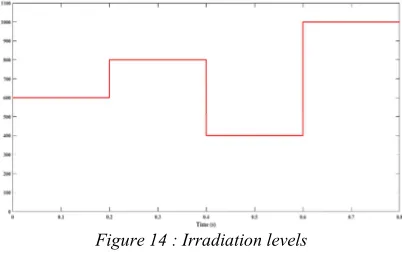
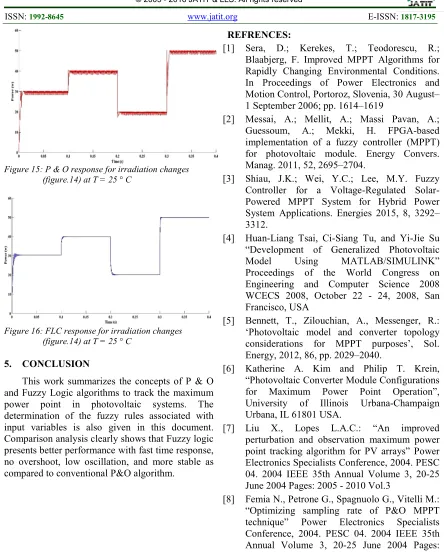
As the MPPT system must be able of maintaining normal functioning during changing irradiation, the
simulation system would therefore change
[image:5.612.317.518.487.621.2]irradiation levels every 0.2 seconds using the sequence 600 -> 800-> 400-> 1000 w/m²
Figure 14 : Irradiation levels
ISSN: 1992-8645 www.jatit.org E-ISSN: 1817-3195
[image:6.612.86.530.65.617.2]475
Figure 15: P & O response for irradiation changes (figure.14) at T = 25 ° C
Figure 16: FLC response for irradiation changes (figure.14) at T = 25 ° C
5. CONCLUSION
This work summarizes the concepts of P & O and Fuzzy Logic algorithms to track the maximum power point in photovoltaic systems. The determination of the fuzzy rules associated with input variables is also given in this document. Comparison analysis clearly shows that Fuzzy logic presents better performance with fast time response, no overshoot, low oscillation, and more stable as compared to conventional P&O algorithm.
REFRENCES:
[1] Sera, D.; Kerekes, T.; Teodorescu, R.; Blaabjerg, F. Improved MPPT Algorithms for Rapidly Changing Environmental Conditions. In Proceedings of Power Electronics and Motion Control, Portoroz, Slovenia, 30 August– 1 September 2006; pp. 1614–1619
[2] Messai, A.; Mellit, A.; Massi Pavan, A.;
Guessoum, A.; Mekki, H. FPGA-based
implementation of a fuzzy controller (MPPT) for photovoltaic module. Energy Convers. Manag. 2011, 52, 2695–2704.
[3] Shiau, J.K.; Wei, Y.C.; Lee, M.Y. Fuzzy Controller for a Voltage-Regulated Solar-Powered MPPT System for Hybrid Power System Applications. Energies 2015, 8, 3292– 3312.
[4] Huan-Liang Tsai, Ci-Siang Tu, and Yi-Jie Su “Development of Generalized Photovoltaic
Model Using MATLAB/SIMULINK”
Proceedings of the World Congress on Engineering and Computer Science 2008 WCECS 2008, October 22 - 24, 2008, San Francisco, USA
[5] Bennett, T., Zilouchian, A., Messenger, R.: ‘Photovoltaic model and converter topology considerations for MPPT purposes’, Sol. Energy, 2012, 86, pp. 2029–2040.
[6] Katherine A. Kim and Philip T. Krein, “Photovoltaic Converter Module Configurations
for Maximum Power Point Operation”,
University of Illinois Urbana-Champaign
Urbana, IL 61801 USA.
[7] Liu X., Lopes L.A.C.: “An improved
perturbation and observation maximum power point tracking algorithm for PV arrays” Power Electronics Specialists Conference, 2004. PESC 04. 2004 IEEE 35th Annual Volume 3, 20-25 June 2004 Pages: 2005 - 2010 Vol.3
[8] Femia N., Petrone G., Spagnuolo G., Vitelli M.: “Optimizing sampling rate of P&O MPPT
technique” Power Electronics Specialists