BUILDING PLATFORM FOR SHARING DIGITAL
RESOURCE UNDER THE BACKGROUND OF NEW URBAN
AGGLOMERATION
1SHANGQIN ZHONG
1
Party School of CCP Foshan Municipal Committee, Foshan, China
E-mail: [email protected]
ABSTRACT
The current building pattern of digital library has failed to meet the needs of the construction of new urban agglomeration. A platform for sharing digital resource is proposed. The network deployment program, framework of the platform, data processing mechanism, and processes of lending and returning books are described. The platform provides not only excellent data security mechanism, but also user-transparent interlibrary loan service of inter-city, which greatly facilitates the city residents. It also promotes the process of building a new urban agglomeration as its innovations in technology, management, and service.
Keywords: Digital Resource Sharing Platform, Digital Library, Interlibrary Loan, New Urban
Agglomeration
1. INTRODUCTION
The reason why urban agglomeration was formed was that every single city in the region wanted to overcome the deficiency in resources, adjust the allocation of resources in a larger scope, and ultimately realize common development. The concept of urban agglomeration with modern sense was proposed in the mid-20th century by a French geographer named Jean Gottman. He believed that urban agglomeration was formed in the process of industrialization and urbanization. It was the highest form of spatial organization when the cities developed to their mature stage. Besides, urban agglomeration could be formally described as the manifestation of a geographically concentrated group of several cities and mega-cities. It was a large, multicore and multilevel commonwealth of metropolises [1]. Since then, many European and American scholars studied the theory of urban agglomeration, and created a lot of achievements. Many countries in the world (such as the United Kingdom, the United States, Poland, Japan, Brazil, etc.) also accumulated a great wealth of practical experience [2-4]. In China, there were also many regions and cities carried out the exploration and practice of constructing urban agglomeration [5-7].
However, on the issue of constructing urban agglomeration, regardless of the scholars’ researches, or the government’s developing plans,
the topics they concerned were always on economy, politics, municipal planning (such as transportation, communications, environmental protection, medical and health services) and other fields. They paid little attention to the cultural exchange and cooperation between cities. The intention of proposing the concept of urban agglomeration was to achieve optimal allocation of resources between cities and realize common development. Moreover, the construction of urban agglomeration should be able to provide city residents a more convenient life and a better living environment. In fact, if it could not share resources in the field of culture, the construction of urban agglomeration would be seriously compromised. Under the background of constructing a new urban agglomeration, this paper studied the development status of existing digital libraries from the perspective of cultural exchange and cooperation, and then designed a digital resource sharing platform for new urban agglomeration.
2. CURRENT DISTRIBUTION STATUS OF
DIGITAL RESOURCES AMONG CITIES
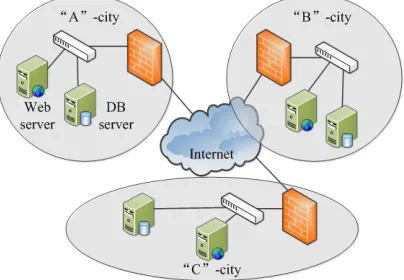
city of the region were independent. There is little resources sharing and business exchanging between them. Supposed an urban agglomeration was made up of 3 cities (represented as “A”-city, “B”-city, and “C”-city), then Figure 1 shows the current network deployment status of digital libraries in the region.
Figure 1. The Current Network Deployment Status Of Digital Libraries.
As can be seen from Figure 1, every city had its own digital library system, which independently contained a website and an acquisition system. Meanwhile, it maintained a local database, which was used to store books information and other resources. The layout pattern like that could undoubtedly make the development of digital libraries to maximize prominent local characteristics of each city, facilitating government agencies to propagate local policies and culture. However, on the other hand, this layout pattern was very inadequate, and mainly reflected in the following two aspects:
a) Considering the system management and data
security, as every city in urban agglomeration had its own digital library system, it had to consider the backup and synchronization schemes of database by itself. In order to keep data safe, manager of the digital library of
“A”-city must take some techniques and
measures to back up the database, in case of losing data when the system was corrupted. Likewise, managers of the digital libraries in
“B”-city and “C”-city had to take similar
measures. To the entire urban agglomeration, obviously, management in this way requires a lot of maintenance efforts, while similar work also increased the waste of human resources.
b) As the related circulation mechanisms and
service had not formed, the sharing of books and digital resources between two cities had
not been realized. A resident of “A”-city
could only know the information of collection
status and digital resource of library in “A”
-city, however, he had no idea about the
information of libraries in “B”-city and
“C”-city. Even he could get the information
of book collection from the websites of
“B”-city and “C”-city, he still could not
borrow books from the libraries of these two cities, as the circulation mechanisms between two cities had not been formed. Thus, in that
situation, if a resident of “A”-city wanted to
borrow a book which was belonged to the
library of “B”-city, there was just only two
ways he could try. He could either go to the
library in “B”-city and borrow the book he
wanted, or ask a friend in “B”-city to
borrow the book and take it to him or mail to him. But no matter which way he tried, the operation was very troublesome. It happened also in the process of returning the book.
It was obviously that the current network deployment status of digital libraries was far from meeting the needs of constructing new urban agglomeration, as it could not achieve the goal of sharing digital resource between cities, could not
facilitating the exchange of cities’ culture, and
could not bring convenience to residents’ lives.
3. DIGITAL RESOURCE SHARING
PLATFORM OF NEW URBAN AGGLOMERATION
3.1. Network deployment
interlibrary loan service in the network environment.
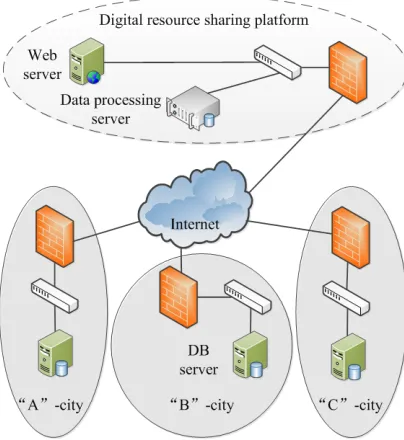
[image:3.612.101.303.235.455.2]Based on these studies, considering the current development status of the construction of new urban agglomeration, especially the current distribution status of digital resources among cities, this paper focused on the issue of re-planning the construction scheme of digital library, proposed and designed a sharing platform of digital resource under the background of new urban agglomeration. Its network deployment was described in Figure 2.
Figure 2. Network Deployment Of Digital Resource Sharing Platform For New Urban Agglomeration.
The hardware environment of digital resource sharing platform was chiefly composed of a web server and several data processing servers. Web server was used to deploy the digital resource sharing platform, while the data processing servers were charge for manipulating various types of data in the platform. There is no any geographical space restrictions to these devices, as they could be placed in any cities of the region.
3.2. Framework Of The Platform
The most important thing to a library was to make it smooth in the processes of acquisition and circulation (lending and returning) of books. Besides, to the digital library of traditional sense, it had another mission, that is to integrate and share electronic resources in the network. The digital resource sharing platform under the background of new urban agglomeration integrated resource of digital libraries of several cities, therefore, the new platform should not only meet the needs of including all the functions of traditional digital
library, but also focus on sharing the local characteristics and culture of each city. The framework of digital resource sharing platform for new urban agglomeration was shown in Figure 3.
As can be seen, Local resources, Network digital resources, Unified acquisition system and Unified circulation system were combined together, and formed the core service module of the platform, which supplied corresponding service to users.
Local resources: It showed local
characteristics and culture of each city. It acted as a bridge for users to collect and search distinctive resource of a city, such as introduction to its tradition and culture , documents of governmental policies, local news and so on.
Network digital resources: This module played
an important role in connecting and sharing resources with other online medias and thematic databases in network.
Unified acquisition system: The system
integrated all acquisition systems of every cities in the region, achieving the goal of unified management through the platform.
Unified circulation system: The system
integrated all circulation systems of every cities in the region. By taking some corresponding facilities and services, it provided transparent interlibrary loan service for users.
3.3. Data Processing Mechanism
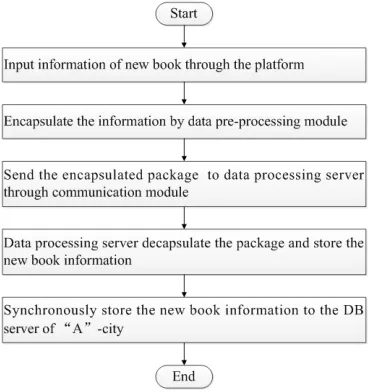
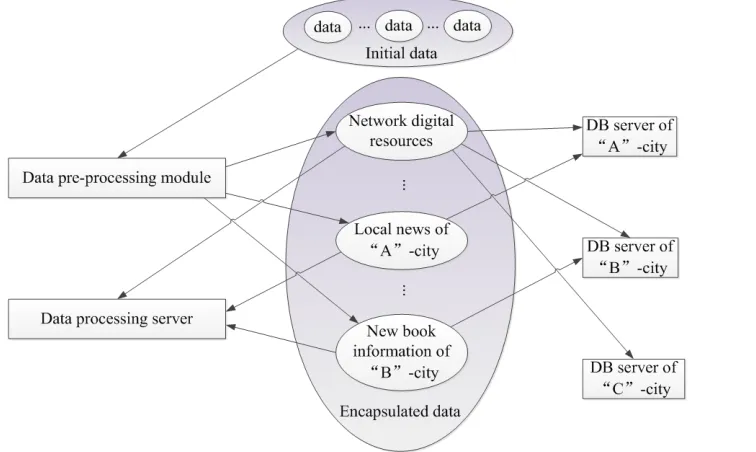
appropriate synchronization strategies to store the data into DB servers of cities in the region. Figure 4 depicts the flow of data, and Figure 5 describes the processing flow of the platform when a new book
was added to the collections of “A”-city's library.
Figure 5. The Processing Flow Of Adding A New Book.
In the digital resource sharing platform, even the data processing server stored all the data in the system, DB servers of each city still stored some public data and the data about its own city. There was two reasons for doing this. Firstly, every DB servers in each city could be considered as backup servers, which would play an important role in data recovery when the data processing server was in trouble. Secondly, database of each city could be reserved to be the basis for developing other local application systems. As the data needed to be backed up, it also had to take some measures to achieve synchronization of data in data processing server.
3.4. User-Transparent Interlibrary Loan Service Of Inter-City
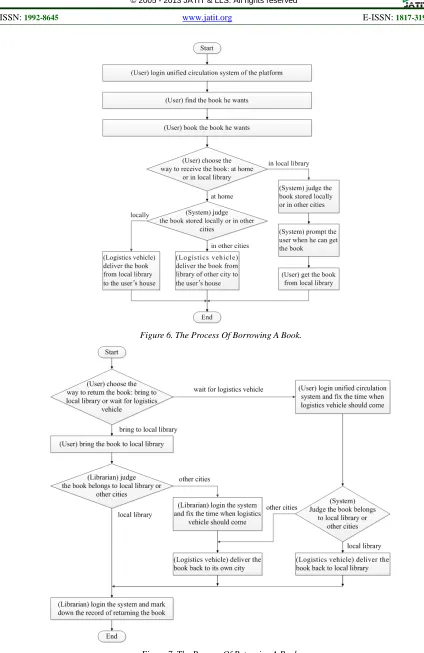
Digital resource sharing platform integrated previous digital libraries into a unified platform, facilitating the sharing of resources. Users in the urban agglomeration, could not only access digital resource in network through the platform, but also borrow books of any libraries in the region via the unified circulation system in the platform. What a user need to do was simple. He just needed to login the platform, book the books he wants, and then wait for the books in his house or fetch the books in local library by himself. Correspondingly, the formalities for returning the books were also very simple. User just needed to be at home waiting for a truck to take away the books or to return them to
[image:4.612.102.288.158.354.2]local library in person. In order to provide the interlibrary loan service of inter-city, it also needed to be supported by appropriate logistics support services, which responsible for transporting the books from one city's library to another city's library or directly to the readers. Figure 6 and Figure 7 independently show the procedure of borrowing a book and the procedure of returning a book.
As can be seen from the procedures, user could achieve the goals of borrowing and returning books within just a few actions. Thus, great convenient was brought to user by the platform. It was very meaningful to users, as people could borrow books from libraries of any cities in the region, without having to care about whether the books were in the library of his own city, where the books from, or how the books be sent to his hands. And his also did not have to worry about to which library he should return the books back, or how he return the books to the library they belonged to. In a word, the entire procedures of borrowing and returning book were transparent to users.
4.CONCLUSION
The construction of new urban agglomeration had proposed new requirements for building digital library of cities. The existing network deployment and service model had been completely unable to meet the needs of facilitating the use of urban residents. Based on the related research, this paper designed and put forward a digital resource sharing platform. The platform not only made improvement on the security of the system, but also provided transparent interlibrary loan service of inter-city for users, which greatly facilitates the city residents. Thus, the platform had made innovations in technology, management and services, and it promoted the process of building a new urban agglomeration. The further direction of our research is to study the billing model of the platform according to the services it provides, as well as the problems of technology and management in the process of integrating the original systems.
5.ACKNOWLEDGMENT
REFRENCES:
[1] Gottman J., “Megalopolis, the Urbanized
Northeastern Seaboard of the United States”, N. Y., 1961.
[2] Bruinsma F., Rietveld P., “Urban
Agglomerations in European Infrastructure
Networks”. Urban Stud, vol. 30, no. 6, pp.
919-934, 1993.
[3] Batten D. F., “Network Cities: Creative Urban
Agglomerations for the 21st Century”. Urban
Stud, vol. 32, no. 2, pp.313-327, 1995.
[4] Kanemoto Y., Ohkawara T., Suzuki T.
“Agglomeration Economies and A Test for
Optimal City Sizes in Japan”. Journal of the
Japanese and International Economies, vol. 10, no. 4, pp. 379-398, 1996.
[5] Yao Shimou, Zhu Yingming, Chen Zhenguang.
“Urban Agglomerations in China”. Hefei:
University of Science and Technology, pp. 3-10, 2001.
[6] Fang Chuanlin, Song Jitao, Zhang Qiang, Li
Ming. “The Formation, Development and Spatial Heterogeneity Patterns for the Structures System of Urban Agglomerations in
China”. ACTA GEOGRAPHICA SINICA, vol.
60, no. 5, pp.827-840, 2005.
[7] Zhao Yong, Bai Yongxiu. “Review on the
Studies on Urban Agglomeration of China”.
Urban Problems, 2007(07), pp. 6-11.
[8] Schatz R., Chen H. “Digital Libraries:
Technological Advances and Social Impacts”.
Computer, vol. 32, no. 2, pp.45-50, 1999.
[9] Yujie Guo. “Construction and Sharing of
Information Resources under the Network
Environment”. Journal of the China Society for
Scientific and Technical Information, vol. 18, supplement, pp. 69-72, 1999.
[10]Min Huang, Haoming Lin, Zongying Yang.
“Building of the Distributive and Collaborative
Virtual Reference System”. Journal of
Shanghai Jiaotong University, vol. 37, supplement, pp. 37-42, 2003.
[11]Yajun Li, changquan Bi. “Building A Digital
Platform, Integration of Science and
Technology Information Resources”. China
Computer & Communication, 2012, no. 2, pp. 189-190.
[12]Meiying Nie, Xinjuan Zhou. “Study on Library
Administrate Decision Using Data Mining”.
IJACT: International Journal of Advancements in Computing Technology, vol. 4, no. 8, pp. 165-172, 2012.
[13]Ying Chen, Runtong Zhang, Haoyue Li, Ruixia
Li, Yuhong Gao. “CALIS-based Cloud Library
Services Platform Model”. AISS: Advances in
Information Sciences and Service Sciences, vol. 3, no. 6, pp. 204-212, 2011.
[14]Airong Jiang. “Interlibrary Loan Services
under the Network Environment”. New
Technology of Library and Information Service, 1997, no. 5, pp. 3-12.
[15]Croft J B. “Model Licences and Interlibrary
Loan/Document Delivery from Electronic
Resources”. Interlending & Document Supply,
vol. 29, no. 4, pp. 165-168, 2001.
[16]Lijun Zeng. “Interlibrary Loan under the
Network Environment”. Journal of Academic
Libraries, 2001, no. 3, pp. 27-29.
[17]Yayong Xie, Qiaoying Zheng, Ruxing Xu.
“Comparison and Discussion of Several
Interlibrary Loan Protocols”. Journal of
Shanghai Jiaotong University, vol. 37, supplement, pp. 239-242, 2003.
[18]Wiley L, Chrzastowski T E. “The Impact of
Electronic Journals on Interlibrary Lending: A Longitudinal Study of Statewide Interlibrary
Loan article Sharing in Illinois”. Library
Figure 3. The framework of digital resource sharing platform.
Figure 6. The Process Of Borrowing A Book.