Global Register Allocation at Link Time
David W. Wall
n Digital Equipment Corporatio
Western Research Lab
Abstract
In previous work in global register allocation, the compiler colors a conflict graph constructed from -o
liveness dataflow information, in order to allocate the same register to many variables that are not simultane usly live. If two procedures are in separately compiled modules, however, the compiler must do this allocation
, o
separately for each procedure. As a result, the two procedures might use different registers for the same global r the same register for different locals.
We can remove these problems if we delay the register allocation until link time. Our compiler pro-t m
duces object modules that can be linked and run without global register allocation, but includes with each objec odule a body of information describing how the module uses variables and procedures. A link-time register
t
allocator then decides which variables are used most frequently, selects registers for them, and rewrites the code o reflect the decision that these variables reside in registers rather than in memory. Construction of the call
m
graph allows us to use the same register for locals of procedures that are not simultaneously active, giving us ost of the advantages of a full-scale coloring without the expense.
h o
When we use our method for 52 registers, our benchmarks speed up by 10 to 25 percent. Even wit nly 8 registers, the speedup can be nearly that large if we use previously collected profile information to guide
b
the allocation. We cannot do much better, because programs whose variables all fit in registers rarely speed up y more than 30%. Moreover, profiling shows us that we usually remove 60% to 90% of the loads and stores of
1
scalar variables that the program performs during its execution, and often much more.
. Introduction
Several recent machines [8,9,10] have been designed with simple instruction sets. They have only a . T
few ways of accessing memory, sometimes no more than a single load instruction and a single store instruction his allows most operations to be fast, since they operate only on registers. In addition, these machines often have a large number of registers, relying on smart compilers to exploit them.
How can we best take advantage of a machine with many registers? One promising idea is to pick the most frequently used variables and keep them in registers instead of in memory. Chaitin et al. [2,3] and Chow
An earlier version of this paper appears in the Proceedings of the SIGPLAN ’86 Symposium on Compiler Construction, published as
[4] have explored a technique in which many different variables can be assigned to the same register. In their
b
technique, the compiler does a liveness dataflow analysis, and builds a conflict graph in which an edge appears etween two variables if they are ever live at the same time. Two variables that are never live at the same time -a
can be kept in the same register, so a coloring of this graph is equivalent to a register allocation for the vari bles. Good linear-time coloring heuristics exist, even though the problem of finding a minimal coloring is NP-complete.
The technique of Chaitin et al. and Chow is less satisfactory if we also want to use separate compila-r r
tion. If procedures in two different modules must be analyzed separately, then there is no way to keep thei egister allocations from interfering with each other. If one procedure calls the other, one of them must save
f b
and restore its locals around the call, in case the other procedure uses the same registers for its own locals. I oth procedures use a common global variable, they may allocate different registers for the global, so each
pro-l f
cedure must spill the global to a home memory location before transferring to the other, and load the globa rom that location whenever it gets control again.
These problems are less important in an environment where the modules of a program are compiled all
s
together instead of separately, or in machines with few registers. The papers by Chaitin et al. seem to assume uch an environment, and the first of these papers describes a machine with only 16 general purpose registers.
s
Both of these assumptions seem unrealistic, however: the machine we are working with has 64 registers, and eparate compilation seems essential if we want to develop large programs.
2
Our solution is to assign variables to registers at link time.
. Global register allocation at link time
If we assign variables to registers over the entire program at link time, these problems disappear. We s a
can keep each global in a specific register where any procedure can access it. And when one procedure call nother, we can keep the locals of the two procedures in different registers, so that there is no need to save and restore them around the call.
Simply postponing the coloring technique until link time is impractical, however. If we wait until link -e
time and then do an expensive dataflow analysis, conflict graph construction, graph coloring, and final code gen ration, we will be doing the bulk of the compiler’s work at link time, and recompilation after a change will
c
take almost as long as if we did not have separate compilation. Moreover, algorithms for dataflow analysis and onflict graph construction require slightly more than linear time; the cost may be acceptable if we apply the
t
algorithms repeatedly to a lot of smaller modules or procedures, but we have found it too expensive to apply hem to an entire program. It is important to do as much as we can at compile time.
-e
We therefore treat the assignment of variables to registers as a form of relocation. The compiler gen rates code that can be linked and executed without further work, but it includes extra information similar in
s w
the allocation, just as a relocating linker rewrites a module in order to relocate it.
e r
Generating code that is correct as it stands but which we can easily modify later is attractive for thre easons. First, it means that the assignment of variables to registers is entirely optional. If the expense of the
s
assignment is unwarranted, or if bugs are suspected, we can omit it. Second, it means we are not forced omehow to allocate registers for all the variables in the program; if we manage to keep the most frequently t k
used variables in registers, we can keep the rest of them in memory and the results are still correct. Finally, i eeps us honest as designers of the system; once we postpone anything until link time, the temptation is great to
e w
postpone everything, so that we can know what the other modules look like. The requirement that we generat orking code at compile time makes it harder to succumb to that temptation when we should not.
e r
Making the assignment of variables to registers optional means that the compiler must set aside som egisters as expression temporaries, and deal with them separately from the registers allocated at link time as the
s i
homes of variables. This is contrary to the philosophy of Chaitin et al., which included expression temporarie n the conflict graph, and introduced spills and reloads in order to reduce the complexity of the conflict graph to
-t
the point where it was colorable using the number of registers available. This meant that global register alloca ion was an integral part of code generation and could never be omitted. We contend that this is inappropriate in a realistic setting with the need for separate compilation and optional optimization.
Our scheme for assigning variables to registers consists of three phases: compilation, register allocation,
2
and module rewriting.
.1. Compilation
The compiler must do two things to support global register allocation. First, it must annotate the code -m
it generates so that it can be rewritten after registers have been allocated. Second, it must collect usage infor ation that lets the allocator build the program call graph and estimate the usage frequency of each variable.
2.1.1. Annotated code generation
Our target machine allows memory access only through a simple load or store instruction. The com-t m
piler generates good code that does not load a variable twice in the same basic block unless necessary, but i akes no attempt to allocate variables to registers. Moreover, it uses only eight registers for expression
tem-c
poraries; if it needs more, then it spills some of these eight into internal memory variables which are themselves andidates for global register allocation. In short, the compiler generates the code that you would expect if the machine had only a few registers.
The compiler annotates some of the instructions with ‘‘register actions’’ that explain how the operands -a
instruction actions
y r
r1 := load y REMOVE. 2 := load z REMOVE.z
x s
r3 := r1 + r2 OP1.y OP2.z RESULT. tore x := r3 REMOVE.x
e t
Each action in this example is qualified by a variable name; the action specifies what needs to be don o the instruction if that variable is assigned to a register at link time. The action REMOVE.v means to delete
t o
the instruction if v is assigned to a register. The action OP1.v, OP2.v, or RESULT.v means to replace the firs perand, second operand, or result of the instruction by the register allocated to v. The three examples below show the rewritten code that results at link time from various selections of register variables.
register y register x,y register x,y,z
r
r2 := load z r2 := load z x := y + z 3 := y + r2 x := y + r2
T
store x := r3
his example was easy. Our job is more complicated if a variable is evaluated and then changed, and s t
later the original value is used. For example, the C assignment ‘‘x = y++ + z’’, which increments y but add he unincremented value to the value of z, might lead to annotated code like:
r
r1 := load y LOAD.y 2 := r1 + 1 RESULT.y
y r
store y := r2 REMOVE. 2 := load z REMOVE.z
x s
r3 := r1 + r2 OP2.z RESULT. tore x := r3 REMOVE.x
e t
The LOAD.y action says that the instruction is loading the current value of y, but that y will be changed befor his value is used for the last time. As a result we cannot delete the load; instead we change it to a register
, w
move that copies the current value of y from its home register into the temporary register. For the same reason e do not flag later uses of this value with an action like OP1.y, as we did in the previous example. If x, y, and z are all assigned to registers, this code segment becomes:
r1 := y 1 x
y := r1 + := r1 + z
. We will see that distinguishing between these two cases is not difficult with a little analysis of the basic block
Some source languages allow an assignment to be used as an expression. In this case, the computed e t
value is used as an operand to more than one command, not just as an operand to the assignment. The variabl o which the value is assigned may even change again before we finally use the computed value. This makes it
r
r1 := load a REMOVE.a b r
r2 := load b REMOVE. 3 := r1 + r2 OP1.a OP2.b
s
store y := r3 STORE.y tore x := r3 STORE.x
a r
A STORE.v action is analogous to a LOAD action. It says that we should replace the store instruction by egister move into the register allocated to v.
There is one degenerate case that we must handle properly. If we compile the assignment ‘‘x = y’’ the above examples would lead us to expect the annotated code:
r1 := load y REMOVE.y x
I
store x := r1 OP1.y REMOVE.
f we assign both x and y to registers, both instructions will be removed! We must therefore handle simple e s
assignments of one variable to another as a special case, which we can do by changing the annotation of th tore:
r1 := load y REMOVE.y x
H
store x := r1 OP1.y STORE.
ow do we decide how to annotate the code in practice? Let us represent a basic block as a sequence r t
of commands, where each command specifies the evaluation of a variable, the performance of an operation, o he assignment of a result. Then the C assignment ‘‘x = y++ + z’’ would appear as:
#
#1: leaf y
2: operate #1 + 1 2 #
#3: assign y :=#
4: leaf z
4 #
#5: operate #1 +# 6: assign x :=#5
-f
There are three types of commands. A leaf command evaluates a single variable. An operation command per orms an operation using the values of previous commands, producing a new value. An assignment command
a m
assigns the value of a previous command to some variable. This organization of commands is appropriate for achine like ours where we must access memory only via loads and stores. Other kinds of commands, such as indirect loads and stores and procedure calls, do not concern us here.
Then generation of unannotated code is easy. To annotate the code with register actions, we must first
c
determine where the value of each command is used; for instance, the value of command #1 above is used in ommands #2 and #5, but not thereafter. Command#1 evaluates the variable y, and command #3 is an
assign-t
ment to y, so the use of command #1 in command#5 means that we must mark#1 as ‘‘time critical,’’ meaning hat the value used is not always the current value of the variable.
Let LIVELEAVES be a set of leaves in this
f
basic block, initially empty. or each command, in reverse order, do:
n if the command is an assignment, the
let DEST be the assignment destination for each leaf in LIVELEAVES, do:
let LEAF be the leaf variable n if LEAF is the same as DEST, the
Mark the leaf as ‘‘time critical’’
e end nd end
if the command is a leaf, then S e
remove it from LIVELEAVE lse
for each operand of the command, do: n if the operand is a leaf command, the
add the leaf command to LIVELEAVES
e end nd end end
This done, we generate annotated code for each command as follows.
. (
Case 1. If the command is a leaf for some variable v, then generate a load into a temporary register Remember that expression temporaries are different from the registers we allocate to variables.) If the leaf is
C
marked ‘‘time critical,’’ then annotate the load with LOAD.v, and otherwise annotate it with REMOVE.v.
ase 2. If the command is an operation, generate the instructions to perform the operation. Usually this is just
v
one instruction, but for operations that are not available in hardware it may be a sequence of instructions. If the alue of this operation is used only once, by an assignment command ‘‘v:=’’, then annotate the instruction that
C
produces the result with RESULT.v.
ase 3. If the command is an assignment to some variable v, generate a store. If the operand is a leaf com -w
mand, or if it is used in some other command as well as this one, then annotate the store with STORE.v. Other ise annotate it with REMOVE.v.
In either case 2 or case 3, if an operand of the command is a leaf for some variable v and is not marked as
o
There are really only two things going on here, each of which consists of two pieces that must fit
s
together properly. First there is the loading of a variable. If the value is used only in places where the variable till has the same value, we can mark the load for removal and mark the uses to be replaced by the variable’s -t
register. If there are uses after the variable has changed, then we must retain the load (but replace it by a regis er move) and leave the uses unchanged. Second there is the assignment of a value to a variable. If the value is
m
used only to assign it to the variable, we can mark it for direct computation into the variable’s register, and ark the store for removal. If the value has other uses, we must retain the store (again replacing it by a register
r
move). A smarter analysis would let us see whether the other uses could instead be replaced by the variable’s egister, but we don’t do that.
2.1.2. Usage information
The compiler collects usage information about each module it compiles, and records this information in a l
the object file. This information includes a list of the procedures in the module. For each procedure there is ist of the variables local to this procedure, a list of the procedures this procedure calls, and a list of the
vari-p
ables this procedure references. Each entry in the last two lists includes an estimate of the number of times the rocedure is called or the variable is referenced in each execution of this procedure. When I obtained the e r
results described later in this paper, these estimates were computed by counting the static number of times th eference is made, with references inside loops, no matter how deeply nested, counting as 10.
2.2. Register allocation
Before the program is linked, the register allocator collects the usage information for all the modules ) a
being linked, and then builds a call graph for the program. This call graph is a directed acyclic graph (DAG nd does not include edges for recursive or indirect calls, which require special handling.
s a
The allocator then estimates the total number of times each procedure is called, by summing the count ssociated with the procedure in all of the call lists. (At first we tried to traverse the call graph and multiply
r R
counts, so that if P called Q ten times and Q called R ten times we ended up with an estimate of 100 calls fo . Since the estimates in the individual call lists were only rough guesses, this tended to give wildly wrong counts, some even overflowing the 32-bit integer. The current more conservative scheme seems to work better.)
The allocator also estimates the total number of times each variable is referenced, by summing the reference counts for each procedure, weighted by the estimated number of times the procedure is called.
The idea behind our register allocation scheme is that locals of procedures that are not simultaneously n active can be grouped together and assigned to the same registers. We do this by traversing the call DAG i*
h reverse depth-first search order [1], assigning the locals of leaf procedures to a series of groups beginning wit
Michael L. Powell is responsible for this insight, for which I am most grateful.
group 0, and then assigning locals of other procedures to a series of groups beginning after the groups used by its children. The algorithm is as follows:†
for each proc p in reverse depth-first search order, do: (* Each child was given groups in a previous
iteration. Leaves have no children. *)
f
childGroups := 0
or each child q of p in the call DAG, do: if groups[q]>childGroups then
childGroups := groups[q]
e end nd
groups[p] := childGroups for each local v of p, do:
assign v to group number "groups[p]"
e
groups[p] := groups[p] + 1 nd
end
The register allocator then assigns each global variable to a singleton group, gives each group a fre-t a
quency that is the sum of the reference frequencies of its variables, and sorts the groups by frequency. Then i ssigns the most frequently used groups to registers.
A variable whose address is taken anywhere in the program is ineligible for assignment to a register.
p
This is an extremely conservative decision, which could be relaxed by using dataflow analysis to determine the laces where the address might be used. We were interested in how well we could do without that sort of
2
analysis, so we didn’t do it.
.3. Module rewriting
When we have decided which variables to keep in registers, we know which register actions to apply to r d
the code of each module. Applying these actions is easy, since each one is independent of context; the compile id the hard work when it generated the actions in the first place. The only tricky part is that we may add or
o
delete instructions, so addresses that appear in instructions or data must be adjusted. Finding these instructions r data is easy as well, because the compiler flags them for relocation by the linker.
w o
The module rewriter starts by building an adjustment table that it uses to map old addresses into ne nes. This table specifies the adjustment that we must make to addresses in a given range; to find the range for a code address we do a binary search. Data addresses are easier: we always adjust them by the change in the
.
size of the code.
Then the rewriter steps through the code segment, modifying or discarding each instruction according to n e
the register actions that apply to it. If the instruction has a relocation entry, the rewriter discards the relocatio ntry if the instruction is removed or if relocation is no longer needed, and modifies the relocation entry by
e r
adjusting the address it applies to if the instruction is retained but has a different address than before. W ewrite the data segments in much the same way; there are no actions to apply, but a data item itself may be flagged for relocation as some kind of address, in which case the value must be adjusted.
We rewrite the linker symbol table in exactly the same way. Each symbol has a value and a type; the type tells us how to adjust the value.
The rewritten module is then returned to the linker, to be combined with other rewritten modules.
2.4. Complications and Extensions
When I implemented the scheme described above, I encountered several complications and several
2
opportunities for extensions. My implementation handles all of these.
.4.1. Initialization
Some variables have initial values that we must consider in our global register scheme.
e p
A global variable may be declared with an initial value. This value normally appears in the core imag roduced by the loader, so no instruction is executed to assign the value to the variable. If we decide that some
e m
variable will reside in a register rather than in memory, we must somehow get that initial value from the hom emory location into the register.
Identifying all such globals is easy for the compiler, so it includes information about these globals with d i
the usage information. The driver program, which is responsible for initializing the program environment an nvoking the user main program, includes an action called INIT. The INIT action is unconditionally performed
-t
by the module rewriter. This action requests that instructions be inserted to copy the initial value into each ini ialized global that has been assigned to a register.
Local variables declared with initial values do not present this problem, since the compiler generates
c
ordinary code to assign their initial values at the beginning of the procedure. This code is annotated just like ode for explicit user statements.
allocation is not requested, our calling conventions require that the calling procedure put arguments on the stack o a
in locations that will correspond to the parameters of the called procedure. If the register allocator decides t ssign one of these parameters to a register, the module rewriter must insert code at the beginning of the
pro-m
cedure to load the argument into that register from the stack. The compiler specifies another register action to ark the place where we must generate these loads.*
2.4.2. Recursive and indirect calls
If the program contains recursive calls, we must do something to maintain the correctness of our
s
scheme. Our approach is potentially expensive, but not extremely so in typical cases. And recursive calls are a mall fraction of the total, especially when tail recursion is removed.
-c
What is the problem with recursive calls? Our aim was to allocate registers so that when we call pro edure P, the registers allocated to P’s locals are not currently in use, so we don’t have to save and restore these
u
registers. This obviously cannot be true in a recursive call, because the set of variables local to P are already in se, in a previous invocation of P. If we kept all of our variables in memory, we would handle this by creating t a
a new frame on the stack. If we are going to use the registers for the new instances of these locals, we mus rchive the old values. This archiving is enough to let P operate correctly, since the new invocation of P cannot access the locals of the previous invocation.
One way to organize the archiving of recursively instantiated locals is to have each recursive procedure r c
be responsible for archiving its own local registers. This unfortunately is not consistent with our algorithm fo ombining non-conflicting locals into groups, as shown by the following call graph:
. T
Here B and C are leaves of the call DAG, because the recursive call from B to A does not appear in the DAG hus it looks like we can use the same group of registers for the locals of B and C; but this is wrong because B
e f
and C can be simultaneously active after all, if B calls A and A calls C. If we made each procedure responsibl or archiving its own locals on entry, we would make the following error. The call to B would not archive the
, b
locals of C because C is not part of any recursive chain. The call from B to A would archive the locals of A ut not those of B and C. But this means that B and C would use the same registers without archiving them in between. So we need a better method.
In fact, we can do better, by having the caller put the argument value directly into the parameter register. We discuss this in section 2.4.3.
We could change the way we group locals, or we could change the way we do archives. On the f e
assumption that recursive calls are much less frequent that non-recursive calls, we chose the latter. Instead o ach procedure in a recursive chain saving its own local registers, the procedure that makes the recursive call
e
saves the locals of all the procedures in the chain. This occasionally saves some things unnecessarily, as in the xample:
Here the recursive call from D to A saves the locals of both B and C, even though only one group of locals can e g
possibly be active. This example is typical, however, in that the locals of B and C are assigned to the sam roup of registers. Moreover, many apparently recursive programs are recursive only in exceptional cases; this
l r
solution allows us to call such a routine in the normal case without archiving its locals unless we do an actua ecursive call.
The same problem occurs with indirect calls, in which a procedure is called though a procedure
vari-t
able, so that we cannot tell at compile time which procedure is being called. Since such a call cannot appear in he call graph, we cannot take it into account when we allocate registers to locals.
y a
It turns out that we can apply the same solution here. An indirect call archives all of the apparentl ctive locals, so that when we arrive at the called procedure we can behave as if we had performed a normal call visible in the call DAG.
You should note that this works only because the languages we are dealing with allow indirect calls
i
only to top-level procedures. If P and Q are both nested in R and both refer to R’s locals, and P calls Q ndirectly, archiving R’s locals around the call is wrong, because Q might legally change one of them. We a s
could still apply the technique by postponing it to run time; the procedure variable could be implemented as tructure that includes information about what needs to be saved. This is not too different from current
imple-l t
mentations, in which the procedure variable includes a display that describes the environment in which to cal he procedure.
2.4.3. Fast argument passing
The scheme we have described so far deals with argument passing in a simple-minded way. We
evalu-a
register. It would be better if the calling procedure could put the argument directly into the parameter register to begin with.
This would not be possible if we were doing global register allocation at compile time, since the called o r
procedure might be in a different module and we would not know which of its parameters would be assigned t egisters. Since we are doing global register allocation at link time, however, it is straightforward to include this optimization.
We use the same idea here that we used in expression evaluation. The compiler generates code that
c
stores the argument on the stack, but flags the store with an action PARM that tells which procedure is being alled and the index of the parameter being passed. (It cannot refer to the parameter by name because it
gen-r
erates the action at compile time, when the called procedure may not be visible.) At link time, the module ewriter checks to see whether that parameter is assigned to a register, and if so converts the PARM action into an ordinary STORE action.
In the section ‘‘Initialization,’’ we described the insertion of loads into the procedure entry code, to r h
load the arguments from the stack into the parameter registers. Now we must omit these loads, since the calle as already put the arguments directly into the parameter registers, and the value on the stack is garbage.
How -t
ever, there remains the possibility that someone will call the procedure indirectly, in which case this optimiza ion cannot be applied. So we leave the inserted loads in place, and instead modify the call so that it enters the procedure after the point at which we have inserted the loads.
Proponents of the Berkeley RISC machine [9] are justly proud of the floating register windows that
w
allow arguments to be passed in registers. It is satisfying to see that we can accomplish much the same thing ithout hardware support or runtime overhead. Moreover, letting the compiler and linker take care of it is more -c
flexible, since we can decide for each program how many registers to use for globals and for locals of each pro edure.
2.4.4. Profiling
We do not keep all of the variables in registers, but only those that seem to be referenced frequently.
c
As a result, the quality of the estimates of the frequency with which variables are referenced and procedures are alled is often important, especially in large programs. These estimates can be improved by using previously r a
gathered execution-time profile information. We have two kinds of profilers that we can use with the registe llocator.
The first is a variable-reference profiler that we built ourselves for precisely this purpose. The compiler
e
prints statistics about removable loads and stores in each basic block, and generates code that counts the times ach basic block is executed. These two sets of information are combined to give us the number of executions
g
inserted instructions, and it does not consider the time spent archiving registers for recursive or indirect calls.
e m
The variable-reference profile has the disadvantage that we may need to recompute it often for it to b ost effective. If the programmer adds a new variable to a procedure that is executed very frequently, that
vari-. A
able will not appear in the previously computed profile and therefore is unlikely to get assigned to a register n alternative is to use gprof [6] to get actual counts of run-time procedure calls, and then combine these with
s c
the compile-time estimates of variable usage by each procedure, which are computed every time the module i ompiled. The result is a profile that is somewhat less precise but also somewhat less sensitive to small changes
2
in the program.
.4.5. Local coloring
In grouping together local variables that we can assign to the same register, the only liveness informa -s
tion that we use is the fact that a local variable cannot be live except when its procedure is active. This is rea onable because more precise liveness information requires expensive intermodule dataflow analysis, and
-t
because the lifetimes of most locals are short anyway. This simplification does have one possibly serious limita ion, however: it does not allow us to combine two non-conflicting locals of the same procedure.
l d
Recognizing two such locals does not require interprocedure dataflow analysis, but only the loca ataflow analysis used by Chaitin et al. and Chow. We made this technique an optional addition to our own. If
n
requested, the compiler does a liveness analysis on each procedure it compiles, grouping together locals that do ot conflict. Of course, it cannot allocate registers to these groups without interfering with the link-time register allocator, so it simply reports these groups to the link-time allocator.
The only tricky part is that the liveness analysis may allow a parameter to be combined with another
l
local; if so, the actions associated with procedure call must make sure that the argument value gets properly oaded into the register that the two variables share. More subtly, we may combine one parameter with another
r
parameter whose argument value is never used; then we should not load the unused argument into the shared egister. The remaining case is two parameters whose arguments are both used; here the liveness information by itself prevents us from combining them.
We could also use this liveness dataflow information to keep track of which locals are live when their
t
procedure calls another procedure. This would let us improve the allocation, since we might be able to keep wo locals in the same register even if they are local to procedures that are simultaneously active. We didn’t do e n
3. Results
I implemented this global register allocator in a code generator used for Fortran, C, and Modula-2, and , my colleagues have used it to port the Unix operating system to the new machine. To learn how well it works* I applied several kinds of allocation to six benchmarks: the Livermore Loops, the Whetstones benchmark, the
r R
LINPACK linear equation benchmark [5], the Stanford suite collected by Hennessy [7], the logic simulato SIM [11], and a timing verifier.
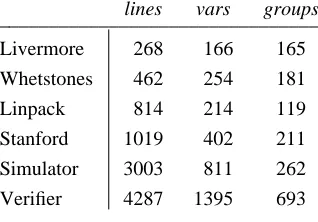
lines vars groups
L
________________________________
ivermore 268 166 165
1 L
Whetstones 462 254 18
inpack 814 214 119
1 S
Stanford 1019 402 21
imulator 3003 811 262
3
[image:14.612.229.388.233.344.2]Verifier 4287 1395 69
Table 1. The six benchmarks.
f v
The six benchmarks ranged in length from 268 to 4287 lines of user source code, and the number o ariables ranged from 166 to 1395. These variables were the candidates for assignment to registers, and
f a
included local user variables, global user variables, and global constants such as numbers and the addresses o rrays and procedures. The third column of Table 1 shows the number of non-conflicting groups the allocator
r w
combined these variables into; if we had this many registers then we could assign every variable to a registe ithout causing any conflicts.
register with with with
h
______________________________________________allocation coloring profile bot
W
Livermore 18% 18% 19% 19%
hetstones 10% 10% 10% 10%
% S
Linpack 13% 13% 13% 13
tanford 25% 25% 27% 28%
% V
Simulator 12% 14% 15% 16
[image:14.612.194.421.501.642.2]erifier 10% 15% 16% 19%
Table 2. Percentage improvement in speed with
I
52 registers allocated to variables.
applied the register allocator to these benchmarks in four different ways and compared the speeds of the resulting code to the speed of the original code with no global register allocation. Table 2 contains the
.
percentage improvements when we compare speed with allocation to speed without allocation. In this table I
n
allowed the allocator to use 52 registers. These 52 registers count only those used for allocating variables, and ot the expression temporaries or addressability registers managed by the compiler. Global register allocation e w
speeded up the benchmarks by 10 to 25 percent over code without it. These improvements apply to a machin ith a one-cycle memory cache; they would be better still for a machine on which the penalty for memory access was greater.
The first column of Table 2 contains the improvement when we did register allocation using the compile-time usage estimates. The compile time usage estimates include recognition of loops.
The second column of Table 2 contains the improvement when we compiled the program with local
s
dataflow analysis and coloring, as described in section 2.4.5. Because this allowed us to combine locals of the ame procedure with each other as well as with locals of non-conflicting procedures, the allocator was able to e l
keep more of the variables in registers. The result was invariably faster, but it was noticeably faster only for th arger programs.
The third column of Table 2 contains the improvement when the usage estimates came from a previ-l c
ously collected profile instead of the compile-time estimates. This tended to make a larger difference than loca oloring did, but again the difference is noticeable only for the larger programs.
e profile.
The fourth column of Table 2 contains the improvement when we used both local coloring and th
register with with with
h
______________________________________________allocation coloring profile bot
W
Livermore 80% 81% 93% 94%
hetstones 73% 75% 84% 88%
% S
Linpack 95% 96% 99% 99
tanford 90% 92% 97% 98%
% V
Simulator 73% 83% 92% 95
erifier 52% 61% 78% 83%
Table 3. Percentage of removable dynamic memory
T
references that were actually removed.
he profile provides the number of executed loads and stores that would be removed if each variable e c
were assigned to a register. If we compare this profile to the list of variables actually assigned to registers, w an see how many of the removable loads and stores we actually removed. The fraction is surprisingly large,
r
There are two reasons that so many of the removable loads and stores got removed. First, these are -a
dynamic loads and stores, actual counts from the execution of the program, and we give priority to those vari
bles that seem to have a large number of run-time references. Second, we look at the call graph to discover -t
non-conflicting procedures and we keep their locals in the same group of registers. I can illustrate the impor ance of both these effects by considering the timing verifier, the largest of the benchmarks. The usage
frequen-t v
cies in the profile range from 0 to 3257639. In the allocation without coloring or profiling, we kept 505 distinc ariables in the 52 registers. If we had assigned only the 52 variables with the highest estimated frequency, we would have removed only 25% of the loads and stores instead of 52%.
The number of loads and stores removed will usually be a good estimate of the speed improvement
d
(measured in number of instructions executed), though it neglects the effects of cache faults and the loads intro-uced to initialize globals, to pass arguments in indirect calls, and to archive locals for recursive or indirect
3
calls. Benchmarks that are small enough that all the variables fit in 52 registers rarely improved by more than 0%, and often by much less. In this light it is unsurprising that there are so few removable loads and stores left in these programs.
These results also suggest that we are getting a benefit from global register allocation that is
compar-s
able to the benefit we would get from any global register allocation scheme. Even if a better scheme could omehow manage to keep all of the variables in 52 registers without introducing spills and reloads, it would not
w
be able to double any of the improvement percentages in Table 2, and usually its advantage over our scheme ould be even smaller.
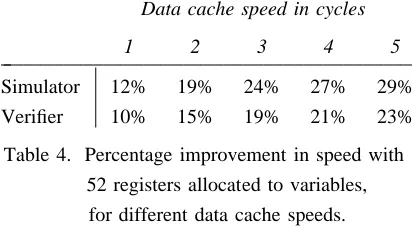
Data cache speed in cycles
5
__________________________________________1 2 3 4
V
Simulator 12% 19% 24% 27% 29%
[image:16.612.205.411.437.554.2]erifier 10% 15% 19% 21% 23%
Table 4. Percentage improvement in speed with 52 registers allocated to variables,
for different data cache speeds.
s t
If a machine has a slower data cache, the penalty for memory references is larger and therefore so i he improvement given by global register allocation. I combined the profile information with information
pro-s
duced by our machine simulator to determine how large the improvements would be if the data cache were lower. Table 4 shows these results. For this table, registers were allocated for the two largest benchmarks -s
register with with with h
______________________________________________allocation coloring profile bot
W
Livermore 16% 17% 18% 18%
hetstones 7% 8% 9% 10%
% S
Linpack 10% 13% 13% 13
tanford 24% 24% 26% 27%
% V
Simulator 9% 13% 14% 15
[image:17.612.195.423.105.233.2]erifier 9% 11% 12% 16%
Table 5. Percentage improvement in speed with
T
32 registers allocated to variables.
ables 5 and 6 show how well the link-time allocation does with fewer registers. Naturally it does not
c
do as well, but substantial increases in speed can occur with as few as 8 registers. It is interesting how well the ompile-time estimates do when few registers are available. Using local coloring or profile information often -t
improves the result, however, and should be considered a common or even normal part of global register alloca ion when few registers are available on the target machine.
register with with with
h
______________________________________________allocation coloring profile bot
W
Livermore 10% 10% 12% 12%
hetstones 3% 3% 5% 5%
% S
Linpack 2% 7% 8% 10
tanford 15% 16% 18% 20%
% V
Simulator 3% 6% 8% 8
[image:17.612.194.425.390.512.2]erifier 2% 3% 5% 7%
Table 6. Percentage improvement in speed with
I
8 registers allocated to variables.
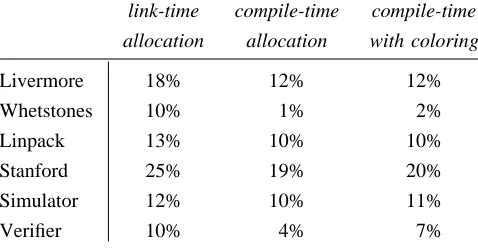
also allowed the register allocator to simulate compile-time global register allocation. In this -t
link-time compile-time compile-time g
________________________________________________allocation allocation with colorin
W
Livermore 18% 12% 12%
hetstones 10% 1% 2%
% S
Linpack 13% 10% 10
tanford 25% 19% 20%
% V
Simulator 12% 10% 11
[image:18.612.189.428.106.231.2]erifier 10% 4% 7%
Table 7. Percentage improvement in speed for link-t time allocation compared to the improvemen
for compile-time allocation.
n o
Table 7 compares link-time allocation using 52 registers without coloring or profiling (the first colum f Table 2) to this compile-time method. Link-time allocation does substantially better.
t y
The compile-time method can also include local coloring, and the combination should be close to wha ou would get if you were to implement the method reported by Chaitin et al. and Chow so that it supported
2 r
separate compilation. The third column of Table 7 shows the improvement that this method gives us. With 5 egisters, our method of link-time allocation without dataflow analysis and coloring is a clear winner over the
4
compile-time local coloring method.
. Conclusions
Link-time register allocation based on the call graph is a reasonable alternative to compile-time alloca-t a
tion based on dataflow analysis and graph coloring. It compresses variables into registers about as well, i llows procedure calls to happen without saving and restoring local register variables, and it allows us to include
c e
global variables in the allocation. If good usage estimates are used, obtained from a profiler or a good stati stimator, speed improvements of 10 to 25 percent are possible even if only a few registers are used.
s c
Another important contribution of this work is the idea of generalizing relocation information to let u heaply postpone important decisions until link time. It is also an effective way to make studies of the sort
l
described here possible; for example, we added the simulated compile-time allocation described in Table 7 quite ate in this study, but we did it merely by applying different link-time interpretations to some of the register
5
actions, with no change to the compiler required. We expect this idea to be useful in other areas as well.
. Future work
Chaitin et al. report good results from the optimization of subsumption. If two variables are assigned to -m
the same register, then any assignment of one into the other can be removed altogether. This is especially com on when the assignment is really the passing of a value parameter. Recognizing these cases requires dataflow
e l
analysis, but it is a good thing to do if you are doing the analysis anyway, for instance if you are including th ocal conflict coloring.
A better solution to the problem of recursive or indirect calls is needed if we want to do functional or
s
object-oriented programming. Recursive calls can probably be handled better by breaking the call graph into trongly connected components and treating each strongly connected component as a single node in the
algo-o
rithm of section 2.2. This would allow the archiving to be done incrementally rather than all at once at the end f the cycle, which might be more robust. Indirect calls are a thornier problem. We may be able to record , b
them in the call graph as if they were separate calls to every procedure that is assigned to a procedure variable ut we may need to do some dataflow and aliasing analysis to limit the number of different procedures that an indirect call might be calling.
We explicitly decided not to do more than the most primitive aliasing analysis in this system. The e i
problem of global register allocation seems mostly independent of the problem of alias detection, and we wer nterested in how well we could do without it. It is clear, though, that the information provided by such an analysis would be helpful some of the time.
Finally, we are interested in designing a hybrid scheme, midway between the traditional compile-time s m
approach and our link-time approach. In the former, all local variables are kept in registers, but these register ust be saved and restored on entry and exit, to prevent interference with other procedures. In the latter, there
t a
are no saves and restores because registers are allocated based on the call graph, but not all local variables ge ssigned to registers. Whenever a local variable is used more than twice, it is worth incurring the expense of a
e n
save and restore if it allows us to keep the variable in a register, and if there is a register available that we ar ot using for something more important during the lifetime of the procedure to which the variable is local. An
e v
allocation scheme that allowed us to do saves and restores only when warranted would allow us to keep mor ariables in registers. However, we are already keeping the most important variables in registers, so it would be
6
interesting to see whether it would be substantially better than our simpler scheme.
. History and acknowledgements
Many people contributed to the ideas described in this paper. Forest Baskett and Michael L. Powell
s
wanted to try to do link-time allocation before I ever joined them. Richard Beigel built a prototype allocator to how the feasibility of the approach, and invented the callgraph traversal algorithm in section 2.2. Michael L.
t
References
[1] Alfred V. Aho and Jeffrey D. Ullman. Principles of Compiler Design, pages 449-451. Addison-Wesley,
[
1979.
2] Gregory J. Chaitin, Marc A. Auslander, Ashok K. Chandra, John Cocke, Martin E. Hopkins, and Peter
[
W. Markstein. Register allocation via coloring. Computer Languages 6: 47-57, 1981.
3] G. J. Chaitin. Register allocation & spilling via graph coloring. Proceedings of the SIGPLAN ’82
Sym-[
posium on Compiler Construction, pages 98-105. Published as SIGPLAN Notices 17 (6), June 1982.
4] Frederick C. Chow. A Portable Machine-Independent Global Optimizer — Design and Measurements. , D
(PhD dissertation) Computer Systems Laboratory Technical Note No. 83-254. Stanford University ecember 1983.
[5] Jack J. Dongarra. Performance of various computers using standard linear equations software in a
For-[
tran environment. Computer Architecture News 11 (5): 22-27, December 1983.
6] Susan L. Graham, Peter B. Kessler, and Marshall K. McKusick. gprof: a call graph execution profiler.
S
Proceedings of the SIGPLAN ’82 Symposium on Compiler Construction, pages 120-126. Published as IGPLAN Notices 17 (6), June 1982.
.
[
[7] John Hennessy. Stanford benchmark suite. Personal communication
8] John L. Hennessy, Norman P. Jouppi, Steven Przybylski, Christopher Rowen, and Thomas Gross. Design
y L
of a high performance VLSI processor. In Randal Bryant, editor, Third Caltech Conference on Ver
arge Scale Integration, pages 33-54. Computer Science Press, 11 Taft Court, Rockville, Maryland.
-[9] David A. Patterson. Reduced instruction set computers. Communications of the ACM 28 (1): 8-21, Janu
ary 1985.
[10] George Radin. The 801 minicomputer. Proceedings of the Symposium on Architectural Support for
Pro -p
gramming Languages and Operating Systems, pages 39-47 (March 1982). Published as SIGARCH Com uter Architecture News 10 (2), March 1982, and as SIGPLAN Notices 17 (4), April 1982.
r [11] Christopher J. Terman. User’s Guide to NET, PRESIM, and RNL/NL. M.I.T. Laboratory for Compute