ANALYSIS ON MANAGEMENT OF DIGITAL LIBRARY
JING ZHAO,HAIBIN ZHANG, JUNXIA QI
Library, Handan College, Handan 056005, Hebei, China.
ABSTRACT
Along with the application of information technology gradually increased in the library, libraries’ digitization and information are becoming more and more mature. Therefore, the management of digital library needs to change ideas, realizes the modernization and science of management to promote digital library to be scientifically efficient operation. Firstly, this paper expounds on the concept of digital library, and summarizes the characteristics of the digital library. What’s more, it further analyzes the digital library’s management innovation under the informatization background. On this basis, the theory combines with practice. It applies mathematics model to construct the scientific management model of the digital library. And through the model analysis, it puts forward some suggestions and practical measures for scientific management of the digital library. To some extent, it provides a new active exploration path for the research of this field.
Keywords:Digital Library, Management Innovation, Model Construction, Comparative Analysis
1. INTRODUCTION
The constant increase and rapid development of information technology bring convenient and rich new management operation mode for modern life. Library information management technology is so widely used that makes great contributions to improving the library management’s efficiency and order. In domestic, the study on digital and information library management also has been increased. Such as, Yan Ren analyzed the problems related to the management of the digital library. And according to some problems of digital library management, such as industry scale, intellectual property, capital scale and the storage of information resources, he made an in-depth discussion and analysis; Sun Yan made relevant research and analysis of the management of the digital library based on digital library standards management, human resource management, digital information resources management and user management. Her research laid an important theoretical foundation for the digital library management; Wang Lin combined with own valuable work experience in the study of library management under the background of
informatization. China's digital library
construction has made some achievements at present. And the digital library research field also attracted widespread attention from all sectors of society[1]. At the same time, formed exploration
on library system development and resource supply, library users and service industry chain. But we also realized that, there still exist some deficiencies in the construction of the digital library, such as problem of digital library management mechanism and mode, the research is also less. Therefore, this paper on the basis of literature construction under the background of information technology, digital library management system, to discuss the digital library management mode and mechanism, pay attention to the evaluation of subjective and objective factors, which makes the digital library can be more clear direction and target, gradually moving toward standardization management, and for users and readers to create more good quality service[2,3].
On the basis of the book management’s brief analysis, she put forward her own opinions on the library management development situation, the innovation idea, and the reasonable measures; Liu Xiaofang found it can complement each other in the comparison of the traditional library and digital library management, together play the important role of library management.
2. THE OVERVIEW OF THE DIGITAL
LIBRARY AND THE FEATURE ANALYSIS
network technology and information technology, also brought the progress of digital libraries. But throughout the situation of our country, we need to combine the social economy, management and teachers to strengthen the effective management of digital library, to achieve the efficient allocation of digital library resources, and the sharing and utilization of resources. Based on the theory, this paper combined with the management elements, established the digital library management system, guiding people to strengthen the mechanism of digital library, such as the planning mechanism, organization mechanism, coordination mechanism and control mechanism, to effectively realize the economic benefit and social benefit of digital library, provide more convenient, fast and the rich cultural resources for users, and better service for readers.
2.1 The Overview of the Digital Library
Digital Library refers to apply modern information technology to construct library that is both excellent pictures and texts. Its essence is a kind of distributed information system based on information technology. Its main characteristics are to use modern information technology to carry out digital information resources sharing. There is no regional, space and time limit, so as to obtain knowledge information[4]. It involves the information digital processing, planning and storage, scientific retrieval, and efficient utilization the whole process.
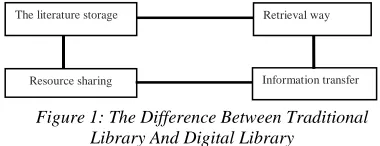
[image:2.612.326.511.215.326.2]Compared with the traditional library, digital library is the inheritance and development of traditional library. They have the same function, but in terms of the library construction and customer service, they have a new embodiment. In general, it can distinguish the difference between traditional library and digital library from four aspects. And the specific is as below.
Figure 1: The Difference Between Traditional Library And Digital Library
Digital library has no longer been restricted by building, time, management personnel, etc, as well as the traditional library. It has broken this restricted library management limitation, and makes a lot of literature resources realize resource sharing.
2.2 The Feature of Digital Library
[image:2.612.97.287.554.627.2]Digital library combined the network and computer hardware and software. It can provide users more quick and convenient services with no-restricted by time and space. It has great advantage compared with the traditional library in the literature information acquisition and literature inquires. On the whole, the digital library has the characteristics of five aspects[5]. The specific is as below.
Figure 2: The Feature Of Digital Library
As shown in Figure 2, the digital library literatures of literature storage are mainly stored by the digital information in the database, while the traditional library made paper literature as the main storage; Traditional library retrieval type used the cards to retrieve required documents. The digital library can apply information technology to easily inquire the huge number of literature through the keywords; Traditional library needed to spend a lot of time on the literature search, but the digital library literature search only takes a few seconds. So it is the traditional library can not be compared; when the literature of traditional library is used by a person, others will be affected by the use limitation, and network library is not restricted by the limit of time and space.
3. THE ANALYSIS OF THE DIGITAL
LIBRARY MANAGEMENT INNOVATION
UNDER THE BACKGROUND OF
INFORMATIZATION
3.1 The Analysis of Management Discretization Innovation
Information technology provides a platform and technical support for the digital library, but information technology can not only as a technical support, and should bring innovation for management mode in the management of the digital library. Under the background of information technology, whether the management of digital library can have stronger flexibility, high efficiency, accuracy and scientific is the problem to be solved by digital library management.
T
h
e f
ea
tu
re
o
f d
ig
ita
l lib
ra
ry
Small information storage space is not easy to damage
Information retrieval is convenient
Remote information transmit is quick
The same information can be used by many people at the same time
The literature storage
Resourcesharing
Retrieval way
Under the background of informatization, the process of digital libraries management can make the whole management be discretized. The entire management is divided into n management unit,
and each management unit u and
n
u
∂
∂
value are
the constant value distribution. Center management organization is in the center of each management unit, so the management expression of i unit of the overall management organization can be expressed as[6]:
dl rr u dl r c n u u ij ij l j n j ij l j n j i j j ) , cos( 2 1 ln 2 1 ) ( 2 1 1 1 n r π
π
∑
∫
∫
∑
= = + ∂ ∂ = ( 1) n i n u G uH i j j
n j j i j n j , , 2 , 1 , 0 ) ( 1 1 = = ∂ ∂ +
∑
∑
== (2
) Under the background of informatization, the construction of the digital library develops rich and various multi-function value-added services, meets the social development goals. What’s more, it makes the aspirations of the readers more clearly, and develops a more humanized service. So in the process of actual analysis, it needs to pay attention to management persons’ function distribution. In the actual management innovation, it needs to make organic distinguish with the traditional management. Here, the structure function is described as the integration of [H] and [G]. When the correlation value of them two is 0, the entire management structure tends to be the most scientific allocation. ] 0 [ ] [ ] ][ [ = ∂ ∂ + n u G u
H (3)
Constructing informatization digital library, through the thorough investigation and study of the readers can make reasonable and efficient library management system, and add more abundant books and other related resource and configuration, keep pace with the Times, be continuous innovation. In the construction of a digital library, the required major digital literature resources can be reproduced transmission. To a certain extent, it will produce corresponding problems because of the protection or copyright of information resources. Therefore, it needs to have the aid of information technology to carry out the operability of the literature resources information protection, in order to achieve the purpose of protecting copyright. Here, the number of exponential function of literature copyright can be set as H. i is the scope of literature protection. j is literature protection degree. Under the
combination of the two, it can construct a model of digital library literature resources protection[7].
≠ ∫ = − ∫ = i j dl r i j dl r H ij ij l ij ij l ij j j , ) , cos( 2 1 , 2 1 ) , cos( 2 1 n r n r π
π (4)
3.2 The Moment Analysis Of Digital Library Storage Management
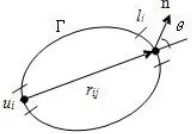
The rapid development of the modern library is based on the information technology whose digital and network has become increasingly mature. The application of information technology greatly reduces the workload of management personnel, the cost of the information flow, and plays a convenient information query platform for the teachers and students. It changes the previous single and traditional library management mode, puts the information management mode into a new heights of integration and networking. In the management system, it can build several equations,
work out
τ
of each equation, and construct the [image:3.612.350.517.119.170.2]moment were of digital library management. As is shown in Figure 3
Figure 3: Moment Were Of Digital Library Management
[image:3.612.377.473.397.464.2]( ) ( ') dx' ) x' -(x 4 x x u L 0 0
∫
=πε
τ
(5)Similar to the overall management, the whole storage management is divided into n units. It makes the primary function as 1on each unit, then
∑
= ≈ n 1 i i ττ (6)
In formula (6), it chooses weight function as the impulse function of each unit center surface.
Assuming that, multiplyingthe equation by weight
function of each unit of j and making integral. It can get[9]: ' ) ' ( ) ( dx ) x' -(x 4 x x u i l
0 0 j n
1 i
j
∑
∫
=
=
πε
τ
(7)
In equation (7), j = 1, 2, 3, ... n. If the weight
function of each unit is 1, it can get the storage’s effective formula: dxdx ) x' -(x 4 x l
U i i
l
0 0 j l 0 n 1 i j 0 ' ) ' (
∫
∫
∑
= =πε
τ
(8)As formula (8) shows, in the management of digital library, it needs to further improve the attention of network security. Because the whole inquires of the digital library is obtained by a number of cross information technology. In the data storage protection, it needs to prevent the leak of literature resource and protect the knowledge rights. For computer viruses, literature information distortion and so on all need the professional computer management personnel to operate, as well as natural disasters bring trauma to the storage of digital library information resources. At the same time, it should pay attention to unknown factors’ existing in the management of the digital library. For example, with the further development of informationization, information war poses some threat to the digital library, so the study on the digital library’s security has great significance.
4. THE CONSTRUCTION OF DIGITAL
LIBRARY’S SCIENTIFIC MANAGEMENT MODEL
It can be said that digital library is virtual library. In the informationization environment, it is a scalable network knowledge sharing system, which is a knowledge center of cross database and correlation and intelligent retrieval integration. It has large scale based on the distributed and no-restricted by time and space. Assuming that, the digital library scientific management model linear operator equation is[10]:
Lu
=
f
(9)Then in formula (9),
L
is the linear operator,f
is the known source function, andu
is thescientific management of the digital library’s model function that requires to be solved. So considering the characteristics of the digital library’s no-restricted by time and space, choosing a set of series of complete primary functions
ϕ ϕ
1,
2,
from the function space, make aboundary unfolding for
u
. So as to the polynomialsum of primary function can be expressed as[11]:
k k k
c
u
∑
ϕ
∞
=
=
1
(10)
In formula (10), if the management factors’ measures of digital library take infinite number, then we can get the approximate solution to a certain extent; If the management factors’ measures of digital library take limited number, then we can get exact solutions to a certain extent;
For example, it takes
n
, then it can be obtained:u
nc
k n k k
=
=∑
1ϕ
(11)Transferring formula (11) into the original equation, it can be obtained:
f L ck k n k ≈
∑
=ϕ
1 (12)After formula (12) being calculated, selecting
n
weight function of management factors’
measures
w w
1,
2,
,
w
n. At the same time,according to the principle that it makes an inner product equal for each weight function on both sides of operator equations equals. So it can form the digital library scientific management model matrix equation, and the undetermined coefficient is
c
k,
k
=
1 2
, ,
,
n
:k n
k k i i
c L w f w
=
∑
< >=< >1
ϕ , , ,
i
=
1 2
, ,
,
n
(13) The scientific management model matrix form of digital library is[12]:
[ ][ ] [ ]
l
ikc
k=
g
i (14) In the formula[ ]
lL w L w
L w L w
ik =
< > < > < > < > ϕ ϕ ϕ ϕ
1 1 2 1
1 2 2 2
[ ]
c
c
c
k
=
1
2
,
[ ]
g
f w
f w
i=
<
>
<
>
,
,
12
(16)
Through the formula (15), (16), it can obtain the
exact solutions
u
n of the scientific managementmodel of digital library, so relying on the high-tech means, with the aid of multimedia network communication platform can lay a solid foundation for strengthening library management technology. In order to successfully transfer traditional management mode into the modern library management mode, it must start from the aspects of service, strengthen the construction of the library management network, rapidly change the idea, and strive to create a new pattern of library automation construction[13]. On the other hand, it should combine daily actual situation, explore the optimal management scheme, so as to further wholeheartedly provide service to give full play to the role of library's service, and construct the school teaching and scientific research.
In the strategic management level, it is in a dominant position, not only the premise foundation of design plan in other management stages, but also the part of other management form the beginning to the end, decide the effective process of other management activities effective. Strategic management involves the culture department needs to carry on the effective planning guide, only the strategic management is correct and effective, to ensure guidance and specific affairs management level forward in the right way. In the guidance management level, need the effective guidance and support from relevant local government and local library industry associations and other organizations, collect forces to support. while relates to a specific business operation management is the implementation and operation of each grass-roots traditional library[14]. Not only need strategic management in a long run, but also need energetically support form the guidance management level, combined with the strengthening implementation and effective operation of business management level, to ensure the effective functioning of community library, and service for the society and users.
Management is actually the combining of plan, organization coordination, control four functions, therefore the essence of management mechanism should represent mutually connection of the entire management system , joint operation, it is the premise and foundation of the objective law of development things, it is a whole that containing
many mechanisms. So the digital library management mechanism also contains the plan mechanism, organization mechanism, coordination mechanism and the control mechanism four aspects
5. CONCLUSION
Under the background of informatization, the management of digital library needs to gather the researchers’ and managers’ research experience and research results, inherit and develop characteristics of digital library’s various aspects. Then, making the high integrated and efficient fully apply in practice and management. Finally, it should make an unremitting effort to build a digital library which has standard management, complete knowledge, improved humanized service, clearly intellectual property right, reasonable allocation of resources, and convenient use for the user.
REFERENCES:
[1] Meiying Nie, XinJuan Zhou, “Study on Library
Administrate Decision Using Data Mining”, IJACT: International Journal of Advancements in Computing Technology, Vol. 4, No. 8, 2012, pp. 165-72.
[2] Hao-chang Sun, Kuan-nien Chen, “A proposed
model for library stacks management”, Library
Collections, Acquisitions, and Technical Services, Vol. 36, No. 2, 2012, pp. 24-29.
[3] Piyawan Siriprasoetsin, Kulthida Tuamsuk,
Cholabhat Vongprasert, “Factors affecting customer relationship management practices in
Thai academic libraries”, The International
Information & Library Review, Vol. 43, No. 4, 2011, pp. 221-229.
[4] Charles Kamau Maina, “Traditional knowledge
management and preservation: Intersections
with Library and Information Science”, The
International Information & Library Review, Vol. 44, No. 1, 2012, pp. 13-27.
[5] Forbes Gibb, Clare Thornley, Stuart Ferguson,
John Weckert , “The application of RFIDs in libraries: an assessment of technological,
management and profession”, International
Journal of Information Management, Vol. 31, No. 3, 2011, pp. 244-251.
[6] Olga Einasto, “Using service quality
monitoring to support library management
decisions: A case study from Estonia”, The
[7] Wendy L. West, Heather S. Miller, Kristen Wilson, “Electronic Journals: Cataloging and Management Practices in Academic Libraries”, Serials Review, Vol. 37, No. 4, 2011, pp. 267-274.
[8] Du Liangxian, Qi Junxia, Guo Pengfei, “The
Application of Semantics Web in Digital
Library Knowledge Management”, Physics
Procedia, Vol. 24, No. 3, 2012, pp. 2180-2186.
[9] Magdalini Vasileiou, Jennifer Rowley, Richard
Hartley, “The e-book management framework: The management of e-books in academic
libraries and its challenges”, Library &
Information Science Research, Vol. 34, No. 4, 2012, pp. 282-291.
[10] Manjunatha Keralapura, “Technology and
customer expectation in academic libraries: A special reference to technical/management
libraries in Karnataka”, The International
Information & Library Review, Vol. 41, No. 3, 2009, pp. 184-195.
[11] Shih-Ting Yang, Ming-Chien Hung, “A model
for book inquiry history analysis and book-acquisition recommendation of libraries,
Library Collections”, Acquisitions, and
Technical Services, Vol. 36, No. 4, 2012, pp. 127-142.
[12] Abashe Atiku Maidabino, A.N. Zainab, “A
holistic approach to collection security implementation in university libraries, Library
Collections”, Acquisitions, and Technical
Services, Vol. 36, No. 8, 2012, pp. 107-120.
[13] Piyasuda Tanloet, Kulthida Tuamsuk, “Core
competencies for information professionals of Thai academic libraries in the next decade
(A.D. 2010–2019) ”, The International
Information & Library Review, Vol. 43, No. 3, 2011, pp. 122-129.
[14] Yong-Mi Kim, June Abbas, “Adoption of
Library 2.0 Functionalities by Academic Libraries and Users: A Knowledge
Management Perspective”, The Journal of