MODELICA-BASED MODELING AND SIMULATION OF
HYDRAULIC POWER STEERING SYSTEM
YONG ZHOU 1,A, YIWEI MO1,B,*, WEI HUANG 1,C, YANGYANG SUN 1,D
East campus 6139 mailbox of Guangxi University, Nanning, Guangxi, 530004,China
E-mail: [email protected] ,[email protected] , [email protected] , [email protected]
ABSTRACT
To investigate the steering characteristics of the hydraulic power steering system, a Modelica-based modeling approach is proposed. An automobile steering system test bench is set up for parameters identification. System characteristic features such as transmission ratio, stiffness, viscous damping and dry friction are estimated by bench test. The full version of hydraulic power steering system model is established in Dymola platform. For the sake of validating the proposed model, the vehicle steering performances are measured in field experiments which test maneuvers include the parking-lot steering and the lemniscate-shape path following. By driving the model with steering wheel angle signals measured in tests, the simulation results provide estimated performance of the hydraulic power steering system. The comparison between simulation and experiment results demonstrate the feasibility of proposed approach.
Keywords: Multi-Domain Modeling, Modelica, Hydraulic Power Steering System, Bench Test
1. INTRODUCTION
Among various subsystems of automobile, the steering system has great influence on vehicle control stability. Therefore, an accurate steering system dynamics model is the key point to predict the vehicle steering performance precisely [1].
For the Hydraulic Power Steering (HPS) or the Electric Power Steering (EPS) involved in the multi-domain modeling of complex system, simulation method is commonly used. The co-simulation between the power assisted steering system and vehicle dynamics is established by integrating software from various discipline fields, such as multi-body dynamics and fluid dynamics software. The internal data from different software need to exchange through the software
interface, in order to achieve the
co-simulation of the entire system. Y.Sun has built the steering system model based on AMESim and ADAMS software. The hydraulic power steering system model is built in AMESim platform, and the multi-body mechanical vehicle model is established in ADAMS/Car environment [2]. Jang has modeled a vehicle multi-body system in ADAMS environment and established an EPS control system in MATLAB/Simulink [3]. Afterwards, a co-simulation between ADAMS and Simulink is performed to evaluate the dynamic responses of the vehicle chassis and the steering system. This
co-simulation method result in the complex modeling approach. On the other hand, the exchange of internal data in model through various software interfaces is restricted by the software vendors.
Although these modeling methods could obtain accurate results, but there are following shortcomings. Discrepancies in modeling tools and representation mechanism give rise to the difficulty in data exchanging between models came from different disciplines. As a result, this
modeling approach lacks the opening and
scalability.
In this paper, Modelica language is used in modeling and simulation of the hydraulic power steering system and the commercial vehicle [4]. The purpose of this paper is to establish a multi-domain simulation model describes the vehicle steering performance. This article is organized as follows. In Section 1, dynamics modeling of hydraulic power steering system is formulated. Section 2 introduces the complete system model built in Dymola platform. The validation of modeling is illustrated in Section 3. Finally, the conclusions are summarized in Section 4.
2. MODELING OF HYDRAULIC POWER
STEERING SYSTEM
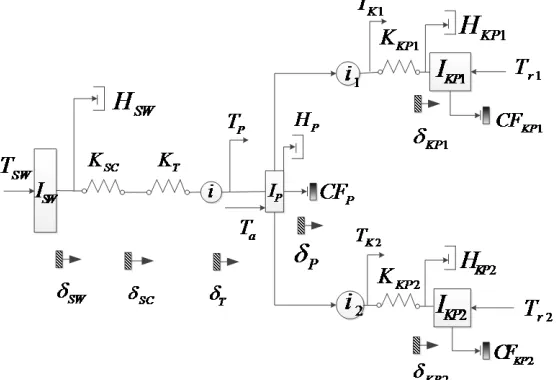
component physical characteristics. The considered steering system of the commercial vehicle includes the steering wheel and column, hydraulic
[image:2.612.172.450.134.324.2]recirculating ball steering unit, the steering linkage and tires. Figure 1 shows the schematic of a hydraulic power steering system.
Figure 1 Hydraulic Steering System Model Schematic
As shown in figure 1, the dynamic model uses the basic concept of compliance elements to transmit torque to each successive element in the
steering system. The dynamic model of
this steering system [5], includes four lumped interia elements. These lumped terms are made up
of the interia at the steering wheel ,interia at the
left and right wheel assemblies about their
respective kingpin axis ( ), and interia of
the pitman arm . There are six rotational
dynamic degrees of freedom used in this model, which are made up of the angular displacement of
the steering wheel , angular displacement of
steering column ,angular displacement of
torsion bar ,transitional motion of the pitman
arm , and the rotational displacement of the left
and right wheel assemblies about each kingpin
axis ( ).The equations of motion for this
system are summarized below in Equations 1 through 8.
(1)
(2)
(3)
(4)
(5)
(6)
(7)
(8)
The basic premise of this model is to input an
angular displacement with the corresponding
angular velocity into the steering wheel and
obtain the required torque back to the driver
the resisting torque
T
r1 (T
r2 ) in model isdetermined by tire dynamics, the tire model and the vehicle model are introduced to construct the whole simulation model. The simple linear model developed by Fiala is used to build the tire model
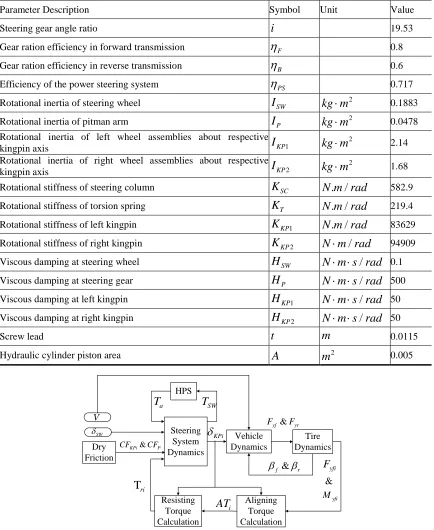
[image:3.612.94.528.175.705.2][6].The vehicle model adopts the single-track linear model [7]. The parameters of the hydraulic power steering system are given in Table 1.
Table 1 Parameters Of The Power Steering System
Parameter Description Symbol Unit Value
Steering gear angle ratio
i
19.53Gear ration efficiency in forward transmission
η
F 0.8Gear ration efficiency in reverse transmission
η
B 0.6Efficiency of the power steering system
η
PS 0.717Rotational inertia of steering wheel
I
SW 2kg m
⋅
0.1883Rotational inertia of pitman arm
I
P 2kg m
⋅
0.0478Rotational inertia of left wheel assemblies about respective
kingpin axis
I
KP12
kg m
⋅
2.14Rotational inertia of right wheel assemblies about respective
kingpin axis
I
KP22
kg m
⋅
1.68Rotational stiffness of steering column
K
SCN m rad
. /
582.9Rotational stiffness of torsion spring
K
TN m rad
. /
219.4Rotational stiffness of left kingpin
K
KP1N m rad
. /
83629Rotational stiffness of right kingpin
K
KP2N m rad
⋅
/
94909Viscous damping at steering wheel
H
SWN m s rad
⋅ ⋅
/
0.1Viscous damping at steering gear
H
PN m s rad
⋅ ⋅
/
500Viscous damping at left kingpin
H
KP1N m s rad
⋅ ⋅
/
50Viscous damping at right kingpin
H
KP2N m s rad
⋅ ⋅
/
50Screw lead
t
m
0.0115Hydraulic cylinder piston area
A
2m
0.005Steering System Dynamics
HPS
Aligning Torque Calculation Resisting
Torque Calculation Dry
Friction V
SW
δ
&
KPi P
CF CF
SW
T
a
T
&
yf yr
F F
&
f r
β
β
F
yfiyfi
M i
AT
T
ri&
Vehicle Dynamics
Tire Dynamics
KPi
[image:3.612.92.532.183.706.2]δ
3. IMPLEMENTATION OF STEERING SYSTEM MODELING IN DYMOLA
Based on the dynamic analysis of the steering system, the whole simulation model is constructed by integrating the steering system model, vehicle model, tire model, dry friction model and the torque calculation model according to their interactional relations in Dymola platform [8]. Fig.2 shows the whole simulation model of the steering system.
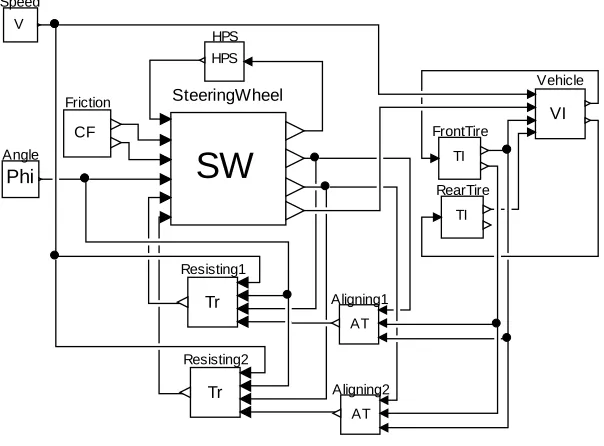
The eq.1-8 mentioned above are programmed in Modelica language. Fig.3 shows the high level modeling diagram in Dymola. It is consistent with the physical system as shown in Fig.2. Each icon
represents a physical component. Composition line
represents physical connection. Differential
algebraic equations govern physical behavior of the component.
The input variables in this model include the vehicle speed
V
and the steering wheel angleδ
SW.It can be used for the evaluation of vehicle steering dynamic performance, such as lateral acceleration, yaw rate and steering wheel torque. Comparison between experimental results and simulation results of proposed model verify the accuracy and efficiency of the proposed model.
Aligning1 AT
FrontTire TI
Resisting1
Tr SteeringWheel
SW
Vehicle
VI
Angle
Phi
Speed V
RearTire TI
Aligning2 AT Resisting2
Tr
Friction
CF
[image:4.612.150.452.271.494.2]HPS HPS
Figure 3 Diagram Of Hydraulic Steering System In Dymola Platform.
4. MODEL VALIDATION WITH
EXPERIMENT
4.1 Bench test
To acquire more accuracy parameters in model, an automobile steering system test bench is set up. The bench is equipped to gather the following signals: steering-wheel angle, steering-wheel torque, left and right front-wheel angle and load. The transmission ratio, stiffness, vicious damping and dry friction characteristic features of steering system are derived from bench test by appropriate post-processing. The parameters of the simulation model are predefined by the characteristic features in Table 1.
4.2 Road Test
In order to validate the model of hydraulic power steering system, two types of maneuvers are performed at various driving condition. One is parking-lot maneuvering in no-load condition to validate the effect of assist steering. The other is lemniscate-shape path following in full-load condition to evaluate the steering handiness of the test vehicle. The steering wheel torque and angle signals are gathered and pretreated by the data acquisition board (DAQ).The test results can be real-time displayed on the notebook.
simulated steering wheel angle is coincident with SWA in Fig.4. After model calculation, the simulated steering wheel torque and the measured steering wheel torque (SWT) have good coincidence in time domain. Because of the variability of the driver inputs, these maneuvers
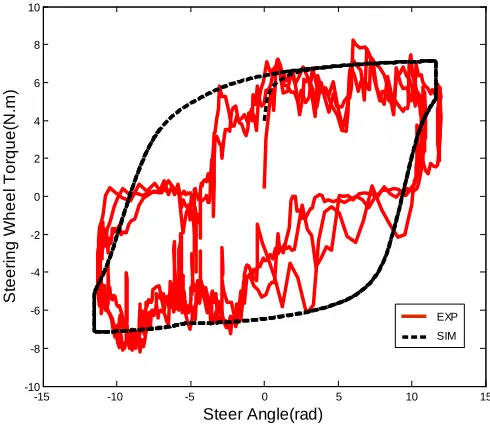
differ from one run to the next. Therefore, four times experiments are performed and the results have very good consistency as shown in the indicator diagram Fig.5. From Fig.4-5, we can see the predictions of the simulation model agree well with the experimental results.
0 10 20 30 40 50 60 70
-15 -10 -5 0 5 10 15
Time(sec)
S
teer
ing W
heel
T
or
que(
N
.m
)
0 10 20 30 40 50 60 70-15
-10 -5 0 5 10 15
S
teer
A
ngl
e(
rad)
[image:5.612.164.468.184.412.2]SWT SWA SIM
Figure 4 Steering Wheel Torque And Angle At Parking-Lot Maneuver
-15 -10 -5 0 5 10 15
-10 -8 -6 -4 -2 0 2 4 6 8 10
Steer Angle(rad)
S
teer
ing W
heel
T
or
que(
N
.m
)
[image:5.612.164.469.186.688.2]EXP SIM
0 20 40 60 80 100 120 -15
-10 -5 0 5 10 15
Time(sec)
S
teer
ing W
heel
T
or
que(
N
.m
)
0 20 40 60 80 100 120 -15 -10 -5 0 5 10 15
S
teer
A
ngl
e(
rad)
SWT
SWA
SIM
Figure 6 Steering Wheel Torque And Angle For Driving On A Lemniscate-Shape Path
-15 -10 -5 0 5 10 15 -10
-8 -6 -4 -2 0 2 4 6 8 10
Steer Angle(rad)
S
teer
ing W
heel
T
or
que(
N
.m
)
[image:6.612.182.427.329.541.2]SIM EXP
Figure 7 Steering Wheel Torque Vs. Angle For Driving On A Lemniscate-Shape Path
Lemniscate-shape path is always used to evaluate the steering handiness of the vehicle. In this vehicle test, the minimum radius of the lemniscate-shape curve is 9 m. Therefore, the polar coordinates
equation of locus is defined
as
L
=
27
⋅
cos(2 )
ψ
. In this case, vehiclemoves at a constant speed 10 km/h. Fig.6-7 show
the comparison between simulation and
experimental results.
As shown in Fig.6, the simulation results coincide well with SWA and SWT. In Fig.7, we can see that the average friction torque of the
simulation results is a little greater than the experimental results. This is due to the linear tire model used in the simulation model.
5. CONCLUSIONS
transmission ratio, viscous damping, stiffness, dry friction are measured through a series of bench test. In order to validate the model of hydraulic power steering system, two types of maneuvers are performed at various driving condition.
As shown in Fig.4-7, we can see the simulation results reflect the actual performance of the hydraulic power steering system. It proves the
rationality of the simulation model. This
comparison between simulation and experiment results demonstrate the feasibility of proposed approach.
This simulation method has a good interactive interface, and can quickly achieve the purpose of modeling and simulation. Meanwhile, the
established model can be used in further
optimization and analysis of the steering system.
ACKNOWLEDGEMENT
This work was jointly supported by Guangxi science and technology project (10100026, 1099006) and Guangxi Key Laboratory of Manufacturing System & Advanced Manufacturing Technology(Grant No.12-071-11S01).
REFERENCES
[1] M.K. Salaani, G.J. Heydinger, P.A. Grygier, Closed Loop Steering System Model for the
National Advanced Driving Simulator, SAE
paper, 2004-01-1072.
[2] Y. Sun, P. He, Y. Zhang, L. Chen, Modeling
and Co-simulation of Hydraulic Power Steering System, ICMTMA, 2 (2011) 595-600.
[3] B.C. Jang, G.. Choi, Co-simulation and
simulation integration for a full vehicle dynamic system. Mathematical and Computer Modeling of Dynamical Systems, 13 (2007) 237-250.
[4] S.E. Mattsson, H. Elmqvist, M. Otter. Physical
system modeling with Modelica. Control
Engineering Practice, 4 (1998) 501-510.
[5] M.Y. Rupp, Passive dynamic steering system
model for use in vehicle Dynamics simulation, Master Thesis, Ohio State University, 1994. [6] E. Fiala, Seitenkrafte am rollenden luftreifen,
ZVDI, 11 (1954) 81-92.
[7] A.Sidhu. Development of an Autonomous Test
Driver and Strategies for Vehicle Dynamics Testing and Lateral Motion Control, Ph.D. Thesis, Ohio State University, 2010.
[8] J.Andreasson. On Generic Road Vehicle