S T U D Y P R O T O C O L
Open Access
Effects of Lysulin
™
supplementation on
pre-diabetes: study protocol for a randomized
controlled trial
Priyanga Ranasinghe
1*, Ranil Jayawardena
2,3, Lal Chandrasena
4, Vivianne Noetzel
5and John Burd
5Abstract
Background:Diabetes mellitus is rapidly becoming one of the leading causes of morbidity and mortality worldwide. Preventive measures have become important, especially in the South Asian region and other parts of the world where diabetes is becoming increasingly prevalent. We postulate that a product containing amino acid lysine, micronutrient zinc and vitamin C will have beneficial effects on glycemic control and disease progression in patients with pre-diabetes and we aim to evaluate this hypothesis using a phase II/III randomized double-blind controlled clinical trial design.
Methods/design:The study will be conducted as a randomized, double-blind, placebo-controlled clinical trial for a period of 6 months. The study has been approved by the Ethics Review Committee of Faculty of Medicine,
University of Colombo, Sri Lanka. A total of 110 adults with pre-diabetes will be recruited for the study. They will be randomly assigned to the test and placebo groups on a 1:1 ratio. The test group will receive two tablets of Lysulin™ three times a day and the control group will receive identical placebo tablets. The study drugs will be double blinded to both investigators and subjects. The visits and the evaluations will be done as follows: screening (visit 0), 1 month (visit 1), 3 months (visit 2) and 6 months (visit 4). The primary outcome will be defined as change in glycemic control measured by HbA1c from baseline. Data will be analyzed using SPSS v16.
Discussion:To our knowledge this is one of the first randomized controlled trials evaluating the effects of Lysulin™ (a combination of lysine, vitamin C and zinc) in pre-diabetes. This study will provide the necessary groundwork for future large-scale multicentered clinical trials. The result, positive or negative, should provide a step change in the evidence guiding current and future policies regarding management of pre-diabetes.
Trial registration:Sri Lanka Clinical Trials Registry,SLCTR/2018/022. Registered on 13 July 2018. Study protocol version 2.0 (23 March 2018).
Keywords:Lysulin™, Pre-diabetes, Lysine, Vitamin C, Zinc
Background
Diabetes mellitus is rapidly becoming one of the leading causes of morbidity and mortality worldwide [1]. In most regions of the world, diabetes has reached epidemic portions, and in the South Asian region alone the pro-jected increase in prevalence of diabetes is out of proportion to the estimated population increase. For in-stance, the total population will increase by 40% from
2000 to 2030, but the percentage of change in preva-lence of diabetes is estimated to be 151% [2]. This has placed an increasing financial burden on health care sys-tems around the world, and in the USA alone the total estimated cost of diagnosed diabetes in 2017 is $327 bil-lion, including $237 million in direct medical costs [3]. An estimated 80% of the world’s population with dia-betes are from developing countries, overwhelming their existing health care facilities [1]. Therefore, preventive measures have become important, especially in the South Asian region and other parts of the world where diabetes is becoming increasingly prevalent.
© The Author(s). 2019Open AccessThis article is distributed under the terms of the Creative Commons Attribution 4.0 International License (http://creativecommons.org/licenses/by/4.0/), which permits unrestricted use, distribution, and reproduction in any medium, provided you give appropriate credit to the original author(s) and the source, provide a link to the Creative Commons license, and indicate if changes were made. The Creative Commons Public Domain Dedication waiver (http://creativecommons.org/publicdomain/zero/1.0/) applies to the data made available in this article, unless otherwise stated. * Correspondence:[email protected]
1Department of Pharmacology, Faculty of Medicine, University of Colombo,
Colombo, Sri Lanka
The causes of type 2 diabetes are multifactorial, and diet plays an important role in its incidence, severity and management [4]. Recent studies have demonstrated that numerous herbal and nutraceutical products have bene-ficial effects in patients by improving glucose and lipid metabolism, antioxidant status, disease progression and capillary function [5]. Lysulin™is one such nutraceutical tablet manufactured in the USA which contains the es-sential amino acid lysine, micronutrient zinc and vitamin C as the active ingredients, together with other standard excipients (Lysulin Inc., San Diego, CA, USA) [6]. Lysulin™ is considered a dietary supplement under the Dietary Supplement Health and Education Act of 1994 of the US National Institute of Health (NIH) Food and Drug Regulatory Authority (FDA), as it contains only amino acids, vitamins and minerals [7].
Lysine is an essential amino acid that plays a major role in calcium absorption, building muscle protein, and the body’s production of hormones, enzymes and anti-bodies. It has also shown numerous beneficial effects in the treatment/prevention of diabetes and/or its compli-cations in in-vivo animal and human studies. In diabetes-induced animal models, lysine has shown bene-ficial effect in lowering blood glucose as well as acting as an inhibitor of protein glycation [8]. Furthermore, the ability of lysine to reduce the formation of glycated pro-teins in diabetes-induced rats has also been shown to delay the appearance of the late pathologies associated with protein glycation [9]. Lysine is known to react with glucose, with the glycated amino acid being excreted in urine, and it has been shown to markedly attenuate the glucose response to ingested glucose without a change in insulin response in humans [10]. Furthermore, studies have shown that lysine reduces the formation of glycated proteins in diabetes-induced animal models [8]. Glycated proteins are known to be involved in the pathogenesis of several chronic diabetes complications, including ne-phropathy leading to chronic kidney disease, neuropathy and retinopathy, as well as in other macrovascular com-plications [11–13]. Hence, it is evident that lysine may have potentially beneficial effect on the reduction of blood glucose as well as on the progression of diabetes and its complications.
Zinc is involved in numerous metabolic pathways as a cofactor for more than 300 enzymes [7]. Insulin, which contains a variable number of zinc atoms, is stored in β-cells of the pancreas and released into the portal ven-ous system at the time of β-cell degranulation. Studies have shown that zinc plays an important role for insulin action, carbohydrate and protein metabolism [10]. Zinc absorption is also known to be altered in patients with diabetes [14]. Numerous studies have shown that zinc supplementation improves glycemic control in patients with type 2 diabetes, with a resultant reduction in
HbA1c of around 0.5% in pooled analysis [15]. A study conducted in Bangladesh demonstrated that individuals with pre-diabetes are also known to have lower serum zinc concentrations compared to those who are healthy [16]. Furthermore, a recently concluded clinical trial on patients with pre-diabetes demonstrated that zinc sup-plementation helps to reduce blood glucose and insulin resistance, while improvingβ-cell function [17]. Further-more, disease progression to diabetes was also reduced and beneficial effects of supplementation were also noted on total and LDL cholesterol [17].
Ascorbic acid (vitamin C), an antioxidant vitamin,
plays an important role in protecting free
radical-induced damage. Previous study has shown a de-crease in the basal vitamin C level in type 2 diabetes [18]. Vitamin C is structurally similar to glucose and can replace it in many chemical reactions, and thus is effect-ive for prevention of nonenzymatic glycosylation of pro-tein [19]. Furthermore, randomized controlled trials have shown that supplementation with vitamin C re-duces blood glucose and serum lipids and improves HbA1c in type 2 diabetes [20]. Hence, we postulate that a product containing amino acid lysine, micronutrient zinc and vitamin C will have beneficial effects on gly-cemic control and disease progression in patients with pre-diabetes. The present study aims to evaluate this hy-pothesis using a phase II/III randomized double-blind controlled clinical trial design.
Methods/design
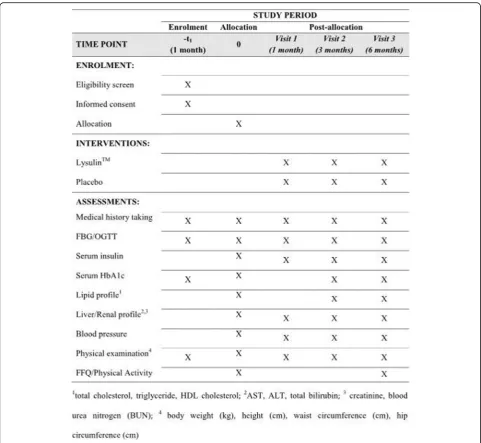
This protocol was written following the Standard Proto-col Items: Recommendations for Interventional trials (SPIRIT) checklist (see Additional file 1) [21]. The schedule of trial enrollment (SPIRIT figure), interven-tions and assessments is presented in Fig.1.
Objectives and hypothesis
Hypotheses
Primary—the glycemic control of people with pre-diabetes who are treated with Lysulin™tablets will be better than that of the control group.
Secondary—progression to diabetes would be reduced and other related metabolic parameters (serum insulin, total cholesterol, triglyceride, HDL cholesterol, LDL cholesterol and blood pressure) will be improved in the treatment group in comparison to the control group.
Objectives
Primary—to evaluate the potential effects of
and disease progression in patients with pre-diabetes.
Secondary—to evaluate effects on serum lipids, anthropometric parameters, blood pressure and appetite, and also to study potential effects of regular administration of Lysulin™tablets on liver and kidney function and the occurrence of self-reported side effects in patients with pre-diabetes.
Study design
The study will be a phase II/III randomized, double-blind, placebo-controlled clinical trial. It will be conducted at the Nawaloka Hospital Research and Education Foundation (NHREF), Nawaloka Hospitals PLC, Colombo, Sri Lanka
for a period of 6 months, assessing the effects of daily sup-plementation of Lysulin™ tablets in patients with pre-diabetes.
Sample size
A total of 110 adults with pre-diabetes will be recruited for the study after a screening test confirming the pres-ence of pre-diabetes as defined in ‘Population’and fur-ther eligibility screening against other inclusion/ exclusion criteria described in ‘Inclusion and exclusion criteria’. Summaries of previous studies of oral antidia-betic drugs suggest that they reduce HbA1a levels by 0.5–1.5% [22]. Numerous studies have shown that zinc supplementation reduces HbA1c by around 0.5% [15].
[image:3.595.57.539.86.529.2]Hence, in the absence of preliminary studies in a com-parable cohort, we assumed an HbA1c reduction of 0.5%. The number of patients required for determination of a 0.5% reduction of HbA1c in the treatment arm, in comparison with the placebo arm, at 80% power and 95% confidence interval with a drop-out rate of 20% was 108 patients. Hence, a total of 110 adults with diagnosed pre-diabetes will be recruited for the study. Subjects will be randomly and equally assigned into two groups (n= 55 each) and will receive either Lysulin™ oral tablet or an identical placebo daily for a period of 6 months. The for-mula used for sample size calculation was as follows:
N¼ ð1=q1þ1=q2Þ ZαþZβ2
h i
=ðE=SÞ2;
whereN= sample size,
q1= proportion of subjects in the treatment group (0.5),
q2= proportion of subjects in the placebo group (0.5),
Zα= critical value of the normal distribution at α
(α = 0.05 and critical value = 1.96),
Zβ= critical value of the normal distribution at β
(β = 0.2 and critical value = 0.84),
E= effect size (0.5% difference in HbA1c between the two groups) and
S= standard deviation of HbA1c in the population (in the absence of previous published studies on pre-diabetes in Sri Lanka that reported HbA1c values, this was as-sumed to be 0.82%, based on previous research conducted among patients with diabetes in Sri Lanka) [23].
Population
Pre-diabetes is defined as the presence of fasting plasma glucose (FPG) between 100 and 125 mg/dl (impaired fasting glucose (IFG)), or 2-h post oral glucose tolerance test (OGTT) plasma glucose between 140 and 199 mg/dl (impaired glucose tolerance (IGT)), or both IFG and IGT, or an HbA1c value between 5.7 and 6.4% [24].
Inclusion and exclusion criteria
Inclusion criteria
a) Age between 18 and 60 years.
b) Screening test confirming the presence of pre-diabetes as defined in‘Population’.
Exclusion criteria
a) On any other vitamin or mineral supplementations. b) Current use of a weight loss medicine or dietary
modification.
c) History of diabetes mellitus.
d) Presently having acute diseases or other untreated illness requiring treatment.
e) Impaired hepatic or renal functions.
f ) Patients with any malignancy or any other unrelated chronic illness.
g) Patients with cardiac, liver or respiratory failure. h) Any condition in the opinion of the primary
investigator that would contraindicate the patient’s participation.
i) Allergy to any of the constituents of the tablets. j) Lactation, pregnancy or unwillingness to use an
effective form of birth control for women of childbearing age.
Suspension criteria
a) Subject’s demand to discontinue the study. b) Serious adverse events or unusual changes in
clinical test results.
c) Principal investigator’s decision to terminate the study (low rates of compliance, complications or unable to sustain the study for various reasons).
Randomization
Randomization for the parallel treatment arms will be carried out after checking the inclusion and exclusion criteria. The patients will be randomized in a 1:1 ratio according to the method of block randomization with a block size of 4. The population will be stratified at randomization based on age (< 30 years and≥30 years) and gender to ensure equal distribution of these vari-ables in the two arms. The randomization sequence would be generated using the SPSS statistical software package (version 14.0). Concealment of the allocation se-quences will be done using sequentially numbered, opaque, sealed, color-coded envelopes. Eligibility assess-ment and enrolassess-ment will be done by one independent investigator, while another investigator will be involved in randomization. The investigator involved in randomization shall open the next respective color-coded envelope depending on the stratification and allocate the patient to the respective group (treat-ment or control). The treat(treat-ment and control groups shall be designated as either ‘A’or‘B’and this allocation shall be kept in a sealed envelope in a secure place dur-ing the course of the study. The manufacturer will be re-sponsible for preparing the study medications designated either‘A’or‘B’.
Blinding
according to the randomization sequence and supplied to the patients by the principal investigator or research assistants when they are randomized to the trial.
Interventions
The treatment drug will be a tablet containing amino acid lysine, elemental zinc and vitamin C as the active ingredient. All of the active ingredients are supple-mented within the Recommended Daily Allowance (RDA) [25, 26]. The placebo tablet contains inactive in-gredients (magnesium stearate and microcrystalline cel-lulose) and will be manufactured to have a similar appearance, shape, weight, taste, color, smell and texture. The drug manufacturing will be done at a US FDA-registered and GMP-certified manufacturing site in the USA. The manufacturer will be responsible for sup-plying the Lysulin™ and placebo tablets. However, the manufacturer/funding organization shall not be involved in any aspects related to the conduct of the study, in-cluding patient recruitment, follow-up and analysis of data.
Recruited subjects will receive either two tablets of Lysulin™ or placebo three times daily, taken 1 h before meals for a period of 6 months. Envelopes containing a monthly supply of Lysulin™or placebo tablet will be pre-pared according to the randomization sequence and sup-plied to the patients. Participants in both groups will receive uniform advice about diet and physical activity, which are considered to be potential confounder vari-ables affecting glycemic control.
Study groups
The treatment group will receive Lysulin™tablets (n= 55). The control group will receive placebo tablets (n= 55).
Study period
The study will be for a period of 6 months and the visits and evaluations will be done as follows; screening (visit 0), 1 month (visit 1), 3 months (visit 2) and 6 months (visit 3) (Fig.1).
Outcomes
Primary outcome index
The primary outcome will be defined as the change in glycemic control measured by HbA1c from baseline.
Secondary outcomes
a) Change in FPG and OGTT plasma glucose from baseline.
b) Development of diabetes during follow-up, as indi-cated by either FPG > 125 mg/dl and/or 2-h OGTT plasma glucose > 199 mg/dl and/or HbA1c > 6.5%, confirmed during follow-up visits [27].
c) Change in lipid profile from baseline (total cholesterol, LDL, HDL and TAG).
d) Change in insulin resistance from baseline. Insulin resistance would be measured by the Homeostasis Model of Assessment—Insulin Resistance (HOMA-IR) calculations based on fasting blood glucose and fasting serum insulin.Β-cell function would be eval-uated in vivo (HOMA-B calculation) and in vitro. e) Change in anthropometric assessment such as body
weight, height, body mass index (BMI), waist circumference (WC), hip circumference (HC) and waist:hip ratio (WHR) from baseline.
f ) Change in systolic blood pressure (SBP) and diastolic blood pressure (DBP) from baseline.
Level of physical activity (International Physical Activ-ity Questionnaire (IPAQ) short form) and dietary intake (validated Food Frequency Questionnaire) would be assessed in both groups as they are confounding factors affecting glycemic control.
Safety assessment index
The following information will be recorded/measured for the safety assessment; vital signs, general medical ex-aminations, renal function tests, liver function tests and adverse events.
Procedures
Recruitment
Participants will be recruited on a voluntary basis from a cohort of patients with pre-diabetes attending Nawaloka Hospitals PLC, Colombo, Sri Lanka. Informed written consent will be obtained from all study participants.
Study schedule
Fasting blood glucose, 2-h OGTT blood glucose, serum insulin, the liver profile (AST, ALT, PT/INR) and the renal profile (blood urea and serum creatin-ine) will be measured at the 0,1, 3 and 6 months. In addition, the serum lipid profile (total cholesterol, tri-glycerides, LDL cholesterol, HDL cholesterol) and serum HbA1c would be measured at baseline, at 3
months and on completion of the study. The details of items which will be measured at every visit are de-scribed in Fig. 1.
Measurement tools
Anthropometric measurements
Height will be measured using Harpenden pocket sta-diometers (Chasmors Ltd, London, UK) to the nearest 0.1 cm. Body weight will be measured in indoor light clothing to the nearest 0 .1 kg using a SALTER 920 digital weighing scale (Salter Ltd, Tonbridge, UK).
between the iliac crest and the lower rib margin at the end of normal expiration using a plastic flexible tape to the nearest 0 .1 cm. Similarly, the hip circum-ference will be measured at the widest part of the buttocks in the inter-trochantric level to the nearest 0 .1 cm. All anthropometric measurements will be made by trained personnel. All anthropometric mea-surements (height, weight, BMI, WC, HC and WHR) will be made using standard calibrated equipment and following recommended guidelines [28]. The equip-ment used for anthropometric measureequip-ments will be calibrated by the Department of Measurement Units, Standards and Services, Colombo, Sri Lanka [29].
Dietary measurements
A culturally validated Food Frequency Questionnaire (FFQ) will be used to obtain habitual intake of calo-ries, macronutrients and micronutrients [30]. The FFQ contains color photographs of three different portion sizes of four commonly consumed foods (rice, green vegetable curry, lentil curry and chicken) and a list of food items (n= 85) with their portion sizes and frequencies. Each respondent is expected to report consumption of each food according to frequency. Food items are categorized into eight food groups, namely: cereals; vegetables; pulses; meat; fruits; drinks;
miscellaneous; and alcohol. The FFQ is
interviewer-administered in the local language (Sinhalese and Tamil). The participants will be asked to recall their usual portion size and intake of foods listed within the FFQ over the past month. FFQ data will subsequently be analyzed and be reported as the intake of calories, carbohydrates, fat, proteins and dietary fibers per day. Furthermore, intake of lysine, vitamin C and zinc will also be analyzed.
Physical activity
Physical activity during the past week will be assessed using the translated and validated short version of the International Physical Activity Questionnaire (IPAQ) administered by an interviewer and will be presented as energy expenditure expressed in metabolic equiva-lent (MET) minutes/week [31]. The continuous score allows the estimation of the weekly energy expend-iture expressed in MET minutes/week. This is ob-tained by multiplying the value of energy expenditure for the given physical activity in MET by the weekly frequency (days per week) and the time in minutes (minutes per day). These values are separately
computed for the three domains of walking,
moderate-intensity activities and vigorous-intensity ac-tivities using the following formulas:
Walking MET minutes=week ¼3:3minutesdays;
Moderate MET minutes=week ¼4:0minutesdays;
Vigorous MET minutes=week ¼8:0minutesdays:
A combined total physical activity MET minutes/week can be computed as the sum of these three domains.
Biochemical analysis
Centrifuged serum separated samples (2200–2500 rpm) will be used for the assays. The glucose assay will be per-formed by an enzymatic colorimetric (glucose oxidase) method in an RxDaytona™ chemical analyzer (Randox Laboratories Ltd, Antrim, UK). Total cholesterol and LDL cholesterol will be analyzed by an enzymatic colori-metric method in a Mindray BA-88A semi auto-analyzer (Mindray Medical International Ltd, China). HDL chol-esterol will be determined by a precipitation method in a Mindray BA-88A semi auto-analyzer. Triglyceride will be analyzed by an enzymatic colorimetric method in a Mindray BA-88A semi auto-analyzer using commercially available enzymatic colorimetric determination kits for triglycerides.
Clinical examination
Seated blood pressure will be recorded on two occasions after at least a 10-min rest using an Accoson mercury sphygmomanometer (Accoson Healthcare, Asia-Pacific Region, Singapore).
Other
In addition to the aforementioned sociodemographic data, drugs and data on side effects would also be gath-ered via a questionnaire.
Compliance calculation
Subjects will be asked to return remaining drugs and their compliance will be evaluated using the following formula:
Complianceð Þ ¼% ½ðdistributed drugsremaining drugsÞ
=distributed drugs 100:
Statistical analysis
Lankan food items and recipes, and will be reported as the intake of calories, carbohydrates, fat, proteins and dietary fibers per day. Summary statistics will be calcu-lated and presented as mean, standard deviation and proportion by group. The baseline and end of study characteristics as well as the laboratory findings of the groups will be compared using two-sample and pairedt test, and P < 0.05 will be considered significant. The Homeostasis Model Assessment (HOMA2) calculator will be used to calculateβ-cell function (HOMA-β) and insulin resistance (HOMA-IR) based on fasting insulin and plasma glucose [32]. The Homeostatic Model Assessment (HOMA) is a method used to quantify insu-lin resistance andβ-cell function. It has good correlation with the traditional, invasive and time-consuming eugly-cemic clamp method (r= 0.88) which is used to measure insulin resistance andβ-cell function.
Multiple regression analyses will be performed, where change in FPG/OGTT/HbA1c post intervention from baseline are the continuous dependent variables and in-dependent variables will be age (continuous), treatment group (0, placebo; 1, Lysulin™), gender (0, female; 1, male), physical activity (continuous), BMI (continuous), energy intake (continuous), carbohydrate intake (con-tinuous) and baseline FPG/OGTT/HbA1c. All analyses will follow intention-to-treat principles and a prespeci-fied analysis plan. Where appropriate, sensitivity analyses will be conducted (e.g., control for additional covariates; and bootstrapped P values for skewed outcomes). In the case of missing data values, we will apply mean imput-ation and regression imputimput-ation where rates are low, and consider multiple imputations where they exceed 10%.
Adverse effect evaluation
All of the active ingredients are supplemented within the Recommended Daily Allowance (RDA) [25, 26]. There-fore, the type of adverse events expected are likely to be minor in nature. However, in the event of a probable ad-verse reaction the following precautions would ensure timely identification and management of patients:
a) Reporting—mechanisms would be set up to ensure direct reporting of probable adverse events to investigators by patients (via telephone available 24 h on all days).
b) During follow-up visits, probable adverse events would be noted by history and examination and in-vestigated in detail. All adverse effects observed will be documented in the case report form (CRF). c) Any serious adverse event as defined in GCP
guidelines will be reported to the National ADR monitoring center at the Department of
Pharmacology, Faculty of Medicine, University of Colombo within 24 h, the Ethics Committee,
Faculty of Medicine, University of Colombo and the Clinical Trials subcommittee of the Drug
Regulatory Authority within 1 week.
d) A Data Safety Monitoring Board (DSMB) identified by the investigators will evaluate all adverse events at regular intervals.
e) Investigations—liver and renal functions would be assessed as detailed earlier.
f ) Management—in the event of an adverse reaction requiring in-hospital management, the facilities and expert management would be available at the Nawaloka Hospital PLC, Colombo, Sri Lanka. g) Termination of study—the complete clinical trial
will be terminated prematurely if there is evidence that the safety of the trial participants can no longer be assured or new scientific information arises during course of the clinical trial regarding safety of the patients.
Data collection
After filling out the case report form (CRF), data collec-tion will be performed according to the standard operat-ing procedures (SOPs) by the trained clinical research associates (CRAs).
Data management and monitoring
Storage
Data will be entered by a minimum number of dedicated staff and saved in a dedicated computer with password protection. Samples would be stored in a secure facility, with redundant measures to ensure specimens are kept in compliant conditions at all times when in storage. Ex-pert staff who have been trained specifically in sample storage and transportation would ensure all regulatory issues are properly handled. Storage technologies with the capability of monitoring the temperature of samples around the clock would be utilized.
Sample disposal
After each analysis is completed and with the approval of the Principal Investigator, the samples stored in the storage facility may be disposed of by the sample custo-dian. A Sample Disposal Sheet is completed and kept for further reference.
Dissemination of study finding
The results of the study will be published in local and international peer-reviewed journals and presented at international conferences and clinical meetings.
Ethical considerations
registered at the Sri Lanka Clinical Trials Registry (SLCTR/18/022). The study will be conducted in com-pliance with the Declaration of Helsinki and the Good Clinical Practice (GCP) guidelines. Any change in trial protocol will be notified to the relevant regulatory au-thorities and trial participants, with new consent being taken from participants, if required.
Discussion
In this article we describe the protocol for a clinical trial design evaluating the effects of Lysulin™ tablets in pa-tients with pre-diabetes. To our knowledge this is one of the first randomized controlled trials evaluating the ef-fects of supplementation of lysine, zinc and vitamin C in patients with pre-diabetes. Hence, the present study will provide the required foundation for future large-scale multicentered clinical trials. Given the present interest in using a variety of nutritional supplements to enhance glycemic control and reduce progression in patients with pre-diabetes, properly planned and methodical scientific studies are a timely necessity. However, in relation to ly-sine, zinc and vitamin C, presently there are no well-designed randomized control trials conducted for a satisfactory time period to support/refute this argument. Hence, the result of the present study, positive or nega-tive, should provide a step change in the evidence guid-ing current and future policies regardguid-ing the use of Lysulin™ as a dietary supplementation and/or treatment in patients with pre-diabetes.
Trial status
Enrollment for the trial has not yet started.
Additional file
Additional file 1:SPIRIT 2013 checklist: recommended items to address in a clinical trial protocol and related documents. (DOC 122 kb)
Abbreviations
ALT:Alanine aminotransferase; AST: Aspartate aminotransferase; CRA: Clinical research associate; CRF: Case report form; HDL: High-density lipoprotein; HOMA-IR: Homeostasis Model of Assessment—Insulin Resistance; IPAQ: International Physical Activity Questionnaire; LDL: Low-density lipoprotein; OGTT: Oral glucose tolerance test; SOP: Standard operating procedure; SPSS: Statistical Package for the Social Sciences
Acknowledgements
Not applicable.
Funding
This work is supported by a grant from Lysulin Inc., USA.
Availability of data and materials
Not applicable.
Authors’contributions
PR, JB, LC, VN and RJ substantially contributed to the general idea and design of the study. PR and RJ planned the data analysis. PR drafted the manuscript. All authors have read and consented to the manuscript.
Consent for publication
Not applicable
Competing interests
The authors declare that they have no competing interests, with the exception of John Burd, who is the CEO of Lysulin, Inc., and Vivianne Noetzel, the Vice President of Clinical and Regulatory affairs of Lysulin, Inc. John Burd and Vivianne Noetzel from Lysulin, Inc. are not involved in conduct of the study, data analysis and reporting of results.
Publisher’s Note
Springer Nature remains neutral with regard to jurisdictional claims in published maps and institutional affiliations.
Author details
1Department of Pharmacology, Faculty of Medicine, University of Colombo,
Colombo, Sri Lanka.2Department of Physiology, Faculty of Medicine,
University of Colombo, Colombo, Sri Lanka.3Institute of Health and Biomedical Innovation, Queensland University of Technology, Brisbane, QLD, Australia.4Nawaloka Hospital Research and Education Foundation (NHREF),
Nawaloka Hospitals PLC, Colombo, Sri Lanka.5Lysulin, Inc., San Diego, CA,
USA.
Received: 21 July 2018 Accepted: 28 February 2019
References
1. Wild S, Roglic G, Green A, Sicree R, King H. Global prevalence of diabetes: estimates for the year 2000 and projections for 2030. Diabetes Care. 2004; 27(5):1047–53.
2. Wild S, Roglic G, Green A, Sicree R, King H. Global prevalence of diabetes. Diabetes Care. 2004;27(5):1047–53.
3. American Diabetes Association. Economic costs of diabetes in the U.S. in 2017. Diabetes Care. 2018;41(5):917–28.
4. American Diabetes Association, Bantle JP, Wylie-Rosett J, Albright AL, Apovian CM, Clark NG, Franz MJ, Hoogwerf BJ, Lichtenstein AH, Mayer-Davis E, Mooradian AD, Wheeler ML. Nutrition Recommendations and
Interventions for Diabetes: a position statement of the American Diabetes Association. Diabetes Care. 2007;30(Suppl 1):S48–65.
5. Bailey CJ, Kodack M. Patient adherence to medication requirements for therapy of type 2 diabetes. Int J Clin Pract. 2011;65(3):314–22. 6. Lysulin.https://lysulin.com. Accessed 1 Feb 2019.
7. Dietary Supplement Health and Education Act of 1994.https://ods.od.nih. gov/About/DSHEA_Wording.aspx. Accessed 1 Feb 2019.
8. Jafarnejad A, Bathaie SZ, Nakhjavani M, Hassan MZ, Banasadegh S. The improvement effect of L-Lys as a chemical chaperone on STZ-induced diabetic rats, protein structure and function. Diabetes Metab Res Rev. 2008; 24(1):64–73.
9. Sensi M, De Rossi MG, Celi FS, Cristina A, Rosati C, Perrett D, Andreani D, Di Mario U. d-Lysine reduces the non-enzymatic glycation of proteins in experimental diabetes mellitus in rats. Diabetologia. 1993;36(9):797–801. 10. Kalogeropoulou D, LaFave L, Schweim K, Gannon MC, Nuttall FQ. Lysine ingestion markedly attenuates the glucose response to ingested glucose without a change in insulin response. Am J Clin Nutr. 2009;90(2):314–20. 11. Frimat M, Daroux M, Litke R, Nevière R, Tessier Frédéric J, Boulanger E.
Kidney, heart and brain: three organs targeted by ageing and glycation. Clin Sci. 2017;131(11):1069.
12. Ahmed N. Advanced glycation endproducts—role in pathology of diabetic complications. Diabetes Res Clin Pract. 2005;67(1):3–21.
13. Saremi A, Howell S, Schwenke DC, Bahn G, Beisswenger PJ, Reaven PD. Advanced glycation end products, oxidation products, and the extent of atherosclerosis during the VA Diabetes Trial and Follow-up Study. Diabetes Care. 2017;40(4):591–8.
14. Kinlaw WB, Levine AS, Morley JE, Silvis SE, McClain CJ. Abnormal zinc metabolism in type II diabetes mellitus. Am J Med. 1983;75(2):273–7. 15. Jayawardena R, Ranasinghe P, Galappatthy P, Malkanthi R, Constantine G,
Katulanda P. Effects of zinc supplementation on diabetes mellitus: a systematic review and meta-analysis. Diabetol Metab Syndr. 2012;4(1):13. 16. Islam MR, Arslan I, Attia J, McEvoy M, McElduff P, Basher A, Rahman W, Peel
and diabetes?: a cross-sectional study from Bangladesh. PLoS One. 2013;8(4): e61776.
17. Ranasinghe P, Wathurapatha WS, Galappatthy P, Katulanda P, Jayawardena R, Constantine GR. Zinc supplementation in prediabetes: a randomized double-blind placebo-controlled clinical trial. J Diabetes. 2017;10:386–97. 18. Kotb A, Azzam KMA. Effect of vitamin C on blood glucose and glycosylated
hemoglobin in type II diabetes mellitus. World J Anal Chem. 2015;3(1A):6–8. 19. Afkhami-Ardekani M, Shojaoddiny-Ardekani A. Effect of vitamin C on blood
glucose, serum lipids & serum insulin in type 2 diabetes patients. Indian J Med Res. 2007;126(5):471–4.
20. Dakhale GN, Chaudhari HV, Shrivastava M. Supplementation of vitamin C reduces blood glucose and improves glycosylated hemoglobin in type 2 diabetes mellitus: a randomized, double-blind study. Adv Pharmacol Sci. 2011;2011:5.
21. Chan AW, Tetzlaff JM, Altman DG, Laupacis A, Gotzsche PC, Krleza-Jeric K, Hrobjartsson A, Mann H, Dickersin K, Berlin JA, et al. SPIRIT 2013 statement: defining standard protocol items for clinical trials. Ann Intern Med. 2013; 158(3):200–7.
22. Sherifali D, Nerenberg K, Pullenayegum E, Cheng JE, Gerstein HC. The effect of oral antidiabetic agents on A1C levels: a systematic review and meta-analysis. Diabetes Care. 2010;33(8):1859–64.
23. Katulanda P, Constantine GR, Mahesh JG, Sheriff R, Seneviratne RDA, Wijeratne S, Wijesuriya M, McCarthy MI, Adler AI, Matthews DR. Prevalence and projections of diabetes and pre-diabetes in adults in Sri Lanka—Sri Lanka Diabetes, Cardiovascular Study (SLDCS). Diabet Med. 2008;25(9):1062–9. 24. Yudkin JS.“Prediabetes”: are there problems with this label? Yes, the label
creates further problems! Diabetes Care. 2016;39(8):1468–71.
25. Institute of Medicine Food and Nutrition Board. Dietary Reference Intakes for Vitamin A, Vitamin K, Arsenic, Boron, Chromium, Copper, Iodine, Iron, Manganese, Molybdenum, Nickel, Silicon, Vanadium, and Zincexternal link disclaimer. Washington, DC: Institute of Medicine Food and Nutrition Board; 2001.
26. National Institute of Health: Nutrient Recommendations: Dietary Reference Intakes (DRI). Maryland: National Institute of Health; 2017.
27. World Health Organization: International Diabetes Federation (2006) Definition and diagnosis of diabetes mellitus and intermediate
hyperglycemia: report of a WHO/IDF consultation. IDF consultation. Geneva: World Health Organization; 2008.
28. Center for Disease Control and Prevention: National Health and Nutrition Examination Survey (NHANES). Anthropometry Procedures Manual. Atlanta: CDC; 2007.
29. Services: calibration.http://124.43.23.68/mussd/about-us/. Accessed 1 Feb 2019.
30. Jayawardena R, Swaminathan S, Byrne NM, Soares MJ, Katulanda P, Hills AP. Development of a food frequency questionnaire for Sri Lankan adults. Nutr J. 2012;11:63.
31. Katulanda P, Jayawardena R, Ranasinghe P, Rezvi Sheriff MH, Matthews DR. Physical activity patterns and correlates among adults from a developing country: the Sri Lanka Diabetes and Cardiovascular Study. Public Health Nutr. 2013;16(9):1684–92.