MAR-APRIL 2017, VOL- 4/30 www.srjis.com Page 4900 SECURITY TECHNIQUES FOR DATA PROTECTION IN CLOUD COMPUTING
Prof. Nida Mushtaque Bandarkar
Asst. Prof. D. G. Tatkare Mahavidyalay, Mangaon Raigad. Pin code- 402117
Cloud computing has a lot of security issues that are gaining great attention nowadays, including the data protection, network security, virtualization security, application integrity, and identity management. Data protection is one of the most important security issues, because organizations won’t transfer its data to remote machines if there is no guaranteed data protection from the cloud service providers. Many techniques are suggested for data protection in cloud computing, but there are still a lot of challenges in this subject. The most popular security techniques include SSL (Secure Socket Layer) Encryption, Intrusion Detection System; Multi Tenancy based Access Control, etc. Goal of this paper is to analyze and evaluate the most important security techniques for data protection in cloud computing. Furthermore, security techniques for data protection will be recommended in order to have improved security in cloud computing.
Introduction:
Cloud computing includes a group of computers that are jointly used to provide different
computations and tasks. Cloud computing is one of the most important IT paradigms in the
last few years. One of the key benefits that is offered from this IT technology for the
companies is reduced time and costs on the market. Cloud computing is providing companies
and organizations to use shared storage and computing resources. It is better than to develop
and operate with the own infrastructure. Cloud computing also provides organizations and
companies to have a flexible, secure, and cost-effective IT infrastructure. It can be compared
with the national electric grids that permit organizations and homes to plug into a centrally
managed, efficient and cost-effective energy source. Main corporations including Google,
Amazon, Cisco, IBM, Sun, Dell, Intel, HP, Oracle, and Novell have invested in cloud
computing and propose a range of cloud-based solutions to individuals and businesses.
There are different types and models in cloud computing regarding the different provided
services. So, the cloud computing involve public cloud, private cloud, hybrid cloud, and
community cloud. Service delivery models, on the other hand, could be categorized as SaaS Scholarly Research Journal's is licensed Based on a work at www.srjis.com
MAR-APRIL 2017, VOL- 4/30 www.srjis.com Page 4901 (Software as a service), PaaS (Platform as a Service), and IaaS (Infrastructure as a Service).
Cloud computing could be usually classified by two ways: by cloud computing location, and
by the offered types of services. By the location of the cloud, cloud computing is typically
classified in: public cloud (where the computing infrastructure is hosted by the cloud vendor);
private cloud (where the computing infrastructure is assigned to a specific organization and
not shared with other organizations); hybrid cloud (the usage of private and public clouds
together); and community cloud (it involves sharing of IT infrastructure in between
organizations of the same community) [1]. If the classification is based on type of offered
services, clouds are classified in these ways: IaaS (Infrastructure as a service), PaaS (Platform
as a Service), and Software as a Service (SaaS) [1].
Authentication in Cloud Computing:
Authentication in cloud computing ensures that the proper entity or person is getting access to
the provided data from the cloud technology provider. When authentication is ensured in the
cloud computing, it means that the user’s identity is proved to the cloud service provider
when accessing the stored information in the cloud. Public and private types of cloud are
using various designs for authentication with RSA. RSA cryptosystem accepted different
models for authentication like two factor authentication, knowledge-based authentication, and
adaptive authentication. AWS (Amazon Web Services) is concentrated on the confidential
information transfer between the web server and the browser including virtual private cloud
[2]. In this context different authentication schemes are implemented, such as multifactor
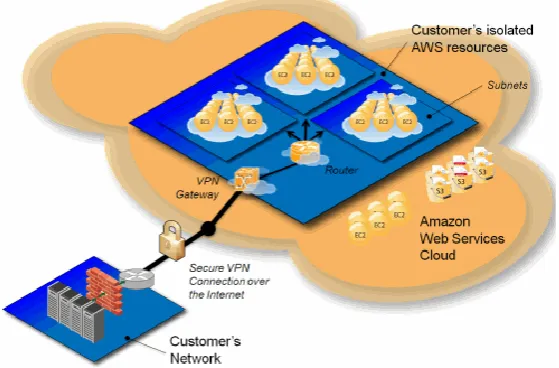
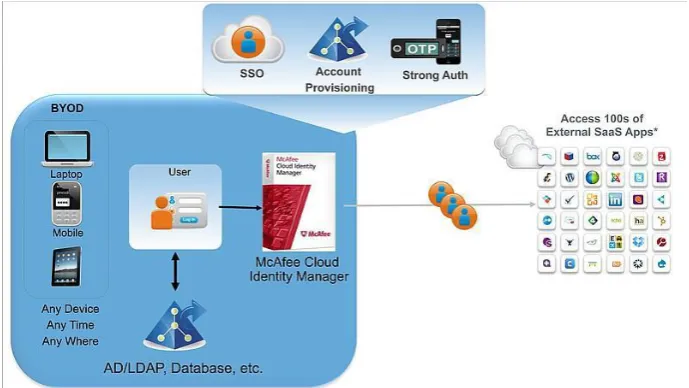
authentication, access management, AWS identity. Figure 1 presents the multifactor
authentication procedure from AWS. There is also a technique for authentication that is
allowing users to use just one password in order to authenticate themselves to multiple
services [3]. With this technique the users are prone to honeypot and dictionary attacks. The
most famous IT companies are using this technique like Google, Microsoft, and Facebook.
In order to enable authentication of the required IP addresses to some external site when
cloud computing is used, Proxy setting could be used. Proxy URL enables only trusted sites
to be accessed.
Hence, we can conclude here that for data protection of the cloud technology the most used
authentication mechanisms are: knowledge based authentication, two factor authentication,
adaptive authentication, multifactor authentication and single password authentication.
Knowledge based authentication, two factor authentication and adaptive authentication are
MAR-APRIL 2017, VOL- 4/30 www.srjis.com Page 4902 Multifactor authentication is used by AWS to secure the data in the cloud. Benefits of this
authentication mechanism are that it enables identity management and access management.
Single password authentication is used from Facebook to enable data protection in the cloud.
Benefits of this kind of authentication mechanism are that it enables security from honeypot
[image:3.595.159.439.183.367.2]attacks and dictionary attacks.
Figure 1. Multi-Factor Authentication from AWS
Confidentiality in Cloud Computing:
Confidentiality is one of the most important security mechanisms for users’ data protection in
the cloud. It includes encryption of the plaintext in cipher text before the data is stored in the
cloud. This technique protects the users’ data and even cloud service providers cannot modify
or read the content that is stored in this way in the cloud
This kind of protection is offered from Dell data protection and encryption where users’ data
is protected when it is stored on the external drive or media. Encryption could be done either
using software or hardware. Great benefit of this kind of protection is that users don’t need to
bother with the enforce policies of Dell data protection and encryption. Dell also uses
Transparent File Encryption to control the users that are accessing the data.
Wuala cloud is another vendor that enables encryption for the data in the cloud. Encryption is
enabled here before personal computers are sending the data to the cloud. This is excellent
protection because even the provider cannot access the data. Authors in [4] are proposing
encryption method for cloud computing that is based on hierarchical attribute. This proposed
security technique for confidentiality in cloud computing gives high performances and great
access control. Authors in [5] are proposing encryption method where owners can control the
MAR-APRIL 2017, VOL- 4/30 www.srjis.com Page 4903 Confidentiality is also provided by the vendor Online Tech which obtains confidentiality in
the cloud computing using encryption methods (like Full Disk Encryption) that encrypt stored
data on hard disk throughout the booting process. Whole Disk Encryption is also used for
encrypting the data with the well known AES (Advanced Encryption Standard) algorithm. If
the device that is using cloud computing technology is lost or stolen there is also a bit locker
password which protects the data on the lost or stolen device.
Hence, we can conclude in this section that confidentiality is very important for protecting
the data in the cloud and different vendors offer different security techniques for ensuring the
confidentiality. Per example, DELL offers hardware and software based encryption, as well
as transparent file encryption. The benefits of this kind of encryption techniques are that they
are easy to implement and intervention of the user is not needed. Wuala is using encryption
techniques on personal computers and this method for encryption in the cloud gives
advantage of the users for accessing the data.
Access Control in Cloud Computing:
Access control is very important security mechanism for enabling data protection in the cloud
computing. It ensures that only authorized users have access to the requested data that is
stored in the cloud. There are different security techniques that enable proper access control
in the cloud computing. Intrusion detection systems, firewalls as well as segregation of
obligations could be implemented on different network and cloud layers. Firewall is enabling
only content that is filtered to pass through the cloud network. Firewall is usually configured
according defined security policies set by the users. Firewalls are usually related to
[image:4.595.125.470.527.721.2]Demilitarized zones (DMZ) which provide additional security of the data.
MAR-APRIL 2017, VOL- 4/30 www.srjis.com Page 4904 Authorization in Cloud Computing:
Authorization in the cloud computing is important for the users when they login to some
cloud service because it enables prove of their identities. So, authorization is usually
employed after the authentication. Oracle Database Vault is an example of security technique
that enables authorization in the cloud. This security technique is offered by the vendor
Oracle. Application data from different administrative users are protected with this au
protecting the privacy of the users enabling them to set privacy policies by themselves. In this
way users are protecting their data in effective way from unauthorized access.
Authorization in the cloud is also offered by VMware which integrates service providers’
policies with the corporate directories and different policies. Certificates or soft tokens are
used for authorization of the end users in secure way. OASIS Cloud authorization enables
security techniques based on management of authorizations. Users logs are maintained with
this method which give location of the users and information about the used devices from the
users.
Recommendations for Improved Data Security in Cloud Computing:
We will mention now the most important recommendations in order to have secured cloud
environment. One of the recommendations is a cloud consumer to be ensured that efficient
governance, risk and compliance processes exist. This means that security controls must exist
in cloud computing similar to those used in traditional IT systems. Anyway, cloud computing
may have different risks to an organization than traditional IT solutions. So, when the
organization uses cloud computing, it is very important consumers to comprehend the level or
risk tolerance.
Other recommendation is that cloud consumers must be assured that the cloud provider has
functionality and processes that manages who has access to the consumer’s applications and
data. This is essential in order to have assurance that access to the cloud environment is
managed and controlled. So management of people, roles and identities is crucial to be
implemented in the cloud environment. When some consumer application is moving to the
cloud it is very important the provider to allow the consumer to assign their user identities
into access groups and roles that reflect their business and operational security policies [7].
Important recommendation to secure the data on the cloud is to be assured that cloud
networks and connections are secure. Cloud consumers must be aware of internal network
attacks like confidentiality breaches or disclosure of confidential data, integrity breaches as
unauthorized modification of data, or availability breaches like denial of service. That is why
MAR-APRIL 2017, VOL- 4/30 www.srjis.com Page 4905 service provider regarding their requirements and security policies that might have. One of
the key recommendations is also the evaluation of security controls on physical infrastructure
and facilities. Cloud consumer is in charge to get assurance from the provider that appropriate
security controls are taken into consideration, because in the cloud computing, the
infrastructure and facilities are usually controlled and owned by the cloud service provider.
1. Data Protection in the Cloud
Protection of data in the cloud is best accomplished when we have a mixture of encryption,
data loss prevention techniques, integrity protection, authentication, and authorization
techniques. When vendors and enterprises use cryptographic algorithms, it is very important
these algorithms to be well known as identified by NIST.
2. Proper Usage of Administrative Privileges
The organization that includes cloud computing should minimize administrative privileges
and only to utilize administrative accounts when they are needed. Automated tools should be
used to inventory all administrative accounts and validate that each user that has
administrative privileges on laptops, desktops, and servers is authorized by senior executive.
All administrative passwords should be complex including numbers, letters and special
characters intermixed, without dictionary words in the password.
All default passwords for operating systems, applications, firewalls, routers, wireless access
points, and other systems should be changed before deploying any new devices in the
networked systems. Service accounts also should have long and difficult to guess passwords
changed on a regular basis. Passwords in storage should be encrypted or hashed. Hashed
passwords should follow the guidance supplied in NIST SP 800-132 or similar guidance.
3 . Wireless Access Control of the Data
Organization that is using cloud computing and possess wireless network(s) should employ
commercial wireless tools for scanning, detection and discovery and commercial wireless
intrusion detection systems. The security official from the organization should regularly
capture wireless traffic from the borders of a facility and utilize commercial and free analysis
tools to resolve whether the wireless traffic was transferred using the encryption that the
organization authorizes or some weaker protocols. In this context the security officials should
also use remote management tools on the wired part of the network in order to extract
information about the wireless potential and devices connected to the systems that are
MAR-APRIL 2017, VOL- 4/30 www.srjis.com Page 4906 4. Data Recovery in Cloud Computing
It is very important each system that is using cloud computing to has automatic back up
procedure at least once a week, and for systems that store sensitive information even more
frequently than once a week. The overall backup procedure should even include the operating
system, application software and data on the machine. Multiple backups over time could be
also implemented and policies of backup should be in compliance with any official or
regulatory .
5. Boundary Defense of the Data in the Cloud
Boundary defense in one organization that is using cloud computing could be implemented
by using free or commercial IDS and sniffers to detect attacks from external sources to the
internal systems of DMZ of the organization or vice versa. It is also beneficial to deny
communications with known malicious IP addresses or limit access only to trusted sites.
Organization should include network based IPS devices as an addition to IDS to block known
bad signatures or behavior of attacks. Two-factor authentication is obligation when using
remote login access as VPN. Only DMZ systems should communicate with private network
systems of the organization via application proxies or application-aware firewalls over
authorized channels. requirements.
Conclusion:
The main goal of this work was to analyze and evaluate the security techniques for data
protection in the cloud computing. For that purpose we analyzed and evaluated the most
important security techniques for data protection that are already accepted from the cloud
computing providers. We classified them in four sections according to the security
mechanisms that they provide: authentication, confidentiality, access control and
authorization.
So, we successfully answered on the key questions in the cloud technology, or simply said
should cloud computing be trusted in data protection. We can conclude that if all
recommended measures are taken into account providing authentication, confidentiality,
access control and authorization, then the cloud computing can be trusted in data protection.
We also focused on the security issues that should be taken into account in depth in order to
have proper data security in the cloud. We recommended important security measures
relating to data protection in the cloud that must be taken into account. We also proposed a
lot of issues that should be considered in order to have improved data security in the cloud
computing, like proper usage of administrative privileges, wireless access control of the data
MAR-APRIL 2017, VOL- 4/30 www.srjis.com Page 4907 References
L. Badger, T. Grance, R. Patt-Corner and J. Voas, “Cloud computing synopsis
and recommendations (draft), nist special publication 800-146”, Recommendations of the National Institute of Standards and Technology, Tech. Rep. (2011).
U. Khalid, A. Ghafoor, M. Irum, and M. A. Shibli, “Cloud based secure and privacy enhanced authentication & authorization protocol”, Procedia Computer Science, 22, (2013), 680-688. T. Acar, M. Belenkiy and A. Küpçü, “Single password authentication”, Computer Networks, 57(13),
(2013), 2597-2614.
G. Wang, Q. Liu, J. Wu and M. Guo, “Hierarchical attribute-based encryption and scalable user revocation for sharing data in cloud servers”, Computers & Security, 30(5), (2011), 320-331. C. I. Fan and S. Y. Huang, “Controllable privacy preserving search based on symmetric predicate encryption in cloud storage”, Future Generation Computer Systems, 29(7), (2013), 1716-1724.