ISSN: 1992-8645 www.jatit.org E-ISSN: 1817-3195
SECRET DATA HIDING BY OPTIMIZING GENERAL
SMOOTHNESS DIFFERENCE EXPANSION-
BASED METHOD
1MUHAMMAD HOLIL, 2TOHARI AHMAD
1,2
Department of Informatics, Institut Teknologi Sepuluh Nopember, Surabaya, 60111, Indonesia
E-mail: [email protected] , [email protected]
ABSTRACT
Computer network has made it easy to exchange data; however, there is a security challenge raising from it. This is because the transmitting data can be intercepted by an attacker. Steganography can be used to prevent an attacker from exploring the information in the intercepted data. There are three common problems in the steganography, those are: obtaining both secret data and cover data from stego data, capacity of the secret data and the quality of the stego data. In this paper we propose a method which works on those problems based on the smoothness difference expansion. The experimental result shows that the proposed method is able to extract both secret and cover data, to increase both capacity and quality of the stego data.
Keywords: Difference Expansion, Block Smoothness, Steganography, Data Hiding, Data Security
1. INTRODUCTION
For the last decades, medical image technology has been growing rapidly. In order to make it easy for medical staff to diagnose a patient, the medical data – for example, identity of patient, medical image and medical record – can be transmitted from one location to another. This ease of transmission may make a patient can be treated fast and accurately, which leads to save the patient life.
Nevertheless, transmitting data over a network is vulnerable to attack. It is possible that an attacker intercepts the data and exploits it for later uses. On the other hand, the data transmission must be done securely. In particular, confidentiality and integrity of the data should be maintained. In order to overcome this security problem, some methods have been introduced, for example steganography. Different from cryptography [13], steganography produces readable data. In the case of images, the stego image may have similar form to the cover image.
In steganography, the secret is embedded to the cover data, such as an image. In the medical environment, the medical data (the secret) is embedded to the respective medical image of the patient (cover data). So, in case an attacker intercepts the stego data, he/she just finds this medical image without knowing who this image belongs to, or any other related information.
Due to its characteristics, any distortion in medical images is not acceptable. Small noises occurred in the medical image may affect the accuracy of the diagnose. Therefore, the extraction process must be able to produce both the original secret and cover data. It means that the process must be reversible [1]. There are two other problems raising from common methods. First, the capacity of the secret can be embedded to the cover data. This problem determines how much data can be hidden in the cover, where larger capacity is better. Second, the similarity between the stego and the cover data, where higher similarity level means better, too.
There have been some research work on those problems. The performance, however, still a challenge. In this paper, we propose a method based on the Quad Smoothness [2] and Generalized Different Expansion (GDE) [3] along with refinement of [4] [5] to increase the capacity and the similarity level while still make the process reversible.
The rest of the paper is structured as follows. Section 2 describes the research relates to the proposed method. Section 3 presents the proposed method whose result is provided in section 4. Finally, the conclusion is drawn in section 5.
ISSN: 1992-8645 www.jatit.org E-ISSN: 1817-3195
The DE method [6] has some advantages.
Mainly, it is able to provide a large embedding capacity with low complexity [7]. This method works by inserting bits of data on the difference between pairs of pixels while retaining its average value, as depicted in (1), where and are adjacent pixels in a 8-bit grayscale image, and are the pixel difference and the average of a pair of pixels, respectively.
భ మ
, (1)
The embedding process is performed by expanding the difference pixel . For secret data ∈ 0,1, the expansion is done by using (2). Difference pixels that contains the secret data is used to generate new pixels ′ and ′ as in (3).
2 x (2)
′
, ′
(3)
[image:2.595.321.498.381.627.2]Practically, new pixels ′ and ′ must not be overflow (greater than 255), or underflow (smaller than 0). This is because, those overflow and underflow values result in unrecoverable data. This means that the original data can lose. In order to avoid this condition, the difference pixels has to fulfill (4).
|| 2 x 255 , if 128 255|| 2 x 1 , if 0 127 (4)
In [8], Alattar proposes triplet DE-based method. It is able to increase the number of bits can be hidden in the cover by replacing the number of pixels in a block, from two (pair) to three (triplet). In further development, he improves the capacity of the previous method by replacing the number of pixel in the block into quad [9] and vector [3].
Furthermore, the size of the block pixels can be more dynamic [3]. This is determined based on the set of neighboring pixels whose size is as in Figure 1. Those pixels are employed to construt a vector , , … , , where N is the number of pixels in a block.
In [3], the average of the first block of pixels is defined in (5). This value is used for determining
ଵ,
ଶ, … ,
ேିଵ (see 6) where the embeddingprocess is applied.
"∑ಿషభసబ
# (5)
(6)
Figure 1: A Block of Pixels (adapted from [3])
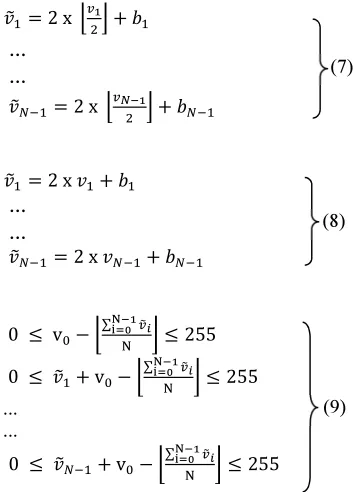
The embedding process itself can be performed in two ways: difference expansion (7) or LSB substitution (8), depending on the requirements specified in (9).
2 x భ
...
...
2 x ಿషభ
2 x
...
...
2 x
0 v "∑ొషభసబ
# 255
0 v "∑ొషభసబ
# 255
... ...
0 v "∑
ొషభ సబ
# 255
At the end of embedding process, the values of until are obtained. The new pixels are calculated using (10) which is the inverse of (5) and (6).
′ "
∑ಿషభసబ
# ′
. ..
′
(7)
(8)
(9)
ISSN: 1992-8645 www.jatit.org E-ISSN: 1817-3195
According to the capability of blocks in carrying
an image, Hsiao et al [10] categorize blocks of image into 3 groups: complex, normal and smooth. Complex blocks are not embedded in order to maintain the quality of the image. Smooth blocks are able to collect two times bigger than that of normal.
In contrast to the previous methods, Lou et al [11] propose Reduced Difference Expansion (RDE). Here, the difference in the original DE method [6] is reduced. As a result, the stego image has higher similarity to the respective cover image. It means that the quality of the stego image is better than before. Other research relates to the stego image quality is performed by Lin et al [2]. In this method, the embedding process is similar to the Quad DE [9]; however, the order of the embedding process is determined based on the smoothness level of each block. The calculation of smoothness level itself is depicted in (10), where % is the average of block ith, and %&&&&& is the average of them (see (11)). The embedding process starts from the smallest to the largest . This method is capable of providing better quality of images, especially in the small data embedding.
∑యసబ మ
(10)
%
&&&&& భమయర
(11)
3. PROPOSED METHOD
As in other data hiding methods, this proposed algorithm consists of two parts, data embedding and data extraction. This is developed based on the Quad Smoothness [2] and Generalized Different Expansion (GDE) [3] and the refinement of our previous research [4] [5].
3.1 Data embedding
Like [2], we calculate the smoothness level before the embedding process begins. In this proposed method, we enhance the block size to quad of vector instead of quad of quad. In addition, the calculation of the smoothness level is taken from the first pixel of each block instead of the average pixel . This smoothness level is calculated based on the variance of the four blocks. In this proposed method, we use the median value instead of as in [2]. This is because the value of median does not change for both before and after the embedding process.
Suppose ', ', ', and ' are the first pixel of block A, B, C and D, respectively. The smoothness level is calculated using (12) and (13).
∑యసబ మ
(12)
%
&&&&& ∑యసబ
(13)
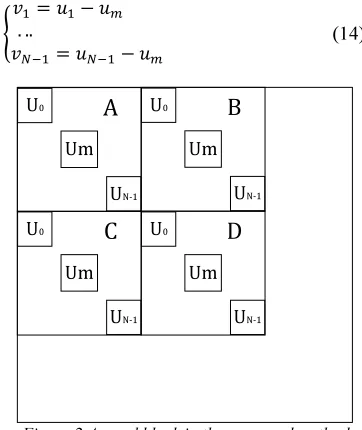
According to the quad smoothness [2], the embedding process is performed according to the smoothness level of each block, where the block with the smallest is embedded firstly. The data embedding for the concerned block is performed like in generalized DE [3], where the process begins with calculating the difference of pixels in the respective block. Different from that, in (5) is removed to make it reversible. Furthermore, we use the median pixel of each block as the base point. This is intended to have a smaller difference value, so that the capacity and the quality of the data is better. For blocks whose pixel number is odd, their median is to be the ; and for that with even, is the closest pixel whose value is smaller than the median itself. In this proposed method, the difference of pixels is specified in (14).
[image:3.595.314.495.366.581.2](. .. (14)
A
UN-1 U0 UmB
UN-1 U0 UmC
UN-1 U0 UmD
UN-1 U0 UmFigure 2 A quad block in the proposed method
ISSN: 1992-8645 www.jatit.org E-ISSN: 1817-3195
̅ , 2 , if 2 - - 2మ|| , if 2 .
2మ , if . 2
(15)
Difference pixels ̅ that have been reduced will be embedded with the secret data. It is done as in generalized DE [3]. In order to improve the message capacity, we embed two bits data into expandable blocks (expandable RDE and expandable non-RDE) whose variance is less than or equatl to 1; and one bit for that with variance is more than 1. For this purpose, we use (16), where , , … , ∈ 0,1,2,3 and (8), for those first and second cases, respectively.
(. .. 4 x
4 x (16)
Once the embedding process is complete, the new pixels can be obtained. In this proposed method, the new pixel is constructed by using (20) which must satisfy the requirements in (21) to prevent those values from overflow or underflow.
1
′
′
…
′
(20)
(0 ′. .. 255
0 ′ 255 (21)
As described before, we divide blocks into four categories: expandable RDE, expandable non-RDE, changeable, and unchangeable whose identity is according to the value in the location map (LM). It has been defined in our previous research [5] that the first two bits of LM are 11, 10, 01 and 00 for expandable RDE, expandable non-RDE, changeable and unchangable, respectively. The size of the LM is 23 2, where p and l are the number of blocks and the number of difference of pixels that contains data in each block.
For expandable RDE, the value of rest bit in LM
is determined according to (22). For changeable block, the value of the remaining bits is determined according to LSB of each difference of pixels. Expandable non-RDE and unchangeable blocks do not need more additional bits, so, the value of rest bits is 0. As in our previous method [4], LM will not be embedded to stego image.
45 60 , if̅7 2మ||
1, if ̅7 2మ|| 8 (22)
3.2 Extraction and recovery process
The data extraction process begins from the smallest to the highest . Then is calculated according to (12). The expandable blocks (expandable RDE and expandable non-RDE blocks) are extracted according to the order of the smoothness level. Those are, two bits LSB for 1, and one bit LSB for 9 1 as depicted in (23).
, :4 x
; , if 1 :2 x
; , if 9 1
(23)
The recovery of the pixel difference depends on the category of each block, whether is expandable RDE, expandable non-RDE or changeable. That is, for both expandable RDE and expandable non-RDE, it is done by performing right shift (one bit if 1, and two bits if 9 1).
For expandable RDE blocks, a further step should be done to recover the reduced pixel value. It is applied to the third bit onwards of the location map 45, where < ∈ 3,4, . . , 3 2, and l is the number of pixels in the resepective blocks [5]; or it can also be determined that < = 2. For this expandable RDE, ̅ that is reduced in the embedding process is recovered to using (24) for ̅- 0, or using (25) which has been specified in [11] for ̅9 0. As for changeable blocks the recovery process is performed as in the [3].
6̅ 2మ|| , if 45 0
̅ 2మ||, if 45 1 (24)
6̅ 2మ||, if 45 1
̅ 2మ|| , if 45 0 (25)
4. EXPERIMENTAL RESULT
ISSN: 1992-8645 www.jatit.org E-ISSN: 1817-3195
capacity and its corresponding PSNR are also
measured.
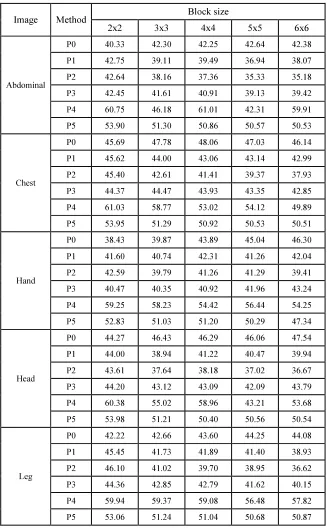
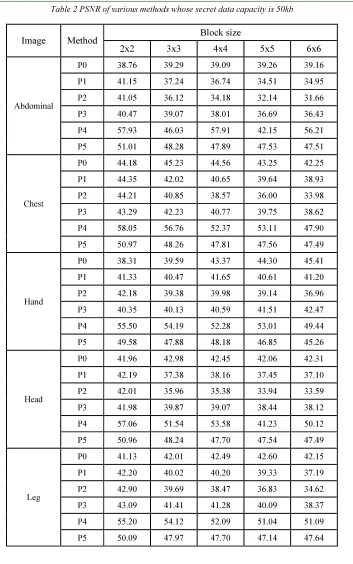
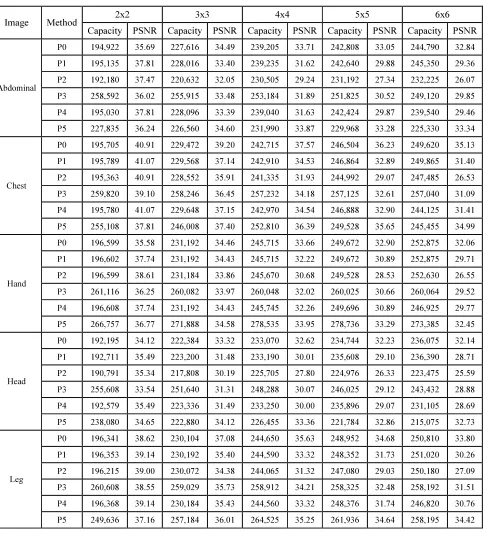
Let P0 represents the generalized DE; P1, P2, P3 and P4 are our previous methods provided in [5]; and P5 is the proposed method in this paper. It is found that P5, in general, has higher PSNR values for relatively high capacity whose block size is 6x6. In contrast, P4 is superior to other methods for less capacity of the secret data. In this case, P5 is the second highest. In more details, these experimental results are depicted in Tables 1, 2, and 3. Therefore, P5 is more appropriate to use for relatively high capacity secret data with a large block size. Moreover, the PSNR of P5 is significantly higher than that of P0 for all block sizes and for all specified capacities.
It is also shown that the best PSNR is obtained with block size of 2x2 and the worst is with 6x6. In more details, the number of the PSNR slightly goes down inline with the rising of the size of the blocks. This is because, increasing the size of the block results in increasing the number of unchangeable blocks caused by the rise of the difference value between the median pixel and other pixels in the respective block.
Furthermore, increasing the capacity or block sizes degrades the stego image quality (decreasing the PSNR value). However, in general, the proposed method (P5) is still able to maintain this image quality, where the decrease is less significant than that of P4.
In terms of the maximum secret data can be embedded into the cover data, the result is varied. Even though its maximum capacity is lower than that of certain methods, P5 is able to obtain the highest PSNR for various block sizes, as shown in Table 4.
5. CONCLUSIONS
In this paper, we propose a method to increase the capacity of the secret data and the similarity between cover and stego data while both the original secret data and the cover data can be obtained without any distortion. The proposed method, which is developed based on smoothness DE, has been able to obtain better results than existing methods, particularly for relatively higher secret data size with a large block size.
REFERENCES
[1] J.-B. Feng, I.-C. Lin, C.-S. Tsai and Y.-P. Chu, "Reversible Watermarking: Current Status and Key Issues," International Journal of Network
Security, pp. 161-171, 2006.
[2] C.-N. Lin, D. J. Buehrer, C.-C. Chang and T.-C. Lu, "Using quad smoothness to efficiently control capacity–distortion of reversible data hiding," The Journal of Systems and Software,
vol. 8, no. 3, p. 1805–1812, 2010.
[3] A. M. Alattar, "Reversible watermark using the difference expansion of a generalized integer transform," IEEE Transactions on
Image Processing, vol. 13, no. 8, pp.
1147-1156, 2004.
[4] T. Ahmad, M. Holil, W. Wibisono and R. M. Ijtihadi, "An Improved Quad and RDE-based Medical Data Hiding Method," in The IEEE International Conference on Computational
Intelligence and Cybernetics
(CyberneticsCom), 2013.
[5] T. Ahmad and M. Holil, "Increasing the Performance of Difference Expansion-based Steganography when Securing Medical Data,"
Smart Computing Review, vol. 4, no. 4, pp.
307-322, 2014.
[6] J. Tian, "Reversible data embedding using a difference expansion," IEEE Transaction on Circuits and Systems for Video Technology,
vol. 13, no. 8, pp. 890-896, 2003.
[7] D. M. Thodi and J. J. Rodríguez, "Expansion embedding techniques for reversible watermarking," IEEE Transactions on Image
Processing, vol. 16, no. 3, pp. 721-730, 2007.
[8] A. M. Alattar, "Reversible watermark using difference expansion of triplets," in
International Conference on Image
Processing, 2003.
[9] A. M. Alattar, "Reversible watermark using difference expansion of quads," in IEEE
International Conference on Acoustics,
Speech, and Signal Processing, 2004.
[10] J.-Y. Hsiao, K.-F. Chan and J. M. Chang, "Block-based reversible data embedding," in
Signal Processing 89 , 2009.
[11] D.-C. Lou, M.-C. Hu and J.-L. Liu, "Multiple layer data hiding scheme for medical images,"
Computer Standards & Interfaces, vol. 31, no.
2, p. 329 –335, 2009.
[12] September 2013. [Online]. Available:
http://www.idimages.org/images/browse/
ImageTechnique/
[13] T. Ahmad, J. Hu and S. Han, “An efficient mobile voting system security scheme based on elliptic curve cryptography,” in NSS 2009 -
Network and System Security, 2009.
ISSN: 1992-8645 www.jatit.org E-ISSN: 1817-3195
Table 1 PSNR of various methods whose secret data capacity is 25kb
Image Method Block size
2x2 3x3 4x4 5x5 6x6
Abdominal
P0 40.33 42.30 42.25 42.64 42.38
P1 42.75 39.11 39.49 36.94 38.07
P2 42.64 38.16 37.36 35.33 35.18
P3 42.45 41.61 40.91 39.13 39.42
P4 60.75 46.18 61.01 42.31 59.91
P5 53.90 51.30 50.86 50.57 50.53
Chest
P0 45.69 47.78 48.06 47.03 46.14
P1 45.62 44.00 43.06 43.14 42.99
P2 45.40 42.61 41.41 39.37 37.93
P3 44.37 44.47 43.93 43.35 42.85
P4 61.03 58.77 53.02 54.12 49.89
P5 53.95 51.29 50.92 50.53 50.51
Hand
P0 38.43 39.87 43.89 45.04 46.30
P1 41.60 40.74 42.31 41.26 42.04
P2 42.59 39.79 41.26 41.29 39.41
P3 40.47 40.35 40.92 41.96 43.24
P4 59.25 58.23 54.42 56.44 54.25
P5 52.83 51.03 51.20 50.29 47.34
Head
P0 44.27 46.43 46.29 46.06 47.54
P1 44.00 38.94 41.22 40.47 39.94
P2 43.61 37.64 38.18 37.02 36.67
P3 44.20 43.12 43.09 42.09 43.79
P4 60.38 55.02 58.96 43.21 53.68
P5 53.98 51.21 50.40 50.56 50.54
Leg
P0 42.22 42.66 43.60 44.25 44.08
P1 45.45 41.73 41.89 41.40 38.93
P2 46.10 41.02 39.70 38.95 36.62
P3 44.36 42.85 42.79 41.62 40.15
P4 59.94 59.37 59.08 56.48 57.82
ISSN: 1992-8645 www.jatit.org E-ISSN: 1817-3195
Table 2 PSNR of various methods whose secret data capacity is 50kb
Image Method Block size
2x2 3x3 4x4 5x5 6x6
Abdominal
P0 38.76 39.29 39.09 39.26 39.16
P1 41.15 37.24 36.74 34.51 34.95
P2 41.05 36.12 34.18 32.14 31.66
P3 40.47 39.07 38.01 36.69 36.43
P4 57.93 46.03 57.91 42.15 56.21
P5 51.01 48.28 47.89 47.53 47.51
Chest
P0 44.18 45.23 44.56 43.25 42.25
P1 44.35 42.02 40.65 39.64 38.93
P2 44.21 40.85 38.57 36.00 33.98
P3 43.29 42.23 40.77 39.75 38.62
P4 58.05 56.76 52.37 53.11 47.90
P5 50.97 48.26 47.81 47.56 47.49
Hand
P0 38.31 39.59 43.37 44.30 45.41
P1 41.33 40.47 41.65 40.61 41.20
P2 42.18 39.38 39.98 39.14 36.96
P3 40.35 40.13 40.59 41.51 42.47
P4 55.50 54.19 52.28 53.01 49.44
P5 49.58 47.88 48.18 46.85 45.26
Head
P0 41.96 42.98 42.45 42.06 42.31
P1 42.19 37.38 38.16 37.45 37.10
P2 42.01 35.96 35.38 33.94 33.59
P3 41.98 39.87 39.07 38.44 38.12
P4 57.06 51.54 53.58 41.23 50.12
P5 50.96 48.24 47.70 47.54 47.49
Leg
P0 41.13 42.01 42.49 42.60 42.15
P1 42.20 40.02 40.20 39.33 37.19
P2 42.90 39.69 38.47 36.83 34.62
P3 43.09 41.41 41.28 40.09 38.37
P4 55.20 54.12 52.09 51.04 51.09
ISSN: 1992-8645 www.jatit.org E-ISSN: 1817-3195
Table 3 PSNR of various methods whose secret data capacity is 100kb
Image Method Block size
2x2 3x3 4x4 5x5 6x6
Abdominal
P0 38.02 38.02 37.49 37.22 37.08
P1 40.13 36.21 35.18 33.05 33.16
P2 39.99 34.99 32.63 30.42 29.36
P3 39.10 37.33 35.95 34.55 34.01
P4 47.92 41.45 45.23 38.63 42.02
P5 47.32 42.43 42.47 41.55 41.71
Chest
P0 42.37 41.72 40.39 39.04 37.93
P1 42.65 39.54 37.51 36.02 34.82
P2 42.29 38.23 35.04 32.34 30.11
P3 41.63 39.29 37.06 35.78 34.55
P4 52.50 53.22 50.50 50.65 43.63
P5 47.95 45.24 44.82 44.53 44.45
Hand
P0 37.37 38.08 39.64 39.36 39.04
P1 39.84 38.02 37.64 36.31 35.96
P2 40.92 37.64 36.19 34.16 32.24
P3 39.56 38.49 37.69 37.21 36.35
P4 51.58 50.33 49.22 49.13 46.69
P5 46.02 44.84 44.69 43.77 42.38
Head
P0 37.11 38.05 37.69 37.46 37.75
P1 38.24 34.81 34.33 33.51 33.23
P2 37.89 33.17 31.92 30.28 29.67
P3 38.54 36.21 35.25 34.06 34.53
P4 49.87 49.97 48.21 40.50 43.81
P5 47.78 45.30 44.76 44.54 44.49
Leg
P0 40.58 40.76 40.69 40.35 39.37
P1 41.34 38.44 37.75 36.70 34.80
P2 42.18 38.50 36.60 34.66 32.01
P3 41.41 40.06 39.29 38.00 36.68
P4 49.48 47.14 46.29 43.47 43.38
ISSN: 1992-8645 www.jatit.org E-ISSN: 1817-3195
Table 4 Maximum capacity (in bits) and its corresponding PSNR
Image Method 2x2 3x3 4x4 5x5 6x6
Capacity PSNR Capacity PSNR Capacity PSNR Capacity PSNR Capacity PSNR
Abdominal
P0 194,922 35.69 227,616 34.49 239,205 33.71 242,808 33.05 244,790 32.84
P1 195,135 37.81 228,016 33.40 239,235 31.62 242,640 29.88 245,350 29.36
P2 192,180 37.47 220,632 32.05 230,505 29.24 231,192 27.34 232,225 26.07
P3 258,592 36.02 255,915 33.48 253,184 31.89 251,825 30.52 249,120 29.85
P4 195,030 37.81 228,096 33.39 239,040 31.63 242,424 29.87 239,540 29.46
P5 227,835 36.24 226,560 34.60 231,990 33.87 229,968 33.28 225,330 33.34
Chest
P0 195,705 40.91 229,472 39.20 242,715 37.57 246,504 36.23 249,620 35.13
P1 195,789 41.07 229,568 37.14 242,910 34.53 246,864 32.89 249,865 31.40
P2 195,363 40.91 228,552 35.91 241,335 31.93 244,992 29.07 247,485 26.53
P3 259,820 39.10 258,246 36.45 257,232 34.18 257,125 32.61 257,040 31.09
P4 195,780 41.07 229,648 37.15 242,970 34.54 246,888 32.90 244,125 31.41
P5 255,108 37.81 246,008 37.40 252,810 36.39 249,528 35.65 245,455 34.99
Hand
P0 196,599 35.58 231,192 34.46 245,715 33.66 249,672 32.90 252,875 32.06
P1 196,602 37.74 231,192 34.43 245,715 32.22 249,672 30.89 252,875 29.71
P2 196,599 38.61 231,184 33.86 245,670 30.68 249,528 28.53 252,630 26.55
P3 261,116 36.25 260,082 33.97 260,048 32.02 260,025 30.66 260,064 29.52
P4 196,608 37.74 231,192 34.43 245,745 32.26 249,696 30.89 246,925 29.77
P5 266,757 36.77 271,888 34.58 278,535 33.95 278,736 33.29 273,385 32.45
Head
P0 192,195 34.12 222,384 33.32 233,070 32.62 234,744 32.23 236,075 32.14
P1 192,711 35.49 223,200 31.48 233,190 30.01 235,608 29.10 236,390 28.71
P2 190,791 35.34 217,808 30.19 225,705 27.80 224,976 26.33 223,475 25.59
P3 255,608 33.54 251,640 31.31 248,288 30.07 246,025 29.12 243,432 28.88
P4 192,579 35.49 223,336 31.49 233,250 30.00 235,896 29.07 231,105 28.69
P5 238,080 34.65 222,880 34.12 226,455 33.36 221,784 32.86 215,075 32.73
Leg
P0 196,341 38.62 230,104 37.08 244,650 35.63 248,952 34.68 250,810 33.80
P1 196,353 39.14 230,192 35.40 244,590 33.32 248,352 31.73 251,020 30.26
P2 196,215 39.00 230,072 34.38 244,065 31.32 247,080 29.03 250,180 27.09
P3 260,608 38.55 259,029 35.73 258,912 34.21 258,325 32.48 258,192 31.51
P4 196,368 39.14 230,184 35.43 244,560 33.32 248,376 31.74 246,820 30.76