R E S E A R C H A R T I C L E
Open Access
Psychoactive substance use among
first-year students in a Botswana University:
pattern and demographic correlates
Anthony A. Olashore
1*, Olorunfemi Ogunwobi
2, Eden Totego
3and Philip R. Opondo
1Abstract
Background:Substance use amongst university students is a recognized problem worldwide. Few studies have
been carried out in this group in Botswana. These studies have been mostly limited to the use of alcohol and tobacco. Therefore, this study was designed to investigate the pattern of general substance use, its association with psychological distress and common socio-demographic factors among first-year undergraduates in a Botswana University.
Methods:A total of 401 students were interviewed using amodified W.H.O. student drug use questionnaireand the 12 itemGeneral Health Questionnaire(GHQ12) to assess the pattern of psychoactive substance use and its relationship with psychological distress amongst university students in Botswana.
Results:Alcohol was the most (31.9%) commonly used psychoactive substance. Age of debut for most psychoactive substances was between the ages of 15–18 years. Current use of alcohol (p= 0.045), amphetamine-type stimulants (p= 0.004) and benzodiazepines (p= 0.021) were associated with significant psychological distress. A positive relationship was observed between low participation in religious activities and substance use (OR = 4.63, 95%CI: 2.03–10.51), while a negative association was observed between not having a friend who uses drugs and substance use (OR = 0.44, 95%CI: 0.19–0.99).
Conclusions:There is a significant substance abuse problem in the undergraduate population in Botswana. Our findings followed the global trend, with alcohol being the most commonly used substance. Religious participation demonstrates potential to be one of the solutions to this problem, but how to harness its seemingly protective influences is a field for further study.
Keywords:Substance use, Risk factors, Psychological distress, University students, Botswana
Background
For several centuries, psychoactive substances have been widely used all over the world for various reasons. Alco-holic beverages for example, have played significant so-cial, economic, political, and traditional roles in many civilizations in Europe, America, and Africa [1]. Several other psychoactive substances have been used in soci-eties for one medicinal purpose or the other. Cannabis use for its medicinal properties is believed to have started in China over 4000 years ago [1].
Despite the medicinal benefits of some psychoactive substances and their social acceptability, they are related to some undesirable health, social, legal and economic outcomes [2]. Tobacco accounts for 8.8% (4.9 million) deaths and 4.1% (59.1million) of Disability Adjusted Life Years (DALYs), while illicit drugs such as opioids, 0.4% of deaths and 0.8% of DALYs [2]. Of concern is the in-creasing relationship between HIV/AIDS infection, vio-lence and substance abuse. In Botswana, heavy use of alcohol has been found to be associated with higher odds of all risky sex behaviors, gender-based violence and HIV transmission in both genders [3]. Furthermore, the relationship between substance use and psycho-logical distress has been demonstrated using the General * Correspondence:[email protected]
1Department of Psychiatry, University of Botswana Medical School, Private
Bag, 00712 Gaborone, Botswana
Full list of author information is available at the end of the article
Health Questionnaire (GHQ) and other psychological instruments [4,5].
Initiation to substance use mostly starts between the ages of 12 and 24 years and males are more susceptible than females, although this gap narrows as the age of initiation increases [4, 6]. The usual ages of entry into the university especially in this part of the world coin-cide with the ages of drug initiation, and for some youths, their first contact is during their university edu-cation. University life especially the early part has been described as a “transitional” period during which stu-dents move from a restricted high school life, mostly su-pervised by parents, to a more independent life which may be readily influenced by a liberal campus environ-ment [7]. Some other factors that may predispose to drug use among undergraduates include academic pres-sure, peer prespres-sure, easy accessibility, and unhealthy family background [8]. Alcohol and tobacco are often the first to be initiated of all the psychoactive substances [6,9]. Alcohol is the most widely used psychoactive sub-stances across the globe, accounting for 90.8% [9]. Ex-cept for the United States of America, Brazil, Mexico, Denmark and Spain where cannabis use ranked second, tobacco is the second most commonly consumed drug in most countries [9]. Studies conducted among univer-sity undergraduates from different parts of Africa gave similar results [4,10].
Previous studies conducted in Botswana have only re-ported on the use of alcohol and tobacco [11–13], which may lead to an erroneous assumption that these are the only drugs abused. Nonetheless, the fact that tobacco has been regarded as a gateway drug [14] suggests the existence of use of other unreported psychoactive sub-stances. To explore this, we set out to investigate the pattern of substance use, its association with psycho-logical distress, and common socio-demographic factors among undergraduates, using an instrument that mea-sures a broader range of drugs. This study will not only add to the existing knowledge and provide a broader picture of substance use but should also identify areas for further research on drug use in Botswana.
Methods
The study was a cross-sectional descriptive study which assessed substance use among full-time first-year stu-dents of a tertiary institution in Botswana. The mini-mum sample size required was 373, but the research instruments were administered to 410 students based on the calculated minimum sample size with an additional 10% allowance for non-response.
The sampling method and procedure for distribution of questionnaires involved a multi-stage sampling technique (i.e., selection done in stages from faculties through de-partments until the final sampling units were arrived at).
In the first stage, five faculties out of the existing seven faculties were selected by simple random technique (balloting). In the second stage, eight departments were randomly selected from 5 faculties, with one department each from two faculties and two from the remaining three selected faculties which have more departments. In the third stage, about 51 respondents were selected from first-year students in each of the preselected departments.
This study was conducted after obtaining ethical ap-proval from the University of Botswana Research and Eth-ical Review Committee. The approval to embark on the study was given based on the assurance that the name of the study site (institution) would not be used in the publi-cation. A written informed consent was also obtained from everyone who agreed to participate in the study.
Two research instruments were used for the present study. The first consisted of a modified version of the 37
item World Health Organization (WHO) drug
question-naire. The WHO developed the prototype in
conjunc-tion with the United Naconjunc-tions Division of Narcotics; the International Narcotics Control Board and the Inter-national Council on Alcohol and Addictions. It was de-signed to aid in epidemiological data collection on drug abuse across different geographical regions of the world, and it is recommended for use among students and other populations. Items in the questionnaire consist of different types of psychoactive/illicit substances, such as Cannabis, cocaine, hallucinogens, opioids, and sedatives. Specific examples relevant to this environment were given for the classes of drugs for simplicity. For example, drugs such as methylphenidate (Ritalin), khat, and crystal-meth were cited in the case of amphetamine-type stimulants (ATS). Participants were also asked to include other forms of drugs not listed in the examples. It mea-sures the lifetime, 12-month and current use (i.e., in the last 30 days) of these psychoactive substances. It also consists of relevant questions on the socio-demographic characteristics of the respondents such as age, religious participation, ethnicity, position in the family, parents’ marital status, parents’ level of education and occupa-tion. Religious participation was measured by frequency of attendance of religious activities, where a subjective response of “never” or “rarely” were grouped as poor participation and“regularly” as good participation. A fic-tional drug ‘maladrine’ was added to the list of psycho-active substances. Those who agreed to have taken this fictional substance were excluded from further analysis to reduce the bias of over-reporting.
found to have good internal consistency across many cul-tures as reflected by Cronbach’s alpha range from 0.82– 0.89 in regions as diverse as Africa, Asia, Europe and South-America [15–17]. Each question has four possible responses; the respondent was asked to choose only one response which best fits how he/she felt recently. The first two responses were scored “0” while the last two were scored“1”each. A score of 1 on each item was considered positive and a score of 0, negative. Positive scores were indi-cative of psychological distress. The cut-off of 3 was derived from the calculated GHQ mean score; hence, a score of 3 or more was used in this study to indicate psychological distress as in a previous study in a similar setting [4].
Data Analysis was done using the Statistical Package for Social Sciences (SPSS for Windows), Version 16. Fre-quency tables were employed for descriptive statistics such as the socio-demographic variables and prevalence of drug use. Cross-tabulations were done to show the prevalence of substance use by gender, and the relation-ships between substance use and GHQ score. A bivariate analysis was performed to explore the relationship be-tween identified socio-demographics and current use of any substance. To further explore this relationship, the significant variables on bivariate analysis were entered into a binary logistic regression, with current use of any substance as the dependent variable. Fishers Exact Test (FET) was used where applicable. The level of statistical significance for all tests was set atp< 0.05.
Results
Socio-demographic characteristics of the respondents
Out of 410 students interviewed, only 401 (97.8%) re-sponses were analyzed. The remaining nine were excluded for admitting to the use of fictional drug,‘maladrine,’that was intentionally included to forestall over-reporting, and for incomplete responses. The mean age of the respon-dents was 20.8 (SD =1.4) years, while the age range was 18–24 years. More female students (50.4%) participated in the study than males (49.6%). Over half (58%) of the par-ticipants came from the Tswana ethnic group. Christianity was the most predominant religion (63.6%), followed by African traditional religion (18.9%), and others (8.8%), such as Hinduism and Buddhism. More than two-thirds of the respondents participated regularly in religious activ-ities and received monthly allowance below150 USD (Table1).
Prevalence and pattern of drug use
The lifetime prevalence of any substance use (defined as at least a single episode of use) was 59.6%, 12-months prevalence (previous year) was 49.4% while the current use was 37.9%. The lifetime prevalence of multiple drug use, technically defined as the use of more than one psy-choactive substance, was 45.1%, 12-months (previous
[image:3.595.304.539.99.504.2]year) was 42.4% and current use 36.4%. Alcohol was the most commonly used psychoactive substance with 31.9% current users. Of these, beer (51.5%) and wine (26.6%) were the most frequent types. This was followed by tobacco which was 18.7% and cannabis, 6.2% (Fig.1). In-halants, which were majorly in the form of petrol and glue, were 3.2%. ATS, which comprised of methylphen-idate, street drugs, crystal meth, and khat were 3.7%, while controlled drug such as benzodiazepines was 1.1%. Except for inhalants (FET,p< 0.01), no gender difference was observed in the rates of psychoactive substance use. Majority of the psychoactive substances were first tried between the ages of 15–18 years. None of the illegal drugs (cocaine, cannabis, heroin, and codeine) uses started before the age of 11 years, but most of those who use inhalants or solvents such as petrol started at the age of 10 (Table2).
Table 1Socio-demographic characteristics of the respondents
Variable Statistic
Age, years; mean (sd) 20.8 (1.4)
Age range 18–24 years
Frequency N Percent
Age groupa 391 100
< 21 years 219 56.0
21–25 years 164 41.9
> 25 8 2.0
Gender 401 100
Male 199 49.6
Female 202 50.4
Religiona 396 100
Christianity 252 63.6
Islam 11 2.8
Traditional religion 75 18.9
Others 35 8.8
No religious affiliation 23 5.8
Religious participation 389 100
Rare or low religious participation 89 22.9
Regular participation 300 77.1
Ethnicity 393 100
Tswana 229 58.3
Kalanga 122 31.0
Others 15 3.9
Foreigners 27 6.9
Monthly Upkeepsa
347 100
Below 130 USD 97 28.0
130–150 USD 199 57.3
Above 150 USD 51 14.7
a
Drug use and psychological distress
About 16% of the students had significant psycho-logical distress, (defined as GHQ score of 3 and above). Current use of alcohol (χ2= 4.03, p= 0.045), ATS (χ2= 8.35, p= 0.004) and benzodiazepines (FET, p= 0.021) were associated with significant psycho-logical distress. Similarly, lifetime use of benzodiaze-pines (FET, 0.005) and codeine (FET, 0.045) were associated with GHQ of 3 and above (Table 3).
Factors that were associated with any substance use among university undergraduates
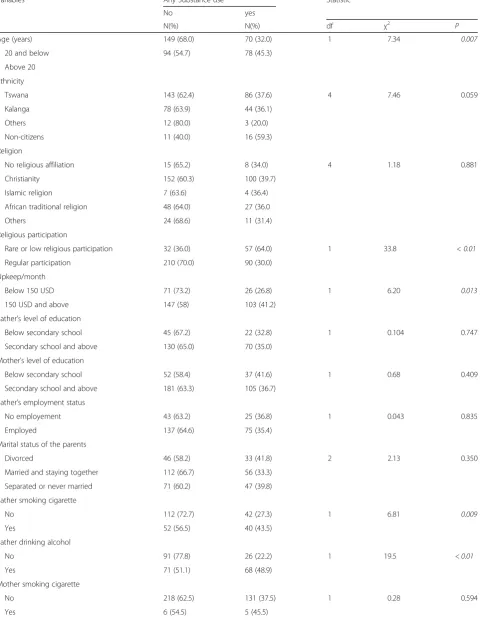
Factors that were significant on bivariate analysis were age 20 years and below (χ2= 7.34, p= 0.007), poor participa-tion in religious activities (χ2= 33.8,p< 0.01), earning 150 USD and above per month (χ2= 6.20, p= 0.013), having a father who smokes cigarette (χ2= 6.81,p= 0.009), having a
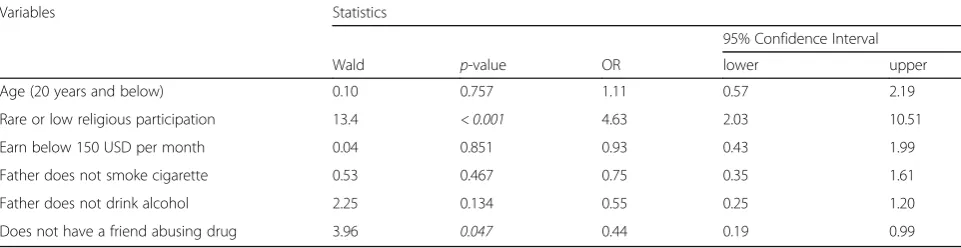
father who drinks alcohol (χ2= 19.5, p= < 0.01), and hav-ing a friend who uses drugs (χ2= 6.57,p= 0.010) (Table4). With logistic regression analysis, only two of these vari-ables were found to have significant relationships with any substance use. Poor participation in religious activities was positively related with any substance use (OR = 4.63,
95%CI: 2.03–10.51), not having a friend who uses
drugs was negatively associated with any substance use (OR = 0.44, 95%CI: 0.19–0.99) (Table 5).
Discussion
Drug use among undergraduates is as noteworthy a prob-lem in Botswana as elsewhere [8,18–20] and has mainly
[image:4.595.56.540.87.281.2]Fig. 1Showing the prevalence of psychoactive substance use among respondents. LSD - Lysergic acid diethylamide. ATS - Amphetamine-type stimulants
Table 2Age at first use of drugs among respondents
Age at first drug use in years, n (%)
Drugs Frequency
(N)
10 or less
11–14 15–18 19 or more
Tobacco 120 6 (5.0) 24 (20.0) 54 (45.0) 36 (30.0)
Alcohol 200 14 (7) 17 (8.5) 93 (46.5) 76 (38.0)
Cannabis 45 – 3 (6.7) 20 (44.4) 22 (48.9)
Cocaine 4 – – 3 (75.0) 1 (25.0)
ATS 33 5 (15.2) 2 (6.1) 8 (24.2) 18 (54.5)
Inhalants 17 11 (64.7) 3 (17.6) 1 (5.9) 2 (11.8)
Benzodiazepines 6 1 (16.7) 1 (16.7) 1 (16.7) 3 (50.0)
Heroin 1 – 1 (100) – –
Codeine 6 – 1 (16.7) 3 (50.0) 2 (33.3)
LSD 1 – – – 1 (100)
[image:4.595.299.537.490.716.2]LSDlysergic acid diethylamide,ATSAmphetamine-type stimulants
Table 3Respondents’drug use and GHQ score
Drugs GHQ score
GHQ (0–2) N (%) GHQ (3–12) N (%) χ2 p
Tobacco
Current use 60 (87.0) 9 (13.0) 1.64 0.200
Alcohol
Current use 104 (87.4) 15 (12.6) 4.03 0.045
Cannabis
Current use 17 (70.8) 7 (29.2) 1.99 0.158
Cocaine
Current use 3 (100) – 0.99
ATS
Current use 8 (53.3) 7 (46.7) 8.35 0.004
Inhalants
Current use 11 (91.7) 1 (8.3) 0.82 0.360
Benzodiazepines
Current use 1 (25.0) 3 (75.0) 0.021*
ATSamphetamine-type stimulants *
[image:4.595.57.291.547.723.2]Table 4Bivariate analysis showing the relationship between identified risk factors and any substance use
Variables Any Substance use Statistic
No yes
N(%) N(%) df χ2 P
Age (years) 149 (68.0) 70 (32.0) 1 7.34 0.007
20 and below 94 (54.7) 78 (45.3)
Above 20
Ethnicity
Tswana 143 (62.4) 86 (37.6) 4 7.46 0.059
Kalanga 78 (63.9) 44 (36.1)
Others 12 (80.0) 3 (20.0)
Non-citizens 11 (40.0) 16 (59.3)
Religion
No religious affiliation 15 (65.2) 8 (34.0) 4 1.18 0.881
Christianity 152 (60.3) 100 (39.7)
Islamic religion 7 (63.6) 4 (36.4)
African traditional religion 48 (64.0) 27 (36.0
Others 24 (68.6) 11 (31.4)
Religious participation
Rare or low religious participation 32 (36.0) 57 (64.0) 1 33.8 < 0.01
Regular participation 210 (70.0) 90 (30.0)
Upkeep/month
Below 150 USD 71 (73.2) 26 (26.8) 1 6.20 0.013
150 USD and above 147 (58) 103 (41.2)
Father’s level of education
Below secondary school 45 (67.2) 22 (32.8) 1 0.104 0.747
Secondary school and above 130 (65.0) 70 (35.0)
Mother’s level of education
Below secondary school 52 (58.4) 37 (41.6) 1 0.68 0.409
Secondary school and above 181 (63.3) 105 (36.7)
Father’s employment status
No employement 43 (63.2) 25 (36.8) 1 0.043 0.835
Employed 137 (64.6) 75 (35.4)
Marital status of the parents
Divorced 46 (58.2) 33 (41.8) 2 2.13 0.350
Married and staying together 112 (66.7) 56 (33.3)
Separated or never married 71 (60.2) 47 (39.8)
Father smoking cigarette
No 112 (72.7) 42 (27.3) 1 6.81 0.009
Yes 52 (56.5) 40 (43.5)
Father drinking alcohol
No 91 (77.8) 26 (22.2) 1 19.5 < 0.01
Yes 71 (51.1) 68 (48.9)
Mother smoking cigarette
No 218 (62.5) 131 (37.5) 1 0.28 0.594
been underreported. The present study, to our know-ledge, was the first to determine the pattern of general drug use among university students in Botswana. The lifetime prevalence for any substance use was 59.6%; 12-month prevalence was 49.4% while the current use was 37.9%. These figures are within the range described in previous literature from the developed countries [9,20,21] and are similar to those found in Africa as well. For ex-ample in West Africa, the lifetime prevalence of any sub-stance use ranged from 56 to 78% and 1-month prevalence, 28–40% among undergraduates [4, 8]. There was a high prevalence of multiple drug use among the respondents with 36.4% currently engaging in multiple drug use. Mul-tiple drug use has been associated with higher rates of complications including rule-breaking behavior [22], sexual and physical abuse [3], and various other psychiatric disor-ders [5]. This relationship is complex and multidirectional. While this present study did not set out to assess the rela-tionships between drug use and anti-social or high-risk be-haviors, the finding of a high prevalence of multiple drug use may be an indication that this population is a high-risk group for complications of drug abuse.
As in many other studies on drug use in youths [4,9,20], alcohol was the most commonly used psychoactive sub-stance with a current prevalence of 31.9%. The significant role of alcohol in many social functions, its wide availability and the social acceptability of its use, are reasons that have been adduced for this trend [8]. Production of
alcohol (mostly from Sorghum) and its consumption has been an integral part of the culture and village life in Botswana, but consumption of alcoholic beverages was traditionally restricted to elders of the community [23]. Rapid industrialization and economic globalization have brought about sudden and extensive social transfor-mations in the developing countries, including Botswana. Children and women who were previously excluded from drinking now constitute a significant proportion of con-sumers of these products [23]. However, our study re-vealed a lower prevalence than what was previously reported in Botswana, 58% [13], 44.4% [12] and Nigeria, 58% [4] among undergraduates. While we cannot make a direct comparison between the current study and the pre-viously conducted studies in Botswana, it is possible that the 30% tax placed on its purchase is playing a significant role in the reduction of alcohol consumption in Botswana, as suggested by previous authors [24].
[image:6.595.58.539.99.223.2]Tobacco was the next most commonly used psycho-active substance in this study group as reported else-where [4,9,20] with a current prevalence of 18.7%. This rate is much higher than the prevalence reported in the Global youth tobacco surveillance report from 2000 to 2007 (9.5%) [25] but similar to the rates from Europe (19.2%) and America (15%) [25]. The rate reported in this study is also lower than what was previously re-ported among teachers in Botswana. Although, the low prevalence among the teachers could have been related Table 4Bivariate analysis showing the relationship between identified risk factors and any substance use(Continued)
Variables Any Substance use Statistic
No yes
N(%) N(%) df χ2 P
Mother drinking alcohol
No 203 (63.6) 116 (36.4) 1 0.78 0.378
Yes 22 (56.4) 17 (43.6)
Friend using any substance
No 200 (64.3) 111 (35.7) 1 6.57 0.010
Yes 34 (47.9) 37 (52.1)
Significantp-value initalics
Table 5Logistic regression showing the factors that are associated with substance use among students
Variables Statistics
95% Confidence Interval
Wald p-value OR lower upper
Age (20 years and below) 0.10 0.757 1.11 0.57 2.19
Rare or low religious participation 13.4 < 0.001 4.63 2.03 10.51
Earn below 150 USD per month 0.04 0.851 0.93 0.43 1.99
Father does not smoke cigarette 0.53 0.467 0.75 0.35 1.61
Father does not drink alcohol 2.25 0.134 0.55 0.25 1.20
Does not have a friend abusing drug 3.96 0.047 0.44 0.19 0.99
[image:6.595.57.538.600.724.2]to Botswana legislation on tobacco control (Botswana Control of Smoking Act, 1992), which strictly prohibits any direct forms of tobacco advertising and use, it is possible that youths are less likely to follow this law. Moreover, only those who have recently completed their first 1 year on campus were included in the present study, and this may also explain the higher prevalence of tobacco use in this sample. First-year students often face significant challenges such as exposure to new courses, more liberal campus environment, peer pressure, secur-ing accommodation, which may stretch their capacity to cope and engender substance use behavior. Among youths, alcohol and tobacco have been referred to as
“soft drugs” taking into consideration that they are legal in most countries and also as“gateway drugs,”based on the trend of being the first psychoactive substance taken by many users before “graduating’to other psychoactive substances [14]. The respondents in our study seem to maintain that pattern. It is, therefore, necessary to set up policies and programs targeted towards controlling the use of these “soft drugs” and prevent the progression to more dangerous drugs.
Consistent with the findings of the global report, can-nabis was the most commonly used illicit substance with 9.2% admitting to using the substance within the last 12 months and 6.2% current users. The rate of those who have used the substance in the last 12 months is similar to what has been reported by previous authors from other countries [4,10,19,21]. Nevertheless, the rates of other illicit and prescription drugs such as cocaine, co-deine, ATS, and benzodiazepines are quite low as in other studies from Africa [4,19], but unlike in the United States, where their uses have been reported to be on the increase [18, 20]. As in other African countries, it is possible that these substances are too expensive to procure and sustain in Botswana, especially by these individuals who mostly survive on stipends from the government.
It is important to note that, apart from inhalant use which was mainly a male-dominated affair, no gender difference was observed in the use of other substances. These findings suggest that drug use is not an entirely male-dominated activity in Botswana. Conversely, gender-based roles pre-scribed for women are protective against drug abuse behav-iors in many communities [4,23]. Men have been reported to be more likely to use tobacco and other illicit substances than women [4,20,22]. Perhaps, the nature of our sample is responsible for this disparity. In Botswana, due to the adoption of western social norms particularly amongst urban youths, there is a little cultural restriction against the use of psychoactive substances by females. This is evidenced by the open consumption of alcohol and tobacco without any apparent social censure. This practice is entirely differ-ent from some other regions in Africa, where such habits are deemed socially unacceptable [4,26].
For most of the substances assessed the age range of debut was 15–18 years. This finding may indicate a crit-ical window period for drug abuse prevention programs in the population. The substances which bucked this trend included solvents such as petrol (aged 10 or less), alongside ATS and benzodiazepines with a higher age of debut (19 and above). As it has been previously docu-mented, this finding suggests that inhalants may play a role as a gateway drug as tobacco [27], and may require specific attention in any drug abuse prevention programs directed toward the pre-adolescent age group. The drugs which had a relatively lower age of debut, i.e., alcohol, tobacco, and inhalants are readily available in the com-munity. Alcohol and inhalants are even more easily ac-cessible for the pre-adolescents since alcohol is freely available in many African households and inhalants such as glue can be purchased without restrictions. Our find-ing demonstrates that universal preventive techniques that result in reduced availability and accessibility of such substances may likely result in reduced consump-tion and abuse of the substances. In addiconsump-tion to the tax and restriction of alcohol and cigarette sales to under-18’s, parents should also be educated on how to prevent access to these substances at home. Perhaps there should also be a restriction on sales of inhalants to children less than 18 years, as in alcohol and tobacco. There is increasing evidence suggesting that a lower age of debut is associated with a higher rate of problems
with drug use ranging from dependence, other
drug-related disorders to delinquency [6], and other mental disorders [5]. Thus, no effort should be spared in preventing minors from experimenting with psycho-active substances.
also significantly associated with psychological distress, al-beit these findings should be interpreted with caution due to the sample size. These “Central Nervous System de-pressants” are in most cases prescription drugs diverted for recreational purposes through self-medication. These drugs are already highly regulated. There is, therefore, a need to enforce the existing regulations and improve them where necessary.
On bivariate analysis, participants whose fathers were not using any psychoactive substance (alcohol or to-bacco), and those who live on less than 150 USD per month were less likely to use drugs. Studies have shown that parental substance use is a factor in substance use among their offspring [29]. For example, Kilpatrick et al. found an increased risk of substance abuse in adoles-cents who had family members with alcohol or drug use problem [30]. In the same vein, smoking in adolescents has been found to be associated with lower family socio-economic status [31]. Cigarettes are cheaper and more accessible for students with little financial resources. Despite these finding, these variables, including age groups failed to predict psychoactive substance use in our sample on logistic regression.
Logistic regression showed that poor participation in religious activities was positively correlated with sub-stance use while not having a friend who uses drugs was negatively correlated. This finding has been shown in studies elsewhere [32, 33]. In a study conducted among 12595 Brazilian university students, frequent participation in religious activities was shown to have a protective ef-fect against substance use [32]. It is possible that partici-pation in religious activities provides opportunities to interact with non-drug using peers. Since peer influence is at peak during adolescence [34], the negative correl-ation between not having a friend who uses drugs and substance use is thus not surprising. Peer group influ-ence has been shown to be a factor in substance use [35] whereas, religious students have also been noted to be less prone to engage in risky behavior [36] such as drug abuse. How to harness these seemingly protective influ-ences is a field for further study.
Conclusions
There is evidence that the use of psychoactive sub-stances is a problem in the undergraduate population in Botswana. The most commonly used psychoactive sub-stance was alcohol as elsewhere, but the government 30% tax policy on alcoholic beverages may have contrib-uted to the relatively lower rate in the current study. There is a high rate of the early debut of inhalants, to-bacco, and alcohol, which is possibly driven by their availability to pre-adolescents mainly. Poor participation in religious activities was positively correlated with sub-stance use while not having a friend who uses drugs was
negatively correlated. The role of religious participation in addressing drug abuse on campus should be further explored.
Recommendations
This study has demonstrated that there is a significant problem of drug use amongst youths in Botswana and it suggests a need for urgent action to reverse the trend. Proper orientation package should be designed for fresh students to enable them to adjust and adapt to the new stage of life very easily. School health policies should be adjusted to include programmes targeted towards drug education and counseling. Participation in religious ac-tivities appears to plays an important role in inhibiting the use of a psychoactive substance. Therefore, a condu-cive environment which encourages religious activities, and other adaptive ways of relieving stress should be en-couraged in the university community.
Limitations and strengths
The study was conducted in one tertiary institution and may not be generalizable to the entire adolescent popula-tion of Botswana, particularly in the context of relatively low university enrolment. It was also cross-sectional de-scriptive and may not be able to determine causality of any of its findings. It is, however, the first to look at sub-stance use generally and not a specific or few subsub-stances. It also attempted to see a relationship between substance use and the associated problems of psychological distress.
Future research
It will be necessary to conduct a similar study in the gen-eral youth population to see how the rates in this group compare with the general youth population. It will be helpful to assess the relationships between substance use and other associated problems like criminal offending and academic performance within this group and other similar groups. The role of religious participation in addressing drug abuse on campus should be further explored. There is also a need to conduct a prospective study on drug users particularly those with a lower age of debut to assess the relationship of age of debut with outcomes.
Acknowledgements
Special thanks to the students who participated in the study and all the staff who assisted in data collection.
Availability of data and materials
The datasets used and analyzed during the current study are available from the corresponding author on reasonable request.
Authors’contributions
Ethics approval and consent to participate
Ethical approval was obtained from the University of Botswana ethical committee (UBR/RES/IRB/1628). The purpose of the study was thoroughly explained to every eligible participant, and a written informed consent was obtained from everyone who agreed to participate in the study.
Consent for publication Not applicable
Competing interests
The authors declare that they have no competing interests.
Publisher’s Note
Springer Nature remains neutral with regard to jurisdictional claims in published maps and institutional affiliations.
Author details
1Department of Psychiatry, University of Botswana Medical School, Private
Bag, 00712 Gaborone, Botswana.2Department of Psychiatry, Bowen
University Teaching Hospital, Ogbomosho, Nigeria.3University of Botswana Medical School, Gaborone, Botswana.
Received: 27 March 2018 Accepted: 13 August 2018
References
1. Sadock BJ, Sadock VA. Kaplan & Sadock’s Synopsis of Psychiatry: Behavioural Sciences/Clinical Psychiatry. 9th edition. Philadelphia: Lippincott Williams & Wilkins; 2003.
2. World Health Organization. Global health risks: mortality and burden of disease attributable to selected major risks. Geneva: World health Organization; 2009. Available fromhttp://www.who.int/healthinfo/global_ burden_disease/GlobalHealthRisks_report_full.pdf
3. Phorano O, Nthomang K, Ntseane D. Alcohol abuse, gender-based violence and HIV/AIDS in Botswana: establishing the link based on empirical evidence. SAHARA J. 2005;2(1):188–202.
4. Babalola EO, Ogunwale A, Akinhanmi A. Pattern of psychoactive substance use among university students in south-western Nigeria. J Behav Health 2013;2(4):334–342. Available from: doi:https://doi.org/10. 5455/jbh.20130921013013
5. Armstrong TD, Costello EJ. Community studies on adolescent substance use, abuse, or dependence and psychiatric comorbidity. J Consult Clin Psychol 2002;70(6):1224. Available from: doi: https://doi.org/10.1037/0022-006X.70.6.1224
6. Substance Abuse and Mental Health Services Administration. Center for Behavioral Health Statistics and Quality. Rockville: The TEDS Report: Age of Substance Use Initiation among Treatment Admissions Aged 18 to 30; 2014. Available from:https://www.samhsa.gov/data/sites/default/files/WebFiles_ TEDS_SR142_AgeatInit_07-10-14/TEDS-SR142-AgeatInit-2014.htm 7. Olley BO. Child sexual abuse, harmful alcohol use and age as determinants
of sexual risk behaviors among freshmen in a Nigerian University. Afr J Reprod Health. 2008;12(2):75–88.
8. Makanjuola AB, Daramola TO, Obembe AO. Psychoactive substance use among medical students in a Nigerian university. World Psychiatry. 2007;6(2):112. 9. Winstock, A R. Reflections on the results of the world’s biggest ever drug
survey: The global drug survey. 2014. Available from:https://www. globaldrugsurvey.com/past-findings/the-global-drug-survey-2014-findings/ 10. Peltzer K, Pharswana N. Substance use among south African students: a
quantitative and qualitative study. Alcohol Drug Abuse Mod. 2008;7(3):112–22. 11. Erick PN, Smith DR. Prevalence of tobacco smoking among school teachers
in Botswana. Tob Induc Dis. 2013;11(1):24.
12. Morutwa G, Plattner IE. Self-control and alcohol consumption among university students in Botswana. Afr J Drug Alcohol Stud. 2014;13(2):69–78. 13. Mphele S, Gralewski C, Balogun S. Stress and alcohol use among college
students: a case of Molepolole college. Stud J Hum Soc Sci. 2013;8(3):1–6. 14. Saddichha S, Sinha BN, Khess CR. The role of gateway drugs and psychosocial
factors in substance dependence in Eastern India. Int J Psychiatr Med 2007; 37(3):257–266. Available from:https://doi.org/10.2190/PM.37.3.b 15. Gelaye B, Tadesse MG, Lohsoonthorn V, Lertmeharit S, Pensuksan WC,
Sanchez SE, Lemma S, Berhane Y, Vélez JC, Barbosa C, Anderade A. Psychometric properties and factor structure of the general health
questionnaire as a screening tool for anxiety and depressive symptoms in a multi-national study of young adults. J Affect Disord. 2015;187:197–202. 16. Glozah FN, Pevalin DJ. Factor structure and psychometric properties of the
general health questionnaire (GHQ-12) among Ghanaian adolescents. J Child Adol Mental Health. 2015;27(1):53–7.
17. Jacob KS, Bhugra D, Mann AH. General health Questionnaire-12:
psychometric properties and factor structure among Indian women living in the United Kingdom. Indian J Psychiatry. 1997;39(3):196.
18. Hasin DS, Saha TD, Kerridge BT, Goldstein RB, Chou SP, Zhang H, Jung J, Pickering RP, Ruan WJ, Smith SM, Huang B. Prevalence of marijuana use disorders in the United States between 2001-2002 and 2012-2013. JAMA Psychiatry. 2015;72(12):1235–42.
19. Osman T, Victor C, Abdulmoneim A, Mohammed H, Abdalla F, Ahmed A, Ali E, Mohammed W. Epidemiology of substance use among university students in Sudan. J Addict. 2016;2016:2476164.
20. Swendsen J, Burstein M, Case B, Conway KP, Dierker L, He J, Merikangas KR. Use and abuse of alcohol and illicit drugs in US adolescents: results of the National Comorbidity Survey-Adolescent Supplement. Arch Gen Psychiatry. 2012;69(4):390–8.
21. Eastwood P, Health and Social Care Information Centre. Statistics on drug misuse: England 2013. Leeds: Health and Social Care Information Centre. p. 2013.
22. McClelland GM, Elkington KS, Teplin LA, Abram KM. Multiple substance use disorders in juvenile detainees. J Am Acad Child Adolesc Psychiatry 2004; 43(10):1215–1224. Available from: doi:https://doi.org/10.1097/01.chi. 0000134489.58054.9c
23. Myadze TI, Rwomire A. Alcoholism in Africa during the late twentieth century: a socio-cultural perspective. Int J Bus Soc Sci. 2014;5(2) 24. Sebego M, Naumann RB, Rudd RA, Voetsch K, Dellinger AM, Ndlovu C. The
impact of alcohol and road traffic policies on crash rates in Botswana, 2004–2011: a time-series analysis. Accid Anal Prev. 2014;70:33–9. 25. Warren CW, Jones NR, Peruga A, Chauvin J, Baptiste JP, Costa de Silva V, el
Awa F, Tsouros A, Rahman K, Fishburn B, Bettcher DW. Global youth tobacco surveillance, 2000-2007. MMWR Surveill Summ. 2008;57(1):1–28. 26. Yunusa MA, Obembe A, Ibrahim T, Njoku CH. Prevalence and specific
psychosocial factors associated with substance use and psychiatric morbidity among patients with HIV infection at Usmanu Danfodiyo University Teaching Hospital, Sokoto State, Nigeria. Afr J Drug Alcohol Stud. 2011;10(1) 27. Omigbodun OO, Babalola O. Psychoactive substance misuse among
Nigerian adolescents. Ann Afr Med. 2004;3:3.
28. World Health Organization. Global status report on alcohol and health 2011. Geneva: Switzerland World Health Organization; 2011. Available from:http:// libdoc.who.int/publications/2011/9789241564151_eng.pdf
29. Chassin L, Pitts SC, DeLucia C, Todd M. A longitudinal study of children of alcoholics: predicting young adult substance use disorders, anxiety, and depression. J Abnorm Psychol. 1999;108(1):106.
30. Kilpatrick DG, Acierno R, Saunders B, Resnick HS, Best CL, Schnurr PP. Risk factors for adolescent substance abuse and dependence: data from a national sample. J Consult Clin Psychol. 2000;68(1):19.
31. Patrick ME, Wightman P, Schoeni RF, Schulenberg JE. Socioeconomic status and substance use among young adults: a comparison across constructs and drugs. J Stud Alcohol Drugs. 2012;73(5):772–82.
32. Gomes FC, Andrade AG, Izbicki R, Moreira-Almeida A, Oliveira LG. Religion as a protective factor against drug use among Brazilian university students: a national survey. Rev Bras Psiquiatr. 2013;35(1):29–37.
33. Wallace JM Jr, Bachman JG. Explaining racial/ethnic differences in adolescent drug use: the impact of background and lifestyle. Soc Probl. 1991;38(3):333–57.
34. Berndt TJ, Murphy LM. Influences of friends and friendships: myths, truths, and research recommendations. Adv Child Dev Behav. 2002;30:275–310. 35. Hodge DR, Cardenas P, Montoya H. Substance use: spirituality and religious
participation as protective factors among rural youths. Soc Work Res. 2001; 25(3):153–61.