University of Huddersfield Repository
Khan, Sheriz and Tzortzopoulos, Patricia
Effects of the Interactions Between LPS and BIM on Workflow in Two Building Design Projects
Original Citation
Khan, Sheriz and Tzortzopoulos, Patricia (2014) Effects of the Interactions Between LPS and BIM on Workflow in Two Building Design Projects. In: Proceedings of the 22nd Annual Conference of the International Group for Lean Construction. IGLC22, 2 . IGLC and Akademika forlag, Oslo, Norway, pp. 933944. ISBN 9788232104604
This version is available at http://eprints.hud.ac.uk/id/eprint/23271/
The University Repository is a digital collection of the research output of the University, available on Open Access. Copyright and Moral Rights for the items on this site are retained by the individual author and/or other copyright owners. Users may access full items free of charge; copies of full text items generally can be reproduced, displayed or performed and given to third parties in any format or medium for personal research or study, educational or notforprofit purposes without prior permission or charge, provided:
• The authors, title and full bibliographic details is credited in any copy;
• A hyperlink and/or URL is included for the original metadata page; and
• The content is not changed in any way.
For more information, including our policy and submission procedure, please contact the Repository Team at: [email protected].
EFFECTS OF THE I
NTERACTIONS
BETWEEN
LPS AND BIM
ON WORKFLOW
IN TWO
BUILDING DESIGN PROJ
ECTS
Sheriz Khan1, Patricia Tzortzopoulos2
ABSTRACT
Variability in design workflow causes delays and undermines the performance of building projects. As lean processes, the Last Planner System (LPS) and Building Information Modeling (BIM) can improve workflow in building projects through features that reduce waste. Since its introduction, BIM has had significant positive influence on workflow in building design projects, but these have been rarely considered in combination with LPS. This paper is part of a postgraduate research focusing on the implementation of LPS weekly work plans in two BIM-based building design projects to achieve better workflow. It reports on the interactions between lean principles of LPS and BIM functionalities in two building design projects that, from the perspective of an interaction matrix developed by Sacks et al. (2010a), promote workflow.
KEYWORDS
BIM, design, planning and control
INTRODUCTION
“The quest to reduce the negative impacts of variability and increase the reliability of workflow has led to the development of LPS for production planning and control” (Hamzeh et al., 2009: 166). BIM has also been developed with reducing variability in workflow in mind. Recent studies (for example, by Khanzode et al., 2006, and Sacks et al., 2010b) indicate that there are synergies between LPS and BIM, and that these synergies can effectively enhance the performance of building projects. Synergies between LPS and BIM can be exploited by building designers to achieve better workflow in building design projects (Bhatla et al., 2012). However, the interactions between LPS and BIM in building design projects are still largely unexplored. There is therefore a need to better understand how the combined application of LPS and BIM in the design stage of building projects can address lean principles, reduce waste and increase efficiency.
Sacks et al. (2010a) laid the groundwork for exploring interactions between lean principles and BIM functionalities. They developed an interaction matrix that practitioners and researchers may use to identify and exploit possible areas of
1 PhD Candidate, School of Art, Design and Architecture, Department of Architecture and 3D
Design, University of Huddersfield, Queen Street Studios, Queensgate, Huddersfield, HD1 3DH, England, United Kingdom. Telephone +1 (321) 674-0309, [email protected]
2 Professor, School of Art, Design and Architecture, Department of Architecture and 3D Design,
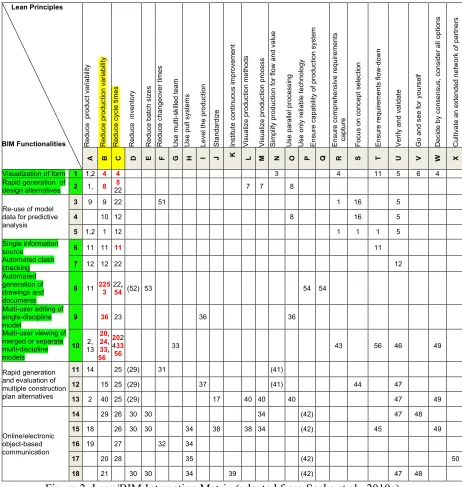
interactions between the lean principles of systems like LPS and the functionalities of BIM. They arranged twenty-four prescriptive lean principles in columns and eighteen BIM functionalities in rows. They used index numbers to represent fifty-six areas of interactions, drawn directly from evidence from research and practice. The nature of the interaction in any cell may be positive, representing synergy between lean and BIM or negative where the use of BIM inhibits implementation of a lean principle.
It was not within the scope of this work to explore all fifty-six areas of interactions. Only some interactions believed to have positive influence on workflow were studied.
RESEARCH METHOD
The method adopted in this work was action research in which the researchers worked closely with building design practitioners at two architectural-engineering (AE) firms/ the aim was to replace their regular weekly task planning meetings with LPS weekly work plans (WWPs) through three four-week learning cycles in one of their BIM-based building design project. The focus of the action research studies was on workflow during the design development phase of a building design project—the phase in which the preliminary design model, created by the architect during the schematic design phase, was shared with other members of the multidisciplinary design team to be used as a starting point for their design tasks. Because these were trial implementations of LPS WWPs, the researchers facilitated an intensive WWP training workshop for the practitioners at each firm.
At the workshops, the researchers also introduced the practitioners to the interaction matrix developed by Sacks et al. (2010a). During the LPS WWP implementations, the researchers and the practitioners used the findings from the interaction matrix to assess the benefits of the interactions between the two lean principles (Reduce production variability and Reduce cycle time) and the seven BIM functionalities (Visualization of form, Rapid generation of design alternatives, Single information source, Automated clash checking, Automated generation of drawings and documents, Multi-user editing of a single discipline model, and Multi-user viewing of merged or separate multi-discipline models) that are believed to have the greatest impact on workflow when they interact positively.
At each WWP meeting, when the PPCs (Percentage Plan Complete) were determined, the practitioners were asked whether they observed any improvement in workflow that could be attributed to positive interactions between any of the two lean principles and any of the seven BIM functionalities applied during the week. The researchers made notes of their responses. At the end of the two action research studies, the practitioners were asked to complete a questionnaire and respond to an interview, designed to identify their overall assessment of the interactions. Evaluation criteria such as the usefulness and effectiveness of the LPS WWPs in practice were also used in this research. The two action research studies are detailed as follows.
ACTION RESEARCH STUDY 1
seven-story hotel which was being designed by an architectural/engineering (AE) firm located in Melbourne, Florida, and which was to be built in Melbourne Beach, Florida, using the design-bid-build method of procurement. The study lasted sixteen weeks, from May to August, 2013. The building design team consisted of a project manager, an architect, two intern architects (IA), a structural engineer, a mechanical engineer, an electrical engineer, a plumbing engineer, four engineers-in-training (EIT), a BIM manager, and six BIM technicians.
The firm uses Autodesk Revit, Autodesk Robot Structural Analysis Professional, AutoCAD Structural Detailing, AutoCAD MEP, Autodesk Ecotect and Autodesk Navisworks to create, analyze and review 3D models, visualize building form and function, detect and resolve structural and MEP (mechanical, engineering and plumbing) clashes, and extract design and construction drawings from the 3D models. Architectural and structural models were linked using Revit, and the MEP engineers used Navisworks for clash detection of their 3D HVAC and plumbing models.
ACTION RESEARCH STUDY 2
This study focused on the effects on workflow of the implementation of LPS WWPs during the design development phase of a $13.6 million, 96,000 square-foot, six-story apartment which was being designed by an AE firm located in Fort Pierce, Florida, and which was to be built in Sebastian, Florida, using the design-bid-build method of procurement. The study lasted sixteen weeks, from July to October, 2013. The building design team consisted of a project manager, the architect, an IA, a structural engineer, a mechanical/electrical/plumbing (MEP) engineer, three EIT, a BIM manager, and five BIM technicians.
The firm uses Autodesk Revit, Autodesk Revit Structure, AutoCAD Structural Detailing, AutoCAD MEP, Autodesk Ecotect and Autodesk Navisworks to create, analyze and review 3D models, visualize building form and function, detect and resolve structural and MEP (mechanical, engineering and plumbing) clashes, and extract design and construction drawings from the 3D models. As in Action Research Study 1, architectural and structural models were linked using Revit, and the MEP engineers used Navisworks for clash detection of their 3D HVAC and plumbing models.
WORKFLOW AT THE AEFIRMS
CURRENT DESIGN MANAGEMENT STYLE AT THE AEFIRMS
Traditional project management practice lacks a mechanism to manage workflow (Howell, 2003). Both AE firms practise the traditional top-down form of design management, with a project management team, consisting of a project manager, the project architect, the project engineers and the BIM manager, developing schedules and pushing them down to the intern architects, engineers-in-training and BIM technicians to execute. The project management team held weekly task planning meetings similar to LPS WWP but characterized by informal conflict resolutions and commitments to accomplish tasks and focused on project planning rather than on production control. They pushed the schedule to project completion, thus devoting insufficient attention to the planning and control of design activities. In contrast, LPS pulls the schedule to production completion.
LPSIMPLEMENTATION
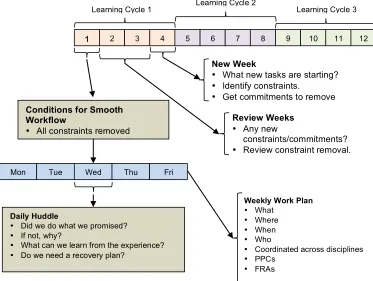
[image:5.595.100.473.448.729.2]LPS WWPs were implemented in three-action research learning cycles (see Figure 1), each cycle lasting four weeks. The WWP meetings were different from traditional weekly planning meetings in that, instead of management dictating a pre-conceived plan, the last planners (the architect and engineers) selected the tasks to be performed using a strict can-be-done filter in their selection. This ensured that only tasks from a workable backlog were scheduled (Ballard, 2000). The method avoided assignment of tasks that ought to be carried out, but which were hampered by unresolved constraints. PPCs and FRAs (Failure Reason Analyses) were conducted simultaneously during the WWP meetings. For each assignment not completed, a root cause analysis was done to prevent the problem from happening again (Ballard, 2000).
Figure 1: The LPS WWP implemented in three learning cycles
1 2 3 4 5 6 7 8 9 10 11 12
Conditions for Smooth Workflow
• All constraints removed
• Work is ready
Daily Huddle
• Did we do what we promised?
• If not, why?
• What can we learn from the experience?
• Do we need a recovery plan?
Learning Cycle 1 Learning Cycle 2 Learning Cycle 3
Mon Tue Wed Thu Fri
Review Weeks
• Any new
constraints/commitments?
• Review constraint removal. • Any management actions New Week
• What new tasks are starting?
• Identify constraints.
• Get commitments to remove constraints.
Weekly Work Plan
• What
• Where • When
• Who
• Coordinated across disciplines • PPCs
BENEFITS OF THE INTERACTIONS BETWEEN LPS AND BIM
Please refer to Sacks et al. (2010a) for full descriptions of lean principles and BIM functionalities, which provided the framework for this work. This section presents an assessment of the benefits of the interactions between the two lean principles of LPS (highlighted in yellow in Figure 2) and the seven BIM functionalities (highlighted in green in Figure 2) selected for study by the researchers and the practitioners. The numbers in black represent explanations of interactions that were on the original interaction matrix; those in bold red represent explanations of interactions that emerged from the two action research studies.
Lean Principles
BIM Functionalities Re
d u ce pr oduct var iabi lity Re d u ce pr oduct ion var iabi lit y Re d u ce c yc le tim e s Re d u ce in ve n to ry Re d u ce in ve n to ry Re d u ce b a tc h s iz e s Re d u ce c h a n g e o ve r tim e s Us e mu lti -ski lled team Us e p u ll sy st e m s Level t he pr oduct ion St a n d a rd iz e In stitu te c o n tin u o u s im p ro ve m e n t Vi su a liz e p ro d u ct io n m e th o d s Vi su a liz e p ro d u ct io n p ro ce ss Si m p lif y pr oduct ion for flo w a n d v a lu e Us e p a ra lle l p ro ce ss in g Us e o n ly r e lia b le t e ch n o lo g y En su re c a p a b ili ty o f p ro d u ct io n s ys te m Ensu re c o m p re h e n si ve r e q u ir e m e n ts capt ur e Foc us on conc ept s el ec tion En su re r e q u ir e m e n ts f lo w -dow n Ve ri fy a n d va lid a te Go a n d s e e f o r yo u rs e lf De ci d e b y co n se n su s, c o n si d e r a ll o p tio n s Cu lti va te a n e xt e n d e d n e two rk of par tner s
A B C D E F G H I J K L M N O P Q R S T U V W X
Visualization of form 1 1,2 4 4 3 4 11 5 6 4
Rapid generation of
design alternatives 2 1, 8 22 8 7 7 8
Re-use of model data for predictive analysis
3 9 9 22 51 1 16 5
4 10 12 8 16 5
5 1,2 1 12 1 1 1 5
Single information source
Automated clash checking
6 11 11 11 11
7 12 12 22 12
Automated generation of drawings and documents
8 11 2253 2254, (52) 53 54 54
Multi-user editing of single-discipline model
Multi-user viewing of merged or separate multi-discipline models
9 36 23 36 36
10 132,
20, 24, 33, 56 202 433
56 33 43 56 46 49
Rapid generation and evaluation of multiple construction plan alternatives
11 14 25 (29) 31 (41)
12 15 25 (29) 37 (41) 44 47
13 2 40 25 (29) 17 40 40 40 47 49
Online/electronic object-based communication
14 29 26 30 30 34 (42) 47 48
15 18 26 30 30 34 38 38 34 (42) 45 49
16 19 27 32 34
17 20 28 35 (42) 50
[image:6.595.76.538.233.720.2]18 21 30 30 34 39 (42) 47 48
1. VISUALIZATION OF FORM
According to the project managers, prior to implementing the LPS WWPs, it was difficult to coordinate the many different design disciplines during the design development phase because each design discipline had its own goals, priorities, agenda and meetings that put different demands and constraints on building design. LPS merged the regular weekly task planning meetings and the BIM coordination meeting into a single LPS WWP meeting attended by all the practitioners, enabling the project managers to better coordinate the various design disciplines. At the LPS WWP meetings, using the Visualization of form functionality of BIM, the practitioners were able to:
• Reduce the time taken for making design decisions and for making design
changes by capturing the design requirements early in the design development process;
• Reduce production variability by capturing the building design in a 3D model
that the clients could easily understand, thus improving communication with the clients and cutting down on the time taken for client decisions which affected overall design development time.
In both building design projects, therefore, the Reduce cycle times and Reduce production variability principles of LPS enhanced the Visualization of form
functionality of BIM, corroborating Explanation 4 in the interaction matrix.
2. RAPID GENERATION OF DESIGN ALTERNATIVES
With LPS weekly work planning, collaboration within and between design disciplines happened earlier in the design development process. This collaboration, combined with the use of the Autodesk Navisworks, enabled practitioners to:
• Reduce cycle times by working concurrently and generating design alternatives
rapidly early in the design development phase;
• Reduce production variability by honouring commitments to complete work by
a certain time and by not keeping anyone from doing their work.
In both building design projects, therefore, the Reduce cycle times and Reduce production variability principles of LPS enhanced the Rapid generation of design alternatives functionality of BIM, corroborating Explanation 8 in the interaction matrix.
3. SINGLE INFORMATION SOURCE
In both building design projects, the pull effect of the LPS WWPs enhanced Single information source functionality of BIM with its parametric building modeling capability, enabling it to:
• Reduce cycle times by allowing the practitioners to make changes to the design
at any time without low-value re-coordination and manual work checking, both of which are time-consuming, giving them more time to work on design and other high-value design problems;
• Reduce production variability by allowing the practitioners to do all of the
Greater concurrency can shorten project duration and this can be achieved by getting early information from precedent activities especially in the design phase (Chua et al., 2008). In both building design projects, therefore, the Reduce cycle times and Reduce production variability principles of LPS enhanced the Single information source
functionality of BIM, corroborating Explanations 11 in the interaction matrix. 4. AUTOMATED CLASH CHECKING
The engineers in both building design projects were able to:
• Reduce cycle times by using Autodesk Navisworks to check for and resolve
clashes in their 3D HVAC and plumbing models which, if they done manually would have been very time-consuming;
• Reduce production variability by being in the same place at the same time
(WWP meeting) checking for and resolving clashes in their models and not doing them separately as they did before implementing LPS.
In both building design projects, therefore, the Reduce cycle times and Reduce production variability principles of LPS enhanced the Automated clash checking
functionality of BIM, corroborating Explanations 12 and 22 in the interaction matrix.
5. AUTOMATED GENERATION OF DRAWINGS AND DOCUMENTS
The architects in both building design projects were able to:
• Reduce cycle times by automatically generating from 3D models drawings in
2D for review by entitlement agencies and in 3D and in colour, rendered for non-technical people like the clients. It would have taken a long time to do these manually;
• Reduce production variability by ensuring that all the information for generating
the drawings and documents were contained in the models produced by the engineers.
Moreover, BIM software such as Autodesk Revit Structure, Autodesk Ecotect and Autodesk Navisworks all enabled collaborative design, reducing cycle times and production variability for building design through quick turn-‐around of structural, thermal, and lighting performance analyses and of evaluation of conformance to design requirements.
In both building design projects, therefore, the Reduce cycle times and Reduce production variability principles of LPS enhanced the Automated generation of drawings and documents functionality of BIM, corroborating Explanations 22, 53 and
54 in the interaction matrix.
6. MULTI-USER EDITING OF ASINGLE DISCIPLINE MODEL
view. This parallel editing of the same model at different workstations with the BIM capability to lock elements edited at each workstation helped to distribute the workload evenly, reduce time cycles and reduce production variability.
In both building design projects, therefore, the Reduce cycle times and Reduce production variability principles of LPS enhanced the Multi-user editing of a single discipline model functionality of BIM, corroborating Explanation 36 in the interaction matrix.
7. MULTI-USER VIEWING OF MERGED OR SEPARATE MULTI-DISCIPLINE MODELS
In both projects, the architects and engineers created their designs with intelligent objects. Regardless of how many times the design changed—or who changed it—the data remains consistent, coordinated, and more accurate across all design disciplines. The architects and engineers used these model-based designs as the basis for new, more efficient collaborative workflows that give all stakeholders a clearer vision of the project and increased their ability to make more informed decisions faster. Model-based coordination, including clash detection, between the various design disciplines was automatic and was done in a fraction of the time required for coordination using 2D CAD. Moreover, the two AE firms had all their design disciplines under one roof, so coordination, communication and collaboration was a cinch. Direct delivery of information removed waiting time and helped the architects and engineers in both building design projects to reduce cycle times and production variability in their search for the most appropriate solution to the design problem.
In both building design projects, therefore, the Reduce cycle times and Reduce production variability principles of LPS enhanced the Multi-user editing of a single discipline model functionality of BIM, corroborating Explanations 20, 24, 33, and 56
in the interaction matrix.
DISCUSSION
The interactions that emerged from the two action research studies supported the hypotheses in Sacks et al. (2010a).
In every instance of interaction, LPS played an important role in reducing cycle times and production variability because it created an environment in which collaboration within and between design disciplines was heightened and commitments by the practitioners to maintaining smooth workflow were honoured.
The practitioners in this research had a clear understanding prior to starting a model of who would be using the model and how the model would be used throughout their project. They knew who would be building the model and whose expertise would be leveraged for that. They had clarity of what the deliverables would be at each stage of the project and what the desired workflow would be. They were also aware that BIM had the potential for greater communication, coordination and collaboration among the various design disciplines. However, as the project managers acknowledged at the end of the studies, in order to fully exploit this potential, they needed a collaborative planning technique like LPS to schedule tasks and control production.
back and forth between 2D drawings extracted from the models created for them by BIM technicians, which did not help in reducing cycle times and production variability. For BIM to be used in a truly lean way, architects and engineers should work directly in 3D models and not keep moving back and forth between 2D drawings extracted from the models created for them by BIM technicians. As their level of sophistication increases with their use of BIM, the 3D models will become the actual design, visualization and coordination tools they were meant to be, and the 2D drawings will become less significant during the design development phase.
Managing the BIM process was a challenge for the BIM managers in the two building design projects, who had moved up the ranks in the AE firms over the years from CAD operators to BIM managers. They lacked the skills necessary to manage the virtual construction of a building, which are similar to those required for managing the actual construction of the building. They admitted that both understanding BIM technology and knowing how to manage the workflow from the various design disciplines were critical to successful coordination of the BIM process. BIM management “requires setting BIM standards, understanding constructability and construction sequence, evaluating chain supply data and vetting data that is submitted to be input into the model” (Thomsen, 2009: 53). Most importantly, it requires knowing how to synthesize this information from the various building design disciplines into an integrated model.
RESEARCH LIMITATIONS
Figure 3: Percent Plan Complete (PPC), hotel design project
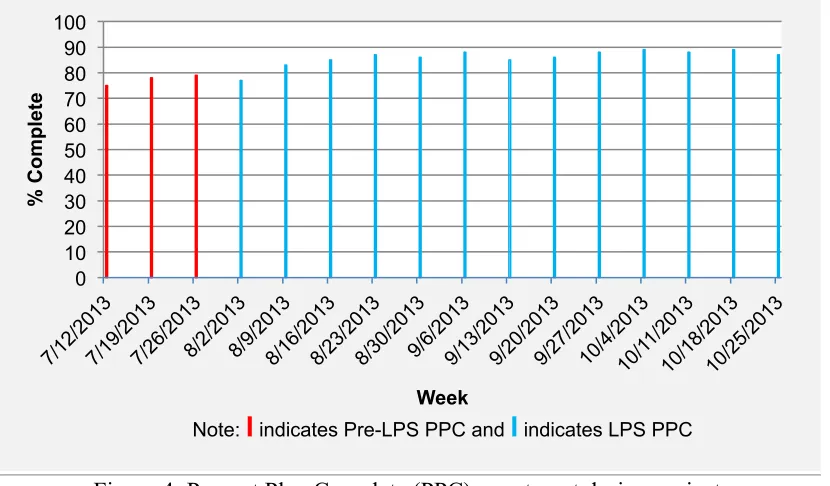
Figure 4: Percent Plan Complete (PPC), apartment design project
CONCLUSIONS
The adoption of a lean technological approach like BIM without an adequate lean managerial approach like LPS to control it can lead to inefficiencies even when the technological approach is effective (Seppänen et al., 2010). The LPS WWPs provided the practitioners in the two building design projects with a systematic process of production planning and control that was focused on improving work flow reliability.
0 10 20 30 40 50 60 70 80 90 100
%
C
o
m
p
le
te
Week
Note:
I
indicates Pre-LPS PPC andI
indicates LPS PPC0 10 20 30 40 50 60 70 80 90 100
%
C
o
m
p
le
te
Week
[image:11.595.95.510.379.622.2]It allowed the last planners (the architects and engineers) to be in position each week to make reliable commitments and keep them. When they were able to do this, workflow became more reliable. With more predictable workflow, the two building design teams were able to make better decisions about resource allocation, scheduling and coordination. The system mandated that every practitioner had a voice with the responsibility to speak up, make and keep promises, and say no when it was required. The main significance of the findings lies in the positive experience the practitioners had with the LPS WWPs. This included recognition of the effect that the system had in encouraging well-informed decisions and negotiations between the practitioners regarding the coordination of tasks.
REFERENCES
Ballard, G. (2000), “The Last Planner System of Production Control,” PhD. Dissertation, Faculty of Engineering, School of Civil Engineering, University of Birmingham, England, UK.
Bhatla, A. and Leite, F. (2012), “Integration Framework of BIM with the Last Planner System,” Proceedings of the 20th Annual Conference of the International Group for Lean Construction, San Diego, California, USA.
Chua, D. and Hossain, A. (2008), “Reduced Duration of the Design Projects with the Concept of Early Estimation of Design Tasks,” Proceedings for the 16th Annual
Conference of the International Group for Lean Construction, Manchester, UK. Hamzeh, F.; Ballard, G.; and Tommelein, I. (2009), “Is the Last Planner System
Applicable To Design? A Case Study,” Proceedings for the 17th Annual Conference of the International Group for Lean Construction, Taipei, Taiwan. Howell, G. (2003), “The Last Planner System: Workflow Management,”
Construction Innovation Forum, Bloomfield Hills, Michigan, USA.
Khanzode et al. (2006), “A Guide to Applying the Principles of Virtual Design & Construction (VDC) to the Lean Project Delivery Process,” CIFE, Stanford University, California, USA.
Sacks, R., Koskela, L., Dave, B., and Owen, R. (2010a), “Interaction of Lean and Building Information Modeling in Construction,” Journal of Construction Engineering and Management, ASCE, 136(9), p. 968-980.
Sacks, R.; Radosavljevic, M.; and Barak, R. (2010b), “Requirements for Building Information Modeling based Lean Production Management Systems for Construction,” Journal of Automation in Construction, Vol. 19, pp. 641- 655. Seppänen, O; Ballard, G.; and Personen, S. (2010), “The Combination of Last
Planner System and Location-Based Management System,” Proceedings IGLC-18, July 2010, Technion, Haifa, Israel.