2016 International Conference on Artificial Intelligence: Techniques and Applications (AITA 2016) ISBN: 978-1-60595-389-2
SAR Automatic Target Recognition Based
on Deep Convolutional Neural Networks
Rong-hui ZHAN
*,
Zhuang-zhuang TIAN, Jie-min HU and Jun ZHANG
Science and Technology on Automatic Target Recognition Laboratory, National University of Defense Technology, Changsha 410073, China
*Corresponding author
Keywords: SAR image recognition, Convolutional neural networks, Deep learning, Error
back-propagation.
Abstract. Deep convolutional neural networks (CNN) have recently proven extremely competitive in challenging visible light image and speech recognition tasks. The goal of the present study is to explore the application of automatically learned convolutional network features to radar target recognition. Specifically, a two-stage convolutional-pooling network architecture is designed and error back-propagation algorithm with momentum acceleration strategy is used to learn the network weights in a supervised fashion. The effectiveness of the proposed method is assessed by SAR image classification tasks on the standard benchmark of MSTAR (Moving and Stationary Target Acquisition and recognition) database. Our experiments show the presented method has achieved encouraging results with a correct recognition rate of 95.64% for three classes of targets and 92.86% for ten classes of targets.
Introduction
Synthetic aperture radar (SAR) is a kind of coherently imaging radar with both high range and azimuth resolutions. Unlike optical sensor which cannot perform well in poor weather conditions, SAR is a kind radar system with all-time and all-weather operating ability, and it has played a great role in military and civil applications, such as reconnaissance, navigation, guidance, remote sensing, and resource exploration etc. With the development of SAR, the technology for images interpretation has become an urgent requirement. Since searching and discriminating targets of interest manually from massive SAR images is a very time-consuming and difficult task, the automatic target recognition (ATR) methods have to be taken into consideration.
However, for the special mechanism of backscatter imaging, the detailed structure of the target in the obtained SAR image will be covered with the speckle noise (resulting from the background), which will inevitably lead to a reduction of image quality. Moreover, SAR image is very sensitive to the variation of target pose, and will vary quickly and abruptly with small change in aspect angles. Therefore, SAR ATR is a challenging task and has become an important research topic for many applications.
Up to now, a variety of SAR ATR methods have been proposed in the literature and these methods are generally implemented via two processing steps, i.e., feature extraction and classification. There are many algorithms for SAR target feature extraction, such as principal component analysis (PCA) [1-3], independent component analysis (ICA) [4-6], Hu invariant moments [7], non-negative matrix factorization (NMF) [8-10] and sparse representation (SR) [11-13], etc. As for the target classification, theoretically any classification algorithms applied to pattern recognition can also be extended to the application of SAR image. The commonly used SAR image classification algorithms include mean square error (MSE) [14], hidden Markov models (HMM) [15], neural network (NN) [16, 17], support vector machine (SVM) [18, 19], Adaboost [20] and so on.
separate treatment of the ATR with feature extraction and classification, the recently developed deep learning architecture [21-23] can automatically learn representations or features from raw data, while jointly performing discrimination to improve the accuracy on different pattern recognition problems. The deep learning models have been receiving increased attention in recent years, and the specific architecture with convolution and pooling (also referred to as deep convolutional neural network, CNN) is found to be highly effective and has been commonly used in computer vision [24-26] and speech recognition [27-28].
In view of the good adaptation of deep CNN to the general problem of pattern recognition, in this paper we propose to introduce the CNN into application of SAR ATR. Specifically, a two-stage convolutional network architecture is designed and used to automatically learn features from SAR images and classify them into different classes. The presented deep learning algorithm is tested on the benchmark MSTAR (moving and stationary target acquisition and recognition) database, and the results show that the new method is effective for SAR image ATR and involves no handcrafted feature extraction step.
Framework of the Deep CNN
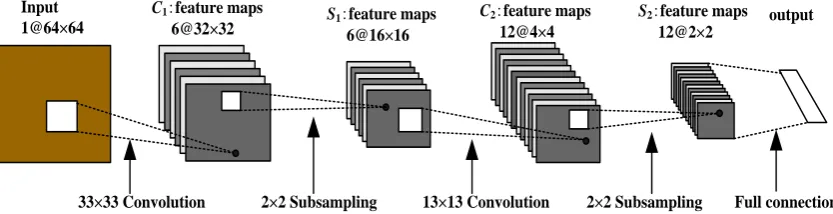
The design of deep neural network architecture in this paper is to achieve high recognition accuracy for the target classification tasks. The overall framework design is illustrated in Fig. 1, where C
represents convolutional layer (also referred to as feature extraction layer). The input of each neuron in C layer is connected with the receptive field of the previous layer and to extract the local feature. There are multiple feature maps in the C layer and each individual feature map represents unique target feature. For each feature map, the network weights are shared by using the same convolutional kernel, and different feature maps have different kernels. Thus, the extracted local features with rotation and shift invariant property are stored in C layer. S represents subsampling layer, where the features extracted from C layer are down-sampled while preserving the scale invariant of the features. In S layer, only the operation of rescale mapping is used, and the number of weights that need to be trained is small, so the computation is quite simple. The last layer of CNN is the fully connected layer, which combines all the pixel units of S2 into a 1D output vector. At the output, each unit of the output vector corresponds to a specific class label.
33×33 Convolution 2×2 Subsampling 13×13 Convolution 2×2 Subsampling Full connection Input
1@64×64
C1:feature maps
6@32×32 S 6@16×161:feature maps
C2:feature maps 12@4×4
S2:feature maps 12@2×2
[image:2.595.83.500.511.618.2]output
Figure 1. The proposed deep convolutional network architecture.
Convolutional Layer
Convolutional neuron layer is the key component of CNN. In image classification task, one or more 2D matrices (or channels) are treated as the input to the convolutional layer and multiple 2D matrices are generated as the output. The number of input and output matrices may be different. The process to compute a single output matrix is defined as:
( ) ( 1) ( ) ( )
, =1
= +
N
l l l l
j i i j j
i
O f I w B
where Ii is the input matrix, l is the index of neuron layers, wi j, is the trainable kernel matrix,
represents convolution operator, Bj is the bias value added to each element of the resulting matrix,
f isthe nonlinear activation function applied to each element of the previous matrix to produce one output matrix Oj.
The most widely used activation functions are sigmoid function ( )=1/(1+f x e-x) and hyperbolic tangent function f x( )=tanh( )x . Both sigmoid and hyperbolic tangent are saturating nonlinear functions that the output gradient drops close to zero as the input increases. In this paper, only the sigmoid function is considered.
Feature Pooling Layer
In the pooling layer, each feature map is treated separately and the operation of pooling plays an important role in CNN for feature dimension reduction. In order to reduce the number of output neurons in the convolutional layer, pooling algorithms include max-pooling and average-pooling. In this paper, the average-pooling algorithm with 2×2 kernel size computes the average values over a neighborhood in each feature map. This results in a reduced-resolution output feature map which is robust to small variations of the features in the previous layer.
Training Using Random Patches
The training method considered here is stochastic gradient descent algorithm, which computes the gradients by the back-propagation method. The details of the procedure are given as follows.
Back-Propagation Details
The main idea of back-propagation algorithm is to iteratively adjust the weights to minimize an error function
2 1
= 2
E d- y
(2) wheredandyrepresent the desired output and the actual output of the network, respectively.
Recall that in (1), each convolutional layer has a number of units (or neurons), each of which takes all outputs of the lower layer as input, multiplies them by network weight, sums the result and passes it through a nonlinear activation function (sigmoid function). For simplicity of notation, this computation can be represented in a more compact vector form as:
( ) ( 1) ( )
= ( w )
l l l
j j j
O f O -
(3) where the bias term is absorbed in the column weight vector by expanding the vector with an extra dimension of 1. Furthermore, all neuron activations in each layer can be represented in the following matrix form:
( ) ( 1) ( )
= ( W ) ( =1,2, , 1)
l l l
O f O - l L- (4)
where ( )
Wl
denotes the weight matrix of the l-th layer, with jth columnw( )jl for anyj.
The first (bottom) layer of the deep CNN is the input layer and the topmost (last) layer is the output layer. For output layer, because no nonlinear function is used, the equation (3) is reduced to
( ) ( 1) ( )
= L = L w L
j j j j
y O O -
minimize the objective function, the weight matrix update for each training sample can be computed as
( ) ( 1) ( )
W =l (Ol )T el ( =1,2,l , )L
-
(6) where is the learning rate, and the error signal vector in the l–th layer ( )l
e is computed backwards
from the sigmoid hidden unit as follows:
( )
= L
e d- y (7)
( ) ( +1) ( +1) T ( ) ( )
=( (W ) ) (1 ) ( = 1, ,2,1)
l l l l l
e e O -O l L- (8)
The overall update equation can now be written as:
( ) ( ) ( )
+1
W =W + Wl l l
t t (9) wheretdenotes the time index of iteration.
Fast Learning Strategy
Strategy for speeding up and stabilizing neural network training are considered in this paper, including batch learning, momentum and weight decay. When batch learning strategy is applied to improve learning speed and accuracy, multiple input samples (5~10 for instance) are formed as a batch to perform one single back propagation update, instead of updating the connection weights using only a single sample for each epoch.
To further speed up the learning, momentum weight updating is applied and the weight increment is now updated by:
( ) ( )
+1 ( )
W = + W
W
l l
t l t
t
E
(10) where E/ W denotes the error gradient with respect to the weight vector, is called the momentum parameter.
The momentum weight update term helps to speed up learning. In this following experiment, we choose the learning rate =0.99, the momentum rate =0.01 for all layers. These learning parameters are selected through experimental tests.
Experiments and Analysis
Dataset Description
The experiment data set was collected by the Sandia National Laboratory (SNL) SAR sensor platform operating at X-band. The collection was jointly sponsored by Defense Advanced Research Projects Agency (DARPA) and Air Force Research Laboratory as part of the Moving and Stationary Target Acquisition and recognition (MSTAR) program [29-30]. The public released datasets include 10 different types of ground military targets (BMP2, BTR70, T72, BTR60, 2S1, BRDM2, D7, T62, ZIL131, ZSU23/4). For each target, images are captured at two different depression angles 15deg and 17deg over all the 360deg aspect angles with 1ft1ft resolution.
Experiment Results
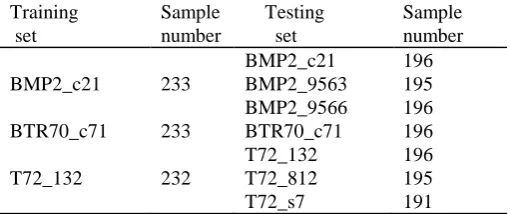
[image:5.595.171.427.158.265.2]The proposed algorithm is tested on two classification experiments. The first one is classifying three classes (i.e., BMP2, BTR70 and T72) of targets from the MSTAR database. The details of training and testing data set are shown in Table 1.
Table 1. Training set and testing samples for three classes of targets.
Training set
Sample number
Testing set
Sample number
BMP2_c21
BTR70_c71
T72_132
233
233
232
BMP2_c21 BMP2_9563 BMP2_9566 BTR70_c71 T72_132 T72_812 T72_s7
196 195 196 196 196 195 191
Since BMP2 and T72 contain three variants, respectively, i.e., BMP2 (sn_9563, sn_9566 and sn_c21), T72 (sn_132, sn_812 and sn_s7), we only select sn_9563, sn_c71 and sn_132 from the target classes of BMP2, BTR70 and T72 as the training set. In the testing set, however, all the three classes of targets including their variants are considered, which means that we have 698 images in the training set and 1365 images in the testing set.
In this paper, the recognition performance is comprehensively measured by probability of correct classification (PCC), average PCC (A-PCC) and over-all PCC (OA-PCC), which are defined as
( ) ( )=
( ) c
t
N k PCC k
N k =1,2,k ,K (11)
1
- = ( )
k
A PCC PCC k
K
(12)( )
- =
( ) c k
t k
N k OA PCC
N k
(13)whereKis the total class number of the target in the testing set,N kt( )andN kc( )represent the total and correctly classified number of sample images of the k-th target class, respectively.
The experiment results are shown in Table 2 and Table 3. For the purpose of performance comparison, the results from two other state-of-the-art methods, i.e., support vector machine classifier (SVM-C) and sparse representation classifier (SR-C), are also given in the tables. It is worth noting that for the classifiers SVM-C and SR-C, the same parameter setup as that in [12] is used in our experiments. For the detailed algorithm implementation of the two classifiers, the reader is referred to reference [12].
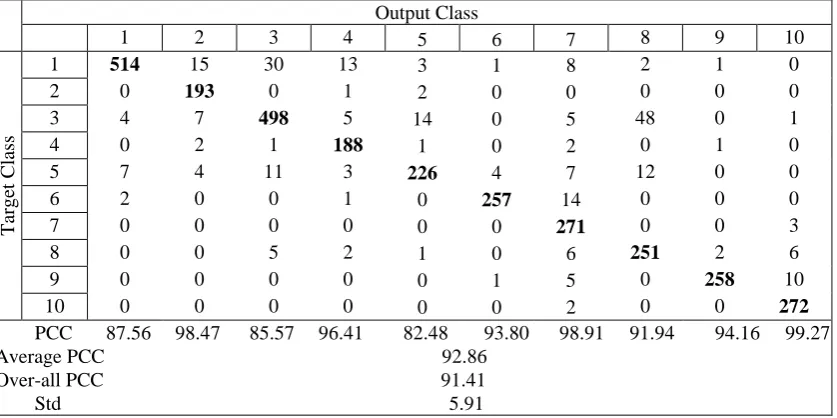
To further test the performance of the recognition methods, ten classes of targets (including the variants) in the MSTAR database are used in the second experiment. The details of training and testing data set are shown in Table 4, and we totally have 2747 training samples and 3203 testing samples.
Table 2. Confusion matrix for the testing set with three classes of targets.
Method Testing image Prediction result
BMP2 BTR70 T72
BMP2 556 11 20
CNN BTR70 0 196 0
T72 44 2 536
BMP2 548 17 22
SR-C BTR70 0 196 0
T72 80 11 491
BMP2 529 15 43
SVM-C BTR70 0 195 1
[image:6.595.170.425.320.469.2]T72 15 9 558
Table 3. Recognition accuracy for three classes of targets (%).
method
SR-C SVM-C CNN
BMP2 93.35 90.11 94.72
Testing classes BTR70 100.0 99.48 100.0
T72 84.36 95.87 92.10
Over-all PCC 90.47 93.92 94.36
Average PCC 92.57 95.15 95.64
Std 7.84 4.27 4.02
Table 4. Training set and testing samples for ten classes of targets.
Class ID Training set Sample number Testing set Sample number 1 2 3 4 5 6 7 8 9 10 BMP2(sn-c9563) BTR70 T72(sn-132) BTR60 2S1 BRDM2 D7 T62 ZIL131 ZSU23/4 233 233 232 256 299 298 299 299 299 299 BMP2(sn-c9563) BMP2(sn-c9565) BMP2(sn-c21) BTR70 T72(sn-132) T72(sn-812) T72(sn-s7) BTR60 2S1 BRDM2 D7 T62 ZIL131 ZSU23/4 195 196 196 196 196 195 191 195 274 274 274 273 274 274
[image:6.595.113.488.491.696.2]Table 5. Confusion matrix and recognition accuracy for CNN method with ten classes of testing targets.
Output Class
1 2 3 4 5 6 7 8 9 10
T
ar
g
et
C
lass
1 514 15 30 13 3 1 8 2 1 0
2 0 193 0 1 2 0 0 0 0 0
3 4 7 498 5 14 0 5 48 0 1
4 0 2 1 188 1 0 2 0 1 0
5 7 4 11 3 226 4 7 12 0 0
6 2 0 0 1 0 257 14 0 0 0
7 0 0 0 0 0 0 271 0 0 3
8 0 0 5 2 1 0 6 251 2 6
9 0 0 0 0 0 1 5 0 258 10
10 0 0 0 0 0 0 2 0 0 272
PCC 87.56 98.47 85.57 96.41 82.48 93.80 98.91 91.94 94.16 99.27 Average PCC 92.86
Over-all PCC 91.41 Std 5.91
Conclusion
In this paper, we have proposed to extend the deep CNN to the application of radar target recognition. Specifically, an effective network architecture with two-stage convolutional kernel and average-pooling strategy is designed to automatically learn the useful features from SAR images. The proposed CNN is tested on the MSTAR dataset, and an average PCC of 95.64% and 92.86% are achieved on the classification task for three and ten classes of targets with variants, respectively. The experiment results indicate the great potential of the CNN in the target recognition of SAR image. For the future work, the proposed method will be further extended to multi-view SAR ATR application.
Acknowledgement
The research work was financially supported by the National Natural Science Foundation of China under grant No.61471370 and No.61401479.
References
[1]V.V. Chamundeeswari, D. Singh, K. Singh, An analysis of texture measures in PCA-based unsupervised classification of SAR images, IEEE Geoscience and Remote Sensing Letters. 6 (2009) 214–218.
[2]L.P. Hu, X.Y. Xing, SAR target feature extraction and recognition based multilinear principal component analysis, Proceedings of SPIE. 9301 (2014) 93010L-1–93010L-6.
[3]X.G. Lu, P. Han, R.B. Wu, Two-dimensional PCA for SAR automatic target recognition, Proceedings of the 1st Asian and Pacific Conference on Synthetic Aperture Radar (2007) 513-516.
[4]H. Wang, Y. Pi, G. Liu, et al, Application of ICA for the enhancement and classification of polarimetric SAR images, Journal of Remote Sensing. 29 (2008) 1649-1663.
[5]J. Ji, Robust approach to independent component analysis for SAR image analysis, IET Image Processing. 6 (2012) 284-291.
[7]Y. Fu, M. Wang, C.Q. Zhang, SAR image target recognition based on Hu invariant moments and SVM, Proceedings of 2009 Fifth International Conference on Information Assurance and Security (2009) 585-588.
[8]R.H. Huan, Y. Pan, K.J. Mao, SAR image target recognition based on NMF feature extraction and Bayesian decision fusion, Proceedings of 2010 Second IITA International Conference on Geoscience and Remote Sensing (2010) 496-499.
[9]R. Vahid, S. Umamahesh, M. Vishal, SAR automatic target recognition via non-negative matrix approximations, Proceedings of SPIE. 8391 (2012) 83910M-2–83910M-6.
[10]Z.Y. Cui, Z.J. Cao, J.Y. Yang, et al, SAR target recognition using nonnegative matrix factorization with L1/2 Constraint, Proceeding of 2014 IEEE Radar Conference (2014) 382-386.
[11]J. Thiagarajan, K. Ramamurthy, P. Knee, Sparse representation for automatic target classification in SAR images, Proceeding of International Symposium on Communication, Control and Signal Processing (2010) 1-4.
[12]H.C. Liu, S.T. Li, Decision fusion of sparse representation and support vector machine for SAR image target recognition, Neurocomputing. 113 (2013) 97-104.
[13]G.G. Dong, N. Wang, G.Y. Kuang, Sparse representation of monogenic signal: with application to target recognition in SAR images, IEEE Signal Processing Letters. 21 (2014) 952-956.
[14]L.M. Novak, G.J. Owirak, W.W. Irving, Performance of 10-and 20-target MSE classifiers, IEEE Transactions on Aerospace and Electronic System. 36 (2000) 1279-1289.
[15]N. Chanin, H.P. Quoc, M.M. Russell, et al, Hidden Markov modelling for SAR automatic target recognition, Proceedings of 1998 IEEE International Conference on Acoustics, Speech and Signal Processing. 2 (1998) 1061-1064.
[16]P. Han, S. Gao, Automatic target recognition of SAR images based on the fuzzy neural networks, Proceedings of 2010 2nd IEEE International Conference on Information Management and Engineering (2010) 102-104.
[17]Y.C. Tzeng, K.S. Chen, A fuzzy neural network to SAR image classification, IEEE Transactions on Geoscience and Remote Sensing. 36 (1998) 301-307.
[18]T. Wu, X. Chen, X.W. Ruang, et al, Study on SAR target recognition based on support vector machine, Proceedings of 2009 2nd Asian-Pacific Conference on Synthetic Aperture Radar (2009) 856-859.
[19]Q. Zhao, J.C. Principe, Support vector machine for SAR automatic target recognition, IEEE Transactions on Aerospace and Electronic Systems. 37 (2001) 643-654.
[20]K. Chen, Y.H. Li, X.J. Xu, et al, A modified AdaBoost algorithm with new discrimination features for high-resolution SAR targets recognition, IEICE Transactions on Information & Systems. E98-D (2015) 1871-1874.
[21]G. Hinton, R. Salakhutdinov, Reducing the dimensionality of data with neural networks, Science. 313 ( 2006) 504-507.
[22]L. Martin, K. Lars, L. Amy, A review of unsupervised feature learning and deep learning for time-series modeling, Pattern Recognition Letters. 42 (2014) 11-24.
[23]J. Schmidhuber, Deep learning in neural networks: an overview, Neural Networks. 61 (2015) 85-117.
[25]Y. Dong, Y. Wu, Adaptive cascade deep convolutional neural networks for face alignment, Computer Standards & Interfaces. 42 (2015) 105-112.
[26]A. Krizhevsky, I. Sutskever, G.E. Hinton, Imagenet classification with deep convolutional neural networks, Advances in Neural Information Processing Systems (2012) 1097-1105.
[27]G. Hinton, L. Deng, D. Yu, et al, Deep neural networks for acoustic modeling in speech recognition: the shared views of four research groups, IEEE Signal Processing Magazine. 29 (2012) 82-97.
[28]N.S. Tara, K. Brian, S. George, et al, Deep convolutional neural networks for large-scale speech tasks, Neural Networks. 64 (2015) 39-48.
[29]J.C. Mossing, T.D. Ross, An evaluation of SAR ATR algorithm performance sensitivity to MSTAR extended operating conditions, Proceeding of SPIE. 3370 (1998) 554-565.