2016 International Congress on Computation Algorithms in Engineering (ICCAE 2016) ISBN: 978-1-60595-386-1
1 INTRODUCTION
As a basic part of the quality-oriented education of college students, English teaching plays a very im-portant role in the student growth and future work. The demonstration and research results of English teaching are quite good. In the Application of Analytic Hierarchy Process in the Classroom Teaching Evalu-ation of College English, Han Hui established a framework for teaching practice. The article which links up with the students and teachers through quan-titative indices scientifically evaluates the teacher’s teaching quality. In the Research of Establishment of English Evaluation Index Weight based on AHP, Li Ying, et al. introduced the fuzzy comprehensive eval-uation into the evaleval-uation system, and the evaleval-uation criterion which is combined with the AHP algorithm is more scientific [1]. English teaching is a practical behavior with multi-process integration under a com-plex background. The teacher is a teaching subject, while the student is a receiving object. In recent years, there are many research results related to the evalua-tion of the teacher’s teaching quality, and it also has a good application in practice [2]. In the evaluation of the English learning effect of the students, College Eng-lish Test-4 and College EngEng-lish Test-6 possess a very important position. In the Exploration of Optimal Weight of Question Types of College English Test-4by AHP, Xu Yueting built a weight redistribution model
of the question types by AHP algorithm in an empiri-cal way, so as to provide a referable theoretiempiri-cal basis and practical framework for the relevant departments to be more reasonable to evaluate the student achievement. Thus, AHP algorithm has a wide appli-cation in the field of eduappli-cation, which can provide a theoretical basis for quantitative analysis on the spo-ken language, bilingual education, textbook rating and other qualitative problems, so the problems which are unable to be quantized in the education can be quan-tized and unified by the mathematical models [3]. In recent years, with the improvement of the degree of internationalization, the foreign teacher working in colleges and universities has become a trend. This way can improve the students’ oral proficiency and foreign cultural level. With the emergence of more and more foreign teachers and foreign language organizations, its quality varies greatly. How to rate and classify is a problem to be urgently solved by the scientific re-searchers and teachers and relevant governmental departments. AHP algorithm can be regarded as a mature and stable algorithm, but the ambiguity of its evaluation index is often criticized by people, and the construction of relevant models is lack of flexibility, even unable to build models. In the Research of Im-provement of AHP-BP Neural Network Algo-rithm—Taking the Evaluation of Circular Economy of the Construction Enterprise as an Example, Cheng Bo proposed an optimal thought through combination of
AHP Algorithm Model and Applied Research of English Teaching
Nan Xu
Department of Basic Courses, Henan Quality Polytechnic, Pingdingshan, Henan, China
ABSTRACT: In English teaching, as a teaching subject, the teacher has an essential impact on the quality of students’ performance. With the deepening of the internationalization, the introduction of foreign teachers plays an important role in the improvement of the quality-oriented college English education. How to evaluate the for-eign teachers to bring in excellent talents is to be solved urgently. This paper rates and ranks the factors affecting the foreign teachers rating through AHP algorithm, so as to propose the theoretical support for the establishment of the rating model. And then it carries out nonlinear fitting through the neural network and adopts the ability to strengthen classification to build an evaluation model with the robustness and fairness, so as to provide credible and reasonable models for the introduction of foreign teachers rating by relevant departments.
the neural network and AHP algorithm, and he con-structed a good classifier. [4] Through the construction of the teaching evaluation model of foreign college teachers based on AHP algorithm, this paper carries out nonlinear fitting through the neural network and adopts the strong approximation ability of the network to build an evaluation model with the robustness and fairness.
2 MODELING
2.1 AHP algorithm
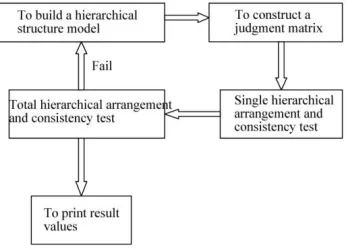
AHP can be a good support for the decision of qualita-tive fuzzy issues. It has a particularly prominent effi-ciency in solving the problem of failure in decoupling for variables coupling. And its modeling is divided into four steps, as shown in flowchart 1.
[image:2.516.67.243.329.454.2]To apply this method to construct a program to solve problems, there is a need to first systematically and hierarchically analyze information to build a prac-tical and effective model, and then decompose the problems and carry out criterion judgment according to the logical framework and dominance relation be-tween the hierarchies.
Figure 1. AHP algorithm flowchart.
To construct a judgment matrix of AHP is a basis for solving the incidence relations between various elements. The judgment of the numerical values of the matrix elements reflects relatively important relations between influencing factors. To determine the weight relations between various indices, there is a need to establish the appropriate judgment matrix between layers. According to the three-scale judgment method, the judgment matrix of the element relations is con-structed as follows.
Three-scale comparison matrix
n )
(
aij n
A : ij
i element is more important than j element
i element is equally important to j element i element is less important than j element 2
a = 1 0
In addition, aij1, that is, the comparative result of
the elements is 1. Then, a sum of each line’s elements of the three-scale comparison matrix is:
n j ij i a r 1;i=1,2,3,…,
n
(1)Find out the maximum value (rmax) and minimum
value (rmin) of the sum of elements, so as to obtain
the comparison elements of the base point of the ma-trix corresponding to rmaxandrmin. And then
respec-tively compare the corresponding comparison ele-ments of the base point in the matrix according to criteria scales from 1 to 3, so as to obtain that the rela-tive importance degree of the comparison elements of the base point of the matrix is bm. bm is a
compari-son scale of the base point elements. The direct com-parison matrix is converted to the indirect judgment matrix through the mathematical changes. And the changing method is shown as follows:
0 1 1 1 0 1 1 min max min max j i m i j j i m j i
ij r r
b r r r r r r b r r r r d
Indirect judgment matrix obtained has the following properties: 1 1 1 1 1 ij m ij ij ij m d b d d d b
That is, the numerical range of
ij
d
is the scale ofm b 1 : ji ij d
d 1
That is, the indirect matrix after the change still has a reciprocal property between the symmetrical ele-ments of the matrix:
3 m
b , which means three scales.
This paper adopts the square root method to solve the problems of ranking weights of
n
elements (n
A A
A1, 2,..., ) in multi-index and obtains the judgment matrix
A
. After solving, the characteristic root of the judgment matrix (A
) isAWmaxW. The characteristic root (W) obtained can be as the ranking weight of the elements (n
A A
A1, 2,..., ) in the index
k
C after normalization. According to the equations,
max
1
max
n n CI
When
CI
0
, that is,
max n, the judgment matrix is identical, so it is called as a complete con-sistency; whenCI
0
, the value of CI is compared with the random indexRI
.When the random consistency ratio is: 1
. 0 / CI RI CR
The matrix has a better consistency. When the random consistency ratio is:
1
.
0
/
CI
RI
CR
The matrix does not have a good consistency. Then the judgment matrix is modified until it has a good consistency.
For the matrix which is at the order from 1 to 10, the consistency indices of the judgment matrix are shown in Table 1.
2.2 Neural network algorithm
BP neural network is a multilayer feedforward bionic algorithm. This algorithm mainly has two features. The first feature is the forward transmission of infor-mation, and the second feature is the back propagation of error. There is no interaction between neurons, and the numerical change has an inherited effect, which is recycled until achieving the desired error, so as to train a matrix with a proportion range that is in line with the expectations [5].
Back propagation of the neural network is essen-tially the nonlinear function, of which the independent variable is an input value of the network, and the de-pendent variable is an output value of the network, thus constructing a function relationship between n dimension and m dimension.
The training network can make data standard and network intelligent [6]. The training steps are as fol-lows:
First step: initialization of the network. Determine the number of nodes at the typing layer (
n
), the number of nodes at the hidden layer (l) and the num-ber of nodes at the printing layer (m) according to the typing and printing matrix(
X,
Y
)
. Then initialize the connected proportion (ijandjk) between theneu-rons at the typing layer and at the printing layer, the range at the hidden layer (
a
) and the printing layer (b
), and preset the acquired rate and agitation func-tion.Second step: output at the hidden layer. Determine
the number of nodes at the printing layer (
n
) accord-ing to the matrix XandY, the connected proportion at the hidden layer (ij) and the range (a
), thuscal-culating the output at the hidden layer (H):
) (
1
n
i
j i ij
j f x a
H
j
1
,
2
,
,
l
(2)In Formula (2),
l
is the number of nodes at the hidden layer;f
is an agitation function.Third step: output at the print layer. Calculate the predicted output of the bionic algorithm (O) by the
output at the hidden layer (H), the connected propor-tion (
jk) and the range (b):
l j jk k
k H b
O
1
k1,2,,m (3)
Fourth step: error calculation. Calculate the predic-tion error (
e
) according to the print obtained by pre-diction (O) and expected print (Y):k k
k
Y
O
e
k
1
,
2
,
,
m
(4)Fifth step: update of proportion. Update the con-nected proportion of the algorithm (
w
ijandw
jk) according to the prediction error (e
):
m
k k jk j
j ij
ij w H H xi w e
w
1
) ( ) 1 (
n
j1,2,,
j
1
,
2
,
,
l
(5)In Formula (5), is the learning rate.
Sixth step: update of range. Update the range (a,b) according to the prediction error of the algorithm (
e
):
m
k k jk j j
j H H w e
a
1
j (1 )
a j1,2,,l
k k
k
b
e
b
k1,2,l (6)Seventh step: determine whether it is the end. Re-turn to the second step if it not reaches the standard.
3 MODEL SOLVING
There are many factors affecting the students achievement in the process of foreign teacher’s teach-ing, which are coupled to each other. It is unable to
Table 1. Consistency indices of the judgment matrix at the order from 1 to 10.
Order 1 2 3 4 5 6 7 8 9 10
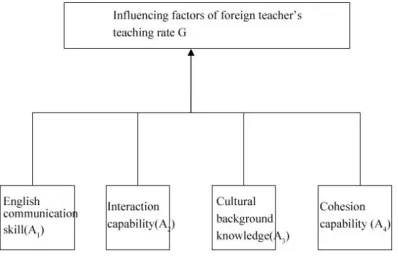
give a quantitative description through the analytic formula, but its evaluation index can be sampled by constructing questionnaires, and the physical and chemical analysis can be done by data set. The influ-encing factors of the foreign teacher’s teaching rate is evaluated and ranked based on the statistical data, so as to confirm ranking models of the influencing fac-tors of teaching. Later, the index of the neural network is built as an input matrix, and rating as an output variable, so as to fit an evaluation model by nonlinear fitting. AHP diagram is shown in Figure 2:
Figure 2. AHP diagram.
The influencing factors of the foreign teacher’s teaching are decomposed into a variety of impact ele-ments. These elements constitute an objective level with different hierarchical relationships based on the English communication skill, interaction capability, and cultural background knowledge and cohesion capability. They also construct an associated mem-bership relation between each influencing factor and general objective. And the statistical data is used to build the judgment matrix, as shown in Table 2.
Table 2. Judgment matrix.
G A1 A2 A3 A4
A1 2 0 0 0
A2 1 2 0 0
A3 1 3 2 0
A4 1 1 1 3
To solve the three-scale judgment matrix of A1, A2, A3 and A4 which is constructed with respect toG, the steps are as follows:
Obtained from Table 2, rmax=7, rmin=1 and bm=6.
And the indirect judgment matrix of the evaluation model of the three-scale judgment matrix is shown as follows:
1 3 8 3 13 6
8 3 1 3 8 3 13
13 3 8 3 1 3
8 6
1 13 3 8 3 1
A
Calculated from Table 2, the maximum eigenvalue
4.2430, and its weight vector isT
w(0.0835,0.1646,0.3879,0.3640) . 4
2430 . 4
max
, so the consistency test is
given to the eigenvalue:
0291 . 0 1
max
n n CI
, 91 . 0 RI
, 10 . 0 0562 .
0
RI CI
CR indicating that Table 2
can pass the consistency test so that the ranking weight of A1, A2, A3 and A4 with respect to G is
T3700 . 0 , 2246 . 0 , 2419 . 0 , 1635 .
0 . And its results are
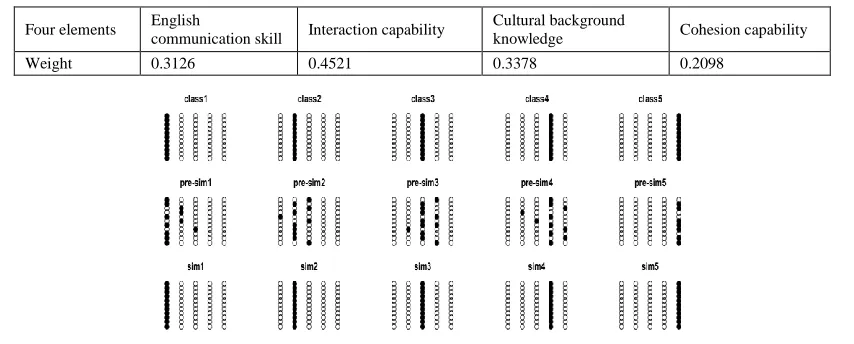
shown as Table 3.
The elements are measured by AHP. The final re-sult is that three factors—interaction capability, Eng-lish communication skill and cultural background knowledge have the largest impact on the teacher’ rating. AHP algorithm can make a quantitative analy-sis of the fuzzy issues, thus quantifying issues. How-ever, the construction of the model can be achieved by the algorithm with a good generalization ability and strong robustness. This paper builds a foreign teach-er’s rating model of the neural network for nonlinear approximation based on the evaluation results of AHP algorithm.
Supposing that the interaction capability, English communication skill and cultural background knowledge are three input variables, the output varia-ble is set as a vector sequence {1, 2, 3, 4, 5} as the rating result, and the number of neurons in the inter-mediate layer is set as 9. The number in the sequence represents the rating results. After network training, the final rating results are shown in Figure 3.
The second line is the original data of prediction. It is observed that the rating matrix is sparse and scat-tered, but the neural network excavates the rules through its powerful nonlinear approximation ability, thus implementing the correct rating.
4 CONCLUSION
[image:4.516.53.251.462.513.2]REFERENCES
[1] David J. Wilkerson, Richard P. Manatt, Mary Ann
Rog-ers & Ron Maughan. 2000. Validation of Student, Prin-cipal, and Self-Ratings in 360° Feedback® for Teacher
Evaluation. Journal of Personnel Evaluation in
Educa-tion. (2).
[2] Ashwell T. 2000. Patterns of teacher response to student
writing in a multiple-draft composition classroom: Is content feedback followed by form feedback the best
method? Journal of Second Language Writing.
[3] Viviana. C. 2006. Teaching Lexical Bundles in the
dis-ciplines: An Example from a Writing Intensive History
Class. Linguistics and Education.
[4] Kyoung-jae Kim, & Hyunchul Ahn. 2012. Simultaneous
optimization of artificial neural networks for financial forecasting. Applied Intelligence, (4).
[5] Leon O Chua & Lin Yang. 1988. Celluar Neural
Net-works: Theory. IEEE Transactions on Circuits and
[image:5.516.47.474.66.238.2]Sys-tems.
Table 3. Weighting coefficient vector of safety assessment solved by four ways.
Four elements English
communication skill Interaction capability
Cultural background
knowledge Cohesion capability
Weight 0.3126 0.4521 0.3378 0.2098