University of Huddersfield Repository
Bonner, John V.H.
Physicality from the sidelines: potential hurdles and solutions in the development of novel
interaction styles
Original Citation
Bonner, John V.H. (2006) Physicality from the sidelines: potential hurdles and solutions in the
development of novel interaction styles. In: Physicality 2006: First International Workshop on
Physicality: Position Papers. University of Lancaster, pp. 1112. ISBN 9781862201781
This version is available at http://eprints.hud.ac.uk/id/eprint/4324/
The University Repository is a digital collection of the research output of the
University, available on Open Access. Copyright and Moral Rights for the items
on this site are retained by the individual author and/or other copyright owners.
Users may access full items free of charge; copies of full text items generally
can be reproduced, displayed or performed and given to third parties in any
format or medium for personal research or study, educational or notforprofit
purposes without prior permission or charge, provided:
•
The authors, title and full bibliographic details is credited in any copy;
•
A hyperlink and/or URL is included for the original metadata page; and
•
The content is not changed in any way.
For more information, including our policy and submission procedure, please
contact the Repository Team at: [email protected].
Table of Contents
PREFACE
First Steps in Physicality………...
Alan Dix (Lancaster University)
ii
Interacting with Material Form
Making the Digital Palpable………...
Monika Büscher (Lancaster University)
Noncommand-based Interaction in Tangible Virtual Environments………...
Johann Habakuk Israel (Fraunhofer Institute)
Building Bowls for Miscellaneous Media………...
Alex Taylor, Shahram Izadi (Microsoft Research Cambridge)
Laurel Swan (Brunel University)
Richard Harper, Bill Buxton (Microsoft Research Cambridge)
Physicality from the Sidelines: Potential Hurdles and Solutions in the Development of
Novel Interaction Styles...………...
John Bonner (Huddersfield University)
1
3
7
11
Ecological and Configurations of Physical Space and
Objects
Physicality, Spatial Configuration and Computational Objects………
Stuart Reeves (Nottingham University)
Work Practice between the Real and the Really Made Up………
Lars Rune Christensen (IT-University of Copenhagen)
Physicality in Tangible Interaction: Bodies and the World...
Eva Hornecker (University of Sussex)
13
16
21
The Physical Human Body
Beyond Physicality: Towards a Phenomenological Approach in the Design of Embodied
Interactions………...
Manuela Jungmann (University of Sussex)
Music, Physicality and the Physiology of Listeners………..
Johan Fagerlönn & Nyssim Lefford (Interactive Institute, Sonic Studio)
26
29
Physical Interaction Style
Interaction with the Physical Aspects of Visual Displays...
Holger Schnädelbach (University of Nottingham)
Physicality and Something Else It's Associated with………...
Masitah Ghazali (Lancaster University)
32
35
Physical-Digital Information Seeking
Information Seeking in the Humanities: Physicality and Digitality………..
Jon Rimmer, Claire Warwick (School of Library, Archive & Info. Studies, UCL)
Ann Blandford, Jeremy Gow (Interaction Centre, UCL)
George Buchanan (University of Wales)
Understanding Physicality on Desktop: Preliminary Results………
Azrina Kamaruddin, Alan Dix (Lancaster University)
37
PREFACE
First Steps in Physicality
Alan Dix
Computing Department, InfoLab21
Lancaster University, Lancaster, LA1 4YR
http://www.hcibook.com/alan/papers/physicality2006-preface/
ABSTRACT
This preface to the Proceedings of Physicality 2006 describes some of the work at Lancaster and in the Equator project that were the initial inspiration for this workshop. We wish to understand physicality both because it is interesting in its own right and also because the understanding can help us design novel digital and hybrid digital–physical artefacts. Our own existing work is used to propose some initial properties and issues of physicality including rules of 'natural' interaction, issues of 'it-ness' and continuity in time and space, the physicality and instrumentation of the human body and issues of embodiment and spatiality.
Author Keywords
Physicality, spatiality, user-interface design, tangible computing, physiological sensing
LOCAL ORIGINS
This workshop stemmed from a growing recognition that issues of the nature of physicality were emerging in several aspects of our research work here at Lancaster and also as part of the inter-disciplinary, multi-site Equator project.
This theme, in different aspects, is very clear in the work of the organisers. Eva Hornecker has worked alongside and studied people in several institutions who are deeply involved in the design of tangible interaction, where the importance of physicality is explicit, even if its precise nature is seldom articulated [9]. Devina Ramduny and I have studied the importance of physical artefacts in work environments (evident in virtually all ethnographic accounts), and more particularly the computational role of those artefacts in socio-technical systems and how studying artefacts and their disposition in the office ecology exposes tacit and often hidden work processes [10]. In Masitah Ghazali's work, perhaps even more explicitly, the precise nature of physicality has been critical in making sense of the way in which the fine details of physical design in day-to-day consumer products enables fluid interaction [6].
In addition, Nicolas Villar et al's work on Pin and Play emphasises the role of spatial arrangement and this is beginning to be teased out in more theoretical accounts of the role of spatiality [13]. Jennifer Sheridan's studies of technological interventions in artistic performance, with myself and colleagues at Nottingham, has again surfaced critical aspects of 'normal' physicality and how these have been systematically broken or bent over many years, for example the way in which limelight creates visual asymmetry between audience and player [1].
The papers in the workshop touch on some of the themes emerging above, but also other aspects such as the physicality of the body and the importance of physicality within the design process.
DEEPER UNDERSTANDING
The workshop brought together a multi-disciplinary group of researchers and designers, whose work, in various ways, relates to physicality. However, the primary goal of the workshop was to start to dig more deeply into the nature of physicality itself. What is it about physical things that we take for granted but perhaps makes them easy to grasp mentally and hence becomes problematic in digital environments? What aspects of physicality by being broken or bent in digital environments are thus surfaced, problematised and become things we can consider and reflect upon?
The first of these questions is clearly moot for many involved in this workshop. The second is perhaps more philosophical, and not one we would expect to answer in two days! Indeed, over the years, when discussing with philosophers the issue of "it-ness" (what it is about a thing that makes it an 'it' before 'it' is a something), I have found it interesting that they repeatedly refer back to the singular spatial and temporal nature of objects, qualities that are not necessarily essential to computational artefacts.
So, to seed discussion, here are a few properties of physicality to be challenged, enriched, rejected or added to.
THREE RULES TO BE BROKEN
Some years ago, in teaching a software engineering course, I tried to characterise what it was that made software engineering more difficult than many areas of more physical engineering. I listed three properties of 'ordinary' physical things – that is inanimate, non-mechanical, 'natural' things like rocks.
directness of effort You push a little, things move a little, you push a lot, things move a lot.
locality of effort Things happen here and now. If you push something it moves at the moment you push it, not earlier or later. If you push in space, not touching an object, it does not move!
visibility of state Whilst the more static appearance of an object may be complex, its dynamic state is defined largely by immediately apparent properties such as location, orientation, and (albeit harder to apprehend) speed and direction of movement and rotation.
These properties are systematically violated by computational artefacts. Take a mobile phone:
directness of effort – violated You press a single digit wrong, and end up dialling Brisbane rather than Blackburn.
locality of effort – violated Looking at spatial directness – the whole purpose of the phone is to talk to someone far away! Temporally as well: voice mail, alarms, waiting for a connection – all are non-local.
visibility of state – violated Hidden within the phone you have a large address book, old text messages and personal settings. Moreover the phone appears to be the repository of distant information and is influenced by invisible, almost magical, electromagnetic fields as you waft the phone near a window seeking signal.
The mention of magic in the last of these is not inconsequential; the violation of these principles often leads to magical explanations, either explicitly or implicitly, in people's understanding of phenomena. Imagine you put a glass down near the edge of a table, then as you turn your back the glass topples and crashes to the floor; it is hard to shake off that momentary chill down the spine even when you realise it has simply overbalanced.
Understanding these properties helps us realise why the design of software (or for that matter complex chemical plants, telecoms networks, and clockwork mice) is difficult. And from understanding comes better design. Many years ago, Harold Thimbleby included proportionality of effort among his GUEPS (generative usability design principles) [12], and in Masitah Ghazali's work the 'three properties', and others derived from and related to them, have been central.
Pinning down these properties is itself difficult; however even more problematically Masitah and others have been trying to experimentally 'test' the effects of some of them in interfaces – but we find it is quite hard to violate single properties without breaking many. Interestingly, we found similar difficulties 'testing' GUEPS back in the 1980s!
IT-NESS AND CONTINUITY OF IDENTITY
As noted, I have often found that philosophers refer back to the singularity of location in space at a given time in their explanations of the most fundamental aspects of thing-ness. Whilst the previous three properties were explicitly about inanimate things (kick a dog now and it may bite you in 5 seconds time), the more fundamental continuity in time and space is true also of animate things. In magical worlds this may not be the same. Hermione is able to study so many subjects at Hogwarts because she travels back and forth in time and is able to be in two places simultaneously [11]. The Frog Prince is continuous in time and space, but fundamentally changes what it/he is as frog becomes prince.
Digital objects (whilst usually not enabling time travel) also violate this fundamental spatio-temporal continuity. When I copy the file containing this paper I suddenly have two copies of 'the same' document. And whilst these are arguably different due to their different file names, the same could not be said for information stored redundantly on a RAID disk. Variables continually change their values. of course, but this could be argued to be like me changing the smile on my face; however, in the Smalltalk programming environment you can say that an object, like the Frog Prince, 'becomes' another of a completely different kind and type.
the directory listing, the file appears to be a peta-byte in extent – far bigger than your hard disk drive. In fact the intermediate data is not explicitly stored anywhere as it is 'known' to be zero (the initialised value) and is only 'called into existence' if you subsequently attempt to read the file. (This is a sure way to frighten your system administrator!)
THE BODY
From earlier more 'inside-to-outside' Cartesian conceptions of cognition, there has developed, over a number of years, an increasing acceptance of the importance of physical embodiment for cognition and even selfhood. This is explicit in frameworks such as distributed cognition [8], where the role of physical artefacts and multiple actors is seen as essential for 'cognition' to occur – thinking as transactional with and within the world, as opposed to disembodied then acted out – imposed upon the world. This has also been central to the conceptions of the computational role of artefacts that Devina, Julie Wilkinson and I developed in the "socio-organisational Church–Turing hypothesis" [4].
Looking more fundamentally at 'the body' itself, Damasio locates consciousness effectively in our brain's self-image of our physical body [3]. Personally I have tended to look slightly more broadly to self-consciousness emerging as an 'accident' of third-order model of mind. In order to understand you I 'construct' a model of your intentions. Because I do this, I may either directly apply the same process to myself (as an 'other'), or more indirectly construct myself as an intentional being in order to understand myself in your eyes … the first party 'I' developing from the third party 'me'. Others place consciousness in a neurological short-cut between mouth and ear, a silent narrative about oneself to oneself [2].
All of these are deeply embodied views where internal self-hood is intimately derived from or tied to external body-hood.
At a physiological level our bodies have an odd role of being both our own and yet also to some extent 'other': 'my' stomach does not always digest at 'my' will. One of the roles that physiological computing has played is in exposing aspects of users' bodily and mental functioning and making these explicit and apparent to 'their' mind. Alternatively, we may keep these 'secret' from the user, creating systems that respond to unconscious (but not necessarily unfelt) signs and signals. For example, Kiel Gilleade and others have worked on physiological sensing to influence computer game play – the body becomes sucked into the digital environment [7].
Strangely, the physical world does not always match our 'natural' understandings of physicality. The early twentieth century saw a series of discoveries, in particular quantum mechanics and relativity, that fundamentally challenged our understandings of the world and led to paradigm shifts of science, and to some extent broader public conceptions.
Perhaps even more strangely, our bodies also exhibit this relativity as nerve signals take a short but appreciable time to travel from eye to brain to hand … not massively different to the fastest Internet packets travelling from end to end of the earth. In computing terms our body is a distributed system; the 'now' we experience is spread over approximately a second and the apparent continuity of movement as we trace our finger across a frosty window pane is, Zeno-like, composed of a series of more discrete commands from central control and observations from field units at a leisurely 5–10 Hz pace.
EMBODIED COMPUTATION AND SPATIALITY
It is a truism (but also a potential fallacy) that computation and information are always physical: electrons speeding along copper tracks and through silicon junctions, magnetic regions polarising, even ink on paper.
Just as the embodiedness of the human body is critical to understanding cognition, physical embodiment reminds us of crucial features of computation; for example, that you can only perform finite computation in finite time and space and that memory 'space' consumes physical space (a peta-byte is currently the size of a collection of large filing cabinets!). The simple Turing Machine, whilst being a conceptual computation engine, apparently moves a tape through itself, or possibly, as a real 'touring' machine, drives along the tape, finding memory externally represented outside of the core (and finite) engine itself.
However, this truism of embodiment is also misleading, as there is a difference between computation and computer, between word and page. Whilst the representatum† is physical the idea of the information is not. As highlighted by the word and page, this is not a new thing but has been a feature of literary works, and, before that, ideas and classes from times when silicon was still simply sand. Indeed the ontological status of ideas has been a difficult and contested topic within philosophy from at least Plato onwards.
†
So far I have only mentioned space briefly in passing, but clearly spatiality is a crucial aspect of physicality. In my previous writing about the development of ideas, expressed most recently in a keynote and chapter for the 2004 Space and Spatiality workshop at Napier, the relationship between spatial thinking and words and that of ideas and concepts has been central [5]. In particular, in the understanding of issues such as transarticulation – the way words form meanings – there are strong parallels between our partially imposed and partially determined namings and understandings of the physical landscape and the parallel namings and understandings of the intellectual landscape.
The physicality of representata, whether paper, silicon or neuron, does not determine but does shape the information, computation, and ideas that flow over and through them: linear narrative, planar graphs and patterns of thinking influenced by our physical existence.
ACKNOWLEDGEMENTS
This paper is drawing on the work of my fellow workshop co-organisers: Masitah Ghazali, Eva Hornecker and Devina Ramduny-Ellis as well as other colleagues at Lancaster and in Equator.
In addition, the Equator project (www.equator.ac.uk) sponsored this workshop and has supported my own work and much of the work referenced here.
REFERENCES
1. Benford, S., Crabtree, A., Reeves, S., Sheridan, J., Dix, A., Flintham, M., and Drozd, A. (2006). Designing for the opportunities and risks of staging digital experiences in public settings. In Proceedings of CHI '06. ACM Press, pp. 427– 436.
2. Bownds, M.D. (1999). Biology of Mind, Fitzgerald Science Press. (Page 94&95, discussion of Daniel Dennett's ideas)
3. Damasio, A. (1994). Descartes' Error: Emotion, Reason, and the Human Brain, Avon Books.
4. Dix, A., Wilkinson, J. and Ramduny, D. (1998). Redefining Organisational Memory - artefacts, and the distribution and coordination of work. in Workshop on Understanding Work and Designing Artefacts, York, 21st September 1998. http://www.hiraeth.com/alan/papers/artefacts98/
5. Dix, A. (2004). Paths and Patches - patterns of geognosy and gnosis. Keynote at Second Workshop on Spaces, Spatiality and Technology Napier University, Edinburgh, 13-14 December 2004. http://www.hcibook.com/alan/papers/space2-2004/
6. Ghazali, M. and Dix, A. (2005). Knowledge of Today for the Design of Tomorrow. in Proceedings of the 2nd International Design and Engagibility Conference (IDEC) 2005, Edinburgh, 6th September 2005
7. Gilleade K., Dix A. and Allanson J, (2005). Affective Videogames and Modes of Affective Gaming: Assist Me, Challenge Me, Emote Me. in Online Proceedings of DIGRA 2005, June 2005.
http://www.gamesconference.org/digra2005/viewabstract.php?id=256
8. Hollan, J., Hutchins, E. and Kirsh, D. (2002). Distributed Cognition: toward a new foundation for human–computer interaction research. in Human–Computer Interaction in the New Millenium, J. Carroll (ed.), Addison Wesley, pp. 74–94 9. Hornecker, E. and Buur, J. (2006). Getting a grip on tangible interaction: a framework on physical space and social
interaction. In Proceedings of CHI '06. ACM Press, pp. 437–446
10.Ramduny-Ellis, D., Dix, A., Rayson, P., Onditi, V., Sommerville, I. and Ransom, J. (2005). Artefacts as designed, Artefacts as used: resources for uncovering activity dynamics. Cognition, Technology and Work, Vol. 7, No. 2, pp: 76–87 11.Rowling, J.K. (1999). Harry Potter and the Prisoner of Azkaban. Scholastic.
12.Thimbleby, H. (1984): Generative User-Engineering Principles for User Interface Design. In: Proceedings of INTERACT 84, 1st IFIP International Conference on Human-Computer Interaction. pp.661–666.
Making the Digital Palpable
Monika Büscher
Department of Sociology, Lancaster University,
Lancaster, UK
INTRODUCTION
Physicality is not just a property of matter and bodies. It is also, importantly, an effect of interaction. People perceive physical attributes (e.g. temperature, smell), physical processes, behaviours, and affordance as they engage with environments, materials, other people, and technologies. In their interactions with matter neither the range of sensory stimuli nor the range of responses are fixed. Many sociological studies with scientists show how matter can be made to ‘speak’ in many different ways [9] and how people can learn to register and interpret stimuli previously unknown or perceived as noise (see, for example, Genevieve Teil’s study of trainee perfumists learning to distinguish a large array of smells, summarised in [9]). People employ a ‘documentary method of interpretation’, by treating actual appearances ‘as “the document of,” as “pointing to,” as “standing on behalf of” a presupposed underlying pattern’ (Mannheim, quoted in [7]) and tap into this stream of agency through ‘experimental interactivity’ [11].
Digitality is not the opposite of physicality. Digital processes are material: Transistors are rapidly switched on or off, fans cool processors, electrical currents activate display photons, etc.. But it is difficult for people to sense many important aspects of this materiality. With many phenomena and processes in the sciences, digital phenomena and processes share the characteristic that their material ‘documentation’ requires long chains of amplification or translation.
While software developers are very good at devising and deciphering such chains, most users of digital technologies are not. They cannot easily make digital matter ‘speak’ in a way they can understand or train their perceptual system to register and interpret sensory information and translations they may encounter. This seriously hampers the appropriation and of digital services and devices.
THE PRACTICAL ACHIEVEMENT OF PALPABILITY
How can designers make digitality and its affordances more palpable, that is, more available to people’s senses? If palpabiltiy is not a property of an object but the outcome of interactions between human actors and material actants, digital technologies should seek to better support human-matter interaction. But to do so, designers need to know more about how this interaction is practically organised, and a series of further questions arises:
• What exactly does a documentary method of
interpreting material activity involve? How do people and matter engage in ‘experimental interactivity’?
• How do people (learn to) make matter ‘speak’ in ways
they can understand? How do they (learn to) register and interpret new sensory stimuli?
• How much understanding and what kind of an
understanding of internal structures and processes is necessary to be able to generate palpability in interaction with material actants?
In order to explore some of these questions I carry out video based ethnographic studies in a range of different settings, focusing on work, play, software development and use.
Work: a number of professionals are routinely concerned
with making complex, very subtle, or hidden material processes palpable for themselves and others, for analysis, diagnosis or evaluation, to communicate with others about them and to enable a decision making process. For example:
• landscape architects engage in the assessment of
proposed new developments (e.g. windfarms) and their effect on the experience of landscapes [3]
• ultrasound scanning nurses and parents-to-be are
concerned with pre-natal care, including the assessment of the risks of physiological or genetic irregularities [4]
• physicians, parents and nurses who care for
prematurely born babies must carry out, and perceive the effects of, treatment meant to facilitate the development of the foetus/child
• emergency response personnel learn to ‘read’ and react
quickly to the ways in which bodies exhibit the consequences of injuries and the ways in which material agents can cause danger [5]
Play: A series of small pilot studies capturing how people
Development and use: I am a member of a team engaged in
the participatory design of an open architecture that supports palpable computing (PalCom [10]). As part of this work, my colleagues and I develop prototypes for use in the different work settings described above. I have collected video records of numerous occasions where developers or users actively make digital processes (or a lack of such processes) palpable, when engaging with these prototypes. A range of characteristics of the architecture are utilised, a range of methods, tools and tactics can be distinguished [2].
TOWARDS MORE PALPABLE COMPUTING
My empirical studies and insights from current sociological thinking about human-matter relations inform the design of palpable computing, which builds upon reflective or declarative methods to make digital processes more palpable [1, 4, 6, 8, 12).
REFERENCES
1. Andersen, P. et al. (2005) Open Architecture for Palpable Computing Some Thoughts on Object Technology, Palpable Computing, and Architectures for Ambient Computing. Object Technology for Ambient Intelligence Workshop, Glasgow, U.K. Proceedings of ECOOP 2005.
2. Büscher M., Christensen, M. and Wolff Olsen, J (2006)
Code work: 'But why? I wanna know why!' Ethnographies of Code: Computer Programs as the Lived Work of Computer Programming, Workshop, Lancaster University 30-31 March 2006.
3. Büscher M. (2006) Vision in motion. Environment and
Planning A 2006, volume 38(2) February, pages 281 –
299.
4. Büscher M. and Jensen, G. (2006) Sound sight: Seeing
with ultrasound. Health Informatics Journal.
(forthcoming).
5. Büscher, M and Mogensen, P. (submitted to CSCW
2006) Design implications from a study of embodied conduct and movement in emergency teamwork. Draft available from [email protected].
6. Dourish P 1995. Accounting for system behaviour: Representatoin, reflection and resourceful action. In
Proceedings of Computers in context, Aarhus, Denmark,
August 1995.
7. Garfinkel, H (1967). Studies in ethnomethodology. Polity.
8. Ingstrup, M. and Hansen, K.M. (2005). A Declarative Approach to Architectural Reflection. WICSA 2005. 9. Latour, B 2004 How to Talk About the Body? the
Normative Dimension of Science Studies. Body &
Society 2004 10: 205-229.
10.PalCom project. http://www.ist-palcom.org/
11.Rammert W, 1999, “Weder festes Faktum noch
kontingentes Konstrukt: Natur als Produkt
experimenteller Interaktivität. (Neither fact nor contingent construct: Nature as the product of experimental interactivity)” Soziale Welt 50 (3) 281-296.
12.Wuyts R. 1998 Declarative reasoning about the structure of object-oriented systems. In Proceedings of
Noncommand-Based Interaction in Tangible Virtual
Environments
Johann Habakuk Israel
Fraunhofer Institute for Production Systems and Design Technology
Pascalstrasse 8-9, 10587 Berlin, Germany
+49 (0)30 / 39006-243
ABSTRACT
Over the last decade, Virtual Reality (VR) systems became more and more important in industry, medicine and entertainment. The visual quality of these systems is impressive, but their interactive features are usually artificial and far-fetched. Users within Virtual Environments (VE) are often bound to complicated interaction devices (e. g. data gloves or force-feedback arms) and have to learn special interaction techniques in order to manipulate virtual objects.
Conceptual errors, which were adapted from the WIMP world, could be a cause for the difficulties of today’s VR interaction techniques. As Tangible Interaction changed the human-computer interaction, it might also change VR interaction techniques. In Tangible VR, the computer interface is distributed on discrete, directly manipulatable physical objects which the user can manipulate without having to consider interaction-syntax.
Author Keywords
Tangible Tools, Hybrid Objects, Tangible Interfaces,
Tangible Virtual Environments, Tangible VR,
Noncommand-Based Interaction, Interaction Syntax, Paperless Office.
NONCOMMAND-BASED INTERACTION
In 1993, Jakob Nielsen defined twelve dimensions1 for
future, noncommand-based user interfaces [6]. There has been progress in some of the dimensions (e. g. software packaging), but nothing changed within the dimension syntax.
According to Nielsen, command-based interfaces typically require to specify objects and functions (commands) in noun-verb or verb-noun syntax. This structure dominates both command languages (e. g. MS-DOS) and graphical user interfaces (GUI), even if they rely on direct manipulation. In GUIs, commands are being placed into menus and objects are being represented by icons. Also most VR interaction techniques require sequential object
1user focus, computer’s role, interface control, syntax, object visibility, interaction stream, bandwidth, tracking feedback, turn-tacking, interface locus, user programming, software packaging
selection and object manipulation actions [3], thus they do not meet the requirements for syntax- and command-free user interfaces.
Reflecting on future user interfaces, Nielsen wrote: “such interfaces will to some degree be syntax free (...) the specification of both action and object are unified into a single token rather than requiring the composition of a stream of user input“ [6, p. 86]. This corresponds to human grasping. Reaching for an object and moving thumb, fingers
overall problem
content
[image:10.612.335.535.209.343.2]problem interaction problem
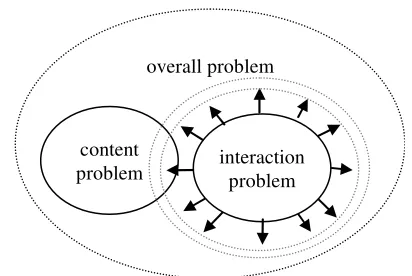
Figure 1a. WIMP: All content problems must be solved with
same interaction techniques. The interaction problem can be adapted only marginally to the content problem.
content problem
overall problem
interaction
problem
Figure 1b. Rich Interaction: To solve the content problem the
user can use various suitable interaction techniques. The interaction problem can be adapted flexibly to the content
[image:10.612.331.537.397.535.2]and hand to positions on the object surface, which are suitable for object-manipulation, is an integrated movement [11].
THE INTERACTION PROBLEM
Working with computers can be defined as interactive problem solving of the content problem and interaction
problem [12]. The content problem relates to the actual
problem itself, the interaction problem arises from solving the content problem with the help of a computer (e. g. positioning problem). In today's WIMP interfaces, designers try to reduce the interaction problem by providing the same, well-known interaction primitives Windows, Icons, Menus and Pointing Devices [6] for all content problems (Figure 1a).
Humans have a rich repertoire of object manipulation abilities. For example leafing through a book is a highly complex procedure, which reveals the book contents and meta information such as age, usage and volume. Instead of reducing the interaction problem to a few limited interaction techniques, humans should be able to use their highly efficient sensomotor skills for the manipulation of virtual objects. They should be able to use different interaction techniques for different content problems, thus extending and diversifying the interaction problem instead of reducing it (Figure 1b).
PAPERLESS OFFICE
In the vision of the paperless office, as few as possible physical objects should be involved in the working process. Preferably all documents should be digital and all tangible, physical documents and tools should disappear from the desk in favour of uniform Personal Computers [2]. But despite the effort being made, the use of paper is still increasing; paperless offices will not work for a long time yet [9]. From this follows that tangible documents and objects are still important to fulfill our work and to organize information.
UBIQUITOUS COMPUTING, AUGMENTED REALITY
Ubiquitous Computing and (Tangible) Augmented Reality (AR) are two approaches which try to integrate real and digital workspace, whereas the digital is basically an overlay on top of the physical environment. Interacting with those systems is usually simple and requires little learning. But if the computer is everywhere, the user looses the means to specify if actions are intended only for the physical or for the digital workspace, which might lead to ambiguity and additional interaction problems. Ubiquitous Computing even tries to make the computer interface invisible. Dourish appropriately comments: "You can not be engaged with something that essentially isn’t there. Invisibility is not engaging; invisibility does not communicate (…) the relationship between the user, the interface, and the entities that the interface controls or represents is continual shifting. The focus of attention and
[image:11.612.315.552.56.183.2] [image:11.612.319.561.518.608.2]action is subject to continual and ongoing negotiation." [4, p. 202].
TANGIBLE VR
Just as the mouse as a native pointing device is not suitable to be used as a general purpose interaction device within WIMP Interfaces, current VR interaction techniques are not suitable for all interaction problems which may arise within Virtual Environments. Most of the interaction techniques are based on complicated selection-manipulation-deselection sequences [7, 3], provide no haptic feedback or require heavy and expansive equipment.
Tangible Interfaces (TUI) are physical objects, which are linked to digital functions or objects [5]. In order to provide successful physical / digital mappings and to ease the interaction problem, TUIs should contain successful spatial mappings, unify input and output space and enable trial-and-error activity [10].
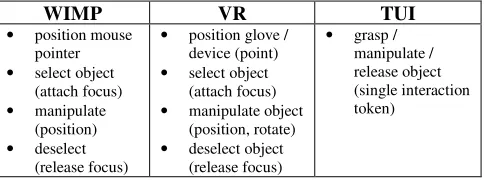
TUIs are directly manipulatable by their sheer physical presence within the workspace. Users can make direct use of tangible objects without having to specify input focus and manipulation technique separately. In the definition of Nielsen such a manipulation can be called a single token of
interaction (Table 1).
WIMP VR TUI
• position mouse pointer
• select object (attach focus)
• manipulate (position)
• deselect (release focus)
• position glove / device (point)
• select object (attach focus)
• manipulate object (position, rotate)
• deselect object (release focus)
• grasp / manipulate / release object (single interaction token)
Table 1. Interaction sequences required for direct object manipulation.
In order to integrate Tangible Interface into Virtual Environments and to detect collisions with virtual objects, the VR system must be aware of the objects' positions and geometries (e. g. by optical tracking). The digital functionality of tangible objects can be integrated into the VR system’s software. For many ergonomic reasons and to facilitate the integration of real and virtual workspace,
immersive environments (e. g. Holobench) should be preferred to immersive environments (e. g. HMD, Cave). By integrating Tangible Interfaces into Virtual Environments, the 1:1 human-computer interface shifts towards a 1:n human-object interface. Furthermore, if the system facilitates simultaneous interaction with multiple objects, two handed interaction becomes naturally.
TANGIBLE TOOLS AND HYBRID OBJECTS
The advantage of Tangible Interfaces to be physically represented is also their biggest disadvantage, because they are very inflexible in changing their shape and usually applicable to only one application [10]. There are two approaches to address this problem: tangible tools and
hybrid objects.
Tangible Tools are general purpose tangible interfaces,
which can be used for different tasks and in different contexts. They are similar to physical tools in that they are
ready to hand (zuhanden), as Heidegger calls it [4, p. 109].
After having learned how to use it, the user acts through the tool and the tool itself is not in the users attention anymore. An exemplary tangible tool is the MIT’s I/O brush [8]. Tangible Tools can also be hybrid.
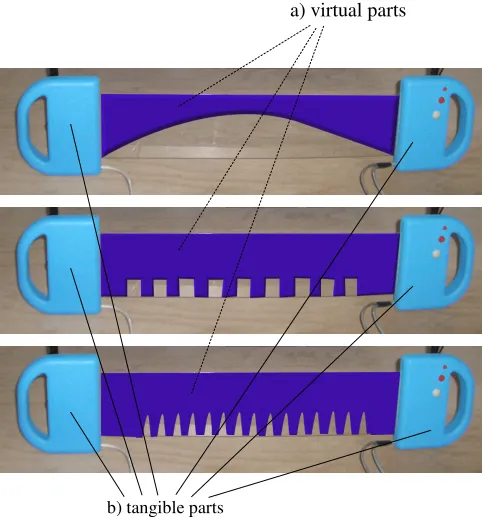
Hybrid objects consist of tangible, physical and virtual, visible, but not tangible parts. They are bridges between the digital and physical world, the interface runs directly through the objects. Usability tests will show to what extent users perceive these objects as units and transfer their manipulation abilities to the digital object. (Hybrid) objects within the user’s attention can be called present at hand (vorhanden) as per Heidegger [4, p. 109].
SUMMARY AND OUTLOOK
The way Tangible Interfaces changed our concepts of human-computer interaction they might also change our concepts of interaction within Virtual Environments. What has begun with Tangible Augmented Reality should be continued with Tangible VR and might finally lead to such smart VR Systems we are waiting for the last ten years. In a next step usability studies on hybrid objects have to be conducted and prototypes have to be developed, which make active use of hybrid objects and tools.
REFERENCES
1. Biahmou Tchebetchou, A. R. Methoden für das
Industriedesign in Virtueller Realität. Ph.D. Thesis,
Technical University of Berlin, 2005.
2. Business Week. The Office of the Future. In: Business
Week No. 2387, 30 June 1975, pp. 48-70
3. Bowman D., Kruiff, E., LaViola, J. & Poupyrev, I. 3D
UserInterfaces: Theory and Practice. Addison-Wesley.
2004
4. Dourish, P. Where the Action Is: The Foundations of
Embodied Interaction. Cambridge, MIT Press, 2001.
5. Ishii, H. & Ullmer, B. Tangible Bits: Towards Seamless Interfaces between People, Bits and Atoms. In:
Proceedings of CHI '97 Conference on Human Factors in Computing Systems, Atlanta, Georgia USA, March
1997, ACM Press, pp. 234-241.
tangible
objects objects virtual hybrid
objects
[image:12.612.316.558.54.317.2]tools
Figure 4. Objects (present-at-hand) and tools (ready-to-hand) in Tangible VR.
1 : 1
[image:12.612.62.290.59.187.2]1 : 1
1 : n
Figure 3. Tangible Virtual Environments: The 1:1
human-computer interface shifts towards a 1:n human-object interface.
a) virtual parts
b) tangible parts
Figure 5. Hybrid tangible tool for Virtual Clay Modeling [1].
[image:12.612.78.272.519.609.2]6. Nielsen, J. Noncommand user interfaces. In:
Communications of the ACM 36, 4, April 1993, pp.
83-99.
7. Poupyrev, I., Weghorst, S., Billinghurst, M. & Ichikawa, T. A framework and testbed for studying manipulation techniques for immersive VR. In: Proceedings of VRST
1997. ACM Press, pp. 21-28.
8. Ryokai, K., Marti, S. & Ishii, H. I/O Brush: Drawing with Everyday Objects as Ink, In: Proceedings of CHI
2004, ACM Press, pp. 303-310.
9. Sellen, A. J. & Harper, R. H. R. The Myth of the
Paperless Office. Cambridge, MIT Press, 2001.
10.Sharlin, E., Watson, B., Kitamura, Y., Kishino, F. & Itoh, Y. On tangible user interfaces, humans and spatiality. In: Personal and Ubiquitous Computing, 8 (5), 2004, pp. 338-346.
11.Smeets, J. & Brenner, E. A new view on grasping. In:
Mot Control, Vol. 3, 1999, pp. 237 - 371.
Building Bowls for Miscellaneous Media
Alex S. Taylor, Shahram Izadi, Laurel Swan
ΒΒΒΒ, Richard Harper, Bill Buxton
Microsoft Research
7 J J Thomson Avenue,Cambridge
CB3 0FB, UK
{ast, shahrami, r.harper, bibuxton}@microsoft.com
Β ΒΒ
Β
Brunel University
Kingston Lane, Uxbridge, Middlesex
UB8 3PH, UK
INTRODUCTION
In this paper, we describe an early design sketch of an augmented bowl. The sketch illustrates how a bowl’s physical properties might be used to enable a simple, lightweight method for casually displaying and containing the media held on devices like digital cameras (still and video), mobile phones, music players, etc.
The features we present of the augmented bowl have been designed to exploit our commonsense understandings and everyday uses of container-like objects. As we’ll explain, in choosing the features, we’ve attempted to build on the ways in which physical content can be casually added to or retrieved from a bowl with little to no thought. We’ve also tried to capture the way bowls loosely contain their physical content, so as to enable an informal and to-hand solution for managing digital media.
The underlying motivation for this work has been to explore innovative methods for displaying and handling digital media, something we feel to be timely given the nascent proliferation of capture and playback devices. Given this proliferation, our intention has been to move beyond the constraints of the personal computer (PC) and consider the possibilities that might exist for using alternative display technologies and physical methods of interaction [see 3].
Beyond the PC
Our ideas for the augmented bowl, as one possible avenue for this research, arose from our ongoing empirical investigations into home life. One possibly unsurprising discovery we’ve made in this work is that household members, in their day-to-day routines, often devise simple, easy-to-use techniques for managing their physical ‘stuff’ [1, 5, 6]. Our bills and correspondence are loosely collected into piles, piles distributed around the home. Bowls and drawers become to-hand containers for bits and pieces that have yet to be sorted or that aren’t quite ready to be thrown out. Indeed, we might argue that such ordinary practices are an essential feature of homes and what we do to make them special—transforming the mundane or possibly profane to sacred [2]. Thus, at times, it would seem that in our daily dealings with stuff we simply want easy-to-hand places to put things that casually and informally organize. A key feature to these places is that they require minimal effort to use—they’re not about engagement, but rather
disengagement. Thus we find these piles, bowls, drawers and so on situated around the home, purposed, as it were, for us to make use of them.
What has become the established PC-centric model of handling digital media contrasts with these types of minimal effort practices and casual forms of storage. The PC’s ability to perform a range of activities related to storage, organization and manipulation demands a level of complexity that makes it unwieldy and thus difficult to incorporate into everyday routines. The convergence of features into a single ‘solution’ makes what should be straightforward operations complicated to perform. Because of this complexity, there exists no casual way to simply contain or store digital media—no parallel to the way in which an object is simply placed in a bowl or drawer and minimally organized by dint of its size and when it was placed there. There is an in-built formality to both containing (or ‘uploading’) content and organizing it that is manifestly not the case with physical containers. Because of this, the PC is more suited to the more formal storage and organization of content that requires highly focused interaction or engagement, the sorts of activities that are often put off in the home for more time-bounded and infrequent occasions.
Digital media containers
Our sketch of the augmented bowl has been undertaken in an effort to contemplate this apparent problem and consider the practical design issues. Broadly, the aim here has been to support the casual and informal organization of digital media by providing lightweight methods of interaction that are highly intelligible to the user. Our focus thus far has been on augmenting physical bowls, building on the particular functions they afford.
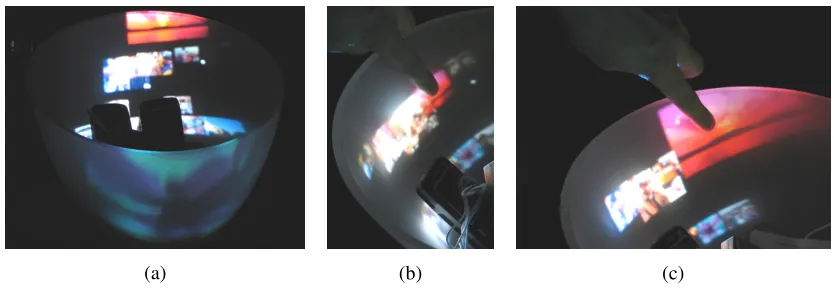
(a) (b) (c)
Figure 1. Augmented bowl.
AN AUGMENTED BOWL
The current manifestation of our bowl is shown in Figure 1a. By no means a finished article and yet to be touch-enabled, this early mockup is intended to inspire our future design work, in particular allowing us to rethink how media can be managed in easier and more lightweight ways. In the following we discuss some of the specific interactions that such a bowl might support, how these can provide utility in the digital domain, and how we believe these link back to our established practices in the physical world.
Containment
In conceiving of a digital media container, we have chosen to preserve the physical properties of a bowl in order to exploit the visual cues that bowls exhibit. A bowl’s shaped surface—its sidedness—indicates that it will bring together objects; that it will contain. The bowl’s visible form affords its use in this respect. Using our envisaged system, the containment of digital media is achieved by placing a digital device in the bowl. The media associated with a device is projected around it, on the bowl’s glass surface. Digital containment is thus achieved by further utilizing the physical properties of the bowl; it is accomplished through the simple act of placing a device in the bowl.
Layering
Using the described bowl, we’re aware that some of the media displayed may get obscured as more physical and digital items are added. We consider this, however, to be an intelligible feature because of the well-established understandings we have of physical bowls. With a conventional bowl, as items are placed in it, other content is obscured. To view lower lying items, we know that the top layers must be sifted through, moved apart or removed. Indeed, we exploit this principle of layering when we wish to let objects lie hidden and out of sight. Thus, our intention is that this interactional feature should hold true for the augmented bowl.
Detaching content
Our proposed method for detaching media from its associated device has also been chosen in an effort to maintain the principle of layering. We envisage content
being ‘peeled’ away from its device and left on the top ‘digital’ layer until obscured by other content. To detach the media, a device’s thumbnails or icons are held down in the bowl with a finger as the device is pulled away (Fig. 1b). Providing visual feedback, media is temporarily stretched to imitate a peeling-like action. This action duplicates the media in the bowl, leaving the original content on the device.
Signaling attention
In apparent conflict with their limited display capabilities, we find that bowls are sometimes used to draw attention to their content. Apparent here is that a bowl is not being utilized for its ability to display its content. Rather, we attract attention to content by the way we place it in relation to the bowl; by putting something out of kilter in a bowl, it stands as a reminder of something to take with you, put away, or otherwise act upon because it has been placed, figuratively speaking, to trip over. The mechanism builds on the at-a-glance quality that physical bowls can have when they are situated in the home, on hallway sideboards or kitchen counters, for instance.
Our augmented bowl supports this idea of signaling attention by allowing media to be dragged up and against the bowl’s side. Using this feature, chosen media can be visually distinguished from low-lying contents. For example, a picture or possibly an address from a mobile phone can be moved up to one of the sides of the bowl to mark it out for a passer-by to see. We have attempted to further develop this feature by building on the specific properties of the bowl. If media is dragged to the topside of the bowl (Fig. 1c), the increase in size of a thumbnail or icon is more pronounced. Thus, given the orientation of the bowl’s topside (facing outwards), media left there is made visible from a distance. We have also made media placed in this section visibly brighter, adding to its visual prominence.
Surface ecologies
interactions with tabletops and walls has been subject to extensive research. Indeed, a number of systems have been presented in the research literature that provide possible solutions to containment and viable techniques for interacting with digital content [eg 7]. At issue here, however, are the distinctive properties of surfaces and the different interactions they afford in settings like the home. What is evident from our observations is that tables and walls do not lend themselves to the same types of containment and storage functions afforded by bowls and other container-like objects.
This point is best illustrated by example. Consider how horizontal surfaces such as tables play into the patterns of home life. As we and others have observed [1], tables are ideally suited to the display and organization of materials, sometimes in shared environments. The physical nature of the table, for example, lends itself to having content spread over it and people arranged around it for the purposes of sorting, organizing, viewing, playing, eating and so on. Usage is thus driven by bounded activities, something that appears all the more pertinent in the home where table-use is regulated by a household’s daily rhythms and negotiated by its members. Any containment afforded by tables is consequently constrained by who and what has overall rights to the table. The table has a social as well as physical character in the home that means any storage is time limited and bound by an established social order.
A sensitivity to the actions and activities afforded by tabletops, walls, containers, etc. gives an indication of how bowls might operate within the larger environment. In essence, bowls can be seen to be part of a wider ecology of surfaces in the home. This notion of surface ecologies [also see 3]—of different surfaces working together and sometimes competing—stands in contrast to the multi-purpose solution of the PC, where an effort is focused on centralizing virtually all operations. Instead, we offer the basis for a solution that should be used only under certain conditions, with a constrained range of operations working in concert with the physical and social surroundings. Our main assertion here is that an augmented bowl should
retain its specialized containment and storage
functionalities. The casual ways in which items can be literally tossed into bowls and the loose organization that results from the physical form of the bowl should be preserved because this appears to be one of the reasons why it is so compelling as a storage container. The design space then becomes one of considering how the bowl works in coordination with the surfaces around it. We propose, for example, that to organize its content more thoroughly, a bowl’s media might be ‘poured’ onto and spread over an interactive tabletop. Similarly, media items might be virtually ‘stuck’ or ‘thrown’ from bowl to wall displays to view content collaboratively.
CONCLUSION
The augmented bowl concept we have presented in this paper is designed to support the need that we sometimes have to effortlessly handle things. As a design sketch, it hopefully provides an idea of how computational resources might be exploited to build on our intimate familiarity with the physical, and done so with a sensitivity to the ways in which our social arrangements imbricate with material surroundings. As opposed to an all-encompassing solution for managing digital media, the bowl is envisaged to be one of several resources that operates within a larger ecology of purpose-built solutions.
As intended, the presented work has raised a host of questions about digital media containment and possible solutions that address real-world practices in homes. For instance, the mapping of physical ‘stuff’ onto digital media is clearly not a direct one. Further, thought needs to be given to the sorts of digital media that might take on physical-like qualities and consequently what media should and should not be displayed in containers like the augmented bowl we describe. Questions are also raised about the literalness of our interpretations in designing the augmented bowl. Is such a literal translation of physical containers necessary? Also, do such tangible interfaces merely limit our potential, while failing to introduce novel and possibly more appealing methods of engaging with our everyday experiences? Why too should our interactions with digital media be constrained by the properties of the physical world when clearly they do not have to?
As we develop this work and progress towards a fully functioning prototype of the augmented bowl, we hope to address these questions as well as the more technical problems. The position we take, here, is that detailed studies of established, real-world practices provide a powerful resource in incremental design. This approach is best complimented, however, with in situ prototyping where people’s everyday interactions with a solution can be used to help develop potentially more novel, but still grounded design ideas.
REFERENCES
1. Crabtree, A. & Rodden, T. Domestic routines and design for the home. Computer Supported Cooperative
Work 13, 2, (2004), 191-220.
2. Douglas, M. Purity and Danger, (originally published 1966), Routledge, London, 2002.
3. Fitzmaurice, G. W. Khan, A. Buxton, W., Kurtehbach, G. & Balakrishnan, R. Sentient data access via a diverse society of devices. ACM Queue, 1, 8 (2003), 53-62. 4. Rodden, T., Crabtree, A., Hemmings, T., Koleva, B.,
5. Taylor, A. S. & Swan, L. Artful systems in the home.
Proc. CHI 2005, ACM Press. (2005), 641-650.
6. Tolmie, P., Pycock, J., Diggins, T., Maclean, A. & Karsenty, A. Unremarkable computing. In Proc. CHI
2002, ACM Press, (2002), 399-406.
7. Wilson, A. TouchLight: An Imaging touch screen and
display for besture-based interaction, Proc.
International Conf. on Multimodal Interfaces, (2004),
Physicality from the Sidelines: Potential Hurdles and
Solutions in the Development of Novel Interaction Styles
John V H Bonner
Department of Informatics
School of Computing and Engineering
Huddersfield University
HD8 8DT
ABSTRACT
This paper provides a pragmatic argument on how best interaction designers and researchers can influence and perhaps even guide the interaction design process of the ever accelerating digital revolution. This is done through important lessons learnt through the development of a set of design tools for a major consumer manufacturer. Principally, idiosyncratic organisational factors need to taken into account when introducing a new design approach or methodology.
Author Keywords
Interaction design, design tools, interactive technology
INTRODUCTION
The promise of pervasive computing, augmented interfaces and ubiquitous smart devices has now been with us for many years. Many papers addressing the future of computing often begin by providing examples of existing consumer products such as mobile phones, PDAs, in-car navigational systems, MP3 players and interactive TV to substantiate how ‘digital’ we are becoming. Furthermore, researchers and designers then often go on to make claims about experiencing and using digital technology that is less intrusive, more ubiquitous and will naturally blend with common everyday physical objects.
FACTORS AFFECTING THE IMPLEMENTATION OF INTERACTION DESIGN TOOLS
There is very little doubt that digital technology will relentlessly progress and evolve. This position paper, however, offers a pragmatic argument on how best interaction designers and researchers can influence and perhaps even guide this accelerating digital evolution. This approach has been shaped by my experiences of managing a research project about 10 years ago. There were three factors beyond the initial remit of the study that prevented our design tools being successfully implemented in the design of future digital products.
Organisational acceptance of design tools to support innovation
Firstly, although the design tools were received with high approval by the designers, organisational acceptance was more difficult. The aim of the research was to provide industrial designers with ‘ergonomics based information’ to support the design of usable product interfaces using emerging digital technologies. This research preceded the now recognised discipline of ‘interaction design’. These design tools were developed to help support consumer product interfaces, where generic design rules from computer interfaces could not be used because product interfaces had different forms of technology, usage behaviour, functionality, and used ‘physical’ control and display technologies.
We placed a heavy emphasis on developing appropriate delivery mechanisms for industrial designers to ensure their acceptance. The tools were underpinned by HCI research and cognitive theory. Very briefly, the first design tool developed was a user requirements capturing tool which used ‘card sorting’ techniques involving the collaboration of anticipated user groups and designers. The second design tool, ‘scenario design’, refined this proposal at a more detailed level with users interacting with crude paper based prototypes within the context of a real scenario. The third design tool was an ‘inspection’ based evaluation tool that assessed the selected or preferred conceptual design solutions from the previous tool. Iterations between these design tools took place until a detailed interface specification was complete. The design tools were tested in two large consumer manufacturing organisations. Although the design tools were found to be ‘successful’ in terms of affecting design decisions, they were not successful in terms of organizational acceptance.
provide organisationally relevant outcomes to be successful. The design tools needed to provide support beyond their immediate functional purposes and support other auxiliary needs. For example, outcomes from design tools had to map easily to organisational reporting structures to improve their viability and competitiveness against other ‘rival’ information that was used for product development decision making.
Research community’s perception of how to provide design knowledge
Second, we placed a heavy emphasis on developing
appropriate delivery mechanisms for industrial designers to
ensure their acceptance. The tools were underpinned by HCI research and cognitive theory and over a period of three years these tools were developed with strong involvement from the designers who were going to use them. This is in contradiction with the common assumption within the HCI research community that design methods development and implementation are separate research endeavours. For example, Sutcliffe and Carroll (1999 p 216) while commenting on 'reusable claims' - contextually sensitive design statements that suggest potential ways in which usability problems can be resolved, they state, 'The
users of claims are intended to be software engineers, so another motivation for this research is to spread HCI knowledge beyond the community of human factors specialists; however, effective delivery of design knowledge is a research topic in its own right...'. We would argue that
the 'delivery of design knowledge' must be an implicit part of producing the design methods and can not be separated.
Venturing beyond conventional products and interaction styles requires commercial collaboration
Thirdly, during this study and through other related work carried out at the time, it became apparent that these new digital technologies, products and services do not inhabit a particular manufacturing or service domain. Very often these predicted or potential digital products cut across consumer product manufacturers, network providers, media
and service providers. These are high risk ventures that require major capital expenditure and huge network infrastructures to provide the products and services product designers and researchers are developing.
A WAY FORWARD
At present we are currently in the process of developing a research studio at Huddersfield University. The primary purpose of this studio is to develop and evaluate future consumer products and interaction styles. Physicality will certainly play a part in our thinking. However, based on the lessons learnt from the work carried out before, it is intended that our approach will learn from the findings of my previous research. Work has already begun on developing an organisational consortium where each organisation has a vested interest in exploiting digital technologies in creative and potentially financially rewarding ways. We hope this will include some unusual partners – furniture manufacturers for example where aspects of physicality are obvious.
We also intend to focus our research in developing ‘bespoke’ design methods. Experience from the previous studies strongly suggests that generic design tools simply do not work. Design tools have to be specifically tailored to meet organisational demands and this has to be part of the design tool development process.
Finally, we hope to develop conceptual product development ideas that are based on high quality empirical evidence but also grounded in the commercial constraints and demands of the research consortium. In this way we hope that we can contribute tangibly to future innovative digital products that also have commercial credibility.
REFERENCE
Sutcliffe, A. G., and Carroll, J. M., 1999, Designing claims for re-use in interactive systems design, International
Physicality, Spatial Configuration and Computational
Objects
Stuart Reeves
Dept. of Computer Science
Jubilee Campus, University of Nottingham, Nottingham, NG8 1BB
ABSTRACT
This paper addresses physicality and the spatial configurational character of interactive technologies that are prevalent within HCI research. The primary issue being presented here is the inextricable link between the fundamental qualities of physicality and the spatial configuration of objects. Firstly, the question of what is meant by ‘physicality’ is discussed in terms of ‘computational’ and ‘non-computational’ objects, in which the importance of physicality’s relationship with spatial configurations is described. Secondly, the impact interactive technologies can have upon spatial configurationand thus physicalityis explored. Finally, the implications for design and HCI are very briefly considered.
Author Keywords
Spatial configuration, sensor technology.
PHYSICALITY AND SPATIAL CONFIGURATION
What is physicality? We can start with a simple definition: the physicality of an object is shaped by the physical properties of that object.2 Tactile and visual senses
primarily inform this; in the case of a mug, the shape and material form the essence of the immediate sensory experience. Somewhere above these immediate, low-level senses of the object lie concepts such as Norman’s “perceived affordances” [6], which attempt to capture the nature of medium-level reasoning about an object’s physical nature. Such notions consider all the perceived actionable properties of an object, such as how a thing is used as in the possibilities afforded by a mug’s handle or a pen’s clicker. There also is higher-level, non-sensory information that helps shape physicality, such as attributed or historical meanings and the aesthetic qualities of an object. For example, affordances and sensory data alone cannot inform someone how an object may be commonly used (e.g., musical instruments, religious objects, etc.), and
2 By ‘object’ is meant things created by humans, rather than
every possible object in the surrounding environment including plant matter, minerals and animals. Furthermore, in considering the properties of physical objects, a ‘macro-level,’ Newtonian sense of physicality as humans directly experience every day is assumed.
as such one’s historical experience or education about an object as well as a common sense, “what anyone knows” body of knowledge associated with an object both in turn further shape the experience of physicality. It is worth noting that this perspective on physicality is admittedly reductionist and abstracted and in that sense is most useful
as a metaphorical way of thinking about physicality.
Why is it useful to understand what physicality is? Within the field of human-computer interaction, the physicality of objects that drive computation (namely, the physical manifestation of the computer, from the traditional mouse and keyboard to tangibles, handheld computers and mobile phones) differs from the physicality of everyday, non-computational objects. Computational objects have properties in addition to their sensable qualities, affordances and associated meanings and aesthetics. Some of these properties ‘break’ commonsense understandings of physicality. Computational objects have internal states that may change the resulting use of that object (the computational ‘black box’), as well as interactive possibilities that are outside of the bounds of ‘normal,’ non-technological physicality (e.g., mobile phones and other objects that create action at-a-distance). (See [3] for a description of these properties.)
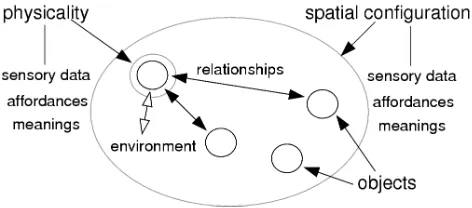
different meanings according to the different configurations they operate in spatially.
Leading on from these examples, spatial configurations can be thought about in similar terms to the way that we have thought about physicality. Configurations have an immediate sensory impact (e.g., visual, tactile). They also have particular spatial affordances or actionable properties, such as how a particular arrangement of objects may afford certain movement/navigation or uses of a space (such as thoroughfare). Finally, these configurations can have associated meanings and aesthetics, such as the configurational meaning of objects in a church (for example, the cross and easterly orientation of a typical cathedral, or the open-plan or cubicle layout of a place of work). Since spatial configurations are configurations of physicalities, the sense, affordances and meanings of both are deeply tied together.
Figure 1 attempts to schematize the various different aspects discussed here.
COMPUTATIONAL OBJECTS AND INTERACTIVE TECHNOLOGY
It is primarily the fundamental link between the spatial configuration of technological objects and the resulting impact upon physicality that is of interest in this paper. In order to understand how this change features for computational objects, we must consider technologies that have some link to the physical environment (i.e., the qualities of input and output).3 This kind of interactive
computational object is increasingly being included in mobile applications (such as games and tourist guides (e.g., [4,1]), museum and gallery interactives (e.g., [7,5]), and performances that are augmented or integrated with technology in some way (for many examples, see [9]). Technologies such as GPS, Wifi, ultrasonics, computer vision and RFID often feature in these examples. Such devices may have components embedded with physical units (e.g., PDAs or wearables) as well as those found in the environment (e.g., video cameras, GPS satellites,