Power, Jess
Are we equipped for wearables? Original Citation
Power, Jess (2005) Are we equipped for wearables? In: Proceedings of the 84th Textile Institute World Conference. TIWC 2005 . The Textile Institute, Releigh, North Carolina, USA. ISBN 1870372670
This version is available at http://eprints.hud.ac.uk/id/eprint/13879/
The University Repository is a digital collection of the research output of the University, available on Open Access. Copyright and Moral Rights for the items on this site are retained by the individual author and/or other copyright owners. Users may access full items free of charge; copies of full text items generally can be reproduced, displayed or performed and given to third parties in any format or medium for personal research or study, educational or notforprofit purposes without prior permission or charge, provided:
• The authors, title and full bibliographic details is credited in any copy; • A hyperlink and/or URL is included for the original metadata page; and • The content is not changed in any way.
For more information, including our policy and submission procedure, please contact the Repository Team at: [email protected].
1 -ARE WE EQUIPPED FOR WEARABLES? Power, E. J.
ABSTRACT
This paper is a combination of three investigations. Firstly it reflects on the results of a survey conducted with a selection of clothing design students, this establishes how the new generation of designers envisage electronics integrated within clothing and how functionality/userability impacts on the fashionability of the garment. It identifies the merits and opportunities of cross-discipline collaboration within the higher education sector and presents a summary of an innovative project that successfully integrated an electronic gesturing device into an item of clothing. The outcome of the project described, was an aesthetically pleasing wearable that interfaced an electronic gesturing device in a manner that was considered both practical and functional. Not only does this paper discuss the wearable design from a fashion perspective, it highlights the design process and subjectively analyses the obstacles encountered by design students in their quest to balance aesthetics and functionality without hindering their creative flare.
1. INTRODUCTION
The concept of fashion being a functional interface is not new, yet are we as designers, technologist and perhaps more importantly, consumers prepared for this revolution? Garments have already been introduced into the marketplaces that combine electronics and wearable computing devices (Gough, 2004). But is the consumer ready to understand, appreciate and interface with this technology? The flow of wearable computing into mainstream fashion is going to challenge even the most creative designers in our fields. Therefore, we should currently be addressing within higher education how we are equipping our future generation of fashion designers to deal with this revolution and establish methods of evaluating the progress. It appears we are all comfortable in our own disciplines and specialist areas, but in reality how well do we integrate together and more importantly how do we incorporate this into the current design curriculum?
This paper is an investigation into how the new age designers envisage wearables integrated into clothing, it acknowledges opportunities in the current fashion design training to develop collaborative projects related to wearable computing and highlights an urgent requirement for further research in this area; A garment is presented that was specifically designed to integrate the Gesture Input System presented by Headon and Coulouris at Eurowearables 03’ (2003). The project outlined in this paper highlights the value of cross-discipline collaboration within the higher education curriculum. It identifies key areas of importance regarding the successful integration of an electronic gesturing system within the taught design process in terms of aesthetics, functionality and the consideration for robustness during testing.
2. AIM
2
-• Assessing how Fashion Design, Clothing and Marketing students perceived
wearables.
• Facilitating cross-discipline student centred research by integrating an electronic gesturing system, developed by Headon and Coulouris (2003) into clothing.
• Reflecting how the student project was received, analysed and how successful the output was in terms of product usability.
• Summarising the merits of this kind of collaboration and reflect on the outcomes
and observations.
3. BACKGROUND
It has previously been identified by Gough that “people are carrying more and more electronic functionality with them” (2004, p.1). Furthermore research has shown that this is set to increase (Gough, 2004), the sales of portable electronic functionalities such as; mobile phones, sound systems, digital cameras watches and mini computers is forever increasing as new technologies immerge. Research is being conducted in the area of wearables within the electronic discipline, but how are we as consumers, designers and technologists equipped to deal with this merging of technology into clothing? This paper investigates some of the issues that arise with the integration of specific electronic functionality within clothing from a designer’s perspective.
3.1 The Survey
A survey was devised to gather some basic information regarding the level of understanding held within a group of clothing students in the UK. A mixed group of second year fashion, clothing and fashion marketing undergraduate students were considered as a representative sample. The group was selected on the basis that all of these students had experienced the product design process, had a high understanding of trend and current directions within fashion, and were considered a feasible age group to accept new processes and technological advancements (77 % were in the age range of 20-25). The limitations were the group as a whole were predominantly female (86 % of the total number of surveys completed) and it could not be assumed that individuals had previously encountered wearable computing (or as the survey termed it intelligent clothing). The percentage of individual students that participated was reliant on class attendance and the goodwill of the students to participate. This survey was considered a pilot, expressing the views of a mixed group of clothing related students and was expected to be expanded at a later date. The total number of completed surveys received was 44.
3
-3.1.1 Analysing the Survey Part A
100 % of all participants declared ownership of a mobile phone and 66 % owned a portable sound system, laptops were the next most popular electronic device, whilst only a small percentage saw the necessity to own palm tops, digital organisers and digital cameras. However, this may be due to the fact that the ubiquitous new age mobile phone acts almost as an electronic panacea, this is an issue that was not evaluated in the survey. 61 % of all participants had these possessions with them when on the move, out of the remaining participants, 76 % did not carry their electronic devices when on the move, because the items were too big and bulky. Thus, we can assume from this study that the majority of individuals within this age group like to carry and communicate electronically when on the move, but some have reservations regarding the size, the weight and the practicality of large electronic devices.
3.1.2 Analysing the Survey Part B
When asked to define intelligent clothing, 52 % declared that they fully understood the term and provided a definition. However, the responses and definitions were extremely varied ranging from garments with pockets to hold mobile electronic equipment, to garments with sensors embedded in the structure. One conclusion that was drawn from this survey was that the definition of intelligent clothing was not clear, and further to that one may ask what do the terms smart and wearable imply? If level two clothing students had such varied interpretations then how was the general public expected to understand and integrate with this sort of technology in the market place?
3.1.3 Analysing the Survey Part C
The real surprise from this survey was that most participants envisaged that intelligent clothing in technical and medical applications would have a higher growth rate than within fashion. This leads us to ask the question; does the new generation of fashion designers not see the need for pervasive technology or indeed electronics in clothing? Alternatively do they not see any aesthetic merit in a functional electronic garment, hence, could we imply that technology will hinder the creative design process; therefore there is no value or place for it, within fashion?
3.2 Summary of the Survey
The hypothesis and research questions that were derived from the survey were; the majority of the students liked to communicate electronically when on the move, whether this is visually, audibly or verbally. Therefore, the fact that current design students perceive intelligent clothing in fashion, as lagging behind the other categories could simply be a lack of clarity to the definition of intelligent clothing/wearables. After all, how can we all want and accept new technology so readily in other aspects of everyday life and reject it in the main factor which we express our individuality (The way we dress).
4
-designers consider electronic functional clothing as untrendy and freaky and therefore never consider it as a mainstream product within their ranges? Or is it a simple case of, how can they know what they want to incorporate when they don’t know what exists? (no-one wanted personal stereos before Sony invented them). Possibly you could argue from a fashion perceptive, that it is impractical to incorporate electronics into clothing because we change them so often. Hence, would we want the same electronics within all our clothing? These are just a few questions that arose from the survey evaluation.
4. THE CROSS-DISCIPLIN PROJECT
This innovative student project was the result of collaboration between Manchester Metropolitan University and Robert Headon and George Coulouris from The University of Cambridge. The project was envisaged to have a two-phased outcome focusing firstly on developing a prototype garment to enable further testing of the new gesture device presented by The University of Cambridge at the IEE Eurowearable ’03 conference (Headon and Coulouris, 2003). The second was the opportunity to research how the design students balanced aesthetics, practicality and functionality within the product design process. The project was intense, running for a period of 10 weeks during Jan 2004 – March 2004, under the umbrella of a new module entitled intelligent clothing. During this work the students had to consider various aspects of the design process in particular the integration and usability of the electronic gesturing device as outlined in Figure 1.
Figure 1 – Schematic Diagram of Gesturing Device
4.1 The Gesture Input Device
Headon and Coulouris identified in 2003 that certain benefits were obtained from the development of the wearable gesture input device. Potential applications range from technical usage such as, the control of a slide presentation, to medical, were a non-contact approach is required to communicate in a clean room environment (Headon and
Coulouris, 2003).The selected electronic gesturing system implemented a RFID (radio
frequency identification device). The gesturing device as displayed in Figure 1 illustrates schematically the components of the system. Basically it consists of three parts.
• Tags (F)
• Reader Chips and RF Circuitry (B, C, D, E)
5
-A is representative of a reader antenna, it was found in earlier experimentation by Headon and Coulouris, that a circular antenna was unsuitable due to the read range not being sufficient, therefore the design was modified to be rectangular (2003). The intention was to pass the Antenna (A) over a single tag (F) to activate a function or gesture. Therefore, the antenna had to be either attached to the cuff of a garment or directly to the wrist. It was found by experimentation that attaching the antenna to the cuff of a garment did not reflect the movement of the wrist whilst gesturing, therefore the antenna was mounted onto a strap to secure it directly to the user’s wrist (Headon
and Coulouris, 2003). The antenna was connected to the reader (C) by a shielded cable
(B) and in turn the reader is driven (via ribbon cable (D)) by an iPaq (E), which could also provided audio feedback if required (Headon and Coulouris, 2003).
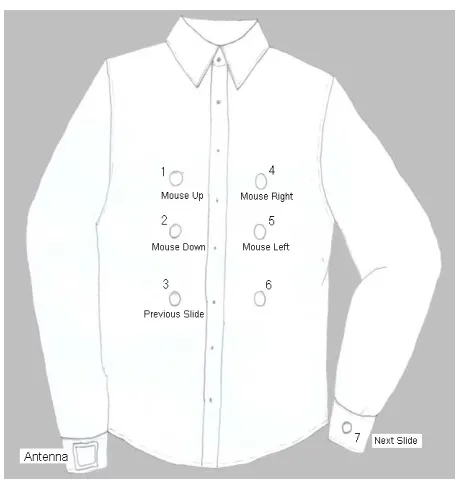
[image:6.595.183.411.452.693.2]The advantages of the components utilised in this gesturing device are; they are low cost and ubiquitous, conveniently wearable and have a low power requirement (Headon and Coulouris, 2003). Each of the tags are embedded in a 30 mm diameter plastic disc and can be positioned onto a garment to facilitate a gesture when communication is made with the antenna (There is the opportunity to use washable tags at a later date). The communication is fed to the RFID (powered by an external battery), which supplies a serial interface and can be housed in a pocket on the wearable. The iPaq receives the communications and using a wireless network communicates to a server that runs the software framework. The software translates the serial communications into a series of commands to the currently active operation. (Headon and Coulouris, 2003). Figure 2 illustrates the original system (presented at Eurowearables 03’) integrated into a garment schematically (Headon and Coulouris, 2003). The selected application is a slide presentation, it can be seen in the illustration that each tag (numbered 1-7) is programmed to execute a command.
6 -4.2 Drawbacks of the Current System
There were some drawbacks identified from the prototype presented at Eurowearables ‘03 (Headon and Coulouris, 2003). Firstly because of the technique used to attach the tags to the garment, there was a possibility of movement during wear. Secondly the gesturing device had been integrated into a commercial garment and no provision was made for the housing of internal circuitry or mechanisms. Thus there was a risk of the circuitry moving or getting damaged during wear, not to mention the bulging pockets containing the RFID, iPaq and battery.
It was identified that it would be beneficial to integrate the circuitry and tags into a specifically designed garment that placed equal emphasis on aesthetics, practicality and functionally. This will also ensure consistency and robustness of the tags during gesturing and will contribute to more reliable results in future trials. A group of Manchester Metropolitan University students set about creating a product to fulfil a specific design brief.
5. THE DESIGN PROCESS
The brief was to design and produce a functional shirt or garment that integrates the gesturing device as illustrated in Figure 1. Further information was given on dimensions, weight and operating conditions of each component. The project focused on the design process and asked the participants to consider additional factors such as; fitness for purpose and the social issues surrounding this topic.
Some students experienced difficulty in combining creativity within the parameters of the gesturing system. There were severe design limitations because of the wires and the requirement to connect the various components. The drape of the garment and sizing had to be carefully examined due to the tags requiring an element of rigidity. Around the cuff area it was a requirement that the Antenna be secure to ensure a strong signal was received during gesturing. Many ideas were discussed and presented by the students however no single design fully met all the design criteria for a variety of reasons.
• Complexity of pattern drafting to include concealed seams
• Consideration of the weight of specific components
• The overall drape of the garment
• Time limitations
However, a combination of the students’ designs with inspiration and technical expertise from the Author provided a suitable prototype to be manufactured.
6. THE CALLABORATIVE GARMENT
7
-The Shirt The Frame
[image:8.595.114.483.58.257.2]
Figure 3 – Final Prototype for the Gesturing Device.
The Shirt The Frame
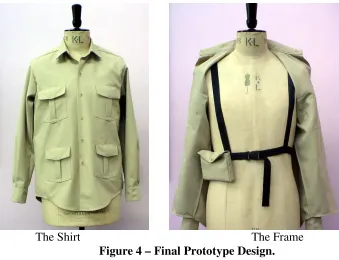
Figure 4 – Final Prototype Design.
[image:8.595.128.467.289.549.2]8
[image:9.595.92.496.54.224.2]-a) Photo of frame with iPaq b) Photo of RFID in Pocket
Figure 5 – Internal Design Features for the Gesturing Device.
The ribbon cable (Figure 1 (D)) is held securely within the frame and is threaded into a shirt pocket at the chest (were there is less fabric movement) it then proceeds to plug into the RFID (Figure 5b), which is housed in Pocket 1 (see Figure 3).
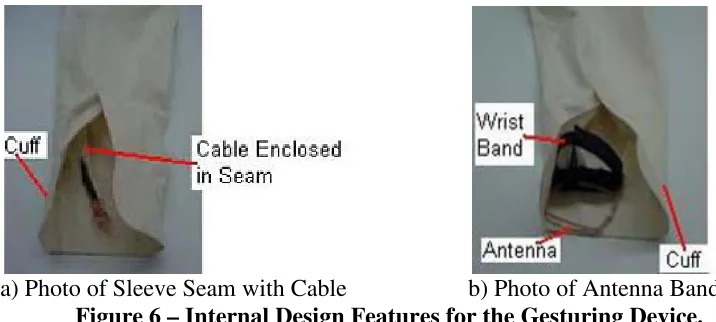
The shielded cable which is plugged into the RFID (Figure 1 (B)) is then threaded through an enclosed tube of fabric running down the sleeve to the cuff to prevent movement during wear (See Figure 6a). The shielded cable at the cuff is attached to the antenna (Figure 1 (A)), which in turn is attached to a wristband (See Figure 6b) to ensure the antenna is securely mounted to the wrist to facilitate gesturing.
a) Photo of Sleeve Seam with Cable b) Photo of Antenna Band.
Figure 6 – Internal Design Features for the Gesturing Device.
[image:9.595.103.461.420.581.2]9
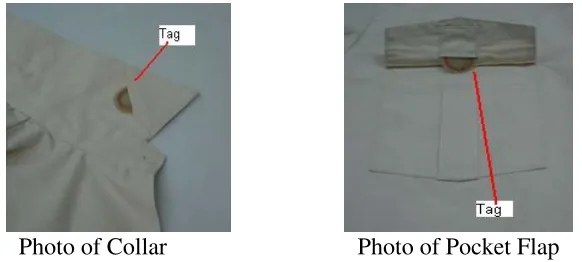
[image:10.595.153.444.55.186.2]-Photo of Collar Photo of Pocket Flap
Figure 7 – Internal Design Features for the Reading Chips.
6.1 SUMMARY OF THE COLLABORATIVE PROJECT
The project was successful in terms of both outcomes; firstly a collaborative prototype garment was produced which integrated the gesturing device (Headon and Coulouris, 2003) whilst ingeniously balancing the aesthetics, practicality and functionality of the garment (See Figure 4). The selected garment was a shirt that a lecturer or speaker could wear whilst conducting a presentation. This wearable would enable the speaker to move around the room whilst maintaining control of the slide presentation. In terms of design, the shirt was produced in a formal style that could be worn with or without a jacket. The fabric was carefully selected to provide maximum drape whilst enabling the electronics within to be concealed effectively. All the electronics were interfaced within the garments in a series of internal tubes and pockets (see Figures 5, 6 and 7) and mounted to the wearer securely by the frame (see Figure 3 and 4). The resultant garment is truly a wearable. It is aesthetically pleasing, the tags are integrated into the garment in positions which ensure they are both stable and do not interfere with the day to day wearing of the shirt. Further trials are currently being undertaken, to determine the accuracy of the tag selections and establish information regarding user feedback. Once this has been achieved any adjustments to the style lines will be assessed to maximise comfort during wear.
10 -7. CONCLUSIONS
In reflection this project has produced three successful outcomes. The first being an aesthetically pleasing wearable, designed specifically for the gesturing device developed by Headon and Coulouris (2003). Secondly an opportunity for a selection of students from Manchester Metropolitan University to develop their product design skills by experiencing cross-discipline research with a practical output taking the form of a wearable. Finally the project has enabled the design process of wearables to be evaluated. The following conclusions have been drawn.
• How new age designers view electronics integrated in clothing with caution. Possibly due to design implications and creative restricting factors.
• The terms, intelligent clothing, smart and wearables are misleading when used in
research and require some formal definitions which are recognisable across all the multi-disciplines they encompass. This will provide a clearer understanding and reduce confusion in the market place should these products have commercial merit.
• Within the fashion design process it has been challenging to balance aesthetics
with practicality and functionality to produce a prototype wearable that is fashionable within the limited time scale. Nevertheless the project has been of value to all concerned and the design limitations are now more fully understood and appreciated. By using a collaboration of students designs combined with design and technical expertise a functional garment prevailed.
• Each individual discipline is comfortable in working in isolation. However, difficulties may be encountered when multi-disciplinary research projects are formed. This paper highlights the value of cross-discipline collaboration within higher educational establishments as part of undergraduate and postgraduate development. It identified gaps within the formal fashion design training and attempted to rectify them by offering a sample of cross-discipline research within the current curriculum. However, this is an area that is vastly understudied and requires further research to determine the true benefit of such collaborations.
• In terms of establishing answers to some of the questions that derived from the
survey conducted as part of this paper, further cross-discipline research is required to formulate an in-depth understanding within the design process both within engineering and the arts.
• The wearable gesturing garment presented in this paper is undergoing further testing to determine the reliability of the original data obtained. However, initial reactions to the design have been positive and the harness approach may be applicable to other wearables, to reduce the freaky element associated with them.
11
-presented a successful example of such collaboration, which resulted in a wearable prototype garment.
8. RECOMMENDATIONS
This project was very much about the integration of a prior developed electronic system (gesturing input device) within a garment. It would be interesting from an educational perspective to monitor a team of electronic engineering and fashion design students working on a new product development within this area. This would provide a valuable insight into the problems and benefits cross-discipline research offers.
ACKNOWLEDGEMENTS The Author would like to thank.
• R. Headon and G. Coulouris from The University of Cambridge for their kind
assistance in allowing the design students at MMU to develop a garment to integrate their gesture input system presented at Eurowearables ’03.
• The students that participated in the project during Jan – March 2004 in particular Anna Michalska, Michelle Threlkeld and Sujeet Dutta.
• All the Manchester Metropolitan Technicians that assisted in the garment
make-up trials, in particular Ella Wai-Yin Wong.
REFERENCES
Gough, P. (2004) Electronics and Clothes: Watt to Wear? Wearable Electronic and Smart Textiles Seminar: Conference Proceedings. Heriot-Watt University. 11th June 2004.
Headon, R. and Coulouris, G. (2003) Supporting Gestural Input for Users on the Move.
IEE Eurowearables ’03: Conference Proceedings. The University of Birmingham. 4th-5th
September 2003.
ADDRESS
Dr. Jess Power ATI CText
Lecturer in Fashion Technology Manchester Metropolitan University
Department of Clothing Design and Technology
Faculty of Food, Clothing and Hospitality Management Hollings Campus
Old Hall Lane Manchester M14 6HR
Tel: 0161 247 2676