University of Huddersfield Repository
Simpson, R.M., Long, Derek, McCluskey, T.L. and Fox, Maria
Generic types as design patterns for planning domain specifications
Original Citation
Simpson, R.M., Long, Derek, McCluskey, T.L. and Fox, Maria (2002) Generic types as design
patterns for planning domain specifications. In: The AIPS2002 Workshop on Knowledge
Engineering Tools and Techniques for AI Planning, April 24th, 2002, Toulouse, France.
(Unpublished)
This version is available at http://eprints.hud.ac.uk/id/eprint/3284/
The University Repository is a digital collection of the research output of the
University, available on Open Access. Copyright and Moral Rights for the items
on this site are retained by the individual author and/or other copyright owners.
Users may access full items free of charge; copies of full text items generally
can be reproduced, displayed or performed and given to third parties in any
format or medium for personal research or study, educational or notforprofit
purposes without prior permission or charge, provided:
•
The authors, title and full bibliographic details is credited in any copy;
•
A hyperlink and/or URL is included for the original metadata page; and
•
The content is not changed in any way.
For more information, including our policy and submission procedure, please
contact the Repository Team at: [email protected].
Generic Types as Design Patterns for Planning Domain Specification
R. M. Simpson
and
T. L. McCluskey
School of Computing and Mathematics, The University of Huddersfield, Huddersfield, UK [email protected], [email protected]
Derek Long
and
Maria Fox
Department of Computer Science, University of Durham, UK
[email protected], [email protected]
Abstract
In this paper we investigate the use of ‘Generic Types’ as design patterns to assist in the specification of plan-ning domains. Current planplan-ning technology uses in-duced patterns discovered in a domain specification to speed up plan creation. We argue that such generic types can also be used to help a domain author to de-velop a design for a domain at specification time using concepts at a much higher level of abstraction than is normally provided by domain specification languages.
Introduction
Research into domain independent AI Planning and Scheduling, has traditionally focused on the devel-opment of algorithms to efficiently find solutions to planning problems within the domain. The problems of dealing with what is perceived to be realistically large problems has been very difficult but recent ad-vances in algorithms appear to make the problems more tractable. Perhaps because of the difficulty in develop-ing capable solution generatdevelop-ing algorithms knowledge engineering for applications of AI Planning technol-ogy is still very much in its infancy. Recent
success-ful AI planning applications (Muscettola et al. 1998;
A. Tate (editor) 1996) have nonetheless highlighted the problems facing knowledge engineering in planning. Questions raised by such work include issues of how to encode knowledge into domain models for use with planning algorithms. Subsequently concern over the de-velopment of knowledge engineering issues in AI Plan-ning has resulted in a set of workshops and initiatives, including (Benjamins, Nunes de Barros, Shahar, Tate and Valente (eds) 1998; PLANET 1999).
In this paper we describe a domain definition strategy and tools to support the knowledge acquisition phase, to be carried out by domain experts rather than experts in AI Planning. We show that planning domains can be constructed using concepts at a much higher level of abstraction than has traditionally been the case in domain independent planning. Traditional languages for the specification of planning domains allow the au-thors of a new domain great freedom in their choice of representation of the domain details. This freedom is we contend for the most part unnecessary and provides
an unwanted conceptual barrier to the development of effective domain definitions. As part of our ongoing project to enhance the tools available for knowledge engineering in planning we recently released a “Graph-ical Interface for Planning with Objects” called GIPO
(Simpson et al. 2001). This is an experimental GUI
and tools environment for building classical planning domain models, providing help for those involved in knowledge acquisition and the subsequent task of do-main modelling. The current work is an enhancement
to theGIPO tools environment which is supported by
EPSRC grant GR/M67421, within the PLANFORM
projecthttp://scom.hud.ac.uk/planform.
Generic Types
The primary purpose of generic types in planning
as introduced by Fox and Long (Fox & Long 1997; Long & Fox 2000; 2001) was to provide control infor-mation to planning algorithms to boost the speed of finding solutions to planning problems. The underlying conjecture in that work is that if common structural elements can be detected in a domain definition then specialised algorithms can be brought to bear on those elements of the problem to speed up the detection of solutions. With this in mind researchers have now iden-tified a number of candidate generic types that can be found in a range of the domains publically available. The purpose of our research is to investigate the
possi-bility of using generic types asdesign patternsto assist
the domain modeller in the construction of an initial specification. Defining a design pattern in his seminal
work (Alexanderet al. 1977), Alexander states that:
Each pattern describes a problem which occurs over and over again in our environment, and then describes the core of the solution to that problem in such a way that you can use this solution a mil-lion times over without ever doing it the same way
twice. Christopher Alexander
it can equally be beneficial for planning domain
engi-neering. The domain modeller can benefit from
en-capsulated clean and elegant solutions to representa-tion of common domain structures. Another advantage is, again as with software engineering practice, the de-signer is encouraged to conceptualise the domain at a higher level of abstraction than has typically been the case for modellers working in STRIPS derivative lan-guages such as PDDL. A further benefit is that the use of canonical, “normalised” domain representations supports the opportunity for reuse of deeper domain knowledge associated with the patterns, such as con-trol knowledge, specialised algorithmic problem-solvers and so on.
The language OCL (Liu & McCluskey 2000) which
has a design suite of toolsGIPO(Simpsonet al. 2001)
itself tries to lift the level of generality at which the modeller can design the domain by making the concept of an object and the changes of state that they undergo central to the conceptualisation of the domain. How-ever the research group acknowledges that the task for the domain modellers who are not themselves experts in the field of A.I. planning is still too difficult. Along with other approaches being investigated by the team, this current research is seen as having the potential to help bridge the gap between the tools and techniques usable by a domain expert, who is not necessarily steeped in the technologies of AI, and those that may only be used by experienced practitioners in the field of AI Planning.
In software engineering, design patterns (Gamma et
al. 1995) are described using stylised natural language
templates, combined with UML class diagrams, describ-ing the relationships between the fundamental build-ing blocks of object-oriented software. In plannbuild-ing do-mains the corresponding notion of a generic type is described using relationships between the fundamental building blocks of planning domain descriptions: sorts (or types), predicates, object states and state transi-tions (associated with operators). These relatransi-tionships can be captured graphically, in a diagram rather like a UML class diagram (Figure 1), or more formally, us-ing declarative specifications of the necessary relation-ships between the components. The formalisation of these descriptions is still the subject of current research, since the precise language should combine expressive-ness with precision and tractability. The role of generic types has expanded from being patterns to be identi-fied and exploited, which demands a description that can be matched efficiently against domain descriptions, to that of domain engineering construct, which is not concerned with pattern-matching, but with expressive-ness and ease of instantiation.
Broadly, a generic type then defines a class of classes of objects all subject to common transformations
dur-ing plan execution. Within OCL we refer tosortswhich
are sets of objects all subject to the same characteri-sation and transformations, in typed-PDDL the range of a type identifies a set of objects all subject to the same characterisation and transformations. A generic
Type L Type M1
at1
Type M2
at1
Type P
at1 in1
1
2 3
4
5
5: The move for M2 is enabled by the loaded condition for the portable type, P. 6: M2 is a carrier for the portables P. 7: The location at which the load or unload takes place is the location of the carrier.
1: A single type satisfies the fingerprints for mobile and portable types (M1 = P).
2: The locatedness properties of the portable and mobile instantiations are the same.
3: The locatedness property links the mobile to a location type, L.
4: A second mobile, M2, also moves on locations L.
6 7
Figure 1: Pattern description for the driver generic type.
type accordingly ranges over the types or sorts of in-dividual domains. The degree of commonality in the characterisation and transformations that these types or sorts must share have been described in the litera-ture in terms of state machines describing the patterns of transformations that the objects undergo.
In the following section we illustrate the way in which a generic type can be used as a design pattern to sup-port a more abstracted view of the structure within a planning domain during the engineering process.
An Extended Example
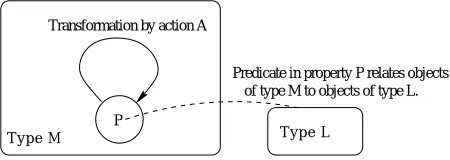
We will describe the generic type for a “mobile”. A “mobile” can initially be thought of as describing the types of objects that move on a map. They can very simply be characterised by the state machine shown in figure 2
Type L
P
Transformation by action A
Type M
[image:3.595.323.552.54.166.2]Predicate in property P relates objects of type M to objects of type L.
Figure 2: The Mobile Generic Type
In this one-state-machine the state is characterised by the property of the mobile object corresponding to its
locatednessand the transition is identified by the action
causing it to move. For this generic type to be applica-ble to a type or sort in a particular domain there must be a type such that there is an action that changes the
truth value of anplaced predicateN >= 2, let us call it
at, where one argument identifies the type in question,
M, and another a valueL which changes as a result of
the application of the operator. That is the value of L
differs in the pre- and post-conditions of the action in
the reference to the at predicate. No other predicate
referencing M should change truth value in the same
[image:3.595.322.547.425.505.2]may (and will) be different in different instances of the generic type. This is a very weak characterisation of a mobile, in that domains that describe actions that per-form transper-formation on some property of the objects in question might fulfill the above requirements and hence be characterised as a mobile. From the point of view of the designer of planning algorithms this does not rep-resent a problem as it just means that any specialised algorithms identified to speed up processing domains containing such structures will have wider application. From the point of view of someone trying to produce tools to assist domain developers it poses a problem in conveying to the user precisely what is the scope and potential uses of the pattern we have described as mo-bile. This problem of communication is probably ex-acerbated when we realise that subtle variations of the pattern need to be distinguished from one another.
Flavours of Mobiles First we characterise the tran-sition made by such a “mobile” in terms of the
formula [at(M obile0, LocA) ∧ LocA = LocB] ⇒
[at(M obile0, LocB)] where the compound predicate
within square brackets to the left of ⇒ describes the
object M obile0 prior to application of the action and
the formula to the right describes it after the application of the operator. The question arises as to the nature of the relationship between the values of LocA and LocB. In the formula they are required to be distinct and, we will assume, of the same type but their relationship is not otherwise constrained.
In some domains a more complex relationship might be required to hold between the two locations in order to allow movement between them. For example if “a” and “b” are locations then the transition from “a” to “b” can only be made if there is a “road” from “a” to “b”. In the case of the logistics domain transition are allowed if both locations are in the same city. In yet other cases e.g. the rocket world the only restriction may be the one we have assumed anyway that the loca-tions are all of the same type and that they are distinct from one another. Distinguishing these differences may be necessary when analysing existing domains with the intention of speeding up solution detection but it does not follow from that that we should provide the domain developer with the freedom to create each variant, with the consequent additional burden of forcing the devel-oper to distinguish conceptually between the different patterns. We must decide whether or not the differences are essential to capturing distinct behaviours of objects in the respective domains or whether they are merely alternative ways of describing the same behaviour and represent nothing deeper than differences in encoding strategies. We believe that there are advantages to re-quiring the developer to come to terms with a minimal toolkit of canonical concepts to allow them to model their domains. We should only deviate from this if min-imality means that the developer must conceptualise a problem at a level of abstraction that is too far removed from a natural way of thinking of the domain, in which
case we may introduce features which from the mini-malist point of view are redundant. Determining what represents a “natural” way of thinking about domain structures is a matter of experience and of judgement — we anticipate the need to refine the collection of generic types offered as a domain design patterns as their use develops.
Data Structures
Consideration of the very simple model of a mobile de-scribed above leads us further to distinguish different elements of a generic cluster. In particular, we need to
distinguish betweendata structuresthat are referenced
in the cluster and the dynamic generic types. Data structures are elements within the domain that are cap-tured in predicates that do not change truth value dur-ing the application of a plan. In PDDL, data structures are given in the initial state of a problem. An exam-ple is the set of connectedness propositions that define the road structure in the truck-world which form a con-nected graph. Such data structures may be referenced by multiple operator definitions within the planning do-main. The dynamic generic types are types or groups of types characterised by the changes in state they make during plan application.
Data structures in planning domains are not normally identified in terms of their structure but are captured implicitly in collections of predicates. In PDDL data structures are to be found in a subset of the
proposi-tions defined as true in the initial state of a problem
definition. In OCL, these static propositions that do
not change truth value during the planning process are
collected together in the atomic invariants section of
the domain specification.
Examples
• Sets In the logistics domain the proposition
in-city(pgh-po,pgh) is used as a way of asserting that
pgh-po is a member of the set of locations defined
as part of the citypgh. Sets may be identified more
simply than this. A set may simply be represented as the values of a particular argument in a predicate. We would describe the locations that can be visited in the brief-case world as forming a set, though they are never referred to in the domain specification other than as values of the location argument in the predi-cate that relates an object such as the “briefcase” to a location. Given this example it might seem that
the range of every typed variable could be regarded
as forming asetbut we distinguish betweendynamic
and static types and only the ranges of static types
are regarded as candidates to be identified as sets. The distinction between dynamic and static objects
we have discussed in (Simpsonet al. 2000). To
sum-marise: dynamic objects are those that would
nor-mally be regarded as changing their properties or
re-lations during plan execution, where asstaticobjects
in theat(brief case1, home) predicate that describes the location of the briefcase1 as being at home, it would be normal to regard briefcase1 as changing lo-cation when moving from “home” to the “office”, but we would not think of the locations themselves as changing state simply as a result of the arrival or departure of a briefcase. Hence we regard the “brief-case” as dynamic but the “home” as static.
• MapsExamples ofmapscan be found in the “travel”
world that contains collections of predicates such as
road(a, b) in the “init” sections of the problem
spec-ifications. The collection taken as a whole for each problem specifies a directed graph which has to be
navigated by somedynamicobject, the locations are
again regarded as static.
• Sequences Examples of sequences are rarer and less
obvious in the public domain planning domains. They occur in such domains as the “elevator” do-main to show the relationships between floors but we would probably use a map in such an instance to model the relationship. In domains such as “truck” and “ferry” and “rocket” worlds there are single step sequences moving from “full” to “empty”, which pro-vides a very primitive way of representing resources in those domains. We generalise this and provide the notion of a sequence to enumerate the stages in the consumption or production of a resource. The use of this idea can be seen in the encoding of fuel lev-els and space resources in the Mystery and Mprime domains (AIPS’98 Planning Competition) and also in aspects of the encoding of the FreeCell domain (AIPS’00 Planning Competition).
Definitions
• A map we define as a named directed graph with
nodes identified by simple labels/names and edges identified by a tuple containing the map name and
node names. The tuple{x,a,b} identifies that there
is an edge in map “x” from node “a” to node “b”.
• Asequencewe define as a fully ordered set with
mem-bers identified by simple labels/names and a unique
named<relation. The tuple{< x,a,b}identifies that
“a” immediately precedes “b” in the “< x” sequence.
• A setwe define as aset of items uniquely identified
by labels and a predicate name identifying the set.
The tuple{x,a}identifies “a” as a member of the set
“x”.
Defining Core Generic Types
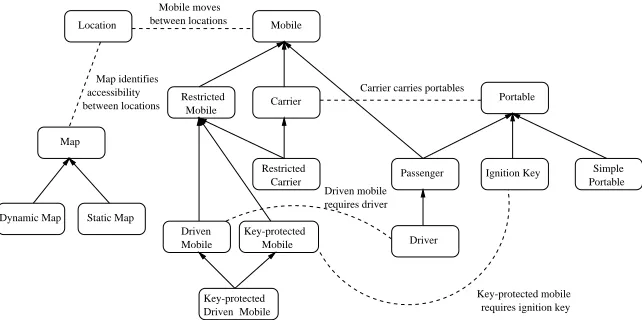
The work done to date primarily identifies a family of types clustering around the notion of a “mobile”. Fig-ure 3 shows an initial pattern language for this collec-tion of patterns. We distinguish two forms of mobile, those constrained to move on “maps” and those that move on “sets”. The first we call “mobiles” the second we call “carriers”. There is then a number of optional
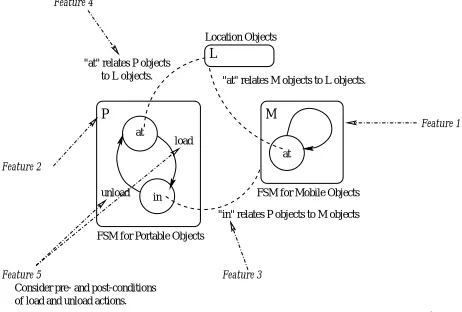
components that can be added to both mobiles and car-riers. First both may be used to transport other objects. In which case the other objects will make a transition analogous to the “mobile” when the mobile moves but they will also make transitions when “loaded” into the mobile and “unloaded”. These objects which we call “portables” can be characterised by state diagrams as shown in figure 4 The behaviour of portables are to be
L
FSM for Mobile Objects
M P
Location Objects
"in" relates P objects to M objects to L objects.
"at" relates P objects
"at" relates M objects to L objects.
FSM for Portable Objects at
in
at
Feature 1
Feature 2
Feature 3 Feature 4
Feature 5
load
unload
Consider pre- and post-conditions of load and unload actions.
The following components form the fingerprint for portability:
1. A previously identified mobile generic type,M, and its linked lo-cation generic type,L.
2. A new type,P, with a FSM containing two states linked by tran-sitions in both directions.
3. One state of the FSM forPmust include a property formed from a predicate linking theP type objects to theMtype objects.
4. Theotherstate of the FSM must contain a property formed from a predicate linking theP type objects to theLtype objects.
5. The operators from which the two transitions in thePtype FSM are derived must require anM object to be located at the same location as thePobject is located at the appropriate end of the transition.
Note that thenamesof the operators and predicates are irrelevant and that the name of the predicate in feature 4 need not be the same
[image:5.595.321.552.162.318.2]as the locatedness predicate for typeM.
Figure 4: The Portable Generic Type
Restricted Mobile
Passenger Ignition Key
Driver
Portable Location
Dynamic Map Map
Static Map
Carrier Mobile
Restricted Carrier
Driven Mobile
Key-protected Mobile
Driven Mobile
Key-protected Key-protected mobile requires ignition key
Simple Portable between locations
accessibility Map identifies
between locations Mobile moves
Carrier carries portables
[image:6.595.146.467.53.213.2]requires driver Driven mobile
Figure 3: A Hierarchy of Mobile-related Generic Types
case arises when the transition of the portable is con-ditional on the portable being in the mobile but it is not required that a portable be in the mobile to allow the mobile itself to make the movement transition. In this case the conditional transition will apply to any in-stance of the portable “in” the mobile. We have there-fore distinguished two types of mobile (a) carriers and (b) mobiles both being capable of being associated with two types of portable (i) drivers (ii) portables.
We have not yet exhausted our elaboration of the “mobile” generic type. In a number of domains, in-cluding one of the simplest, the “rocket” world, there is a notion of fuel which is a resource to be consumed as a result of the mobile moving. In the rocket world the fuel is consumed in one shot. The rockets starts with fuel full but any movement action results in the rocket being empty of fuel. We can easily see that the consumption of the resource could have been staged and to accom-plish this we model the movement action as traversing
a step of a sequence on each movement. Given the
sequence {full, half, empty} a single movement action
might take the rocket from full to half and from half
to empty. With the notion of resources we can
aug-ment any transition as any transition might consume or produce some resource. The movement action may consume fuel, but equally loading or unloading some portable may consume energy.
In the discussion above we have not described fea-tures of mobiles that require “dynamic maps” nor “key” enabled actions. We have given an indication of the complexity and flexibility of the “mobile” generic type, viewed as a design pattern.
Composition of Generic Types
The problems of the composition of patterns falls broadly in two. The simple case is that already ex-plored where a complex pattern has many optional but predictable variations. Examples are where a mobile requires a driver or consumes a resource. The more problematic case is where the domain contains two or
more patterns where the same object type plays a role in more than one pattern instance. This can happen even in domains just containing mobiles. In a variation of the “hiking” domain we may have cars which can be used to transport the hikers from one centre to another but the hikers themselves may be mobiles in that they also walk from some locations to neighbouring moun-tain tops. In relation to the car(s) mobile pattern the hikers will play the role of either, or both, the roles of “drivers” and “portables” but in relation to their walk-ing they play the role of mobiles perhaps even with their own portables such as the “tent” which they may carry on some walks.
The problem of composition also occurs where we have conceptually independent patterns. To illustrate, one of the patterns we are working with we call a “bis-tate” and it represents objects that typically exist in one of two states and there are actions to change back and forth between the states. A canonical example of a bistate would be a switch that can be “off” or “on”. In the hiking domain the tent that the hikers sleep in may play a role as “portable” relative to the car and the hikers themselves, but may additionally be modelled as a bistate in that it is typically either “up” i.e. erected or “down”. In this case the “erect” transition may be
captured by the formula [down(T ent0)]⇒[up(T ent0)]
The “load” and “unload” transitions associated with the tent as portable may be captured as:
[at(T ent0, LocA)]⇒[in(M obile0, T ent0, LocA] and [in(M obile0, T ent0, LocA]⇒[at(T ent0, LocA)]. The combination that we require is to associate the “down” state with the “at” state but we cannot simply replace the designation of the “down” state with that of the “at” state because the “at” state carries extra information about the location of the tent. We could not adequately describe the transition of the tent when
we take it down as [up(T ent0)] ⇒ [at(T ent0, LocA)]
as there is no indication as to how the “LocA”
vari-able is to be bound. Obviously the location of the
erected. Accordingly to preserve the location informa-tion we must merge the arguments in the “at” and “down” states and then propagate additional argu-ments to the other state descriptors in the merged pat-terns. In this case the “erect” transition now becomes [at(T ent0, LocA)] ⇒ [up(T ent0, LocA)] and the “take down” transition is similarly enhanced.
The strategy shown here is the one that we gener-ally follow in combining instances of patterns where a common state exists between the roles of the merged patterns.
Domain Definition using Generic Types
To enable the domain developer to use the identified generic types to structure a domain we have developed a series of dialogs which we have integrated into the
[image:7.595.311.515.92.252.2]GIPO domain development tool. The dialogues allow
Figure 5: The Pattern Manager
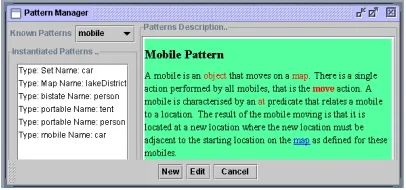
the user to choose the relevant patterns and then tailor them to the problem in hand. In simple cases tailoring is simply a matter of naming the components of the pattern in an appropriate way. In more complex cases the user must add optional components to the pattern again by form filling and in the most complex cases en-sure that domains using multiple patterns allow them to interact with each other in the correct way. The set of dialogues form a domain editor in such a way that the user committing her choices in the editing dialogues will result in the formal domain specification being au-tomatically generated. We illustrate the process with snapshots taken from the “Pattern Manager” in figure 5 which is used to control the addition and editing of pat-terns known and instantiated within the domain. We also show the main dialog for defining the parameters of the “mobile” pattern in figure 6.
Evaluation
The implemented pattern editors that we have pro-duced currently give good coverage of domains featuring “mobiles” of one sort or another. Our evaluation is cur-rently limited to testing to see if we can produce using the pattern editors versions of the domains that have
been made available as part of previous AIPS
[image:7.595.47.250.285.380.2]compe-titions. We are judging equivalence of domains not at
Figure 6: The Mobile Dialog
the level of encoding the operators and problems but rather at the level of generality that would allow us to say that derived solutions to equivalent problems are equivalent. We do not require for example that any planner that works with the original will work with our generated version, as this is not the case even in the rocket world as our encoding uses conditional effects whereas the commonly available originals typically do not. We would also judge domains to be equivalent even where they do not contain the same number of
operators or predicates, for example a move operator
may be either expanded into multiple move operators
each responsible for moving objects of different sorts or conversely we may contract multiple operators into a
single operator dealing with a more generalsort.
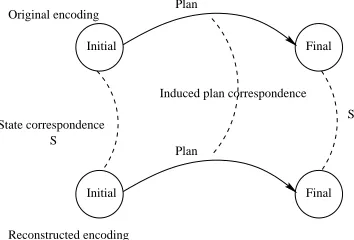
An interesting observation is that though the pattern-directed reconstructions of classic domains are not always identical to the familiar encodings we con-sider it a strength of the use of patterns that a canon-ical encoding, with its attendant well-understood be-haviours, is used to encode the domains. Nevertheless, it raises an important point about the expected be-haviour that a domain is intended to capture. In recon-structing domains we expect to find that there is a cor-respondence between legal states of the reconstructed domain and the original encoding, with an induced cor-respondence between plans in the two domains (see fig-ure 7). Confirmation that this correspondence exists forms a reasonable element of the evaluation of the use of the pattern-directed approach to domain construc-tion.
Initial Final Plan
Initial Final
Plan State correspondence
S
S Induced plan correspondence Original encoding
[image:8.595.85.262.60.180.2]Reconstructed encoding
Figure 7: Equivalence between domain encodings.
approach to be an efficient and convenient way to gen-erate domains. A separate dimension of evaluation is to consider the extent to which the patterns provide support across a wide range of domains. For example, one might consider how many benchmark domains can be reconstructed using the patterns, with the patterns providing support for a high-level view of the domain objects and their behaviours. It is of interest to note that many of the benchmark domains include a trans-portation element (Logistics, Gripper, Briefcase, Grid, Mystery and MPrime are all examples). The Tyreworld domain consists chiefly of interlocking bistate elements (hubs can be up or down, nuts are on or off, loose or tight, and wheels are on or off, inflated or deflated). Many of the other domains contain a construction com-ponent (Hanoi, Blocksworld, Assembly and Freecell) and we are currently exploring the implementation of a generic cluster to support construction.
Further Work
The work described above is still work in progress. We continue to develop it at a number of levels. We con-tinue to work on incorporating known “generic types”
into theGIPOtool and to enhance the facilities within
the tool for creating, editing and combining patterns. At the level of the patterns themselves there is still more work to be done in identifying new patterns and elaborating further the existing patterns. We are also working at formulating more formally the rules for com-bining patterns with an ultimate goal of providing a for-mal description of patterns and an “algebra” for their composition. Ideally the outcome of this work would be tools to allow the domain designer to develop a wide range of domain definitions without the need to develop the domain in any way at the level of the underlying
specification language such asOCLorPDDL. A further
goal of the work is also to provide planning algorithms with information on the instantiated patterns to allow them to use this as control information to inform the planning process itself. We do not expect however that this will eliminate the need for further domain analysis to assist in speeding up planning solution production.
References
A. Tate (editor). 1996. Advanced Planning
Technol-ogy: Technological Achievements of the ARPA/Rome
Laboratory Planning Initiative. IOS Press.
Alexander, C.; Ishikawa, S.; Silverstein, M.; Jacobson,
M.; Fiksdahl-King, I.; and Angel, S. 1977. A Pattern
Language. Oxford University Press.
Benjamins, Nunes de Barros, Shahar, Tate and Va-lente (eds). 1998. Workshop on Knowledge Engineer-ing and Acquisition for PlannEngineer-ing: BridgEngineer-ing Theory and Practice. Proceedings of AIPS.
Fox, M., and Long, D. 1997. The Automatic Inference
of State Invariants in TIM. JAIR9:367–421.
Gamma, E.; Helm, R.; Johnson, R.; and Vlissides, J.
1995.Design Patterns: Elements of reusable software.
Addison-Wesley.
Liu, D., and McCluskey, T. L. 2000. The OCL Lan-guage Manual, Version 1.2. Technical report, Depart-ment of Computing and Mathematical Sciences, Uni-versity of Huddersfield .
Long, D., and Fox, M. 2000. Automatic synthesis
and use of generic types in planning. In Proc. of 5th
Conference on Artificial Intelligence Planning Systems
(AIPS), 196–205. AAAI Press.
Long, D., and Fox, M. 2001. Planning with generic
types. Technical report, Invited talk at IJCAI’01
(forthcoming Morgan-Kaufmann publication). Muscettola, N.; Nayak, P. P.; Pell, B.; and Williams, B. C. 1998. Remote Agent: To Boldly Go Where
No AI System Has Gone Before.Artificial Intelligence
103(1-2):5–48.
PLANET. 1999. PLANET Knowledge Technical
Co-ordination Unit. http://scom.hud.ac.uk/planet.
Simpson, R. M.; McCluskey, T. L.; Liu, D.; and Kitchin, D. E. 2000. Knowledge Representation in
Planning: A PDDL toOCLhTranslation. In
Proceed-ings of the 12th International Symposium on Method-ologies for Intelligent Systems.
Simpson, R. M.; McCluskey, T. L.; Zhao, W.; Aylett, R. S.; and Doniat, C. 2001. GIPO: An Integrated Graphical Tool to support Knowledge Engineering in
AI Planning. InProceedings of the 6th European