2017 2nd International Conference on Information Technology and Industrial Automation (ICITIA 2017) ISBN: 978-1-60595-469-1
An Evaluation Method of the Drafting Unit of
National Standard Based on AHP
Yunpeng Chen, Xia Wang, Jingjing Han and Yan Wang
ABSTRACT
The paper introduces the application of analytic hierarchy process (AHP) in evaluating the drafting units of national standard. Based on the theory of AHP, evaluation indicators of drafting units of national standard are established. The influences and significances of drafting units include four subordinate level indicators: location, competent department, type of industry and type of standard. Then these indicators are weighted through AHP, and the evaluation model is built.
INTRODUCTION
In order to strengthen the management of national standards, the national standards have to be formulated.
Developing national standards is helpful for rational development and utilization of national resources, promoting scientific and technological achievements. It is also important to ensure safety and the health of the people, protect the environment and the interests of consumers through advanced technology, reasonable economy, safe and reliable, coordination of form a complete set.
The management institution of national standard is Standardization Administration of China [1]. The drafting unit is a department for writing standard. The comprehensive strength of the national standards drafting units must be in their industry forward and their product quality, technology and innovation are in the industry leading [2].
________________________
Yunpeng Chen, Xia Wang, Chinese Standardization Research Institute, Haidian, Beijing, China, 100191.
THE THEORY OF AHP
Analytic Hierarchy Process (AHP) is a hierarchical weighted decision analysis method which is proposed by a professor at the University of Pittsburgh in the early 1970s. AHP is a decision-making method of qualitative and quantitative analysis which would resolve the elements related to the decision into objectives, principles and scheme [3].
The basic steps of AHP include: 1. Conceptualize the complex problem and find out the object of study the main factors involved. 2. Analyze the correlation of each factor, the subordinate relations and build the structure model of orderly steps. 3. Compare the same level of various factors on the relative importance of a layer of standards and establish judgment matrix. 4. Calculate compared factors relative weights on the principles of last layer by the judgment matrix and do the consistency check. 5. Calculate the synthetic weight of overall goal on all levels relative to the system and do the hierarchy total sort [4].
THE ESTABLISHMENT OF EVALUATION SYSTEM
The Establishment of Index System and the Explanation
First of all, according to the requirement of the AHP, we determine target layer, criterion layer and layer scheme of ladder hierarchy.
In reference to a number of AHP, on the basis of the literature and combined with the characteristics of the national standards drafting unit, we determine the quality of the drafting unit to evaluate the overall goal by their locations, competent departments, industry types, standard types and identify them as primary index. Then it is decomposed and detailed to construct an evaluation index system of the national standard drafting units.
Location: This indicator explains the unit’s area. It includes 7 parts: North China area, Central China area, Northeast area, Northwest area, South China area, East China area and Southwest area. In particular, North China area includes Beijing, Tianjin, Hebei, Shanxi, Inner Mongolia autonomous region. Central China area includes Henan, Hunan and Hubei province. Northeast area includes Heilongjiang, Jilin and Liaoning province. Northwest area includes Shaanxi, Gansu, Qinghai province, The Ningxia Hui Autonomous region, The Xinjiang Uygur Autonomous region. South China area includes Fujian, Hainan, Guangdong, Taiwan, Hong Kong and Macao. East China area includes Shanghai, Shandong, Jiangsu, Zhejiang, Anhui and Jiangxi. Southwest area includes The Guangxi Zhuang autonomous region, Sichuan, Yunnan, Guizhou, Chongqing and The Tibet Autonomous region.
Group Corporation (CNIGC), China Electrical Equipment Industrial Association (CEEIA) Chinese Academy of Sciences (CAS), etc.
Type of industry: Industry types are classified according to the three major industries. The first industry includes agriculture, forestry, animal husbandry and fishery. The second industry involves mining, manufacturing, electricity, gas and water production and supply industry, construction industry [5]. The third industry has transportation, warehousing and postal service, information transmission, computer services and software industry, wholesale and retail trade, accommodation and catering industry, finance, etc.
Type of standard: It refers to the type of national standards drafted by the involved units. We concern the main part of the type in the data. They are security, product, method, administration, environment protection, basis and health [6].
The Weighted Indicators
THE PRINCIPLE OF QUANTIFYING THE INDICATORS
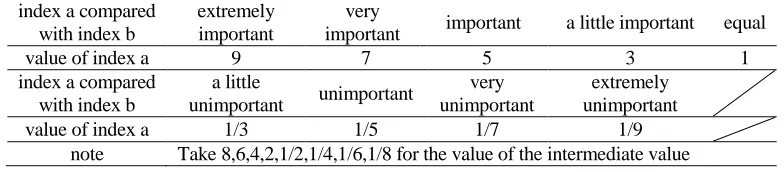
According to its importance relative to the index of last level, the importance degree and degree of unimportance for the indicators are compared which are at the same level. Then, we give a score through the standard shown in Table I.
CALCULATING WEIGHT OF EACH INDEX
Information of the AHP method is based on judgment matrix and matrix ranking vector is obtained by the ordering principle. Then we can calculate the index weight coefficient and complete the following steps:
Calculating the volume of the element of each line in judgment matrix B:
1 , 1, 2,..., , 1, 2,..., n
i j
j
M b i n j n
(1)
Calculating the n root value of each line:
, 1, 2,...,
n
i i
W M i n
(2) in which n is the order number of matrix.
Normalizing the vector
1, 2,...,
T NW W W
, Wt is that desires of the weight
coefficient of every index value, and the computation formula is shown as follows:
1
, 1, 2,..., , 1, 2,...,
t t n
j j
W
W j n t n
W
TABLE I. STANDARD OF SCORING JUDGMENT MATRIX INDEX. index a compared
with index b
extremely important
very
important important a little important equal
value of index a 9 7 5 3 1
index a compared with index b
a little
unimportant unimportant
very unimportant
extremely unimportant
value of index a 1/3 1/5 1/7 1/9
note Take 8,6,4,2,1/2,1/4,1/6,1/8 for the value of the intermediate value
THEAPPLICATION OF THE ANALYTIC HIERARCHY PROCESS (AHP) In the first-level indicators, drafting units’ location and competent department have the equal quality. So we give a same weight for the two first-level indexes. For the type of industry and standard, we give their weight based on the analysis of data of detailed national standard in 2013 and 2016as 0.35 and 0.25.
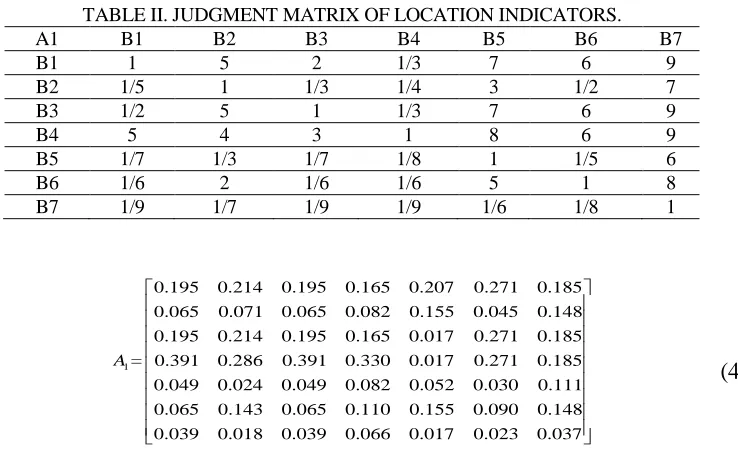
Then, we could calculate the judgment matrix. We use the each rank number of each province in the 7 location indicators. Then, add the number of each area. For example, in the North China area, we add the GDP ranking number of these 5 province-level administrative. Next, we use this number divided by 5, and the mean number has be solved. We set this mean number as a new ranking number. By parity of reasoning, we could get the rest of 6 mean number, and find 6 ranking number of the rest of location indicators. By our statistical analysis based on the 2016 GDP ranking of Chinese mainland's 31 provincial-level administrative region, we could give the location indicators’ judgment matrix shown in Table II.
We could get a judgment matrix. Next we normalized it and get matrix A1.
Using the above method, we calculate the weight of each index respectively. They are W1=0.25,W2=0.09,W3=0.19,W4=0.24,W5=0.06,W6=0.13,W7=0.04 .
Then, we check whether weights have logic errors by consistency index.
According to the formula
max 1 n i i i AW nW
to get the largest eigenvalue of
matrix: max 28.816. Consistency index
max 28.816-7 = =3.636 1 6 n CI n
. Random
TABLE II. JUDGMENT MATRIX OF LOCATION INDICATORS.
A1 B1 B2 B3 B4 B5 B6 B7
B1 1 5 2 1/3 7 6 9
B2 1/5 1 1/3 1/4 3 1/2 7
B3 1/2 5 1 1/3 7 6 9
B4 5 4 3 1 8 6 9
B5 1/7 1/3 1/7 1/8 1 1/5 6
B6 1/6 2 1/6 1/6 5 1 8
B7 1/9 1/7 1/9 1/9 1/6 1/8 1
(4)
[image:5.612.109.491.394.683.2]This suggests that the consistency of judgment matrix is satisfied and the weight has no logic error. Using the same method to calculate index weight at each level, specific is shown in Table III.
TABLE III. QUALITY EVALUATION INDEX SYSTEM.
quality evaluation
index system
first-level index second-level index synthetic of weight
(A1) location
0.2
B1 North China 0.25 0.05
B2 Northeast China 0.09 0.018
B3 East China 0.19 0.038
B4 South China 0.24 0.048
B5 Northwest China 0.06 0.012
B6 Central China 0.13 0.026
B7 Southwest China 0.04 0.008
(A2) competent department
0.2
B8 ministry 0.36 0.072
B9 bureau 0.23 0.046
B10 enterprise 0.14 0.028
B11 academic institution 0.14 0.028
B12 association 0.08 0.016
B13 committee 0.05 0.01
(A3) type of industry
0.35
B14 the first industry 0.30 0.105
B15 the second industry 0.16 0.056
B16 the third industry 0.54 0.189
(A4) type of standard
0.25
B17 security 0.17 0.042
B18 product 0.17 0.042
B19 method 0.17 0.042
B20 administration 0.17 0.042
B21 environmental protection 0.17 0.042
B22 basis 0.17 0.042
1
0.195 0.214 0.195 0.165 0.207 0.271 0.185 0.065 0.071 0.065 0.082 0.155 0.045 0.148 0.195 0.214 0.195 0.165 0.017 0.271 0.185 = 0.391 0.286 0.391 0.330 0.017 0.271 0.185 0.049 0.024 0.049 0.082 0.052 0.030 0.111 0.065 0.143 0.065 0.110 0.
A
155 0.090 0.148 0.039 0.018 0.039 0.066 0.017 0.023 0.037
Quality Evaluation Index System of Drafting Unit
After the determination of the overall goals, index decomposition, the establishment of the evaluation standard system and weighting of the indicators, we could get a total evaluation index system table for drafting units of national standard [7].
The number, where the table right side of every index, is its weights relative to the superior indexes. If it is relative to the overall goal, the various index of synthetic weight W ai aij, where ai,aij is weight of the first-level and second-level index
respectively.
From the index weights we can find that the third industry, the first industry, the second industry and the type of standard are more important indexes of quality evaluation index system.
CONCLUSION
AHP is a combination of man's subjective judgment to analyze the complex qualitative problems of quantitative methods. But the main limitations are people's subjective judgment for system evaluation result has great influence. This paper applies AHP to evaluate the drafting unit and a set of quantitative evaluation index system is established. The evaluation index system for drafting national standard has the certain reference value.
ACKNOWLEDGEMENTS
This paper is supported by the Data Acquisition of Brand Evaluation and Relevant National Standards Research Application Technology Applicability (252016z-4623-01).
REFERENCES
1. Kunxiu Ren. 2015. “The Empirical Study on the Contributions, Comparison and Nature of the
National Standards: the Case of Ten Countries”, Journal of Shanghai Economic Management
College, 13(1): 3-12.
2. Chuntian Li. 2012. “The Evolvement and Significance of the Theory of Standards
Classification”, China Standardization, 1:53-58.
3. Gianluca Lax, Giuseppe M. L. Same. 2008. “A Reputation Model for C2C commerce.”
Electronic Commerce Research, 08(20): 193-216.
4. Huixin Ke, Hao Shen. 2005. Statistical Analysis Method in the Investigation. Communication
University of China Press, pp. 193-220.
5. Michael B. Gordy. 1998. “A Comparative Anatomy of Credit Risk Models.” Board of
6. Chuntian Li, 2010. Introduction to Standardize. China Renmin University Press, pp.19-20, 110-114.
7. LuJian Chang, Liao Jing. 2010. “E-Commerce Customer Credit Evaluation Based on AHP.”