2017 2nd International Conference on Manufacturing Science and Information Engineering (ICMSIE 2017) ISBN: 978-1-60595-516-2
Research on Architecture and Mode of
Internet of Things Based on Industrial
Process Control System
Yijie Li and Biyuan Jian
ABSTRACT
Computer technology, network technology, communication technology and control technology to construct the network structure based on the industrial control system, using the method of system engineering, analysis of industrial process control framework and networking logic hierarchical structure, the establishment of industrial control network structure of three layers, the accuracy of feature show things and main functions. Correctly build a system architecture and model that is easy to apply and has industrial control and Internet of things capabilities. The three layer Internet of things framework is of practical significance for the composition and analysis of the architecture of industrial control Internet of things. It provides the basis and reference for the structure and mode of the Internet of things of industrial control system.1
KEYWORDS
Industrial Control; Internet of Things;System Model
INTRODUCTION
The establishment of the industrial control networking is industrial components interconnected system with the aim of perception, and relates to the network communication and information processing, sensor, service technology, identification, localization, synchronization, data mining, network integration and other technical field.
An automatic control system that represents the parameters of a production process as controlled quantities that are close to a given value or maintained within a given range. Industrial process refers to the interaction and conversion of material and energy in a production plant or equipment. The main parameters of the process control are temperature, pressure, flow, liquid level, composition, concentration, etc.. By controlling the process parameters, the output of the product can be increased, the quality is improved and the energy consumption is reduced in the process of production. The process control system usually adopts the form of feedback control, and the closed process control is the main mode.
The establishment of the industrial control networking is industrial components interconnected system with the aim of perception, and relates to the network communication and information processing, sensor, service technology, identification, localization, synchronization, data mining, network integration and other technical field.
An automatic control system that represents the parameters of a production process as controlled quantities that are close to a given value or maintained within a given range. Industrial process refers to the interaction and conversion of material and energy in a production plant or equipment. The main parameters of the process control are temperature, pressure, flow, liquid level, composition, concentration, etc.. By controlling the process parameters, the output of the product can be increased, the quality is improved and the energy consumption is reduced in the process of production. The process control system usually adopts the form of feedback control, and the closed process control is the main mode.
INDUSTRIAL CONTROL SYSTEM INTERNET OF THINGS ARCHITECTURE
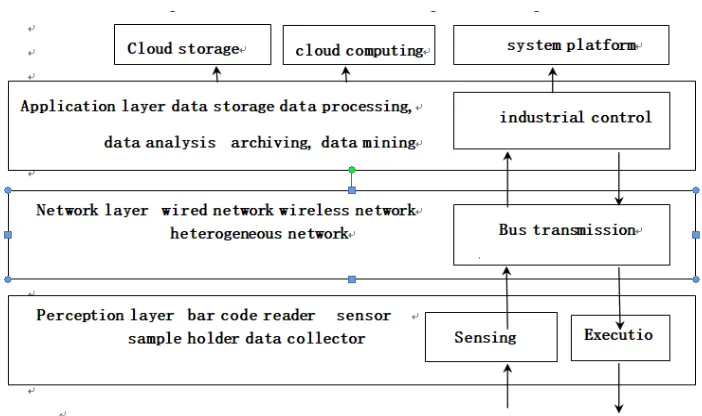
As a kind of diversified and complex system, industrial control Internet of things involves each layer of information technology from top to bottom. The system architecture can be divided into three layers: perception layer, network layer and application layer. One specific aspect of the public does not belong to the technology of networking technology, networking technology, but with the three layer architecture has a relationship, it includes the identification and analysis, security technology, network management and production management etc..
Figure 1. Industrial control system structure diagram of Internet of things.
The industrial control system consists of an industrial control system, an industrial control system platform, a data communication system, a sensing system, and a system execution unit. The sensing system transfers the sampled data from the industrial control system to the industrial control system through the communication system. The industrial control system carries out data processing, and the processed data is displayed by the platform of the industrial control system. And transfer to the Internet of things application layer, cloud storage and cloud computing. The feedback information of industrial control system is transferred from communication system to executive part, and the control engineering of industrial control system is completed.
INDUSTRIAL CONTROL THE COMPOSITION OF THE INTERNET OF THINGS
The network layer network layer: the future self-sensing layer of all kinds of information through network transmission to the application layer, including mobile communication network, the Internet, cable networks, wireless networks and the formation of fusion network. Focuses on the network layer from the perception layer, after a preliminary processing of data by all kinds of network transmission problems.
Application layer: application layer mainly includes service support layer and application subset layer. The core function of the Internet of things is to collect, develop and utilize the information resources. The main function of service support layer is to form a dynamic data resource base which adapts to the requirement of industrial control system and updates in real time according to the data collected at the bottom. There are also cloud storage and cloud computing that are based on industrial process control data. Data mining, data mining.
The structure of industrial control Internet of things consists of three layers: Perception layer: the sensing layer consists of data acquisition sub layer, short distance communication technology and cooperative information processing sublayer. The data acquisition sublayer obtains the physical information and the data information in the control object through various types of sensors. The data collection of the Internet of things involves sensors, RFID, multimedia information acquisition, two-dimensional code and real-time positioning technology. The short distance communication technology and the cooperative information processing sub layer cooperate the local data to improve the acquisition accuracy of the field information.
The network layer network layer: the future self-sensing layer of all kinds of information through network transmission to the application layer, including mobile communication network, the Internet, cable networks, wireless networks and the formation of fusion network. Focuses on the network layer from the perception layer, after a preliminary processing of data by all kinds of network transmission problems.
Application layer: application layer mainly includes service support layer and application subset layer. The core function of the Internet of things is to collect, develop and utilize the information resources. The main function of service support layer is to form a dynamic data resource base which adapts to the requirement of industrial control system and updates in real time according to the data collected at the bottom. There are also cloud storage and cloud computing that are based on industrial process control data. Data mining, data mining.
APPLICATION OF INTERNET OF THINGS IN INDUSTRIAL CONTROL SYSTEM
Industrial control applications can be divided into 4 categories:
(1) the cognitive ability of the industrial control system to the sampling system. Comprehensive information collection is the foundation of the Internet of things.
(2) on the basis of network transmission, it is not divided by the type of industrial control system, but divided by the way of providing network services, emphasizing the existing network services. Such as seamless access to heterogeneous network environments, collaborative heterogeneous network business provision, and application oriented terminal capability collaboration.
(3) setting up the application target and integrated information processing of industrial control Internet of things, including the collection, distribution, analysis, implementation of network and control system of application objects.
(4) the industrial Internet of things has broken down the local geographical restrictions, and realized the network of information acquisition, transmission, storage, combination and use of the equipment needed by the control network.
CONCLUSIONS
Industrial control Internet of things is the application of computer technology and network technology in the industrial field. It has the characteristics of the Internet and the Internet, but also has its own characteristics. Characteristic is the structure and mode of industrial control Internet of things.
(1) based on computer technology, network technology, communication technology and control technology, the structure of Internet of things of industrial control system is constructed.
(2) using the method of system engineering, the framework of industrial process control and the logical hierarchy of Internet of things are analyzed. The three layer structure of industrial control Internet of things is established, and the characteristics and connotation of Internet of things are precisely indicated.
(3) provide the basis and reference for the structure and mode of Internet of things of industrial control system.
REFERENCES
1. Ali Salehi, Karl Aberer. GSN, Quick and Simple Sensor Network Deployment [R]. European Conference on Wireless Sensor Networks, Netherlands, 2007.
2. Yin Hide Fen, Gong Huaming. Discussion on the application of middleware technology in the Internet of things [J]. Technology Square, 2010 (11).