S T U D Y P R O T O C O L
Open Access
Internet-based self-help treatment for depression
in multiple sclerosis: study protocol of a
randomized controlled trial
Rosa E Boeschoten
1,2*, Joost Dekker
1,2, Bernard MJ Uitdehaag
3,4, Chris H Polman
3, Emma H Collette
5,
Pim Cuijpers
2,6, Aartjan TF Beekman
1,2and Patricia van Oppen
1,2Abstract
Background:Depression in MS patients is frequent but often not treated adequately. An important underlying factor may be physical limitations that preclude face-to-face contact. Internet-based treatment showed to be effective for depressive symptoms in general and could thus be a promising tool for treatment in MS.
Methods/design:Here, we present a study protocol to investigate the effectiveness of a 5 week Internet-based self-help problem solving treatment (PST) for depressive symptoms in MS patients in a randomized controlled trial. We aim to include 166 MS patients with moderate to severe depressive symptoms who will be randomly assigned to an Internet-based intervention (with or without supportive text-messages) or waiting list control group. The primary outcome is the change in depressive symptoms defined by a change in the sum score on the Beck Depression Inventory (BDI-II). Secondary outcomes will include measures of anxiety, fatigue, cognitive functioning, physical and psychological impact of MS, quality of life, problem solving skills, social support, mastery, satisfaction and compliance rate. Assessments will take place at baseline (T0), within a week after the intervention (T1), at four months (T2) and at ten months follow-up (T3: only the intervention group). The control group will be measured at the same moments in time. Analysis will be based on the intention-to-treat principle.
Discussion:If shown to be effective, Internet-based PST will offer new possibilities to reach and treat MS patients with depressive symptoms and to improve the quality of care.
Trial Registration:The Dutch Cochrane Center, NTR2772
Keywords:Depression, Multiple sclerosis, Internet, Treatment, Randomized controlled trial
Background
Multiple Sclerosis (MS) is a chronic and progressive in-flammatory autoimmune disorder of the central nervous system. MS is a relatively common disease -affecting ap-proximately 1–2 per 1000 individuals- and mainly com-mences in early to middle adult life. MS patients suffer from a variety of neurological symptoms such as fatigue, poor balance, impaired speech, bladder and bowel dys-function, weakness, pain, spasms, cognitive deficits [1,2].
Lifetime risks for depressive disorders in MS patients are high (~50%) [3]. Findings thus far indicate that de-pression seems more severe and common in MS com-pared with healthy people. However, due to overlap of MS symptomatology with neurovegetative depressive symptoms such as fatigue, sleeping problems and cogni-tive impairment, estimated depression prevalence in MS might be overrated. It also remains unclear to what de-gree depressive symptoms are a neurological conse-quence of the disease or a psychological reaction to the presence of a chronic medical condition with an uncer-tain and unpredictable course [4]. Some studies that compared depression in MS with other neurologic con-ditions and chronic diseases, suggest that depression in * Correspondence:[email protected]
1Department of Psychiatry, VU University Medical Center Academic Anxiety
Outpatient Clinic and GGZinGeest, A. J. Ernststraat 1187, Amsterdam, HL 1081, The Netherlands
2
EMGO Institute for Mental Health and Care Research, VU University, Amsterdam, The Netherlands
Full list of author information is available at the end of the article
MS can be partly attributed to the additional neuro-logical impact of MS [4-6].
Irrespective of its unclear etiology, depression in MS patients causes significant suffering and disability. De-pression is associated with fatigue, cognitive impairment, and poorer social support [7]. Moreover, it is related to lower quality of life [8], increased risk of suicide [9] and may adversely affect health status via effects on the im-mune system or indirectly by influencing behavior that affects risk of MS exacerbation [10,11].
However, depression in MS patients often stays un-diagnosed [12]. There may be several explanations for the high level of unrecognized depression in MS patients. It is suggested that MS patients are not actively screened and diagnosed by their clinician on depression. In addition, patients could feel resistance to disclose their emotional problems or perceive them as an unsolv-able component of the disease, therefore leaving them unmentioned [3]. Besides, as a result of overlapping symptomatology, confounded symptoms may be entirely attributed to MS when in fact a portion of those symp-toms are attributable to depression. However, depression does not seem to remit spontaneously and may even worsen over time if not treated [11].
MS patients seem to respond well to psychothera-peutic and / or medical treatment for depression [13,14]. Depression in MS patients seems to be related to poor problem solving skills [7], and learning various coping strategies has been found to reduce symptoms of depres-sion in MS patients [14]. Research shows that Cognitive Behaviour Therapy (CBT) with a focus on developing sufficient coping skills is preferred to insight-oriented or supportive group therapy [11,14,15]. Problem Solving Therapy (PST) is a form of CBT and assumes that de-pressive symptoms can be caused by (practical) pro-blems people face in their daily lives combined with poor problem-solving skills. PST focuses on enabling people to solve problems by teaching them more ad-equate problem-solving skills and helping to accept those problems that cannot be changed [16,17]. PST in particular seems a favourable treatment for people with depressive symptoms and a somatic disease [18]. Never-theless, the literature on PST for depression in MS patients is limited [19].
Given the evidence for its responsiveness to treatment, it is remarkable that depression in MS patients is so in-frequently treated [3,13]. Apart from general obstacles as lack of time, no self-perceived need for care or stigma associated with treatment, MS patients may have disease-related barriers such as transportation problems, physical immobility, fatigue and exacerbations of the disease that might interfere with having face-to-face treatment [14]. Consequently, medication consults or face-to-face psychotherapy may not be feasible forms of
treatment for some MS patients [20]. Therefore, alterna-tive treatment delivery should be considered to increase access to mental health care. Telephone administered CBT has previously shown to be more effective in redu-cing depressive symptoms in MS patients compared to MS patients receiving supportive emotion-focused ther-apy [21] or no mental healthcare at all [22]. Recently, the Internet has grown as an important tool for deliver-ing mental health interventions [23]; Internet-based CBT or PST appear to be as effective as face-to-face therapy [24] and a successful method of treatment for depression in general [24,25]. Internet-based treatment is easily accessible, cost-effective and can reach a large number of people with functional impairments due to physical health problems which makes it an attractive treatment for the MS population.
However, there are few publications on Internet-based treatment for depressed MS patients. Recently, a multi-center trial was suggested, based on a pilot study that explored Internet-based CBT for the treatment of de-pression [26]. Qualitative data from this research group showed that existing Internet-based CBT packages might not just be appropriate for MS patients due to MS related physical and cognitive impairments, inappropri-ate content, social isolation and problems with computer use [27]. However, data from our recent pilot study on Internet-based treatment for depression in MS showed evidence that Internet-based self-help PST treatment [28], adjusted to MS patients, can be a feasible treatment [29]. Patients reported satisfaction with the intervention which reduced depressive symptoms, especially in those MS patients who completed the intervention. These findings encourage us to examine the effectiveness of this Internet-based self-help course for treatment of de-pressive symptoms in MS in a randomized controlled trial (RCT) with longer follow-up. With an easily access-ible Internet-based self-help intervention we hope to im-prove the level of care and treat a group of MS patients
with depressive symptoms who could experience
disease-related barriers to participate in face-to-face counselling.
a self-help Internet program for depressive symptoms compared to no reminders [33]. Recently, Mohr and colleges [34] investigated the feasibility of a multimodal e-mental health treatment for depressed patients in a pilot study, and suggested that joint effects of Internet and telephone administered support for depression are promising. In order to further increase compliance, we therefore plan to use telephone support in the form of text-messages in addition to the Internet-based intervtion. However, whether extra text-messages would en-hance compliance rates for Internet-based PST is not known.
The aims of our RCT will therefore be multiple. First, we will examine the effectiveness of an Internet-based PST self-help intervention on the primary outcome measure depressive symptoms in MS patients and on secondary outcome measures related to depression and MS such as quality of life, fatigue and cognitive func-tioning. If the intervention shows to be effective, predic-tors of a favorable outcome will be further explored. Finally, we will investigate whether text-messages added to the intervention will be effective to increase compli-ance rate of Internet-based treatment.
Methods Study design
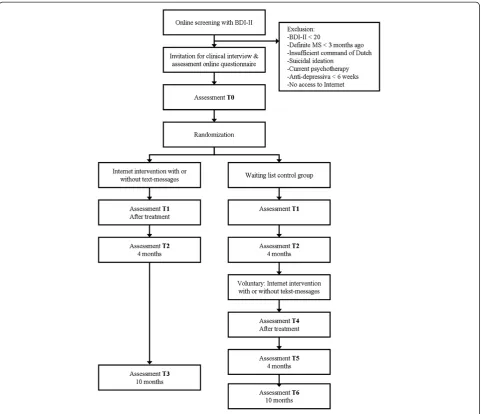
The presented study is a RCT in which a 5-week Inter-net-based self-help PST intervention will be tested ver-sus a waiting list control group. Eligible and consenting patients will be assessed at baseline (T0), within a week after the intervention (T1), at four months (T2) and at ten months follow-up (T3: only the intervention group). The control group will be measured at the same moments in time. Patients in the waiting list condition who still want to participate in the intervention after they completed the four months follow-up assessment are again measured after the intervention (T4), four months later (T5) and at ten months follow-up (T6). Data will be collected by self-report measures adminis-tered through the Internet. In addition, a telephone interview at baseline will be carried out by trained re-search staff.
Randomization takes place at individual level after baseline measurements (T0). We will use block-randomization with variable block sizes. A randomly allocated number of patients who take part in the inter-vention will receive supportive text-messages on their mobile phones in addition to the intervention. Alloca-tion will be unknown to the investigators and will be performed by an independent researcher using a compu-terized random digit generator. The study protocol was approved by the Medical Ethics Committee of the VU University Medical Center (VUmc) (registration number 11/047). Written informed consent is obtained from all
participants. Figure 1 displays the flowchart of the study design.
Recruitment
MS patients will be recruited from the Neurology De-partment of the VUmc, through calls in MS newsletters and Internet-sites concerning MS (e.g. Dutch MS co-operation; MS Centres), at MS meetings and via MS nurses. Interested patients will be asked to complete an online screening on their depressive symptoms, and sev-eral socio-demographic and MS-specific questions (i.e. year of diagnosis, onset of first symptoms, medication usage, type of MS). Eligible patients will be further informed about the study and asked to return written informed consent. Subsequently, patients general practi-tioner (GP) and neurologist will be informed about participation.
Inclusion and exclusion criteria
MS patients with depressive symptoms who are willing to take part in an Internet-based self-help course can participate in the study. Patients (i) have to be 18 years or older, (ii) score 20 or higher on the Beck Depression Inventory (BDI-II) [35], indicating a moderate or severe depression and (iii) report a diagnosis of definite MS more than 3 months ago which will also be confirmed by their neurologist. Potential patients will be excluded if they are currently receiving psychotherapy, do not have Internet access, do not have a sufficient command of the Dutch language, or report suicidal ideation. Patients will not be excluded if they are taking pre-scribed medication for depression or anxiety disorders over 6 weeks with stable dosage.
To exclude patients with suicidal intention, item 9
‘Suicidal thoughts or wishes’ of the BDI-II will be used. Patients who score ‘3’ (“I would kill myself if I had the chance”), will be contacted, further assessed and excluded and referred to their GP if necessary. Suicidal ideation will be also checked with an interviewer-rated scale of current suicidal ideation of the WHO-Composite International Diagnostic Interview (CIDI, World Health Organiszation (WHO) version 2.1) [36]. Patients with a score of 29 or higher on the BDI-II will be monitored extra.
Interview
patients indicate that their depressive symptoms are due to these attributes, a psychiatric diagnosis is not given. We decided that in case MS patients reported their MS or MS medication to be the reason for their sadness or anhedonia, the interviewer makes a note and scores the item negatively.
Further, the Perceived Need of Care Questionnaire (PNCQ) [37] will be used to measure patients' utilization of health care resources, needs for mental health care and the meeting of those needs. Further, the telephonic version of the Expanded Disability Status Scale [38] will be used to asses physical (MS) functioning and disability level.
Outcome measures Primary outcome measure
The primary outcome is the change in depressive symp-toms defined by a change in the sum score on the Beck
Depression Inventory (BDI-II, second edition) [35,39]. This self-report instrument is most often used to meas-ure depression severity in MS patients [3], and has shown to be valid, reliable and appropriate for the MS population [40,41].
Secondary outcome measures
Secondary outcomes will include measures of anxiety, fatigue, cognitive functioning, physical and psychological impact of MS, quality of life, problem solving skills, so-cial support, mastery, satisfaction and compliance rate. The measurement scales mentioned below have shown to be reliable, valid and responsive, and are widely used as an outcome measure in MS research and/or research on psychiatric conditions.
[image:4.595.58.540.88.502.2]Depression Scale [43]. We will use the Fatigue Severity Scale (FSS) [44] and Multiple Sclerosis Neuropsycho-logical Questionnaire (MSNQ) [45] to measure fatigue and cognitive functioning, respectively. In addition, we will use the Multiple Sclerosis Impact Scale (MSIS-29) [46] to assess the physical and psychological impact of MS and the EuroQol quality of life measure comprising a five-part questionnaire (EQ-5D) and a visual analogue self-rating scale (EQ-VAS) [47]. Social support will be measured with the Social Support Inventory [48] which contains questions on details about social support from the four most intimate persons. We will use the Social Problem Solving Inventory-Revised (SPSI-R) to deter-mine individual problem-solving skills [49]. Further-more, Mastery or locus of control, is measured by an abbreviated version of the Pearlin Mastery Scale [50]. Between follow-ups; psychotherapy and -medication usage will be registered.
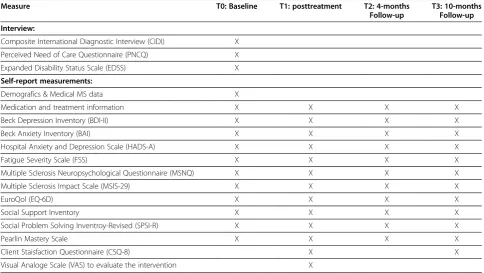
With the Client Satisfaction Questionnaire (CSQ-8) [51] we will check whether patients were satisfied with the care they received. The Visual Analogue Scale (VAS) will be assessed to evaluate patients opinions about the intervention as a whole, the website and received sup-port, (via the website and by text-messages if applicable) and additionally explore reasons for drop-out. Feasibility of additional text-messages will further be assessed by compliance rate; data on number of treatment sessions and drop-out will be collected. Table 1 describes the measures used at each assessment point.
Internet-based problem solving treatment
The Internet-based self-help intervention examined in this study is an online problem solving therapy (PST) [16]. We adjusted the original online intervention [28] for MS patients with co-morbid depression, conserving the intent of the PST-based intervention. Modifications concerned additional information about MS and its psy-chosocial consequences and texts and examples applying to MS patients. We also added a mood-chart to the intervention for daily mood-registration during the course. The mood-chart could stimulate patients to visit the website regularly and therefore enhance compliance. In addition, it offers the possibility to monitor the patients mood. The whole intervention exists of five modules with text, exercises and figures, and is called
‘Worry Less’(“Minder Zorgen”). Patients are asked to at-tend one module a week and work on their assignments for at least 2 hours per week.
[image:5.595.56.541.460.733.2]Patients can access the intervention from their personal computers via the Internet (https://minderzorgen.e-behan-deling.nl). Support during the intervention will be pro-vided by trained psychologists and supervised clinical psychology Master students, and consists of communica-tion through brief, weekly e-mails sent through the web-site and a weekly standardized e-mail to announce a new module. The e-mail correspondence is merely intended to facilitate the patient’s effective use of the self-help method. Patients have the possibility to contact their coach at any moment for additional support via the website.
Table 1 Summary of measures
Measure T0: Baseline T1: posttreatment T2: 4-months
Follow-up
T3: 10-months Follow-up
Interview:
Composite International Diagnostic Interview (CIDI) X
Perceived Need of Care Questionnaire (PNCQ) X
Expanded Disability Status Scale (EDSS) X
Self-report measurements:
Demografics & Medical MS data X
Medication and treatment information X X X X
Beck Depression Inventory (BDI-II) X X X X
Beck Anxiety Inventory (BAI) X X X X
Hospital Anxiety and Depression Scale (HADS-A) X X X X
Fatigue Severity Scale (FSS) X X X X
Multiple Sclerosis Neuropsychological Questionnaire (MSNQ) X X X X
Multiple Sclerosis Impact Scale (MSIS-29) X X X X
EuroQol (EQ-6D) X X X X
Social Support Inventory X X X X
Social Problem Solving Inventroy-Revised (SPSI-R) X X X X
Pearlin Mastery Scale X X X X
Client Staisfaction Questionnaire (CSQ-8) X X
Text-messages
As part of the intervention, a number of patients will re-ceive weekly text-messages on their mobile phones to support them during the intervention with the aim to enhance compliance. Patients will be randomly assigned to the intervention with- or without text-messages. In the latest case, patients will receive four standard text-messages a week. Text-text-messages will be sent to their mobile phones 1) at the start of a new module, 2) during the week to remind patients to fill in the exercise and mood-chart, 3) when homework is handed in by email, and 4) when feedback is returned by their coach. When homework is not handed in on time, patients will receive a reminder text-message. Patients cannot reply to the text-messages.
Waiting list control group
Patients randomized to the waiting list control group re-ceive no Internet-based PST. In accordance with the procedure of patients who participate in the interven-tion, patients in the waiting list control group are free to accept any medical or psychological intervention given in the time period of the study. The received mental healthcare will be registered. After completion of the four months follow-up assessment, patients are offered to participate in the Internet-based intervention on vol-untary basis irrespective their BDI-II score at T2. Patients who subsequently take part in the intervention and follow-up measurements will be additionally analysed.
Sample size
The power calculation is based at the comparison at T1 to T0 between the two groups. We want to be able to demonstrate moderate effects (d= 0.5) on the primary outcome measure, while using a power 0.80, with alpha set at .05 (two-tailed). Therefore, a total set of N = 64 completers is needed in each condition. Taking into ac-count the drop-out percentage of our pilot, we aim to include 166 patients.
Analysis
Non-parametric and parametric statistical tests are used to assess differences between the conditions with regard to baseline assessment of all relevant demographic and clinical variables. Missing data will be processed using regression imputation or a conservative Last Observa-tion Carried Forward method (LOCF) (depending on the sort and size of the missing data). Analysis will be based on the intention-to-treat principle. Paired t-tests are used to assess the changes within each condition be-tween pre-treatment and post-treatment. Difference in outcome between the Internet-based intervention and waiting list control group is evaluated by means of
mixed model analysis of covariance and baseline differ-ences will be included as a covariate in the analyses. Treatment effect over time will be tested by adding a group*time interaction term into the model. Cohen’s for-mula will be used to evaluate the magnitude of the effect of the intervention on outcome measures [52]. To calcu-late clinically significant improvement and recovery we will use the standardized method of Jacobson and Truax [53]. If the intervention shows to be effective, predictors of outcome will be explored by analyses of interaction between patients characteristics and treatment. Data of waiting list patients who decided to participate in the intervention will be analysed separately. Finally, descrip-tive statistics of compliance rate and satisfaction will be used to explore the feasibility of text-messages as a way to increase compliance rate to Internet-based treatment.
Discussion
The described study protocol is designed to investigate the effectiveness of an Internet-based self-help PST intervention for depressive symptoms in MS patients in a RCT. Treatment through Internet offers the possibility to reach a group of underserved MS patients who could experience disease-related barriers to participate in face-to-face counselling. Besides, the self-help aspect of Internet-based treatment could be appealing to a group of patients that already is dependent of professionals in the medical circuit because of their MS. According to our knowledge, the effectiveness of Internet-based treat-ment for depressive symptoms in MS patients has not been examined yet. Our trial will also shed more light on the applicability of PST in itself for patients who suf-fer from MS.
The external validity of our study is high because of the low level of exclusion criteria and the use of Internet that enables us to reach and treat a large part of the MS population. It should be noted that Internet-based treat-ment may not be suitable for MS patients who are not familiar with the Internet, or who suffer from MS related problems such as impaired vision and arm/hand dys-function. In addition, we will exclude patients with mild depressive complaints (BDI-II < 20). As a consequence, evidence will be lacking whether the intervention could be effective for this group of patients. However, our pilot-study [29] showed that patient with more severe depressive symptoms experienced more benefit from the intervention than patients with fewer depressive com-plaints. Moreover, patients with fewer depressive symp-toms at baseline (<20) were more likely to drop out of treatment and indicated to be less satisfied with the intervention. A meta-analysis [23] supports this finding and suggests that patients with less severe psychological difficulties may be less motivated to receive ongoing help. Driessen and colleagues concluded in their meta-analysis [54] that psychological treatment might even be more efficacious for more severely depressed patients than low severely depressed patients. For these reasons we decided to focus on MS patients with moderate or high depressive complaints.
To conclude, a study protocol to investigate the effect-iveness of Internet-based PST for depressive symptoms in MS patients is presented in order to enhance meth-odological clarity and further research on treatment for depressed MS patients. Internet-based PST offers the possibility to reach and treat many MS patients with de-pressive symptoms and to improve the quality of care. Our RCT is aimed at contributing to better recognition and adequate treatment of depressive symptoms in MS patients in the future.
Competing interests
There are no conflicts of interests for all authors.
Authors’contributions
PvO, JD, BU, AB, PC, CP, EC and RB contributed to the design of the study. The study is being coordinated by PvO, JD and BU. The present manuscript was drafted by RB, PvO, JD and BU. All authors contributed to critical revision of the manuscript for important intellectual content. All authors read and approved the final manuscript.
Funding
This work was supported by the Stichting MS Research [grant number 09–678 MS].
Author details
1Department of Psychiatry, VU University Medical Center Academic Anxiety
Outpatient Clinic and GGZinGeest, A. J. Ernststraat 1187, Amsterdam, HL 1081, The Netherlands.2EMGO Institute for Mental Health and Care Research,
VU University, Amsterdam, The Netherlands.3Department of Neurology, VU University Medical Center, Amsterdam, The Netherlands.4Department of
Epidemiology and Biostatistics, VU University Medical Center, Amsterdam, The Netherlands.5Department of Medical Psychology, VU University Medical
Center, Amsterdam, The Netherlands.6Department of Clinical Psychology, VU
University, Amsterdam, The Netherlands.
Received: 31 May 2012 Accepted: 31 August 2012 Published: 11 September 2012
References
1. Compston A, Coles A:Multiple sclerosis.Lancet2002,359:1221–1231. 2. Hauser SL, Oksenberg JR:The neurobiology of multiple sclerosis: genes,
inflammation, and neurodegeneration.Neuron2006,52:61–76. 3. The Goldman Consensus Group statement on depression in multiple
sclerosis.Mult Scler2005,11:328–337.
4. Holden K, Isaac CL:Depression in multiple sclerosis: reactive or endogenous?Clin Neuropsychol2011,25:624–639.
5. Dalton EJ, Heinrichs RW:Depression in multiple sclerosis: a quantitative review of the evidence.Neuropsychology2005,19:152–158.
6. Schubert DS, Foliart RH:Increased depression in multiple sclerosis patients. A meta-analysis.Psychosomatics1993,34:124–130.
7. Arnett PA, Barwick FH, Beeney JE:Depression in multiple sclerosis: review and theoretical proposal.J Int Neuropsychol Soc2008,14:691–724. 8. Janardhan V, Bakshi R:Quality of life in patients with multiple sclerosis:
the impact of fatigue and depression.J Neurol Sci2002,205:51–58. 9. Feinstein A:An examination of suicidal intent in patients with multiple
sclerosis.Neurology2002,59:674–678.
10. Mohr DC, Goodkin DE, Likosky W, Gatto N, Baumann KA, Rudick RA:
Treatment of depression improves adherence to interferon beta-1b therapy for multiple sclerosis.Arch Neurol1997,54:531–533. 11. Mohr DC, Goodkin DE:Treatment of depression in multiple sclerosis.
Clin Psychol Sci Pract1999,6:1–9.
12. Mohr DC, Hart SL, Howard I, Julian L, Vella L, Catledge C, Feldman MD:
Barriers to psychotherapy among depressed and nondepressed primary care patients.Ann Behav Med2006,32:254–258.
13. Siegert RJ, Abernethy DA:Depression in multiple sclerosis: a review.
J Neurol Neurosurg Psychiatry2005,76:469–475.
14. Walker ID, Gonzalez EW:Review of intervention studies on depression in persons with multiple sclerosis.Issues Ment Health Nurs2007,28:511–531. 15. Mohr DC, Boudewyn AC, Goodkin DE, Bostrom A, Epstein L:Comparative
outcomes for individual cognitive-behavior therapy, supportive-expressive group psychotherapy, and sertraline for the treatment of depression in multiple sclerosis.J Consult Clin Psychol2001,69:942–949. 16. Mynors-Wallis L:Problem solving treatment for anxiety and depression: A
practical guide. New York: Oxford University Press; 2005.
17. Warmerdam L, van Straten A, Twisk J, Riper H, Cuijpers P:Internet-based treatment for adults with depressive symptoms: randomized controlled trial.J Med Internet Res2008,10:e44.
18. Beltman MW, Voshaar RC, Speckens AE:Cognitive-behavioural therapy for depression in people with a somatic disease: meta-analysis of randomised controlled trials.Br J Psychiatry2010,197:11–19.
19. Patten SB, Newman S, Becker M, Riddell C, Metz L:Disease management for depression in an MS clinic.Int J Psychiatry Med2007,37:459–473. 20. Ehde DM, Bombardier CH:Depression in persons with multiple sclerosis.
Phys Med Rehabil Clin N Am2005,16:437–448. ix.
21. Mohr DC, Hart SL, Julian L, Catledge C, Honos-Webb L, Vella L, Tasch ET:
Telephone-administered psychotherapy for depression.Arch Gen Psychiatry2005,62:1007–1014.
22. Mohr DC, Likosky W, Bertagnolli A, Goodkin DE, Van Der Wende J, Dwyer P, Dick LP:Telephone-administered cognitive-behavioral therapy for the treatment of depressive symptoms in multiple sclerosis.J Consult Clin Psychol2000,68:356–361.
23. Melville KM, Casey LM, Kavanagh DJ:Dropout from Internet-based treatment for psychological disorders.Br J Clin Psychol2010,49:455–471. 24. Cuijpers P, Donker T, van Straten A, Li J, Andersson G:Is guided self-help
as effective as face-to-face psychotherapy for depression and anxiety disorders? A systematic review and meta-analysis of comparative outcome studies.Psychol Med2010,40:1943–1957.
25. Spek V, Cuijpers P, Nyklicek I, Riper H, Keyzer J, Pop V:Internet-based cognitive behaviour therapy for symptoms of depression and anxiety: a meta-analysis.Psychol Med2007,37:319–328.
cognitive behavioural therapy for the treatment of depression in people with multiple sclerosis: external pilot trial.Trials2011,12:259.
27. Hind D, O'Cathain A, Cooper CL, Parry GD, Isaac CL, Rose A, Martin L, Sharrack B:The acceptability of computerised cognitive behavioural therapy for the treatment of depression in people with chronic physical disease: a qualitative study of people with multiple sclerosis.
Psychol Health2010,25:699–712.
28. van Straten A, Cuijpers P, Smits N:Effectiveness of a web-based self-help intervention for symptoms of depression, anxiety, and stress: randomized controlled trial.J Med Internet Res2008,10:e7.
29. Boeschoten RE, Nieuwenhuis MM, Van Oppen, Uitdehaag BMJ, Polman CH, Collette EH, Cuijpers P, Beekman ATF, Dekker J:Feasibility and outcome of a web-based self-help intervention for depressive symptoms in patients with multiple sclerosis: A pilot study.J Neurol Sci2012,315:104–109. 30. Eysenbach G:The law of attrition.J Med Internet Res2005,7:e11. 31. Christensen H, Griffiths KM, Farrer L:Adherence in internet interventions
for anxiety and depression.J Med Internet Res2009,11:e13. 32. Krishna S, Boren SA, Balas EA:Healthcare via cell phones: a systematic
review.Telemed.J E. Health2009,15:231–240.
33. Clarke G, Eubanks D, Reid E, Kelleher C, O'Connor E, DeBar LL, Lynch F, Nunley S, Gullion C:Overcoming Depression on the Internet (ODIN) (2): a randomized trial of a self-help depression skills program with reminders.
J Med Internet Res2005,7:e16.
34. Mohr DC, Duffecy J, Jin L, Ludman EJ, Lewis A, Begale M, McCarthy M Jr:
Multimodal e-mental health treatment for depression: a feasibility trial.J Med Internet Res2010,12:e48.
35. Beck AT, Steer RA, Brown G:The Beck Depression Inventory. Secondth edition. San Antonio: Psychological Corp; 1996.
36. World health organization:Composite international diagnostic interview (CIDI) a) CIDI-interview (version l.O), b) CIDI-user manual, c) CIDI-training manual d) CIDI-computer programs. Geneva: World health organisation; 1990. 37. Meadows G, Harvey C, Fossey E, Burgess P:Assessing perceived need for
mental health care in a community survey: development of the Perceived Need for Care Questionnaire (PNCQ).Soc Psychiatry Psychiatr Epidemiol2000,35:427–435.
38. Lechner-Scott J, Kappos L, Hofman M, Polman CH, Ronner H, Montalban X, Tintore M, Frontoni M, Buttinelli C, Amato MP, Bartolozzi ML, Versavel M, Dahlke F, Kapp JF, Gibberd R:Can the expanded disability status scale be assessed by telephone?Mult Scler2003,9:154–159.
39. Van Der Does AJW:BDI-II Manual: The Dutch Version of the Beck Depression Inventory. 2nd edition. Enschede: Ipskamp; 2002.
40. Moran PJ, Mohr DC:The validity of Beck depression inventory and Hamilton rating scale for depression items in the assessment of depression among patients with multiple sclerosis.J Behav Med2005,
28:35–41.
41. Aikens JE, Reinecke MA, Pliskin NH, Fischer JS, Wiebe JS, McCracken LM, Taylor JL:Assessing depressive symptoms in multiple sclerosis: is it necessary to omit items from the original Beck Depression Inventory?
J Behav Med1999,22:127–142.
42. Beck AT, Epstein N, Brown G, Steer RA:An inventory for measuring clinical anxiety: psychometric properties.J Consult Clin Psychol1988,56:893–897. 43. Zigmond AS, Snaith RP:The hospital anxiety and depression scale.
Acta Psychiatr Scand1983,67:361–370.
44. Krupp LB, LaRocca NG, Muir-Nash J, Steinberg AD:The fatigue severity scale. Application to patients with multiple sclerosis and systemic lupus erythematosus.Arch Neurol1989,46:1121–1123.
45. Benedict RH, Munschauer F, Linn R, Miller C, Murphy E, Foley F, Jacobs L:
Screening for multiple sclerosis cognitive impairment using a self-administered 15-item questionnaire.Mult Scler2003,9:95–101. 46. Hobart J, Lamping D, Fitzpatrick R, Riazi A, Thompson A:The Multiple
Sclerosis Impact Scale (MSIS-29): a new patient-based outcome measure.
Brain2001,124:962–973.
47. Dolan P:modeling valuations for euroqol health states.Med Care1997,
35:1095–1108.
48. Stansfeld S, Marmot M:Deriving a survey measure of social support: the reliability and validity of the Close Persons Questionnaire.Soc Sci Med 1992,35:1027–1035.
49. D'Zurilla TJ, Nezu AM, Maydeu-Olivares A:Social problem-solving-inventory-revised (SPSI-R). Technical manual. North Tonawanda, NY: Multi health systems; 2002.
50. Pearlin LI, Schooler C:The structure of coping.J Health Soc Behav1978,
19:2–21.
51. de Brey H:A cross-national validation of the client satisfaction questionnaire: the Dutch experience.Eval program plan1983,6:395–400. 52. Cohen J:Statistical Power Analysis for the Behavioral Sciences. Hillsdale:
Lawrence Erlbaum Associates; 1988.
53. Jacobson NS, Truax P:Clinical significance: a statistical approach to defining meaningful change in psychotherapy research.J Consult Clin Psychol1991,59:12–19.
54. Driessen E, Cuijpers P, Hollon SD, Dekker JJ:Does pretreatment severity moderate the efficacy of psychological treatment of adult outpatient depression? A meta-analysis.J Consult Clin Psychol2010,78:668–680. doi:10.1186/1471-244X-12-137
Cite this article as:Boeschotenet al.:Internet-based self-help treatment for depression in multiple sclerosis: study protocol of a randomized controlled trial.BMC Psychiatry201212:137.
Submit your next manuscript to BioMed Central and take full advantage of:
• Convenient online submission
• Thorough peer review
• No space constraints or color figure charges
• Immediate publication on acceptance
• Inclusion in PubMed, CAS, Scopus and Google Scholar
• Research which is freely available for redistribution