2020 4th International Conference on Modelling, Simulation and Applied Mathematics (MSAM 2020) ISBN: 978-1-60595-674-9
Critical Evaluation and Optimal Allocation Model of Ship Spare Parts
Zheng TANG
1, Ming-chi LIN
2,*and Cheng-yu WANG
31Department of Management Engineering and Equipment Economy, Naval University of
Engineering, Wuhan 430033, China
2Department of Management Engineering and Equipment Economy, Naval University of
Engineering, Wuhan 430033, China
3Department of Management Engineering and Equipment Economy, Naval University of
Engineering, Wuhan 430033, China
*Corresponding author
Keywords: Spare parts allocation, Spare parts criticality, Genetic algorithm.
Abstract. In the case of limited funding, in order to avoid the serious consequences of the shortage of critical spare parts on equipment, priority must be given to ensuring that critical spare parts are not in shortage. The assumption of the traditional equipment support model is that the criticality of spare parts is the same, which will lead to the priority of lower-priced spare parts rather than the critical ones under the constraints of limited funds. In order to overcome this shortcoming, an optimal allocation model based on the criticality of spare parts is established in this paper. The genetic algorithm software were used to solve the model. The practical case shows that under the circumstance of limited guarantee funds, the key-based spare parts allocation model can be adjusted according to the criticality of the spare parts, the priority is given to the highly critical spare parts, and the critical general spare parts are also considered.
Introduction
All manuscripts must be in English, also the table and figure texts, otherwise we cannot publish your paper.
Please keep a second copy of your manuscript in your office. When receiving the paper, we assume that the corresponding authors grant us the copyright to use the paper for the book or journal in question. Should authors use tables or figures from other Publications, they must ask the corresponding publishers to grant them the right to publish this material in their paper.
Use italic for emphasizing a word or phrase. Do not use boldface typing or capital letters except for section headings (cf. remarks on section headings, below).
The implementation of China's "Belt and Road" development strategy has given the Chinese Navy a new mission: to escort the "21st Century Maritime Silk Road", safeguard China's maritime rights and interests, and protect the safety of maritime passages. This requires the navy to move further into the deep blue and have a strong capacity for offshore operations. The increase in the frequency and intensity of the use of ship equipment leads to an increase in equipment failure rates, and the pressure on ship maintenance support is increasing. At present, during the voyage mission of the Navy, the maintenance of faulty equipment is carried out by means of replacement parts. Ships must not be equipped with too many spare parts. It is difficult for equipment managers to formulate a spare part configuration plan for the ship formation. At the same time, due to the criticality and complexity of the configuration of the ship's spare parts along with the ship, it is also a hot issue to carry out the maintenance of spare parts for the ship formation.
METRIC model has too many assumptions, some scholars have extended the model in order to use it for practical engineering problems [3-4]. The assumptions of the above studies are that the criticality of spare parts is the same, but in actual engineering practice, in order to avoid the shortage of critical spare parts affecting the operational performance of the equipment system, the criticality of spare parts must be considered when solving the optimization of spare parts allocation. Some scholars first studied how to determine the criticality of spare parts more accurately. Zhang Yi [5] carried out FMECA analysis of spare parts based on reliability, maintainability, economy and other factors to establish a critical evaluation system; Huang Jianxin et al. [6] proposed a method of importance evaluation based on Monte Carlo simulation, which is effective The impact of human subjective factors is reduced, and the accuracy of the evaluation is improved; Zuo Wenbo et al. [7] proposed a method for evaluating the importance of air defense and antimissile equipment units combining Vague sets and gray correlation analysis theory, which can objectively and accurately evaluate the importance of air defense and antimissile equipment units can also be used as a reference for other equipment. In the aspect of research on the optimal allocation of spare parts considering the critical differences of spare parts, Moon et al. [8] used the analytic hierarchy process to analyze the criticality of the Korean Navy's spare parts and studied the spare parts inventory based on the critical analysis. Jin Jiashan et al. [9] used fuzzy analytic hierarchy process and Monte Carlo simulation method to find the critical index of spare parts for repairable spare parts, and optimized the allocation of spare parts by marginal effect method; Zhou Liang et al. [10] took the criticality of spare parts as one of the constraints on the optimization of spare parts configuration, and established a spare parts configuration optimization model that constrained the cost of spare parts, volume of spare parts, and criticality of spare parts.
Based on the research of the above scholars, this article first comprehensively analyzes the critical factors of spare parts to construct a criticality evaluation system of spare parts, and uses TOPSIS to calculate the critical weight coefficients of spare parts based on the analytic hierarchy process to obtain the weights of each index. Then, with the spare parts guarantee funds as a constraint, a critical spare parts optimal allocation model is established, and the model is solved by using genetic algorithms. Finally, a practical case is used to compare the critical allocation scheme with the traditional allocation scheme, which proves that the model can Under the condition of limited guarantee funds, the storage amount of spare parts is adjusted according to the criticality of spare parts, and the spare parts with high criticality are prioritized, and the critical spare parts are also considered.
Evaluation of the Criticality of Spare Parts
Solving Process of Critical Weight Coefficient of Spare Parts
The criticality of the spare parts refers to the role played in the equipment and the degree of impact on the system performance after failure. The more critical the spare parts, the more critical the role of the equipment to form the operational integrity. Critical spare parts are often characterized by high prices, long supply cycles, and high process requirements. Therefore, shortages should be avoided as much as possible during the execution of tasks. This article quantifies the criticality of spare parts, and uses the size of the criticality coefficient of spare parts to indicate the critical difference of spare parts.
levels, assign weights scientifically, and calculates the critical weight coefficients of spare parts in combination with the TOPSIS method.
Evaluation System for Criticality of Spare Parts
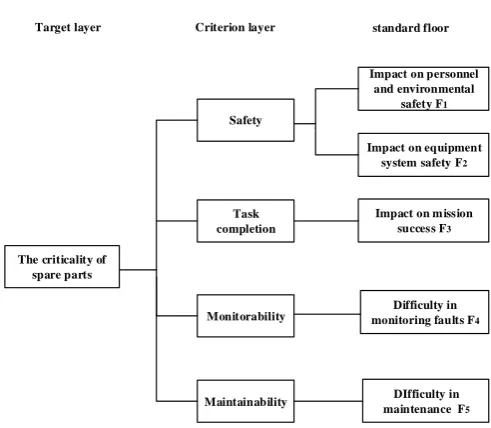
[image:3.595.174.420.247.461.2]The determination of the criticality of equipment spare parts is a multi-level, multi-depth, and multi-factor problem. For a scientific and objective evaluation, a comprehensive index evaluation system needs to be established to make a large number of factors that affect and restrict each other clear, layered, complete and available. sequence. Based on the comprehensive and referenced existing experience, a critical spare parts evaluation index system as shown in Figure 1 was established based on the characteristics of the ship's spare parts. The evaluation system includes safety, mission completion, monitorability. The criticality of spare parts is evaluated in four aspects of maintainability.
Figure 1. Evaluation index system of equipment spare parts importance.
The impact on personnel and environmental safety refers to whether the equipment will cause danger or pollution to the personnel and the working environment after the failure of the spare parts. The scoring standards are shown in Table 1.
Table 1. Scoring criteria for impact on people and the environment.
grade Impact of failure on people and the environment fraction
1 No effect 1
2 Less effected 4
3 Greater effected 7
4 Serious effected 10
The impact on the equipment system safety refers to the degree of impact on the equipment system safety after the failure of the spare parts. The scoring standards are shown in Table 2.
The criticality of spare parts
Safety
Task completion
Impact on personnel and environmental
safety F1
Impact on equipment system safety F2
Impact on mission success F3
Difficulty in monitoring faults F4
DIfficulty in maintenance F5
Target layer Criterion layer standard floor
Monitorability
[image:3.595.157.439.554.684.2]Table 2. Scoring criteria for impact on equipment system.
grade Impact of failure on equipment system safety fraction
1 No effect 1
2 Less effected 4
3 Greater effected 7
4 Serious effected 10
[image:4.595.160.437.286.407.2]The impact on task success is the degree of impact on the success of the task after the failure of the spare part.
Table 3. Scoring criteria for impact on success of mission.
grade Impact of failures on mission success fraction
1 No effect 1
2 Less effected 4
3 Greater effected 7
4 Serious effected 10
The difficulty of fault monitoring refers to the difficulty of monitoring before the failure of the spare parts. The scoring standards are shown in Table 4.
Table 4. Scoring criteria for difficulty of fault monitoring.
Grade Difficulty in monitoring faults fraction
1 Less difficulty 1
2 Moderate difficulty 4
3 High difficulty 7
4 Extreme difficulty 10
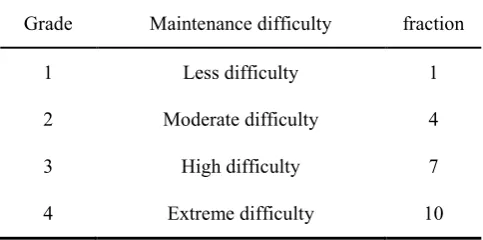
Difficulty of maintenance refers to the ease with which the spare part can be repaired and replaced, which is limited by the technical level and number of maintenance personnel, maintenance equipment and levels, and facilities. They are divided into 4 categories according to their difficulty, and the scoring standards are shown in Table 5.
Table 5. Scoring criteria for difficulty of repair.
Grade Maintenance difficulty fraction
1 Less difficulty 1
2 Moderate difficulty 4
[image:4.595.163.434.465.585.2] [image:4.595.177.419.673.793.2]Calculation of Critical Weight of Spare Parts
Analytic Hierarchy Process (AHP) [11] was used to calculate the weight of each influencing factor in the evaluation index system. Because the AHP method is already a very mature method, this article does not specifically describe how the AHP method determines the index weight. It mainly introduces how to calculate the critical weight calculation of spare parts in combination with the TOPSIS method.
The TOPSIS method is a commonly used multi-objective decision analysis method for finite schemes. [12] This article replaces the type of the scheme with the spare type of the equipment system. Using this method to calculate the relative closeness between the spare part and the ideal solution, and then calculate the critical weight coefficient of the spare part according to the closeness. (1) The equipment system has m type spare parts: 𝐴1, 𝐴2, ⋯ , 𝐴𝑚and the indicator system has n indicators: F1, F2, ⋯ F𝑛. The initial score matrix P can be obtained based on the evaluation values
of the spare parts for different indicators.
P = [
𝑟11 𝑟12 ⋯ 𝑟1𝑛
𝑟21 𝑟22 ⋯ 𝑟2𝑛
⋯ ⋯ ⋱ ⋯ 𝑟𝑚1 𝑟𝑚2 ⋯ 𝑟𝑚𝑛
].
(2) Normalize the initial judgement matrix. The types of indicators in the matrix P are divided into benefit-type indicators and loss-type indicators. The standardized calculation formulas are different, respectively:
Benefit indicators:𝑏𝑖𝑗=max𝑟𝑖𝑗−min𝑗𝑟𝑖𝑗
𝑗𝑟𝑖𝑗−min𝑗𝑟𝑖𝑗. (1)
Loss indicators:𝑏𝑖𝑗=maxmax𝑗𝑟𝑖𝑗−𝑟𝑖𝑗
𝑗𝑟𝑖𝑗−min𝑗𝑟𝑖𝑗. (2)
i = 1,2, ⋯ , 𝑚;j = 1,2, ⋯ , 𝑛
standardized decision matrix B.
B = [
𝑏11 𝑏12 ⋯ 𝑏1𝑛 𝑏21 𝑏22 ⋯ 𝑏2𝑛 ⋯ ⋯ ⋱ ⋯ 𝑏𝑚1 𝑏𝑚2 ⋯ 𝑏𝑚𝑛
].
(3) Multiply the index weight value 𝑊𝑖 calculated by the analytic hierarchy process with matrix B
to obtain a weighted standardized decision matrix R
R = [
𝑤1𝑏11 𝑤2𝑏12 ⋯ 𝑤𝑛𝑏1𝑛 𝑤1𝑏21 𝑤2𝑏22 ⋯ 𝑤𝑛𝑏2𝑛
⋯ ⋯ ⋱ ⋯ 𝑤1𝑏𝑚1 𝑤2𝑏𝑚2 ⋯ 𝑤𝑛𝑏𝑚𝑛
].
(4) Determine positive ideal solution and negative ideal solution
Benefit-type and loss-type indicators have their respective positive ideal solutions and negative ideal solutions. J stands for benefit-type indicators set, and 𝐽′ stands for loss-type indicators set.
X+ = {max
𝑖𝑤𝑖𝑏𝑖𝑗| 𝑗 ∈ J| min𝑖𝑤𝑖𝑏𝑖𝑗|𝑗 ∈ 𝐽′} = {𝑋1+, 𝑋2+, ⋯ , 𝑋𝑛+}.
X− = {min
𝑖𝑤𝑖𝑏𝑖𝑗| 𝑗 ∈ J| max𝑖𝑤𝑖𝑏𝑖𝑗|𝑗 ∈ 𝐽′} = {𝑋1−, 𝑋2−, ⋯ , 𝑋𝑛−}.
d𝑖+ = √∑𝑛 (𝑋+−
𝑗=1 𝑤𝑖𝑏𝑖𝑗)2. (3)
d𝑖− = √∑𝑛 (𝑋−−
𝑗=1 𝑤𝑖𝑏𝑖𝑗)2 (4)
(6) Calculate the relative proximity C𝑖∗ and Calculate the critical weight of spare parts 𝐼𝑆𝑖
C𝑖∗ = d𝑖 −
d𝑖++d𝑖−. (5)
𝐼𝑆𝑖 = C𝑖∗
∑𝑚𝑖=1C𝑖∗. (6) The size of the critical weight coefficient 𝐼𝑆𝑖 indicates the criticality of the spare parts. The larger
the critical weight coefficient, the more critical the role of the spare part in the equipment system, and the greater the impact of the shortage on the equipment system.
Spare Parts Allocation Model Based on Criticality of Spare Parts and Solving Algorithm
When ships are performing tasks independently or in formations, they are far away from the shore, have a long mission period, and are highly independent. The quality of the ship's spare parts allocation plan is the key to successfully completing the task. Considering the special conditions of ship maintenance, when the equipment fails, its performance can usually only be restored by replacing parts. Due to the limitations of the size, weight, cost, and actual support capabilities of the ship, it is impossible to meet the needs of all ship-based spare parts directly from the ship or from other ships in the formation. Therefore, under the constraints of limited support funds, it is necessary to consider highly critical spare parts, especially when wartime or logistical support costs are tight, the supply of highly critical spare parts must be guaranteed first, while taking into account the general Spare parts.
Spare Parts Allocation Model Based on Criticality of Spare Parts
The traditional spare parts support model [2] assumes that the criticality of each spare part is the same. When the spare parts support funds are limited, in order to achieve the goal of high overall availability of equipment, the traditional allocation model will preferentially allocate spare parts with lower costs, which will leads to the result that the priority is given to the price rather than to the critical spare parts, so there are certain limitations. Aiming at the problem that the criticality of spare parts has an impact on the configuration of spare parts, but is difficult to model directly, considering that priority should be given to meet critical spare parts without shortage when resources are limited, a spare parts allocation model based on the criticality of spare parts is established.
The number of spare parts shortage is an important indicator to measure the efficiency of spare parts support. The meaning of the expression is the number of spare parts that cannot meet the actual demand for spare parts. Because the actual demand for spare parts is a random variable, the expected shortage number EBO is introduced in order to measure the effectiveness of spare parts (s), this indicator is calculated as:
𝐸𝐵𝑂(𝑠) = ∑∞ (𝑥 − 𝑠)𝑝𝑟(𝑥)
𝑥=𝑠+1 . (7)
𝑝𝑟(𝑥 = 𝑘) = 𝑚𝑇𝑘!𝑘𝑒−𝑚𝑇,𝑘 = 0,1, ⋯ (8) Where mT is the average value of the Poisson distribution, which represents the average demand for spare parts during the task cycle, m is the average annual demand, and T is the duration of the task cycle.
According to the METRIC model, the availability of equipment can be calculated indirectly through the spare parts shortage number EBO (s), and the calculation formula is:
Aj = 100 ∏ {1 −𝐸𝐵𝑂𝑁𝑖(𝑠𝑖) 𝑗𝑍𝑖 }
𝑍𝑖
=
𝑚
𝑖=1 100 ∏𝑚𝑖=1Ai . (9)
According to the formula, the availability of the equipment system can be approximated as the
availability of each spare part Ai= {1 −𝐸𝐵𝑂𝑖(𝑠𝑖 ) 𝑁𝑗𝑍𝑖 }
𝑍𝑖
,Where 𝑁𝑗 is the number of installations of the
equipment on the ship; 𝑍𝑖 is the number of installations of i spares in this type of equipment.
𝑁𝑗 and 𝑍𝑖 are fixed values. According to the calculation formula of Ai, we can know that the size of 𝐸𝐵𝑂𝑖(𝑠𝑖) determines the availability of spare parts Ai,The smaller the value of 𝐸𝐵𝑂𝑖(𝑠𝑖) is, the higher the
availability of spare parts is. So the problem of finding the minimum of the shortage of critical spare parts can be transformed into the problem of finding the maximum of the availability of critical spare parts.
Multiply the critical weight coefficient 𝐼𝑆𝑖 of the spare part with the spare part availability Ai to
obtain the spare part availability based on the criticality of the spare part:
Ai′= 𝐼𝑆𝑖Ai. (10) Because 𝐼𝑆𝑖 is constant, if the objective function is calculated by multiplication, we can get the
result below:
Aj′= ∏𝑚 Ai′=
𝑖=1 ∏ 𝐼𝑆𝑖
𝑚
𝑖=1 Aj . (11) Observing the formula carefully, we can find that the traditional equipment availability Aj is
multiplied by a new constant ∏ 𝐼𝑆𝑖 𝑚
𝑖=1 . If the objective function of the model is obviously back to the
traditional calculation scope of equipment availability, it cannot reflect the key differences of spare parts. Because the goal of the model is to give priority to meeting the configuration of critical spare parts with limited funding and to reflect the critical differences of spare parts, so the above-mentioned problems can be avoided by adding the availability of critical spare parts. The calculation formula is:
C = ∑𝑚𝑖=1Ai′. (12)
Ai′ indicates the availability of spare parts based on the criticality of spare parts, and C indicates the
sum of availability of spare parts.
Based on the above analysis, a critical spare parts optimization model is established as follows:
max ∑𝑚𝑖=1Ai′
s. t. {∑ 𝑠𝑖𝑎𝑖 ≤ 𝑀
𝑛
𝑖=1
Where 𝑎𝑖 represents the cost of spare parts i, 𝑠𝑖 represents the number of spare parts i, and M
represents the total expenditure.
Genetic Algorithm Solving
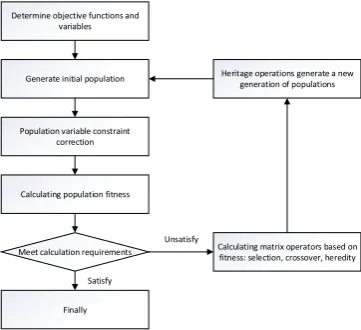
and select some individuals for gene replication, crossover, and mutation to form the next generation population. According to the theory of evolution, highly adaptable individual genes have a greater probability of being passed on to the next generation. Therefore, through the evolution of multiple generations, the overall fitness of the population and the adaptability of the individuals within it will be improved, thereby achieving the purpose of optimal calculation. The process is shown in Figure.
Figure 2. The process of the Genetic Algorithm.
Case Study
Because there are too many types of spare parts for a certain equipment system, considering that the main purpose of this article is to introduce methods and models, five kinds of the most representative electronic spare parts are selected as research objects. Assuming the mission period T is 0.25 years, the number of equipment systems installed on the ship is 1, and table 6 is the relevant data of 5 types of spare parts.
Table 6. Data on spare parts.
Spare part type
Single quantity [Each]
Annual average demand
unit price [ten thousand]
S1 2 20 5
S2 2 28 3.7
S3 2 48 2.6
S4 2 64 1.4
S5 3 96 0.8
Eight experts are invited to score the various indexes of spare parts, and the critical weight coefficients of 5 types of spare parts are calculated through calculation. Among them, the critical weight coefficient of S1 is 0.42, the critical weight coefficient of S2 is 0.19, and the critical weight of S3 The coefficient is 0.1, the critical weight coefficient of S4 is 0.24, and the critical weight coefficient
of S5 is 0.07.
Under the constraint of only 1 million yuan in spare parts support funds, Matlab software is used to select a population size of 500 to generate a population based on the model and method built. After 50 generations of optimized calculation results, a spare parts configuration plan considering the key
Determine objective functions and variables
Generate initial population
Population variable constraint correction
Calculating population fitness
Meet calculation requirements
Finally
Calculating matrix operators based on fitness: selection, crossover, heredity Heritage operations generate a new
generation of populations
Satisfy
[image:8.595.137.459.471.653.2]Table 7. Configuration scheme based on different criticality of spare parts.
Spare part type S1 S2 S3 S4 S5
Scheme of
allocation 6 5 6 17 15
EBO 0.4868 2.2646 6.004 1.5853 9.0208
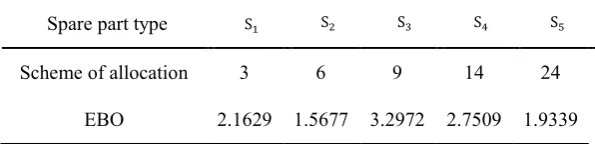
The results of the spare parts configuration plan based on the same criticality of the spare parts according to the genetic algorithm are shown in Table 8:
Table 8. Configuration scheme based on the same criticality of spare parts.
Spare part type S1 S2 S3 S4 S5
Scheme of allocation 3 6 9 14 24
EBO 2.1629 1.5677 3.2972 2.7509 1.9339
Comparing the two configuration schemes, the arrangement order of the criticality coefficients of the spare parts based on the different criticality of the spare parts can be found to be the same as the order of the expected number of spare parts. The higher the critical weight coefficient of the spare parts is, the lower the expected shortage of the spare parts is, that is, the configuration of the model can give priority to the configuration of key spare parts with limited funding, reducing the possibility of shortages and increasing the availability of spare parts. Based on the same critical configuration scheme of spare parts, the expected shortage of all spare parts is relatively balanced, and it is impossible to highlight the highly critical spare parts. On the contrary, the S5 spare parts, which are
the most critical and at the lowest price, have the least expected shortage, and it is possible that the shortage of critical spare parts will have serious consequences for equipment systems.
Summary
By establishing a critical evaluation index system for spare parts, combining the analytic hierarchy process and TOPSIS method, the critical weight of the spare parts can be calculated to quantitatively describe the criticality of the spare parts, but the selection of the critical evaluation index will be different according to different equipment types. It is necessary to make reasonable choices for specific types of equipment, and the criticality of spare parts to the equipment is not fixed, it will change according to different tasks.
The critical spare parts configuration model constructed in this article can consider the critical differences of spare parts under the condition of limited funds, and can reduce the possibility of shortage of critical spare parts as far as possible. Therefore, this method can help the decision-making department when formulating the spare parts allocation plan.
References
[1] Yang C, Hou X M, Liao X H, Qing H F, Xu Q. Literature analysis and content summary of equipment maintenance support resource allocation [J]. Journal of Ordnance Equipment Engineering, 2019, 40(07):170-175.
[2] Sherbrooke C C. METRIC: A multi-echelon technique for recoverable item control [J]. Operations Research, 1968, 16(1): 122-141.
[image:9.595.148.446.239.311.2][4] Sherbrooke C C. VARI-METRIC: improved approximations for multi-indenture, multi-echelon availability models[J]. Operations Research, 1986, 34(2): 311-319.
[5] Zhang Y. Decision of equipment maintenance method based on importance classification [J]. Ordnance Automation, 2005(06):23-24.
[6] Huang J X, Bian Y Q. Evaluation of Radar Equipment Importance Based on Monte Carlo Simulation [J]. Ordnance Automation, 2009, 28(09):26-28.
[7] Zuo W B, Zhao Y J, Zhang D Z. Method for evaluating unit importance of air defense and antimissile equipment [J]. Command and Control and Simulation, 2018, 40(03):104-108.
[8] Moon S. Simpson A. Hicks C. The development of a classification model for predicting the performance of forecasting methods for naval spare parts demand[J]. International Journal of Production Economics, 2013, 143(2):449-454.
[9] Cai Z M, Jin J S, Chen Y Q. Optimal inventory modelling of spare parts under the criticality. [J]Systems Engineering and Electronics, 2017, 39(08):1765-1773.
[10] Zhou L, Meng J, Li Y, Liu W. Optimization method for radiation interference cancellation equipment of ship spare parts configuration with critical under multiple constraints [J]. Systems Engineering and Electronics:1-11[2019-12-11].
[11] Xu S B. Analytic Hierarchy Process [M]. Tianjin: Tianjin University Press.1988.