2019 International Conference on Computational Modeling, Simulation and Optimization (CMSO 2019) ISBN: 978-1-60595-659-6
Quantitative Analysis of Blending Speed of a Horizontally Rotating Drum
with Internal Baffles by Using DEM Simulation
Zhong-ke TIAN
*, Cong-cong HAN and Hai-yong YU
College of Electromechanical Engineering, Qingdao University of Science and Technology, Qingdao 266061, China
*Corresponding author
Keywords: Rotating drum, Internal baffles, Blending process, DEM simulation.
Abstract. How to get the best uniformity in the shortest time has always been a hot and difficult point in the quantitative analysis of bulk mixing process using rotating drum. With the advent of Discrete Element Method (DEM), the mixing behavior of particle material in blender has been extensively studied these years. In this paper, the reasonable rotary speeds for blending process as well as the ideal process durations of a horizontally rotating drum with internal baffles in batch mode are quantitatively determined by running simulations based on DEM software PFC3D. The particle-counting codes, developed in PFC3D built-in programming language FISH, take important roles in evaluating the corresponding effects of different process parameters, which overcomes the uncertainty of usual qualitative analysis of simulation results.
Introduction
The mixing of granular materials is an important process in many industries. How to get the best uniformity in the shortest time has always been a hot and difficult point in the quantitative analysis of bulk mixing process using rotating drum and relatively limited progress has been made in optimization of mixer design and mixing process parameters [1]. Related researches still rest upon common sense and intuition [2, 3].
With the advent of Discrete Element Method (DEM), originally presented by Cundall and Strack [4] and improved by Cundall and Hart [5], the mixing behavior of particle material has been extensively studied these years. DEM models the particulate system as an assembly of singular discrete and interacting particles, which provides insight into the mechanisms governing particle flow and becomes a powerful tool for optimizing mixing processes [6, 7, 8, 9, 10, 11, 12].
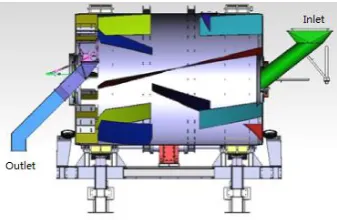
[image:1.595.213.382.623.733.2]A rotating drum is simple a cylinder rotating about its central axis, while the solids motion in it is very complicated [13, 14, 15]. To improve the axial mixing performance of a rotating drum, blades or baffles are often internally placed in it [16]. In this paper, based on DEM software PFC3D (demonstration version 4.0) of Itasca Consulting Group Inc, the blending speed of a horizontally rotating drum mixer with internal baffles (as shown in Fig. 1) in batch mode were determined.
PFC3D Model
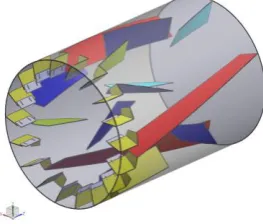
The term “PFC3D model” denotes the sequence of PFC3D commands that define the problem conditions for numerical solution. For simplicity, the main structure of the mixing drum is assumed to be a rigid cylinder surface, whose length is 4.82 m and diameter is 3.5m. More than 17,500 wall statements were written into the PFC3D model file to construct the internal baffles shown in Fig. 2. Each wall is given a unique identification number id. The location of each wall is defined by four vertices and the x-, y- and z-coordinates are specified for each vertex following the keyword face.
wall id=100001 type cylinder end1 0 0 2.410 end2 0 0 -2.410 rad 1.750 1.750; wall id=100002 origin 0 0 2.410 normal 0 0 -1;
wall id=100003 origin 0 0 -2.410 normal 0 0 1; ……
wall id=790000003 face (-0.350566, -1.724730, -2.400000) (-0.350565, -1.724730, -2.410000) (-0.234582, -1.744290, -2.410000);
……
wall id=790000840 face(-0.295999, 0.256737, -2.359730) (-0.295998, -0.450369, -3.066840) (0.296003, -0.450369, -3.066840);
[image:2.595.231.363.331.443.2]……
Figure 2. Shape and distribution of the baffles in the mixing drum.
The granular media consist of three batches of spherical rubberlike pellets, whose density is of 3250 kg/m3. Each batch has a mass of about 620 kg.
In PFC3D model, balls interact with other balls or walls via point contact. Forces that develop from ball-ball or ball-wall interactions act at the contact. Each contact model may consist of at least two parts: (1) a contact stiffness model; (2) a slip and separation model. PFC3D has two different stiffness models (linear springs and simplified Hertz-Mindlin), one slip model (frictional slip) built into the code [17, 18, 19].
The default stiffness model is the linear-spring model, which is generally sufficient for most analyses. This model is invoked when the normal (spring) stiffness and shear (spring) stiffness are specified with the property command for balls and the wall command for walls. A normal stiffness value is assigned with the kn keyword, and a shear stiffness value with the ks keyword, following the property and wall commands. The units for ball stiffness are [force/displacement] (e.g., N/m). Slip between two balls, or between a ball and a wall, is prescribed in terms of a friction coefficient. The friction coefficient is specified with the friction keyword after the property command for balls and after the wall command for walls.
Simulation Results and Discussion
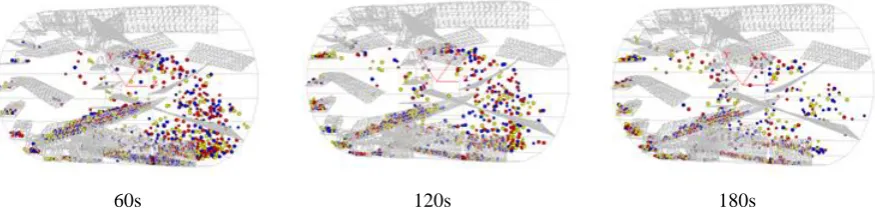
The rational blending speed was planned to be selected from 2RPM, 3RPM and 4RPM. Fig. 3 demonstrates the transient granule state of 3RPM mixing process at 60s, 120s and 180s, respectively.
[image:3.595.80.518.131.239.2]60s 120s 180s Figure 3. Transient granule states of 3RPM mixing process.
Taking into consideration of the efficiency of the subsequent discharging process, it is expected that the three granular media in the shadow region (shown in Fig. 4) should be the more the better and as evenly as possible at a given blending time. In order to determine the ideal RMP from the three options, following codes were developed in PFC3D built-in programming language FISH [17] to realize corresponding counting work.
restore given time.sav def count_balls bp = ball_head; yellow_ball=0; blue_ball=0; red_ball=0; loop while bp#null if b_z(bp) <= -1.71; if b_z(bp) >= -2.21; if b_id(bp)<=500
yellow_ball=yellow_ball+1; else
if b_id(bp)>=1001 red_ball=red_ball+1; else
blue_ball=blue_ball+1; end_if
end_if end_if; end_if
bp = b_next(bp); end_loop
ii=out(' yellowe_ball = '+string(yellow_ball)) ii=out(' blue_ball = '+string(blue_ball)) ii=out(' red_ball = '+string(red_ball)) end
Figure 4. Shadow region for particle number statistics in blending process.
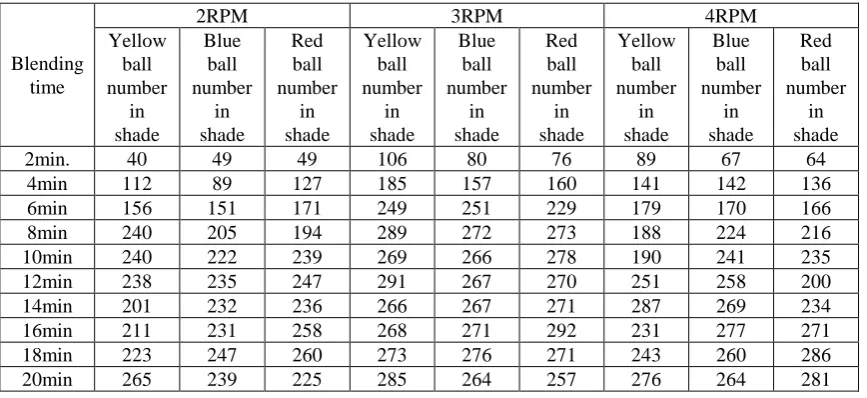
The influence of RPM on mixing effect is reflected by the data listed in Table 1. It is evident that, in terms of efficiency and uniformity, 3RPM results in relatively optimal mixture quality. Furthermore, inferred from the data of Table 1, it could also be noticed that the blending process should run 14~18 minutes.
Table 1. Quantitative data of RPM influence on mixing effect.
Blending time
2RPM 3RPM 4RPM
Yellow ball number in shade Blue ball number in shade Red ball number in shade Yellow ball number in shade Blue ball number in shade Red ball number in shade Yellow ball number in shade Blue ball number in shade Red ball number in shade
2min. 40 49 49 106 80 76 89 67 64
4min 112 89 127 185 157 160 141 142 136
6min 156 151 171 249 251 229 179 170 166
8min 240 205 194 289 272 273 188 224 216
10min 240 222 239 269 266 278 190 241 235
12min 238 235 247 291 267 270 251 258 200
14min 201 232 236 266 267 271 287 269 234
16min 211 231 258 268 271 292 231 277 271
18min 223 247 260 273 276 271 243 260 286
20min 265 239 225 285 264 257 276 264 281
Conclusions
In this paper, the reasonable rotary speeds for blending process as well as the ideal process durations of a horizontally rotating drum with internal baffles in batch mode are quantitatively determined by running simulations based on DEM software PFC3D. The particle-counting codes, developed in PFC3D built-in programming language FISH, take important roles in evaluating the corresponding effects of different process parameters, which overcomes the uncertainty of usual qualitative analysis of simulation results.
Acknowledgement
[image:4.595.83.517.318.517.2][3] J. Bridgwater, Mixing of powders and granular materials by mechanical means—A perspective, Particuology. 10 (2012) 397–427.
[4] P.A. Cundall, O.D.L. Strack, A discrete numerical model for granular assemblies, Geotechnique. 29 (1979) 47–65.
[5] P.A. Cundall, R.D. Hart, Numerical modelling of discontinua, Engineering Computations. 9 (1992) 101–113.
[6] M. Marigo, D.L. Cairns, M. Davies, A. Ingram, E.H. Stitt, Developing mechanistic understanding of granular behavior in complex moving geometry using the Discrete Element Method: Part B: Investigation of flow and mixing in the Turbula® mixer, Powder Technology. 212 (2011) 17–24.
[7] M. Jiang, Y. Zhao, G. Liu, J. Zheng, Enhancing mixing of particles by baffles in a rotating drum mixer, Particuology. 9 (2011) 270–278.
[8] P. W. Cleary, Particulate mixing in a plough share mixer using DEM with realistic shaped particles, Powder Technology. 248 (2013) 103–120.
[9] M. Halidan, G. R. Chandratilleke, S. L. I. Chan, A. B. Yu, J. Bridgwater, Prediction of the mixing behavior of binary mixtures of particles in a bladed mixer, Chemical Engineering Science. 120 (2014) 37–48.
[10] M. Alian, F. E. Mozaffari, S. R. Upreti, Analysis of the mixing of solid particles in a plowshare mixer via discrete element method (DEM), Powder Technology. 274 (2015) 77–87.
[11] R. K. Soni, R. Mohanty, S. Mohanty, B.K. Mishra, Numerical analysis of mixing of particles in drum mixers using DEM, Advanced Powder Technology. 27 (2016) 531–540.
[12] M. Yamamoto, S. Ishihara, J. Kano, Evaluation of particle density effect for mixing behavior in a rotating drum mixer by DEM simulation, Advanced Powder Technology. 27 (2016) 864–870.
[13] A.C. Santomaso, Y.L. Ding, J.R. Lickiss, D.W. York, Investigation of the granular behaviour in a rotating drum operated over a wide range of rotational speed, Chemical Engineering Research and Design. 81 (2003) 936-945.
[14] M. Kwapinska, G. Saage, E. Tsotsas, Mixing of particles in rotary drums: A comparison of discrete element simulations with experimental results and penetration models for thermal processes, Powder Technology. 161 (2006) 69–78.
[15] H. Henein, J.K. Brimacombe, A.P. Watkinson, Experimental study of transverse bed motion in rotary kilns, Metallurgical Transactions B. 14B (1983) 191–205.
[16] F. Yu, G. Zhou, J. Xu, W. Ge, Enhanced axial mixing of rotating drums with alternately arranged baffles, Powder Technology. 286 (2015) 276–287.
[17] Itasca Consulting Group, Inc., PFC3D Version 4.0 User’s Guide, 2012.
[18] G. Dondi, A. Simone, V. Vignali, G. Manganelli, Numerical and experimental study of granular mixes for asphalts, Powder Technology. 232 (2012) 31–40.