2016 3rd International Conference on Information and Communication Technology for Education (ICTE 2016) ISBN: 978-1-60595-372-4
1 INTRODUCTION
Along with population growth, urbanization and industrialization process, the volume of municipal solid waste generation in China has been increasing sharply in the past 30 years and the total amount of municipal solid waste yields will continue to increase, plastics are very useful as they are very functional, light and economical, based on the historical survey, plastic in municipal solid waste contributed to 54~123 kg DM/t raw waste received at the municipal solid waste incineration plant (Tian H.Z & Gao J.J. 2013). Although plastics in municipal solid waste was recyclable materials, by now, a well-operated waste classification system has not been set up in China, thus plastics are hard to be classify as the municipal solid waste used the mixed collection method.
PP, PVC and latex gloves are mainly composed of carbon and hydrogen, and PVC also contains chlorine, when PVC incineration, it can generates hazardous HCl gas, dioxins containing Cl which is harmful to incinerator and environment. At present, most waste plastics cause serious environmental problems due to the disposal by reclamation and incineration. In China, incineration is a significant component of waste management program for large cites especially in the eastern and coastal provinces with dense population and lack of adequate sites for land fill, thus it was necessary to study the pyrolysis characteristic of typical plastic and latex gloves in solid waste.
Thermal cracking of plastic waste was usually carried out either in high temperatures (>700℃), to produce an olefin mixture (C1-C4) and aromatic
compounds (mainly benzene, toluene and xylene) or in low temperature (400-500℃)(thermolysis) where three fractions are received: A high-calorific value gas, condensable hydrocarbon oil and waxes (Aguado J. & Serrano D.1999). Kinds of energy efficient reactor was always used to test pyrolysis of plastic waste, and yield of the pyrolytic oil, wax, pyrogas and char from pyrolysis of plastic waste were get at a certain temperature (Abbas-Abadi M.S. & Haghighi M.N. 2014, Lopez-Urionabarrenchea A. & Marco I de. 2012). For change of temperature, resarch on pyrolysis characteristic of PP and PVC, either themselves or mixture with different materials by Thermogravimetric was published (Cafiero L. & Castoldi E. 2014, Elvira J.M.G. & Benabente R. 2015).
TG analysis is one of the most commonly used techniques to explore the primary reaction of the decomposition of solids, TG illustrates the thermal decomposition in terms of the mass loss, whereas TG-FTIR extends the thermal analysis by the additional monitoring, it was a powerful method which has been used in previous studies to measure evolved gases during the thermal treatment of various mateirals (Pǎrpǎritǎ E. & Nistor M.T. 2014,
Wu J.L & Chen T.J. 2014). This method offered the potential for the simultaneous, real-time measurement of multiple gas phase compounds in complex mixture, but less research on simultaneous
Evaluation of Thermal Decomposition and Pyrolysis Process
Parameters on Typical Polymer Materials in Solid Waste
Hongmei Zhu, Nijie Jing, Ming Lv
Hangzhou Dianzi University, Hangzhou, Zhejiang, 310018, China
Changming Du
Sun Yat-Sen University, Guangzhou, Guangdong, 510275, China
gas evolved especially the pyrolysis model for evolved gas. At the same time, pyrolysis characteristic of latex gloves which always used as single use medical supplies is not clear. Thus in the present study, we studied the evolved gas analysis during the thermal degradation of PP, PVC and latex gloves.
2 MATERIALS AND EXPERIMENT METHOD
2.1 Experiment material
Plastic PP, Plastic PVC and latex gloves were chosen as experiment samples for they are familiar in municipal solid waste or medical waste. In order to make the sample heated sufficiently, we bought small plastic PP pellet,powder plastic PVC, and split latex gloves to small pieces (square of 1mm) before experiment. The small sample size used in this work ensured that temperature gradients within the sample were minimized. The results of elemental analysis of samples were shown in Table 1.
Table 1. Ultimate analysis of materials.
Material Ultimate analysis (%) QHHV(MJ/kg)
C H O N S
Plastic
PP 81.80 10.00 7.94 0.0 9
0.0
5 46.994 Plastic
PVC 41.55 4.81
52.95 (Cl)
0.0 9
0.0
2 21.699 latex
Gloves 84.80 10.50 1.57 0.4 0
0.6
1 43.279
2.2 Experimental method
The Nicolet Nexus 670 spectrometer and Mettler Toledo TGA/SDTA851e thermo analyzer were coupled by a Thermo-Nicolet TGA interface model, of which the stainless transfer line and gas cell were set to 180 ℃ to minimize the change of evolved gas. Samples were heated at 30℃.min-1 in a nitrogen environment; the volatile products were swept immediately into the gas cell, which minimized secondary reactions. Pyrolysis products were analyzed by Fourier transform infrared (FTIR) spectroscopy, resolution in FTIR was set as 4 1/cm, and the spectral region was set as 4000 ~ 400 1/cm. Approximately 12 mg samples were used in the study. A detailed description of the TG-FTIR can be found in the literature (Zhu H.M & Chen W.Y. 2015).
2.3 Numerical method
From the datum of TG/DTG experiment, the first reaction based Arrhenius theory is commonly assumed in the kinetic analysis during pyrolysis, as well as the dynamics of commonly used 30 mechanism function of universal integral equation and differential equation (Hu R. Z. & Shi Q.Z.
2008.), activation energy E, logarithmic of former factor lgA, linear correlation coefficient for the corresponding mechanism function can be calculated. The principle of choosing the basis of mechanism functions as follows: first, the activation energy E is between 80-250 kJ/mol and logarithmic of former factor lgA is between 7-30, second, the linear correlation coefficient between result from differential method and result from integral method is greater than 0.98; third, the difference between result from differential method and result from integral method is small. According to the above criterion, we could get the most suitable mechanism kinetic function and the corresponding E and A value as correct result.
3 RESULTS AND DISCUSSION
3.1 TG and DTG analysis
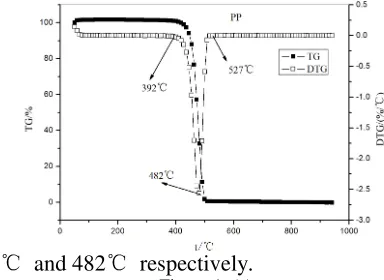
TG and DTG curves were shown in Figure 1 (a)-(c), it shows that curves are similar when the temperature was lower than 200 ℃ or higher than 560 ℃. However, from 200 ℃ to 560 ℃, pyrolysis processes of plastic PP and latex gloves are similar, but the pyrolysis temperature range and temperature peak are different, to plastic PP, the pyrolysis temperature was from 392 ℃ to 527 ℃, and the temperature of the maximum rate of the mass changes as determined from DTG curve was 482℃, corresponding to the mass transition ratio of 99%.
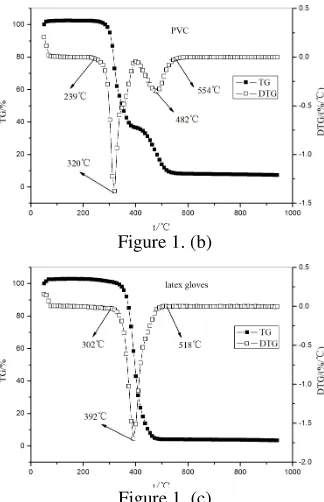
To plastic PVC, there are two degradation steps, the first mass transition of 61% was observed in the range 280℃ to 400 ℃, the second mass transition of 31% was observed in the range 400 ℃ to 560
℃, and the temperature of the maximum rate of the mass changes as determined from DTG curve was
320℃ and 482℃ respectively.
[image:2.612.332.524.521.661.2]Figure 1. (b)
Figure 1. (c)
To latex gloves, the pyrolysis temperature was from 302 ℃ to 518 ℃, and the temperature of the maximum rate of the mass changes as determined from DTG curve was 392℃, corresponding to the mass transition ratio of 95%. The residual char&ash in proximate analysis of these three materials was plastic PVC < latex gloves < plastic PP. So the final weight loss has relation with the residual char&ash. Thus the differences in TG curve may be caused by different volatile and moisture contents in each material.
3.2 Kinetic analysis
The result of mechanism kinetic function, E and A value for pyrolysis of PP, PVC and latex glove from differential method and result from integral method were shown in Table 2, and transformation ratio was defined as (quality of max temperature - the initial quality)/(final quality - initial quality).
[image:3.612.94.256.35.286.2]Figure 1. (a)-(c) TG and DTG curves for pyrolysis of PP, PVC and latex gloves.
Table 2. Kinetic parameters and mechanism functions for PP, PVC and latex gloves.
Material t/℃
Transformation ratio/%
activation energy
E/kJ.mol-1 former factor A/s
-1
mechanism function
D* I** D* I**
PP 392-
518 99.51 201.79 197.08 8.96e+19 4.57e+19
2 1
3 3 3 1
( ) (1 ) [1 (1 ) ] 2
f α α α
− = − − −
1 2 3 ( ) [1 (1 ) ]
Gα = − −α
PVC
302-
383 61.88 88.24 95.75 1.87e+13 4.79e+14
1 2
( ) (1 )[ ln(1 )] 3
f α α α
−
= − − −
3
( ) [ ln(1 )]
G α = − −α
383-
545 31.03 101.98 97.18 1.63e+10 9.55e+09
latex gloves
329-
482 95.58 150.34 159.40 1.34e+18 4.15e+19
*: Differential equation **: integral equation
Value of activation energy and temperature of initial weight loss was one to one correspondence, that is to say, temperature of initial weight loss for PVC was lowest, and temperature of initial weight loss for PP was highest, and value of activation energy for the three experiment materials was PVC<latex gloves<PP,the value of activation energy E reflects to the difficulty of the reaction, also reflects the influence of temperature on the reaction rate constant, when the value of the E is high, reaction rate constant increased as the temperature increased, the increase of temperature is benefit to the reaction which has high value of activation energy E.
The result of kinetic parameters from the first reaction based Arrhenius theory either by differential
method or by integral method had only a single activation energy E, The gas evolution during the process of pyrolysis is due to the particular functional group's position in the structure of the original material, as the functional group's position is different, the activation energy needed to break functional group is different, so in the next section we focused on pyrolysis gas evolution and its kinetic analysis.
3.3 FTIR analysis
[image:3.612.76.535.339.539.2]from TG was swept into gas cell, absorbance information at different wavenumber and different time can be obtained by Fourier transform. When the time was fixed, absorbance information at different wavenumber can be obtained to analyze the composition of gas at this moment; at the same time, when the wavenumber was fixed, absorbance information at different time can also be obtained under this wavenumber to analyze the certain component as a function of time. The sharp peak at 3084 cm-1 and 3025 cm-1 indicated the presence of alkene –C-H stretching vibrations. The peaks between 3000 cm-1 and 2800 cm-1 was due to the presence of –CH3, -CH2, and C-H functional groups,
which are indicative of aliphatic species such as alkanes. The peak at 2919 cm-1 represented a symmetrical –CH2 stretch and broad medium peak at
2870 cm-1 was indicates a symmetrical –CH2 stretch.
The symmetrical absorbance peak between 2600 cm
-1
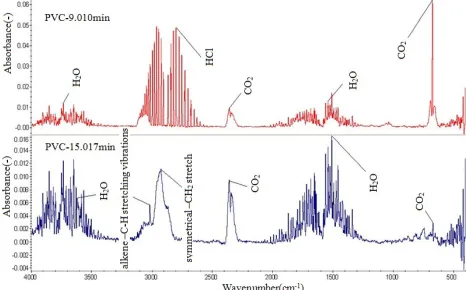
to 3100 cm-1, and maximum peak at 2798 cm-1 represented to HCl. The C=C absorbance peak between1600 cm-1 and 1700 cm-1 confirmed that alkene groups were present in the hexane soluble fractions, the peak between 1300 cm-1 to 1500 cm-1 was due to the deformation vibrations of C-H bonds, peak in 894 cm-1 represented C-H out-of-plane bending vibration of alkene structures.
Combined with the 3D spectrum and standard spectra, main products could be identify, after the composition of pyrolysis product was identified, the distribution of each product against time and temperature could be obtained.
[image:4.612.320.553.223.368.2]After evolved gases from TG were swept into the gas cell, absorbance information at different wavenumber and different time could be obtained by Fourier transform, according to the functional groups region(4000-1333cm-1) as well as the fingerprint region(1333-667cm-1).
Figure 2. Products from the maximum intensity for latex gloves pyrolysis and PP pyrolysis (392℃and 482℃).
For and PP pyrolysis and latex gloves pyrolysis, products from the maximum intensity were overlaid in Figure 2, we could found that the products from degradation of latex gloves are mainly alkene, such as butadiene and methyl hexene, CH4, as well as
branched chain alkanes. Products from degradation of PP are mainly alkene and alkane, such as propylene and propane. But the different of standard spectrum for alkene or alkane is no significant, thus it is difficult to specific identification alkane or alkene from the mixed gas except CH4. In addition,
like O2, N2 and H2 equivalent nuclear molecules due
to changes in vibration without dipole moment, unable to get its absorption spectrum from FTIR.
For PVC pyrolysis, products from the first and second maximum intensity were shown in Figure 3, we could found that the products from first degradation of PVC is mainly HCl, and the products from second degradation are CH4, saturated alkane
and CO2.
Figure 3. Products from the first and second maximum intensity for PVC pyrolysis (320 and 500℃).
(a) PP pyrolysis
[image:4.612.57.298.505.650.2](c) latex gloves pyrolysis
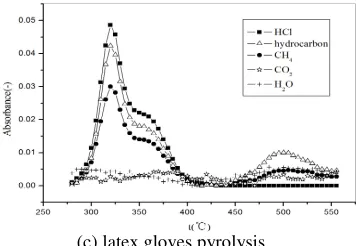
Figure 4. (a)-(c) Distribution of evolution gas for pyrolysis of PP, PVC and latex gloves.
The analysis of the evolution patterns shown in Figure 4 leads to the following observations:
To PP, products evolve at temperature range 400-540 ℃, mainly alkane and alkene, and the amount of alkane is more than alkene, PP pyrolysis at higher temperature than latex gloves.
To PVC, products evolve at two temperature range, respectively in 280~415 ℃ and 415 ~ 555
℃, all HCl as well as mainly CH4 and hydrocarbons
evolve in first temperature range, at the same time, less than 25% hydrocarbon is observed in the second temperature range, the amount of products is hydrocarbon>CH4>HCl>H2O>CO2.
To latex gloves, products evolve at temperature range 300-520 ℃, mainly CH4, alkane and alkene,
alkane and alkene evolve almost at the same temperature, but CH4 evolve at higher temperature
than alkane and alkene. That is to say, for latex gloves, the macromolecular structure of hydrocarbons evolve in the pyrolysis of latex gloves, and then further cracking generation of CH4, the
amount of products is alkene>alkane≈CH4, the
products of latex glove pyrolysis related to latex gloves materials, which is always made by alkene, such as butadiene rubber is made by butadiene and styrene copolymer, butadiene rubber is made by the polymerization of butadiene. structure of rubber with linear structure, branched structure and crosslinking structure, when heating these structure, polymer pyrolysis for large molecules, and then further cracking for small molecules.
4 CONCLUSIONS
Three kinds of materials in medical waste were studied, that is plastic PP, plastic PVC and latex gloves, it was successful to analyze the pyrolysis process and evolved gases by using TG-FTIR, including the evolution of volatile species and dynamic analysis.
Pyrolysis of plastic PP and latex was similar, but the pyrolysis of plastic PP turned out to be the most concentrative, followed by latex gloves and plastic PVC. For volatile species analysis, HCl can be easily identify, but the different of standard spectrum for alkene or alkane is no significant, thus it was difficult to specific identification alkane or alkene
from the mixed gas. The gaseous fractions recovered presented a mainly aliphatic composition consisting of a series of alkanes and alkenes of different carbon number which with a great potential to be recycled back into the petrochemical industry as a feedstock for the production of new plastics or refined fuels.
For dynamic analysis, first reaction based Arrhenius theory by either integral equation or differential equation was used to get the kinetic parameters and mechanism functions for pyrolysis of PP, PVC and latex gloves, the kinetic parameters and pyrolysis model can be used as source terms in the species transport equation in CFD simulation to fulfill the CFD modeling of pyrolysis. Such a model would be valuable for understanding and improving the pyrolysis process.
5. ACKNOWLEDGMENTS
The Project was supported by: National Natural Science Foundation of China (51506042), Zhejiang Provincial Natural Science Foundation of China (LQ16E060003). Zhejiang Provincial Natural Science Foundation of China (LY16E090006).
REFERENCES
[1]Abbas-Abadi M.S. & Haghighi M.N. 2014. Evaluation of pyrolysis process parameters on polypropylene degradation products [J], Journal of analytical and applied pyrolysis, 109:272-277.
[2]Aguado J. & Serrano D. 1999. Feedstock recycling of plastic wastes [M], The Royal Society of Chemistry, Cambridge.
[3]Cafiero L. & Castoldi E.2014. Identification and characterization of plastics from small appliances and kinetic analysis of their thermally activated pyrolysis [J], Polymer degradation and stability, 109:307-318.
[4]Elvira J.M.G. & Benabente R. 2015. Correlation between chain microstructure and activation energy in the pyrolysis of a high molecular weight isotactic polypropylene[J], Polymer degradation and stability, 117:46-57.
[5]Hu R. Z. & Shi Q.Z. 2008. Dynamic of thermal analysis [M], Beijing: Science Press.
[6]Lopez-Urionabarrenchea A. & Marco I de.2012. Catalytic stepwise pyrolysis of packaging plastic waste [J], Journal of analytical and applied pyrolysis, 96:54-62.
[7]Pǎrpǎritǎ E. & Nistor M.T.2014. TG/FT-IR/MS study on
thermal decomposition of polypropylene/biomass composites [J], Polymer degradation and stability, 109:13-20.
[8]Tian H.Z & Gao J.J.2013. Atmospheric pollution problems and control proposals associated with solid waste management in Chian: A review[J], Journal of hazardous materials, 252-253:142-154.
[9]Wu J.L. & Chen T.J. 2014. TG/FTIR analysis on co-pyrolysis behavior of PE, PVC and PS [J], Waste management, 34(3):676-682.
[image:5.612.91.272.20.143.2]