
R E S E A R C H A R T I C L E
Open Access
Exploring mental health professionals
’
practice in relation to smoke-free policy
within a mental health trust: a qualitative
study using the COM-B model of behaviour
Charlie Albert Smith
1*, Ann McNeill
2,3, Loren Kock
1and Lion Shahab
1Abstract
Background:Smoking has played a significant role in the historical culture of mental healthcare settings. Mental health professionals (MHPs) often hold dismissive attitudes regarding the importance of smoking cessation in the context of mental healthcare. In 2007, English mental health inpatient buildings were required by law to become smoke-free, and healthcare trusts have more recently begun to implement comprehensive policies (i.e. smoke-free grounds and buildings) and staff training in response to national guidance. It is therefore important to explore MHPs practice around smoking, smoking cessation, and smoke-free policy adherence. This study aimed to explore these issues by using the COM-B (capability, opportunity, motivation, behaviour) model to systematically identify barriers to, and facilitators for, MHPs addressing smoking with their patients.
Methods:Five focus groups with a total of 36 MHPs were conducted between March and August 2017. MHPs were recruited from one of the largest mental health trusts in Europe. Discussions were guided by a semi-structured guide. Responses were audio recorded, transcribed and coded using thematic analysis and the COM-B framework.
Results:Addressing smoking with patients was undermined by MHPs’1) psychological capability to recall training content, misunderstand the potential benefits of addressing patient smoking and harm reduction approaches; 2) physical opportunity in terms of time constraints, and easy accessibility of tobacco in the community; 3) social opportunity in terms of increased cultural value of tobacco following inpatient smoke-free policy implementation, and lack of support from colleagues to enforce the smoke-free policy; 4) automatic motivation, including intrinsic biases regarding patients abilities and motivations to quit, and 5) reflective motivation, including perceived job role and decision making processes related to addressing behaviours deemed more important than smoking. The main facilitating factors identified were MHPs’having opportunity in the form of patients asking directly for support, and MHPs having access to resources such as stop smoking services and spirometers.
Conclusion:Multiple barriers were identified across all key domains of the COM-B framework that undermine MHPs’ practice regarding smoking cessation. Few facilitators were identified which may have implications for future smoke-free policy and clinical practice.
Keywords:Smoke free policy, Tobacco control, Mental health, Behaviour change, COM-B
* Correspondence:[email protected]
1Department of Behavioural Science and Health, University College London,
1-19 Torrington Place, London WC1E 6BT, UK
Full list of author information is available at the end of the article
Background
Over the past two decades, smoking prevalence in the general population of the United Kingdom (UK) has
decreased from 27% in the mid-90’s to around 17% in
2017 [1]. However, smoking prevalence among people
with mental illness continues to be around 40% [2]. To-bacco smoking is one of the single, largest preventable causes of death worldwide [3]. People with mental health conditions smoke considerably more and have increased levels of nicotine dependency, and therefore are at greater risk of smoking-related harm [2]. Research has found that smokers with mental health conditions are at increased risk of dying prematurely compared with smokers without mental health conditions [4]. One important contributor to this persistent social inequality has been the smoking culture which has been prominent throughout mental health care systems across the world; smoking breaks were believed to be the foundation whereby therapeutic rela-tionships were built between patient and professionals, and cigarettes were used as currency by professionals to reinforce desired patient behaviour [5–7].
Fortunately, the past decade has seen a progressive movement of change, with smoke-free policies becoming commonplace across healthcare facilities [8]. In the UK, the Health Act 2006 declared all inpatient residential set-tings to become smoke-free as of July 2008 [9], and soon after the National Institute of Health and Care Excellence (NICE) published guidelines for secondary care services (PH48) which encouraged smoke-free policies to be ex-tended to outdoor areas with no exceptions [10]. These comprehensive guidelines also provided recommendations on how intensive tobacco dependence treatment should be implemented in mental health services, as well as stop smoking training for front-line staff. However, research up to now has shown that services face difficulty in their attempts to enforce smoke-free policies [9–12], with one prominent concern being health professionals’ practice regarding smoking in the mental healthcare context [13]. Findings from a mixed-methods systematic review and meta-analysis reported that Mental Health Professionals (MHPs) generally hold permissive views around smoking, as well as many misconceptions regarding mental health patients’motivations and abilities to quit [14]. Even smok-ing cessation counsellors in the National Health Service (NHS), who are trained to provide specialist cessation sup-port to highly dependent smokers, resup-port that they gener-ally lack the necessary knowledge and resources to do so. This is in spite of demonstrating high motivation to ad-dress smoking among those with mental illness [15]. These findings suggest that the NICE guidance is not being suc-cessfully implemented into services to support mental health patients to stop smoking.
The COM-B model of behaviour change is a compre-hensive framework which is based on the assumption that
behaviour is the outcome of an individual’s capability to execute it, opportunity to take part in it, and the motiv-ation to engage in it [16]. All three conditions must be met for any given behaviour to change; capability and opportunity directly influence motivation, and motivation indirectly influences capability and opportunity through behaviour. The COM-B model is a part of the behaviour change wheel [16] that can be used to identify the barriers and facilitators to behaviour change, which in turn can be used to design and implement the most appropriate set of interventions to achieve this change. This theoretical framework has been widely applied to the behaviour of non-mental health professionals [17–19], and may prove to be useful with regard to informing smoking cessation interventions within mental healthcare settings. The present study aimed to adopt the theoretical COM-B model to understand MHPs current practice around addressing smoking with their patients (‘behaviour’) as the product of MHPs ‘capability’, ‘opportunity’, and ‘ motiv-ation’. Specifically, the purpose of this paper is to system-atically identify and qualitatively explore any existing barriers which currently prevent MHPs to address smok-ing with their patients, ussmok-ing the COM-B model of behav-iour. This will be further informed by the theoretical domains framework (TDF), which is a validated theoret-ical framework used to support intervention design [20]. To the authors’ knowledge, this is the first study of its kind to incorporate a validated behavioural framework to smoking cessation practices in mental healthcare.
Methods Participants
disorder service. The target patient group of services ranged from common mental illness (e.g. depression and anxiety), to more severe mental illness (e.g. bipolar and schizophrenia) and personality disorders (e.g. antisocial and borderline).
Interview protocol and data collection
Five focus groups (one per service) were conducted by the first author (CS) and a research assistant (ZA) between
March and August 2017, following a semi-structured interview guide. Participants were provided with an infor-mation sheet before participation, which outlined the aims of the study. Brief introductions took place before each focus group in order for the researchers to introduce themselves and their purpose for conducting the focus group. All focus groups were audio recorded and tran-scribed verbatim by the first author (CS), and a random selection were cross-checked by ZA for accuracy. Data collection ceased when CS and ZA agreed that saturation had been reached, following regular discussions of prelim-inary themes. The focus groups were scheduled at the convenience of the participants and were conducted in an interview room on the hospital site where the services were based. The focus groups lasted between 45 and 60 min. Notes were not taken during the focus groups and no repeat interviews were conducted.
The interview protocol was devised following a system-atic review of the literature [14]. The schedule was piloted in one focus group and two interviews with inpatient MHPs, and was then refined using an iterative process. The resulting topic guide included the following themes:
Experiences of addressing smoking with mental health patients
Attitudes toward smoking cessation and harm reduction in the mental health context
Attitudes and adherence to the smoke-free policy and mandatory training
Data analysis
[image:3.595.56.287.98.588.2]Data were analysed using thematic analysis [21]. In the first stage of analysis, data was uploaded onto Nvivo v.11 software [22] to facilitate data management, and then all transcripts were read repeatedly by the first author to be-come familiar with the whole data set. All transcripts were then reviewed and meaningful text was inductively coded by CS. Three transcripts were read and coded by the third author (LK) to assure reliability. Regular meetings between CS and LK took place whereby independent coding was compared and discussed, which was an ongoing procedure until a set of established codes were agreed upon. Once all codes were agreed, CS and LK discussed and allocated each code to the appropriate component of the COM-B model. To allow flexibility, comparisons of codes to the COM-B framework were constantly being made to assure codes that could be interpreted as being more than one function of COM-B were being allocated to the most appropriate component. Regular discussions took place during this process to assure that all codes were allocated to the most appropriate COM-B domain, and an inquiry audit was used whereby the remaining authors who were not involved with the interviews and initial coding pro-cesses monitored the research process and data analysis.
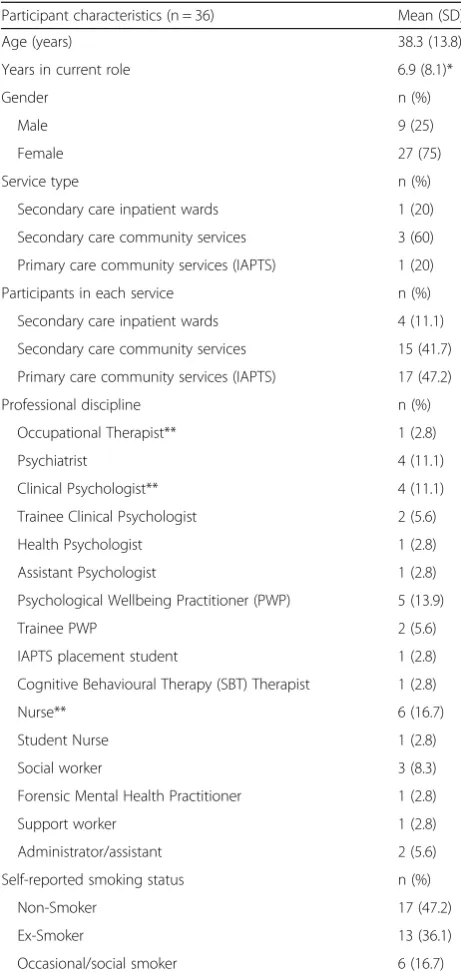
Table 1Participant characteristics
Participant characteristics (n = 36) Mean (SD)
Age (years) 38.3 (13.8)*
Years in current role 6.9 (8.1)*
Gender n (%)
Male 9 (25)
Female 27 (75)
Service type n (%)
Secondary care inpatient wards 1 (20)
Secondary care community services 3 (60)
Primary care community services (IAPTS) 1 (20)
Participants in each service n (%)
Secondary care inpatient wards 4 (11.1)
Secondary care community services 15 (41.7)
Primary care community services (IAPTS) 17 (47.2)
Professional discipline n (%)
Occupational Therapist** 1 (2.8)
Psychiatrist 4 (11.1)
Clinical Psychologist** 4 (11.1)
Trainee Clinical Psychologist 2 (5.6)
Health Psychologist 1 (2.8)
Assistant Psychologist 1 (2.8)
Psychological Wellbeing Practitioner (PWP) 5 (13.9)
Trainee PWP 2 (5.6)
IAPTS placement student 1 (2.8)
Cognitive Behavioural Therapy (SBT) Therapist 1 (2.8)
Nurse** 6 (16.7)
Student Nurse 1 (2.8)
Social worker 3 (8.3)
Forensic Mental Health Practitioner 1 (2.8)
Support worker 1 (2.8)
Administrator/assistant 2 (5.6)
Self-reported smoking status n (%)
Non-Smoker 17 (47.2)
Ex-Smoker 13 (36.1)
Occasional/social smoker 6 (16.7)
Trustworthiness among authors was established through open and honest discussions, and all authors had good knowledge of the COM-B and TDF frameworks.
Results Themes
Psychological capability: Having the knowledge and skills to address smoking with patients
Generally, MHPs were aware that smoking was a common behaviour among their patient groups. Only three MHPs stated that they had read the smoke-free policy; many mis-understood the purpose of the policy, understanding it to be for “practicality” purposes rather than to promote non-smoking and improve the health of patients and staff:
“I didn’t understand that the policy was around
helping people to change their behaviour. I just
thought it was the logistics and practicalities of don’t
smoke in the hospital grounds. In the same way as you
wouldn’t expect people sitting out there drinking
bottles of vodka. But that doesn’t necessarily mean you
are there trying to change those people’s problems with
alcohol. So if that is the policy then that is news to
me.”(Male, ex-smoker, Clinical Psychologist,
commu-nity based).[…]
“Even in inpatient setting, when you speak to them
about smoking cessation, it’s not because of stop
smoking. It’s because they are not allowed to smoke in
hospitals. So you don’t prescribe something based on
someone wanting to stop smoking. You prescribe to
keep them on nicotine whilst they are on the ward…
So you talk about it, but you prescribe it in the end
just to pull them through until their next cigarette.”
(Male, occasional smoker, Psychiatrist, community & inpatient based).
The majority of MHPs indicated that they had com-pleted the online smoke-free mandatory training. How-ever, a common issue which was observed in all focus groups was that many MHPs could not remember the content of this training. This was expressed either indir-ectly (i.e. verbally questioning if particular topics were covered) or directly; the latter being attributed to the large amount of content, as well as the perceived plexity and irrelevance to clinical practice. It was com-mon for MHPs to mention the difficulty they faced in passing the online assignment following the training:
“I think almost too much information, and the part
that’s more relevant to me was right at the end, like
how you have those conversations with people, and I think if the training was just that in a more
experiential way, like role plays. But it does help you
practice to have those conversations with people and how to bring it up, because its uncomfortable, and that felt more relevant. But because it was right at the end, I was fed up by then. I noticed that I had that
temptation to skip through it.”(Female, non-smoker,
Clinical Psychologist, IAPTS). […]
“Practically speaking as a clinician and a manager as
well, I think that it’s too long. I think there is way too
much science in there for the majority of clinical staff in the trust. Hardly any clinical staff need to know about the neuro pathways that affect nicotine
addiction and its interaction with antipsychotic drugs.
It’s kind of overshot the mark massively. I think it’s
good that we should all have some training, but I
think it’s too much and pitched at the wrong level” –
(Male, Ex-Smoker, Clinical Psychologist and service manager, IAPTS).
Moreover, knowledge around alternative approaches, such as tobacco harm reduction, was generally poor among MHPs. Those who were ill-informed criticised it due to be-lieving patients adopting this approach would take in higher concentrations of nicotine through alternative sources, such as Nicotine Replacement Therapy (NRT) and electronic cigarettes. This was often believed to be problematic, and as a result, many of these MHPs indicated that it was better for patients to continue smoking rather than adopting harm-reduction as an alternative strategy:
“The more it goes on the more upset I am about
prescribing all these extras because sometimes people use more nicotine than if they were allowed to smoke
every two hours.”(Female, ex-smoker, Psychiatrist,
Community & inpatient based). […].
“I’ve got limited knowledge, but I think realistically if
you’re able to just stop, then possibly you’re going to
more likely have stayed stop without having to rely on something else. Like some people get addicted to the patches and the tablets; all these different things that
they are trying to do to help them stop. But it’s just
transferring that addiction to another area.”(Female,
ex-smoker, PWP, community based).
Physical opportunity: Environmental factors that influence MHPs practice relating to addressing smoking with patients
Many MHPs indicated that they record patients’
opportunity for discussion by directly asking for advice during sessions, and if professionals felt they had time:
“I have talked to people who felt smoking was a major
problem for them and quitting smoking was a major goal. I have done some problem solving around that in terms of if they are using it, what else can they be
doing. But that’s usually if they have brought it to me
with something that they need help with. As opposed
to me saying let’s sit and talk about smoking.”
(Female, non-smoker, PWP, IAPTS). […]
“If they tick on the form that actually I’m happy with
the level that I’m smoking, that’s not something I’m
looking to make changes in, then it feels a bit
uncomfortable to bring it up in the context of having a
lot of things to do in that assessment anyway.”
(Female, non-smoker, clinical psychologist, IAPTS).
However, some MHPs indicated they would take cer-tain situations as opportunities to initiate a discussion around smoking. One manager of an inpatient ward spoke about how she takes the opportunity to discuss smoking with patients while escorting them on commu-nity leave. Yet, in spite of acknowledging that facilitating patient smoking is forbidden, she explained how being outside of the hospital perimeter makes it difficult to physically stop patients from smoking tobacco:
“I think our time out of the ward is a very good
opportunity to talk about quitting smoking, and plus the fact that when they are on escorted leave, town leave not ground leave, they are not really supposed to smoke when they are on their leave. But of course, you
can’t actually physically stop them”(Female,
ex-smoker, Nurse & ward manager, inpatient based).
Similarly, almost all MHPs working in the community expressed how difficult it is to support patients to stop smoking in the community due to tobacco being widely available to community patients when they are not on hospital premises. Many MHPs provided examples of how patients continue to bring tobacco onto hospital sites and smoke in the presence of no-smoking signs:
“The problem with enforcement I think is coming from
inpatient to community. Our patients don’t give a
monkey about smoking outside the door, next to the no smoking sign. Whereas I think inpatient is able to enforce it a little bit differently, particularly you know they have to go outside the grounds of the unit or
whatever. But yeah it’s hard to see how it’s possible or
how that problem to getting people to take it seriously.
Do you man handle people off the grounds? I don’t
really understand.”(Male, ex-smoker, Clinical
Psych-ologist, community based).
One MHP who reported having experience in both in-patient and community services described how having ac-cess to certain resources helped to engage mental health patients to consider quitting smoking. These resources in-cluded the use of a spirometer and having a stop smoking service onsite where patients could be referred to:
“My best experience of trying to address people's
smoking has been with the use of a spirometer that gives you a measurement of lung age, which in the
previous service where I worked we had one…I was
looking after people in their 40s and most of them had lung ages of a very heavy smoking population and a lot of them had lung ages between 80-110, and that was a really great motivational tool. The other advan-tage about this particular service is that there was a dedicated smoking cessation team and dedicated clinic and groups, so it was very easy to slot people in, and it was very clear who was going to see them and where they were going to go. Those people were very
access-ible, so it all worked really well.”(Female, ex-smoker,
Psychiatrist, community & inpatient based).
Social opportunity: Social factors that influence MHPs practice relating to addressing smoking with patients
Some MHPs acknowledged how smoking was once an activity shared between staff and patients, and how the trust has progressed in de-normalising this social culture which was once ingrained into the psychiatric commu-nity. However, numerous accounts of policy breaching were discussed among participants in the context of both inpatient and outpatient settings which indicated a different culture developing. Many MHPs spoke about this new culture whereby patients frequently hide to-bacco around hospital grounds due to not being allowed to take tobacco onto inpatient units, which are then sometimes searched for by other patients:
“I think one of the other things you find is they hide
their cigarettes and come back to them a few hours
later. I’ve seen people do that here…And it becomes
like an Easter egg hunt and I think it’s because people
might go and they know where their friends are hiding them. I think there has got to be more of a policy
around how you handle that”. (Male, occasional
smoker, Forensic Mental Health Practitioner, community based).
policy has led to tobacco becoming a valuable currency among patients. As a result, some MHPs discussed how pa-tients are now under pressure to bring tobacco and smoking-related paraphernalia onto the wards for fellow peers:
“People are under pressure to bring cigarettes and
lighters in onto the ward whereas before you didn’t have
that pressure to bring cigarettes.”(Female, ex-smoker,
Psychiatrist, community & inpatient based). […]
“Yes, and you have this double bubble called debts. So
everything is one hundred percent. So if you borrow one cigarette, you may as well bring two cigarettes
back”(Male, ex-smoker, Psychiatrist, community &
in-patient based).
Although inpatient policy breaches were less com-monly reported compared with community services, in-consistent policy implementation among inpatient staff may jeopardise MHPs ability to successfully maintain this momentum. One MHP shared an experience of how poor support from his colleagues undermined his efforts to enforce the smoke-free policy on one inpatient unit:
“It’s good if it gets implemented and followed through
properly, but it doesn’t. Patients keep on smoking on
the wards and staff are scared to confront patients, so
they don’t do anything about it. I regularly go on the
ward and being an ex or occasional smoker, I go on
and immediately smell it, and I say ugh who’s
smoking? I walk straight to the room of the patient smoking and I say this patient is smoking, and the
response is, oh no he’s not! Which is ridiculous! So I
don’t think it’s getting used as it should”. (Male,
occasional smoker, Psychiatrist, community and inpatient based).
Automatic motivation: Biases that affect MHPs practice relating to addressing smoking with patients
It was apparent that many MHPs held intrinsic biases
regarding patients’smoking behaviour. Some MHPs
as-sumed that patients already have the necessary tools re-quired to successfully quit smoking, and so smoking was not considered to be a topic which needs to be ad-dressed with patients during clinical contact:
“I think it’s common knowledge and everyone knows
the consequences of smoking, so why do I have to state the obvious every time I see the clients, because they
are not stupid. They’ve got the knowledge but they
made the choice they want to make.”(Female,
occasional smoker, Nurse, community based).
More often, MHPs commented on patients’ abilities
and motivation to quit smoking. Specifically, many be-lieved that mental health patients are resistant to address their smoking, as tobacco was considered to be one of the few pleasures these patients have in their lives:
“From experience I have not really met many who
would ever want to give up. That seems to be the one
thing they like about their life.”(Male, ex-smoker,
Clinical Psychologist, community based). […].
“I think overall they are locked up and banged up in a
secure environment, so what can they do? So obviously when they go on their escorted or unescorted leave,
invariably they do smoke.”(Female, ex-smoker, Nurse
& Ward Manager, inpatient based).
Some MHPs commented on how patients do not per-ceive smoking as being a psychiatric problem which should be addressed within a mental health service. Subsequently, fears of inflicting misbalance to the power dynamic of the established therapeutic relationship may
subconsciously deter professionals from advising
patients to quit smoking:
“They can’t see it as a psychiatric problem, so they
can’t see why you’re asking. It’s none of your business
kind of thing.”(Male, ex-smoker, Psychiatrist,
commu-nity & inpatient based). […]
“Some patients interpret it as part of control. Because
of the dynamics it’s why are you telling me what to do.
Can I tell you to stop smoking? It’s my life…”(Male,
non-smoker, Social Worker, community Based).
Reflective motivation: Self-conscious decision making and reasoning that influence MHPs practice relating to addressing smoking with patients
The extent to which MHPs felt addressing smoking was part of their role varied. Within community settings, some MHPs expressed how their role is fundamentally to provide information and raise awareness, with few mentioning they would take it upon themselves to provide smoking cessation advice:
“We have got a responsibility to provide them with
some information about health promotion and smoking comes into that. But I think in the community
that’s probably where our role ends. You know, we can
offer them where to find some more information or
give some advice, but Erm…yeah. I think that’s it
really”. (Female, Occasional Smoker, Nurse & Team
Other professionals within the community expressed their views of how the trust’s requirement to monitor
patients’ smoking was something which had been
im-posed on them, rather than it being something which they would pursue otherwise:
“I think that it has been made a part of my job, more
than I would do it as part of my job, with the smoking.
It’s an unhealthy habit, there are lots of unhealthy habits.
But its more something I’ve kind of been told to do.”
(Female, ex-smoker, Social Worker, community based).
Explanations given as to why smoking was not necessar-ily a priority for MHPs in the community were often based around the complexity and heterogeneity of mental health; often being associated with many complex needs and behaviours which MHPs place greater emphasis on:
“I don’t think I’ve ever offered. It just never comes to
mind. I don’t know why. But maybe the number of
problems people tend to come to me with, that doesn’t
seem to ever factor in their list of…well it’s not even a
problem for them, but even if it is then its way down the list behind other drugs or other problems that they
are having.”(Male, ex-smoker, Clinical Psychologist,
community based).
However, although many MHPs placed greater em-phasis on other areas of the patient’s health, it was com-mon for some MHPs to reflect on their practice and state that they would address smoking with patients in the context of there being a clear physical health or fi-nancial issue:
“I think sometimes because people have got issues with
their medication as well, if they are mixing the two together, you might be more likely to focus on discussing their issues about their medication with
them and that you can’t mix two difficult issues
together and you’re unlikely to be successful in
discussing both so unless there is an obvious physical health problem that was becoming a major concern, I
would probably choose the medication.”(Male,
ex-smoker, Social Worker, community based).[…]
“I often ask about it if they are a smoker and just say,
is that something you’re looking to give up or not?
Especially if there are financial issues or health issues or maybe if they are smoking a lot of marijuana or
something like that.”(Female, non-smoker, Clinical
Psychologist, IAPTS).
Perhaps due to the greater emphasis placed on smok-ing and inpatient settsmok-ings, these MHPs felt more obliged
to stopping patients from smoking, which was also often noted by MHPs in the community. However, although it was their responsibility to enforce policies and raise awareness about smoking, professionals working on the wards expressed how it was not their responsibility to
“police” smoking. As a result, some were often compla-cent with patients’smoking outside the premises, and in some instances condoned limited smoking when patients were granted leave in the context of harm-reduction:
“It isn’t our role as clinicians to police smoking. If it
were illegal which cannabis is, we take a different approach on that obviously. But with smoking as of yet
not illegal, we can’t stop them. Literally. When they go
out on their leave, which isn’t every minute of every
day, they may smoke. But while they are in the
building, they are not smoking.”(Female, ex-smoker,
Nurse & Ward Manager, inpatient based).[…]
“I don’t allow them to smoke that much so they are
only allowed two cigarettes when they go out on leave.
It causes a lot of problems with negotiations.”(Female,
ex-smoker, Psychiatrist, community & inpatient based).
Many MHPs in community services stated that they would not approach patients who were smoking on hos-pital grounds if they did not know them. A common rea-son for this was fear of experiencing potential conflict:
“In all honesty, I’d worry about being thumped! You
don’t know what the patient’s history is. You don’t
know what the risk history is. I think that’s tricky.”
(Female, ex-smoker, Psychiatrist, community &
inpatient based). […]
“I’ve seen people smoking, just near our office actually,
and I feel a bit conflicted and there is some dissonance. Because I think it probably is my role as a senior
clinician to enforce the policy, it’s probably all of our role
to do that really. But at the same time I have other conflicting ideas which get in the way of me doing that.
Like…I don’t want to get into conflict with someone and
they are not a patient being seen in our team, they are
clearly inpatients. And…I’m really busy and I’ve got
other things I could be doing with my time, so there are always excuses that I think I could make for myself to not
get into a conflict situation about it”(Male, Ex-Smoker,
Clinical Psychologist and service manager, IAPTS).
Discussion
Findings from this study suggest that addressing smok-ing with mental health patients may be undermined by
(environmental influences and peer support); and motiv-ation (biases, self-identity and priorities). Particular bar-riers included misunderstanding of nicotine and harm reduction, unfamiliarity with the smoke-free policy, in-ability to recall training content; time constraints, resili-ent smoking culture, intrinsic biases, perceived job role and responsibilities/priorities. A key facilitator to MHPs addressing smoking with patients was MHPs opportun-ity to do so. Specifically, addressing smoking with pa-tients was facilitated by papa-tients bringing smoking as an agenda to meetings with MHPs, as well as MHPs having access to resources such as on-site stop smoking services and spirometers. The authors discuss these findings below, and provide a number of potential recommenda-tions for future research and clinical services which have been informed from the wider literature and the behav-iour change wheel [16]. Further implications and recom-mendations are listed in Table2.
Regarding capability, it was found that many MHPs hold misconceptions in relation to patients’ abilities to quit smoking, which reflect the views found by the meta-analysis of Sheals and colleagues [14]. Moreover, MHPs tend to believe that alternative approaches to ces-sation, such as harm reduction, have little or no benefit to these patients due to misinterpreting nicotine as be-ing the harmful substance where abstinence is needed
[6]. This is despite many of these MHPs claiming to
[image:8.595.59.538.331.733.2]have engaged in mandatory online smoking cessation training. One notable finding of the present study was that MHPs in community settings could not recall the content of this training, with many stating that the test assignment at the end was difficult to pass. Moreover, many professionals commented on the small applicabil-ity they felt the smoke-free policy and training had to non-inpatient services, which was often provided as the reason why many had not read the smoke-free policy. It
Table 2Identified barriers and suggested interventions that have been informed by the literature, COM-B and TDF [16]
Barriers identified COM-B TDF Intervention
function
Possible intervention
Poor comprehension of harm reduction approaches, smoke-free policy and its purpose.
Unable to recall training content MHPs lack the confidence to address smoking with patients who do not initially indicate willingness to quit.
Psychological capability Knowledge Memory, attention and decision Cognitive and interpersonal skills Education Training Environmental restructuring Enablement
Brief, face-to-face or online smoking cessation training tailored specifically to MHPs roles [35]. Training which allows MHPs to practice the skills required to address smoking with patients (e.g. role play group training), thus improving capability as well as confidence and motivation [24]
Inability to monitor patients’smoking in community services.
Lack of time and resources to provide smoking cessation interventions (only ask about smoking at initial assessment).
Physical opportunity Environmental context and resources Training Restriction Environmental restructuring Enablement
Improve access to specialist equipment, such as spirometers and CO monitors [26] [27]. Improve communications/referral process between mental healthcare (non-smoking specialists) services and stop smoking services (smoking specialists) [36].
Tobacco has become a prominent contraband item in the community and inpatient settings.
Lack of support from colleagues to enforce smoke-free policy.
Social opportunity
Social influences Restriction Environmental restructuring Modelling Enablement
Group training to encourage team work and shared learning across different care teams [24]. Videos of positive attitudes of fellow healthcare providers and colleagues.
Increased vigilance to prevent anti-social behaviour (i.e. hiding tobacco in bushes and units) that is sensitive to mental healthcare contexts (e.g.‘watchful eyes’intervention [37] has been found to be effective in other contexts, but may not be appropriate in settings whereby patients experience paranoia).
Intrinsic biases regarding mental health and smoking. Automatic motivation Reinforcement Emotion Training Incentivisation Persuasion Coercion
Improve clinical reasoning and decision making skills, such as through reflective practice and active metacognitive review [23].
Use of emotive videos of patients who want to quit, but cannot due to their mental health.
Smoke-free policy and training lacks relevance to non-inpatient services. Prioritise alcohol and other substances over tobacco.
Only intervene with tobacco use in light of financial or physical health issue. Belief that addressing smoking with patients could provoke retaliation from some patients.
Reflective motivation Professional role and identity Beliefs about capabilities Beliefs about consequences Intentions Goals Education Persuasion Modelling Incentivisation Coercion Enablement
Tailoring training to clinical setting/role, and manuals to aid MHPs [23].
Incorporate smoking cessation into other treatments [34].
Improving awareness that‘preventing’is more beneficial compared with‘treating’.
may be that the rationale for the policy and need for train-ing has not been communicated clearly to professionals, which is a recommendation in the NICE guidance [10].
Tailoring training content to different professional
backgrounds and clinical settings, as well as incorporating accessible resources such as professional manuals, could improve knowledge and bridge the existing gap between training targets and current practice, especially in commu-nity mental health services [23]. In addition, it is note-worthy that participants who had completed training only engaged with the mandatory online smoking cessation training, and had not participated in the advanced optional face-to-face training which is provided by the trust. Research suggests that group training is more effective than web-enabled video training with regard to improving outcomes that are affected by the availability of
profes-sional knowledge [24]. Indeed, a number of MHPs
commented on how they felt uncomfortable to bring up smoking cessation with their patients, and so the incorpor-ation of group-based training may improve MHP's com-munication skills and confidence through activities such as role-play and feedback [24]. Making these changes to the resources available to MHPs may therefore improve their capability which could have positive implications for MHP's practice, as well as their motivation to address smoking with their patients. As this study did not include professionals who had received the advanced optional training, further research should investigate whether these barriers relating to capability of the COM-B model differ in this group, as this may also provide useful when devel-oping the mandatory training.
Regarding opportunity, it is apparent that the environ-mental infrastructure of services affects MHP's ability to address smoking with patients and enforce the smoke free policy. MHPs in inpatient settings have increased daily contact with patients compared with MHPs who solely practice in the community, and so have more physical opportunities to address smoking with patients. This study highlighted the lack of physical opportunity which commu-nity MHPs feel they have to discuss smoking with their pa-tients; often referring to time constraints and the inability to monitor patients’ progress because of having limited face-to-face contact with patients. In line with the behav-iour change wheel, enabling MHPs by increasing access to resources which can be used in the community may assist in overcoming this barrier, which could improve the motiv-ation of both the patient and MHPs. One participant of the present study mentioned how the close proximity and easy access of a stop smoking service at one hospital aided her in supporting patients to quit smoking. However, recent funding budget cuts across English NHS services have had a negative impact on stop smoking services [25], resulting in some locations not having easy access to this resource. Nonetheless, the same MHP also spoke of her experience
using a spirometer which helped her in the past to engage patients in discussion regarding their smoking. One rando-mised controlled trial (RCT) found that telling smokers their lung age significantly improved the likelihood of them quitting smoking at 12 month follow-up [26]. Therefore, increasing accessibility to spirometers in the community may facilitate the interaction between MHPs and patients with regard to smoking cessation, and may therefore re-solve one existing problem community MHPs face in mon-itoring progress. Increasing access to such resources may be even more crucial for disadvantaged services in which there is no on-site stop smoking service. This was the case for a number of services recruited for the present study, which further demonstrates how NICE recommendations are not currently being met [10]. Furthermore, as patients’ directly requesting help from MHPs was a facilitating fac-tor that encouraged them to support patients, it is feasible that the inclusion of spirometers during routine smoking screenings would potentially motivate more patients to quit and seek support, which in turn would encourage MHPs to provide this requested support. Another suggestion may also be to provide services with carbon monoxide testing machines to allow MHPs to record and monitor patients’ smoking behaviour, which is a NICE recommendation for identifying pregnant women who smoke [27]. Indeed, some studies have supported the use of exhaled carbon monoxide readings for encouraging quit attempts and cessation [28,
29]. Further research should explore the potential impact of such measures becoming an essential component of smok-ing status screensmok-ings within mental health services.
to have the highest impact. This would particularly be the case for MHPs in the community who often stated that they would not approach a patient smoking on hospital grounds due to time constraints and also fearing violence in retaliation. Research has reported that an increase in violence was a major concern for inpatient MHPs before the implementation of smoke-free policies, although the opposite was found in reality [31]. Therefore, improving education and communication of these findings, along with offering practical workshops where MHPs can prac-tice instigating conversations with patients regarding smoking, may succeed in improving MHPs confidence to address smoking more frequently and seriously with their patients. The potential to achieve reductions in violent in-cidences as a result of supporting patients to quit smoking may particularly be an incentive for forensic services where general risk of violence may be higher [32].
Finally, MHPs tended to believe that mental health pa-tients have multiple behaviours that take priority over smoking, such as illicit substance misuse. These findings are in line with those reported in a recent qualitative study; patients of substance misuse services are motivated to apply their learning to smoking cessation but do not re-ceive support or encouragement from staff within the sub-stance misuse services [33]. Research has shown that smoking cessation can be successfully incorporated into treatments addressing illicit substance use without jeopar-dising recovery goals, which contradicts these arguments made by some of the participants in the present study [34]. In line with the behaviour change wheel, raising awareness of this, in addition to emphasising the degree of impact which tobacco smoking has on physical and mental well-being, may encourage MHPs to consider incorporating smoking cessation in their practice when addressing illicit substance misuse with patients. Training developers should consider incorporating content regarding this common barrier in future training programmes.
Limitations
The purposeful sampling methods to recruit MHPs from only five settings within one mental health trust in England means the findings cannot be generalised to the MHP population, or other settings within that trust or other mental health trusts. Given the multidisciplinary nature of mental health services and the small number of partici-pants in this study, the sample is also not representative of the services they work in. Moreover, due to the design of the study, as well as the complexity of the healthcare path-way, systematic subgroup comparisons were not possible. Indeed, many professionals, such as psychologists and psy-chiatrists, work in both inpatient and community services, thus making it difficult to classify these MHPs as commu-nity or inpatient based. This also made systematic compar-isons between inpatient and community MHPs difficult.
However, this study highlighted a number of differences between inpatient and community services which have im-plications for the development of smoke-free policy and smoking cessation practice in mental healthcare pathways. One comparison of interest was whether smoking or vap-ing status influenced MHPs responses, which this study found to not be the case. Nonetheless, further research should explore potential relationships such as these more systematically.
The application of COM-B allowed us to identify fac-tors that impacted MHPs practice regarding smoking in their roles. However, we encountered some difficulty in separating the COM-B categories. For instance, it was difficult to distinguish whether inability to recall training content was the result of MHPs memory and attention (i.e. psychological capability) or their lack of concern to remember (i.e. motivation). Where possible, we used au-thor agreement to provide a parsimonious analysis of re-sponses to fit the COM-B framework. As the interview guide was not based on the COM-B model, the data allowed for inductive coding which could be classified into a COM-B framework, therefore not limiting the scope of the data.
Finally, the role of the researcher (CS) should be consid-ered when interpreting the data of the present study. Al-though the researcher had attended a qualitative training course prior to the focus groups, it is possible that previous experiences and beliefs could have influenced the study. Unfortunately, it was not practical for participants to com-ment on the transcripts before data analysis begun, which would have further enhanced trustworthiness and reduced the potential impact of researcher bias. Moreover, the researcher’s previous clinical experience of working in one of the services recruited in the present study could have in-fluenced how data was interpreted and coded. Attempts to minimise this included use of a semi-structured interview guide, as well as a second coder (LK), who had no prior re-lationship with participants. It is also feasible that having an established working relationship prior to interviews could have influenced participants’ responses (e.g. social desirability bias). However, establishing data saturation through identifying common themes across focus groups suggests this would have had minimal impact to the main findings.
Conclusions
be achieved through supporting them to do so. This unawareness in combination with environmental and resource constraints negatively affects community MHPs motivation to address smoking with their patients.
Abbreviations
COM-B:Capability, opportunity, motivation–behaviour model; MHP: Mental health professionals; NHS: National health service; NICE: National Institute for Health and Care Excellence; TDF: Theoretical domain framework
Acknowledgments
The authors would like to thank the research participants who provided the data, and the NHS trust for their support.
Funding
This study was supported by the Lynn MacFadyen studentship with funding from Cancer Research UK (C27061/A18679 and C27061/A24481) and the British Heart Foundation (PG/16/56/32246). Funders of this research provided finances only and had no involvement in the research activities.
Availability of data and materials
The data are not publicly available due to them containing information that could compromise research participant privacy/consent.
Authors’contributions
LS and AM obtained research funding and contributed to the design of the research protocol. LS and AM contributed to the systematic review that the interview schedule was based upon. CS facilitated all focus groups, and transcribed recordings verbatim. CS took the lead in analysing the data. LK coded three transcripts to cross-check analysis and agree on theme inter-pretation. CS drafted the manuscript with further critical input from LK, AM and LS. All authors have read and approved the manuscript.
Authors’information
CS is a male PhD student at University College London. He attended and completed a five-day training course in qualitative research methods before the focus groups were conducted.
AM is a female professor in tobacco control at King’s College London. LK is a male PhD student at University College London.
LS is a senior lecturer (associate professor) at University College London.
Ethics approval and consent to participate
Participants received information sheets outlining the study and provided written consent before focus groups commenced. The study was approved by the University College London (UCL) ethics committee (application reference 10,093/001).
Consent for publication Not applicable.
Competing interests
LS is a HEFCE funded member of staff at University College London. He has received honoraria for talks, an unrestricted research grant and travel expenses to attend meetings and workshops from Pfizer and an honorarium to sit on advisory panel from Johnson&Johnson, both pharmaceutical companies that make smoking cessation products. He has acted as paid reviewer for grant awarding bodies and as a paid consultant for health care companies. Other research has been funded by the government, a community-interested company (National Centre for Smoking Cessation) and charitable sources. He has never received personal fees or research funding of any kind from alcohol, electronic cigarette or tobacco companies. CS is a male PhD student at University College London. Before this post, he was an honorary Assistant Psychologist for a community forensic psychological treatment service and so was known to one focus group of the present study. The other authors have no competing interests to declare.
Publisher’s Note
Springer Nature remains neutral with regard to jurisdictional claims in published maps and institutional affiliations.
Author details
1Department of Behavioural Science and Health, University College London,
1-19 Torrington Place, London WC1E 6BT, UK.2National Addiction Centre, King’s College London, 4 Windsor Walk, London SE5 8BB, UK.3UK Centre for Tobacco and Alcohol Studies, Nottingham NG5 1PB, UK.
Received: 30 May 2018 Accepted: 16 January 2019
References
1. West R., Brown J., Beard E. Latest Statistics—Smoking in England. 2017. Available at: http://www.smokinginengland.info/latest-statistics/ (accessed March 2018) (Archived at http://www.webcitation.org/72zJO20K6). 2. Szatkowski L, McNeill A. Diverging trends in smoking behaviors according
to mental health status. Nicotine Tob Res. 2015;17:356–60.https://doi.org/ 10.1093/ntr/ntu173.
3. World Health Organisation. WHO | tobacco. In: WHO; 2017.
4. Bandiera FC, Anteneh B, Le T, Delucchi K, Guydish J. Tobacco-related mortality among persons with mental health and substance abuse problems. PLoS One. 2015;10:e0120581.https://doi.org/10.1371/journal.pone.0120581.
5. Lawn S, Campion J. Achieving smoke-free mental health services: lessons from the past decade of implementation research. Int J Environ Res Public Health. 2013;10:4224–44.
6. Ratschen E, Britton J, McNeill A. The smoking culture in psychiatry: time for change. Br J Psychiatry. 2011;198:6–7.https://doi.org/10.1192/bjp.bp.110.081372. 7. Robson D, Yates M, Craig TJK, Healey A, McNeill A. Time to smoke:
facilitating smoking breaks in mental health inpatient settings: table 1. Nicotine Tob Res. 2016;18:1794–7.https://doi.org/10.1093/ntr/ntw103. 8. Tidey JW, Miller ME. Smoking cessation and reduction in people with
chronic mental illness. BMJ. 2015:h4065.https://doi.org/10.1136/bmj.h4065. 9. Jochelson K. Smoke-free legislation and mental health units: the challenges
ahead. Br J Psychiatry. 2006;189:479–80.https://doi.org/10.1192/bjp.bp.106.029942. 10. Smoking: acute, maternity and mental Smoking: acute, maternity and
mental health services health services Y Your responsibility our responsibility. 2013.https://www.nice.org.uk/guidance/ph48/resources/ smoking-acute-maternity-and-mental-health-services-pdf-1996364658373. Accessed 20 Apr 2018.
11. Ratschen E, Britton J, McNeill A. Implementation of smoke-free policies in mental health in-patient settings in England. Br J Psychiatry. 2009;194:547– 51.https://doi.org/10.1192/bjp.bp.108.051052.
12. Ratschen E, Britton J, McNeill A. Smoke-free hospitals–the English experience: results from a survey, interviews, and site visits. BMC Health Serv Res. 2008;8:41.https://doi.org/10.1186/1472-6963-8-41.
13. Ratschen E, Britton J, Doody GA, Leonardi-Bee J, McNeill A. Tobacco dependence, treatment and smoke-free policies: a survey of mental health professionals’knowledge and attitudes. Gen Hosp Psychiatry. 2009;31:576– 82.https://doi.org/10.1016/j.genhosppsych.2009.08.003.
14. Sheals K, Tombor I, McNeill A, Shahab L. A mixed-method systematic review and meta-analysis of mental health professionals’attitudes toward smoking and smoking cessation among people with mental illnesses. Addiction. 2016;111:1536–53.
15. Simonavicius E, Robson D, McEwen A, Brose LS. Cessation support for smokers with mental health problems: a survey of resources and training needs. J Subst Abus Treat. 2017;80:37–44.https://doi.org/10.1016/j.jsat.2017.06.008. 16. Michie S, van Stralen MM, West R. The behaviour change wheel: a new
method for characterising and designing behaviour change interventions. Implement Sci. 2011;6:42.https://doi.org/10.1186/1748-5908-6-42. 17. Alexander KE, Brijnath B, Mazza D. Barriers and enablers to delivery of the
healthy kids check: an analysis informed by the theoretical domains framework and COM-B model. Implement Sci. 2014;9:60.https://doi.org/10. 1186/1748-5908-9-60.
18. Mazza D, Chapman A, Michie S. Barriers to the implementation of preconception care guidelines as perceived by general practitioners: a qualitative study. BMC Health Serv Res. 2013;13:36.https://doi.org/10.1186/ 1472-6963-13-36.
19. Boscart VM, Fernie GR, Lee JH, Jaglal SB. Using psychological theory to inform methods to optimize the implementation of a hand hygiene intervention. Implement Sci. 2012;7:77.https://doi.org/10.1186/1748-5908-7-77. 20. Atkins L, Francis J, Islam R, O’Connor D, Patey A, Ivers N, et al. A guide to
investigate implementation problems. Implement Sci. 2017;12:77.https:// doi.org/10.1186/s13012-017-0605-9.
21. Braun V, Clarke V, Braun V, Clarke V. Using thematic analysis in psychology. Qual Res Psychol. 2006;3(2):77–101.
22. Bazerley P, Jackson K. Qualitative data analysis with Nvivo; 2013. 23. Brose LS, McEwen A, Michie S, West R, Chew XY, Lorencatto F. Treatment
manuals, training and successful provision of stop smoking behavioural support. Behav Res Ther. 2015;71:34–9.https://doi.org/10.1016/J.BRAT.2015.05.013. 24. Garzonis K, Mann E, Wyrzykowska A, Kanellakis P. Improving patient
outcomes: effectively training healthcare staff in psychological practice skills: a mixed systematic literature review. Eur J Psychol. 2015;11:535–56.https:// doi.org/10.5964/ejop.v11i3.923.
25. Action on Smoking & Health. Feeling the heat: The decline of Stop Smoking Services in England. 2017.https://www.cancerresearchuk.org/sites/default/ files/la_survey_report_2017.pdf/. Accessed 11 May 2018.
26. Parkes G, Greenhalgh T, Griffin M, Dent R. Effect on smoking quit rate of telling patients their lung age: the Step2quit randomised controlled trial. BMJ. 2008;336:598–600.https://doi.org/10.1136/bmj.39503.582396.25. 27. National Institute of Health and Care Excellence (NICE). Smoking: stopping
in pregnancy and after Smoking: stopping in pregnancy and after childbirth childbirth Y Your responsibility our responsibility. 2010.https://www.nice. org.uk/guidance/ph26/resources/smoking-stopping-in-pregnancy-and-after-childbirth-pdf-1996240366789. Accessed 11 May 2018.
28. Beard E, West R. Pilot study of the use of personal carbon monoxide monitoring to achieve radical smoking reduction. J Smok Cessat. 2012;7:12– 7.https://doi.org/10.1017/jsc.2012.1.
29. Shahab L, West R, McNeill A. A randomized, controlled trial of adding expired carbon monoxide feedback to brief stop smoking advice: evaluation of cognitive and behavioral effects. Health Psychol. 2011;30:49– 57.https://doi.org/10.1037/a0021821.
30. Harker K, Cheeseman H. The Stolen Years: The Mental Health and Smoking
Action Report. 2016.
31. Robson D, Spaducci G, McNeill A, Stewart D, Craig TJK, Yates M, et al. Effect of implementation of a smoke-free policy on physical violence in a psychiatric inpatient setting: an interrupted time series analysis. Lancet Psychiatry. 2017;4:540–6.https://doi.org/10.1016/S2215-0366(17)30209-2. 32. Dickens G, Piccirillo M, Alderman N. Causes and management of aggression
and violence in a forensic mental health service: perspectives of nurses and patients. Int J Ment Health Nurs. 2013;22:532–44.https://doi.org/10.1111/j. 1447-0349.2012.00888.x.
33. Walsh H, Duaso M, McNeill A. Missed opportunities: a qualitative study of views and experiences of smoking cessation amongst adults in substance misuse treatment. Addict Res Theory. 2018:1–7.https://doi.org/10.1080/ 16066359.2018.1441403.
34. Baca CT, Yahne CE. Smoking cessation during substance abuse treatment: What you need to know. J Subst Abuse Treat. 36:205–19. doi:https://doi.org/ 10.1016/j.jsat.2008.06.003.
35. Kerr S, Whyte R, Watson H, Tolson D, McFadyen AK. A mixed-methods
evaluation of the effectiveness of tailored smoking cessation training for healthcare practitioners who work with older people. Worldviews Evidence-Based Nurs. 2011;8:177–86.https://doi.org/10.1111/j.1741-6787.2011.00219.x. 36. Graber ML, Kissam S, Payne VL, Meyer AND, Sorensen A, Lenfestey N, et al.
Cognitive interventions to reduce diagnostic error: a narrative review. BMJ Qual Saf. 2012;21:535–57.https://doi.org/10.1136/bmjqs-2011-000149.
37. Bateson M, Callow L, Holmes JR, Redmond Roche ML, Nettle D. Do images
![Table 2 Identified barriers and suggested interventions that have been informed by the literature, COM-B and TDF [16]](https://thumb-us.123doks.com/thumbv2/123dok_us/318723.1032932/8.595.59.538.331.733/table-identified-barriers-suggested-interventions-informed-literature-com.webp)
