Modelling Extraction Transformation Load embedding
Privacy Preservation using UML
Kiran P
Research Scholar VTU,Belgaum Karnataka, India
S Sathish Kumar
Research Scholar MGR University, Chennai
Tamil Nadu,India
Kavya N P
Prof & Head Dept of MCA,RNSIT Bangalore,Karnataka,India
ABSTRACT
Extraction Transformation Load plays an important phase in development of data warehouse due its complexity of selecting data from different location and having different structures. The recent industry of data warehouse is driven by Privacy Preserving Data Mining which ensures privacy of sensitive information during Mining and is a requirement of most Data Bases. Current approaches to modelling extraction transformation load do not include privacy representation in Conceptual Modelling. This paper proposes object-oriented approach to model Extraction Transformation Load embedding privacy preservation. The major components of extraction include Data Source, Source Identifier, Retrieval, Join, Privacy Preserving Area and Data Staging Area. All the above mentioned components have been modelled using Unified Modelling Language.
Keywords
Privacy Preserving Data Mining, ETL, Data Stage Area, Privacy Preserving Area , Data Warehouse.
1.
INTRODUCTION
Providing security to the data which is retrieved from distributed heterogeneous databases and data mined after it is integrated are one of the leading issues in database research and industry. Extraction Transformation Load (ETL) is an important stage in developing the Data Warehouse. The Extraction process starts with identification of the heterogeneous databases and their format of representation. This information must be transformed, which may include elimination of data based on some conditions, change of format from one representation to the other also called filtering, merging of data from multiple sources and usually in databases we use different primary keys but in data warehouse we require additional keys called surrogate keys so there is a requirement to have an efficient mechanism to assign surrogate keys. The next important task is aggregation of information in order to help the queries and to improve the performance of the Data Warehouse. All these transformed data must be placed in the Data Warehouse which is done in Load phase.
ETL processes are one of the important components of DWs, because erroneous or ambiguous data will give improper results which will affect business decisions made by the manager. Therefore, there is a requirement to design ETL correctly at the initial stages to improve data quality which will improve decision making. Embedding privacy on to the ETL representation plays an important task since most of the present DW requires some of the information to be kept confidential. In this paper, we have used Unified Modelling
Language to represent modelling of ETL embedding privacy preservation.
Data Staging Area
Secure Data
Privacy Preserving Area
Privacy Algorithm
Server Component
Data extraction
Client component
[image:1.595.323.525.277.615.2]DBMS Flat File
Fig. 1 Deployment Diagram for Architecture of Data Extraction Embedding Privacy Preservation
Data Source
+Sid +stype +Sclient +Set_Sid() +Set_Stype() +Set_Sclient()
Source Identifier
+Sid
+Identify_new_source() +Identify_change_source() +Inform_to_join()
Retrieval
+Sid
+Set_conn_source() +Update_to_join()
Join
+Integrate_data() +Invoke_retrieval() +Update_to_PPA()
Privacy Preserving Area
+Clean_transform() +Secure_data() +Update_to_DSA()
Data Stagining Area
+update_data() 1..*
1
1..*
1
[image:2.595.67.514.81.288.2]1..* 1..*
Fig. 2 Class Diagram for ETL embedding Privacy Preservation
Flat files DBMS
Data Source PPA
DSA Extraction join
Set_conn
Idtfy_chg
Cleaning
Transform
Privacy preserving
Loading
[image:2.595.82.501.344.517.2]<<include>> <<include>>
Fig. 3 Use case diagram for ETL embedding privacy preservation
2. RELATED WORK
ETL is an important foundation of building data warehouse[1]. Users extract the required data from the data source, clean the data in accordance with pre-defined model schema and then data will be loaded into the data warehouse. A common management and design tool for ETL , system structure and program framework has been discussed in [1]. Traditional methods of ETL development are very much difficult to meet business requirements so the authors have demonstrated an extended UML mechanism by which a faster representation is possible [2]. In [3] the authors have studied how the meta data can be used such that higher performance can be achieved and has also shown optimization using meta data concept gives better performance.
Time oriented retrieval plays an important while retrieving data from data warehouse and while achieving speed it’s also important to achieve accuracy which is a challenging task. To achieve and accelerate data warehouse processes the author
[4] has suggested methods to increase the speed during join and aggregation. A method called change data capture which is used to increase the performance in Extraction has been discussed.
A survey of existing modelling techniques, their
characteristics notation and activities has been analyzed in [5]. This study states that there is a clear classification of ETL process modelling approaches but there is no clear and enough research in this area.
Logical optimization of ETL processes based on state-space search problem has been discussed in [6]. Authors have also indicated heuristic algorithms towards minimization of the execution cost of an ETL workflow.
: DS: Data Source RC : Rerieval component SI : Source Identifier JC : Join component PPA : Privacy Preserving Area DSA : Data Staging Area
1 : Identify_source()
2 : Inform_to_join()
3 : Invoke_retrieval() 4 : Set_conn_source()
5 : Conn_done()
6 : Update_to_join()
7 : Integrate_data()
8 : Update_to_PPA()
9 : Clean_transform() 10 : Identify_chg_source()
11 : Inform_to_Join()
12 : Secure_data()
13 : Invoke_retrieval()
14 : Set_conn_source() 15 : Update_to_DSA()
16 : Update_data() 17 : Conn_done()
18 : Update_to_join()
19 : Integrate_data()
20 : Update_to_PPA()
21 : Clean_transform()
22 : Secure_data()
23 : Update_to_DSA()
[image:3.595.79.524.83.515.2]24 : Update_data()
Fig. 4 Sequence Diagram for ETL embedding Privacy Preservation
In [8] an object-oriented approach has been used to represent ETL process by means of Unified Modelling Language (UML) and gives a brief idea regarding the class diagrams, use-case and sequence diagram that is required for ETL representation. Author in [9] have extended the earlier representation of [8] and has given a new dimension in representing secure data extraction through UML, but in none of the papers there is no representation of ETL embedding privacy. In this paper we are representing ETL in Privacy Preserving Data Mining using UML.
3.
ARCHITECTURE OF DATA
EXTRACTION EMBEDDING PRIVACY
USING UML
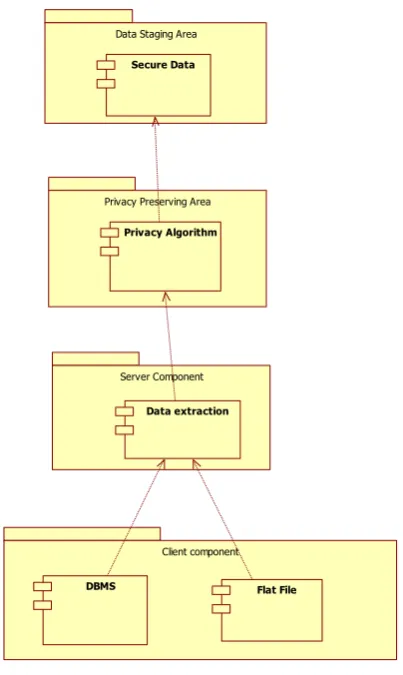
Deployment diagram for architecture of data extraction embedding privacy is shown in figure 1. The lover level deployment consists of different source location where in the data is distributed, the data may be present as a flat file or DBMS. Each of this is represented as a separate component
level contains server component which retrieves information from different Data sources and also contains additional components such as Retrieval component, source identifier and Join components which has not been indicated in the architecture diagram. The retrieval component does the actual retrieval of data from source to destination. Source identifier identifies different sources that is required by the DSA and also informs join component if there is any change in the content of the source. Join component does an integration of different sources into the appropriate format suitable for Privacy Preserving Area (PPA).
4.
UML MODELING FOR DATA
EXTRACTION EMBEDDING PRIVACY
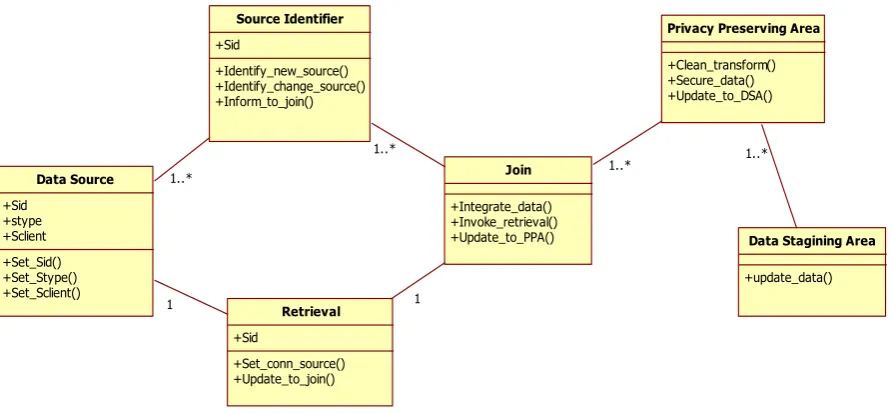
The class diagram for data extraction embedding privacy is shown in figure 2. The main components of this diagram are Data Source, retrieval component, source identifier, join, PPA and DSA. The description of these components is as follows4.1
Data source
Contains functionalities of setting server-id, setting source-type and setting source client for retrieval.
4.2
Source identifier
Identifies new sources by sid and informs to the join. It also identifies if there is a change in the source content and those sid will be informed to the join.
4.3
Retrieval component
Task of retrieval component is to connect data source and update the contents to the join.
4.4
Join class
Does the job of integrating data that is received from multiple clients in to a single logical schema representation.
4.5
PPA
is the most important and major component of this architecture, its task include cleaning and transformation of data followed by privacy preserving of some of the attributes. Privacy preservation may be done by means of data distortion or data manipulation which depends on the content of data base.
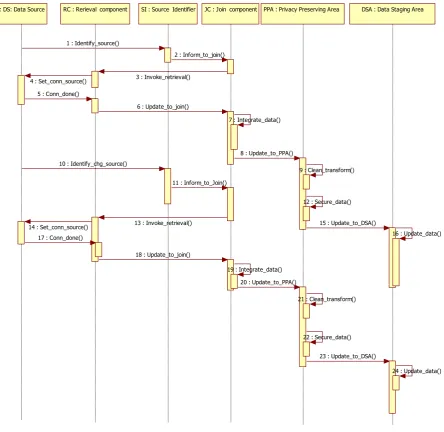
Use case diagram and sequence diagram is given in figure 3 and 4 respectively. UML modelling has been implemented using star UML.
5.
ALGORITHM FOR DATA
EXTRACTION EMBEDDING PRIVACY
The main procedure for data extraction embedding privacy is as follows.// identifying the sources and creating the source list. This is done by the methods of Source Identifier class 1. Identify the list of clients connected to the server 2. Set the properties for the source
3. If it is a new source add to the data source list
//source identifier maintains a copy of the new source list which is used later on to differentiate between the new source and the updated source
4. Source identifier informs join component
5.Join component establishes the connection and extracts data by means of retrieval component
6.Retrieved data is Loaded on to the join component which does the merger of multiple attributes present in different locations by means of a equi join
7. Join components informs PPA.
8. PPA does the transformation of the loaded data
// it also removes Identifiers and retains quasi identifiers & sensitive data
9. The transformed data is privacy preserved
10. Privacy preserved data is loaded on to the data staging area which is used for mining
11. Source identifier also identifies the changes in data source, if there is a change then the steps are repeated from step 4.
// Modification / updating of Data Staging Area (DSA).
6.
EXPERIMENTAL RESULTS
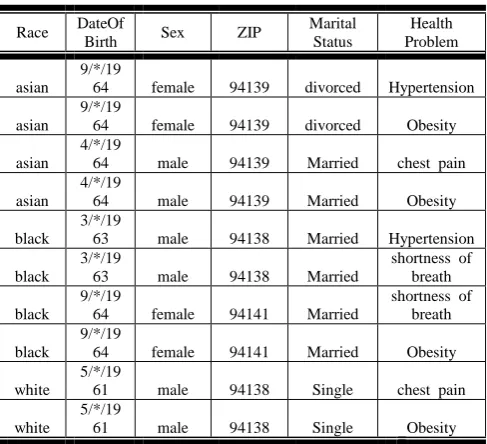
[image:4.595.309.556.261.502.2]The method of extraction, transform and load embedding privacy preservation was done on medical data set. The medical data contains sensitive information which may be revealed during mining. After merging multiple tables and transformation the resultant table is shown in Table 1. Identifiers patient_name & patient_address are removed before loaded on to the Data Staging Area. The resultant table contains the following fields Race, DOB, Sex, Zip , Marital Status and Health problem.. This information is passed on to secure data function which does k-anonymity. Anonymization technique [10, 11, 12] has been considered for privacy preservation. The experiment was conducted using Matlab 7. K=2 and Maxsup=1 has been considered for the resultant table is shown in Table 2.
Table 1. Resultant Data after Transformation
Race DateOf
Birth Sex ZIP
Marital
Status Health Problem asian 9/27/19
64 female 94139 divorced Hypertension
asian 9/30/19
64 female 94139 divorced Obesity
asian 4/18/19
64 male 94139 married chest pain
asian 4/15/19
64 male 94139 married Obesity
black 3/13/19
63 male 94138 married Hypertension
black 3/18/19
63 male 94138 married
shortness of breath black 9/13/19
64 female 94141 married
shortness of breath black 9/7/196
4 female 94141 married Obesity
white 5/14/19
61 male 94138 single chest pain
white 5/8/19
61 male 94138 single obesity
white 9/15/19
61 female 94142 widow
shortness of breath
Table 2. Resultant Data after Secure Data
Race DateOf
Birth Sex ZIP
Marital Status Health Problem asian 9/*/19
64 female 94139 divorced Hypertension
asian
9/*/19
64 female 94139 divorced Obesity
asian
4/*/19
64 male 94139 Married chest pain
asian
4/*/19
64 male 94139 Married Obesity
black
3/*/19
63 male 94138 Married Hypertension
black
3/*/19
63 male 94138 Married
shortness of breath black
9/*/19
64 female 94141 Married
shortness of breath black
9/*/19
64 female 94141 Married Obesity
white
5/*/19
61 male 94138 Single chest pain
white
5/*/19
[image:4.595.311.555.533.755.2]7.
CONCLUSION AND FUTURE WORK
This paper discusses embedding privacy preserving in Extraction Transformation Load using UML modelling. We have shown an UML modelling from initial stages of software which helps in better design representation. This representation gives an architectural change and functions that must be incorporated for embedding privacy in ETL and has been validated in the motivation example of medical data set. This architecture also gives us flexibility of adding various transformations which ultimately helps in preserving data. Future work may include a combination embedding secure communication and privacy preserving. In this approach we have considered conceptual modelling of ETL future work may also concentrate on reliability, performance etc.8.
REFERENCES
[1] Fang Ying-lan and Han Bing, Design and
Implementation of ETL Management Tool, In proc. of International Symposium on Knowledge Acquisition and Modeling, pp 446-449, 2009.
[2] Xudong Song, Xiaolan Yan and Liguo Yang,Design ETL
Metamodel based on UML Profile, In proc. of Second International Symposium on Knowledge Acquisition and Modeling, pp 69-72,2009.
[3] Lunan Li, A Framework Study of ETL Processes Optimization Based on Metadata Repository, In proc of Computer Engineering and Technology (ICCET), pp 125-129, 2010.
[4] Darshan M. Tank, Amit Ganatra and Y P Kosta, Speeding ETL Processing in Data Warehouses Using High-Performance Joins For Changed Data Capture (CDC), In proc. of International Conference on Advances in Recent Technologies in Communication and Computing, 2010
[5] L. Muñoz, J. N. Mazón and J. Trujillo, ETL Process Modeling Conceptual for Data Warehouses: A Systematic Mapping Study, IEEE Latin America Transactions, vol. 9, no. 3, june 2011.
[6] Alkis Simitsis, Panos Vassiliadis, and Timos Sellis, State-Space Optimization of ETL Workflows, IEEE Transactions On Knowledge and Data Engineering, vol. 17, no. 10, october 2005.
[7] Alkis Simitsis, Chetan Gupta, Song Wang and
Umeshwar Daya, Partitioning Real-Time ETL
Workflows, In Proceedings of ICDE Workshops, pp 159-162, 2010.
[8] M. Mrunalini, T.V. Suresh Kumar, D. Evangelin Geetha and K. Rajanikanth, Modelling of Data Extraction in ETL Processes Using UML 2.0, DESIDOC Bulletin of Information Technology, Vol. 2, pp. 3-9, 2006.
[9] M Mrunalini, T V Suresh Kumar and K Rajani Kanth, Simulating Secure Data Extraction in Extraction Transformation Loading (ETL) Processes, In proc. Of Third UKSim European Symposium on Computer Modeling and Simulation,2009.
[10]G. Aggarwal, T. Feder, K. Kenthapadi, R. Motwani, R. Panigrahy, D. Thomas, and A. Zhu. Anonymizing tables. In Proc. of the 10th Int'l Conference on Database Theory, January 2005.
[11]R. Bayardo and R. Agrawal. Data privacy through optimal k-anonymity. In Proc. of the 21st Int'l Conference on Data Engineering, April 2005.
[12]K. Lefevre, D.J. Dewitt, R.Ramakrishna, Incognito: Efficient fulldomain k-anonymity, In Proc. of the 24th
ACM SIGMOD International Conference on
Managemant of Data, pp. 4960, Baltimore, Maryland, USA, 2005