Optimal Planning for Distribution Network using GA
B Anil Kumar
M.Tech.[Power System] Student,
Department Of Electrical Engineering N.I.T, Hamirpur (Hp)
Lobzang Phunchok
M.Tech.[Power System] Student,
Department Of Electrical Engineering N.I.T, Hamirpur (Hp)
Y.R.Sood
Professor Department Of Electrical
Engineering N.I.T, Hamirpur (Hp)
ABSTRACT
This paper presents an approach for optimal routing of distribution network including sitting of substation. The problem of distribution system planning (DSP) is a large scale, very complex and difficult to define problem. This paper presents the application of an efficient Genetic Algorithm (GA) for the optimal design of large distribution system, solving the optimal feeder routing and locating of substation. GA was used to solve the optimization of DSP problem which includes the discrete nature of substation installation and feeder routing. Several searching procedure including coding and encoding the chromosome, fitness evaluated, reproduction, crossover, and mutation are examined in details. The concept of minimum spanning is implemented on a simple virgin land with 9 node and its demerits are overcome by proposed method of GA. All the final result of DSP is obtain by GA. In this paper a simple example of virgin land is solved by minimum spanning tree and demerits are overcome with GA and results are obtained by GA.
Keywords
Distribution planning, genetic algorithm, minimum spanning tree
1.
INTRODUCTION
The electric utility system is usually divided into three subsystems which are generation, transmission, and distribution. A fourth division, which sometimes is made, is sub transmission. Distribution plays a very important part as the consumers are directly affected by its efficiency. Distribution system planning is a combinatorial optimization problem where the objective is to determine the optimum way of supplying a given set of loads. The process involves the selection of the number, location and size of the substations and the primary feeder configuration such that the cost of installation along with the cost of energy loss is a minimum while maintaining the radially of the network and at the same time not violating the capacity and voltage drop constraints in any part of the network. Some mathematical programming techniques, such as Mix-Integral Program(MIP)[1,2], Branch and Bound [3], Dynamic Program(DP)[4], Quadratic MIP[S], AI Expert system approach[5,6], Branch Exchange[7], computer-based distribution SCADA system [8], set theory and the Prolog programming language[9],a rule-based expert system by combining heuristic rules with mathematical algorithms [10], knowledge-based programs[11] etc., were extensively used to solve this problem. In this paper genetic algorithm [12] will be adopted for solving the given problem
2.
GENETIC ALGORITHM
OPTIMIZATION
[image:1.595.325.538.309.709.2]Genetic Algorithms (GAs) are numerical optimization algorithms inspired from the genetic and evolution mechanisms observed in natural systems and population of living being [13].
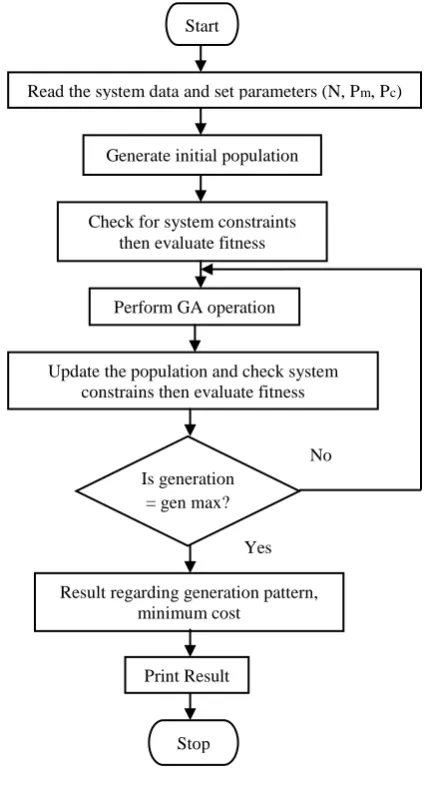
Fig 1: Flow chart for GA
They are stochastic search techniques based on the mechanism of natural selection and natural genetics. GAstarts with an initial set of random solutions called population (N).
Start
Read the system data and set parameters (N, Pm, Pc)
Generate initial population
Perform GA operation
Update the population and check system constrains then evaluate fitness
Check for system constraints then evaluate fitness
Is generation = gen max?
Print Result
Stop
Result regarding generation pattern, minimum cost
Each individual in the population is called chromosome, representing a solution to the problem. A chromosome is a string structure, typically a concatenated list of binary digits representing a coding of control parameters of a given problem. The chromosomes evolve through successive iterations, called generations. During each generation, the chromosomes are evaluated, using some fitness to create next generation, new chromosomes called offspring are formed by using genetic operator Reproduction crossover and mutation. A new generation is formed by selecting, according to the value of fitness function, some of the parents and offspring and rejecting others, so as to keep the population size constant. Those chromosomes having higher values of fitness functions have higher probabilities of being selected. GAs are differ and advantageous then other conventional methods in many ways, such as GAs do not require any prior knowledge, space limitation or special properties of the function to be optimized, like smoothness, convexity or existence of derivative. GAs operates on the encoded strings of the problem parameters rather than actual parameters of the problem and it uses probabilistic transaction rules. GAs use a population of points rather than a single point in their search, this allows it to explore several areas of the search space simultaneously, reducing the probability of getting stuck in local minima.[14]
3.
SUBSTATION PLANNING MODEL
To plan a substation load magnitude has to be determine and its geographic location; then the distribution substations must be placed and sized in such a way as to serve the load at maximum cost effectiveness by minimizing feeder losses and construction costs while considering the constraint of service reliability.
The problem can be stated as
𝑓
= 𝑓𝑖𝑥𝑒𝑑 𝑐𝑜𝑠𝑡 𝑜𝑓 𝑖 𝑠𝑢𝑏𝑠𝑡𝑎𝑡𝑖𝑜𝑛 ∗ 𝑥𝑖
𝑛𝑠
𝑖=1
+ 𝑐𝑜𝑠𝑡 𝑜𝑓 𝑐𝑜𝑛𝑠𝑡𝑎𝑛𝑡 𝑡𝑟𝑎𝑛𝑠𝑓𝑜𝑟𝑚𝑒𝑟 𝑙𝑜𝑠𝑠𝑒𝑠 𝑎𝑡 𝑖 𝑛𝑠
𝑖=1
+ 𝑓𝑒𝑒𝑑𝑒𝑟 𝑏𝑎𝑦 𝑐𝑜𝑠𝑡 𝑛𝑑
𝑗 =1 𝑛𝑠
𝑖=1
+ 𝑐𝑜𝑠𝑡 𝑜𝑓 𝑓𝑒𝑒𝑑𝑒𝑟 𝑠𝑒𝑔𝑚𝑒𝑛𝑡 𝑏𝑒𝑡𝑤𝑒𝑒𝑛 𝑖 𝑛 𝑗 𝑛𝑜𝑑𝑒 𝑛𝑑
𝑗 =1 𝑛𝑠
𝑖=1
∗ 𝑥𝑖𝑗 + 𝑙𝑜𝑠𝑠 𝑐𝑜𝑠𝑡 𝑐𝑜𝑒𝑓𝑓𝑖𝑐𝑖𝑒𝑛𝑡 ∗ 𝑝𝑖𝑗 2 𝑛𝑑
𝑗 =1 𝑛𝑠
𝑖=1
Were loss cost coefficient i=
8.76r
(kv )²∗ length of feeders ∗
cost of energy at the kth year ∗loss load factor of k year (1+annual discount rate )k
feerer life in year
k=1
Pij = power flow in the feeder between the I and j th node in kva
ns=number of substation node nd=number of load node f=cost function to be minimize
xi =binary integer variable which denotes the decision to select site i for a new substation
xij= binary integer variable which denotes the decision to select a branch between the nodes i and j for network connection (1 denotes selection and 0 denotes rejection) Subjected to =
1 Line flow must be in limits.
2 Capacity of substation cannot be over loaded. 3 Bus voltages can‟t violate its upper and lower limits.
4.
NUMERICAL EXAMPLE
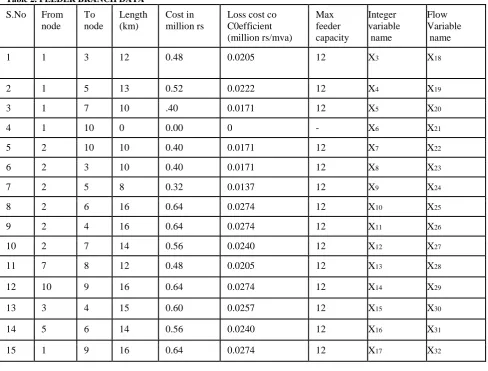
[image:2.595.314.543.298.505.2]This network is the example considered by Ponnavaiko&Rao[15] and is a problem of selecting the optimal locations for 132/33 kV substations and the 33 kv feeder routings to feed the demands at the 33/11kv substations in the area. Maximum permissible capacity of each substation is 50 MVA and installation cost is Rs 3.1 million. Capacity of each feeder is 12MVA. Load and branch data for the test system are given in Table 1&2 respectively
Table 1. GENERAL DATA
General data Value
Load factor 0.40
Loss load factor 0.21
Cost of energy Rs 0.3
Discount rate 0.10
Power factor 0.80
System life 25 years
Conductor size Raccoon (Acsr)
Fixed cost of the substation Rs 3 million
Feeder bay cost Rs 0.1 million
Feeder cost per km Rs 0.4 million
This approach is more appropriate for rural areas because of the uncertainties associated with future load and the flexibility in selecting the sites for substation and feeder routing. This approach thus serves only as a tool for formulating general guideline for system planning this problem is based on assumption that the area is virgin and no electrical network existing in the area. The load locations demand level and the feasible sites for substation are known in advance.
The problem is a nine node system in which node 1 and node 2 is selected for substation placement. Every node has some load in MVA and substation capacity assumed as 50MVA and is shown in fig 2.
Case 1 when substation 1 is selected it will feed all the load that is substation has to be connected to all the load node and it may be also possible that all the load point may be connected to each other as shown in fig 3. Our work is to find and choose the most optimal and cost efficient way to feed all the node without violating the limits of system.
optimal path. Result got when above problem is solved with minimum spanning tree are shown in fig 4 and fig 5
Table 2. FEEDER BRANCH DATA
S.No From node
To node
Length (km)
Cost in million rs
Loss cost co C0efficient (million rs/mva)
Max feeder capacity
Integer variable name
Flow Variable name
1 1 3 12 0.48 0.0205 12 X3 X18
2 1 5 13 0.52 0.0222 12 X4 X19
3 1 7 10 .40 0.0171 12 X5 X20
4 1 10 0 0.00 0 - X6 X21
5 2 10 10 0.40 0.0171 12 X7 X22
6 2 3 10 0.40 0.0171 12 X8 X23
7 2 5 8 0.32 0.0137 12 X9 X24
8 2 6 16 0.64 0.0274 12 X10 X25
9 2 4 16 0.64 0.0274 12 X11 X26
10 2 7 14 0.56 0.0240 12 X12 X27
11 7 8 12 0.48 0.0205 12 X13 X28
12 10 9 16 0.64 0.0274 12 X14 X29
13 3 4 15 0.60 0.0257 12 X15 X30
14 5 6 14 0.56 0.0240 12 X16 X31
15 1 9 16 0.64 0.0274 12 X17 X32
Fig 2: representation of nodes.
6 MVA
9
5 MVA
3
5 MVA
8
4 MVA
5
3 MVA
6
3 MVA
7
3 MVA
4
5 MVA
50 MVA
1
Fig 3: Representation of nodes and there feeders routing
Fig 4: minimum spanning tree result using substation 1
Fig 5: minimum spanning tree result using substation 2
When both substation 1 and 2 used the minimum spanning tree fails to give optimal path for feeding all the nodes when considered.
When we consider more than one substation we move to GA. As minimum spanning tree fails to give result when 2 substation are selected at a time.
5.
RESULT OBTAINED FROM GA
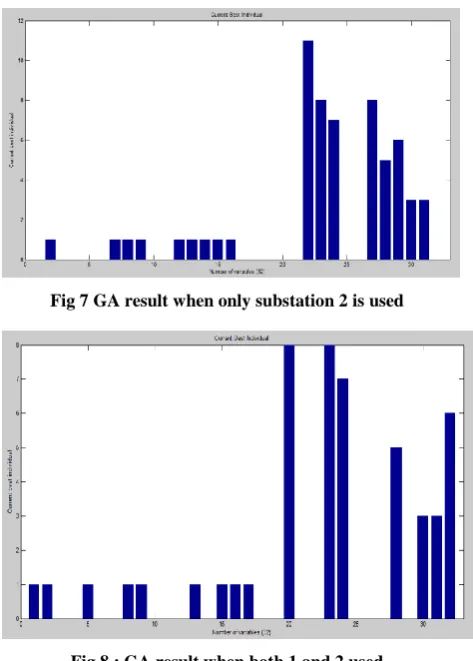
When we formulate this problem with GA we get 32 variable (X1 to X32) objective function in which X1 and X2 are substation integer variable and X3 to X17 feeder integer variable in which 1 indicate that substation or feeder is selected and 0 indicate it is not selected during process.X18 to X32 indicate flow variable which show how much flow of power is in feeder without violating the limits.
Fig 6: GA result when only used substation 1
6 MVA
9
5 MVA
3
5 MVA
8
4 MVA
5
3 MVA
6
3 MVA
7
3 MVA
4
5 MVA
50 MVA
1
[image:4.595.317.547.548.719.2] [image:4.595.57.285.548.717.2]Fig 7 GA result when only substation 2 is used
Fig 8 : GA result when both 1 and 2 used
Fig 1 shows the result when substation 1 is selected and corresponding substation variable is selected X1. Selected feeders(X3, X4, X5, X6, X13, X14, X15 and X16) are also shown and can be identify by feeder variable. Flow variable shows how much flow of power in the corresponding feeder in MVA without violating the limits. Similarly fig 7 and fig 8 shows the result when substation 2 and when both the substation 1 and 2 are used.
Table 3: Test results using GA
Sr no Substation selected Result with GA(million rs)
1 Substation 1 selected 12.6204
2 Substation2 selected 15.17699
3 Substation 1 &2 selected 15.1062
The above Result shows that it is optimal to select substation 1 which give minimum cost and reaming two are costly with respect to substation 1.
6.
PROBLEM EXTENSION
Above problem formation IR losses were not consider as it doesn‟t contains any prior network as it is a virgin land. The above problem can be extended or the above objective function can be used for extension of distribution planning. We can say that we can optimize distribution network were already a network is present. For this objective function will have to consider both construction losses and power losses. Power losses can be said as the variable cost because this cost
cannot be estimated in the initial stages without knowing the losses in the system. This cost mainly depends on the various iron and copper losses of the substations which also include cost involving in delivering and receiving the power.
7.
CONCLUSION
In this paper, the problem of optimal sizing and sitting of the substations and network routing is studied. The problem was solved using GA and was found that the most optimal and cost effective way to supply the lost is by using substation 1and it is also shown that how can same methodology can be use to optimize the existing power system network.
8.
REFERENCES
[1] Gonen, T., and B.L. Foote, „Distribution-System Planning Using Mixed-Integer Programming‟,Proceeding IEE, vo1.128, Pt. C, no.2, pp. 70-79, March 1981.
[2] R.N. Adams and M.A. Laughton, „Optimal planning of power networks using mixed-integer programming Part I static and time-phased network synthesis‟, Proc. IEE, v01.121(2), pp. 139-147, February 1974.
[3] G.L.Thompson, D.L.Wal1, „A Branch and Bound model for Choosing Optimal Substation Locations‟, IEEE Trans. PAS, pp 2683-2688, May 1981.
[4] R.N. Adams and M.A. Laughton, „A dynamic programming network flow procedure for distribution system planning‟, Presented at the IEEE Power Industry Computer Applications Conference(PICA), June 1973.
[5] Brauner, G. and Zobel, M. „Knowledge Based Planning of Distribution Networks‟, IEEE Trans Power Delivery, vo1.5, no.3, pp. 1514-1519, 1990.
[6] Chen, J. and Hsu, Y. „An Expert System for Load Allocation in Distribution Expansion Planning‟, IEEE Trans Power Delivery, vo1.4, no.3, pp 1910-1917,1989.
[7] S.K.Goswami, „Distribution System Planning Using Branch Exchange Technique‟, IEEE Trans. On PowerSystem, v01.12, no.2, pp.718-723, May 1997.
[8] S. Kato, T. Naito, H. Kohno, H. Kanawa, and T. Shoji, “Computer-based distribution automation”, IEEE Trans. PWRD, Vol. 1, NO. 1, pp. 265-271, 1986.
[9] K. P. Wong and H. N. Cheung, “Artificial intelligence approach to load allocation in, distribution substations”, Proc. IEE, Part C, Vol. 134, NO. 5, pp. 357-364, 1987.
[10]K.K. Li, G.J. Chen, T.S. Chung and G.Q. Tang, “Distribution Planning Using a Rule-Based Expert System Approach”, IEEE International Conference on Electric Utility Deregulation, Restructuring and Power Technologies (DRPT2004) April 2004.
[11]S.N. Talukdar, E. Cardozo, and T. Perry, “The operator‟s assistant-an intelligent, expandable program for power system trouble analysis”, IEEE Trans., PWRS, Vol. 1, No. 3, pp. 182- 187, 1986.
[12]D.E. Goldberg, Genetic Algorithm in Search, Optimization and Machine Learning, Addison Wesley, 1989.
[14]Mr. s. k. singh, Mr.kh.c.singh, Mr.l.phunchok, and prof. y.r.sood “Genetic algorithm a Nobel approach for economic load dispatch” International journal of engineering research and application 2012
[15] Ponnavaikko, M., PrakasaRao, K.S.P., and Venkata, S.S., " Distribution System Planning Through a Quadratic Mixed Integer Programming Approach, IEEE Transactions on Power Delivery, Vol. PWRD-2, No.