http://dx.doi.org/10.4236/msce.2014.28001
Decrease in Cation Exchange Capacity of
Zeolites at Neutral pH: Examples and
Proposals of a Determination Method
Moses Wazingwa Munthali, Ponyadira Kabwadza-Corner, Erni Johan, Naoto Matsue
Laboratory of Applied Chemistry for Environmental Industry, Faculty of Agriculture, Ehime University, Matsuyama, Japan
Email: [email protected]
Received 26 May 2014; revised 20 June 2014; accepted 18 July 2014
Copyright © 2014 by authors and Scientific Research Publishing Inc.
This work is licensed under the Creative Commons Attribution International License (CC BY).
http://creativecommons.org/licenses/by/4.0/
Abstract
Cation exchange capacity (CEC) is an important characteristic of zeolites, especially when they are used as adsorbents in the aqueous system. However, no international standard method exists for the determination of CEC of zeolites. We determined CEC of Linde-type A and Na-P1 type zeolites at various pH (4 to 10) with a simple method, where Na+-saturated zeolites were prepared, and then
various amounts of HCl were added. CEC was simply calculated by subtracting the amount of Na+ in
the final supernatant from the content of Na+ of the Na+-saturated zeolites. CEC of the zeolites
de-creased with decreasing pH and with decreasing Na+ concentration of the final supernatant. The
concentration of Na+ of the supernatant, CEC of the zeolites began to decrease at weakly alkaline
or neutral pH, and that of the Linde-type A zeolite became about half at pH around 6. When CEC was plotted against pH-pNa; where pNa is negative logarithm of the activity of Na+; CEC of each
zeolite was expressed by a curve. It indicates that the CEC or the amount of Na+ retention is
univo-cally determined by the ratio of activities of Na+ and proton.
Keywords
Cation Exchange Capacity, Na+ Retention, pH Dependence, Linde-Type A Zeolite,
Na-P1 Type Zeolite
1. Introduction
uti-lizing their high negative charge density and high selectivity toward some kinds of cations [1] [2]. When zeolites are used as adsorbent in aqueous system, cation exchange capacity (CEC) of zeolites is one of the important factors to estimate their ability, but no international standard method is available for the determination of CEC of zeolites. A possible reason for this is that CEC of zeolites have been considered to be same as the amount of isomorphous substitution. On one hand, CEC of soil clay minerals in aqueous system had been extensively stu-died with agricultural purposes: in this case, “cation” meant cations except for proton. Consequently, two types of negative charges, namely pH-dependent and pH-independent negative charges had been recognized in soil clay minerals [3]. The pH-dependent negative charge is due to the dissociation of Si-OH, Al-OH and Fe-OH groups of soil clays, and the pH-independent negative charge was ascribed to 2:1 type layer silicate clay miner-als such as montmorillonite. Because origin of the negative charge of the 2:1 type layer silicate clay minerminer-als is isomorphous substitution, negative charges derived from isomorphous substitution, including those of zeolites, had been thought to be independent of pH, at least under environmental pH of about 4 - 10 [4]. Some studies were carried out concerning pH-dependent adsorption of Ca2+ [5], Pb2+ [6], sulfa drugs [7], and phenol [8] on zeolites from acidic to alkaline pH range. However, detailed cation retention behavior of various zeolite species as affected by pH is not known, especially at neutral pH region. In this study, we found that the CEC (the amount of Na+ retention) of Lintype A and Na-P1 type zeolites decreased with decreasing pH, and the de-crease began at pH around 7 to 9. We also proposed a simple method to determine the effect of pH and cation activity on the CEC of zeolites.
2. Materials and Methods
2.1. Sample Preparation
Two zeolite species were used in this study. Linde-type A zeolite was obtained from Wako Chemicals Ltd, and Na-P1 type zeolite was synthesized in this study. Linde-type A zeolite is a common zeolite species, and Na-P1 type zeolite is a main zeolite species when low price “artificial zeolite” is synthesized from coal fly ash. In a 250 mL centrifuge bottle, 10 g of the zeolite was washed five times with 150 mL of 1 M NaCl to saturate the zeolite with Na+. Then the content was washed twice with 150 mL of water, washed once with 100 mL of acetone, air- dried, and used as a sample.
2.2. Determination of CEC
The Na+ contained in the sample are retained exchangeable Na+ and free Na+ as NaCl. The sum of retained and free Na+ contents of the sample (hereafter Na+ content) was determined by washing 1 g of the sample with 30 mL of 1 M NH4NO3 in a 50 mL centrifuge bottle for seven times. Water content of the sample was determined by heating at 105˚C for 3 h. The content of Si and Al of the samples was determined after dissolution with hy-drofluoric acid. The determination of CEC (the amount of Na+ retention) of the samples was carried out with the following method, which was modified from a method proposed for soil clays [9]. One gram of a sample was put in a 250 mL centrifuge bottle, and 200 mL of 0 to 7.5 mM HCl solution was added. The mixture was shaken for 3 h at 25˚C ± 0.5˚C, centrifuged at 2000 g, and the concentration of Na+ and pH of the supernatant were measured. Preliminary experiments indicated that the Na+ concentration and pH of the supernatant became con-stant within 3 h, and the measured Na+ concentration and pH are hereafter referred to as equilibrium Na+ con-centration and equilibrium pH, respectively. The CEC (the amount of Na+ retention) of the sample was simply calculated from the difference between Na+ content of the sample and the amount of Na+ in the supernatant. Similar CEC determination as the above was carried out using 50 mL centrifuge bottle, 1 g of sample, 20 mL of solutions containing of 0 to 75 mM HCl and 83 mM NaCl, to estimate the effect of solution Na+ concentration on CEC at a same equilibrium pH. The volume of 20 ml was used in order to increase the relative change of Na+ concentration in the supernatant, and to increase the accuracy of Na+ concentration determination. The concen-tration of Al and Si in the supernatant was measured to check the dissolution of the sample, and the measure-ment of Na, Al and Si was carried out using atomic absorption spectrophotometer (Hitachi Z-5000).
3. Results and Discussions
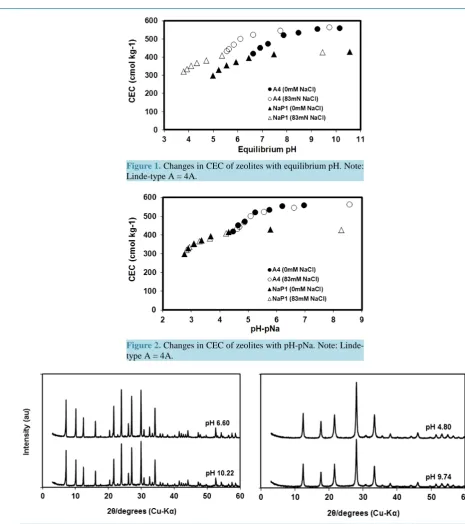
Figure 1 shows change in CEC (the amount of Na+ retention, cmol∙kg−1, 105˚C oven dry basis) of the zeolite samples with change of equilibrium pH. Closed symbols in Figure 1 show the results without NaCl background solution in total volume of 200 mL, and open symbols are the results with 83 mM NaCl in 20 mL. In the ab-sence of NaCl, the concentrations of Na+ in the supernatants were from 0.3 mM to 7.4 mM for Linde-type A zeolite, and 0.1 mM to 6.6 mM for Na-P1 type zeolite, with increasing the amount of addition of HCl. When 83 mM NaCl was added, they were 88 mM to 153 mM for Linde-type A zeolite, and 85 mM to 138 mM for Na-P1 type zeolite.
In the absence of the NaCl background solution (closed symbols in Figure 1), at higher pH region, CEC of the two samples were slightly affected by pH. With increasing the amount of HCl addition, equilibrium pH de-creased, and CEC of the two zeolites decreased with the decrease of the equilibrium pH. The CEC of Na-P1 type zeolite began to decrease from pH about 7 (Figure 1, closed triangles), and that of Linde-type A zeolite began to decrease from pH about 9 (Figure 1, closed circles). The decrease of CEC indicates that the negative charge of zeolite was partly compensated by the adsorption of proton with the exchange with Na+. The adsorption of pro-ton onto the zeolites is due to greater selectivity of the zeolites toward propro-ton, and Figure 1 reveals that the ad-sorption of proton on the two zeolites occurred even at neutral pH region. In other words, CEC of the two zeo-lites is pH-dependent, and the zeozeo-lites are strong base like Si-O− of Si-OH group. Decrease in the retention of cations by zeolites with decrease in pH were also reported for Ca2+ on Linde-type A zeolite [5], and for Pb2+ on NKF-6 zeolite [6].
When 83 mM NaCl was added as a background solution (open symbols in Figure 1), CEC of the samples began to decrease from around pH 6 for Na-P1 type zeolite, and from around pH 8 for Linde-type A zeolite. As a result, at a same equilibrium pH in Figure 1, CEC of open symbols were greater than those of closed symbols, and the difference was greater at lower equilibrium pH. This means that not only pH, but also Na+ concentration (more accurately, activity of Na+) affected CEC or the amount of Na+ retention of the zeolites. The effect of a monovalent cation (M+) concentration on CEC was already reported for soils and soil clay minerals, and the ef-fect of both pH and M+ concentration was expressed by taking the abscissa as pH-pM or log M
{
( ) ( )
+ H+}
[10].
Then we re-plotted the data in Figure 1 by taking the abscissa as pH-pNa, as shown in Figure 2. The figure shows that closed symbols and open symbols are nearly converged to a curve in both types of zeolites. This in-dicates that, in these experimental systems, CEC (the amount of Na+ retention) is univocally determined by the ratio of activities of Na+ and proton, similar to the case of soils and soil clay minerals [10]. Figure 2 also indi-cates that the determination of CEC with the addition of NaCl in the HCl solution is not necessary. By plotting CEC against pH-pNa using the results with simple HCl solutions, CEC at a pH with higher Na+ concentration is easily obtained. Here, Na+ in aqueous solution is in hydrated form and weakly held or adsorbed onto zeolites [11]. In this case, the adsorption of proton on zeolite is more preferred than Na+. Furthermore, specific Brönsted and Lewis acid-base sites exist in zeolite micropores [12] [13]. Considering the Lewis acid-base sites, after a proton is adsorbed through ion exchange with Na+, the proton acts as a Lewis acid while the O between Si-O-Al acts as a Lewis base. Then the O gives lone pair electrons to the proton which results into a negative charge neu-tralization due to the formation of covalent bonding between the O and the proton [14]. The formed covalent bonding results into neutral charge and a loss of negative charge in zeolite. The covalent bonding is much stronger than the ionic bonding formed by Na+ cation in balancing up the negative charge. The addition of HCl was from 0 to 150 cmol for 1 kg of zeolite. Within this range, the change in XRD pattern was not observed as shown in Figure 3, and the amount of dissolution of Si and Al was less than 0.5% and 0.1%, respectively. With more addition of HCl, it is clear that the zeolites are dissolved. When zeolites are used in aqueous systems, the dissolution of the zeolites should be taken into account.
In this study, two types of zeolites were used, and Na+ was used as an index cation for the determination of CEC. In addition to pH and the activity of an index cation, CEC of a zeolite may change with index cation spe-cies and the amounts and spespe-cies of coexistent ions. However, CEC data obtained with the method used in this study will give the basic information for the prediction of cation retention and solubility of a zeolite in more complicated aqueous systems.
4. Conclusion
Figure 1. Changes in CEC of zeolites with equilibrium pH. Note: Linde-type A = 4A.
[image:4.595.194.434.85.225.2]Figure 2. Changes in CEC of zeolites with pH-pNa. Note: Linde- type A = 4A.
Figure 3. XRD patterns of Linde-type A zeolite (left) and Na-P1 zeolite (right) after CEC measurement without NaCl addition. pH values on each XRD pattern indicate equilibrium pH.
References
[1] Misaelides, P. (2011) Application of Natural Zeolites in Environmental Remediation: A Short Review. Microporous and Mesoporous Materials, 144, 15-18. http://dx.doi.org/10.1016/j.micromeso.2011.03.024
[2] Wang, S. and Peng, Y. (2010) Natural Zeolites as Effective Adsorbents in Water and Wastewater Treatment. Chemical Engineering Journal, 156, 11-24. http://dx.doi.org/10.1016/j.cej.2009.10.029
[3] McBride, M.B. (1989) Surface Chemistry of Soil Minerals. In: Dixon, J.B. and Weed, S.B., Eds., Minerals in Soil En-vironments, 2nd Edition, SSSA Book Series No. 1, Soil Science Society of America, Madison, 35-88.
[4] Ferreiro, E.A., Helmy, A.K. and de Bussetti, S.G. (1995) Interaction of Fe-Oxyhydroxide Colloidal Particles with Montmorillonite. Clay Minerals, 30, 195-200. http://dx.doi.org/10.1180/claymin.1995.030.3.03
[5] Qin, C., Wang, R. and Ma, W. (2010) Characteristic of Calcium Adsorption by Ca-Selectivity Zeolite in Fixed-pH and in a Range of pH. Chemical Engineering Journal, 156, 540-545. http://dx.doi.org/10.1016/j.cej.2009.04.006
[6] Yang, X., Yang, S., Yang, S., Hu, J., Tan, X. and Wng, X. (2011) Effect of pH, Ionic Strength and Temperature on Sorption of Pb(II) on NKF-6 Zeolite Studied by Batch Technique. Chemical Engineering Journal, 168, 86-93.
http://dx.doi.org/10.1016/j.cej.2010.12.039
[7] Fukahori, S., Fujiwara, T., Ito, R. and Funamizu, N. (2011) pH-Dependent Adsorption of Sulfa Drugs on High Silica Zeolite: Modelling and Kinetic Study. Desalination, 275, 237-242. http://dx.doi.org/10.1016/j.desal.2011.03.006
[8] Yousef, R. and El-Eswed, B. (2009) The Effect of pH on the Adsorption of Phenol and Chlorophenols onto Natural Zeolite. Colloids and Surfaces A: Physicochemical and Engineering Aspects, 334, 92-99.
http://dx.doi.org/10.1016/j.colsurfa.2008.10.004
[9] Wada, S. (1983) pH- and Ionic Concentration-Dependence of Monovalent Cation Retention by Clays and Clay Minerals Expected in Soils. Soil Science and Plant Nutrition, 29, 561-564.
http://dx.doi.org/10.1080/00380768.1983.10434660
[10] Wada, S. and Kawabata, K. (1991) Ion Adsorption on Variable Charge Materials and Thermodynamics of Ion Ex- change. Soil Science Plant Nutrition, 37, 191-200. http://dx.doi.org/10.1080/00380768.1983.10434660
[11] Deka, R.C., Roy, R.K. and Hirao, K. (2004) Local Reactivity Descriptors to Predict the Strength of Lewis Acid Sites in Alkali Cation-Exchanged Zeolites. Chemical Physics Letters, 389, 186-190.
http://dx.doi.org/10.1016/j.cplett.2004.03.094
[12] Almutairi, M.T., Mezari, B., Filonenko, A., Magusin, P.C.M.M., Rigutto, M.S., Pidko, E.A. and Hensen, E.J.M. (2013) Influence of Extraframework Aluminum on the Brønsted Acidity and Catalytic Reactivity of Faujasite Zeolite. Chem-CatChem, 5, 452-456.
[13] Serykh, A.I. (2005) Nature of Cadmium Cationic Sites in Cadmium-Modified ZSM-5 Zeolite According to the Drift Studies of Molecular Hydrogen Adsorption. Microporous and Mesoporous Material, 80, 321-326.
http://dx.doi.org/10.1016/j.micromeso.2004.10.024