Contaminants and injury
induce inking on
peaches and nectarines
Carlos H. Crisosto o R. Scott Johnson P Kevin R. Day Bob Beede o Harry Andris
Brown and black spots on the fruit‘s skin are called “inking.”
After 3 years of study, we have demonstrated that physical injury combined with contamination cause skin discoloration, called inking, on peaches and nectar- ines. Abrasion damage releases anthocyanin(pheno1ic pigments, which are located in the skin cells, allowing the reaction of these pig- ments with the heavy-metal con- taminants. We found that iron, copper and aluminum were the most deleterious contaminants of those studied in inducing inking on abraded fruit. Approximately
10 ppm iron was enough to induce inking at the physiological fruit pH (-3.5). This contamination can oc- cur within 15 days before harvest, or during harvest or packing op- erations. Foliar-nutrient, fungicide and insecticide preharvest sprays may act as sources of contamina- tion for inking development, de- pending on the preharvest appli- cation interval. To reduce inking incidence, we have developed safe preharvest application inter- vals that yield low inking inci- dence benomyl for iprodione (Rovral), triforine (Funginex), vinclozolin (Ronilan OF) (Senlate) and certain foliar nutrients con- taining heavy metals.
Inking on peach And nectarine fruits has become an increasingly frequent problem during the last decade in California, Washington, Georgia, South Carolina and Colorado. Inking, or skin discoloration, is also a problem
in other production areas of the world including Italy, Australia, Argentina and Chile. Inking symptoms appear as discolored brown-and-black spots, and are restricted to the skin. Al- though inking affects only the fruit’s cosmetic appearance, the disorder causes economic losses to the peach and nectarine industries each year be- cause blemished fruit are not market- able. Through our previous anatomi- cal studies, we learned that the type of physical injury associated with inking is abrasion (Crisosto et al. 1993). The damaged skin cells, where the antho- cyanin/phenolic pigments are located, collapsed while the underlying fleshy cells (mesocarp cells) remained intact. Unfortunately, abrasion injury fre- quently occurs during harvest and hauling operations, and it is very diffi- cult to eliminate.
As a follow-up to our previous work, we decided to determine where inking damage occurs during post- harvest handling operations, and if physical damage and/or exogenous contamination are related to its develop- ment. This information is fundamental to understanding inking development and for generating recommendations to reduce inking incidence for the stone fruit i n d u s t j .
‘Inking occurrence during commer- cial harvest and postharvest handling was recorded on ‘Flavorcrest’, ’Elegant Lady’ and ‘OHenry’ peaches grown in an area with a history of inking, the Traver area of Tulare County. We col- lected samples on three harvest dates for each cultivar and at three handling points during harvest and transport:
(1) directly from the tree and field- packed; (2) from bins, after bin filling and transport in the orchard to the loading point, approximately 4 miles; and (3) from bins arriving at the pack- inghouse (after handling and trans- porting to the packinghouse).
for each cultivar for each treatment. Fruit samples were picked at random from three trees selected previously and marked. Fruit were tracked dur- ing routine harvest and collected at the three locations noted. After collection, fruit samples were carefully placed in tray packs, padded and packed in the orchard or packinghouse before being transported to the UC Kearney Agri- cultural Center (KAC) for subsequent inking evaluation.
Effects of pH and metallic ions We randomly picked ’Flavorcrest’, ’Elegant Lady’ and ’O’Henry’ peaches, and ‘May Glo’ and ’Flaming Red’ nec- tarines at commercial maturity accord- ing to ground color from orchards at or near the KAC. The fruit were care- fully handled to avoid physical dam- age. We separated 20 fruit from each of five randomly selected trees (repli- cations) per cultivar into two main treatments (50 fruit each), unwashed (UW) and washed (W). Washed fruit were submerged in tap water for 5 minutes, rinsed with distilled water (dH20) and placed on clean paper towels to air-dry.
The purpose of the washing treat- ment was to remove metallic ions and/or other contaminants from the fruit surface. Each treatment was ap-
Some of the fruit were abraded to study the role of Injury In Inking. The frult were abraded with a rotatable automatic toothbrush and a fruit holder.
plied to nonabraded fruit (NA) and abraded fruit (A). The fruit was abraded with a rotatable automatic toothbrush and a fruit holder. The fruit holder was a modified apple peeler, which allowed forward and backward movement of the fruit dur- ing reversible rotations. During abra- sion, the fruit was hand-rotated for- ward and then backward (one cycle) while the automatic toothbrush head abraded the skin; the cycle was done three times with the initial toothbrush head positioned 0.5 cm apart from the previous one, to maximize uniform abrasion. The hand-rotation speed was kept as consistent as possible for all fruit samples.
In each subtreatment - abraded and nonabraded - fruit were ran- domly sampled for preparation of skin disks. Six skin disks were used for each of the different pH and ion appli- cations. The disks were sampled from the red-colored surface of the fruit, ei- ther nonabraded or abraded, using a cork borer (44 mm2 inner area). The disks were randomly placed on a piece of cardboard covered with a paper towel. Each disk was identified by the layout order during the following ex- periments. After measuring the color with a Minolta Colorimeter CR 200 in the L*a*b* color-notation system
(C illuminant, calibrated with stan- dard white plate, and 0” viewing angle), we placed the skin disks in the treatment solutions (30 mL). Air bubbles on the skin-disk surface were removed by stirring gently. For pH treatments, solutions of pH 3,4,5,6,7, 8 and 9 were prepared with phosphate buffer (0.1M).
dium, aluminum, ferrous-iron, copper, tin and zinc ions were prepared in a fi- nal ion concentration of 100 ppm in dHzO. For iron-concentration treat- ments, ferrous-iron solutions were prepared in ion concentrations of 10, 25,50,75,100 and 200 ppm. Ion com- pounds used were all in chloride-salt form for uniformity and all solutions were prepared daily. Solutions of 100 ppm bicarbonate or nitrate were also used. The control solution was dHzO and an untreated check was used for abraded and nonabraded subtreatments.
After a 15-minute incubation pe- riod, the disks were taken out, blotted with Kimwipes, and air-dried for 1 minute, then the color was measured again. Discoloration was expressed by the relative change in the color value a*, as Aa*, since it amply reflected the visual darkening on the skin disks. The Aa* was calculated as the differ-
For ion treatments, solutions of so-
ence between the a* before treatment and the a* after incubation. The higher value of Aa* reflected a darker discol- oration.
Preharvest chemical sprays
Red’ nectarines, and ‘Kern Sun’, ’Flavorcrest’, ‘Elegant Lady’, ’OHenry’, ’Summer Lady‘ and ‘Cal Red’ peaches for our preharvest chemical spray experiments. Fungi- cides and foliar nutrients commonly used by the California stone-fruit in- dustry were selected and applied to entire trees according to label instruc- tions.
At least eight trees per cultivar were used as replicates for each treat- ment, except for ‘Kern Sun’ and ’Cal Red’ where 25 trees per replicate were used and four rows were left as a buffer between treatment-replicates (approximately 6-acre plot). All of the fungicide and foliar-nutrient sprays were applied using an air-blast sprayer (approximately 100 gal/acre). Z.I.P. (2 qt/acre/100 gal) was applied 1,18 and 22 days before harvest (DBH); Rovral(0.5 lb/lOO gal) and Funginex (12 oz/lOO gal) were applied 7,3 and 1 DBH; Benlate (2 lb/lOO gal) and Ronilan DF (0.5 lb/100 gal) were applied 4 and 14 DBH, respectively.
We chose ’Fantasia’ and ’Flaming
Fruit located in the outer canopy were harvested at commercial maturity. Harvesting was done using picking bags, followed by dumping in wooden bins, and transport on trailers to the KAC’s F. Gordon Mitchell Postharvest Laboratory. Four boxes of approxi- mately 60 fruit each (volume filled) were hand-packed from each tree (rep- licate). These boxes were labeled, room-cooled, and kept in cold storage for later inking evaluation.
Samples from each spray solution used in our experiments were sent out for commercial analysis for iron, cop- per, aluminum and tin.
Inking evaluation
In all experiments, fruit samples were placed in a room controlled at 68” F (20” C) and 80% relative humid- ity for 2 to 3 days before inking evalu- ation. We determined inking by two methods. The first method was by per- centage of individual fruit with inking symptoms (incidence). The second was by an aggregated inking index (AII) based on measurements of total fruit surface area affected by inking (intensity). A11 was measured using a 0.9 cm diameter loop; a larger discol- ored area was counted as two or more,
accordingly. The percentage of cull fruit was calculated based on the Cali- fornia Quality Standards (USDA 1987), which states that any fruit presenting a discolored area 20.9 cm in diameter should be rejected.
Average incidence of inking in- creased dramatically with fruit han- dling after harvest (fig. 1). High inking levels were detected on fruit sampled during harvest as well as before and after fruits were transported to the packinghouse. Inking incidence on fruit picked directly into tray packs and transported gently to KAC was 42%’ 42% and 29% for ‘Flavorcrest‘, ‘Elegant Lady’ and ’O’Henry’, respec- tively. Inking incidence before and af- ter transport to the packinghouse was nearly 100%. High cull levels, up to 40%, were measured after transport within and out of the orchard on ’Flavorcrest’, ‘Elegant Lady’ and ’O’Henry’ peaches. Fruit picked di- rectly from the tree and field packed (tree) had 17% culls.
Skin disk responses
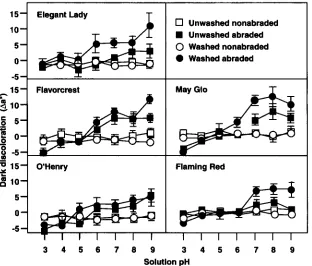
on skin disks of nonabraded fruit ei- ther unwashed or washed when ex- posed to pH solutions from 3 to 9 in all
Dark discoloration did not develop
peach and nectarine cultivars tested (fig. 2). On abraded skin disks from unwashed and washed fruit, the red- ness intensified after incubation in a buffer of pH 3, especially on those from the cultivars ‘May Glo’,
’Flavorcrest’, ‘OHenry’ and ‘Elegant Lady’. Treatment in buffers of pH 4 and 5 did not markedly change the Aa* of skin disks in any of the cultivars ex- amined. On skin disks from
‘Flavorcrest’, ‘Elegant Lady’ and ‘OHenry’ peaches, some discoloration started to occur in a buffer of pH 6. In buffers of pH 7,8 and 9, dark discol- oration of various degrees developed on the abraded skin disks of all of the cultivars (fig. 2). The washing treat- ment induced significant dark discol- oration only on abraded ‘May Glo‘ and ‘Flaming Red’ nectarines. Abra- sion treatment significantly increased the development of dark discoloration in all of the tested cultivars (data not shown).
A significant interaction between washing and abrasion on dark- discoloration formation was deter- mined. The UW-NA and W-NA com- binations showed no dark-discolora- tion formation; however, the abraded fruit with or without washing dis-
Fig. 1. Influence of haNest operations on percentage with inking and percentage of culls of ‘Flavorcrest’, ‘Elegant Lady’ and ‘O’Henry’ fruit collected at harvest: (1) di- rectly from the tree and fleid-packed (tree), (2) after bin filling and transport In the or- chard to the loading point (orchard), and
(3) after handling and transport to the packinghouse (packinghouse). Each value represents an average of three cuitivars using four replications of 18 fruit each. Vertical bars represent standard error.
15
-/
Elegant Lady T10 5 0 -5 15
h
Y
4
10.-
s 5g o
0
-5CI
-
-
1 5 4
10 OHenry
5 0 -5
3 4 5 6 7 8 9
0 Unwashed nonabraded
W Unwashed abraded
0 Washed nonabraded 0 Washed abraded
Flaming Red
-
3 4 5 6 7 8 9Solution pH
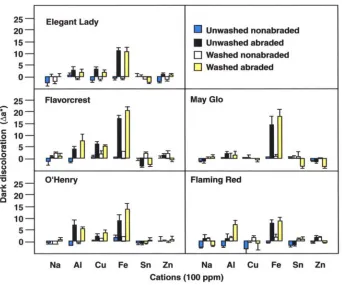
[image:3.594.38.202.435.599.2] [image:3.594.232.544.436.702.2]Fig. 3. Dark discoloration of peach and nectarine fruit after 15-minute incubation in metallic-ion solutions (dH,O, pH 3.5). Vertical bars represent standard error.
25
4
Elegant Lady 20q
5 0cn
.-
25- O'Henry
0 Unwashed nonabraded Unwashed abraded
0 Washed nonabraded
0 Washed abraded
May Glo
Flaming Red
0 50 100 150 200 0 50 100 150 200
Ferrous iron concentration (ppm)
Fig. 4. Change in color (ha*) of skin disks from peach and nectarine fruit in response to different iron concentrations of solutions. Vertical bars represent standard error.
played high levels of dark discolora- tion. The W-A treatment yielded the highest dark-discoloration formation among all of the cultivars. This may be explained due to an increase in abra- sion susceptibility by immersing fruit in water prior to our low-level abra-
sion treatment. Disappearance of the dark discoloration caused by high-pH buffers was noticed a few hours after the skin disks were removed from the buffers. An experiment was conducted to monitor the posttreatment change in skin color using skin disks from
washed fruit of 'Cal Red' peaches and 'Flamekist' nectarines. The results in- dicated that the dark discoloration caused by high pH gradually disap- peared after about 3 to 5 hours, leav- ing red to light-brown spots. Thus, ex- posing fruit to clean water during hydrocooling and/or washing does not induce inking.
Metallic-ion solutions
On skin disks from NA fruit, whether washed or unwashed, no dark discoloration was observed after any metallic-ion 100-ppm-solution treatments in all of the cultivars, ex- cept copper on 'May Glo' and 'Flam- ing Red' (fig. 3). On skin disks with or without washing, ions of iron, alumi- num and copper caused evident dis- coloration (fig. 3). The discoloration caused by iron and aluminum ions was black. Of the metallic-ion solu- tions tested, iron caused the most se- vere discoloration. Sodium-, stannous- or zinc-ion solutions had little effect on the Aa* of the skin disks (fig. 3), as did bicarbonate and nitrate solutions. With iron, skin disks from fruit of 'May Glo' and 'Flavorcrest' developed more discoloration than those of 'El- egant Lady', 'OHenry' and 'Flaming Red'. The skin disks of 'Flavorcrest' and 'O'Henry' fruit showed more dis- coloration than other cultivars when treated with aluminum. The dark dis- coloration caused by iron and alumi- num did not fade for at least 4 days. Thus, hydrocooling abraded fruit with water containing heavy metals may be inducing inking.
Since iron was the most effective ion in causing skin discoloration, a concentration effect was investigated. Iron solutions of 10 to 200 pprn did not cause discoloration on skin disks of NA fruit with or without washing treatment of any cultivars after 15 minutes of incubation (fig. 4).
tration as low as approximately 10 ppm caused dark discoloration in all the cultivars tested. The Aa*s on skin disks of W-A fruit were generally higher than those of UW-A fruit. Iron concentrations of >50 pprn resulted in no significant change in the a* value.
With abraded disks, an iron concen-
[image:4.594.34.376.18.303.2] [image:4.594.35.369.319.608.2]Preharvest sprays
'Kern Sun' peach inking intensity was highest on fruit from the Benlate 3 DBH, Rovral 1 and 3 DBH and Z.I.P. 1 and 18 DBH treatments (table 1). The Rovral7 DBH, Ronilan [ [ 1 and 8 DBH, Funginex 1 , 3 and 7 DBH, and Z.I.P. 22 DBH treatments did not induce any commercially important inking devel- opment on peach fruit from 'Kern Sun'. Non-abraded fruit did not present inking symptoms in any of these treatments. Fruit from the com- mercial treatment (Rovral applied at bloom time) did not exhibit any com- mercially significant inking (table 1). The role of fungicides acting as con- taminants in inking incidence has been demonstrated in our previous trials.
High iron, aluminum and copper, and low tin concentrations were de-
tected in most of the pesticides ana- lyzed in these studies (table 2). High iron (1,930 to 2.5 ppm) and aluminum (3,920 to < 5.0 ppm) concentrations were measured in phosmet (Imidan 50WP), thiophanate-methyl (Topsin M), Benlate, Rovral, Bacillus
thuringiensus var. Kurstaki (DiPel2x) and systhane (Rally). Foli-Cal, Funginex, Rally and Topsin M had copper concentrations ranging from 1,960 to 6.95 ppm. Tin levels were usu- ally below 5 ppm in most of the chemicals analyzed.
Recommendations
Based on these experiments, we de- veloped the following recommendations to help growers reduce inking problems.
handle fruit gently, avoid long hauling 1. To reduce abrasion damage,
distances and keep harvest containers free of dirt.
2. Contamination of fruit can be re- duced by keeping harvesting equip- ment clean; avoiding dust contamina- tion on fruit; checking water quality for heavy-metal (iron, aluminum and copper) contamination; and avoiding foliar-nutrient sprays containing heavy metals within 22 days before harvest (unless there is a deficiency). We de- veloped the following tentative preharvest application intervals: foliar nutrients containing heavy metals = 22 DBH, Benlate = 12 DBH, Rovral = 7 DBH, Funginex = 3 DBH and Ronilan
= 1 DBH.
3. In case of a possible inking situa- tion with peaches and/or nectarines, delay packaging for 48 hours to detect fruit inking damage during grading.
4. As a short-term solution, we sug- gest that chemical manufacturers (fo- liar nutrients, fungicides and insecti- cides) develop preharvest application intervals to avoid inking.
5. As a long-term solution, we sug- gest that chemical manufacturers at- tempt to identify and remove possible sources of contamination from prod- ucts that may contribute to inking.
C.H. Crisosto is Postharvest Physiologist and R. Scott Johnson is Extension Pomolo- gist, Pomology Department, UC Davis, located at Kearney Agricultural Center, Parlier; K.R. Day is Farm Advisor, UCCE Tulare County; B. Beede is Farm Advisor, UCCE Kings County; H . Andris is Farm Advisor, UCCE Fresno County.
Further reading
Cheng GW, Crisosto CH. 1997. Iron- polyphenol complex formation and skin dis- coloration in peaches and nectarines. J Amer SOC Hort sci 122(1):95-9.
Cheng GW, Crisosto CH. 1995. Browning potential, phenolic composition, and polyphenoloxidase activity of buffer extracts of peach and nectarine skin tissue. J Amer SOC Hort Sci 120(5):835-8.
Cheng GW, Crisosto CH. 1994. Develop- ment of dark skin discoloration on peach and nectarine fruit in response to exogenous con- taminations. J Amer Soc Hort Sci 119(3):529- 33.