with Difference Aggregate Sizes
Ahmad Z. Mohd Ali, Prof Jay Sanjayan, Dr Maurice Guerrieri
Swinburne University of Technology, Hawthorn, Victoria.
Abstract: This paper presents the fire test results of high strength concrete full-scale wall panels. The effect of aggregate size and pore pressures will be discussed. The course aggregate sizes varied from 7 mm, 14 mm to 20 mm. Two types of aggregates were tested, namely, granite and basalt. Hydrocarbon fire temperature versus time in accordance to EN1991-1-2 was used for exposing the specimens. Thermal diffusivities for these specimens were calculated from the thermal-couple data by using the Finite Difference back calculation method. The spalling was measured by weight loss before and after firing, and ranged from 7.5% to 32.5%. The thermal diffusivity graph shows that water changed into steam at temperatures ranging from 110oC to 155oC. This corresponds to pressures induced by the steam ranging from 0.042 MPa and 0.442 MPa. This is significantly less than the tensile strength of concrete, which is estimated to be about 3 MPa. Therefore, the pore pressure from steam in the concrete is only one of the factors that influence the spalling of concrete.
Keywords: Concrete, full-scale wall panels, spalling, fire, thermal diffusivity
1. INTRODUCTION
Concrete is the most manmade material used on the earth and second used material after water [1]. It is a popular choice of construction’s material due to the versatility and durability of the concrete itself. It plays a vital role in many aspects of everyday life such as buildings, roads, bridges, railways structure[2]. Concrete structures were designed to withstand various types of environment conditions from mild conditions to very severe conditions. Fire represents one of the most severe environmental conditions to which concrete structures may be subjected especially in close conduct structure like tunnel [3, 4].
Spalling is one of the defects on concrete exposed to fire especially high strength concrete structure [5]. Bailey in 2002 mentioned that concrete structures exposed to fire were still considered stable due to the compression membrane action [6]. However, spalling of the concrete at the soffit of the slab exposed the bottom bar and the flexural capacity of the slab was drastically reduced [7, 8]. Several researchers have indicated the explosive spalling of concrete especially in high strength concrete as failure indicator due to its high velocity of spalling debris[9, 10]. There are numbers of reasons why concrete spalled. Vapour pressure is one of the reasons underlined by number of researches. Vapour pressure in high density concrete with low diffusivity especially in high strength concrete exceed the tensile stress and caused explosive spalling [9-11]. Thermal stress at high temperature due to high thermal gradient and low thermal diffusivity is an
issue closely related to concrete spalling as well [12]. Khalifa et al. [13] in 1999 described thermo-mechanical is one of a contributing factor in concrete spalling as well. Thermal dilation gradient due to difference thermal expansion between cement paste and aggregate has resulted initial fracture and energy release from the fracture subsequence in spalled concrete [14-16].
Size effect to concrete spalling is a factor need to address in this investigation. There are numbers of researches relating size effect to concrete mechanical properties. Bazant (1987), Ince (2004) and Yi (2007) suggested that specimen’s size is a factor in concrete performance in flexural and shear strength [17-19]. Chen in 2004 investigating the effect of aggregate’s size in described bigger aggregate’s size resulting in higher fracture energy hence resulting in higher resistance in cracking [20].
2.0 Experimental Programme
2.1 Material
V.K. Sahu et al., Int. J. Of Integrated Engineering Vol. 3 No. 1 (2011) p. 1-4
2.2 Concrete Properties
[image:2.595.52.285.142.299.2]All specimens sizes for this research is 3.38 m x 3.36 m x 0.2 m (thickness). The properties of the concrete are shown in Table 1.
Table 1: Concrete Properties
Properties
Course Aggregate Weight (kg per m3)
Fine Aggregate Weight (kg per m3)
W/C
Compressive Strength at 28 days (MPa)
7 mm (max) Aggregate
1100 577 0.3 70
14 mm (max) Aggregate
1100 577 0.3 70.7
20 mm (max) Aggregate
960 620 0.3 69.4
2.3 Test Setup
All specimens were casted at factory and tested for at least at 28 days. Compressive test were performed at the age of 28 days for all specimens.
2.3.1 Thermal Data Collection
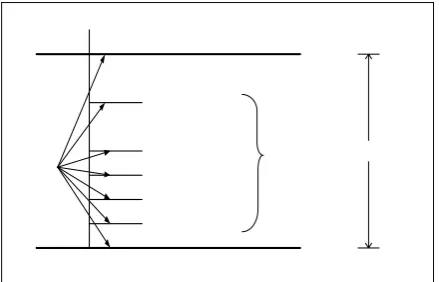
[image:2.595.65.285.538.679.2]Hydrocarbon fire temperature versus time in accordance to EN 1991-1-2 was used for exposing the specimens [21]. The fire tests conducted for minimum of 120 minutes. The temperature of the furnace (near exposed surface) were measured and recorded by the furnace’s temperature sensor to the data logger. The temperature of wall panels specimens at the depth of 25 mm, 50 mm, 75 mm, 100 mm, 150 mm and unexposed surface were also measured and recorded by using thermal couples to the data logger. The illustration of thermal couple’s locations is shown in Figure 1.
Figure 1: Thermal Couple’s Location
2.3.2 Spalling analysis
The weight of the specimens were measured before and after the specimens exposed to fire. The weight difference is considered as the weight spalled concrete.
2.3.3 Thermal diffusivity analysis
Thermal diffusivity for each specimen was calculated by using the Finite Difference back calculation method. Based on the temperature data from the fire test, thermal diffusivity value were calculated on trial and error basis based on the general equation:
t
T
x
T
where K is thermal diffusivity
The correct value of thermal diffusivity is determined when the temperature calculated from thermal diffusivity equation equal with temperature from experimental data.
3.0 Result and Discussion
3.1 Spalling
From the observation during fire exposure, concrete spalled within the 30 minutes of fire exposure. Specimen with 7 mm basalt aggregate is the most spalled specimen with 32.49% of the specimen spalled after exposed to fire. Figure 2 shows the percentage of concrete spalling after the specimens were exposed to fire. 7 mm basalt aggregate wall panel recorded the highest spalling percentage with 32.5% concrete spalled. Wall panels with 14 mm and 20 mm basalt aggregates spalled 7.5% and 12.7% respectively. Granite aggregate wall panels’ spalling percentages are 22.9%, 23.5 and 13.5% for 7 mm, 14 mm and 20 mm aggregate size respectively. From these results, it is an indication that aggregate size is not exhibiting a clear trend to concrete spalling.
Figure 2: Spalling Concrete Percentage
3.2 Temperature Result
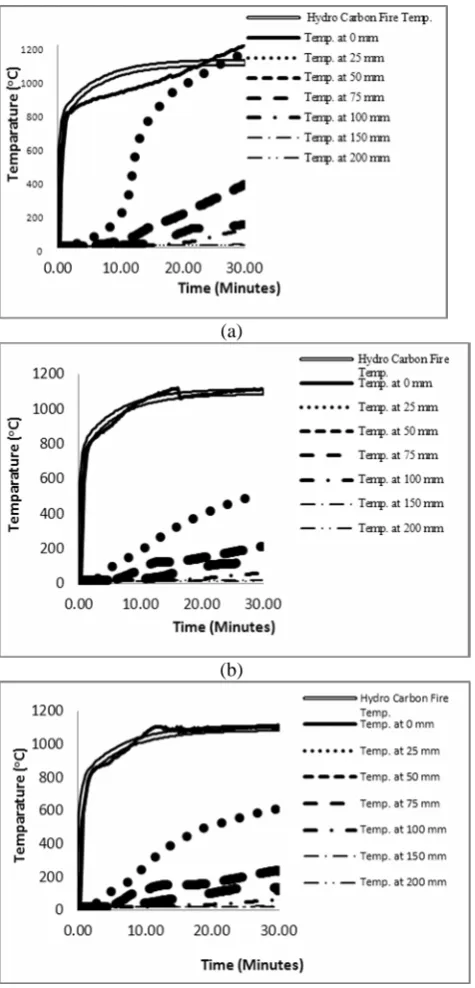
The thermal analyses for this investigation were done by using the first 30 minutes thermal data obtained from the data logger due to no concrete spalling observed after 30
[image:2.595.304.551.555.694.2]20 mm granite aggregates specimen. Unfortunately, the data gauges for the specimen with 20 mm granite aggregates were damaged during the fire exposure and data logger could not retrieve most of the data. Figure 3 shows the temperatures vs. time for the specimen at each depth during fire exposure.
(a)
(b)
(c)
(d)
[image:3.595.304.542.71.406.2](e)
Figure 3: Temperature for specimens with (a) 7 mm basalt aggregates (b) 14 mm basalt aggregates (c) 20 mm basalt aggregates (d) 7 mm granite aggregates (e) 14 mm
granite aggregates
From the graphs in Figure 3, it is clear indication that concrete spalled depth was less than 25 mm except for 7 mm basalt aggregate specimen. Figure 3(a) shows that temperature at 25 mm depth significantly increased after 10 minutes of fire exposure and identical with temperature at exposed surface. At this stage, the concrete surround the thermal couple at 25 mm depth spalled and the thermal couple is exposed directly to the fire.
[image:3.595.58.296.173.668.2]V.K. Sahu et al., Int. J. Of Integrated Engineering Vol. 3 No. 1 (2011) p. 1-4
(a)
(b)
(c)
(d)
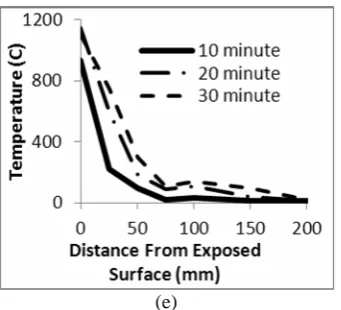
[image:4.595.338.509.69.224.2](e)
Figure 4: Temperature across the thickness of the specimens with (a) 7 mm basalt aggregates (b) 14 mm basalt aggregates (c) 20 mm basalt aggregates (d) 7 mm granite aggregates (e) 14 mm granite aggregates
3.3 Thermal Diffusivity
Thermal diffusivity for all specimens is shown in Figure 5. All specimens exhibit decreased significantly when the temperature reached between 110oC to 155oC. This phenomenon can be considered as water changing phase. During this period, water in the concrete absorbs the heat to transform from liquid phase to steam phase. This temperature can be defined as saturated stream temperature. Pressure from saturated steam corresponds to saturated steam temperature were calculated. Values from saturated steam pressure and saturated steam temperature are used to estimate superheated steam pressure based on fire temperature [22]. However, the difference between saturated steam pressure and superheated steam pressure is very small and can be considered as equal. Specimen with 14 mm granite aggregates saturated steam temperature is 110oC, which is lowest saturated steam temperature. The saturated steam pressure correspond to the temperature is 0.042 MPa. The saturated steam temperatures for specimens with 14 mm granite aggregates, 7 mm basalt aggregates, 14 mm basalt aggregates and 20 mm basalt aggregates are 113oC, 120oC, 130oC and 155oC respectively. The highest saturated steam pressure correspond to highest saturated steam temperature (20 mm basalt aggregate) is 0.442 MPa. This is significantly less than tensile strength of concrete, which is estimated to be 3 MPa.
[image:4.595.315.529.616.748.2]1. A full-scale high strength concrete wall panels spalled between 7.5% and 32.5%. Concrete spalled in the first 30 minutes of fire exposure. There are no any further concrete spalled observed after this period.
2 Even though it is predicted that aggregate’s size effect in concrete spalling can be observed, there are no obvious trend between the percentage of concrete and the sizes of the aggregate.
3 The depth of concrete spalling is less than 25 mm from exposed surface except for wall panel with 7 mm basalt aggregates.
4 Thermal diffusivity dropped significantly between the temperatures of 110oC and 155oC. This temperature can be described as saturated steam temperature. Heat was absorbed by water in the concrete to change phases from liquid to steam.
5 Maximum saturated steam pressure induced by the steam corresponds to maximum saturated steam temperature of 155oC is 0.442 MPa. This is significantly less that tensile strength of concrete which is estimated to be 3 MPa. Hence, steam pressure itself is not a critical factor for concrete spalling. However, it is strongly suggested that combining steam pressure together with thermal-mechanical mechanism such as expansion of aggregates and contraction of cement paste is main factor in concrete spalling.
Acknowledgement
The fire test setup was conducted in CESARE fire test furnace Victoria University, Hopper Crossing, Victoria. Contribution by Dr Daniel Kong, Dr Maurice Guerrieri and Michael Culton who conducted the fire test is gratefully acknowledged.
References
[1] O. B. Raijiwala and H. S. Patil, "Geopolymer concrete: A green concrete," in 2nd
International Conference on Chemical, Biological and Environmental Engineering, ICBEE 2010, Cairo, 2010, pp. 202-206 [2] C. C. A. Australia. (2010, 8 September 2011).
Sustainable Concrete Materials.
[3] W. Khaliq and V. K. R. Kodur, "Effect of High Temperature on Tensile Strength of Different Types of High-Strength Concrete," ACI Materials Journal, vol. 108, pp. 394-402, 2011. [4] J. H. J. Kim, et al., "Fire resistant behavior of
newly developed bottom-ash-based cementitious coating applied concrete tunnel lining under RABT fire loading," Construction and Building Materials, vol. 24, pp. 1984-1994, 2010. [5] G. Sanjayan and L. J. Stocks, "Spalling of
high-strength silica fume concrete in fire," ACI Materials Journal, vol. 90, pp. 170-173, 1993. [6] C. Bailey, "Holistic behaviour of concrete
buildings in fire," Proceedings of the Institution
[7] Y. S. Heo, et al., "Synergistic effect of combined fibers for spalling protection of concrete in fire,"
Cement and Concrete Research, vol. 40, pp. 1547-1554, 2010.
[8] K. D. Hertz, "Limits of spalling of fire-exposed concrete," Fire Safety Journal, vol. 38, pp. 103-116, 2003.
[9] L. T. Phan and N. J. Carino, "Review of mechanical properties of HSC at elevated temperature," Journal of Materials in Civil Engineering, vol. 10, pp. 58-64, 1998. [10] J. Yang and G. F. Peng, "The Mechanism of
Explosive Spalling and Measures to Resistant Spalling of Concrete Exposed to High Temperature by Incorporating Fibers: a
Review," in Advances in Building Materials, Pts 1-3. vol. 168-170, L. J. Li, Ed., Stafa-Zurich: Trans Tech Publications Ltd, 2011, pp. 773-777. [11] D. Y. Anderberg, "Spalling Phenomena of HPC
and OC," presented at the NIST Workshop on Fire Performance of High Strength Concrete, Gaithersburg, 1997.
[12] T. Z. Harmathy, Fire Safety Design and Concrete. Essex, England: Longman Scientific and Technical, 1993.
[13] P. Kalifa, et al., "Spalling and pore pressure in HPC at high temperatures," Cement and Concrete Research, vol. 30, pp. 1915-1927, 2000.
[14] M. Kanéma, et al., "Spalling, Thermal, and Hydrous Behavior of Ordinary and High-Strength Concrete Subjected to Elevated Temperature," Journal of Materials in Civil Engineering, vol. 23, pp. 921-930, 2011. [15] Z. Pan, et al. (2010) Fracture Properties of
geopolymer paste and concrete. Magazine of Concrete Research. 1-9.
[16] Z. P. Bazant and M. T. Kazemi, "Determination of fracture energy, process zone longth and brittleness number from size effect, with application to rock and conerete," International Journal of Fracture, vol. 44, pp. 111-131, 1990. [17] Z. P. Bazant and H.-H. Sun, "SIZE EFFECT IN
DIAGONAL SHEAR FAILURE: INFLUENCE OF AGGREGATE SIZE AND STIRRUPS,"
ACI Materials Journal, vol. 84, pp. 259-272, 1987.
[18] S. T. Yi, et al., "Effect of specimen size on flexural compressive strength of reinforced concrete members," Cement and Concrete Composites, vol. 29, pp. 230-240, 2007. [19] R. Ince and E. Arici, "Size effect in bearing
strength of concrete cubes," Construction and Building Materials, vol. 18, pp. 603-609, 2004. [20] B. Chen and J. Liu, "Effect of aggregate on the
fracture behavior of high strength concrete,"
V.K. Sahu et al., Int. J. Of Integrated Engineering Vol. 3 No. 1 (2011) p. 1-4
[21] BSI, "BS EN 1991-1-2: Actions on Structures.," in Part 1 -2: General Actions - Actions on structures exposed to fire. Brussels: European Committee for Standardization, 2005.
[22] SpiraxSarco. (2011, 19 September 2011). Steam Tables. Available: