COBRA 2013
10
th
– 12
th
September
RICS COBRA 2013
The Construction, Building and Real Estate Research Conference of the
Royal Institution of Chartered Surveyors
Held in New Delhi, India in association with the University of Ulster and
IIT Delhi
10
th-12
thSeptember 2013
Royal Institution of Chartered Surveyors Parliament Square
London SW1P 3AD United Kingdom
www.rics.org/research
The papers in this proceeding are intended for knowledge sharing, stimulate debate, and research findings only. This publication does not necessarily represent the views of RICS, the University of Ulster or IIT Delhi.
The RICS COBRA Conference is held annually. The aim of COBRA is to provide a platform for the dissemination of original research and new developments within the specific disciplines, sub-disciplines or field of study of:
- Management of Building and Infrastructure Projects - Cost and value management
- Building technology
- Building regulation and control
- Construction procurement and Project Delivery Systems - Public Private Partnerships
- Contract management
- Health and safety management - Risk management
- Project management
- Infrastructure Planning and Development
2013 RICS Cobra New Delhi, India 10 - 12 September 2013
STRUCTURING BEST VALUE DELIVERY PROCESS
OF PPP INFRASTRUCTURE PROJECTS IN MALAYSIA
Christy P. Gomez1 and Muhammad M. Gambo2
1,2 Department of Construction and Property Management, Universiti Tun Hussein Onn Malaysia,
86400,Parit Raja, Batu Pahat, MALAYSIA
ABSTRACT
The rapid human population growth rate coupled with the need for improved infrastructure project delivery has necessitated the participation of private sector for the procurement of such projects. Public Private Partnerships (PPP) is one such private sector driven procurement approach which has evolved to solve the infrastructure deficits in Malaysia. However, its practice is riddled with issues identified as being related to the ineffective structuring of the project-specific Special Purpose Vehicle (SPV). This SPV, currently is primarily driven by Value for Money (VfM) objectives. Both from an industry and research perspective the structuring of the SPV has not received serious attention. Exploratory research findings indicate that VfM objectives arising from evaluation against the Public Sector Comparator (PSC) together with general policy guidelines seem to be the primary „driver‟ in the delivery of PPP projects. As the VfM objectives are primarily set within operational parameter boundaries, there is a lack of overall long-term strategic focus. Based on the understanding of structuration theory, it is proposed that operational indicators matched with project-specific VfM outcomes be aligned with the concepts of Best Value (BV) using a Balanced Scorecard (BSC) approach; linking cause to effect, for successful delivery of PPP infrastructure projects.
Keywords: balanced scorecard, best value, public private partnership, special purpose vehicle, value for money.
INTRODUCTION
With annual investment needs which stands at $165 billion, it is a fact that the developing countries in South East Asia face a huge deficit of basic amenities and essential public infrastructure (Yepes 2005). The need for effective infrastructure facilities cannot be over emphasized, as effective infrastructure plays a major role in determining the success of the key sectors of every economy; wherein the provision of such needed infrastructure facilities in housing, water, energy and transport are critical in achieving improved standard of living and also helps towards poverty reduction (Sanghi, et al. 2007).
Governments primarily face an ever increasing need to find sufficient financing to develop and maintain infrastructure required to support growing populations. Traditionally, this has been the reason for the private sector participation in resolving the infrastructure challenges facing the public sector (Pongsiri 2006; Cheung and Kajewski 2010); which was originally initiated under the banner of Privatisation and Private Finance Initiative (PFI).
[image:4.595.157.506.407.569.2]Private sector involvement in infrastructure provision and services delivery is not an entirely new approach in Malaysia, but had been in existence since 1983; basically in the form of privatization then, whereby the public users pay for the services of the economic infrastructure projects rendered in the form of such projects as toll roads, ports, and electrical power supply by independent power producers (IPPs), sewerage systems etc. (Salleh and Siong 2008). In 2006, after a period of 22 years, the privatization policy of the private sector‟s role in infrastructure delivery evolved into that of Public Private Partnership (PPP), as the mechanism for the private sector‟s role in infrastructure delivery. The PPP was formally defined Under the Ninth Malaysia plan report (2006), as ‘the transfer to the private sector, the responsibility to finance and manage a package of capital investment and services including the construction, management, maintenance, refurbishment and replacement of the public sector assets which creates a standalone business. The private sector will create the asset and deliver a service to the public sector client. In return, the private sector will receive payment commensurate with the levels, quality and timeliness of the service provision throughout the concession period’ (Ninth Malaysia Plan 2006).
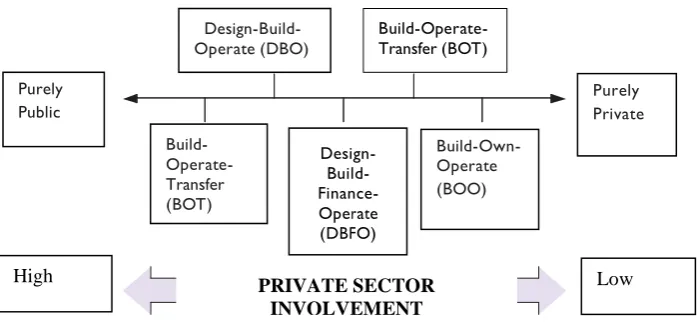
Figure 1: Continuum of Types of PPP (source: Kwak, et al. 2009)
Hence, it is evident that the concept of Public Private Partnership (PPP) has since progressed from the earlier approaches of just focusing mainly on private finance to take on a wider perspective of also bringing in key strengths available within the private sector requiring greater private sector involvement (see Figure 1). Thus, current mainstream view regarding PPP is as a system which is primarily aimed at achieving the best output possible by pulling together and mobilizing funds, technologies, managerial skills, operational efficiencies and facilitating innovations that exists in the private sector (Akintoye, et al. 2005; Huang, et al. 2005).
Design-Build-
Operate (DBO) Build-Operate-Transfer (BOT)
Purely Public
Purely Private Build-Own-
Operate (BOO)
Design- Build- Finance-Operate (DBFO)
Build- Operate-Transfer (BOT)
High PRIVATE SECTOR Low
SITUATING THE RESEARCH
It is noted by Takim, et al. (2011) that undeniably the concept of VfM in PPP is the ultimate goal for most developing countries in delivering, what is considered as being public projects. Value for money (VfM) is defined as „‟ the optimum combination of whole-of-life costs and quality (or fitness for purpose) of the good or service to meet the user‟s requirement‟‟ articulated through the mechanism of using a Public Sector Comparator (PSC) (HM treasury 2006). Currently the drive to use PPPs is increasingly premised on the pursuit of the VfM objectives, and thereby VfM plays the role of a determining factor in deciding whether a project is to be pursued using the PPP approach or not (OECD 2008).
In the Malaysian scenario, despite the widespread adoption PPP for delivering infrastructure projects, the implementation policy and the achievement of the VfM objectives for achieving end user‟s expectation have not been adequately met (Takim, et al. 2009; Ismail, et al. 2011). It is noted by Burger and Hawkesworth (2011) that in practice the VfM objective is very often blurred, and the choice between using a PPP and traditional infrastructure procurement may be skewed by factors other than the VfM objectives. Moreover, as the concept includes both qualitative and quantitative aspects and typically involves an element of judgment on the part of government; a precise measure for VfM concept does not exist but is merely regarded as what a government judges to be an optimal combination of quantity, quality, features and price (i.e. cost), over the whole of the project‟s lifetime.
This paper argues for a more strategic systemic approach towards leading strategic indicators of Best Value (BV) rather than solely concentrating on lagging operational indicators of VfM. Hence, the attempt here is to situate the PPP research debate into the broader Business and Management field, and as such draw attention to the work of Kaplan and Norton (1996) on the Balanced Scorecard (BSC); with the key strategic aim of achieving Best Value rather than settling for VfM. The BSC is seen as being more than adequate to be adapted for the purpose of establishing a comprehensive systemic framework that can align the SPV‟s necessary operational measures (the VfMs) with a coherent set of leading performance measures aimed at achieving BV.
The BV perspective is described as a notion which refers to the optimum outcome of a business process (Akintoye, et al. 2003; Zhang 2006). Four fundamental principles that facilitate the implementation of BV are accountability, transparency, continuous improvement and ownership (DETR 1999). Primarily, accountability and transparency requires responsibility and being answerable to the consumers, and most importantly having an open, all inclusive approach to decision making. Whilst Continuous improvement means that the parties responsible for implementing the PPP project need to embrace the ideas of experiment and change, planning and budgeting in the long run; having to establish a dynamic framework of planning for sustainable future improvements, cost reductions and competition. The four BV principles that facilitate the implementation of BV are fundamentally consistent with the four perspectives of the BSC strategy, i.e financial, customer, internal business process, and lastly learning and growth; by which these perspectives are known to translate organizational missions into operational objectives and measures.
enabling the achievement of the BV objective in general. And for the BV goal to be achieved in PPP infrastructure projects, the VfM objective must be clearly taken into cognizance and effected based on the four principles that facilitate the implementation of BV (through the use of an enhanced PSC approach in line with the BSC methodology).
Here, it is concluded that mainstream PPP research on performance measurement models has tended to view PPP as rather a form of an „industry-specific and unique cross-sector partnership organization; and as such has catapulted a search for unique performance-measurement model solutions focusing primarily on just VfM objectives. Thus PPP researchers have failed to take into account the work of Kaplan and Norton on the Balanced Scorecard and other similar previous relevant work for the purpose of developing a mechanism for delivering Best Value. Utilizing the concept of structuration, this paper attempts to review the current contextual rules that seem lacking in the PPP delivery process, which has given rise to weak structural properties of the systemic context leading to weak structural properties of the PPP project organization, the SPV (see Manning 2008).
RESEARCH STRATEGY
The National PPP policies and guidelines were analysed to indicate the extent to which the SPV structure directly serves to operationalize strategies with respect to the accepted notion of VfM; and the gap that exists in measuring up to Best Value objectives. Primary data collection was undertaken using the interview method based on an exploratory research strategy with PPP practitioners.
The interview respondents were identified through convenient sampling and were drawn from the pool of experts who had been directly involved in the planning and execution of PPP infrastructure projects in Malaysia. The respondents all have a minimum of five years experience in the implementation of PPP in the construction industry; are holders of at least a university degree qualification and are all senior executives or holding upper middle management positions in their respective organizations. Out of the seven respondents that participated in the survey, three belonged to the private sector, while the remaining are attached to public sector related organizations; all involved in the procurement and the subsequent operation and management of infrastructure projects using the standard PPP model.
PPP infrastructure project skills sets/competencies: the practice perspective
PPP as an infrastructure delivery approach is considered an innovative form of collaboration between the public and private sectors in the delivery of infrastructure facilities by which the need for unique skills and competencies to effectively manage such collaboration is an issue of great importance. This is considering the wide range of interlinking relationships and agreements that does exists between the various stakeholders concerned, the risk allocation mechanism that characterizes the approach and moreover the long term commitment involved with respect to the concessioning period of the PPP implementation (Mistarih, et al. 2012).
approach through the PPP. Hence, this research tends to elucidate on these needed PPP skills/competencies with respect to its role in delivering the much needed VfM objectives and the overall effective implementation of the PPP in infrastructure delivery keeping in mind that they are part of the larger agenda for achieving Best Value.
Ranking of the PPP infrastructure projects required skills sets/competencies
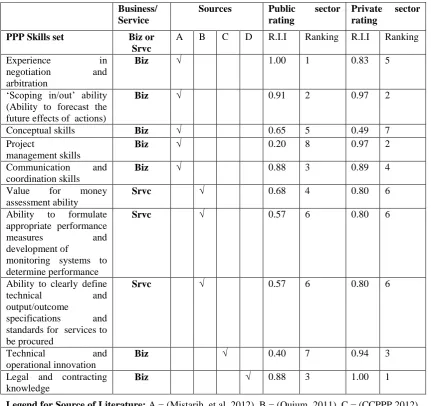
From the PPP skill sets/competencies obtained from previous literature as shown in the Table 1.0 below, the respondents were asked to identify which of the stakeholders in the PPP implementation matches up with these competencies, and moreover rate the importance of these skills in the 5 point Likert scaling where; 5 = Highly important, 4 = Important, 3 = Moderately important, 2 = mildly important, 1 = Less important.
The skills sets/competencies were rated in the order of their importance based on two stakeholder categorization: the public sector in the form of the government and the private sector in the form of the SPV.
The ratings provided by the respondents using the five point Likert scale were combined and then converted into relative importance indices for each of the skill sets/competencies, using the relative importance index (RII) ranking technique.
Where W: Summation of the weighting to each skill set/competency, A: Highest ranking (5) and N: Total number of respondents for that skill/competency
RESEARCH ANALYSIS AND DISCUSSION
Based on literature review and document analysis of standard PPP policy guidelines, following are particular key issues relevant to the scope of the study.
The special purpose vehicle (SPV) decision making processes towards delivering the VfM objectives in the PPP infrastructure project operation stages.
With regards to the SPV‟s decision making processes involved towards delivering the VfM objectives in the PPP infrastructure project operation stages, the respondents stated the fact that there exists no specifically tailored guidelines as to delivering the VfM objectives during the operation stages but they do merely only comply with the operation and maintenance (O&M) and other asset management technical schedules that were agreed upon during the signing of the concession agreement. This finding envisages the fact that during the operation stages of the PPP infrastructure projects in Malaysia, the SPV‟s are only focused on the basic maintenance of the built facility rather than also ensuring that the end users do benefit from the VfM objectives that is expected to be delivered in the operation stages of the constructed PPP infrastructure facility (clearly not addressing Best Value objectives).
The Lagging VfM Agenda of PPP Projects in Malaysia – the Policy Perspective
PPP Programme is Value for Money (VfM), defined as „the optimal combination of whole life cost and quality to meet the users ‟requirements‟ (in this paper it is argued that the leading indicator of Best Value needs to be the strategic intent).
Generally, VfM is broadly stated to be achieved through (these do not constitute the systemic contextual rules that can contribute to strong structural properties of the SPV for intended purposeful action):
risk transfer which allocates risks optimally between the public and private Sectors;
long term nature of contracts (which embodies whole life costing); the use of output specification which allows bidders to innovate; competition that provides fair value of the project;
performance-based payment mechanism; private sector management expertise and skills.
[image:8.595.102.534.335.741.2]PPP infrastructure projects’ required skills sets/competencies
Table 1.0: PPP Skills Sets/Competencies ranking
Legend for Source of Literature: A = (Mistarih, et al. 2012), B = (Quium 2011), C = (CCPPP 2012), D = (Mizrachi and Attar 2011)
Business/ Service
Sources Public sector rating
Private sector rating
PPP Skills set Biz or Srvc
A B C D R.I.I Ranking R.I.I Ranking
Experience in negotiation and arbitration
Biz √ 1.00 1 0.83 5
„Scoping in/out‟ ability (Ability to forecast the future effects of actions)
Biz √ 0.91 2 0.97 2
Conceptual skills Biz √ 0.65 5 0.49 7 Project
management skills
Biz √ 0.20 8 0.97 2
Communication and coordination skills
Biz √ 0.88 3 0.89 4
Value for money assessment ability
Srvc √ 0.68 4 0.80 6
Ability to formulate appropriate performance measures and development of
monitoring systems to determine performance
Srvc √ 0.57 6 0.80 6
Ability to clearly define technical and output/outcome
specifications and standards for services to be procured
Srvc √ 0.57 6 0.80 6
Technical and operational innovation
Biz √ 0.40 7 0.94 3
Legal and contracting knowledge
The VfM objectives can be classified into financial and non-financial, or in this instance as Business-related and Service-related with respect to the internal processes that are required in order to achieve the objectives. Based on a cause and effect relationship, the necessary skill sets identified through literature review relevant to the particular internal processes for delivering the VfM objectives are treated as the respective operational indicators (that are amenable to being studied through this methodology, which it is acknowledged as having limitations in not being exhaustive in addressing the wider agenda of Best Value). It is evident from Table 1.0 that both the private and the public sector consider the service skill sets to be ranked rather low whilst business skill sets to be of more importance. Hence, it is concluded that there is a tendency to focus on a high business strategy rather than service. However, clearly in the case of PPP infrastructure projects both business and service are to be accorded equal importance.
Additionally, focused interview data was analysed to explore the extent of SPV‟s structuration influenced by current VfM objectives, the results are presented below.
The challenges/issues facing the SPV’s in their quest to achieving the VfM objectives for PPP infrastructure projects in Malaysia
Lack of effective policies to guide the SPV‟s towards delivering the VfM objectives.
Change of key personnel and/or SPV ownership.
The nature of the current regulations and guidelines with respect to the setup and operation of SPV towards achieving the VfM objectives of the PPP infrastructure projects
There are no purposefully tailored laws/regulations governing the set up and operation of the SPV‟s towards achieving the VfM objectives in the PPP infrastructure projects in the industry.
Aspects by which actions needs to be taken to enable the SPV’s to deliver VfM objectives in PPP infrastructure projects
Enhancement of the regulations to ensure that only experienced, capable and financially stable SPV‟s are selected during the PPP tendering processes.
Drafting an effective and proper best practice procedure to guide the SPV‟s in the delivery of the VfM objectives in the PPP project operation stages.
A Minimum paid up capital requirement of the SPV‟s should be changed from
that of a fixed amount to that of a percentage proportion of the expected total cost of the PPP project.
Engagement of relevant experts in the drafting of the terms and conditions of the concession agreements.
CONCLUSIONS
towards achieving their business strategy objective rather than delivering the much needed VfM objectives in PPP project implementation in Malaysia. This is a justification for the necessity to structure the SPV to achieve just not VfM but to be aligned in a strategic manner towards Best Value. This is recognized as putting in place the necessary structuring systemic contextual rules to enable more efficient service delivery. It is proposed here that the Best Value strategic objectives are to be translated into a coherent set of operational indicators and performance measures in the form of skills set and outcomes using the BSC approach. Thus, providing for a greater focus on the process of delivering the outcomes in a structured and systemic manner.
Hence, through a mixed method research strategy, the research findings indicate that VfM objectives arising from evaluation against the Public Sector Comparator (PSC) together with general policy guidelines seem to be the primary „driver‟ in the delivery of PPP projects. As the VfM objectives are primarily set within operational parameter boundaries, there is a lack of overall long-term strategic focus. Based on the understanding of structuration theory, it is proposed that operational indicators matched with project-specific VfM outcomes be aligned with the concepts of Best Value (BV) using a Balanced Scorecard (BSC) approach; linking cause to effect, for successful delivery of PPP infrastructure projects.
REFERENCES
Akintoye, A., Edwards, P.J. & Hardcastle, C., (2005). The allocation of risk in PPP/PFI construction projects in the UK. International Journal Of Project Management, 23(1), pp. 25-35.
Akintoye, A., Hardcastle, C., Beck, M., Chinyio, E., and Asenova, D. (2003). “Achieving best value in private finance initiative project procurement.” Construction Management and Economics, 21(5), pp. 461–470.
Burger, P and Hawkesworth, I (2011), „How to Attain Value for Money: Comparing PPP and Traditional Infrastructure Public Procurement‟, OECD Journal on Budgeting, 2001(1).
Cheung, E. & Kajewski, S., (2010). The Researcher‟s Perspective on Procuring Public Works. Structural Survey, 28(4), pp. 300-13.
DETR (1999) Implementing Best Value: A Consultation Paper on Draft Guidance, HMSO, London.
Huang, T., Shen, L.Y., Yam, C.H. & Zhao, Z.Y., (2005). An analysis to the existing practice of managing government-invested project in China. Construction Economics, 2005(1), pp.16-20.
Ismail, K., Takim, R. & Nawawi, A.H., (2011). The Evaluation Criteria of Value for Money (VFM) of Public Private Partnership (PPP) bids. In International Conference on Intelligent Building and Management. Singapore.
Kaplan, R.S. and Norton, D.P. (1996).Translating Strategy into Action: The Balanced Scorecard. Harvard Business School Press: USA.
Manning, S. (2008). Embedding Projects in Multiple Contexts – a Structuration Perspective. International Journal of Project Management. 26 (2008), pp. 30-37.
Mistarih, A.M., Al Refai, M.S., Al Qaid, B.A. & Qeed, M.A., (2012). Competency Requirements for Managing Public Private Partnerships. International Journal of Business and Management, 7(12), pp.60 - 73.
Ninth Malaysia Plan (2006-2010). Available at
http://www.epu.jpm.my/rm9/html/english.htm accessed 8th July 2013.
Pongsiri, M., (2002). Regulation And Public Private Partnerships. International Journal Of Project Sector Management, 15(6), pp.487-95.
Salleh, D. & Siong, H.C., (2008). The Involvement of Private Sector in Local Infrastructure Development In Malaysia. Jurnal Alam Bina, 11 (2), pp.74 - 100.
Sanghi, A., Sundakov, A., Hankinson, D., 2007. Designing and Using Public-Private Partnership Units in Infrastructure: Lessons from Case Studies Around the World. World Bank, Washington, DC. Available at
https://openknowledge.worldbank.org/handle/10986/10644
Takim, R., Ismail, K. & Nawawi, A.H..&.J.A.., (2009). The Malaysian private finance initiative and value for money. Asian Social Science, 5(3), pp.103 - 111.
Takim, R., Ismail, K. and Nawawi, A.H. (2011). A value for money assessment method for Public Private Partnership: A lesson from Malaysian approach. In International Conference on Economics and Finance Research, 4 (2011) IACSIT Press, Singapore.
Yepes, T., (2005). Expenditure on Infrastructure in East Asia Region, 2006-2010. Report paper. World Bank ,Washington, DC.