Journal of Chemical and Pharmaceutical Research, 2013, 5(12):721-731
Research Article
CODEN(USA) : JCPRC5
ISSN : 0975-7384
Design and evaluation of the maintenance-free technologies for a novel digital
methane detection system based on catalytic sensor
Xu Hui Zhang
Department of Mechanical Engineering, Xi’an University of Science and Technology, Yanta Road, Xi’an, China _____________________________________________________________________________________________
ABSTRACT
Digital methane detecting and alarm miner’s lamp has proved to be a very effective methane monitoring technique in recent years. The mini methane detection system is the kernel of those lamps. The function of detection system based on analog circuit is limited, which leads to high maintenance costs and unstable performance. The maintenance-free technologies were developed and evaluated for a mini intelligent methane detection and alarm system using innovations in computer technology, modern signal analysis and processing technology in this paper. After introduced state of the art of intelligent methane detection systems, a mini intelligent methane detecting system was presented to research the maintenance-free technologies, which includes system-level auto-zero, automatic and visualized off-line calibration based on PC, and intelligent online calibration based on a wireless sensor network (WSN). The methods and steps of those technologies were described in detail. Finally, the experiments were carried out to validate and evaluate those technologies. The results show that the techniques to be the effective and efficient way to lighten workload on calibration, to prolong the off-line calibration cycle of the methane measuring device, and to improve the calibration accuracy. The size of the mini methane detection system allows it may to be mounted directly on a miner's alarm lamp and portable gas detector.
Key words: Methane detection; Maintenance-free; Auto-calibration; Visualized calibration; WSN
_____________________________________________________________________________________________
INTRODUCTION
Standard methane detection systems use a catalytic methane sensor called a pellistor [1]. All mining equipment must be equipped with methane monitors that operate continuously to record methane levels at the face. Foreign products have the advantages that they are stable and reliable and have a long correction cycle and long life. In the domestic market, however, detection pellistors show instability when used as methane sensor. Moreover, some miners are assigned to hold the instruments for detecting methane, which may cause data error, missing, or no alarm and which may seriously threaten the safety of miners in coal production. It is difficult to change the current methane detection protocols.
The placement of the methane detector and alarm on the miner’s lamp is designed to notify the miner whenever methane levels exceed a predetermined limit at the location of the miner. It is designed to sound and/or light and alarm if methane concentration is excessive. This is an important advancement of methane monitoring technology because it changes the traditional alarming mechanism "Asking to withdraw" with "Having to withdraw" and because it realizes the alarm mode of multi-point distribution and networked monitoring and alarming.
develop a maintenance-free methane monitor.
THE INTELLIGENT METHANE DETECTING SYSTEM
Many countries have researched intelligent portable methane detection. Present commercial combustible detectors show the microminiaturization, intelligence and versatility trend of the gas detecting device, such as RKI’s GX-86 [4], TBE’s MAX5 [5] and TS4000 [6] type intelligent gas detector from General Monitors in the U.S. The performance evaluation of IYONI II (developed by GfG (Pty) Ltd, South Africa.) by scientists from NIOSH (National Institute for Occupational Safety and Health, Pittsburgh Research Lab) has shown the viability of the miner’s methane detection and alarm lamp [7]. A systematic study of performance characteristics [8] and factors affecting of methanometers [9] has been made by C.D. Taylor from the Pittsburgh Research Lab. It has been shown that humidity and oxygen concentration impact detection veracity [10] [11]. Some scholars have used multi-sensor arrays and microelectro-mechanical systems to detect different kinds of gases [12]. Hélène Debeda adopted two detectors based on semiconductor oxides and/or pellistors to develop a reliable methane detector [13]. Min-Ming Tong researched the dynamic correction of thermostatic methane detection with a catalytic sensor [14]. Although digital gas detection systems have played an important role in coal mine safety in recent years, some potential safety problems deserve further investigation. In addition, the mini size and power consumption of the mini intelligent detecting system puts forward higher requirements for the system design.
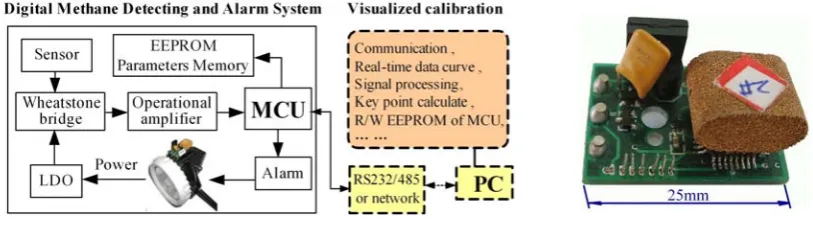
Figure 1 shows a diagram of the mini intelligent methane detecting and alarm system that we designed. The heating catalytic methane sensor is connected to a Wheatstone bridge circuit, where the signal from the bridge is proportional to the concentration of methane gas in air that passes over the sensor head. An operational amplifier is used to increase the voltage. The increased signal voltage is treated with A/D Converter and sent to an ATMega48V, a high performance, and low power consumption 8-Bit micro-controller produced by ATMEL Corporation. The digital value is compared with the constant reference value being stored in EEPROM. If the methane concentration of the workplace is over the threshold concentration, the MCU will give a switch signal through its digital I/O ports to alarm the miner, who wears the methane detection and alarm lamp.
The intelligent methane sensor has an interface to a host computer with a serial communication or network to perform the automation and visualization of the sensor calibration. Figure 2 demonstrates the mini intelligent methane detector and its use of a digital methane detection and alarm lamp. Many factors were considered in the system’s design, not only its micro size, low cost, low power consumption and good anti-interference but also the relationship between system’s intelligence level and hardware and software resources.
[image:2.595.105.512.459.573.2]
Fig.1 Principle diagram of methane detecting system Fig.2 The digital methane detector
MODELING AND INFLUENCING FACTORS ANALYSIS FOR METHANE DETECTING SYSTEM
[image:2.595.185.430.679.752.2]Assumed that the power supply of the detector is stable with no interference, the mathematical model of the digital methane detecting system is built. Figure 3 shows the block diagram for the maintenance-free process of the intelligent methane detection and alarm system. The Gw, GT, GI and GD represent the conversion circuit (Wheatstone bridge for methane measuring), condition circuits (filter and amplifier), external disturbances (EMI, power disturb and other factors) and A/D process concerning the methane concentration, respectively.
For the automatic calibration process, we know that the concentration of the standard gas sample is equal to the output of the GD in ideal state. Through dynamic adjustment of a Digital Potentiometer, we may get a Wheatstone bridge balance or an Operational Amplifier changeable gain. This Digital Potentiometer performs the same electronic adjustment function as a potentiometer, trimmer, or variable resistor. Nevertheless, the calibration system is better than the traditional methane detecting devices, which are operated manually.
The transfer function of the system is given by
)] ( ) ( ) ( [ ) ( ) ( ) ( 1 ) ( ) ( )
( G sRs G s
s G s G s G s G s G s
C W I
D T W D T + +
= . (1)
The output of the sensor changes along with the methane concentration at a certain work current. The statistical equation of the sensor may be described as follows
C k T dt T d cΔ = Δ + Δ
τ (2)
where
τ
is time constant of sensor and o 0.3851 / Cτ= Ω . kc is the changed speed of methane concentration, also a constant in steady state gas surroundings. ΔCAnd ΔThere represent the gas concentration increment and component temperature, respectively.
Considering the Wheatstone bridge measurement circuits without non-linear influence, this paper use the following equation to solve for the transfer function
s
R
V
k
k
G
s c bw
1
⋅
⋅
=
τ
(3)where ks is a constant referred to as the gain or sensitivity of the system because it represents the scale coefficient of the gas concentrations and the sensor output voltage. Note that the parameters are valid for a methane concentration below 4%. R is the resistance of the sensor, and Vb is the DC excited voltage of the Wheatstone bridge.
The transfer function of the other modules is as follows: GT =kT, and GD=kD. The noise model is a multi-variable time series model, which is simplified as white noise and may be treated with a filter. Hence, a new simplified formula of the block diagrams is given by
1 1 ) ( + = Ts s
G (4)
where
b s c T D
R
T V
k k k k
τ ⋅
= . (Note: the formula does not include external interference: G sI( )=0 for simplification.)
In practice, the methane detection is affected by external interference and internal nonlinear characteristics. Next, we will study the zero drift, non-linear solution to be used in the system.
Fig.4 Wheatstone bridge for methane detection V R R R R R R R I R I V V u white black black black sen in
i ⎟⎟×
⎠ ⎞ ⎜⎜ ⎝ ⎛ + − + = − = − = + 2 1 1 1 1
2 (5)
Assumed the respective errors of
R
1,R
2 and the environmental impact are ignored,theR
blackequals theR
whitein the catalytic components in the factory. The above formula (5) may be written as
R
R
R
R
R
R
u
black black blacki
+
Δ
Δ
×
=
×
⎟⎟
⎠
⎞
⎜⎜
⎝
⎛
Δ
+
−
=
2
4
5
.
2
5
.
2
2
2
1
(6)The variable quantity of resistance,
Δ
R
, makes the output voltage produce a nonlinear error. The output of the Wheatstone bridge has a nonlinear relationship with the methane concentration. The impact of this non-linear error must be considered in the design.The resistance of the platinum wire shows much more serious nonlinear characteristics when heated. Such nonlinear characteristics can be expressed using a polynomial approximation:
n n
X
W
X
W
X
W
X
W
Y
=
1+
2 2+
3 3+
⋅
⋅
⋅
+
(7)where X is the detecting signal, Y is the output of the system, and W1、W2、W3, …, Wn are coefficients.
The above nonlinear characteristic (formula (6) and (7)) can be calibrated by MCU. If corrections to the sensitivity are performed, a variety of different concentrations of methane are required. However, this is hard to achieve in practice, and, moreover, the cost of maintaining system would be greatly increased. A localized linear correction method is proposed in the paper. Using linear segments, simple linear processing can be performed.
The questions that puzzled designers can now be solved using intelligent technologies. Well-designed electronic circuits can be used to treat auto zero, sensitivity damping and nonlinearity compensation of the sensor. Equation (2) shows that the sensor is not equipped to detect a rapidly changing methane concentration. An intelligent methane detection system may increase accuracy and reliability. Additionally, automatic correction, non-linear compensation, automatic fault diagnosis, and other functions of the detection system can be enhanced.
In a word, to realize maintenance-free detection, the key technology concerns dynamic adjustment of the system state, auto-zero, auto-calibration of system nonlinear and data post-processing.
MAINTENANCE-FREE TECHNOLOGIES IN THE DIGITAL METHANE DETECTING SYSTEM
Maintenance-free technologies in this paper mainly include three aspects:
Digital potentiometer performs the function of a mechanical potentiometer, but replaces the mechanics with a simple 2-wire digital interface. For the host computer adjusting digital potentiometer according to the output of A/D, not just the Wheatstone bridge output, so this correction method is a system-level auto-zero.
PC-based automatic and visualized off-line calibration: The intelligent methane sensor has an interface to a host computer with a serial communication or network to perform automatic and visualized calibration. This method needs standard concentration gas sample and is mainly using in first calibration in plant or periodic calibration using in coal mine.
WSN-based on-line calibration: Area monitoring is a common application of wireless sensor network (WSN). An intelligent methane sensor system equipped with the network connectivity can perform the calibration autonomously, and there is no need to prepare standard gases for each system as in the conventional calibration.
1. System-level auto-zero
The methane measurement system requires signal paths with very low offset voltage and low offset voltage drift over time and temperature. With standard linear components, the only possible calibration technique is system-level auto-zero. The performance of digital methane measurement systems is not only determined by sensor components, electronic parts and zero-drift of the operational amplifier but also by the precision of A/D circuit and power supply. Therefore, the system-level auto-calibration must be taken out.
1.1 Non-zero output correction by digital potentiometer
Power supply voltage fluctuations lead to zero-offset, which will impact the measurement accuracy. Our design uses the miner's lamp’s battery system (traditional accumulators or lithium batteries) and adopts the low-noise LDO voltage regulator (2.5V) for providing power to the Wheatstone bridge circuit, the differential operational amplifier and the MCU.
The power supply is positive 2.5V, so the output of the Wheatstone bridge must meet Vsen<Vin+ (shown in figure 4). To ensure a positive saturated output, one could use a non-balanced bridge measuring method, which used resistance in series or in parallel on the arm of the Wheatstone bridge, such as parallel resistance with the white sensing element of the sensor or a series resistance with resistance of R2. Another way is to adjust the digital potentiometers automatically so as to balance the Bridge. The shortcoming of the former is the small gas compensation at the Bridge negative saturated output, resulting in a low value of the current concentration. This would result in an erroneously low value of the methane concentration being detected. The latter could increase hardware costs and the complexity of the circuit. In the experiment, a digital potentiometer is adopted to balance the Wheatstone bridge.
In general, mechanism of non-offset output correction is adjusted digital potentiometer according to results of A/D in the air until the level equal to zero. This puts forward in periodic calibration and doesn’t need to run in each using process.
1.2 Dynamic automatic adjusting to eliminate zero-drift of hardware circuit.
The mini digital methane detecting system must meet timely protection needs when using on equipments underground in coal mine. Because methane concentration changes slowly in coal mine (even more to several ten minutes), a dynamic auto-zero method is adopted to eliminate zero-drift of hardware circuit. The procedure is listed as follows:
Delay 10ms: Elimination discharge time of resistors and capacitors.
Continuously sampling n times: compute the arithmetic average, recorded as
x
0(x
0is the sampling data ofdynamic zero drift):
∑
==
n ii
t
n
x
1 0
1
(8) Where
t
i is the current sampling value and n is sampling number.Continuous sampling n times: compute the arithmetic average, recorded as
x
1 (includes the effect of zero drift):∑
==
n ii
t
n
x
1 1
1
(9) Where
x
1 is the current sampling value and n is sampling times.Computing the sampling data y in air: analyze Figure 4, the
x
1<
x
0may meet in practice. So the calibration value in air should be calculated as below:If
x
1≥
x
0,y
=
x
1−
x
0; ory
=
0
.In addition, a digital filter was designed in the software to ensure the accuracy and reliability of the mini intelligent methane measurement and alarm system.
2. Automatic and visualized off-line calibration based on PC
The techniques and apparatus for auto-calibration are very important for developing a mini intelligent methane detection system. The special auto-calibration device can reduce the errors caused in the gas alarm calibration process. Together with the publication of the industry standards AQ6209-2007 (Digital methane detection and alarm lamp for miners), the continuous work time has extended from 7d to 15d [15], which has made analogous methane detectors more difficult to popularize and apply because of their calibration and debugging process.
The traditional calibration process of methane detector consists of two parts:
Calibration in production plant. The detectors are successively put in pure dry air and certain concentration CH4. The sensor must pre-aging before measurement. Initially, the sensors are set in an atmosphere of pure dry air. The required amount of methane is then introduced creating an almost step change concentration and the conductance of the sensors is monitored until the static response is reached 30s.
Periodic calibration in service. That the methane concentration signal is not linear with output voltage of the measurement bridge. The electric nonlinearity for sensitivity may drift over time and must periodic calibrating to ensure reliability of detection. The cycle of periodic calibration has prolonged from 7 days to 15 days by the new Coal Mine Industry Standards of China (AQ6209-2007).
Due to the development of the technology for intelligent sensors, computers and signal processing, it was possible to design an auto-calibration system based on MCU. The software filtration technology can improve the signal-to-noise ratio (SNR). An advantage of regular auto-zero calibration avoids the usual cumbersome in-calibration process and, at the same time, improves the detection accuracy by means of effectively restraining the shift of the sensor’s measurement circuit. Using a linear interpolation method of nonlinear sensor calibration, we obtained an accurate alarm threshold and modified the reliability of the alarm signal.
The intelligent sensor can communicate with a personal computer through the calibration instrument that we designed. The concentration data of CH4 are sent to the host computer for real-time display of A/D data and implementing the automation and visualization of the calibration process. This process can effectively reduce the workload of calibration and maintenance costs.
The function of the monitoring software is to set up the main communication parameters of RS232 and real-time display curves of gas concentration in calibration or experiment, intelligently obtaining alarm points through curves and automatically downloading calibration data to EEPROM in ATMega48V.
Automatic and visualized calibration software has been developed successfully on a windows platform with VC++. The RS232 library contains many functions that handle all aspects of serial communications. One may chose the calibration value automatically, and EEPROM can be operated remotely. This has laid a solid foundation for its further use in research of remote calibrating and remote fault diagnosis.
Sensor network is a new field and developing rapidly. Because of its tremendous application potential, it has caused great concern of many countries in military, industrial and academic. A calibration method based on a wireless sensor network is used to achieve online calibration [11].
As a node of a wireless network, the mini digital methane detection system can be used not only for collecting the methane concentration data but also for the calibration and diagnosis of the sensors for comparison with nearby sensors in the network. Based on a 2.4 GHz radio transceiver chip nRF2401, the Norwegian Nordic companies monolithic integrated, the close point-to-multipoint wireless methane measurement network was developed. Figure 5 is shown the framework of the wireless methane sensor network. The auto-calibration of the methane detection system based on a wireless sensor network utilized the result of the other nearby nodes in a coal mine to gain more efficiency and reliable monitoring.
Sensor Node 1 nRF2401 Module Data processing node
nRF2401 Module
Sensor Node 2 nRF2401 Module
Sensor Node 3 nRF2401 Module
Fig.5 Framework of wireless methane sensor network
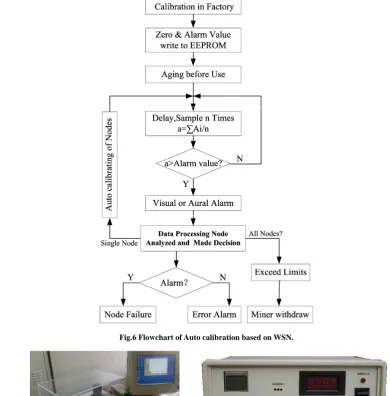
The principle of auto-calibration based on wireless sensor network is described as Figure 6. Firstly, off-line correction is put forward as section 3.3. The A/D conversion value in air and 1% CH4 environment were recorded and written to EEPROM. The stability tests in accordance with the standards (MT/T 409-1995) were performed to number of randomly selected sensors.
Then online calibration based on WSN will be carried out when necessary. Steps as follow:
The all sensor nodes alarm in entire wireless network: the methane concentration exceeding safety limits can be judged by all nodes status. If all lamps alarmed by voice and/or light, the methane concentration in working mine face areas goes beyond the safety concentration limit. Miners must withdraw immediately.
If individual alarm: Automatic calibration program was activated, automatic correction orders were sent from data processing node to other nodes. After delay a time, data processing node collects the correction nodes automatically after the completion of the sampling data and alarm status.
If there is no further alarm: It shows alarm error or meets a gas. The methane is in order.
If still alarm: The system of the node may fault itself, it should be replacement.
Therefore, it would be reasonable to hypothesize the existence of CH4 distribution underground. In normal circumstances, a sensor system equipped with the network connectivity can perform the calibration autonomously in the field, and there is no need to prepare standard gases for each system as in the conventional calibration.
ANALYSIS AND EVALUATION OF EXPERIMENT RESULTS
Fig.6 Flowchart of Auto calibration based on WSN.
Fig.7 Experimental testing platforms and calibration Instrument
The tests show that the system’s power can work in a wide voltage range (3-6V) with small ripple voltage. The LDO circuit can provide a stable 150mA current and 2.5V voltage even if the voltage difference lowers to 400mV. The application proves that the performance of the voltage source is steady and reliable.
The dynamic adjustment of the digital potentiometer is simply to insure the balance of the Wheatstone bridge. Figure 8 shows the response curves of a detector detecting 1% CH4. Using this method, we can get an ideal sensitivity curve by storing a set of tap points of the digital potentiometer.
Experimental data of the four components are shown in Figure 9. Those components were selected from 25 methane monitoring nodes and labeled (a)-(d).
[image:8.595.99.490.73.470.2]Analysis shows that the sensitivity curve migration is regular. The single supply of the operational amplifier and the imbalance of the Wheatstone bridge lead to the zero offset in detection. The zero offset of the (b) and (c) nodes may result in a false alarm for its negative zero offset. That is, the actual measured methane concentration is low. When the sampling value of the concentration is 1%, the true concentration is 1.1% or even higher.
[image:8.595.127.488.426.525.2]The evaluation of the sensor system was first made in terms of focusing on the long-term stability of the gas sensor. Among the various factors that affect the gas sensor’s response (e.g., interference gases and aging problems), the zero drift was found to be the major cause of errors in the measured gas concentrations.
Fig.8 Response curves using Digital Potentiometer to detect
Fig.9 Sensitivity curve trends with zero drift
Fig.10 Real-time data curve of detecting 1% CH4
was minimized, and sensor nonlinearity was repaired as well.
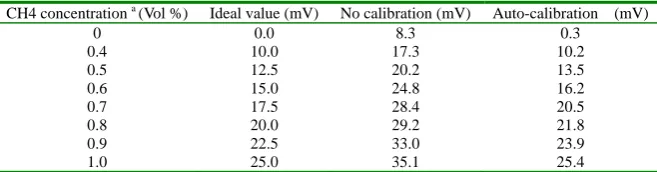
Table 1. Experimental data comparison
CH4 concentration a (Vol %) Ideal value (mV) No calibration (mV) Auto-calibration (mV)
0 0.0 8.3 0.3
0.4 10.0 17.3 10.2
0.5 12.5 20.2 13.5
0.6 15.0 24.8 16.2
0.7 17.5 28.4 20.5
0.8 20.0 29.2 21.8
0.9 22.5 33.0 23.9
1.0 25.0 35.1 25.4
a
Samples of CH4 from a dynamic volumetric device. Those samples just used in experimental process because the sample has minimal fluctuation. We used standard concentration methane in the initial calibration.
CONCLUSION
This paper has demonstrated the maintenance-free technology of a mini digital methane detection and alarm system for a miner’s lamp. The intelligent detection system can perform calibration autonomously, and it is unnecessary to prepare standard methane for each system as in conventional calibration methods. Based on technical analysis and industrial prototype tests, the mini intelligent methane measurement and alarm system was introduced. Theoretical analysis and experimental results show that the maintenance-free technology has improved the detection accuracy, prolonged the calibration cycle of the methane measuring equipment and lessened the working strength on calibration.
Further study shall be carried out regarding the extension of the maintenance-free technology based on WSN and the addition of more general cases so as to make the system function perfectly and practically.
Acknowledgements
Part of this work is supported by the National Natural Science Foundation Project (U1361121), Natural Science Basic Research Plan in Shaanxi Province of China (2012JM8093), Key Project of Chinese Ministry of Education(211179) and Scientific Research Program Funded by Shaanxi Provincial Education Department (08JK361 and 11JK0848). The authors acknowledge the support from the students, Liangbin Huang, Yuanhua Zhou, Xiaogang Yang, Chen Lei and Qinghua Mao for their assistance in the experiments and measurements.
REFERENCES
[1]Coal Mine Safety Regulations, State Production Safety Supervision Authority and National Coal Mine Safety Supervision Bureau, Beijing, 2005, pp. 18-38.
[2]Min-Ming Tong, Shen-Qiang Yang, Fen Tian, Journal of China University of Mining and Technology, 4(2003) 399-401.
[3]Ru-Lin Wang, Coal Mine Automation, 4(1998) 16-18.
[4]Operating instructions for MAX5: Portable Combustion Efficiency Monitor, California, USA. http:// www.tbe.com.
[5]Instruction Manual of Model GX-86: Portable Four Gas Monitor, RKI Instruments, Inc., http://www.rkiinstruments.com.
[6]Instruction Manual of Model S4000C: Intelligent Sensor for Combustible Gas Detection, http://www.generalmonitors.com
[7]J.E. Chilton, C.D. Taylor. Evaluation of IYONIII methanometers, National Institute for Occupational Safety and Health, Pittsburgh Research Lab, 2002
[8]C.D. Taylor, E.D. Thimons, J.A. Zimmer. Factors Affecting the Location of Methanometers on Mining Equipment, Proc. 7th International Mine Ventilation Congress, Krakow, Poland, June 17-22, 2001.
[9]C.D. Taylor, J.E. Chilton & T. Mal, Evaluating Performance Characteristics of Machine-Mounted Methane Monitors by Measuring Response Time, Proc. of the 9th U.S. Mine Ventilation Symposium, Ontario, Canada, June 8-12, 2002.
[10] Jorge Orts, Eduard Llobet, Xavier Vilanova, Jesus Brezmes, Xavier Correig, Sensors and Actuators B, Chemical, 60 (1999) 106–117.
[11] Zhang Xuhui, Visualization Calibration Method of an Intelligent Methane Detection System[C]. The 2nd International Conference on Electrical and Control Engineering, ICECE2011, Yichang, China, Sept. 16-18, 2011: 5163-5166.
[13] Hélène Debeda, Laurent Dulau, Francis Menil, Claude Lucat, P. Massok, Sensors and Actuators B, Chemical, 44 (1997) 248–256
[14] Tong Minming. Chinese Journal of Scientific Instrument, 2001, 22(5): 463-465.
[15] AQ6209-2007: Digital methane detecting and alarm miner’s lamp, Coal mine industry standards, R.P. China,