
A NOVEL APPROACH TO DATA MINING USING
SIMPLIFIED SWARM OPTIMIZATION
A thesis submitted in fulfillment of the requirements for the
degree of Doctor of Philosophy in the School of Information Technologies at
The University of Sydney
Noorhaniza Wahid
ii
ABSTRACT
Data mining has become an increasingly important approach to deal with the rapid growth of data collected and stored in databases. In data mining, data classification and feature selection are considered the two main factors that drive people when making decisions. However, existing traditional data classification and feature selection techniques used in data management are no longer enough for such massive data. This deficiency has prompted the need for a new intelligent data mining technique based on stochastic population-based optimization that could discover useful information from data.
In this thesis, a novel Simplified Swarm Optimization (SSO) algorithm is proposed as a rule-based classifier and for feature selection. SSO is a simplified Particle Swarm Optimization (PSO) that has a self-organising ability to emerge in highly distributed control problem space, and is flexible, robust and cost effective to solve complex computing environments. The proposed SSO classifier has been implemented to classify audio data. To the author’s knowledge, this is the first time that SSO and PSO have been applied for audio classification.
iv
PUBLICATIONS
Refereed Journal Articles:
1. Wei-Chang Yeh, Noorhaniza Wahid, Yuk Ying Chung. “Effective Audio Classification Algorithm using Swarm-based Optimization Technique Approach”, submitted to Expert System with Applications (SCI journal with Impact Factor 2.908).
2. Wei-Chang Yeh, Noorhaniza Wahid, Yuk Ying Chung. “A Hybrid Network Intrusion Detection System using Simplified Swarm Optimization (SSO)”, submitted to Applied Soft Computing(SCI journal with Impact Factor 2.415). 3. Wei-Chang Yeh, Noorhaniza Wahid, Yuk Ying Chung. “A New Simplified
Swarm Optimization (SSO) Data Mining Classification Algorithm”, submitted to Computers & Industrial Engineering (SCI journal with Impact Factor 1.057).
Refereed Conference Paper:
v
ABBREVIATIONS
Acronym Expended term
ABC Artificial Bee Colony
ACO Ant Colony Optimization
ADEL Ankyloglossia with Deviation of the Epiglottis and Larynx AI Artificial Intelligence
AIS Artificial Immune Systems
A-NIDS Anomaly-based Network Intrusion Detection Systems
ANN Artificial Neural Network
ARS Average Rule Size
BPSO Binary Particle Swarm Optimization
BW Baum-Welch
CHD Coronary Heart Disease
CLPSO Comprehensive Learning PSO
CPSO Constricted PSO
CPSO Cooperative Particle Swarm Optimizer
DE Differential Evolution
DFT Discrete Fourier Transform
DoS Denial of Service
DPSO Discrete PSO
EAs Evolutionary Algorithms
ELS Exchange Local Search
EP Evolutionary Programming
ES Evolution Strategy
FCM Fuzzy C-Means
FCPS-classifier Fuzzy Controlled Particle Swarm-classifier
FDTs Fuzzy Decision Trees
FIPS Fully Informed Particle Swarm
FN False Negatives
FP False Positives
FPPSO Feature Partitioning PSO
GA Genetic Algorithm
GEPSVM Generalized Eigenvalue Proximal SVM
GMM Gaussian Mixture Model
GNB General Naive Bayes
GP Genetic Programming
GRBF Gaussian RBF
HEHRS Hierarchical Rule Sets
vi
Acronym Expended term
HMM Hidden Markov Model
IA Immune Algorithm
IDS Intelligent Dynamic Swarm
IDSRS Intelligent Dynamic Swarm with Rough Set IkNN Informative k Nearest Neighbor
IPS-classifier Intelligent Particle Swarm-classifier
IS Immune System
KDD Knowledge Data Discovery
kNN kNearest Neighbour
KPCM Kernel-based Possibilistic C-Means LCM Linear time Closed itemset Miner LDPSO Linearly Decreasing PSO
LDWPSO Linear Decreasing Weight PSO
LGP Linear Genetic Programming
LMNN Large Margin Nearest Neighbor
LPC Linear Predictive Coding
MARS Multivariate Adaptive Regression Splines MFCC Mel Frequency Cepstral Coefficient
MI Mutual Information
MLP MultiLayer Perceptron
MOPSO Multi-Objective PSO
MSSE Mean Sum Squared Error
NB Naive Bayes
NFL Nearest Feature Line
NIDS Network Intrusion Detection Systems NIP Numerical Interval Pruning
NN Neural Network
NN Nearest Neighbor
OBSI Octave Band Signal Intensities
P2PkNN Peer-to-Peer kNN
PCA Principal Component Analysis
PM Partition Matrix
PSO Particle Swarm Optimization
PSO-NCC PSO-Nearest Centroid Classifier PUNN Product Unit Neural Network
QDE Quantum-Inspired Differential Evolution QPPs Quadratic Programming Problems
R2L Remote to Local
RBF Radial Basis Function
RHMM Reverse HMM
vii
Acronym Expended term
RSC Rough Set Classification
RSC-PGA Rough Set Classification Parallel Genetic Algorithm
RST Rough Sets Theory
RWS Roulette Wheel Selection
SA Simulated Annealing
SI Swarm Intelligence
SMO Sequential Minimal Optimization SNNB Selective Neighborhood Naive Bayes
SOM Self Organizing Maps
SR Silence Ratio
SSO Simplified Swarm Optimization
SSO-ELS SSO with Exchange Local Search SSO-WLS SSO with Weighted Local Search SVDF Support Vector Decision Function
SVM Support Vector Machine
TN True Negatives
TP True Positives
TSP Traveling Salesman Problem
TSVM Twin SVM
U2R User to Root
WEKA Waikato Environment for Knowledge Analysis WFPPSO Weighted Feature Partitioning PSO
WLS Weighted Local Search
viii
LIST OF FIGURES
Figure 1.1. The processes of KDD [3] ... 3
Figure 2.1. Maximum margin hyperplane denoted with for linearly separable case [40] .... 22
Figure 2.2. The classification hyperplane which defines two linear separable classes in +1 region and -1 region [40] ... 23
Figure 2.3. Non-linear transformation of the input data to a high-dimensional feature space [40] ... 25
Figure 2.4. An example of how PART algorithm build a partial tree [49]. Grey nodes denote unexpanded nodes; black nodes denote leaves ... 28
Figure 2.5. A classification tree for the personal loan application problem [1]... 30
Figure 2.6. The categories of population-based optimization algorithms ... 37
Figure 2.7. The simple scheme of a swarm [4] ... 39
Figure 2.8. GA flowline over several operations [77]... 40
Figure 2.9. Representation of chromosome binary encoding in the GA [78] ... 41
Figure 2.10. A path along which ants are travelling from their nest to the food source [85] .. 44
Figure 2.11. The behaviour of honeybees foraging for nectar [72] ... 48
Figure 2.12. Visualising PSO particle update [89]... 53
Figure 4.1. The particles’ update position scheme for the proposed SSO... 71
Figure 4.2. SSO rule mining encoding scheme... 74
Figure 4.3. PSO rule mining encoding scheme... 75
Figure 4.4. Block diagram of the proposed digital audio classification system... 82
Figure 4.5. The block diagram of the MFCCs transformation procedure [156] ... 90
Figure 4.6. The process of how to calculate the average MFCCs feature vector [157] ... 92
Figure 4.7. The overall performance of SSO against PSO and SVM ... 97
Figure 4.8. Performance results on swarm classifiers with respect to different number of particles against maximum generation = 50 ... 98
Figure 5.1. The SSO-based mining approach with local search strategy ... 102
Figure 5.2. The process of the exchange local search ... 104
Figure 5.3. The UpperBound and LowerBound exchange strategy for one selected attribute in each generation (Note: UB = UpperBound, LB = LowerBound) ... 105
Figure 6.1. Overall structure of the proposed intrusion detection scheme ... 118
Figure 6.2. Performance results on swarm classifiers with respect to different number of particles... 138
ix
Figure C.1. Number of particles (m) vs maxGen = 10 ... 175
Figure C.2. Number of particles (m) vs maxGen = 20 ... 175
Figure C.3. Number of particles (m) vs maxGen = 30 ... 176
Figure C.4. Number of particles (m) vs maxGen = 40 ... 176
Figure D.5. Number of particles (m) vs maxGen = 10 ... 177
Figure D.6. Number of particles (m) vs maxGen = 20 ... 177
Figure D.7. Number of particles (m) vs maxGen = 40 ... 178
x
LIST OF TABLES
Table 2.1. A decision table ... 13
Table 4.1. The summary of audio signals properties ... 87
Table 4.2. The setting of parameters for swarm intelligence classifiers... 94
Table 4.3. Comparison of the best classification accuracies and ARS size for SSO and PSO over 5 runs, when m = 30 and maxGen = 50... 95
Table 4.4. The classification accuracies (%) of SSO and PSO in different settings of m and maxGen, and SVM ... 96
Table 5.1. Details about the 13 UCI repository datasets used in the experiments ... 107
Table 5.2. Prediction variables of the breast cancer dataset ... 108
Table 5.3. Parameters setting for SSO and PSO algorithms ... 111
Table 5.4. Summary of classification accuracies (%) and average rule set size for SSO and PSO with and without exchange local search ... 112
Table 5.5. Comparison of classification accuracies (%) and ranking of the techniques for SSO-ELS and other classifiers ... 114
Table 5.6. Average classification accuracies and general ranking of the techniques on all datasets... 115
Table 5.7. The sum of ranking of the techniques and general ranking based on the total ranking ... 116
Table 6.1. Types of attacks and their categories ... 130
Table 6.2. The label mapping for the 41 features of network data... 132
Table 6.3. Detailed descriptions of six selected features from 10% KDDCup 99 dataset... 134
Table 6.4. The setting of parameters for SSO-WLS, SSO and PSO classifiers ... 135
Table 6.5. The classification accuracies (%) of SSO-WLS, SSO and PSO in different settings of m and maxGen... 136
Table 6.6. The training average and validation average of NID dataset over 10 fold cross validation ... 139
Table 6.7. The classification accuracies of A-NIDS over three runs using swarm intelligence classifiers ... 140
Table 6.8. The performance difference of SSO-WLS when compared to four other classifiers ... 142
Table A.1. Result 1: SSO classifier... 167
Table A.2. Result 2: SSO classifier... 168
xi
Table A.4. Result 1: SSO-ELS classifier... 169
Table A.5. Result 2: SSO-ELS classifier... 169
Table A.6. Result 3: SSO-ELS classifier... 170
Table A.7. Result 1: PSO classifier... 170
Table A.8. Result 2: PSO classifier... 171
Table A.9. Result 3: PSO classifier... 171
Table A.10. Result 1: PSO-ELS classifier... 172
Table A.11. Result 2: PSO-ELS classifier... 172
Table A.12. Result 3: PSO-ELS classifier... 173
Table B.13. Feature B’s mapping format ... 174
Table B.14. Feature C’s mapping format ... 174
xii TABLE OF CONTENTS
ABSTRACT ... ii
ACKNOWLEDGMENTS ... iii
PUBLICATIONS ... iv
ABBREVIATIONS...v
LIST OF FIGURES... viii
LIST OF TABLES ...x
CHAPTER 1. Background Information and Problem Statements ... 1
1.1. Data Mining... 2
1.2. Motivation and Problem Statements... 3
1.3. Objectives and Contributions of the Thesis ... 6
1.4. Outline of the Thesis ... 6
CHAPTER 2. Literature Review of Feature Selection and Data Mining ... 9
2.1. Feature Selection Overview ... 9
2.1.1. Feature Selection Problems ... 10
2.1.2. Rough Sets Theory... 13
2.2. Data Mining Overview... 18
2.2.1. Classification Task in Data Mining... 18
2.2.2. Traditional Data Classification Methods... 20
2.2.2.1. Support Vector Machines Classifier... 20
2.2.2.2. Decision Tree ... 26
2.2.2.3. kNearest Neighbor Classifier ... 30
2.2.2.4. Naive Bayes Classifier... 32
2.3. Summary and Conclusions... 35
CHAPTER 3. Data Mining using the Particle Swarm Optimization Algorithm ... 36
3.1. Population-based Optimization Algorithms... 36
3.1.1. Genetic Algorithm... 39
3.1.2. Ant Colony Optimization ... 43
3.1.3. Artificial Bee Colony ... 47
3.1.4. Particle Swarm Optimization... 51
3.1.4.1. The Particle Swarm Optimization Algorithm ... 51
3.1.4.2. Drawbacks of PSO ... 54
xiii
3.2. The Categories of PSO-based classifier ... 57
3.2.1. The PSO Algorithm for Rule-based Classification Model... 57
3.2.2. Nearest Neighbor like Classification... 61
3.2.3. The PSO Algorithm as Optimizer within Other Learning Algorithms 62 3.2.4. Clustering with Population-based Optimization Algorithms ... 63
3.2.5. The PSO Variants for Data Classification ... 65
3.3. Summary and Conclusions... 67
CHAPTER 4. Data Mining using the Simplified Swarm Optimization Algorithm ... 69
4.1. Introduction to the Proposed SSO Algorithm ... 70
4.2. SSO Rule Mining Scheme... 73
4.3. SSO Rule Evaluation ... 76
4.4. SSO Rule Pruning... 78
4.5. Audio Classification using the SSO rule-based Algorithm... 80
4.5.1. Related Work in Audio Classification... 82
4.5.2. Data Collection and Pre-processing of Audio Data ... 86
4.5.3. Feature Extraction for Audio Data... 88
4.5.3.1. Original MFCC ... 89
4.5.3.2. Average MFCCs Features... 91
4.5.4. Evaluation of Audio Classification Accuracy ... 93
4.5.5. Results and Discussion ... 94
4.6. Summary and Conclusions... 99
CHAPTER 5. The Proposed SSO with Exchange Local Search Strategy for Data Classification ...101
5.1. The Proposed Exchange Local Search Strategy for SSO ...101
5.2. Experimental Setup...106
5.2.1. Dataset Description and Testing Condition...106
5.2.2. Results and Discussion ...111
5.3. Summary and Conclusions...116
CHAPTER 6. A Hybrid SSO-based Rough Set Reduction Method for Network Intrusion Detection Systems ...118
6.1. Introduction to Network Intrusion Detection Systems ...119
6.2. Related Work in A-NIDS using Feature Selection and Data Mining...123
6.2.1. Feature Selection in A-NIDS ...123
6.2.2. Data Mining-Based A-NIDS ...125
6.3. The Proposed Weighted Local Search Strategy for SSO...127
6.4. Experimental Setup...129
6.4.1. Dataset Description ...129
xiv
6.4.3. Feature Selection using SSORS...132
6.4.4. A-NIDS using SSO-WLS ...135
6.4.5. Results and Discussion ...135
6.5. Summary and Conclusions...142
CHAPTER 7. Conclusions and Future Work ...144
7.1. Summary ...144
7.2. Limitation and Future Direction ...147
REFERENCES...150
APPENDIX A ...167
APPENDIX B ...174
APPENDIX C ...175
1
CHAPTER 1. Background Information and Problem
Statements
In the emerging age of digital information we are overwhelmed with data, while our capability to analyse and interpret such huge datasets lags behind. Furthermore, it has been estimated that every 20 months the amounts of data stored in the world’s databases are doubled, which caused difficulties when trying to justify this figure in a quantitative sense [1]. Often, traditional data analysis, and interpretation of changing data, has become insufficient for data processing as the data volumes grow exponentially. In addition, due to the advancement of software capabilities and hardware tools that enable the automated data collection, as well as the decreasing trend in their cost, there has been a dramatic increase in the data being collected and stored in databases. Although in recent years information collection and storage has become easier and more inexpensive, great effort is required to extract relevant knowledge information from such large-scale databases. Therefore, a new generation of computational techniques and tools is required to support the extraction of useful knowledge from the rapidly growing volume of data. Hence, data mining becomes the reliable solution for elucidating the patterns that underlie it.
2
classical data mining techniques, heuristic approaches based on swarm intelligence algorithms have gained more attention and have been adopted in data classification problems in order to find a good solution. This thesis proposes and presents some new data mining approaches based on a population-based optimization algorithm for various data classification problems. The second topic being discussed in this thesis is about feature selection, which presents a new hybrid rough set reduction approach to feature selection. At this stage, this thesis is concerned with finding new approaches in both topics that contribute to the best classification accuracy; computation time is not taken into consideration. In this chapter, section 1.1 presents a brief discussion on data mining from the perspective of Knowledge Data Discovery (KDD). In section 1.2, the motivation is described and the problem statement in this thesis is identified. Next, the objective and contribution of the thesis is stated in section 1.3, followed by the organisation of the thesis in section 1.4.
1.1. Data Mining
3
[image:16.612.112.519.158.295.2]potentially useful and ultimately understandable patterns in data and converting it into useful information [3]. An overview of the steps constituting the KDD process is depicted in Figure 1.1.
Figure 1.1. The processes of KDD [3]
Data mining in KDD applies a specific algorithm to extract meaningful knowledge so that the discovered knowledge can be applied in the related area to increase working efficiency and also to improve the quality of decision-making. Data mining involves several steps such as data integration from various databases, data pre-processing, and induction of a model using a learning algorithm. Based on the requirements of the problem domain, various techniques that expose diverse kinds of patterns from a given dataset have been implemented in data mining. The most common techniques learned in data mining include data classification, data clustering, association rule discovery, and outlier detection.
1.2. Motivation and Problem Statements
As mentioned earlier, data mining has been widely used to solve various kinds of data classification problems. However, data classification has turned out to be one of the most pervasive problems that encompasses many diverse applications in the data mining field. These problems have attracted more active research in order to find
4
efficient approaches to address them, and the outcome of the research is still unsatisfactory.
The ultimate goal of classification is to discriminate new data into the most likely of the specific categorical variable (the class) based on the induction model generated by the classifier. However, the classification problem has become very complicated and computationally infeasible when the number of possible different combinations of variables is so high. Hence, Swarm Intelligence (SI) algorithms are generally more suitable to solve these difficult problems because they are based on stochastic population-based approaches. In addition, they are also capable of avoiding becoming stuck in a local optimal and can find a global optimal solution [4].
5
In many applications, people are dealing with massive data that contains multi-dimensional attributes such as network intrusion data, stock market data, medical data, weather forecast data and much more. Thus, data classification is faced with a problem when it has to generate rules with many attributes or features. Obviously, the time required to generate rules is proportional to the number of features. In addition, irrelevant and redundant features can reduce both the predictive accuracy and comprehensibility of the induced rule and degrade the classifier speed (due to its high dimensionality). Thus, selecting the most relevant features is necessary, and this strategy is implemented to simplify the rules and reduce its computational time while retaining the quality of classification, as it represents the original features set.
This thesis proposes and investigates the application of a new efficient population-based optimization algorithm for data mining population-based on the PSO algorithm. The new technique is referred as a Simplified Swarm Optimization (SSO) algorithm. Like PSO, SSO solves data mining problems by simulating the social interaction among agents or particles in their population, such as birds flocking or fish schooling. To deal with the problem of feature selection, a new hybrid swarm intelligence-based rough set theory for feature selection using SSO is proposed as a way to improve some performance criterion, such as accuracy of data classification. In this thesis, the author is concerned with introducing a new population-based optimization technique for data mining and feature selection that contributes to maximising the classification accuracy. Therefore, computation time is not taken into consideration.
6
experiments for comparison with the proposed technique. Those benchmark classifiers were implemented from Waikato Environment for Knowledge Analysis (WEKA) [1]. The employed classifiers were set with their default parameters as set in WEKA.
1.3. Objectives and Contributions of the Thesis
This section outlines the main objectives and contributions to the area of data mining, particularly in feature selection and classification problems.
i. To develop and implement an efficient data classification technique based on an SSO algorithm to be implemented in audio datasets.
ii. To develop and implement a novel Exchange Local Search (ELS) strategy to improve the performance of the SSO rule-based classifier on various datasets. iii. To develop and implement a new hybrid SSO-based Rough Set for feature
selection and Weighted Local Search (WLS) strategy with SSO classifier to improve the Anomaly-based Network Intrusion Detection System (A-NIDS).
1.4. Outline of the Thesis
The remainder of this thesis is structured as follows:
7
“CHAPTER 3 Data Mining using the Particle Swarm Optimization Algorithm” provides some introduction to four population-based optimization algorithms (with more emphasis on the PSO). This chapter also reviews the implementation of PSO algorithms for data mining purposes in various applications and problem domains. Four approaches have been highlighted in PSO-based classification including: PSO for Rule-based Classification Model, Nearest Neighbor Classification, PSO as Optimizer within Other Learning Algorithms, and Clustering with PSO Algorithms. Also, some PSO variants for data classification are discussed in this chapter.
“CHAPTER 4 Data Mining using Simplified Swarm Optimization Algorithm” presents the Simplified Swarm Optimization (SSO) algorithm that is based on traditional PSO for data mining. This is followed by the principle of the SSO algorithm; the SSO rule mining scheme; the SSO rule evaluation; and SSO rule pruning. The proposed algorithm is then applied to audio data and it is compared with Support Vector Machine (SVM) to investigate its competitiveness.
“CHAPTER 5 The Proposed SSO with Exchange Local Search for Data Classification” presents a proposed Exchange Local Search (ELS) strategy to be incorporated with SSO for data classification. To show the applicability of the proposed approach, SSO with ELS (SSO-ELS) is then applied to 13 datasets obtained from public sources such as the UCI repository database. The performance is compared with and without ELS for SSO and PSO, and four other traditional classifiers including SVM, J48, PART and kNearest Neighbor.
8
reduction for features dimensionality reduction. This approach is specifically applied to solve the classification problem in Anomaly-based Network Intrusion Detection Systems (A-NIDS) due to its large amount of attributes. This is followed by the principle of the proposed SSO with Weighted Local Search (WLS) strategy for mining anomaly intrusion patterns. The experimental results, when compared with original SSO and PSO, and also with SVM and Naive Bayes, show the effectiveness of hybridizing SSO-WLS approaches for A-NIDS detection.
9
CHAPTER 2. Literature Review of Feature Selection
and Data Mining
In recent years, the field of automated data mining has emerged as an important area of applied research when dealing with the voluminous data collected in various industries. This is due to the low cost and availability of larger storage devices. Thus, two major data mining tasks that must be solved are feature selection and classification. In this chapter, the investigation on several techniques of feature selection and data classification is continued, and comprehensive reviews on both topics are presented in section 2.1 and section 2.2. In this thesis, the new data mining algorithms based on the population-based optimization algorithm are proposed in Chapter 3.
2.1. Feature Selection Overview
Feature selection plays an important role in data pre-processing technique for data mining [2]. It is a process of finding a subset of features from the original set of features, and forming patterns in a given dataset to obtain the optimal one according to the given goal of processing and criterion. It reduces the number of features, removes irrelevant, redundant, or noisy data and brings immediate effects for applications: speeding up a data mining algorithm, improving mining performance such as classification accuracy, and improving results comprehensively.
In the context of classification, feature selection can be structured into three fractions: filter method, wrapper method and embedded method [9]. Filter methods rely on the
10
learning algorithm. Each feature is ranked according to some univariate metric, and only the highest ranking features are used while the remaining low ranking features are eliminated. Afterwards, this subset of features is presented as input to the classification algorithm. Therefore, feature selection is allowed to be performed only once, and then different classifiers can be evaluated. A number of multivariate filter techniques were introduced to overcome univariate problems in filter methods.
Wrapper methods embed the model hypothesis search within the feature subset space. These methods begin by looking for the dependency from a suboptimal subset. Then this value is fed into the fitness function of the selected learning algorithm and evaluated in order to find the suitable features. These methods suffer from a high risk of overfitting and require huge computational cost.
Meanwhile, in the third category of feature selection, namely, embedded methods, the search for an optimal subset of features is built into the classifier construction, which can be seen as a search in the combined space of feature subsets and hypotheses. Thus, their function is seen as more specific to a given learning algorithm. Embedded methods are less computationally intensive than wrapper methods due to the internal interaction with the classification model during the feature selection process.
2.1.1. Feature Selection Problems
11
variables with a high Fi value. Then, the features with a high Fi value will be selected as the most relevant features. In statistical subset selection, being optimal usually means being most suitable for classification or data approximation. Although it may not be apparent, the subset selection problem may become prohibitive because of its computational complexity [10]. It is not possible to rank the items in our set simply according to their individual properties and select only the best. The item properties may depend strongly on each other and a subset of individually “bad” features may prove to be rather “good” because of positive interaction effects. Because of this uncertainty, the only apparent way of searching for optimal subsets is to evaluate all the 2n possible item combinations.
Generally, feature selection is composed of two parts. First, there is a searching strategy that selects a feature subset. By searching all the feature subset, we shall
ensure the number of
M N
where N is the original features, M is the feature subset,
and M < N. If we optimized an M, we should be able to estimate the combination number of 2N. Therefore, we must select a good searching strategy to evaluate quite a number of combinations because it is definitely inefficient to evaluate the whole feature sets. In addition, testing all subsets is a combinatorial NP-hard [11] problem that requires an exponential amount of computational time. Second, there is a fitness function that evaluates the feature subsets, returns their scores to the corresponding subsets and finally selects the best subset.
12
feature selection which employed a heuristic approach, such as hill-climbing methods, has proven more efficient when dealing with little noise and a small number of features [12, 13]. On the other hand, due to the reason that heuristic methods fail to find an optimal reduct [14], many researchers have shifted to metaheuristic approaches such as Genetic Algorithm (GA), Simulated Annealing (SA), Tabu Search, Ant Colony Optimization (ACO) and Particle Swarm Optimization (PSO) [15].
13 2.1.2. Rough Sets Theory
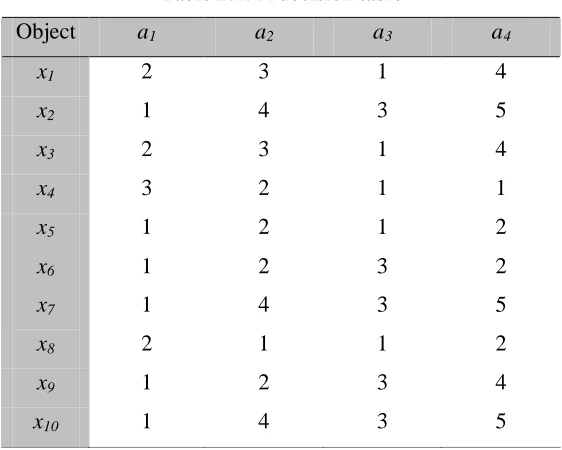
[image:26.612.143.424.365.590.2]Rough sets theory (RST), which was proposed by Pawlak [20], has been successfully applied as a feature selection method to discover data dependencies and reduce the number of attributes contained in a dataset. It involves mathematical theory that is able to deal with imprecise, uncertain and vague information [21]. At the first stage of the feature selection procedure, rough set is used to reduce and clean data with minimal model assumption. Then the result is used as a basis for further analysis performed with our proposed method. Rough set has been proven as an efficient tool for feature selection as it does not require any preliminary or additional knowledge except for the supplied data.
Table 2.1. A decision table
Object a1 a2 a3 a4
x1 2 3 1 4
x2 1 4 3 5
x3 2 3 1 4
x4 3 2 1 1
x5 1 2 1 2
x6 1 2 3 2
x7 1 4 3 5
x8 2 1 1 2
x9 1 2 3 4
x10 1 4 3 5
14
the decision attribute, while the rest of the attributes are the condition attributes. Some basic concepts of rough set are explained below.
The information system of a decision table is defined as a tuple T = (U, A), where U is a non-empty set of finite objects (the universe) and A is a non-empty finite set of attributes. As in Table 2.1, the information table assigns an object x to the universe U with U = {x1, x2,….., x10}. Whereas each attribute or feature a A is associated with a set a of its value denoted as A = {a1, a2,…., a4}. It is called the domain of a. The attribute set A can be partitioned into two subsets, C and D, which are called condition and decision attributes, respectively.
For a subset of attributes R A, the R-indiscernibility relation is denoted by IND(R), is an equivalence relation defined as:
)}
(
)
(
,
:
)
,
{(
)
(
R
x
y
U
U
a
R
a
x
a
y
IND
Eq. 1where a(x) denotes the value of feature a of object x. If (x,y) IND(R), x and y are said to be indiscernible with respect to R. The family of all equivalence classes of IND(R) is denoted by U/IND(R). Each element in U/IND(R) is a set of indiscernible
objects with respect to R. Equivalence classes U/IND(C) and U/IND(D) are called condition and decision classes. According to the objects from the example in Table 2.1, we consider the full set of attributes A = {a1, a2, a3, a4} and the sets of U/IND(R) can be listed as U/IND(R) = {{x1, x3},{x2, x7, x10},{x4},{x5},{x6},{x8},{x9}}.
15
Eq. 2. The upper approximation of X is the set of elements of U that are possibly in X is defined as in Eq. 3.
} : ) ( / { )
(X E U IND R E X
R Eq. 2
} : ) ( / { )
(X EU IND R EX
R Eq. 3
Consider the target set X = {x1, x2, x3, x4}, therefore the lower approximation and R-upper approximation can be represented as RX {x1,x3,x4}and
} , , , , ,
{x1 x3 x4 x2 x7 x10 X
R , respectively. Let R and S be equivalence relations over U, then the positive, negative and boundary regions can be defined as:
S U XR S RX
POS / ) (
S U XR S U RX
NEG / ) (
S U X S U XR S R X R X
BND / / ) ( ) ( ) (
The positive region, POSR(S) is a set of objects of U that can be classified with certainty to classes U/IND(S) employing attributes of R. The negative region NEGR(S), is the set of all elements U that cannot be classified to classes of U/S. On
the other hand, the boundary region BNDR(S) is the set of all elements that can be possibly, but not certainly, classified in this way. If the boundary region is empty, that
16
Another important issue in data analysis is discovering dependencies between attributes. Let R and S be subsets of A. We will say that S depends on R in a degree k (0 k 1), denoted R kS if
| |
| ) ( | ) (
U S POS S
kR R Eq. 4
If k = 1, S depends totally on R, and if k < 1, S depends partially on R, and if k = 0, then S does not depend on R. In other words, S depends totally (partially) on R, if all (some) elements of the universe U can be surely classified to blocks of the partition U/S employing R [14]. Dependency degree k can be used as heuristic in greedy
algorithms to compute feature reduction.
The reduction of attributes is achieved by comparing equivalence relations generated by a set of attributes. Let A = (U, C D) be a decision table where C is the set of condition features, and D is the set of decision features. The degree of dependency between condition and decision features, R(D), is called the equality of approximation of classification induced by the set of decision features [22]. The aim of feature reduction is to remove redundant features so that the reduced set provides the same quality of classification as the original set. A reduct is defined as a subset of minimal cardinality Rmin of the conditional attribute set C in such a way that R C is said to be a D-reduct of C if R(D) = C(D). A given decision table may have many feature reducts, thus the set of all reducts is defined in Eq. 5.
)} ( ) ( , )
( ) ( | {
17
For instance, suppose that C = {a1, a2, a3, a4}, R1 = {a2, a3, a4} and R2 = {a1, a2, a4}. As a reduct is the minimal set of attributes preserving the positive region such that
) ( ) (
1 D C D
R
and ( ) ( )
2 D C D
R
, then Red = {{a2, a3, a4}, {a1, a2, a4}}.
The intersection of all the sets in Rmin is called the core. The core is the set of attributes that are contained by all reducts, defined as
) ( )
(C RED C
CORED D where REDD(C)is the D-reduct of C. In other words, the core is the set of attributes that cannot be removed without changing the positive region. This means that all attributes present in the core are indispensable. Therefore, from the above example of Red, we conclude that core (C) = {a2, a4}.
18
number of features from the original set, IDSRS could improve the computation speed when compared with the original PSO.
2.2. Data Mining Overview
In practice, the two primary goals of data mining tend to be prediction and description. Prediction involves using some variables or fields in the dataset to predict
unknown or future values of other variables of interest. On the other hand, description emphasises finding patterns describing the data that can be interpreted by humans. The goal of predictive data mining is to produce a model expressed as an executable code which can be used to perform data mining tasks such as classification, prediction or other similar tasks. On the other hand, the goal of descriptive data mining is to gain an understanding of the analysed system by uncovering patterns and relationships in large datasets. Thus, the goals of prediction and description are achieved by using data mining techniques to solve data mining problems by realising several data mining tasks such as data classification, estimation, prediction, and association rules. The following section particularly focuses on data classification, which is our main consideration in this thesis.
2.2.1. Classification Task in Data Mining
19
specific attribute called a class attribute. The goal of the classification algorithm is to induce a model so that it can classify any new instances into classes according to class values. Data classification can be divided into two categories: unsupervised classification and supervised classification.
i. Unsupervised classification: A method of unsupervised classification uses only the matrix of dissimilarity. No information of the class of an object is provided to the method. The objective is then to build a set of groups where each group contains a set of sufficiently similar objects. The number of classes and their contents are not known at the beginning. In data mining, unsupervised classification is also known as clustering [1]. Clustering divides the data into groups of similar objects and each group consists of objects that are similar between themselves and dissimilar to objects of other groups. There are many clustering algorithms that exist such as hierarchical clustering, K-Means clustering, Fuzzy C-Means clustering and many more. The two most popular classes of clustering algorithms are K-Means and Fuzzy C-Means (FCM) [27].
20
In this section we are interested in the problem of supervised classification, therefore, the application of unsupervised classification in data mining will not be discussed in further detail. Support Vector Machines, kNearest Neighbor, Decision Tree (i.e.: PART and J48) and Naive Bayes classifiers are in the group of supervised classification and they have been used as state-of-the-art benchmarking classifiers throughout this thesis. The next sections, section 2.2.2.1 to section 2.2.2.4, will briefly describe the basic principle for each of the supervised classifiers and their applications in data classification problems.
2.2.2. Traditional Data Classification Methods
2.2.2.1. Support Vector Machines Classifier
Support Vector Machines (SVMs) are a group of supervised learning methods that can be applied to classification or regression. Theoretically, SVM is a well-motivated algorithm that is based on the statistical learning proposed by Vapnik [28]. SVM has shown promising empirical good performance and successful application in many fields such as bioinformatics, text categorisation, speaker verification, handwritten digit recognition, face detection, engineering and science, financial market evaluation [29], pattern recognition [30], image recognition [31] and many more. SVM has received overwhelming attention as a classification technique from diverse research communities due to its suitability, and works very well with high-dimensional data as well as avoiding the curse of the dimensionality problem [32].
21
lead to the degradation of the classification performance. In order to improve the outlier sensitivity problem of standard SVM for two-class data classification, Yang et al. [33] introduced Weighted Support Vector Machine (WSVM). Different weights generated by Kernel-based Possibilistic C-Means (KPCM) are assigned to different data points such that WSVM learns the decision surface according to the relative importance of the data point in the training set. Furthermore, the training example is usually non-fuzzy where the output is either 1 or 0. However, due to the noise and error of measurement, the training examples are usually uncertain (fuzzy) [34]. Ji et al. [35] introduced the concept of fuzzy linear separable and approximately fuzzy linear separable for training two-class classification. Other works that related to fuzzy training data sets are also presented by Kikuchi and Abe [36] and Lin and Wang [37].
22
SVM was originally designed for binary classification in order to construct an optimal or maximal hyperplane so that the margin of separation between the negative and positive dataset will be maximised. There are many hyperplanes that might classify the data. The best hyperplane is chosen based on the one that represents the largest separation, or margin, between the two classes. So we chose the hyperplane so that the distance from it to the nearest data point on each side is maximised. Figure 2.1 illustrates how SVM finds the unique hyperplane having the maximum margin of linearly separable classes of objects denoted with .
[image:35.612.176.441.307.469.2]
Figure 2.1. Maximum margin hyperplane denoted with for linearly separable case [40]
SVM works by mapping the input vectors into a higher dimensional feature space and then obtains the optimal separating hyperplane in the higher dimensional feature space. As depicted in Figure 2.1, two objects from class +1 – defined by the hyperplane H1 – and three objects from class -1 – defined by hyperplane H2 which were represented inside the circle – are called support vectors. For classification problems, SVM plots the training vectors in the high-dimensional feature space, and labels each vector by its class. SVM classifies data by determining a set of support
H1
H2 +1 +1
+1 +1 +1 +1
+1 +1 -1 -1 -1 -1 -1 -1 -1 -1 -1 +1
+1
-1
-1
-1
23
vectors, which are members of the set of training inputs that outline the maximum margin hyperplane in the feature space.
A binary classification problem to find a maximal margin classifier in SVM is presented as the following explanation. Suppose we are given some training data N where each training data is denoted by a pair of (xi,ci). Each xi is a real number with xi = (xi1, xi2,…, xid)T corresponds to the attribute set for the ith training data, and i = (1, 2, …, N). Each object xi belongs to a class ci{-1,+1}. Any hyperplane can be written in the following form:
w . xi + b = 0, Eq. 6
[image:36.612.134.502.405.591.2]where w and b are parameters of the model. A training set of objects is linearly separable if at least one linear classifier exists defined by the pair (w,b), which correctly classifies all training data as shown in Figure 2.2.
Figure 2.2. The classification hyperplane which defines two linear separable classes in +1 region and -1 region [40]
As the objective of training SVM is to find a pair of (w,b) with the largest margin, the parameters are subject to the following two constraints:
+1 +1
+1 +1
+1
+1
+1
-1 -1
-1 -1
-1 -1
-1 -1
-1 H
w . xi + b = 0 w . xi + b > 0
w . xi + b < 0
w
24 w . xi + b > 0, if ci = 1
w . xi + b < 0 if ci = -1
Eq. 7
In this case, w and b in Eq. 7 can be rewritten in a more compact form as below:
ci(w . xi + b) 1, i = 1, 2,…, N Eq. 8
The margin separation between these two hyperplanes is defined by (w,b) is w2 and
therefore we want to minimise w , where w is the norm of the vector w. However,
it is difficult to solve the optimization problem as it depends on w that involves square roots, which is known as a convex optimization problem. Hence, the Lagrange
multiplier is used by substituting w with 2 2 1
w without changing the solution.
Combining the Lagrange multiplier with Eq. 8 produces dual formulation of the optimization as in the following equation:
1 , . 2 1 j i j i j i j i N i iD cc x x
L , Eq. 9
where i 0 and under constraint
N I i i c 1 0 .
150
REFERENCES
[1] I. H. Witten and E. Frank, Data Mining: Practical Machine Learning Tools and Techniques, Second ed. San Fransisco: Morgan Kaufmann, 2005.
[2] J. Han and M. Kamber, Data Mining: Concepts and Techniques. San Fransisco: Morgan Kaufmann, 2001.
[3] U. Fayyad, G. Piatetsky-Shapiro, and P. Smyth, "The KDD Process for Extracting Useful Knowledge from Volumes of Data," Communication of the ACM, vol. 39, no. 11, pp. 27-34, Nov. 1996.
[4] C. Grosan, A. Abraham, and M. Chris, "Swarm Intelligence in Data Mining," In: A. Abraham, C. Grosan, and V. Ramos, (Eds) Studies in Computational Intelligence, vol. 34, pp. 1-20, Springer-Verlag: Berlin Heidelberg, 2006. [5] R. C. Eberhart and Y. Shi, "Particle swarm optimization: developments,
applications and resources," in Proceedings of the 2001 Congress on Evolutionary Computation, Seoul, South Korea, May 27-30, vol. 1, pp. 81-86, 2001.
[6] T. Sousa, A. Silva, and A. Neves, "Particle Swarm based Data Mining Algorithms for classification tasks," Parallel Computing, vol. 30, no. 5-6, pp. 767-783, May/June 2004.
[7] G. Chen, Q. Chen, and W. Guo, "A PSO-based approach to rule learning in network intrusion detection," In: B. Y. Cao (Ed) Advances in Soft Computing, vol. 40, pp. 666-673, Springer: Berlin-Heidelberg, 2007.
[8] S. H. Zahiri and S. A. Seyedin, "Swarm intelligence based classifiers," Journal of the Franklin Institute, vol. 344, no. 5, pp. 362-376, Aug. 2007.
[9] I. Guyon and A. Elisseeff, "An introduction to variable and feature selection," The Journal of Machine Learning Research, vol. 3, pp. 1157 - 1182, Mar. 2003.
[10] R. Jensen and Q. Shen, "Fuzzy-Rough Sets Assisted Attribute Selection," IEEE Transactions on Fuzzy Systems, vol. 15, no. 1, pp. 73-89, Feb. 2007.
[11] H. Liu and L. Yu, "Toward integrating feature selection algorithms for classification and clustering," IEEE Transactions on Knowledge and Data Engineering, vol. 17, no. 4, pp. 491-502, Apr. 2005.
151
[13] J. S. Deogun, S. K. Choubey, V. V. Raghavan, and H. Sever, "Feature selection and effective classifiers," Journal of the American Society for Information Science, vol. 49, no. 5, pp. 423-434, Apr. 1998.
[14] X. Wang, J. Yang, X. Teng, W. Xia, and R. Jensen, "Feature Selection Based on Rough Sets and Particle Swarm Optimization," Pattern Recognition Letters, vol. 28, no. 4, pp. 459-471, Mar. 2007.
[15] L. Ke, Z. Fenga, and Z. Rena, "An efficient ant colony optimization approach to attribute reduction in rough set theory " Pattern Recognition Letters, vol. 29, no. 9, pp. 1351-1357, July 2008.
[16] R. Bello, Y. Gomez, A. Nowe, and M. M. García, "Two step particle swarm optimization to solve the feature selection problem," in Proceedings of The 7th International Conference on Intelligent Systems Design and Applications, Rio de Janeiro, Brazil, Oct. 22-24, pp. 691-696, 2007.
[17] C. S. Yang, L. Y. Chuang, J. C. Li, and C. H. Yang, "Chaotic maps in binary particle swarm optimization for feature selection," in Proceedings of the 2008 IEEE Conference on Soft Computing on Industrial Applications, Muroran, Japan, June 25-27, pp. 107-112, 2008.
[18] Y. Chen, D. Miaoa, and R. Wanga, "A rough set approach to feature selection based on ant colony optimization," Pattern Recognition Letters, vol. 31, no. 3, pp. 226-233, Feb. 2010.
[19] C. Bae, W. C. Yeh, Y. Y. Chung, and S. L. Liu, "Feature selection with Intelligent Dynamic Swarm and Rough Set " Expert Systems with Applications, vol. 37, no. 10, pp. 7026-7032, Oct. 2010.
[20] Z. Pawlak, "Rough sets," Internat. J. Comput. Inform. Sci, vol. 11, no. 5, pp. 341-356, 1982.
[21] Z. Pawlak, Rough Sets, Theoretical Aspects of Reasoning about Data. Boston, MA: Kluwer Academic Publishers, 1991.
[22] Z. Pawlak, "Rough set approach to knowledge-based decision support," European Journal of Operational Research, vol. 99, no. 1, pp. 48-57, May 1997.
[23] L. Pan, H. Zheng, and L. Li, "A Hybrid Feature Selection Approach Based on the Bayesian Network Classifier and Rough Set," in LNAI, vol. 5009, pp. 707-714, Springer-Verlag: Berlin Heidelberg, 2008.
152
[25] M. M. Wa'el, H. N. Agiza, and E. Radwan, "Intrusion Detection Using Rough Set Parallel Genetic Programming Based Hybrid Model," International Journal of Computer Science and Network Security, vol. 9, no. 10, pp. 23-33, Oct. 2009.
[26] X. Wang, J. Yang, R. Jensen, and X. Liu, "Rough Set Feature Selection and Rule Induction for Prediction of Malignancy Degree in Brain Glioma," Computer Methods and Programs in Biomedicine, vol. 83, pp. 147-156, 2006.
[27] D. Karaboga and C. Ozturk, "Fuzzy clustering with artificial bee colony algorithm," Scientific Research and Essays, vol. 5, no. 14, pp. 1899-1902, July 2010.
[28] V. N. Vapnik, Statistical Learning Theory. New York: John Wiley, 1998. [29] S. T. Li, W. Shiue, and M. H. Huang, "The evaluation of consumer loans
using support vector machines," Expert Systems with Applications, vol. 30, no. 4, pp. 772–782, May 2006.
[30] Y. C. Wu, Y. S. Lee, and J. C. Yang, "Robust and efficient multiclass SVM models for phrase pattern recognition," Pattern Recognition Letters, vol. 41, no. 9, pp. 2874-2889, Sept. 2008.
[31] H. A. Park and K. R. Park, "Iris recognition based on score level fusion by using SVM," Pattern Recognition Letters, vol. 28, no. 15, pp. 2019-2028, Nov. 2007.
[32] P. N. Tan, M. Steinbach, and V. Kumar, Introduction to Data Mining: Pearson Addison Wesly, 2006.
[33] X. Yang, Q. Song, and Y. Wang, "A weighted support vector machine for data classification," International Journal of Pattern Recognition and Artificial Intelligence, vol. 21, no. 5, pp. 961-976, Aug. 2007.
[34] J. T. Jeng, C. C. Chuang, and S. F. Su, "Support vector interval regression networks for interval regression analysis," Fuzzy Sets and Systems, vol. 138, no. 2, pp. 283-300, Sept. 2003.
[35] A. b. Ji, J. h. Pang, and H. j. Qiu, "Support vector machine for classification based on fuzzy training data " Expert Systems with Applications, vol. 37, no. 4, pp. 3495-3498, Apr. 2010.
[36] T. Kikuchi and S. Abe, "Comparison between error correcting output codes and fuzzy support vector machines," Pattern Recognition Letters, vol. 26, pp. 1937-1945, 2005.
153
[38] O. L. Mangasarian and E. W. Wild, "Multisurface proximal support vector classification via generalized eigenvalues.," IEEE Transactions on Pattern Analysis and Machine Intelligence, vol. 28, no. 1, pp. 69-74, 2006.
[39] Jayadeva, R. Khemchandani, and S. Chandra, "Twin support vector machines for pattern classification," IEEE Transactions on Pattern Analysis and Machine Intelligence, vol. 29, no. 5, pp. 905-910, 2007.
[40] O. Ivanciuc, "Applications of Support Vector Machines in Chemistry," In: Reviews in Computational Chemistry, vol. 23, pp. 291-400, 2007.
[41] S. W. Fei, M. J. Wang, Y. B. Miao, J. Tu, and C. L. Liu, "Particle swarm optimization-based support vector machine for forecasting dissolved gases content in power transformer oil," Energy Conversion and Management, vol. 50, no. 6, pp. 1604-1609, June 2009.
[42] M. K. Markey, G. D. Tourassi, and C. E. Floyd, "Decision tree classification of proteins identified by mass spectrometry of blood serum samples from people with and without lung cancer," Proteomics, vol. 3, pp. 1678-1679, 2003.
[43] M. A. Karaolis, J. A. Moutiris, D. Hadjipanayi, and C. S. Pattichis, "Assessment of the Risk Factors of Coronary Heart Events Based on Data Mining With Decision Trees," IEEE Transactions on Information Technology in Biomedicine, vol. 14, no. 3, pp. 559 - 566, 2010.
[44] D. E. van de Vlag and A. Stein, "Incorporating Uncertainty via Hierarchical Classification Using Fuzzy Decision Trees," IEEE Transactions on Geoscience and Remote Sensing, vol. 45, no. 1, pp. 237 - 245, 2007.
[45] P. C. Chang, C. Y. Fan, and W. Y. Dzan, "A CBR-based fuzzy decision tree approach for database classification," Expert Systems with Applications, vol. 37, no. 1, pp. 214-225, 2010.
[46] Y. Song, W. H. Wang, and F. J. Guo, "Feature extraction and Classification for Audio Information in News Video," in Proceedings of the 2009 International Conference on Wavelet Analysis and Pattern Recognition, Baoding, July 12-15, pp. 43-46, 2009.
[47] D. Tjondronegoro and Y. P. P. Chen, "Using decision-tree to automatically construct learned-heuristics for events classification in sports video," in Proceedings of the IEEE International Conference on Multimedia and Expo, ICME 2006, pp. 1465-1468, 2006.
154
[49] E. Frank and I. H. Witten, "Generating Accurate Rule Sets Without Global Optimization," in Proceedings of the Fifteenth International Conference on Machine Learning, pp. 144 - 151, 1998.
[50] J. R. Quinlan, C4.5: Programs for Machine Learning. San Mateo: Morgan Kaufmann, 1993.
[51] S. R. Safavian and D. Landgrebe, "A survey of decision tree classifier methodology," IEEE Transactions on Systems, Man and Cybernetics, vol. 21, no. 3, pp. 660-674, May-June 1991.
[52] D. W. Aha, D. Kibler, and M. K. Albert, "Instance-Based Learning Algorithms," Machine Learning, vol. 6, pp. 37-66, 1991.
[53] T. M. Mitchell, Machine Learning: McGraw-Hill, 1997.
[54] Z. Xie, W. Hsu, Z. Liu, and M. Lee, "SNNB: A selective neighborhood based naive bayes for lazy learning," in Proceedings of the Sixth Pacific-Asia Conference on KDD, pp. 104–114, 2002.
[55] Y. Song, J. Huang, D. Zhou, H. Zha, and C. L. Giles, "IKNN: Informative K-Nearest Neighbor Pattern Classification," in LNCS, Knowledge Discovery in Databases: PKDD, vol. 4702, pp. 248-264, 2007.
[56] L. Baoli, Y. Shiwen, and L. Qin, "An improved k-nearest neighbor algorithm for text categorization," in Proceedings of the 20th international conference on computer processing of oriental languages, 2003.
[57] X. P. Yu and X. G. Yu, "Novel text classification based on K-nearest neighbor," in Proceedings of the Sixth International Conference on Machine Learning and Cybernetics, ICMLC 2007, vol. 6, pp. 3425-3430, 2007.
[58] K. Q. Weinberger and L. K. Saul, "Fast solvers and efficient implementations for distance metric learning," in Proceedings of ACM International Conference, vol. 307, pp. 1160–1167, 2008.
[59] G. H. John and P. Langley, "Estimating continuous distributions in Bayesian classifiers," in Proceedings of the Eleventh Conference on Uncertainty in Artificial Intelligence, San Mateo, pp. 338-345, 1995.
[60] I. Rish, "An empirical study of the naive Bayes classifier," IBM Research Division, NY RC 22230 (W0111-014), Nov. 2, 2001.
155
[62] J. Yu, F. Cheng, H. Xiong, W. Qu, and X. Chen, "A Bayesian approach to support vector machines for the binary classification," Neurocomputing, vol. 72, pp. 177-185, 2008.
[63] S. B. Kim, K. S. Han, H. C. Rim, and S. H. Myaeng, "Some Effective Techniques for Naive Bayes Text Classification," IEEE Transactions on Knowledge and Data Engineering, vol. 18, no.11, pp. 1457-1466, Nov. 2006.
[64] M. L. Green and P. D. Karp, "A Bayesian method for identifying missing enzymes in predicted metabolic pathway databases," BMC Bioinformatics, vol. 5, no. 76, 2004.
[65] D. Karaboga and B. Basturk, "On the performance of artificial bee colony (ABC) algorithm," Applied Soft Computing, vol. 8, no. 1, pp. 687-697, Jan. 2008.
[66] D. Karaboga and B. Akay, "A comparative study of Artificial Bee Colony algorithm," Applied Mathematics and Computation, vol. 214, no. 1, pp. 108-132, Aug. 2009.
[67] C. Grosan and A. Abraham, "Hybrid Evolutionary Algorithms: Methodologies, Architectures, and Reviews," Studies in Computational Intelligence (SCI), vol. 75, pp. 1–17, 2007.
[68] E. Bonabeau, M. Dorigo, and G. Theraulaz, Swarm Intelligence: From natural to Artificial systems. New York: Oxford University Press, 1999.
[69] K. Shafi and H. A. Abbass, "Biologically-inspired Complex Adaptive Systems Approaches to Network Intrusion Detection," Information Security Technical Report, vol. 12, no. 4, pp. 209-217, 2007.
[70] M. Dorigo, M. Birattari, and T. Stutzle, "Ant Colony Optimization, Artificial Ants as a Computational Intelligence Technique," IEEE Computational Intelligence Magazine, vol. 1, no. 4, pp. 28-39, 2006.
[71] G. C. Luh and C. H. Chueh, "A multi-modal immune algorithm for the job-shop scheduling problem," Information Sciences, vol. 179, no. 10, pp. 1516 - 1532, Apr. 2009.
[72] D. Karaboga, "An idea based on honey bee swarm for numerical optimization," Technical Report TR06, Erciyes University, Engineering Faculty, Computer Engineering Department, 2005.
156
[74] H. Samarghandi, P. Taabayan, and F. F. Jahantigh, "A particle swarm optimization for the single row facility layout problem," Computers and Industrial Engineering, vol. 58, no. 4, pp. 529-534, May 2010.
[75] J. H. Holland, Adaptation in Natural and Artificial Systems. Ann Arbor, MI: University of Michigan Press, 1975.
[76] D. E. Goldberg, Genetic algorithm in search optimization and machine learning. Reading, MA: Addison-Wesley, 1989.
[77] M. A. Abed, A. N. Ismail, and Z. M. Hazi, "Pattern recognition Using Genetic Algorithm," International Journal of Computer and Electrical Engineering,, vol. 2, no. 3, pp. 1793-8163, June 2010.
[78] M. Wall. Introduction to Genetic Algorithms. Available: http://lancet.mit.edu/~mbwall/presentations/IntroToGAs/index.html, Access on: Aug. 16, 2010.
[79] M. Dorigo and G. D. Caro, "Ant Coloy Optimization: A New Meta-Heuristic," in Proceedings of Congress of Evolutionary Computing, pp. 1470-1477, 1999. [80] W. C. Yeh, W. W. Chang, and Y. Y. Chung, "A new hybrid approach for
mining breast cancer pattern using discrete particle swarm optimization and statistical method," Expert System with Applications, vol. 36, no. 4, pp. 8204 - 8211, May 2009.
[81] T. C. Chen and T. C. Hsu, "A GAs based approach for mining breast cancer pattern," Expert System with Applications, vol. 30, no. 4, pp. 674-681, May 2006.
[82] M. H. Tseng and H. C. Liao, "The genetic algorithm for breast tumor diagnosis - The case of DNA viruses," Applied Soft Computing, vol. 9, no. 2, pp. 703–710, Mar. 2009.
[83] M. H. Tseng, S. J. Chen, G. H. Hwang, and M. Y. Shen, "A genetic algorithm rule-based approach for land-cover classification," ISPRS Journal of Photogrammetry & Remote Sensing, vol. 63, no. 2, pp. 202-212, 2008.
[84] M. Dorigo, V. Maniezzo, and A. Colorni, "Ant system: optimization by a colony of cooperating agents," IEEE Transactions on Systems, Man, and Cybernetics, Part B: Cybernetics, vol. 26, no. 1, pp. 29-41, Feb. 1996.
[85] Ant Colony Optimization. Available:
http://en.wikipedia.org/wiki/Ant_colony_optimization, Access on: July 2010. [86] M. Dorigo and T. Stützle, The Ant Colony Optimization Metaheuristic:
157
[87] D. Karaboga, "Artificial bee colony algorithm," Scholarpedia, 5(3):6915, 2010.
[88] J. Kennedy and R. Eberhart, "Particle swarm optimization," in Proceedings of the 1995 IEEE International Conference on Neural Networks. Part 4 (of 6) Perth, Aust, Nov. 27 - Dec. 1, vol. 4, pp. 1942-1948, 1995.
[89] X. Li and A. P. Engelbrecht, "Particle Swarm Optimization - an introduction and its recent developments," in GECCO 2007 Tutorial, Access on: July 29, 2010.
[90] H. Liu, A. Abraham, and W. Zhang, "A fuzzy adaptive turbulent particle swarm optimisation," International Journal of Innovative Computing and Applications, vol. 1, no. 1, pp. 39-47, Apr. 2007.
[91] F. van den Bergh, "An Analysis of Particle Swarm Optimizers," PhD Thesis, Department of Computer Science, University of Pretoria, South Africa, 2002. [92] D. W. van der Merwe and A. P. Engelbrecht, "Data clustering using particle
swarm optimization," in Proceedings of the 2003 Congress on Evolutionary Computation CEC '03, vol. 1, pp. 215 - 220, 2003.
[93] R. Poli, J. Kennedy, and T. Blackwell, "Particle swarm optimization An overview," Swarm Intelligence, vol. 1, pp. 33-57, 2007.
[94] M. Montes de Oca, T. Stützle, M. Birattari, and M. Dorigo, "Frankenstein’s PSO: A composite particle swarm optimization algorithm," IEEE Transactions on Evolutionary Computation, vol. 13, no. 5, pp. 1120–1132, 2009.
[95] J. Kennedy and R. C. Ebehart, "A discrete binary version of the particle swarm algorithm," in Proceedings of the 1997 IEEE International Conference on Systems, Man, and Cybernetics. Part 5 (of 5), Orlando, FL, United States, Oct. 12-15, pp. 4104-4108, 1997.
[96] Y. Shi and R. Eberhart, "A modified particle swarm optimizer," in Evolutionary computation Proceedings. IEEE World congress on computational intelligence, pp. 69-73, 1998.
[97] M. Clerc and J. Kennedy, "The particle swarm-explosion, stability, and convergence in a multidimensional complex space," IEEE Transactions on Evolutionary Computation, vol. 6, no. 1, pp. 58–73, 2002.
[98] R. Mendes, J. Kennedy, and J. Neves, "The fully informed particle swarm: simpler, maybe better," IEEE Transactions on Evolutionary Computation, vol. 8, no. 3, pp. 204–210, 2004.
158
functions," IEEE Transactions on Evolutionary Computation, vol. 10, no. 3, pp. 281–295, 2006.
[100] B. Alatas and E. Akin, "Multi-objective rule mining using genetic algorithms " Knowledge-Based Systems, vol. 22, no. 6, pp. 455-460, Aug. 2009.
[101] F. Du, W. Shi, L. Chen, Y. Deng, and Z. Zhu, "Infrared image segmentation with 2-D maximum entropy method based on particle swarm optimization (PSO)," Pattern Recognition Letters, vol. 26, no. 5, pp. 597-603, Apr. 2005. [102] Z. Lian, X. Gu, and B. Jiao, "A similar particle swarm optimization algorithm
for permutation flowshop scheduling to minimize makespan," Applied Mathematics and Computation, vol. 175, no. 1, pp. 773-785, Apr. 2006.
[103] I. D. Falco, A. D. Cioppa, and E. Tarantino, "Facing classification problems with Particle Swarm Optimization," Applied Soft Computing, vol. 7, no. 3, pp. 652-658, June 2007.
[104] Z. Chang and W. W. Ping, "An improved PSO-based rule extraction algorithm for intrusion detection," in Proceedings of the 2009 International Conference on Computational Intelligence and Natural Computing, Wuhan, China, June 6-7, pp. 56-58, 2009.
[105] A. Asuncion and D. J. Newman, UCI Machine Learning Repository. Available: http://www.ics.uci.edu/~mlearn/MLRepository.html, Access on: 2007
[106] S. X. Wu and W. Banzhaf, "The use of computational intelligence in intrusion detection systems: A review," Applied Soft Computing Journal, vol. 10, no. 1, pp. 1-35, Jan. 2010.
[107] T. Sousa, A. Neves, and A. Silva, "Swarm Optimisation as a New Tool for Data Mining," in Proceedings of the International Parallel and Distributed Processing Symposium (IPDPS'03), Nice, France, Apr. 22-23, 2003.
[108] S. T. Li, C. C. Chen, and J. W. Li, "A multi-objective particle swarm optimization algorithm for rule discovery," in Proceedings of the 3rd International Conference on Intelligent Information Hiding and Multimedia Signal Processing, IIHMSP 2007, Kaohsiung, Taiwan, pp. 597-600, 2007.
[109] Z. Wang, X. Sun, and D. Zhang, "A PSO-based classification rule mining algorithm," in LNCS. vol. 4682 LNAI, pp. 377-384, Heidelberg: Springer Verlag, 2007.
![Figure 1.1. The processes of KDD [3]](https://thumb-us.123doks.com/thumbv2/123dok_us/8779536.903410/16.612.112.519.158.295/figure-the-processes-of-kdd.webp)
![Figure 2.1. Maximum margin hyperplane denoted with for linearly separable case [40]](https://thumb-us.123doks.com/thumbv2/123dok_us/8779536.903410/35.612.176.441.307.469/figure-maximum-margin-hyperplane-denoted-linearly-separable-case.webp)
![Figure 2.2. The classification hyperplane which defines two linear separable classes in +1 region and -1 region [40]](https://thumb-us.123doks.com/thumbv2/123dok_us/8779536.903410/36.612.134.502.405.591/figure-classification-hyperplane-defines-linear-separable-classes-region.webp)
