Journal of Chemical and Pharmaceutical Research
ISSN No: 0975-7384 CODEN(USA): JCPRC5
J. Chem. Pharm. Res., 2010, 2(5): 67-74
67
Preparation of Stable Zero Valent Iron Nanoparticles using
Different Chelating Agents
$
Murad Basha Allabaksh, $,*Badal Kumar Mandal, $Mohan Kumar Kesarla
$$
Koppala Siva Kumar and $$Pamanji Sreedhara Reddy
$
Trace Element Speciation Research Laboratory, Environmental and Analytical Chemistry Division, School of Advanced Sciences, VIT University, Vellore, India
$$
Department of Physics, Sri Venkateswara University, Tirupati, India
___________________________________________________________________________
ABSTRACT
Zero valent iron nanoparticle (nZVI) technology is becoming an increasingly popular choice for treatment of environmental remediation and remediation of contaminated sites as iron is inexpensive, non-toxic and environmentally compatible. Nanoparticles are attractive for remediation of various contaminants because of their unique physiochemical properties, especially its high surface area over iron filings. Still today the main problem of nZVI based remediation technology is to synthesize air stable nZVI. The present study has attempted to synthesize air stable nZVI in the presence of Ethylenediaminetetraacetic acid (EDTA), Diethylenetriamine pentacetic acid (DTPA), Nitriloacetic acid (NTA), trans-1,2-diaminocyclohexane-N,N,N’,N’-tetraacetic acid (CDTA), Hydroxyethylenediaminetetraacetic acid (HEDTA), Triethylene tetraamine (TRTA) and N-cetyl-N,N,N-trimethyl ammonium bromide (CTAB) chelating agents. Nanoparticles have been characterized by using X-ray diffraction, Scanning Electron Microscopy/Energy Dispersive X-ray Spectroscopy, Fourier Transformed IR and UV-Vis spectrometry. The chelating effect was the best for EDTA, NTA and HEDTA, but the least for CDTA and CTAB. Hydroxyl groups, lone pair electrons on nitrogen atom and steric effects of cyclohexane ring and bulky surroundings played the main role to provide air stability towards synthesized nZVI. Fourier transformed IR study showed that no peak from any chelating agent was observed in the spectrum which was supported by powder XRD study.
Keywords: Air stable nZVI, environmental remediation, chelating agent, steric effect and
SEM/EDS.
___________________________________________________________________________
INTRODUCTION
68
of oxygen is a challenging task. When this material comes in contact to air, immediately oxide formation takes place. Moreover, ignition property of nZVI makes the material difficult to handle. Typically Fe(0)-based nano particles are prepared by reducing Fe(II) or Fe(III) in an aqueous phase using sodium borohydride. Although other solvent-based methods such as micro emulsion based methods, sonication-assisted method, sol-gel methods have been reported [4], the water-based approach appears the most suitable for environmental applications, because of its minimal use of environmentally harmful solvents and chemicals. However, because of particle agglomeration, the water-based method often fails to produce the desired stable Fe nanoparticles without a stabilizer.
In order to stabilize nZVI many researchers have employed the nZVI synthesis with a wide variety of stabilizing agents, surfactants and capping agents. For example He et al. [4] reported that by using food-grade water soluble starch both the disposability and the reactivity of Fe nanoparticles were improved. But the starch stabilized Fe particles became less stable, as evidence by the appearance of floc precipitates after 2 days, thereby limiting long-term storage and commercial application of these Fe nanoparticles. Also, Niu et al. [2] used starch during the synthesis of nZVI as dispersing cum stabilizing agent and according to He et al. [5] a stock solution of Fe(II) was added to the CMC solution to prepare desired concentration of Fe and CMC. The mixture was purged with N2 for 15min to complete the
formation of the Fe-CMC complex. The Fe(II) ions were then reduced to Fe(0) using sodium borohydride to the mixture.
So, in all the traditional methods the only problem was the stability. To suppress the oxidation many methods have been developed such as vacuum drying, freeze drying and using vacuum chamber etc., which are very complicated and expensive too [6].
Therefore, the preparation of air stable nZVI is a challenge to chemists and scientists. The main objectives of the present investigation was I) to synthesize nZVI in the presence of different chelating agents such as Ethylenediaminetetraacetic acid (EDTA), Diethylenetriamine pentacetic acid (DTPA), Nitriloacetic acid (NTA), trans1,2diaminocyclohexaneN,N,N’,N’tetraacetic acid (CDTA), Hydroxyethylenediaminetetra -acetic acid (HEDTA), Triethylene tetraamine (TETA), and N-cetyl-N,N,N-trimethyl ammonium bromide (CTAB); ii) to characterize them using powder X-ray diffraction (XRD), Scanning Electron Microscopy/Energy Dispersive X-ray Spectroscopy (SEM/EDS), Fourier Transformed IR (FT-IR) and UV-Vis spectrometry and iii) to verify stability spectrophotometrically.
EXPERIMENTAL SECTION Chemicals:
All the chemicals and chelating agents used in this study such as FeSO4.7H20, Sodium
borohydride (NaBH4), Ethylenediaminetetraacetic acid (EDTA), Diethylenetriamine
69 Methodology:
Synthesis of nZVI stabilized by disodium salt of EDTA (Sample 1):
The 0.1M FeSO4 in 150ml of Milli-Q water (4.1703 g) and 0.05M EDTA in 100 ml Milli-Q
water (3.7224 g) were mixed in a three necked round bottomed flask by using propeller mixing. The 0.75M NaBH4 in 100 ml Milli-Q water (2.837 g) was added dropwise into the
mixture solution. Slowly the solution turned to black colour. The black coloured particles were washed trice with absolute ethanol and finally filtered, dried, and pulverized.
Synthesis of nZVI stabilized by DTPA (Sample 2):
The 0.1M FeSO4 in 150ml of Milli-Q water (4.1703 g) and 0.01M DTPA in 100 ml distilled
water (0.400g)(because of the solubility of DTPA in water is 0.500g/100ml) were mixed in a three necked round bottomed flask by propeller mixing. The 0.5M NaBH4 in 100 ml Milli-Q
water (1.892g) was added drop wise into the mixture solution. Slowly the solution turned to black colour. The black coloured particles were washed trice with ethanol and finally filtered, dried, and pulverized.
Synthesis of nZVI stabilized by NTA (Sample 3):
The 0.1M FeSO4 in 150ml of Milli-Q water (4.1703 g) and 6.3x10⁻³M NTA in 100 ml
Milli-Q water (0.120g)(because of the solubility of NTA in water is 0.120g/100ml) were mixed in a three necked round bottomed flask by propeller mixing. The 0.5M NaBH4 in 100 ml Milli-Q
water (1.892g) was added drop wise into the mixture solution. Slowly the solution turned to black colour. The black coloured particles were washed trice with ethanol and finally filtered, dried, and pulverized.
Synthesis of nZVI stabilized by CDTA (Sample 4):
The 0.1M FeSO4 in 150ml of Milli-Q water (4.1703 g) and 0.05mM NTA in 100 ml Milli-Q
water (0.2mg)(because of the solubility of CDTA in water is very difficult to overcome this the solution was heated in water bath for about 1/2h, the substance was dissolved. The solution was kept aside for 3 h, no residue was formed) were mixed in a three necked round bottomed flask by using propeller mixing. A 0.5M NaBH4 in 100 ml distilled water (1.892g)
was added drop wise into the mixture solution. Slowly the solution turned to black colour. The black coloured particles were washed trice with ethanol and finally filtered, dried, and pulverized.
Synthesis of nZVI stabilized by HEDTA (Sample 5):
The 0.1M FeSO4 in 150ml of Milli-Q water (4.1703 g) and 0.1M HEDTA in 100 ml Milli-Q
water (because of the solubility of HEDTA in water is very easy) were mixed in a three necked round bottomed flask by propeller mixing. A 0.5M NaBH4 in 100 ml Milli-Q water
(1.892g) was added drop wise into the mixture solution. Slowly the solution turned to black colour. The black colored particles were washed trice with ethanol and finally filtered, dried, and pulverized.
Synthesis of nZVI stabilized by TETA (Sample 6):
The 0.1M FeSO4 in 150ml of Milli-Q water (4.1703 g) and 0.05M TETA in 100 ml Milli-Q
water (TETA was dissolved in water) were mixed in a three necked round bottomed flask by propeller mixing. A 0.5M NaBH4 in 100 ml Milli-Q water (1.892g) was added drop wise into
70 Synthesis of nZVI stabilized by CTAB (Sample 7):
The 0.1M FeSO4 in 150ml of Milli-Q water (4.1703 g) and 0.5M NTA in 100 ml Milli-Q
water (CTAB was dissolved in water) were mixed in a three necked round bottomed flask by propeller mixing. A 0.5M NaBH4 in 100 ml Milli-Q water (1.892g) was added drop wise into
the mixture solution. Slowly the solution turned to black colour. The black coloured particles were washed trice with ethanol and finally filtered, dried, and pulverized.
Stability study by UV-Visible Spectroscopy
The 2 mg of nZVI sample and 10 ml absolute ethanol were taken in a test tube and kept for sonication for about 7 hrs. After that, the wavelength at maximum absorbance was measured using UV-Vis Spectroscopy. And after 30 days using same sample and same procedure wave length was noted down at maximum absorbance. The results were compared with that of the known commercial nZVI.
Characterization:
The black coloured solid nZVI samples stabilised by 7 different chelating agents were characterized using powder XRD, SEM/EDS, FT-IR (Avatar-330, Thermonicolet, USA) and UV-Vis spectrometry (UV-1601, Shimadzu, Japan). Powder XRD analysis was done using Bruker D8 Advance Diffractometer (Bruker AXS, Germany) with Cu Kα radiation (λ= 1.54Å). XRD pattern of stabilized nZVI samples was recorded over a 2θ range of 10-90°. SEM/EDS analysis was carried out using a Carl Zeiss SEM instrument attached to EVO MA 15 (Oxford Instrument). The solid samples were sprinkled on the adhesive carbon tape which is supported on a metallic disk. The sample surface images were taken at different magnifications. Simultaneously, EDS spectrum was recorded at selected areas on the solid surface to obtain the information on surface atomic distribution and chemical composition.
RESULTS AND DISCUSSION
Zero valent iron nanoparticles (nZVI) have long been recognized as an excellent electron donor, regardless of its particle size. Size is one of the most important parameters that control the dispersion characteristics of particles [7]. The particle size of the synthesized nZVI was investigated primarily using UV-Vis spectroscopy. Normally, nanoparticles scatter visible light rather than absorption and wave length (λmax) increases with decreasing particle size. After sonication of nZVI samples for 7 hrs at room temperature λmax was determined at maximum absorbance on zero day and thirtieth day. The λmax of commercial nZVI was 363 nm at maximum absorbance which was equivalent to an average of 25 nm particles (sample no ‘0’ on the Figure 1). The UV-Vis analysis (Fig. 1) showed that particle size of nZVI synthesized in the presence of HEDTA, TETA and CTAB was about 25 nm whereas particle size of all other nZVI synthesized with other chelating agents such as EDTA, DTPA, NTA and CDTA was about in the rage of 30-45 nm (Fig. 1). There was almost no change in particle size of all nZVI after 30 days of storage at open air under ambient temperature (~28-35oC) (Fig. 1). These results clearly showed that all the synthesized nZVI using chelating agents were stable after 30 days of storage.
71
synthesized nZVI. Basically, DTPA has strong steric effect and TETA has no hydroxyl group which provided less chelating to nZVI, whereas EDTA, NTA and DTPA provided a strong chelating to nZVI using their hydroxyl groups as well as nitrogen lone pairs of electrons.
0 1 2 3 4 5 6 7
0 50 100 150 200 250 300 350 400
W
a
v
e
le
n
g
th
Sample No.
[image:5.595.168.423.132.327.2]Fresh nZVI One month old nZVI
Fig. 1: Determination of particle size of nZVI by UV-Vis study after dispersion in ethanol using sonication.
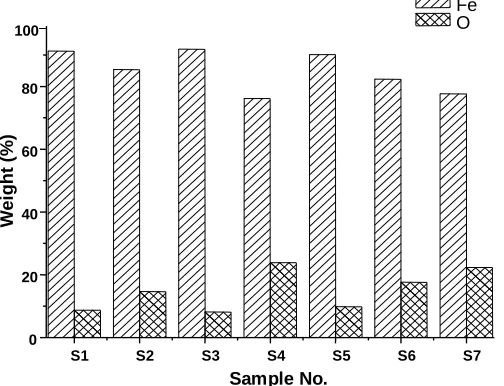
In addition, CDTA (with cyclohexane ring) and CTAB (without hydroxyl group and nitrogen lone pairs of electrons) provided minimum chelating to nZVI which was evident from low wt. percentage of 76.17% Fe and 77.65% Fe respectively (Fig. 2).
S1 S2 S3 S4 S5 S6 S7
0 20 40 60 80
W
e
ig
h
t
(%
)
Sample No.
Fe O
100
Figure 2: Atomic distribution (by wt.%) in nZVI by EDS: S1-EDTA-nZVI, S2-DTPA-nZVI, S3-NTA-nZVI, S4-CDTA-nZVI, S5-HEDTA-nZVI, S6-TRTA-nZVI and S7-CTAB-nZVI.
[image:5.595.172.424.448.641.2]72
(77.65%). Under the experimental conditions of EDS the stability of CDTA-nZVI and CTAB-nZVI was less compared to all other 5 nZVI samples. Surface morphologies of nZVI were carried out by SEM analysis and it was shown in Fig. 3S1 to Fig. 3S7. All nZVI particles were uniform in size and spherical in shape. The diameter of all nZVI was less than 200 nm (Fig. 3).
S1 S2 S3
S4 S5 S6
S7
Figure 3: SEM Images of synthesized nZVI: S1-EDTA-nZVI, S2-DTPA-nZVI, S3-NTA-nZVI, S4-CDTA-S3-NTA-nZVI, S5-HEDTA-S3-NTA-nZVI, S6-TRTA-nZVI and S7-CTAB-nZVI.
The oxidation states and phases of nZVI were checked using powder XRD (Fig. 4S1-S7). It was clear that the synthetic nZVI was in its zero valent state and no appearance of
0 10 20 30 40 50 60 70 80 90 500 550 600 650 700 750 800 In te n s it y ( a .u ) 2θθθθ
0 10 20 30 40 50 60 70 80 90 500 550 600 650 700 750 800 850 In te n s it y ( a .u ) 2θθθθ
0 10 20 30 40 50 60 70 80 90 450 500 550 600 650 700 750 In te n s it y ( a .u ) 2θθθθ
0 10 20 30 40 50 60 70 80 90 450 500 550 600 650 700 750 In te n s it y (a .u ) 2θθθθ
0 10 20 30 40 50 60 70 80 90 350 400 450 500 550 600 650 In te n s it y ( a .u ) 2θθθθ
0 10 20 30 40 50 60 70 80 90 250 300 350 400 450 500 In te n s it y ( a .u ) 2θθθθ
0 10 20 30 40 50 60 70 80 90 550 600 650 700 750 800 850 In te n s it y ( a .u ) 2θθθθ
44.1528 45.2251 44.7104
44.7498 44.4737 43.8229
44.9865
S1 S2 S3
S4 S5 S6
[image:6.595.129.409.153.401.2]S7
Figure 4: XRD patterns of synthesized nZVI: S1-EDTA-nZVI, S2-DTPA-nZVI, S3-NTA-nZVI, S4-CDTA-S3-NTA-nZVI, S5-HEDTA-S3-NTA-nZVI, S6-TRTA-nZVI and S7-CTAB-nZVI.
[image:6.595.134.438.447.692.2]73
in JCPDS (00-006-0696), indicated mainly the formation of nano iron in zero valent state. These findings supported exactly the results reported elsewhere [9-16].
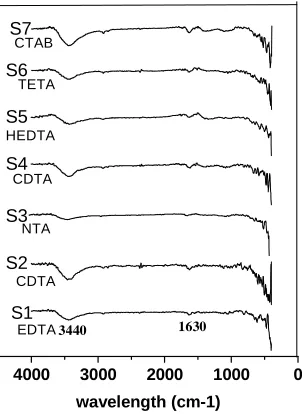
Figure 5 shows FT-IR analysis results of all nZVI samples taken after 16 months of their synthesis. Physically there was no change in colour after 16 months which indicated that no oxidation or negligible oxidation of outer surface of nZVI occurred. There was no existence of any functional group corresponding to any chelating agent used during the synthesis of nZVI except hydroxyl group at 3440 cm-1 which might appear due to partial oxidation of surface iron to lepidocrocite (FeOOH).
4000 3000 2000 1000 0
CTAB
TETA
HEDTA
CDTA
NTA
CDTA
EDTA
wavelength (cm-1)
3440 1630
S7
S6
S5
S4
S3
S2
[image:7.595.214.365.212.419.2]S1
Figure 5: FTIR spectrum of synthesized nZVI: S1-EDTA-nZVI, S2-DTPA-nZVI, S3-NTA-nZVI, S4-CDTA-nZVI, S5-HEDTA-nZVI, S6-TRTA-nZVI and S7-CTAB-nZVI.
CONCLUSION
The present study has synthesized air stable nZVI using seven different chelating agents. The stability and characterization results clearly show that the present synthesis method would be useful to synthesize and could solve long pending stability issue of nZVI for its versatile applications in environmental remediation and water purification. With the smart choice of chelating agent (s) preparation of more stable nZVI would be possible.
Acknowledgements
Mr. MBA greatly acknowledges the help of VIT University, Vellore - 632014, India for the platform given to do this research. Also, he greatly acknowledges the help of the facility generated by DST sponsored project (SR/SI/PC/13/2007).
REFERENCES
74
[3] SR Kanel; B Manning; L Charlet; H Choi. Environ. Sci. Technol., 2005, 39(5), 1291-1298.
[4] F He; D Zhao. Ind. Eng. Chem. Res., 2007, 46(1), 29-34. [5] F He; D Zhao. Environ. Sci. Technol., 2005, 39(9), 3314-3320. [6] HC Choi; ABM Giasuddin; SR Kanel. US Pat., 0 091 054 A1, 2008.
[7] BE Logan. Environmental Transport Processes, 1st Edition, John Wiley and Sons, New York, 1999; 564-613.
[8] C Uzum; T Shahwan; AE Eroglu; I Lieberwirth; TB Scott; KR Hallam. Chem. Eng. J.,
2008, 144(2), 213-220.
[9] CB Wang; WX Zhang. Environ. Sci. Technol., 1997, 31(7), 2154–2156.
[10] MD Shultz; JU Reveles; SN Khanna; EE Carpenter. J. Am. Chem. Soc., 2007, 129(9), 2482-2487.
[11] KS Lin; NB Chang; TD Chuang. Sci. Technol. Adv. Mater., 2008, 9(1), 1-9.
[12] BA Manning; JR Kiser; H Kwon; SR Kanel. Environ. Sci. Technol., 2007, 41(2), 586-592.
[13] JT Nurmi; PG Tratnyek; V Sarathy; DR Baer; JE Amonette; K Pecher; C Wang; JC Linehan; DW Matson; R Lee Penn; MD Driessen. Environ. Sci. Technol., 2005, 39(5), 1221– 1230.
[14] L Li; M Fan; RC Brown; JV Leeuwen; J Wang; W Wang; Y Song; P Zhang. Crit. Rev.
Environ. Sci. Technol., 2006, 36(5), 405–431.
[15] YQ Liu; SA Majetich; RD Tilton; DS Sholl; GV Lowry. Environ. Sci. Technol., 2005, 39(5), 1338-1345, 2005.