Journal of Chemical and Pharmaceutical Research, 2013, 5(10):141-146
Research Article
CODEN(USA) : JCPRC5
ISSN : 0975-7384
Simulation study on the influence of submergence depth on oil-well pump in
the gas oil well
Dong Kang-Xing
a, Jiang Min-zheng
aand CAO Yan-peng
ba
Northeast Petroleum University, Daqing, China
bChina Petroleum Pipeline Bureau, Langfang, China
_____________________________________________________________________________________________
ABSTRACT
In the swabbing process of pumping unit, submergence depth is the one of principal elements that affects filling degree of sucker pump. Based on the one-dimension equation of fluid into the pump, gas state equation, fill factor equation, the solving model of filling degree of pump unit is established. Writing program with Visual Basic 6.0, the calculate simulation of performance to oil-well pump is explored. The results shows: submergence depth is increased, the filling degree and pressure in the pump also are increased and transient fluid-loss is decreased.
Key words: Filling degree; Submergence depth; Gas-bearing; Oil-well pump
_____________________________________________________________________________________________
INTRODUCTION
When pump in the swabbing process, the free gas, solution gas and condensate gas exist in the pump chamber, these gases occupied a part of pump chamber volume which can reduce fullness degree of the pump, thus affecting pump fullness degree[1]. In the whole upstroke and down-stroke process only intracavity gases are expanding and compressing without liquid lifting when it's serious, then the "gas locking" [2]of pump can be appeared and can't be able to work. Submergence depth is the energy within the reservoir fluid send to the pump barrel, it directly affects the working condition of the pump[3,4]. Although the pump admission coefficient is large when submergence depth is higher, pump efficiency can be lesser increased and has the potential to reduce because of the increasing elastic expansion of sucker rod. When submergence depth is small, the pump efficiency can be also affected as pump inlet are more gas separation and pump admission coefficient is lesser[5,6].
In this paper, mathematical models of fluid into the pump are established on the basis of fluid into the pump one dimensional equation, gas state equation and admission coefficient equation, we can through the VB programming[7,8] to complete the simulation calculation of pump performance, research the influence of gas on pump efficiency under different submergence. Which can provide theoretical basis for structure optimization design of the well pump and have great significance for improving the pumping unit well system efficiency, saving energy and reducing consumption, improving the efficiency of the oil field comprehensive development .
EXPERIMENTAL SECTION
SIMULATION SECTION
One dimensional unstable flow equation of fluid into the pump
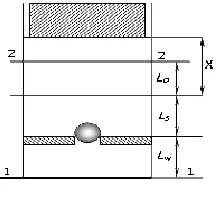
Choose the open area as shown in figure 1. end face 1-1 is located in the bottom of the pump liner, end face 2-2 is located in the liquid in the pump. Application of the actual flow instability energy equation between the end face 1-1 and 2-2. 2 2 2 2 2
1 30 1
1 ( )
2
p
l h l
m s
s w ml m v
A
dv p p v
k g l l l
dx l l l k nπ x s x ρ ρ µ A
= × − + − − − + + + + ⋅ ⋅ ⋅ − (1) ( , , , ) L L dv
f p v x L
dx = (2)
Full of coefficient equation
2 30 1 ( ) ( , ) o x L x L
L v x dx
n xs x
L f v x
π
= − = ∫
(3) / L xβ = (4)
Equation of gas pressure in the pump
At the time of t, the piston moved to x position, and the flow is L, according to the real gas state equation:
(1 )
( )
a w s
p s a a
ZTp f L L L
p R R
T B x L L
− + + = − − − l l (5) ( , , )
p= f p L x (6)
Ll
Leakage produced by wear and tear, sand, wax and corruption is difficult to calculate, according to the indicator diagram to analyze the severity of the leakage. Leakage of the new pump to work properly, generally can be calculated according to the measured loss when the pump testing, also can calculate and analyze the relationship between the leakage and the swabbing parameters according to the following formula.
pump leakage between the piston and liner:
static conditions
3
1 12
De g H
q
v l
π ∆
= ⋅ (7)
2
1 2
q =
π
DeVρ (8)When the piston upward movement
[image:2.595.242.350.76.177.2]3
1 2
1
12 2
De g H
q q q DeV
v l ρ
π ∆ π
∆ = − = ⋅ − (9)
p q L A ∆ =
l (10)
Fluid into the pump motion equations
/
( , )
( , , )
( ,
, , )
L L LL x
L
f v x
p
f p L x
dv
f p v x L
dx
β =
=
=
=
(11) Calculation methodAssume that Inside and outside differential pressure can overcome the valve ball's weight, affirm the fixed valve open and the suction process begins
(
p
h−
p
B)
A
k≥
G
(12)B h
G
p
p
A
≤
−
k (13)Before the fixed valve opening, the volume under standard condition of the gas release from the liquid inside the pump clearance volume is:
(1
)
(
)
w s pa p s
o
f
L A
V
R
R
B
−
=
−
(14)( p s)(1 w) a
o s
a B o
R R f
Tp
X Z L
T p B
− −
= (15)
Input parameters of pump
Calculate pressure inside pump Upload reservoir physical parameters
Calculate pump displacement coefficient
Yes
Save date and output Eecel
End Begin
No
Calculate gas-liquid flow parameters Input parameters of pump
unit
The theoretical formula of pump displacement coefficient in this article can calculate the movement characteristics of pump well[9],and it has a high precision, suitable for calculate the Pump performance. The semi-empirical formula of Pump displacement coefficient also has a high precision, and the computing speed is faster than the former. Its limitations is suitable for specific oil block Only, and some of the parameters need field acquisition.
RESULTS AND DISCUSSION
In this paper, using advanced programming language VB6.0 to develop the software, through input reservoir parameters and pumping unit parameters, to calculate pump displacement coefficient and other dynamic parameters. Design flow chart is as follows:
Parameters of pump performance in calculating of simulation: well depth is 1000m, stroke length is 3m, pumping speed is 9min-1, water-output is 46m3/d, oil-output is 16.88 m3/d and gas -output is 762.98 m3/d. The gas-liquid ratio is about 12 and is a fixed value. The other physical parameters of reservoir could reference the information of database. Observe the effect to parameters of pump by change the submergence depth.
Influence of submergence depth to the coefficient of fullness
The coefficient of fullness as the displacement is shown in Figure 2. As the whole variant trend of four curves in Figure 2, we can know the coefficient of fullness rapidly increase as the plunger-up and then extent reduces smoothly.
Through the contrast of four curves, the coefficient of fullness as increases the submergence depth increasing. It is that inlet pressure of pump increase along with the coefficient of fullness’ increasing. Relative to the inlet pressure of the lower submergence depth, the standing valve open earlier. Also the higher submergence depth could reduce spillover of undisclosed gas, avoid the affection of the gas to the coefficient of fullness, increase the liquid pass into pump and add the coefficient of fullness.
Influence of Sinking degree to the liquid level speed inside the pump
The relation curve of velocity and displacement of the liquid surface in the pump is shown in figure 3,It can be seen from the whole change trend of the four curve in the figure 3 that the liquid surface showed a trend of fluctuations with the change of the plunger displacement. This is because the multiphase fluid flow into the pump is an unstable process, the first half of the upstroke, the liquid surface speed in the pump increases volatility, but showed a trend of gradual decline in the second half of the upstroke as the influence of the bounces of the fixed valve ball.
F
u
ll
c
o
e
ff
ic
ie
n
t
Plunger displacement/m
Depth 85m Depth 135m Depth 235m Depth 285m
It can be seen from the curve contrast, the submergence depth, the faster of the liquid level to be the first peak in an instant of the pump valve open, This is because the increase of submergence make pump inlet pressure increases, which makes the pump liquid reaching the peak quickly. When the liquid level speed reach the peak, it is suddenly reduce and formed the first peak wave. This is because the pump pressure began to rise and then to fall lead to changes in the velocity of the liquid surface.
Influence of Sinking degree to pressure inside the pump
The curve of the pressure inside pump and the displacement is shown as Figure 4, from the overall trend of the four curves in Figure 4 can be seen that in the first half stroke of up-stroke, the pump pressure has a trend of fluctuations and in the second half of up-stroke, the pump pressure trends to be gradually smooth. This is because in the first half stroke of up-stroke, under the influence of the inertia of the liquid, the pump pressure changes significantly, thereby have a fluctuating tendency and in the second half of up-stroke, the standing valve is fully opened and traveling valve is completely closed, the pressure change inside pump is smaller, and shows a steady trend.
From the comparison of the four curves in Figure 4 it can be seen that the average pressures inside pump are different when submergence depths are different, and with the increase of submergence depth, the pump pressure increases accordingly, and can be found that while submergence depth increases, pump pressure trends to be a more stable state in the second half of up-stroke. Therefore, the liquid impact damage to the pump and valve of the gas
p
re
ss
u
re
Plunger displacement/m
Depth 85m Depth 135m Depth 235m Depth 285m
Fig4 curve of pressure inside pump and displacement
li
q
u
id
le
v
e
l
sp
e
e
d
Plunger displacement/m
Depth 85m Depth 135m Depth 235m Depth 285m
and liquid is reduced by choosing a relatively large and the reasonable submergence depth.
CONCLUSION
(1)The pump admission coefficient increases with the submergence depth increases, while the submergence depth is above 200m, and then increases the submergence depth, increase rate of admission coefficient tends to be smaller and smaller.
(2) Liquid level velocity inside pump showed a trend of fluctuations, along with the change of plunger displacement. the greater the submergence depth is, the faster the liquid level speed gets to be the first peak at the valve opening moments.
(3) In the first half stroke of up-stroke, the pump pressure has a trend of fluctuations and in the second half of up-stroke, the pump pressure trends to be gradually smooth. With the increase of submergence depth, the pump pressure increases accordingly.
Acknowledgement
Project supported jointly by “Twelfth Five-year” National Science and Technology Support Program (2011BAA02B00-01).
REFERENCES
[1] GU Zhi-hong, PENG Hui-qin, GENG Hui-ying. Petroleum Machinery, 2006, 34(2):64-68. [2] WANG Yan-hong. China Petroleum and Chemical Standard and Quality, 2012, 1:284.
[3] SHI Zai-hong, CHEN Jia-lang, WEI Zhao-sheng. Oil Drilling & Production Technology, 1994, 16(1):66-70. [4] LIU Ming-de, SUN Xi-shou, JIANG Yu-mei. Oil-Gasfield Surface Engineering, 1998, 17(3):16-18.
[5] DONG Shi-min, CUI Xiao-hua. Petroleum Machinery, 2002, 30(1):37-39. [6] J, Sujeet, J. Chem. Pharm. Res. , 2013,5(4),1-3
[7]A Kiran; TM Kumar; N Raghunandan; A Shilpa, J. Chem. Pharm. Res.,2012,4(5),2580-2584 [8]G, Ngangom; DK Pramodini; ST Imoba, J. Chem. Pharm. Res., 2013,5(2),78-51